

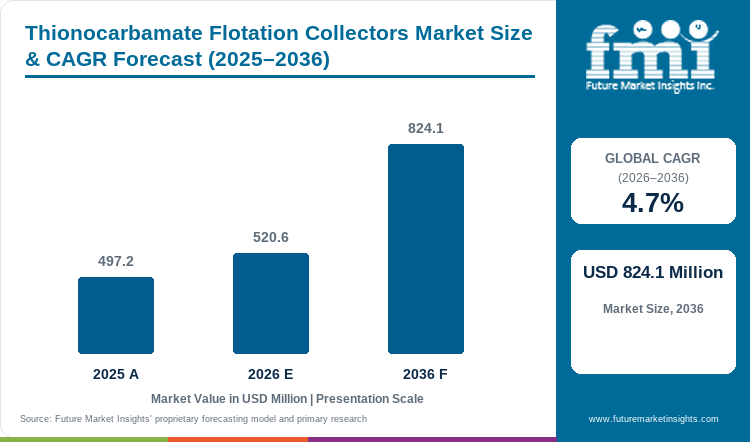
- Market Size (2026)
- USD 520.6 Mn
- Forecast (2036)
- USD 824.1 Mn
- CAGR (2026 to 2036)
- 4.7%
How big is Thionocarbamate Flotation Collectors Market in 2026?
USD 520.6 Million in 2026 and USD 824.1 Million by 2036 at a 4.7% CAGR.
The market is valued at USD 497.2 Million in 2025. Spending on thionocarbamate flotation collectors is tied to tonnes routed through sulfide flotation circuits and the cost of lost selectivity. The USA Geological Survey reported in 2026 that lower ore grades affected copper production at several USA operations during 2025. Lower head grades increase the value of maintaining recovery while controlling pyrite mass pull. Published mineral-surface research on O-isopropyl-N-ethyl thionocarbamate also documents copper-sulfide affinity and selectivity against pyrite under relevant test conditions. The commercial case therefore depends on collector programs that can protect recovery and concentrate quality as feed conditions change. Repeat purchases follow only after plant trials demonstrate that dosage and concentrate performance justify adoption.
Argentina is project-led, so supplier activity begins with testwork and pre-commissioning qualification. Chile has an established concentrator base where lower grades and operating constraints increase the value of incremental recovery improvements. Canada combines operating mines with new copper-zinc capacity, creating commissioning demand alongside brownfield optimization. Japan has limited domestic mine volume, so technical activity is more closely linked to overseas copper supply and impurity management. Across these markets, thionocarbamate chemistry becomes recurring revenue when it fits local mineralogy and the wider reagent scheme. Supply continuity and site support then determine whether qualification becomes repeat ordering.
Key Takeaways
- The market is valued at USD 520.6 Million in 2026 and is forecast to reach USD 824.1 Million by 2036 at a 4.7% CAGR.
- O-isopropyl thionocarbamates account for 31.0% of Collector Type demand in 2026.
- Copper ores account for 39.0% of Ore Type demand in 2026.
- Rougher flotation accounts for 34.0% of Application Stage demand in 2026.
- Argentina is forecast to expand at 5.5% CAGR from 2026 to 2036, followed by Chile at 5.2% and Peru at 5.1%.
- Competition centers on selective sulfide-flotation chemistry, metallurgical qualification, technical service, and reliable mine-site supply.
Analyst Perspective
“Collector selection is decided at the plant rather than by chemistry name alone. A supplier must show that the reagent improves copper recovery or concentrate quality on the site’s own ore while remaining compatible with the existing flotation scheme. That makes metallurgical support and reliable supply important after the initial laboratory result. Opportunities are strongest where higher pyrite content, changing feed characteristics, or lower head grades create a measurable reason to revise an established collector program.”
- Nikhil Kaitwade, Principal Consultant, Future Market Insights
How is the Thionocarbamate Flotation Collectors Market segmented?
The market is segmented by Collector Type, Ore Type, Application Stage, End Use, Sales Channel, and Region.
Collector Type separates established thionocarbamate chemistries from modified or blended formulations designed for different selectivity requirements. Ore Type distinguishes the mineral associations that govern adsorption and unwanted sulfide recovery. Application Stage shows where collectors enter the circuit, separating rougher and scavenger work from cleaner and selective-separation steps. End Use distinguishes operating concentrators from distributors and pilot-scale users with different consumption patterns. Sales Channel separates direct mine supply and technical-service arrangements from distributor and regional-formulator routes. Region captures differences in mine development, concentrator activity, logistics, and supplier access.
What makes O-isopropyl thionocarbamates central to the Collector Type category?
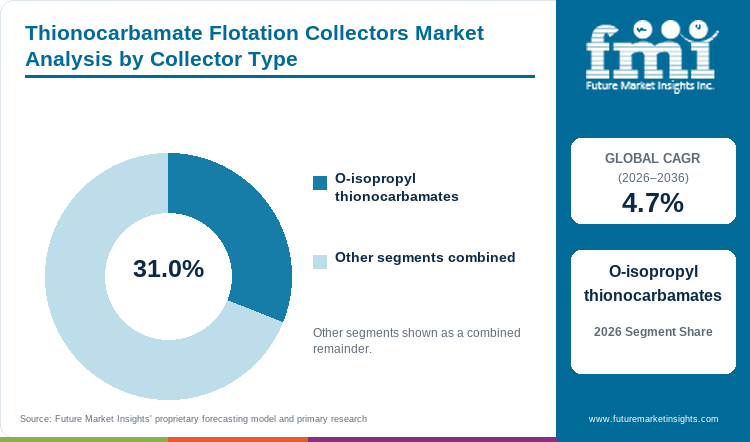
O-isopropyl thionocarbamates are established selective collectors for copper-sulfide flotation. Peer-reviewed surface studies on O-isopropyl-N-ethyl thionocarbamate document interaction with copper sulfide minerals and useful selectivity against pyrite compared with conventional xanthates under relevant conditions. Hydrolytic stability can also support operation at pH conditions where some xanthate programs become less suitable. Ore mineralogy and the wider reagent suite still determine dosage and plant value. The chemistry nevertheless gives metallurgists a recognized starting point for selective collector testwork.
- O-isopropyl thionocarbamates hold a 31.0% share in 2026 because the chemistry combines copper-sulfide collection with useful pyrite selectivity.
- Clariant documents HOSTAFLOT X 023 as an IPETC collector for copper sulfides, including applications where selectivity is important.
Why do Copper ores lead the Ore Type category?
Copper ores provide the clearest commercial fit between thionocarbamate chemistry and recurring industrial use. The collectors are strongly associated with sulfide copper minerals where recovery of chalcopyrite or related copper phases must be balanced against pyrite and other sulfides. Molybdenum-copper feeds and complex sulfides can use selective collector schemes but add further separation objectives. Nickel and gold-associated sulfides form additional applications where mineralogy supports the chemistry.
- Copper ores represent a 39.0% share in 2026 because thionocarbamate collectors are directly associated with selective copper-sulfide flotation.
- Published mineral-surface research has evaluated O-isopropyl-N-ethyl thionocarbamate adsorption on copper sulfide ore minerals and its selectivity relative to xanthates.
How does Rougher flotation anchor the Application Stage category?
The rougher bank has the largest first-pass influence on recovery because it receives the bulk feed before downstream cleaning. A collector that improves early copper attachment while limiting pyrite recovery can reduce the burden on later stages. The effect becomes more important when head grade declines or feed mineralogy changes. Scavenger stages recover residual value, while cleaner stages refine concentrate quality. Rougher leadership therefore reflects its position in the flotation workflow rather than an assumption that all collector addition occurs at one point.
- Rougher flotation holds a 34.0% share in 2026 because collector choice at this stage strongly affects the initial recovery-versus-mass-pull balance.
- Clariant continues to develop collector systems for sulfide flotation, including products aimed at difficult recovery conditions and changing ore characteristics.
What supports Copper concentrators in the End Use category?
Copper concentrators are recurring reagent consumers because collectors are dosed continuously against processed ore. Procurement also operates within strict metallurgical qualification. A new chemistry must show improvements in recovery, concentrate grade, selectivity, or operating stability without creating unacceptable effects elsewhere in the circuit. Polymetallic concentrators can use similar products but face more complex separation targets. Distributors aggregate demand and pilot plants support testing, but neither consumes reagents at the same production scale.
- Copper concentrators account for a 57.0% share in 2026 because operating plants are the main recurring consumers of thionocarbamate flotation collectors.
- Lower ore grades and concentrator operating problems increase the importance of maintaining stable recovery and concentrate quality.
What drives Direct mine supply in the Sales Channel category?
Direct mine supply fits the way flotation reagents are qualified and replenished at large concentrators. Once a collector is accepted, the site requires consistent specifications and dependable delivery. Technical service also becomes valuable when ore response changes or dosage is adjusted. Distributors and regional formulators remain important where mines require local inventory or smaller delivery quantities. Direct supply nevertheless has an advantage when interruption or off-spec material could affect recovery and concentrate quality.
- Direct mine supply holds a 47.0% share in 2026 because qualified collector chemistry is commonly paired with planned replenishment and technical support.
What are the drivers, restraints, and opportunities in the Thionocarbamate Flotation Collectors Market?
Lower-grade and more variable sulfide feeds support selective collector demand, while plant-specific qualification slows switching. Tailored high-selectivity collector programs create the clearest opportunity for additional demand.
- Driver: Concentrators need to protect copper recovery and concentrate selectivity as sulfide feeds become lower-grade or more variable.
- Restraint: Collector response changes with mineralogy, water chemistry, circuit pH, and the surrounding reagent scheme, making site qualification necessary before switching.
- Opportunity: High-selectivity formulations and co-collector programs can address circuits that require better pyrite rejection or reduced reliance on conventional xanthates.
The main demand driver is the cost of losing copper recovery when concentrators process more difficult feed. Lower head grade means incremental losses of valuable mineral can have a larger effect on saleable concentrate per tonne milled. Thionocarbamate collectors are relevant where selectivity helps recover copper sulfides while limiting excessive pyrite recovery. The purchasing response is therefore greater willingness to test chemistry that protects the recovery-grade balance under changing ore conditions.
The restraint appears during qualification. Collector performance depends on the mineral surface, water chemistry, pH, frother system, depressants, and other established operating conditions. A technically credible alternative can remain in trial for an extended period or fail at plant scale despite encouraging laboratory results. This protects qualified incumbent formulations and raises the value of metallurgical support.
The clearest opportunity is to formulate around a defined separation problem rather than sell a one-product replacement. High-pyrite copper feeds can reward collectors that maintain copper recovery while reducing unwanted sulfide mass. Clariant positions thionocarbamates within a wider HOSTAFLOT collector portfolio for sulfide ores, including customized formulations and xanthate-replacement options. Suppliers that combine formulation work with plant test protocols and regional supply have a stronger route from laboratory evaluation to recurring consumption.
Which country CAGRs are included in the Thionocarbamate Flotation Collectors Market?
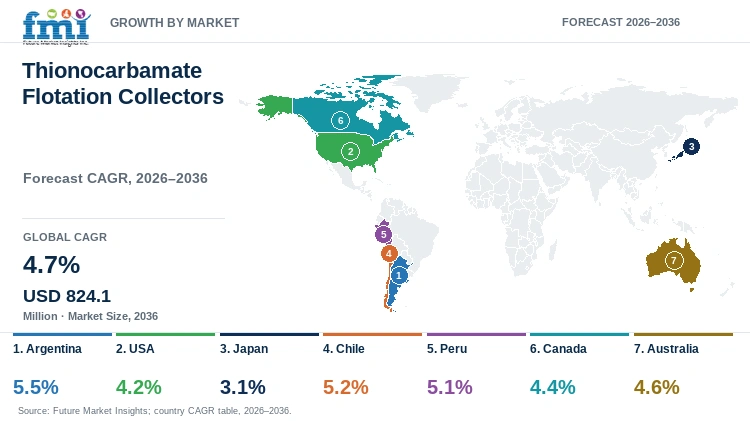
| Country | CAGR, 2026 to 2036 |
|---|---|
| Argentina | 5.5% |
| USA | 4.2% |
| Japan | 3.1% |
| Chile | 5.2% |
| Peru | 5.1% |
| Canada | 4.4% |
| Australia | 4.6% |
How do country-level CAGRs compare in the Thionocarbamate Flotation Collectors Market?
Country growth rates span 2.4 percentage points from Argentina at 5.5% to Japan at 3.1%. Argentina, Chile, and Peru form the upper band, reflecting copper-project and concentrator activity across South America. Australia stands at 4.6%, followed by Canada at 4.4% and the USA at 4.2%. Japan records the lowest rate at 3.1%, with demand more closely tied to technical programs and overseas copper interests than to a large domestic sulfide-mining base.
- Argentina exceeds Chile by 0.3 percentage points. Actual reagent volumes will depend on project construction, commissioning, and metallurgical qualification.
- Chile and Peru differ by only 0.1 percentage points, making mine-specific ore response and account access more important than the headline CAGR difference.
- Peru exceeds Australia by 0.5 percentage points, while Australia continues to offer demand from technically demanding operating mines and new projects.
- USA exceeds Japan by 1.1 percentage points. USA demand is more directly connected to domestic mine and concentrator activity.
CAGR is one planning input. Market scale, concentrator throughput, logistics, qualification timelines, and access to operating sites can matter more than modest differences in forecast growth.
Country-wise Analysis
- Argentina: Demand for Thionocarbamate Flotation Collectors in Argentina is forecast to expand at 5.5% CAGR from 2026 to 2036. Resolution 1154/2026 approved the Vicuña project under Argentina’s large-investment regime and describes a San Juan mining complex containing a concentrator for copper, gold, and silver processing. Reagent demand will follow project construction and metallurgical qualification. Suppliers that participate in testwork before commissioning can compete for initial collector specifications.
- USA: Sales of Thionocarbamate Flotation Collectors in USA are forecast to rise at 4.2% CAGR from 2026 to 2036. USA demand is largely tied to operating and brownfield flotation circuits. Lower ore grades and disruptions at concentrator operations increase the importance of stable recovery, but new reagent programs still need site qualification. Suppliers require responsive technical service and dependable inventory to convert trials into repeat orders.
- Japan: Adoption of Thionocarbamate Flotation Collectors in Japan is forecast to expand at 3.1% CAGR from 2026 to 2036. JOGMEC and CODELCO signed a cooperation agreement in December 2025 covering technology to reduce impurities in copper raw materials, building on flotation-based impurity separation work. Japan’s commercial opportunity is therefore more closely linked to technical programs and Japanese-connected overseas copper projects than to domestic bulk reagent consumption.
- Chile: Demand for Thionocarbamate Flotation Collectors in Chile is forecast to grow at 5.2% CAGR from 2026 to 2036. Chile’s large installed copper-concentrator base creates recurring opportunities for selective collector optimization as ore grades and operating conditions change. Mature plants remain cautious about altering established reagent programs, so suppliers require in-country technical support and dependable delivery.
- Peru: Sales of Thionocarbamate Flotation Collectors in Peru are forecast to increase at 5.1% CAGR from 2026 to 2036. Peru’s Ministry of Energy and Mines reported copper production of 2,769,794 metric fine tonnes in 2025, up 1.2% from 2024. The principal challenge is ore variability across a large concentrator base. Suppliers can differentiate through ore-specific testwork and reliable local supply.
- Canada: Demand for Thionocarbamate Flotation Collectors in Canada is forecast to expand at 4.4% CAGR from 2026 to 2036. Canada’s Major Projects Office records that the McIlvenna Bay copper-zinc project was approximately 88% complete as of January 31, 2026 and remained scheduled for commercial production in mid-2026. New-project commissioning creates an opportunity for reagent qualification alongside optimization work at established sites.
- Australia: Demand for Thionocarbamate Flotation Collectors in Australia is forecast to rise at 4.6% CAGR from 2026 to 2036. The Australian Government projects copper export earnings to increase from AUD 14.6 billion in 2025-26 to AUD 18.3 billion in real terms by 2030-31. Long mine-to-supply distances make regional inventory and delivery reliability important alongside metallurgical performance.
Who are the notable companies in the Thionocarbamate Flotation Collectors Market?
Clariant, Nasaco, and Quadra supply documented thionocarbamate collectors or thionocarbamate-containing flotation products.
Clariant offers thionocarbamates within its HOSTAFLOT sulfide-flotation collector range. HOSTAFLOT X 023 is described by the company as an IPETC collector for copper sulfides where selectivity is important. Nasaco lists NASCOL 201 as isopropyl ethyl thionocarbamate for selective flotation of copper, nickel, and lead sulfides. Quadra supplies Polyfloat 7009, a thionocarbamate and dithiophosphate collector blend used in sulfide-flotation applications.
- Clariant: Direct thionocarbamate chemistry supported by a wider sulfide-flotation collector portfolio.
- Nasaco: NASCOL 201 provides a direct IPETC offering for selective sulfide flotation.
- Quadra: Polyfloat 7009 combines thionocarbamate with dithiophosphate chemistry for sulfide-flotation applications.
Competitive Benchmarking: Thionocarbamate Flotation Collectors Market
| Company | Positioning | Product Offering |
|---|---|---|
| Clariant | Thionocarbamate and broader sulfide-flotation collector supplier | HOSTAFLOT X 023, documented as an IPETC collector for copper sulfides |
| Nasaco | Direct thionocarbamate collector supplier | NASCOL 201, documented as isopropyl ethyl thionocarbamate for selective sulfide flotation |
| Quadra | Supplier of thionocarbamate-containing collector blends | Polyfloat 7009, combining thionocarbamate and dithiophosphate chemistry for sulfide flotation |
Key Developments in the Thionocarbamate Flotation Collectors Market
- In April 2025, Clariant documented HOSTAFLOT X 023 as a high-performance IPETC collector for copper sulfides. The product is positioned for applications where selectivity is important and can be paired with xanthates in selected sulfide circuits.
- In September 2025, Clariant used FLOTAC 2025 in Chile to present flotation technologies for more selective mineral processing, reinforcing its technical focus on sulfide-flotation reagent systems.
- Nasaco continues to offer NASCOL 201 as an isopropyl ethyl thionocarbamate collector for copper, nickel, lead, and related sulfide applications. This is treated as current product evidence rather than a dated corporate development.
Key Players in the Thionocarbamate Flotation Collectors Market
Direct Thionocarbamate Collector Suppliers
- Clariant
- Nasaco
- Quadra
Thionocarbamate Flotation Collectors Market - Report Scope
| Coverage field | Report scope |
|---|---|
| Market breakdown | Collector Type; Ore Type; Application Stage; End Use; Sales Channel; Region |
| Quantitative Units | USD Million |
| Market Definition | Revenue from thionocarbamate-based flotation collectors sold within the defined collector-type, ore-type, application-stage, end-use, and sales-channel universe. The scope excludes downstream concentrate or metal revenue and substitute reagents sold without thionocarbamate as an active component. |
| Regions Covered | North America; Latin America; Western Europe; Eastern Europe; East Asia; South Asia and Pacific; Middle East and Africa |
| Countries Covered | Argentina; USA; Japan; Chile; Peru; Canada; Australia; and additional countries covered in the full report |
| Key Companies | Clariant; Nasaco; Quadra |
| Forecast Period | 2026 to 2036 |
| Approach | Hybrid bottom-up and top-down sizing that reconciles supplier activity with end-use consumption, ore-processing indicators, segment structure, and country operating conditions. |
Thionocarbamate Flotation Collectors Market - Research Methodology
| Method | Approach |
|---|---|
| Primary Research | FMI uses structured discussions with collector manufacturers, mineral-processing reagent distributors, concentrator procurement teams, plant metallurgists, and subject-matter specialists. Research examines market boundaries, purchasing criteria, qualification barriers, channel behavior, and substitution patterns. |
| Desk Research | FMI reviews government mineral statistics, company technical literature, public filings, peer-reviewed flotation studies, project announcements, and other traceable industry material relevant to the defined market. |
| Market Sizing and Forecasting | Market sizing reconciles collector consumption across ore types, application stages, end users, sales channels, and countries. Forecast assumptions consider concentrator activity, project commissioning, ore-quality pressure, reagent qualification cycles, and supplier access. |
| Data Validation | Segment and country views are reconciled to the global market total and checked against the stated scope. Downstream metal revenue, flotation hardware, and substitute chemicals without thionocarbamate active content are excluded. |
Thionocarbamate Flotation Collectors Market by Segments
Thionocarbamate Flotation Collectors Market segmented by Collector Type:
- O-isopropyl thionocarbamates
- O-ethyl thionocarbamates
- Modified thionocarbamates
- Blend collectors
- High-selectivity collectors
Thionocarbamate Flotation Collectors Market segmented by Ore Type:
- Copper ores
- Molybdenum-copper ores
- Nickel sulfides
- Complex sulfides
- Gold-associated sulfides
Thionocarbamate Flotation Collectors Market segmented by Application Stage:
- Rougher flotation
- Scavenger flotation
- Cleaner flotation
- Selective separation
Thionocarbamate Flotation Collectors Market segmented by End Use:
- Copper concentrators
- Polymetallic concentrators
- Mining reagent distributors
- Pilot plants
Thionocarbamate Flotation Collectors Market segmented by Sales Channel:
- Direct mine supply
- Technical service contracts
- Mining chemical distributors
- Regional formulators
Thionocarbamate Flotation Collectors Market by Region
- North America
- United States
- Canada
- Latin America
- Brazil
- Mexico
- Argentina
- Chile
- Western Europe
- Germany
- France
- United Kingdom
- Italy
- Spain
- Benelux
- Nordics
- Eastern Europe
- Poland
- Czech Republic
- Romania
- Hungary
- East Asia
- China
- Japan
- South Korea
- South Asia and Pacific
- India
- ASEAN
- Australia and New Zealand
- Middle East and Africa
- GCC Countries
- South Africa
- Türkiye
- Israel
Research Sources and Bibliography
- Buckley, A. N., Hope, G. A., Lee, K. C., Petrovic, E. A., & Woods, R. (2014, December). Adsorption of O-isopropyl-N-ethyl thionocarbamate on Cu sulfide ore minerals. Minerals Engineering, 69, 120-132.
- Ministerio de Economía, Argentina (2026, July 30). Resolución 1154/2026.
- USA Geological Survey (2026). Mineral Commodity Summaries 2026.
- Japan Organization for Metals and Energy Security (2025, December 8). Agreement on Cooperation for Technology to Reduce Impurities in Copper Raw Materials with CODELCO.
- Comisión Chilena del Cobre (2026, May 19). Chile copper outlook update.
- Ministerio de Energía y Minas, Peru (2026, March 11). 2025 mining production update.
- Government of Canada, Major Projects Office. McIlvenna Bay Project, update dated February 19, 2026.
- Australian Government, Department of Industry, Science and Resources (2026). Resources and Energy Quarterly: June 2026.
- Clariant (2025, September). FLOTAC 2025.
- Nasaco International. NASCOL 201 Product Data Sheet.
- Quadra Chemicals. Polyfloat 7009.
- Clariant (2025, April 9). HOSTAFLOT X 023.
This bibliography is provided for reader reference and is not exhaustive because the full report contains the complete source list and detailed citations.
This Report Answers
- What are the Thionocarbamate Flotation Collectors Market sizes in 2026 and 2036, and what CAGR is forecast across the period?
- Which ore-quality and concentrator operating pressures support demand for selective thionocarbamate collectors?
- Why do O-isopropyl thionocarbamates hold the leading position within Collector Type?
- How does the dominance of Copper ores shape collector demand and formulation priorities?
- Why does Rougher flotation hold the leading position within Application Stage?
- How do growth rates differ across Argentina, USA, Japan, Chile, Peru, Canada, and Australia?
- Which companies supply documented thionocarbamate collectors or thionocarbamate-containing flotation systems?
- How do plant-specific mineralogy and reagent qualification constrain switching and slow adoption?
Frequently Asked Questions
What is driving growth in the Thionocarbamate Flotation Collectors Market?
Growth is supported by the need to protect copper recovery and concentrate selectivity as sulfide feeds become lower-grade or more variable. Concentrators value collector systems that can limit pyrite recovery without sacrificing valuable-mineral recovery under site-specific operating conditions.
Who are the key players in the Thionocarbamate Flotation Collectors Market?
Key companies include Clariant, Nasaco, and Quadra. Their documented offerings include direct thionocarbamate chemistry or thionocarbamate-containing collector blends for sulfide flotation.
What notable restraint affects the Thionocarbamate Flotation Collectors Market?
Plant-specific qualification is a major restraint because collector performance changes with ore mineralogy, water chemistry, circuit pH, and interactions with existing reagents. A laboratory result therefore requires plant validation before a production chemistry is changed.
Why should executives track the Thionocarbamate Flotation Collectors Market?
Collector chemistry can influence recovery and concentrate quality across large ore throughputs. New mine capacity, declining ore grades, changing mineralogy, and impurity-management requirements can therefore create commercially significant reagent opportunities.
What business problem does the Thionocarbamate Flotation Collectors Market address?
Thionocarbamate collectors help concentrators recover valuable sulfide minerals while limiting unwanted pyrite and other sulfide recovery. The objective is to improve the recovery-grade balance without destabilizing the wider reagent scheme.
What should mineral-processing procurement teams evaluate in the Thionocarbamate Flotation Collectors Market?
Procurement teams should evaluate recovery and concentrate-grade performance on site-specific ore, compatibility with the complete reagent program, specification consistency, delivery reliability, technical support, handling requirements, and the operational cost of changing an established chemistry.
Preview the report firsthand - request a free sample
Get SampleGet the brochure for pricing and purchase details.
Get PDFTable of Content
- Key Takeaways
- Market Size and CAGR
- Top Growth Driver
- Fastest Growing Segment
- Leading Region
- Key Companies
- Emerging Opportunities
- Executive Summary
- Global Market Outlook
- Demand-side Trends
- Supply-side Trends
- Technology Roadmap Analysis
- Analysis and Recommendations
- Analyst Perspective (What is happening? Why now? What should investors know?)
- Key Questions Answered
- How large is the market?
- What is the CAGR?
- What are key trends?
- Which region dominates?
- Who are the leaders?
- Market Overview
- Market Coverage / Taxonomy
- Market Definition / Scope / Limitations
- Research Methodology
- Chapter Orientation
- Analytical Lens and Working Hypotheses
- Market Structure, Signals, and Trend Drivers
- Benchmarking and Cross-market Comparability
- Market Sizing, Forecasting, and Opportunity Mapping
- Research Design and Evidence Framework
- Desk Research Programme (Secondary Evidence)
- Expert Input and Fieldwork (Primary Evidence)
- Tooling, Models, and Reference Databases
- Data Engineering and Model Build
- Quality Assurance and Audit Trail
- Market Background
- Market Dynamics (Drivers, Restraints, Opportunity, Trends)
- Scenario Forecast (Optimistic, Likely, Conservative)
- Impact Analysis
- AI Impact
- Sustainability Impact
- Regulatory Impact
- Technology Impact
- Consumer / Buyer Analysis
- Purchase Drivers
- Adoption Barriers
- Buyer Journey
- Opportunity Map Analysis
- Product Life Cycle Analysis
- Supply Chain Analysis
- Investment Feasibility Matrix
- Value Chain Analysis
- PESTLE and Porter's Analysis
- Regulatory Landscape
- Regional Parent Market Outlook
- Production and Consumption Statistics
- Import and Export Statistics
- Global Market Analysis and Forecast, 2021 to 2036
- Historical Market Size Value (USD Million) Analysis, 2021 to 2025
- Current and Future Market Size Value (USD Million) Projections, 2026 to 2036
- Y-o-Y Growth Trend Analysis
- Absolute $ Opportunity Analysis
- Global Market Pricing Analysis, 2021 to 2036
- Global Market Analysis and Forecast, By Collector Type, 2021 to 2036
- Introduction / Key Findings
- Historical Market Size Value (USD Million) Analysis By Collector Type, 2021 to 2025
- Current and Future Market Size Value (USD Million) Analysis and Forecast By Collector Type, 2026 to 2036
- O-isopropyl thionocarbamates
- O-ethyl thionocarbamates
- Modified thionocarbamates
- Blend collectors
- High-selectivity collectors
- Y-o-Y Growth Trend Analysis By Collector Type, 2021 to 2025
- Absolute $ Opportunity Analysis By Collector Type, 2026 to 2036
- Global Market Analysis and Forecast, By Ore Type, 2021 to 2036
- Introduction / Key Findings
- Historical Market Size Value (USD Million) Analysis By Ore Type, 2021 to 2025
- Current and Future Market Size Value (USD Million) Analysis and Forecast By Ore Type, 2026 to 2036
- Copper ores
- Molybdenum-copper ores
- Nickel sulfides
- Complex sulfides
- Gold-associated sulfides
- Y-o-Y Growth Trend Analysis By Ore Type, 2021 to 2025
- Absolute $ Opportunity Analysis By Ore Type, 2026 to 2036
- Global Market Analysis and Forecast, By Application Stage, 2021 to 2036
- Introduction / Key Findings
- Historical Market Size Value (USD Million) Analysis By Application Stage, 2021 to 2025
- Current and Future Market Size Value (USD Million) Analysis and Forecast By Application Stage, 2026 to 2036
- Rougher flotation
- Scavenger flotation
- Cleaner flotation
- Selective separation
- Y-o-Y Growth Trend Analysis By Application Stage, 2021 to 2025
- Absolute $ Opportunity Analysis By Application Stage, 2026 to 2036
- Global Market Analysis and Forecast, By End Use, 2021 to 2036
- Introduction / Key Findings
- Historical Market Size Value (USD Million) Analysis By End Use, 2021 to 2025
- Current and Future Market Size Value (USD Million) Analysis and Forecast By End Use, 2026 to 2036
- Copper concentrators
- Polymetallic concentrators
- Mining reagent distributors
- Pilot plants
- Y-o-Y Growth Trend Analysis By End Use, 2021 to 2025
- Absolute $ Opportunity Analysis By End Use, 2026 to 2036
- Global Market Analysis and Forecast, By Sales Channel, 2021 to 2036
- Introduction / Key Findings
- Historical Market Size Value (USD Million) Analysis By Sales Channel, 2021 to 2025
- Current and Future Market Size Value (USD Million) Analysis and Forecast By Sales Channel, 2026 to 2036
- Direct mine supply
- Technical service contracts
- Mining chemical distributors
- Regional formulators
- Y-o-Y Growth Trend Analysis By Sales Channel, 2021 to 2025
- Absolute $ Opportunity Analysis By Sales Channel, 2026 to 2036
- Global Market Analysis and Forecast, By Region, 2021 to 2036
- Introduction
- Historical Market Size Value (USD Million) Analysis By Region, 2021 to 2025
- Current Market Size Value (USD Million) Analysis and Forecast By Region, 2026 to 2036
- North America
- Latin America
- Western Europe
- Eastern Europe
- East Asia
- South Asia and Pacific
- Middle East and Africa
- Market Attractiveness Analysis By Region
- North America Market Analysis and Forecast, By Country, 2021 to 2036
- Historical Market Size Value (USD Million) Trend Analysis By Market Taxonomy, 2021 to 2025
- Market Size Value (USD Million) Forecast By Market Taxonomy, 2026 to 2036
- By Country
- United States
- Canada
- By Collector Type
- By Ore Type
- By Application Stage
- By End Use
- By Sales Channel
- By Country
- Market Attractiveness Analysis
- By Country
- By Collector Type
- By Ore Type
- By Application Stage
- By End Use
- By Sales Channel
- Key Takeaways
- Latin America Market Analysis and Forecast, By Country
- Historical Market Size Value (USD Million) Trend Analysis By Market Taxonomy, 2021 to 2025
- Market Size Value (USD Million) Forecast By Market Taxonomy, 2026 to 2036
- By Country
- Brazil
- Mexico
- Argentina
- Chile
- By Collector Type
- By Ore Type
- By Application Stage
- By End Use
- By Sales Channel
- By Country
- Market Attractiveness Analysis
- By Country
- By Collector Type
- By Ore Type
- By Application Stage
- By End Use
- By Sales Channel
- Key Takeaways
- Western Europe Market Analysis and Forecast, By Country
- Historical Market Size Value (USD Million) Trend Analysis By Market Taxonomy, 2021 to 2025
- Market Size Value (USD Million) Forecast By Market Taxonomy, 2026 to 2036
- By Country
- Germany
- France
- United Kingdom
- Italy
- Spain
- Benelux
- Nordics
- By Collector Type
- By Ore Type
- By Application Stage
- By End Use
- By Sales Channel
- By Country
- Market Attractiveness Analysis
- By Country
- By Collector Type
- By Ore Type
- By Application Stage
- By End Use
- By Sales Channel
- Key Takeaways
- Eastern Europe Market Analysis and Forecast, By Country
- Historical Market Size Value (USD Million) Trend Analysis By Market Taxonomy, 2021 to 2025
- Market Size Value (USD Million) Forecast By Market Taxonomy, 2026 to 2036
- By Country
- Poland
- Czech Republic
- Romania
- Hungary
- By Collector Type
- By Ore Type
- By Application Stage
- By End Use
- By Sales Channel
- By Country
- Market Attractiveness Analysis
- By Country
- By Collector Type
- By Ore Type
- By Application Stage
- By End Use
- By Sales Channel
- Key Takeaways
- East Asia Market Analysis and Forecast, By Country
- Historical Market Size Value (USD Million) Trend Analysis By Market Taxonomy, 2021 to 2025
- Market Size Value (USD Million) Forecast By Market Taxonomy, 2026 to 2036
- By Country
- China
- Japan
- South Korea
- By Collector Type
- By Ore Type
- By Application Stage
- By End Use
- By Sales Channel
- By Country
- Market Attractiveness Analysis
- By Country
- By Collector Type
- By Ore Type
- By Application Stage
- By End Use
- By Sales Channel
- Key Takeaways
- South Asia and Pacific Market Analysis and Forecast, By Country
- Historical Market Size Value (USD Million) Trend Analysis By Market Taxonomy, 2021 to 2025
- Market Size Value (USD Million) Forecast By Market Taxonomy, 2026 to 2036
- By Country
- India
- ASEAN
- Australia and New Zealand
- By Collector Type
- By Ore Type
- By Application Stage
- By End Use
- By Sales Channel
- By Country
- Market Attractiveness Analysis
- By Country
- By Collector Type
- By Ore Type
- By Application Stage
- By End Use
- By Sales Channel
- Key Takeaways
- Middle East and Africa Market Analysis and Forecast, By Country
- Historical Market Size Value (USD Million) Trend Analysis By Market Taxonomy, 2021 to 2025
- Market Size Value (USD Million) Forecast By Market Taxonomy, 2026 to 2036
- By Country
- GCC Countries
- South Africa
- Türkiye
- Israel
- By Collector Type
- By Ore Type
- By Application Stage
- By End Use
- By Sales Channel
- By Country
- Market Attractiveness Analysis
- By Country
- By Collector Type
- By Ore Type
- By Application Stage
- By End Use
- By Sales Channel
- Key Takeaways
- Key Countries Market Analysis
- United States
- Pricing Analysis
- Market Share Analysis, 2025
- By Collector Type
- By Ore Type
- By Application Stage
- By End Use
- By Sales Channel
- Canada
- Pricing Analysis
- Market Share Analysis, 2025
- By Collector Type
- By Ore Type
- By Application Stage
- By End Use
- By Sales Channel
- Mexico
- Pricing Analysis
- Market Share Analysis, 2025
- By Collector Type
- By Ore Type
- By Application Stage
- By End Use
- By Sales Channel
- Brazil
- Pricing Analysis
- Market Share Analysis, 2025
- By Collector Type
- By Ore Type
- By Application Stage
- By End Use
- By Sales Channel
- Chile
- Pricing Analysis
- Market Share Analysis, 2025
- By Collector Type
- By Ore Type
- By Application Stage
- By End Use
- By Sales Channel
- Germany
- Pricing Analysis
- Market Share Analysis, 2025
- By Collector Type
- By Ore Type
- By Application Stage
- By End Use
- By Sales Channel
- United Kingdom
- Pricing Analysis
- Market Share Analysis, 2025
- By Collector Type
- By Ore Type
- By Application Stage
- By End Use
- By Sales Channel
- Italy
- Pricing Analysis
- Market Share Analysis, 2025
- By Collector Type
- By Ore Type
- By Application Stage
- By End Use
- By Sales Channel
- Spain
- Pricing Analysis
- Market Share Analysis, 2025
- By Collector Type
- By Ore Type
- By Application Stage
- By End Use
- By Sales Channel
- France
- Pricing Analysis
- Market Share Analysis, 2025
- By Collector Type
- By Ore Type
- By Application Stage
- By End Use
- By Sales Channel
- India
- Pricing Analysis
- Market Share Analysis, 2025
- By Collector Type
- By Ore Type
- By Application Stage
- By End Use
- By Sales Channel
- ASEAN
- Pricing Analysis
- Market Share Analysis, 2025
- By Collector Type
- By Ore Type
- By Application Stage
- By End Use
- By Sales Channel
- Australia and New Zealand
- Pricing Analysis
- Market Share Analysis, 2025
- By Collector Type
- By Ore Type
- By Application Stage
- By End Use
- By Sales Channel
- China
- Pricing Analysis
- Market Share Analysis, 2025
- By Collector Type
- By Ore Type
- By Application Stage
- By End Use
- By Sales Channel
- Japan
- Pricing Analysis
- Market Share Analysis, 2025
- By Collector Type
- By Ore Type
- By Application Stage
- By End Use
- By Sales Channel
- South Korea
- Pricing Analysis
- Market Share Analysis, 2025
- By Collector Type
- By Ore Type
- By Application Stage
- By End Use
- By Sales Channel
- Poland
- Pricing Analysis
- Market Share Analysis, 2025
- By Collector Type
- By Ore Type
- By Application Stage
- By End Use
- By Sales Channel
- Hungary
- Pricing Analysis
- Market Share Analysis, 2025
- By Collector Type
- By Ore Type
- By Application Stage
- By End Use
- By Sales Channel
- Türkiye
- Pricing Analysis
- Market Share Analysis, 2025
- By Collector Type
- By Ore Type
- By Application Stage
- By End Use
- By Sales Channel
- South Africa
- Pricing Analysis
- Market Share Analysis, 2025
- By Collector Type
- By Ore Type
- By Application Stage
- By End Use
- By Sales Channel
- Argentina
- Pricing Analysis
- Market Share Analysis, 2025
- By Collector Type
- By Ore Type
- By Application Stage
- By End Use
- By Sales Channel
- Peru
- Pricing Analysis
- Market Share Analysis, 2025
- By Collector Type
- By Ore Type
- By Application Stage
- By End Use
- By Sales Channel
- Australia
- Pricing Analysis
- Market Share Analysis, 2025
- By Collector Type
- By Ore Type
- By Application Stage
- By End Use
- By Sales Channel
- United States
- Market Structure Analysis
- Competition Dashboard
- Competition Benchmarking
- Market Share Analysis of Top Players
- By Regional
- By Collector Type
- By Ore Type
- By Application Stage
- By End Use
- By Sales Channel
- Emerging Startups
- Innovation Benchmarking
- Competition Analysis
- Competition Deep Dive
- Clariant
- Overview
- Product Portfolio
- Profitability by Market Segments
- Sales Footprint
- Strategy Overview
- Marketing Strategy
- Product Strategy
- Channel Strategy
- Nasaco
- Quadra
- Clariant
- Case Studies
- Success Stories
- Recent Developments
- Competition Deep Dive
- Assumptions & Acronyms Used


