

- Market Size (2026)
- USD 620.7 Mn
- Forecast (2036)
- USD 1011.1 Mn
- CAGR (2026 to 2036)
- 5.0%
How big is Hydroxamate Flotation Collectors Market in 2026?
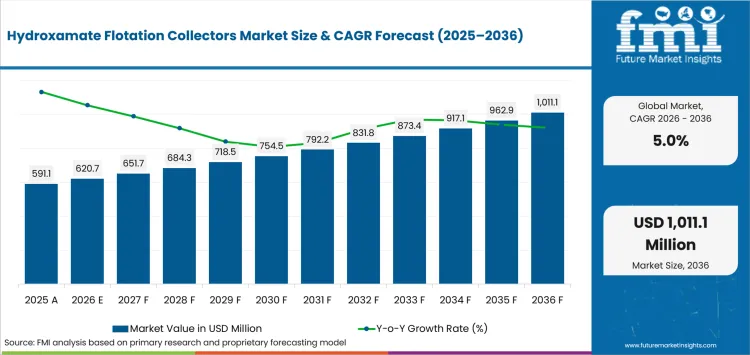
USD 620.7 million in 2026 and USD 1,011.1 million by 2036 at a 5.0% CAGR.
Demand for hydroxamate flotation collectors is projected to expand at a 5.0% CAGR between 2026 and 2036, increasing valuation from USD 620.7 million in 2026 to USD 1,011.1 million by 2036 as critical-mineral concentrators test selective chemistry on oxide and rare-earth feeds. The IEA’s May 2025 outlook put rare-earth demand at 91 kt in 2024 and projects 123 kt in 2030. Higher throughput widens the project pool reaching flotation testwork. Each ore still needs a proven recovery-grade window prior to regular reagent supply.
Project maturity determines how quickly critical-mineral investment becomes collector demand. The USA Department of Energy announced up to USD 15 million for its Mine of the Future laboratory call on September 26 2025 and named beneficiation as a research topic. The program targets the path from bench work toward commercial demonstration. Hydroxamate revenue still depends on whether site trials hold a recovery-grade advantage under the actual ore and water conditions.
Key Takeaways
- Demand is concentrated in mineral circuits where chelating collectors can improve selectivity against oxide or carbonate-bearing gangue following ore-specific testwork.
- In 2026, alkyl hydroxamates are expected to lead collector type with 29.0% share because their chain chemistry can be tuned for oxide and rare-earth flotation.
- By ore type, rare earth ores are estimated to hold 27.0% in 2026 owing to separation problems that place a premium on selective collector response.
- By application stage, rougher flotation is forecast to represent 37.0% in 2026 driven by the cost of losing valuable mineral ahead of cleaner stages.
- Ore mineralogy and water conditions can extend qualification. A formulation that raises recovery on one feed may also pull unwanted gangue on another.
- Some of the key players in this market include Axis House Group (Pty) Ltd., Syensqo SA, Clariant AG, BASF SE, AECI Mining Chemicals, Nouryon, and Orica Limited.
Analyst Perspective
"Hydroxamate pricing should be judged against the recovery-grade window a mine can hold under its own mineralogy. The stronger commercial offer pairs selective collector chemistry with site testwork and replenishment that keeps the validated dose available at plant scale."
- Nikhil Kaitwade, Principal Consultant, Future Market Insights
How is the hydroxamate flotation collectors market segmented?
The hydroxamate flotation collectors market is segmented by collector type, ore type, application stage, end use, sales channel and region.
Collector types are alkyl hydroxamates, aryl hydroxamates, mixed hydroxamate blends, chelating hydroxamates and specialty rare-earth collectors. Ore types are rare earth ores, oxidized copper ores, tungsten - tin ores, iron oxide minerals and phosphate - industrial minerals. Application stages are rougher flotation, cleaner flotation, selective oxide flotation and pilot-scale beneficiation. End uses are rare earth concentrators, copper concentrators, industrial mineral plants and mining reagent distributors. Sales channels are direct mine contracts, specialty reagent suppliers, technical service packages and regional distributors. Region follows the regional taxonomy below.
What makes alkyl hydroxamates central to the collector type category?
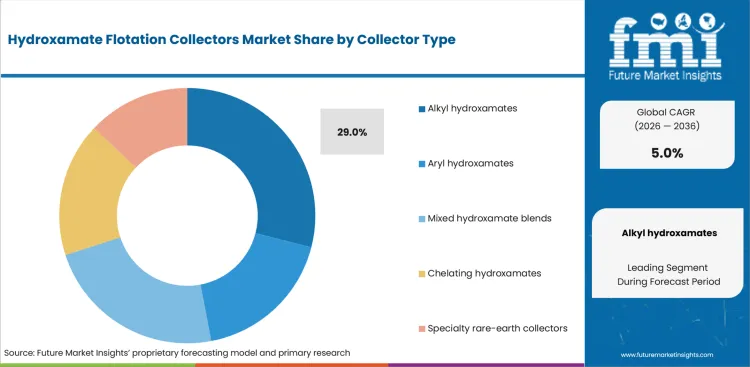
Alkyl hydroxamates pair a tunable hydrocarbon chain with a chelating group. They suit circuits where beneficiation reagents must separate oxide minerals from similar gangue. Site dosage and pH decide whether attachment improves concentrate quality.
- By collector type, alkyl hydroxamates are estimated to hold 29.0% in 2026 owing to their use in oxide and rare-earth collector design.
- Ames Laboratory reported on February 2 2026 that Bayan Mining and Minerals received commercial rights to three CMI-supported technologies for rare-earth beneficiation, leaching and separation. The licensing agreement moves collector work closer to integrated rare-earth flowsheets.
Why do rare earth ores lead demand within the ore type category?
Rare-earth concentrators separate bastnaesite or monazite from carbonate and silicate gangue. Clariant’s Flotation 2025 program presented collectors and frothers for both minerals in November 2025. The chosen hydroxamate must raise recovery without excessive gangue, so it is tested beside other flotation reagents.
- Rare earth ores are set to lead the ore type category with 27.0% share in 2026 due to the value placed on selective collection in complex rare-earth feeds.
- Concentrators compare recovery and concentrate grade on the actual ore prior to locking a rare-earth collector package.
How does rougher flotation shape the application stage category?
Rougher flotation sets the first major recovery limit following conditioning. Losses here reduce the mineral available to later cleaning. Plants compare collector response with mineral processing equipment conditions prior to locking a reagent recipe.
- In 2026, rougher flotation is expected to lead the application stage category with 37.0% share because early recovery performance determines the mass available to cleaners.
- BASF said in May 2025 that it was intensifying research on sulfidic and non-sulfidic flotation formulations. BASF's work places reagent design beside laboratory testing since rougher performance changes with ore type and operating conditions.
Why do rare earth concentrators lead demand within the end use category?
Gangue raises downstream treatment load at rare-earth concentrators. In August 2025 the USA Department of Defense announced a USD 150 million loan for added heavy rare-earth separation capacity at Mountain Pass. Hydroxamate dosage must match mineralogy. Collector decisions also affect the broader rare earth metals processing chain.
- By end use, rare earth concentrators are forecast to represent 34.0% in 2026 driven by the need to protect concentrate quality ahead of downstream separation.
- Concentrators value collectors that protect feed quality ahead of cracking and separation since downstream penalties rise with gangue.
What drives direct mine contracts in the sales channel category?
Direct contracts keep metallurgists and reagent teams in the same loop during trials. Dose changes alter grade and recovery, so these contracts suit specialty extraction reagents and flotation collectors. Contract terms also set replenishment timing for remote operations.
- The direct mine contracts segment is projected to hold 44.0% share in 2026 owing to site trials and ongoing dose support once a collector is qualified.
- Clariant used Procemin 2026 to discuss customized flotation solutions and formal reagent evaluation for copper processing. The program keeps technical review close to the mine account.
What are the drivers, restraints and opportunities in the Hydroxamate Flotation Collectors Market?
Critical-mineral processing raises the need for selective collectors, ore variability slows qualification and technical-service models provide the clearest route to repeat revenue.
- Driver: New rare-earth and non-sulfide mineral projects increase the number of ores entering reagent testwork.
- Restraint: Mineralogical variation can lengthen laboratory and plant trials until a hydroxamate formulation becomes a stable operating recipe.
- Opportunity: Reagent suppliers can earn repeat volume by pairing selective chemistry with testwork and dependable mine-site supply.
Critical-mineral projects are sending more ores into metallurgical testwork for selective collectors. Natural Resources Canada announced 26 new investments and partnerships in October 2025 including rare-earth projects. The announced projects do not guarantee hydroxamate purchases. They increase the number of flowsheets that must qualify mining flotation chemicals against recovery and concentrate-grade targets. Project timing then determines whether testwork becomes continuous reagent volume.
Ligand structure and pH can change rare-earth flotation response, which lengthens qualification. Ames Laboratory documented in October 2025 that aromatic EDHBA produced 2-3% higher REE yield than aliphatic OHA at basic pH in microflotation tests. A mine therefore needs ore-specific trials prior to changing collector chemistry. Flotation activators and depressants can shift the same operating window. That raises technical selling cost.
Regional technical coverage becomes valuable once a mine establishes a working collector recipe. AECI’s February 2025 results described expansion into Peru and significant growth in Australia as the group concentrated on mining. The same local service model can support flotation sulfidizing agents and specialty collectors. Repeat revenue depends on turning trial results into a stable recipe with replenishment close to the mine.
Which country CAGRs are profiled in the Hydroxamate Flotation Collectors Market?
| Country | CAGR |
|---|---|
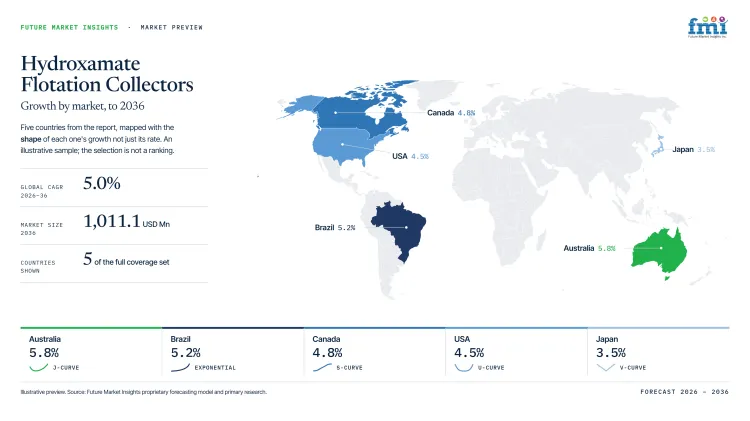
| Australia | 5.8% |
| Chile | 5.4% |
| Brazil | 5.2% |
| South Africa | 5.1% |
| Canada | 4.8% |
| USA | 4.5% |
| Japan | 3.5% |
How do country-level CAGRs compare in the Hydroxamate Flotation Collectors Market?
The 2.3-point spread separates project-led markets from mature processing bases. Australia and Chile occupy the upper band above 5.3% but their commercial routes differ. Brazil and South Africa form a second group near 5.0%, Canada and the USA follow with steadier project conversion. Japan is the lower-growth case with limited domestic mine-circuit volume.
- Australia's assay network gives miners faster access to formal flotation testwork.
- Chile's incumbent reagent programs raise switching costs for new hydroxamate suppliers.
- Brazil's ore diversity requires localized testwork before collectors are selected.
- South Africa's concentrator base supports local reference cases for hydroxamate adoption.
- Canada's project-finance institutions help sustain long pilot cycles for new collectors.
- USA rare-earth output remains concentrated in relatively few mining operations.
- Japan's distributor channel is suited to smaller technical flotation programs.
Similar rates conceal different switching costs and project timing. The full report provides country-level CAGR analysis for North America, Latin America, Western Europe, Eastern Europe, East Asia, South Asia and Pacific and Middle East and Africa.
Country-wise Analysis
- Australia pairs a mature mining-services sector with new rare-earth projects that can run local flotation testwork at mine scale. Australia is estimated to post 5.8% CAGR over the forecast period, driven by non-sulfide project activity and nearby metallurgical laboratories. Geoscience Australia’s February 2026 data show rare-earth Economic Demonstrated Resources rose 18% in 2024 and production increased 7%. Local laboratories can screen CMC flotation depressants beside collectors ahead of a plant campaign. Remote mine distances increase freight exposure and minimum inventory requirements for reagent suppliers. Reagent companies with Australian stock can move successful bench results into plant trials faster than import-only competitors under variable operating mineralogy.
- Chile has deep flotation expertise but hydroxamate use is concentrated in oxide and transitional feeds rather than the country’s total copper circuit base. On September 7 2026 Cochilco reported that concentrates represented almost 64% of national copper production in 2025. Hydroxamate flotation collector sales in Chile are forecast to expand at 5.4% CAGR by 2036, supported by targeted oxide and mixed-ore duties. Incumbent reagent programs give concentrator teams a strong technical reference during collector trials. The shift toward sulfide ore narrows the addressable hydroxamate application pool further. New entrants need a measurable recovery-grade gain on the specific oxide zone instead of using total copper tonnage as a demand proxy.
- Brazil is bringing more critical-mineral projects into domestic processing instead of stopping at extraction. Brazil’s hydroxamate flotation collectors outlook is anticipated to advance at 5.2% CAGR over the assessment period, attributable to rare-earth and other non-sulfide projects entering technical evaluation. Geological variety gives laboratories several ore systems for collector trials locally. The Ministry of Mines and Energy published its 2026 critical-minerals investor guide on March 2 2026 and identified processing opportunities in major projects. Specialist flotation support remains uneven outside Brazil's main established mining districts. Companies pairing polyglycol flotation frothers with collector testwork can enter during pilot campaigns until plant recipes become fixed.
- South Africa has local reagent manufacturing and mine-facing metallurgical teams near major mineral belts. The Department of Mineral and Petroleum Resources confirmed Cabinet approval of the Critical Minerals and Metals Strategy on May 20 2025. The South African hydroxamate flotation collectors sector is projected to record 5.1% CAGR during the assessment period, supported by domestic beneficiation capacity and an operating mine base. Nearby service teams shorten troubleshooting cycles during full-scale or pilot plant trials. Power interruptions and logistics constraints can disrupt reagent production, testing, or replenishment schedules. Local stock carries more commercial weight than an equivalent formulation that depends on long import routes and distant technical support teams.
- Canada has advanced rare-earth deposits but many projects sit far from reagent distribution and all-season logistics. Remote infrastructure lengthens the interval between pilot work and continuous plant supply. Hydroxamate flotation collector demand in Canada is forecast to rise at 4.8% CAGR over the forecast period, driven by projects moving from resource definition into processing design. Natural Resources Canada named Strange Lake in an October 31 2025 backgrounder with an offtake and technology collaboration for rare-earth production and processing. Specialist research institutions support early flowsheet development and reagent-screening work for projects. Regional warehousing becomes decisive once a northern project proves enough throughput to justify steady collector inventory.
- The USA already mines bastnaesite at Mountain Pass and has a concentrated set of rare-earth processing assets. Adoption of hydroxamate flotation collectors in the USA is estimated to expand at 4.5% CAGR through 2036, supported by operating concentrate production and new separation projects. The USA Geological Survey estimated 51,000 tons of rare-earth oxide equivalent in mineral concentrates for 2025. Existing production gives reagent developers a direct setting for plant trials and long-term regional supply. A few projects can dominate national demand and concentrate account risk. Companies need site evidence prior to treating broad critical-mineral funding as proof of collector consumption.
- Japan has limited domestic mine-circuit volume and depends more on overseas rare-earth partnerships than large local concentrators. JOGMEC and Iwatani signed a long-term offtake agreement on March 17 2025 for heavy rare-earth oxides from Caremag in France. Hydroxamate flotation collector demand in Japan is forecast to rise at 3.5% CAGR over the forecast period, supported by specialist research and overseas project work. Technical institutes and distributors can evaluate formulations on imported feed without a large mine network. The smaller domestic operating base limits opportunities for recurring direct mine contracts. Reagent companies fit best through laboratory collaboration and specialist distribution for imported material or pilot programs.
Who are the notable companies in the Hydroxamate Flotation Collectors Market?
Axis House Group (Pty) Ltd., Syensqo SA, Clariant AG, BASF SE, AECI Mining Chemicals, Nouryon and Orica Limited are the notable companies and adjacent flotation platforms profiled in this market.
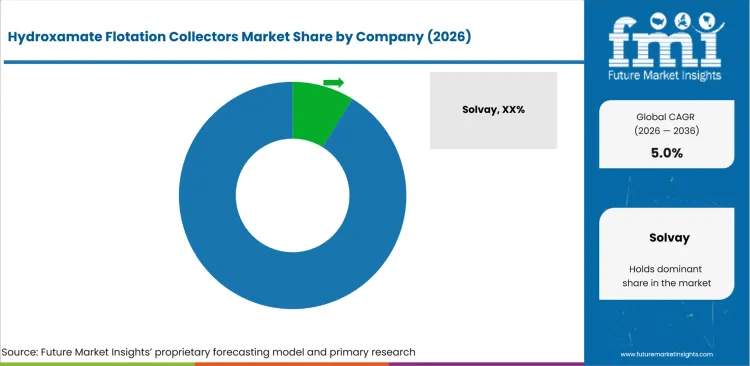
Axis House has the clearest record of dedicated hydroxamate development. Syensqo spans broader mining reagents. Clariant and BASF document rare-earth or non-sulfidic flotation. AECI and Nouryon provide mine service. Orica brings an adjacent collector network.
- Dedicated hydroxamate and specialty collector position: Axis House Group (Pty) Ltd.
- Broader rare-earth and non-sulfidic flotation platforms: Syensqo SA, Clariant AG and BASF SE.
- Mine-chemical and collector networks: AECI Mining Chemicals, Nouryon and Orica Limited.
Competitive Benchmarking: Hydroxamate Flotation Collectors Market
| Company | Hydroxamate / Non-Sulfide Fit | Ore-Specific Application Support | Mine-Site Supply Execution | Geographic Reach |
|---|---|---|---|---|
| Axis House Group (Pty) Ltd. | High | High | High | Southern Africa, Australia and international accounts |
| Syensqo SA | Medium | High | High | Global |
| Clariant AG | Medium | High | High | Global |
| BASF SE | Medium | High | High | Global with Australian flotation channel |
| AECI Mining Chemicals | Low | High | High | Southern Africa and selected growth corridors |
| Nouryon | Low | High | High | Global with mining laboratories |
| Orica Limited | Low | Medium | High | Global mine network |
Scoring basis: High chemistry fit requires direct hydroxamate evidence. Medium covers rare-earth or non-sulfidic flotation chemistry. Low marks adjacent collectors. High application support requires mine-facing technical work. High supply execution requires manufacturing or service reach in mining regions.
Key Developments in the Hydroxamate Flotation Collectors Market
- In June 2025, BASF and FUCHS signed an Australian flotation and dewatering cooperation agreement. FUCHS became the market interface while BASF retained chemistry development. The arrangement places application support closer to mines.
- In November 2025, Nouryon opened a larger Shanghai innovation center with a natural-resources laboratory that includes mining work. The facility expands regional testing for mineral-processing formulations even though Nouryon's public portfolio is broader than hydroxamates.
- In April 2026, Orica acquired the Danafloat collector range from FMC Corporation with formulation intellectual property and customer relationships. Danafloat mainly targets sulfide copper. The acquisition extends Orica’s collector channel into mine accounts.
Key Players in the Hydroxamate Flotation Collectors Market
Direct Hydroxamate and Specialty Collector Positions
- Axis House Group (Pty) Ltd.
- Syensqo SA
Rare-Earth and Non-Sulfidic Flotation Platforms
- Clariant AG
- BASF SE
Broader Mine-Chemical and Collector Networks
- AECI Mining Chemicals
- Nouryon
- Orica Limited
Hydroxamate Flotation Collectors Market - Report Scope
| Coverage field | Report scope |
|---|---|
| Market breakdown | By collector type, ore type, application stage, end use, sales channel and region. |
| Quantitative Units | USD million. |
| Market Definition | Revenue from hydroxamate-based flotation collectors sold for mineral beneficiation. Non-hydroxamate collectors and standalone technical-service fees are excluded unless inseparable from collector supply. |
| Regions Covered | North America, Latin America, Western Europe, Eastern Europe, East Asia, South Asia and Pacific and Middle East and Africa. |
| Countries Covered | Australia, Chile, Brazil, South Africa, Canada, USA, Japan, and 25+ countries included in the full report. |
| Key Companies Profiled | Axis House Group (Pty) Ltd., Syensqo SA, Clariant AG, BASF SE, AECI Mining Chemicals, Nouryon, Orica Limited. |
| Forecast Period | 2026 to 2036. |
| Approach | Primary and secondary research with market triangulation. |
Hydroxamate Flotation Collectors Market - Research Methodology
| Method | Approach |
|---|---|
| Primary Research | FMI analysts gathered input from manufacturers, service providers, technology developers, distributors, end users, procurement teams, and subject-matter experts. Interviews examined purchasing decisions, product or service evaluation, adoption barriers, approval requirements, pricing considerations, and expectations for technical or commercial support. Respondents were also asked what evidence is required before a trial, pilot, or initial order develops into regular purchasing. |
| Desk Research | Desk research covered government statistics, regulatory publications, trade data, industry associations, technical literature, standards, company filings, product information, and official corporate announcements. Sources were reviewed for relevance, publication date, geographic coverage, and consistency with the defined market scope. Claims relating to performance, applications, approvals, capacity, investment, and commercial activity were retained only when supported by credible public evidence. |
| Market Sizing and Forecasting | The market model combined the baseline value with historical performance, segment structure, pricing and volume indicators, adoption levels, company participation, and country-level demand conditions. Forecast assumptions considered economic activity, investment trends, regulatory developments, technology adoption, purchasing cycles, supply availability, and barriers to wider market use. Segment and regional estimates were reconciled before the final market total was calculated. |
| Data Validation | Estimates were checked against multiple independent indicators, including public data, company activity, trade patterns, industry developments, and findings from primary interviews. Validation also tested whether products, services, applications, and company revenues fell within the defined market boundaries. Adjacent categories, unsupported claims, overlapping revenues, and activities without direct market relevance were excluded to reduce double counting and maintain consistency across segments and countries. |
Hydroxamate Flotation Collectors Market by Segments
Hydroxamate Flotation Collectors Market segmented by Collector Type:
- Alkyl hydroxamates
- Aryl hydroxamates
- Mixed hydroxamate blends
- Chelating hydroxamates
- Specialty rare-earth collectors
Hydroxamate Flotation Collectors Market segmented by Ore Type:
- Rare earth ores
- Oxidized copper ores
- Tungsten - tin ores
- Iron oxide minerals
- Phosphate - industrial minerals
Hydroxamate Flotation Collectors Market segmented by Application Stage:
- Rougher flotation
- Cleaner flotation
- Selective oxide flotation
- Pilot-scale beneficiation
Hydroxamate Flotation Collectors Market segmented by End Use:
- Rare earth concentrators
- Copper concentrators
- Industrial mineral plants
- Mining reagent distributors
Hydroxamate Flotation Collectors Market segmented by Sales Channel:
- Direct mine contracts
- Specialty reagent suppliers
- Technical service packages
- Regional distributors
Hydroxamate Flotation Collectors Market by Region:
- North America
- United States
- Canada
- Latin America
- Brazil
- Mexico
- Argentina
- Chile
- Western Europe
- Germany
- France
- United Kingdom
- Italy
- Spain
- Benelux
- Nordics
- Eastern Europe
- Poland
- Czech Republic
- Romania
- Hungary
- East Asia
- China
- Japan
- South Korea
- South Asia and Pacific
- India
- ASEAN
- Australia and New Zealand
- Middle East and Africa
- GCC Countries
- South Africa
- Türkiye
- Israel
Research Sources and Bibliography
- Geoscience Australia. (2026, February 26). Australia's Identified Mineral Resources 2025: Introduction.
- International Energy Agency. (2025, May 21). Rare earth elements 2025.
- Ames Laboratory. (2026, February 2). Exclusive global license to Bayan for CMI-supported rare earth elements (REE) processing technologies.
- Comisión Chilena del Cobre. (2026, September 7). Cochilco publica estudio sobre el mercado de concentrados y la industria mundial de fundiciones.
- Patents and Companies Registration Agency. (2026, May 31). Zambia Intellectual Property Journal, Volume 1 No. 5: AP/P/2026/017267, Hydroxamate preparation.
- Clariant. (2025, November 17-20). Flotation 2025.
- Clariant. (2026, July 7-9). Procemin 2026.
- BASF. (2025, May 20). BASF mining solutions strengthens commitment to copper hydrometallurgy and flotation research and development.
- BASF. (2025, June 18). BASF mining solutions and FUCHS announce cooperation to serve the Australian mining industry.
- BASF. (2025, August 28). BASF opens Mining Solutions Laboratory in conjunction with Al-Farabi Kazakh National University in Kazakhstan.
- Nouryon. (2025, November 10). Nouryon opens new innovation center in Shanghai to accelerate localized innovation and customer collaboration in China.
- Natural Resources Canada. (2025, October 31). Canada unlocks 26 new investments and partnerships with 9 allied countries to secure critical minerals supply chains.
- Natural Resources Canada. (2025, October 31). Backgrounder: Canada unlocks 26 new investments and partnerships with 9 allied countries to secure critical minerals supply chains.
- Ministry of Mines and Energy, Brazil. (2026, March 2). MME publica Guia do Investidor 2026 para fortalecer atração de investimentos estrangeiros em minerais críticos.
- Department of Mineral and Petroleum Resources, South Africa. (2025, May 20). Minister Gwede Mantashe: Approval of Critical Minerals and Metals Strategy for South Africa and Draft Mineral Resources Development Bill.
- USA Geological Survey. (2026, February 6). Mineral commodity summaries 2026.
- Japan Organization for Metals and Energy Security. (2025, March 17). Equity and debt financing to Caremag SAS - Project participation to diversify rare earth sources.
- USA Department of Defense. (2025, August 10). Office of Strategic Capital announces first loan through DoD agreement with MP Materials to secure critical materials supply chain.
- Ames Laboratory. (2025, October 1). Measuring collector adsorption to inform flotation performance.
- AECI Limited. (2025, February 26). AECI reports 2024 results: Strategic execution drives transformation.
- Orica Limited. (2026, April 17). Orica expands portfolio into copper chemistry with Danafloat acquisition.
- Orica Limited. (2025, September 5). Continued strength in underlying business performance.
- AECI Limited. (2026). Reviewed condensed consolidated financial results and cash dividend declaration for the year ended 31 December 2025.
- Syensqo SA. (2026). Annual reports: Syensqo 2025 Annual Integrated Report.
- Syensqo SA. (2026, May 21). Syensqo launches strategic review of its Performance & Care segment.
- USA Department of Energy. (2025, September 26). Lab Call: Mine of the Future Research, Development, and Demonstration.
This bibliography is provided for reader reference and is not exhaustive. The full report contains the complete reference list and detailed citations.
This Report Answers
- How large is the hydroxamate flotation collectors market in 2026 and 2036?
- Which mineral-processing conditions create repeat demand for hydroxamate collectors?
- Which collector type accounts for 29.0% of revenue in 2026?
- Why do rare earth ores account for 27.0% of revenue by ore type?
- How do country growth rates differ among the seven profiled markets?
- Which local conditions shape qualification in Australia, Chile and other profiled countries?
- Which companies supply direct hydroxamate chemistry or adjacent flotation platforms?
- What limits conversion from laboratory performance to recurring mine-site purchases?
Frequently Asked Questions
How big is the hydroxamate flotation collectors market in 2026?
The hydroxamate flotation collectors market is valued at USD 620.7 million in 2026 and projected at USD 1,011.1 million by 2036. Selective oxide and rare-earth flotation supports growth.
What is the CAGR of the hydroxamate flotation collectors market from 2026 to 2036?
The hydroxamate flotation collectors market is projected to grow at a CAGR of 5.0% between 2026 and 2036. Critical-mineral processing brings more ore bodies into reagent qualification.
Which collector type leads the hydroxamate flotation collectors market?
The alkyl hydroxamates segment is expected to hold 29.0% of the hydroxamate flotation collectors market in 2026, attributable to tunable chemistry for oxide and rare-earth feeds. Mineralogy sets the dose and pH range.
Which application stage leads the hydroxamate flotation collectors market?
The rougher flotation segment is expected to hold 37.0% of the hydroxamate flotation collectors market in 2026, driven by recovery value ahead of cleaner stages. Early losses reduce mineral available for cleaning.
Which countries are projected to record the highest growth in the hydroxamate flotation collectors market?
Australia is projected to grow at 5.8% CAGR followed by Chile at 5.4% and Brazil at 5.2% through 2036. Rare-earth projects and oxide-copper niches convert into collector demand at different rates.
Which companies are active in the hydroxamate flotation collectors market?
Key companies operating in the market include Axis House Group (Pty) Ltd., Syensqo SA, Clariant AG, BASF SE, AECI Mining Chemicals, Nouryon, and Orica Limited. They differ in hydroxamate specificity and mine-site support.
Preview the report firsthand - request a free sample
Get SampleGet the brochure for pricing and purchase details.
Get PDFTable of Content
- Key Takeaways
- Market Size and CAGR
- Top Growth Driver
- Fastest Growing Segment
- Leading Region
- Key Companies
- Emerging Opportunities
- Executive Summary
- Global Market Outlook
- Demand-side Trends
- Supply-side Trends
- Technology Roadmap Analysis
- Analysis and Recommendations
- Analyst Perspective (What is happening? Why now? What should investors know?)
- Key Questions Answered
- How large is the market?
- What is the CAGR?
- What are key trends?
- Which region dominates?
- Who are the leaders?
- Market Overview
- Market Coverage / Taxonomy
- Market Definition / Scope / Limitations
- Research Methodology
- Chapter Orientation
- Analytical Lens and Working Hypotheses
- Market Structure, Signals, and Trend Drivers
- Benchmarking and Cross-market Comparability
- Market Sizing, Forecasting, and Opportunity Mapping
- Research Design and Evidence Framework
- Desk Research Programme (Secondary Evidence)
- Expert Input and Fieldwork (Primary Evidence)
- Tooling, Models, and Reference Databases
- Data Engineering and Model Build
- Quality Assurance and Audit Trail
- Market Background
- Market Dynamics (Drivers, Restraints, Opportunity, Trends)
- Scenario Forecast (Optimistic, Likely, Conservative)
- Impact Analysis
- AI Impact
- Sustainability Impact
- Regulatory Impact
- Technology Impact
- Consumer / Buyer Analysis
- Purchase Drivers
- Adoption Barriers
- Buyer Journey
- Opportunity Map Analysis
- Product Life Cycle Analysis
- Supply Chain Analysis
- Investment Feasibility Matrix
- Value Chain Analysis
- PESTLE and Porter's Analysis
- Regulatory Landscape
- Regional Parent Market Outlook
- Production and Consumption Statistics
- Import and Export Statistics
- Global Market Analysis and Forecast, 2021 to 2036
- Historical Market Size Value (USD Million) Analysis, 2021 to 2025
- Current and Future Market Size Value (USD Million) Projections, 2026 to 2036
- Y-o-Y Growth Trend Analysis
- Absolute $ Opportunity Analysis
- Global Market Pricing Analysis, 2021 to 2036
- Global Market Analysis and Forecast, By Collector Type, 2021 to 2036
- Introduction / Key Findings
- Historical Market Size Value (USD Million) Analysis By Collector Type, 2021 to 2025
- Current and Future Market Size Value (USD Million) Analysis and Forecast By Collector Type, 2026 to 2036
- Alkyl hydroxamates
- Aryl hydroxamates
- Mixed hydroxamate blends
- Chelating hydroxamates
- Specialty rare-earth collectors
- Alkyl hydroxamates
- Y-o-Y Growth Trend Analysis By Collector Type, 2021 to 2025
- Absolute $ Opportunity Analysis By Collector Type, 2026 to 2036
- Global Market Analysis and Forecast, By Ore Type, 2021 to 2036
- Introduction / Key Findings
- Historical Market Size Value (USD Million) Analysis By Ore Type, 2021 to 2025
- Current and Future Market Size Value (USD Million) Analysis and Forecast By Ore Type, 2026 to 2036
- Rare earth ores
- Oxidized copper ores
- Tungsten/tin ores
- Iron oxide minerals
- Phosphate/industrial minerals
- Rare earth ores
- Y-o-Y Growth Trend Analysis By Ore Type, 2021 to 2025
- Absolute $ Opportunity Analysis By Ore Type, 2026 to 2036
- Global Market Analysis and Forecast, By Application Stage, 2021 to 2036
- Introduction / Key Findings
- Historical Market Size Value (USD Million) Analysis By Application Stage, 2021 to 2025
- Current and Future Market Size Value (USD Million) Analysis and Forecast By Application Stage, 2026 to 2036
- Rougher flotation
- Cleaner flotation
- Selective oxide flotation
- Pilot-scale beneficiation
- Rougher flotation
- Y-o-Y Growth Trend Analysis By Application Stage, 2021 to 2025
- Absolute $ Opportunity Analysis By Application Stage, 2026 to 2036
- Global Market Analysis and Forecast, By End Use, 2021 to 2036
- Introduction / Key Findings
- Historical Market Size Value (USD Million) Analysis By End Use, 2021 to 2025
- Current and Future Market Size Value (USD Million) Analysis and Forecast By End Use, 2026 to 2036
- Rare earth concentrators
- Copper concentrators
- Industrial mineral plants
- Mining reagent distributors
- Rare earth concentrators
- Y-o-Y Growth Trend Analysis By End Use, 2021 to 2025
- Absolute $ Opportunity Analysis By End Use, 2026 to 2036
- Global Market Analysis and Forecast, By Sales Channel, 2021 to 2036
- Introduction / Key Findings
- Historical Market Size Value (USD Million) Analysis By Sales Channel, 2021 to 2025
- Current and Future Market Size Value (USD Million) Analysis and Forecast By Sales Channel, 2026 to 2036
- Direct mine contracts
- Specialty reagent suppliers
- Technical service packages
- Regional distributors
- Direct mine contracts
- Y-o-Y Growth Trend Analysis By Sales Channel, 2021 to 2025
- Absolute $ Opportunity Analysis By Sales Channel, 2026 to 2036
- Global Market Analysis and Forecast, By Region, 2021 to 2036
- Introduction
- Historical Market Size Value (USD Million) Analysis By Region, 2021 to 2025
- Current Market Size Value (USD Million) Analysis and Forecast By Region, 2026 to 2036
- North America
- Latin America
- Western Europe
- Eastern Europe
- East Asia
- South Asia and Pacific
- Middle East & Africa
- Market Attractiveness Analysis By Region
- North America Market Analysis and Forecast, By Country, 2021 to 2036
- Historical Market Size Value (USD Million) Trend Analysis By Market Taxonomy, 2021 to 2025
- Market Size Value (USD Million) Forecast By Market Taxonomy, 2026 to 2036
- By Country
- USA
- Canada
- By Collector Type
- By Ore Type
- By Application Stage
- By End Use
- By Sales Channel
- By Country
- Market Attractiveness Analysis
- By Country
- By Collector Type
- By Ore Type
- By Application Stage
- By End Use
- By Sales Channel
- Key Takeaways
- Latin America Market Analysis and Forecast, By Country
- Historical Market Size Value (USD Million) Trend Analysis By Market Taxonomy, 2021 to 2025
- Market Size Value (USD Million) Forecast By Market Taxonomy, 2026 to 2036
- By Country
- Brazil
- Mexico
- Chile
- Rest of Latin America
- By Collector Type
- By Ore Type
- By Application Stage
- By End Use
- By Sales Channel
- By Country
- Market Attractiveness Analysis
- By Country
- By Collector Type
- By Ore Type
- By Application Stage
- By End Use
- By Sales Channel
- Key Takeaways
- Western Europe Market Analysis and Forecast, By Country
- Historical Market Size Value (USD Million) Trend Analysis By Market Taxonomy, 2021 to 2025
- Market Size Value (USD Million) Forecast By Market Taxonomy, 2026 to 2036
- By Country
- Germany
- UK
- Italy
- Spain
- France
- Nordic
- BENELUX
- Rest of Western Europe
- By Collector Type
- By Ore Type
- By Application Stage
- By End Use
- By Sales Channel
- By Country
- Market Attractiveness Analysis
- By Country
- By Collector Type
- By Ore Type
- By Application Stage
- By End Use
- By Sales Channel
- Key Takeaways
- Eastern Europe Market Analysis and Forecast, By Country
- Historical Market Size Value (USD Million) Trend Analysis By Market Taxonomy, 2021 to 2025
- Market Size Value (USD Million) Forecast By Market Taxonomy, 2026 to 2036
- By Country
- Russia
- Poland
- Hungary
- Balkan & Baltic
- Rest of Eastern Europe
- By Collector Type
- By Ore Type
- By Application Stage
- By End Use
- By Sales Channel
- By Country
- Market Attractiveness Analysis
- By Country
- By Collector Type
- By Ore Type
- By Application Stage
- By End Use
- By Sales Channel
- Key Takeaways
- East Asia Market Analysis and Forecast, By Country
- Historical Market Size Value (USD Million) Trend Analysis By Market Taxonomy, 2021 to 2025
- Market Size Value (USD Million) Forecast By Market Taxonomy, 2026 to 2036
- By Country
- China
- Japan
- South Korea
- By Collector Type
- By Ore Type
- By Application Stage
- By End Use
- By Sales Channel
- By Country
- Market Attractiveness Analysis
- By Country
- By Collector Type
- By Ore Type
- By Application Stage
- By End Use
- By Sales Channel
- Key Takeaways
- South Asia and Pacific Market Analysis and Forecast, By Country
- Historical Market Size Value (USD Million) Trend Analysis By Market Taxonomy, 2021 to 2025
- Market Size Value (USD Million) Forecast By Market Taxonomy, 2026 to 2036
- By Country
- India
- ASEAN
- Australia & New Zealand
- Rest of South Asia and Pacific
- By Collector Type
- By Ore Type
- By Application Stage
- By End Use
- By Sales Channel
- By Country
- Market Attractiveness Analysis
- By Country
- By Collector Type
- By Ore Type
- By Application Stage
- By End Use
- By Sales Channel
- Key Takeaways
- Middle East & Africa Market Analysis and Forecast, By Country
- Historical Market Size Value (USD Million) Trend Analysis By Market Taxonomy, 2021 to 2025
- Market Size Value (USD Million) Forecast By Market Taxonomy, 2026 to 2036
- By Country
- Kingdom of Saudi Arabia
- Other GCC Countries
- Türkiye
- South Africa
- Other African Union
- Rest of Middle East & Africa
- By Collector Type
- By Ore Type
- By Application Stage
- By End Use
- By Sales Channel
- By Country
- Market Attractiveness Analysis
- By Country
- By Collector Type
- By Ore Type
- By Application Stage
- By End Use
- By Sales Channel
- Key Takeaways
- Key Countries Market Analysis
- USA
- Pricing Analysis
- Market Share Analysis, 2025
- By Collector Type
- By Ore Type
- By Application Stage
- By End Use
- By Sales Channel
- Canada
- Pricing Analysis
- Market Share Analysis, 2025
- By Collector Type
- By Ore Type
- By Application Stage
- By End Use
- By Sales Channel
- Mexico
- Pricing Analysis
- Market Share Analysis, 2025
- By Collector Type
- By Ore Type
- By Application Stage
- By End Use
- By Sales Channel
- Brazil
- Pricing Analysis
- Market Share Analysis, 2025
- By Collector Type
- By Ore Type
- By Application Stage
- By End Use
- By Sales Channel
- Chile
- Pricing Analysis
- Market Share Analysis, 2025
- By Collector Type
- By Ore Type
- By Application Stage
- By End Use
- By Sales Channel
- Germany
- Pricing Analysis
- Market Share Analysis, 2025
- By Collector Type
- By Ore Type
- By Application Stage
- By End Use
- By Sales Channel
- UK
- Pricing Analysis
- Market Share Analysis, 2025
- By Collector Type
- By Ore Type
- By Application Stage
- By End Use
- By Sales Channel
- Italy
- Pricing Analysis
- Market Share Analysis, 2025
- By Collector Type
- By Ore Type
- By Application Stage
- By End Use
- By Sales Channel
- Spain
- Pricing Analysis
- Market Share Analysis, 2025
- By Collector Type
- By Ore Type
- By Application Stage
- By End Use
- By Sales Channel
- France
- Pricing Analysis
- Market Share Analysis, 2025
- By Collector Type
- By Ore Type
- By Application Stage
- By End Use
- By Sales Channel
- India
- Pricing Analysis
- Market Share Analysis, 2025
- By Collector Type
- By Ore Type
- By Application Stage
- By End Use
- By Sales Channel
- ASEAN
- Pricing Analysis
- Market Share Analysis, 2025
- By Collector Type
- By Ore Type
- By Application Stage
- By End Use
- By Sales Channel
- Australia & New Zealand
- Pricing Analysis
- Market Share Analysis, 2025
- By Collector Type
- By Ore Type
- By Application Stage
- By End Use
- By Sales Channel
- China
- Pricing Analysis
- Market Share Analysis, 2025
- By Collector Type
- By Ore Type
- By Application Stage
- By End Use
- By Sales Channel
- Japan
- Pricing Analysis
- Market Share Analysis, 2025
- By Collector Type
- By Ore Type
- By Application Stage
- By End Use
- By Sales Channel
- South Korea
- Pricing Analysis
- Market Share Analysis, 2025
- By Collector Type
- By Ore Type
- By Application Stage
- By End Use
- By Sales Channel
- Russia
- Pricing Analysis
- Market Share Analysis, 2025
- By Collector Type
- By Ore Type
- By Application Stage
- By End Use
- By Sales Channel
- Poland
- Pricing Analysis
- Market Share Analysis, 2025
- By Collector Type
- By Ore Type
- By Application Stage
- By End Use
- By Sales Channel
- Hungary
- Pricing Analysis
- Market Share Analysis, 2025
- By Collector Type
- By Ore Type
- By Application Stage
- By End Use
- By Sales Channel
- Kingdom of Saudi Arabia
- Pricing Analysis
- Market Share Analysis, 2025
- By Collector Type
- By Ore Type
- By Application Stage
- By End Use
- By Sales Channel
- Türkiye
- Pricing Analysis
- Market Share Analysis, 2025
- By Collector Type
- By Ore Type
- By Application Stage
- By End Use
- By Sales Channel
- South Africa
- Pricing Analysis
- Market Share Analysis, 2025
- By Collector Type
- By Ore Type
- By Application Stage
- By End Use
- By Sales Channel
- USA
- Market Structure Analysis
- Competition Dashboard
- Competition Benchmarking
- Market Share Analysis of Top Players
- By Regional
- By Collector Type
- By Ore Type
- By Application Stage
- By End Use
- By Sales Channel
- Emerging Startups
- Innovation Benchmarking
- Competition Analysis
- Competition Deep Dive
- Solvay
- Overview
- Product Portfolio
- Profitability by Market Segments
- Sales Footprint
- Strategy Overview
- Marketing Strategy
- Product Strategy
- Channel Strategy
- Clariant
- Nouryon
- Orica
- Axis House
- Senmin
- Nasaco
- Coogee Chemicals
- Quadra Chemicals
- Kemcore
- Solvay
- Case Studies
- Success Stories
- Recent Developments
- Competition Deep Dive
- Assumptions & Acronyms Used


