

- Market Size (2026)
- USD 920.6 Mn
- Forecast (2036)
- USD 1485.3 Mn
- CAGR (2026 to 2036)
- 4.9%
How big is Xanthate Flotation Collectors Market in 2026?
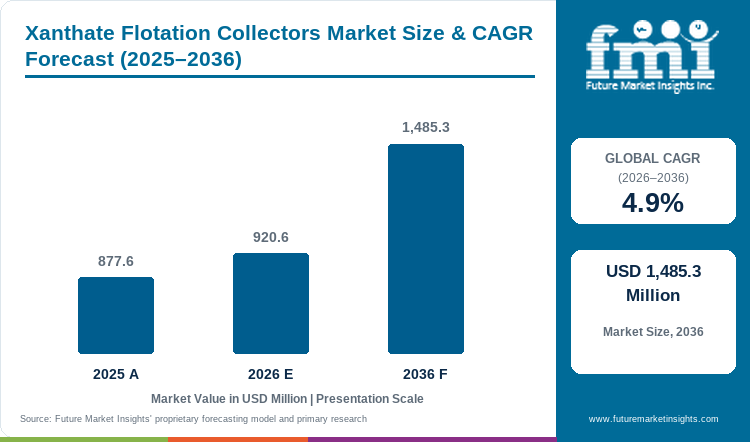
USD 920.6 Million in 2026 and USD 1485.3 Million by 2036 at a 4.9% CAGR.
Demand for xanthate flotation collectors is projected to expand at 4.9% CAGR between 2026 and 2036, increasing market value from USD 920.6 Million in 2026 to USD 1485.3 Million by 2036. The market was valued at USD 877.6 Million in 2025. The reagent is consumed in the flotation circuit, so supplier revenue follows operating throughput and repeat replenishment rather than one-time equipment installation. Mine teams compare collector performance with dosage and handling requirements before a grade becomes part of the operating recipe.
The International Energy Agency reported in May 2025 that copper demand under its Stated Policies Scenario could rise by about 30% to 2040, while the announced project pipeline points to a material supply shortfall by 2035. The same outlook identifies declining ore grades as a pressure on future copper supply. For sulfide concentrators, those conditions raise the value of maintaining recovery while controlling reagent consumption per tonne of ore.
Key Takeaways of Xanthate Flotation Collectors Market
- Xanthate collector demand is tied to sulfide-ore throughput because the reagent is consumed during flotation and reordered as concentrators operate.
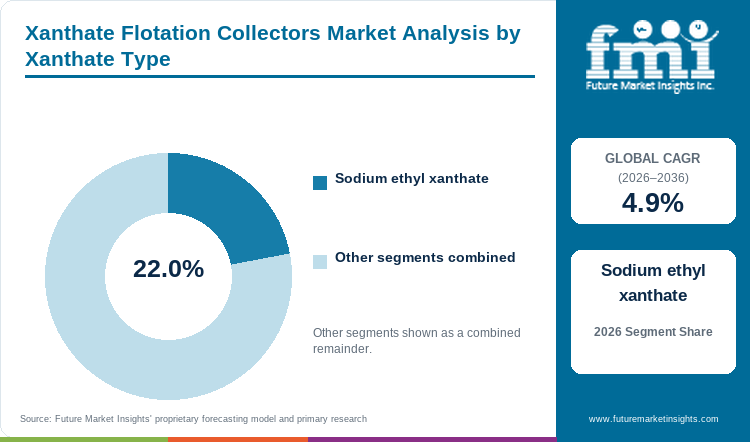
- In 2026, sodium ethyl xanthate is projected to account for 22.0% of Xanthate Type demand, while copper sulfide ores are estimated at 33.0% of Ore Type demand.
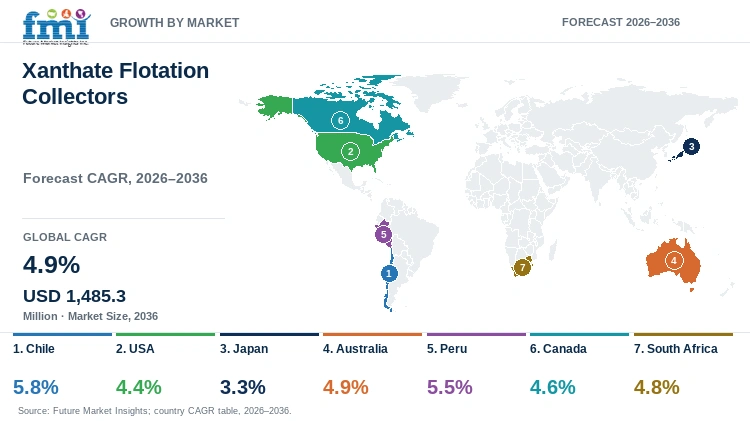
- Chile leads country-level growth at 5.8% CAGR through 2036, followed by Peru at 5.5%, Australia at 4.9%, South Africa at 4.8%, Canada at 4.6%, USA at 4.4%, and Japan at 3.3%.
- Pellets/granules are forecast to hold 38.0% of Form demand in 2026 because dry storage and lower-dust transfer suit the handling requirements of mine-site operations.
- Mining concentrators account for 62.0% of End Use demand in 2026 because collectors are dosed continuously against processed ore volume and metallurgical recovery targets.
- Directly evidenced participants include Nouryon, Orica, AECI Mining Chemicals, Coogee Chemicals, Syensqo, Clariant, Nasaco, Axis House, Quadra Chemicals and Kemcore. Market analysis also uses current mining-chemical, safety and mineral-processing records.
Analyst Perspective
"A xanthate program earns approval on metallurgical response and operating fit at the mine. Buyers should compare recovery with dosage and handling burden, then confirm that performance holds as ore blend or water chemistry changes."
- Nikhil Kaitwade, Principal Analyst at Future Market Insights
How is the Xanthate Flotation Collectors Market segmented?
The xanthate flotation collectors market is segmented by Xanthate Type, Ore Type, Form, End Use, Sales Channel and Region.
Xanthate Type separates the named collector chemistries used in sulfide flotation. Ore Type identifies the mineral system in which the collector is applied. Form covers how the reagent reaches the plant and is prepared for dosing. End Use identifies the purchasing or consuming organization. Sales Channel distinguishes direct producer supply from distributor and service routes. Region captures differences in mine activity, logistics and reagent qualification.
What makes sodium ethyl xanthate central to the Xanthate Type category?
Sodium ethyl xanthate serves established sulfide-flotation circuits where plant teams want a familiar collector chemistry with supply options that fit site infrastructure. Coogee Chemicals lists liquid sodium ethyl xanthate for direct mine delivery, while other suppliers offer solid xanthate grades for plants that prepare working solution on site. The commercial test remains plant response: the grade stays in the recipe only when recovery and selectivity remain acceptable at the required dose.
- Sodium ethyl xanthate accounts for 22.0% of Xanthate Type demand in 2026, supported by established use in sulfide-flotation circuits and multiple delivery formats.
- Coogee Chemicals states that its liquid sodium ethyl xanthate is transported by road tanker to site storage, eliminating solid reagent handling and on-site dissolution in operations that use this route.
Why do copper sulfide ores lead the Ore Type category?
Copper sulfide concentrators are a major center of xanthate demand because froth flotation is widely used to upgrade sulfide-bearing feed before downstream processing. The IEA's May 2025 copper outlook combines long-run demand growth with pressure from declining ore grades. Large operations run continuously, so a collector that passes metallurgical qualification becomes a repeat-consumption item. Supplier selection therefore depends on recovery and dosage within the wider flotation reagents program used at the plant.
- Copper sulfide ores account for 33.0% of Ore Type demand in 2026 because high-throughput concentrators use collectors continuously to separate valuable sulfide minerals from gangue.
- The International Energy Agency reported in May 2025 that copper demand is projected to grow about 30% to 2040 under stated policies, while declining ore quality adds processing intensity.
How do pellets/granules support the Form category?
Pellet and granule forms address handling before the reagent enters the flotation circuit. Nasaco's sodium isopropyl xanthate documentation specifies pellet supply to minimize dusting and recommends that prepared solution should not be stored for extended periods because carbon disulfide can form during decomposition. Pelletized supply lets a concentrator store dry reagent and prepare working solution close to use. The form still requires hazardous-material controls, but it can reduce dust during dry transfer.
- Pellets/granules account for 38.0% of Form demand in 2026 because they support dry storage and lower-dust transfer while allowing mines to prepare solution near the dosing point.
- Nasaco’s sodium isopropyl xanthate technical sheet specifies pelletized supply to minimize dusting and recommends short storage of prepared solutions because decomposition can produce carbon disulfide.
What supports mining concentrators in the End Use category?
Mining concentrators consume xanthates as operating reagents, so chemical performance is directly linked with payable-metal recovery. A grade is usually retained only after laboratory or plant trials establish an acceptable operating window. Changes in ore blend or water chemistry can force retuning even when the underlying collector remains familiar. That makes the concentrator the main consumption point and a core buyer of beneficiation reagents.
- Mining concentrators account for 62.0% of End Use demand in 2026 because collectors are dosed continuously against processed ore volume and metallurgical recovery targets.
- AECI Mining Chemicals lists solid and liquid metal-sulfide xanthate collectors within its mineral-beneficiation reagent portfolio.
Why does direct mine supply lead the Sales Channel category?
Direct mine supply can reduce commercial handoffs around a chemical that must arrive with consistent specification and suitable dangerous-goods controls. Large concentrators can coordinate packaging or tanker configuration with delivery cadence and technical support. Coogee Chemicals describes road-tanker delivery of liquid sodium ethyl xanthate to mine-site storage, a route that removes solid handling and on-site dissolution where the plant is configured for liquid supply. Distributors remain important for smaller or geographically dispersed users.
- Direct mine supply accounts for 46.0% of Sales Channel demand in 2026 because high-volume concentrators value specification control, predictable replenishment, and supplier accountability.
- Coogee Chemicals documents direct road-tanker delivery of liquid sodium ethyl xanthate to site storage, illustrating how supplier logistics can become part of the reagent proposition.
What are the drivers, restraints and opportunities in the Xanthate Flotation Collectors Market?
Sulfide-ore processing supports recurring collector demand, while carbon disulfide risk raises handling requirements and regional supply models create room for service-led growth.
- Driver: Higher sulfide-ore processing workloads support recurring collector consumption as concentrators protect recovery across changing feed conditions.
- Restraint: Carbon disulfide formation and flammability increase storage, ventilation and dangerous-goods requirements around xanthate handling.
- Opportunity: Mine-specific collector programs and regional inventory can reduce lead time while aligning reagent form with local handling systems.
Demand is supported by the processing workload required to recover metal from larger or lower-grade sulfide feeds. The IEA projects copper demand to rise by about 30% to 2040 under stated policies and identifies declining ore grades as a pressure on future supply. Concentrators therefore place greater value on stable recovery without an uneconomic increase in reagent dosage. Collector selection sits inside the wider mining flotation chemicals program.
The main restraint sits in storage and worker-safety control. Safe Work Australia identifies carbon disulfide as a decomposition product of xanthates used in mining, and NIOSH classifies carbon disulfide as a flammable liquid. Nasaco also recommends short storage of prepared xanthate solutions because decomposition can produce carbon disulfide. Mines may adjust flotation activators when mineral response changes, so a collector is qualified as part of the full reagent scheme.
The commercial opportunity is to reduce operating friction around the reagent. Mines differ in water quality and dissolution equipment, while storage capacity and transport access also change the preferred supply model. Liquid delivery can fit sites with tankage, while pellet supply can reduce dust during dry handling. Regional inventory lowers replenishment risk. CMC flotation depressants can support selectivity where gangue suppression is required, so technical service remains part of the purchasing decision.
Which country CAGRs are compared in the Xanthate Flotation Collectors Market?
| Country | CAGR |
|---|---|
| Chile | 5.8% |
| USA | 4.4% |
| Japan | 3.3% |
| Australia | 4.9% |
| Peru | 5.5% |
| Canada | 4.6% |
| South Africa | 4.8% |
How do country-level CAGRs compare in the Xanthate Flotation Collectors Market?
The country CAGRs in this analysis span 2.5 percentage points from Chile at 5.8% to Japan at 3.3%. Chile and Peru form the upper band at 5.8% and 5.5%. Australia, South Africa, Canada and USA range from 4.9% to 4.4%, while Japan is forecast at 3.3%. The comparison measures forecast pace rather than absolute market size.
- Chile leads Peru by 0.3 percentage points, so the top band is commercially close; supplier differentiation is more likely to come from mine coverage and technical service than from headline growth alone.
- Peru exceeds Australia by 0.6 percentage points. That gap supports earlier channel investment around new Peruvian projects, while Australian growth rewards dependable supply to established and expanding operations.
- Australia, South Africa, Canada, and USA sit within a 0.5-point range. Similar CAGRs mask different logistics, ore portfolios, water conditions, and procurement practices, so a single regional sales model would be inefficient.
- USA exceeds Japan by 1.1 percentage points, the largest adjacent gap among the countries shown. Japan therefore calls for selective technical account development rather than the same volume-led approach used in large mine-processing markets.
CAGR does not identify the largest revenue pool. It measures forecast expansion from each country's own starting point. Existing concentrator capacity and project timing affect addressable sales, as do reagent intensity and route-to-mine economics. Country growth rates therefore need to be read with operating mine demand and qualification requirements.
Country-wise Analysis
- Chile: Copper concentrators operate large continuous-processing systems, while water chemistry is becoming a more important reagent-selection variable. Demand for Xanthate Flotation Collectors in Chile is forecast to expand at 5.8% CAGR from 2026 to 2036. COCHILCO's 2025-2034 projection shows copper-mining water demand rising from 18.5 m3/s in 2024 to 20.6 m3/s in 2034, with seawater becoming the principal source. Greater saline-water use can change flotation response, which increases the value of plant-specific reagent testing and local technical support.
- USA: Mine and concentrator buyers in the United States generally require site-specific metallurgical qualification before changing a production reagent. Demand for Xanthate Flotation Collectors in USA is forecast to expand at 4.4% CAGR from 2026 to 2036. The USA Geological Survey reported in February 2026 that the value of USA mineral production increased 5.6% in 2025 to about USD 112 billion. Suppliers therefore need consistent product quality and trial support backed by reliable regional stock.
- Japan: Demand is shaped more by mineral security and technical processing capability than by a large domestic sulfide-mine base. Demand for Xanthate Flotation Collectors in Japan is forecast to expand at 3.3% CAGR from 2026 to 2036. JOGMEC announced in December 2025 a cooperation agreement with CODELCO that included impurity reduction in copper raw materials and referenced flotation-based separation of arsenic-bearing copper minerals. The opportunity is therefore concentrated in technical programs rather than volume-led domestic mine demand.
- Australia: Remote concentrators place a premium on dependable reagent replenishment because production interruptions are costly. Demand for Xanthate Flotation Collectors in Australia is forecast to expand at 4.9% CAGR from 2026 to 2036. Australia's Department of Industry reported in June 2026 that copper export earnings are projected to increase from AUD 14.6 billion in 2025-26 to AUD 18.3 billion in real terms by 2030-31. Suppliers need inventory planning and dangerous-goods transport capability that fit each site's dissolution or storage system.
- Peru: Demand spans operating copper concentrators and projects that create reagent accounts as beneficiation circuits approach commissioning. Demand for Xanthate Flotation Collectors in Peru is forecast to expand at 5.5% CAGR from 2026 to 2036. MINEM's June 2026 Mining Investment Project Portfolio lists 66 projects across 19 departments with estimated combined investment of USD 64.075 billion. Project timing remains the main conversion issue, so suppliers need early technical engagement followed by scalable delivery once a concentrator reaches stable operation.
- Canada: Buyers operate across a geographically dispersed mining system, so reagent economics include transport reliability and access to application support. Demand for Xanthate Flotation Collectors in Canada is forecast to expand at 4.6% CAGR from 2026 to 2036. Natural Resources Canada reports that Canada ranked twelfth in mined copper output in 2024 and represented about 2% of global production. Regional distribution and winter-resilient logistics therefore matter alongside plant-level qualification.
- South Africa: Concentrators process gold, platinum-group metals and base-metal ores across different flowsheets, so collector requirements vary by operation. Demand for Xanthate Flotation Collectors in South Africa is forecast to expand at 4.8% CAGR from 2026 to 2036. The South African government approved a Critical Minerals and Metals Strategy in May 2025 with emphasis on exploration and beneficiation. Suppliers need local technical capability and responsive inventory to serve varied ore systems.
Who are the notable companies in the Xanthate Flotation Collectors Market?
Nouryon, Orica, AECI Mining Chemicals, Coogee Chemicals, Syensqo, Clariant, Nasaco, Axis House, Quadra Chemicals and Kemcore are the notable companies covered in this market.
Competition in the xanthate flotation collectors market comes from direct xanthate manufacturers, broad flotation-chemistry suppliers and regional technical distributors. AECI Mining Chemicals, Coogee Chemicals, Nasaco and Kemcore have current public xanthate offerings or planned xanthate capacity. Nouryon, Orica, Syensqo and Clariant compete through wider collector portfolios and application support. Axis House and Quadra Chemicals combine regional supply with mineral-processing services.
- Direct xanthate supply: AECI Mining Chemicals, Coogee Chemicals, Nasaco and Kemcore compete through grade availability and mine-oriented replenishment.
- Broader flotation chemistry: Nouryon, Orica, Syensqo and Clariant compete through wider collector systems and technical programs that can supplement conventional xanthates.
- Regional technical distribution: Axis House and Quadra Chemicals compete through regional access and mineral-processing support.
Competitive Benchmarking: Xanthate Flotation Collectors Market
| Company | Direct Xanthate Product Coverage | Flotation Technical Support | Mine-site Supply and Logistics | Geographic Reach |
|---|---|---|---|---|
| Nouryon | Medium | High | High | Global mining markets through established specialty-chemicals operations |
| Orica | Medium | High | High | Global mining network with strong Australia and international mine access |
| AECI Mining Chemicals | High | High | High | Southern Africa with broader international mining-chemicals reach |
| Coogee Chemicals | High | Medium | High | Australia, with direct mine delivery capabilities |
| Syensqo | Medium | High | High | International mining markets through specialty-chemicals operations |
| Clariant | Medium | High | High | Global mining-solutions customer base and technical support |
| Nasaco | High | High | Medium | International base- and precious-metals concentrator customers |
| Axis House | Medium | High | High | Southern Africa with selected international mineral-processing reach |
| Quadra Chemicals | Medium | High | High | Canada and USA-focused mining distribution reach |
| Kemcore | High | Medium | High | Southern and Central African mining corridors with expanding regional infrastructure |
Key Developments in the Xanthate Flotation Collectors Market
- In April 2026, Orica announced the acquisition of the Danafloat™ product range from FMC Corporation. Danafloat supplies dithiophosphate-based sulfide-flotation collectors for copper and other base-metal ores. The addition broadens Orica's collector portfolio in Europe, the Middle East, Africa and Latin America and increases competitive pressure around technical-service-led flotation programs.
- In December 2025, Kemcore reported that its planned Integrated Battery Mineral Chemicals Manufacturing Facility in Palapye, Botswana had been identified as a priority project. The facility includes planned pelletized sodium isobutyl xanthate capacity of 20,000 tonnes per year, with construction targeted for 2026-2028. If completed, the facility would place xanthate production closer to Southern and Central African mining customers.
Key Players in the Xanthate Flotation Collectors Market
Direct Xanthate Supply and Manufacturing
- AECI Mining Chemicals
- Coogee Chemicals
- Nasaco
- Kemcore
Broad Flotation Chemistry and Technical Platforms
- Nouryon
- Orica
- Syensqo
- Clariant
Regional Mineral-processing Distribution and Support
- Axis House
- Quadra Chemicals
Xanthate Flotation Collectors Market - Report Scope
| Coverage field | Report scope |
|---|---|
| Market breakdown | Xanthate Type; Ore Type; Form; End Use; Sales Channel |
| Quantitative Units | USD Million |
| Market Definition | Revenue from xanthate flotation collectors sold within the defined Xanthate Type, Ore Type, Form, End Use, and Sales Channel universe. Downstream finished-product revenue and revenue from adjacent or substitute collector chemistries are excluded. |
| Regions Covered | North America; Latin America; Western Europe; Eastern Europe; East Asia; South Asia and Pacific; Middle East and Africa |
| Countries Covered | Chile; USA; Japan; Australia; Peru; Canada; South Africa; more than twenty-five additional countries in the full report |
| Key Companies Covered | Nouryon; Orica; AECI Mining Chemicals; Coogee Chemicals; Syensqo; Clariant; Nasaco; Axis House; Quadra Chemicals; Kemcore |
| Forecast Period | 2026 to 2036 |
| Approach | Primary and secondary research with market triangulation. |
Xanthate Flotation Collectors Market - Research Methodology
| Method | Approach |
|---|---|
| Primary Research | FMI analysts gather input from xanthate and mining-chemical producers, distributors, concentrator personnel, procurement teams and subject-matter specialists. Interviews test product usage, buying criteria, channel practices and handling requirements. |
| Desk Research | Desk research reviews mining statistics, regulator publications, company filings, product documentation, technical literature and safety guidance relevant to xanthate flotation collectors and their operating context. |
| Market Sizing and Forecasting | Market sizing combines product-supply evidence with mine and concentrator activity, ore exposure, reagent-use patterns, form and channel structure, and the timing of mining projects. Forecast assumptions consider throughput, ore complexity, substitution pressure, safety practices and regional supply availability. |
| Data Validation | Findings are checked across independent sources and reconciled to the market definition. Adjacent flotation chemistries and downstream finished products are excluded from the xanthate collector revenue boundary. |
Xanthate Flotation Collectors Market by Segments
Xanthate Flotation Collectors Market segmented by Xanthate Type:
- Sodium ethyl xanthate
- Sodium isopropyl xanthate
- Potassium amyl xanthate
- Sodium isobutyl xanthate
- Mixed xanthate blends
Xanthate Flotation Collectors Market segmented by Ore Type:
- Copper sulfide ores
- Lead-zinc ores
- Nickel ores
- Gold-bearing sulfides
- Polymetallic ores
Xanthate Flotation Collectors Market segmented by Form:
- Pellets/granules
- Powder
- Aqueous solution
- Custom blends
Xanthate Flotation Collectors Market segmented by End Use:
- Mining concentrators
- Toll flotation plants
- Reagent distributors
- Research/pilot plants
Xanthate Flotation Collectors Market segmented by Sales Channel:
- Direct mine supply
- Mining chemical distributors
- Reagent service contracts
- Regional blending plants
Xanthate Flotation Collectors Market by Region:
- North America
- United States
- Canada
- Latin America
- Brazil
- Mexico
- Argentina
- Chile
- Western Europe
- Germany
- France
- United Kingdom
- Italy
- Spain
- Benelux
- Nordics
- Eastern Europe
- Poland
- Czech Republic
- Romania
- Hungary
- East Asia
- China
- Japan
- South Korea
- South Asia and Pacific
- India
- ASEAN
- Australia and New Zealand
- Middle East and Africa
- GCC Countries
- South Africa
- Türkiye
- Israel
Research Sources and Bibliography
- International Energy Agency (2025, May 21). Global Critical Minerals Outlook 2025.
- USA Geological Survey (2026, February 6). Value of USA mineral production rose last year, driven by precious metals prices.
- Comisión Chilena del Cobre (COCHILCO) (2026). Informe Proyección del Consumo de Agua en la Minería del Cobre 2025-2034.
- Australian Department of Industry, Science and Resources (2026, June). Resources and Energy Quarterly, June 2026.
- Ministry of Energy and Mines of Peru (MINEM) (2026, June 17). Cartera de Proyectos de Inversión Minera 2026.
- Natural Resources Canada (2026). Copper facts.
- Japan Organization for Metals and Energy Security (JOGMEC) (2025, December 8). JOGMEC and CODELCO Sign Cooperation Agreement for Stable Copper Supply and Impurity Reduction.
- Government of South Africa (2025, May 20). Approval of the Critical Minerals and Metals Strategy South Africa.
- Safe Work Australia (2020, March 20). Health monitoring for carbon disulfide.
- USA National Institute for Occupational Safety and Health (NIOSH) (2019). Pocket Guide to Chemical Hazards: Carbon disulfide.
- AECI Mining Chemicals (2026). Mineral Beneficiation: Xanthates and Customised Solutions.
- Coogee Chemicals (2026). Explore Our Product Range: Xanthates (CMAX).
- Nasaco International (2018). NASCOL 311 Sodium Isopropyl Xanthate Technical Data.
- Orica (2026, April 17). Orica completes acquisition of Danafloat product range.
- Kemcore (2025, December 3). Integrated Battery Mineral Complex Identified as a Priority Project.
- Nouryon (2026). Flotation - Collectors.
- Syensqo (2026). Chemical Reagents for Mineral Processing.
- Axis House Group (2026). Mining Reagents, Flotation Reagents & Processing Solutions.
- BASF (2019, May 15). BASF names Quadra Chemicals as new distributor for its Mining Solutions Business in Canada and Alaska.
This bibliography is provided for reader reference and is not exhaustive. The full report contains the complete reference list and detailed citations.
This Report Answers
- What is the Xanthate Flotation Collectors Market size in 2026 and what value is forecast for 2036?
- Which mining and mineral-processing pressures support demand for xanthate flotation collectors?
- Why does Sodium ethyl xanthate hold the leading position within Xanthate Type?
- How does the leadership of Copper sulfide ores influence collector demand at concentrators?
- Why do Pellets/granules hold the leading position within Form?
- How do growth rates compare across Chile, USA, Japan, Australia, Peru, Canada, and South Africa?
- Which roles do Nouryon, Orica, AECI Mining Chemicals, Coogee Chemicals, Syensqo, Clariant, Nasaco, Axis House, Quadra Chemicals and Kemcore play in the competitive landscape?
- How do carbon disulfide formation and hazardous handling limit xanthate adoption or raise total cost?
- What should mine procurement and metallurgical teams evaluate before selecting a xanthate collector and supply model?
Frequently Asked Questions
How big is the Xanthate Flotation Collectors Market in 2026?
The xanthate flotation collectors market is valued at USD 920.6 million in 2026 and is forecast to reach USD 1485.3 million by 2036. Growth is supported by sulfide-ore concentrators consuming the reagent continuously during flotation, which sustains repeat replenishment as mine throughput and ore-grade pressures persist across established operations.
What is the CAGR of the Xanthate Flotation Collectors Market from 2026 to 2036?
The xanthate flotation collectors market grows at a CAGR of 4.9% between 2026 and 2036, supported by concentrators maintaining recovery while managing reagent dosage per tonne of ore as copper demand rises and declining ore grades add processing intensity across sulfide-flotation circuits.
Which xanthate type leads the Xanthate Flotation Collectors Market?
Sodium ethyl xanthate accounts for 22.0% of the xanthate flotation collectors market by xanthate type in 2026, supported by established use in sulfide-flotation circuits and multiple delivery formats, including liquid supply for direct mine delivery and solid grades for on-site solution preparation.
How much will the Xanthate Flotation Collectors Market add between 2026 and 2036?
The xanthate flotation collectors market is set to add USD 564.7 million between 2026 and 2036, growing from USD 920.6 million to USD 1,485.3 million as sulfide-ore processing volumes expand and concentrators sustain recurring reagent consumption across a widening base of mining operations.
Who are the leading companies in the Xanthate Flotation Collectors Market?
Ten companies lead the xanthate flotation collectors market, including Nouryon, Orica, AECI Mining Chemicals, Coogee Chemicals, Syensqo, Clariant, Nasaco, Axis House, Quadra Chemicals, and Kemcore, competing through collector chemistry, technical support, and mine-site supply logistics across direct and distributor channels worldwide.
Preview the report firsthand - request a free sample
Get SampleGet the brochure for pricing and purchase details.
Get PDFTable of Content
- Key Takeaways
- Market Size and CAGR
- Top Growth Driver
- Fastest Growing Segment
- Leading Region
- Key Companies
- Emerging Opportunities
- Executive Summary
- Global Market Outlook
- Demand-side Trends
- Supply-side Trends
- Technology Roadmap Analysis
- Analysis and Recommendations
- Analyst Perspective (What is happening? Why now? What should investors know?)
- Key Questions Answered
- How large is the market?
- What is the CAGR?
- What are key trends?
- Which region dominates?
- Who are the leaders?
- Market Overview
- Market Coverage / Taxonomy
- Market Definition / Scope / Limitations
- Research Methodology
- Chapter Orientation
- Analytical Lens and Working Hypotheses
- Market Structure, Signals, and Trend Drivers
- Benchmarking and Cross-market Comparability
- Market Sizing, Forecasting, and Opportunity Mapping
- Research Design and Evidence Framework
- Desk Research Programme (Secondary Evidence)
- Expert Input and Fieldwork (Primary Evidence)
- Tooling, Models, and Reference Databases
- Data Engineering and Model Build
- Quality Assurance and Audit Trail
- Market Background
- Market Dynamics (Drivers, Restraints, Opportunity, Trends)
- Scenario Forecast (Optimistic, Likely, Conservative)
- Impact Analysis
- AI Impact
- Sustainability Impact
- Regulatory Impact
- Technology Impact
- Consumer / Buyer Analysis
- Purchase Drivers
- Adoption Barriers
- Buyer Journey
- Opportunity Map Analysis
- Product Life Cycle Analysis
- Supply Chain Analysis
- Investment Feasibility Matrix
- Value Chain Analysis
- PESTLE and Porter's Analysis
- Regulatory Landscape
- Regional Parent Market Outlook
- Production and Consumption Statistics
- Import and Export Statistics
- Global Market Analysis and Forecast, 2021 to 2036
- Historical Market Size Value (USD Million) Analysis, 2021 to 2025
- Current and Future Market Size Value (USD Million) Projections, 2026 to 2036
- Y-o-Y Growth Trend Analysis
- Absolute $ Opportunity Analysis
- Global Market Pricing Analysis, 2021 to 2036
- Global Market Analysis and Forecast, By Xanthate Type, 2021 to 2036
- Introduction / Key Findings
- Historical Market Size Value (USD Million) Analysis By Xanthate Type, 2021 to 2025
- Current and Future Market Size Value (USD Million) Analysis and Forecast By Xanthate Type, 2026 to 2036
- Sodium ethyl xanthate
- Sodium isopropyl xanthate
- Potassium amyl xanthate
- Sodium isobutyl xanthate
- Mixed xanthate blends
- Y-o-Y Growth Trend Analysis By Xanthate Type, 2021 to 2025
- Absolute $ Opportunity Analysis By Xanthate Type, 2026 to 2036
- Global Market Analysis and Forecast, By Ore Type, 2021 to 2036
- Introduction / Key Findings
- Historical Market Size Value (USD Million) Analysis By Ore Type, 2021 to 2025
- Current and Future Market Size Value (USD Million) Analysis and Forecast By Ore Type, 2026 to 2036
- Copper sulfide ores
- Lead-zinc ores
- Nickel ores
- Gold-bearing sulfides
- Polymetallic ores
- Y-o-Y Growth Trend Analysis By Ore Type, 2021 to 2025
- Absolute $ Opportunity Analysis By Ore Type, 2026 to 2036
- Global Market Analysis and Forecast, By Form, 2021 to 2036
- Introduction / Key Findings
- Historical Market Size Value (USD Million) Analysis By Form, 2021 to 2025
- Current and Future Market Size Value (USD Million) Analysis and Forecast By Form, 2026 to 2036
- Pellets/granules
- Powder
- Aqueous solution
- Custom blends
- Y-o-Y Growth Trend Analysis By Form, 2021 to 2025
- Absolute $ Opportunity Analysis By Form, 2026 to 2036
- Global Market Analysis and Forecast, By End Use, 2021 to 2036
- Introduction / Key Findings
- Historical Market Size Value (USD Million) Analysis By End Use, 2021 to 2025
- Current and Future Market Size Value (USD Million) Analysis and Forecast By End Use, 2026 to 2036
- Mining concentrators
- Toll flotation plants
- Reagent distributors
- Research/pilot plants
- Y-o-Y Growth Trend Analysis By End Use, 2021 to 2025
- Absolute $ Opportunity Analysis By End Use, 2026 to 2036
- Global Market Analysis and Forecast, By Sales Channel, 2021 to 2036
- Introduction / Key Findings
- Historical Market Size Value (USD Million) Analysis By Sales Channel, 2021 to 2025
- Current and Future Market Size Value (USD Million) Analysis and Forecast By Sales Channel, 2026 to 2036
- Direct mine supply
- Mining chemical distributors
- Reagent service contracts
- Regional blending plants
- Y-o-Y Growth Trend Analysis By Sales Channel, 2021 to 2025
- Absolute $ Opportunity Analysis By Sales Channel, 2026 to 2036
- Global Market Analysis and Forecast, By Region, 2021 to 2036
- Introduction
- Historical Market Size Value (USD Million) Analysis By Region, 2021 to 2025
- Current Market Size Value (USD Million) Analysis and Forecast By Region, 2026 to 2036
- North America
- Latin America
- Western Europe
- Eastern Europe
- East Asia
- South Asia and Pacific
- Middle East and Africa
- Market Attractiveness Analysis By Region
- North America Market Analysis and Forecast, By Country, 2021 to 2036
- Historical Market Size Value (USD Million) Trend Analysis By Market Taxonomy, 2021 to 2025
- Market Size Value (USD Million) Forecast By Market Taxonomy, 2026 to 2036
- By Country
- United States
- Canada
- By Xanthate Type
- By Ore Type
- By Form
- By End Use
- By Sales Channel
- By Country
- Market Attractiveness Analysis
- By Country
- By Xanthate Type
- By Ore Type
- By Form
- By End Use
- By Sales Channel
- Key Takeaways
- Latin America Market Analysis and Forecast, By Country
- Historical Market Size Value (USD Million) Trend Analysis By Market Taxonomy, 2021 to 2025
- Market Size Value (USD Million) Forecast By Market Taxonomy, 2026 to 2036
- By Country
- Brazil
- Mexico
- Argentina
- Chile
- By Xanthate Type
- By Ore Type
- By Form
- By End Use
- By Sales Channel
- By Country
- Market Attractiveness Analysis
- By Country
- By Xanthate Type
- By Ore Type
- By Form
- By End Use
- By Sales Channel
- Key Takeaways
- Western Europe Market Analysis and Forecast, By Country
- Historical Market Size Value (USD Million) Trend Analysis By Market Taxonomy, 2021 to 2025
- Market Size Value (USD Million) Forecast By Market Taxonomy, 2026 to 2036
- By Country
- Germany
- France
- United Kingdom
- Italy
- Spain
- Benelux
- Nordics
- By Xanthate Type
- By Ore Type
- By Form
- By End Use
- By Sales Channel
- By Country
- Market Attractiveness Analysis
- By Country
- By Xanthate Type
- By Ore Type
- By Form
- By End Use
- By Sales Channel
- Key Takeaways
- Eastern Europe Market Analysis and Forecast, By Country
- Historical Market Size Value (USD Million) Trend Analysis By Market Taxonomy, 2021 to 2025
- Market Size Value (USD Million) Forecast By Market Taxonomy, 2026 to 2036
- By Country
- Poland
- Czech Republic
- Romania
- Hungary
- By Xanthate Type
- By Ore Type
- By Form
- By End Use
- By Sales Channel
- By Country
- Market Attractiveness Analysis
- By Country
- By Xanthate Type
- By Ore Type
- By Form
- By End Use
- By Sales Channel
- Key Takeaways
- East Asia Market Analysis and Forecast, By Country
- Historical Market Size Value (USD Million) Trend Analysis By Market Taxonomy, 2021 to 2025
- Market Size Value (USD Million) Forecast By Market Taxonomy, 2026 to 2036
- By Country
- China
- Japan
- South Korea
- By Xanthate Type
- By Ore Type
- By Form
- By End Use
- By Sales Channel
- By Country
- Market Attractiveness Analysis
- By Country
- By Xanthate Type
- By Ore Type
- By Form
- By End Use
- By Sales Channel
- Key Takeaways
- South Asia and Pacific Market Analysis and Forecast, By Country
- Historical Market Size Value (USD Million) Trend Analysis By Market Taxonomy, 2021 to 2025
- Market Size Value (USD Million) Forecast By Market Taxonomy, 2026 to 2036
- By Country
- India
- ASEAN
- Australia and New Zealand
- By Xanthate Type
- By Ore Type
- By Form
- By End Use
- By Sales Channel
- By Country
- Market Attractiveness Analysis
- By Country
- By Xanthate Type
- By Ore Type
- By Form
- By End Use
- By Sales Channel
- Key Takeaways
- Middle East and Africa Market Analysis and Forecast, By Country
- Historical Market Size Value (USD Million) Trend Analysis By Market Taxonomy, 2021 to 2025
- Market Size Value (USD Million) Forecast By Market Taxonomy, 2026 to 2036
- By Country
- GCC Countries
- South Africa
- Türkiye
- Israel
- By Xanthate Type
- By Ore Type
- By Form
- By End Use
- By Sales Channel
- By Country
- Market Attractiveness Analysis
- By Country
- By Xanthate Type
- By Ore Type
- By Form
- By End Use
- By Sales Channel
- Key Takeaways
- Key Countries Market Analysis
- United States
- Pricing Analysis
- Market Share Analysis, 2025
- By Xanthate Type
- By Ore Type
- By Form
- By End Use
- By Sales Channel
- Canada
- Pricing Analysis
- Market Share Analysis, 2025
- By Xanthate Type
- By Ore Type
- By Form
- By End Use
- By Sales Channel
- Mexico
- Pricing Analysis
- Market Share Analysis, 2025
- By Xanthate Type
- By Ore Type
- By Form
- By End Use
- By Sales Channel
- Brazil
- Pricing Analysis
- Market Share Analysis, 2025
- By Xanthate Type
- By Ore Type
- By Form
- By End Use
- By Sales Channel
- Chile
- Pricing Analysis
- Market Share Analysis, 2025
- By Xanthate Type
- By Ore Type
- By Form
- By End Use
- By Sales Channel
- Germany
- Pricing Analysis
- Market Share Analysis, 2025
- By Xanthate Type
- By Ore Type
- By Form
- By End Use
- By Sales Channel
- United Kingdom
- Pricing Analysis
- Market Share Analysis, 2025
- By Xanthate Type
- By Ore Type
- By Form
- By End Use
- By Sales Channel
- Italy
- Pricing Analysis
- Market Share Analysis, 2025
- By Xanthate Type
- By Ore Type
- By Form
- By End Use
- By Sales Channel
- Spain
- Pricing Analysis
- Market Share Analysis, 2025
- By Xanthate Type
- By Ore Type
- By Form
- By End Use
- By Sales Channel
- France
- Pricing Analysis
- Market Share Analysis, 2025
- By Xanthate Type
- By Ore Type
- By Form
- By End Use
- By Sales Channel
- India
- Pricing Analysis
- Market Share Analysis, 2025
- By Xanthate Type
- By Ore Type
- By Form
- By End Use
- By Sales Channel
- ASEAN
- Pricing Analysis
- Market Share Analysis, 2025
- By Xanthate Type
- By Ore Type
- By Form
- By End Use
- By Sales Channel
- Australia and New Zealand
- Pricing Analysis
- Market Share Analysis, 2025
- By Xanthate Type
- By Ore Type
- By Form
- By End Use
- By Sales Channel
- China
- Pricing Analysis
- Market Share Analysis, 2025
- By Xanthate Type
- By Ore Type
- By Form
- By End Use
- By Sales Channel
- Japan
- Pricing Analysis
- Market Share Analysis, 2025
- By Xanthate Type
- By Ore Type
- By Form
- By End Use
- By Sales Channel
- South Korea
- Pricing Analysis
- Market Share Analysis, 2025
- By Xanthate Type
- By Ore Type
- By Form
- By End Use
- By Sales Channel
- Poland
- Pricing Analysis
- Market Share Analysis, 2025
- By Xanthate Type
- By Ore Type
- By Form
- By End Use
- By Sales Channel
- Hungary
- Pricing Analysis
- Market Share Analysis, 2025
- By Xanthate Type
- By Ore Type
- By Form
- By End Use
- By Sales Channel
- Türkiye
- Pricing Analysis
- Market Share Analysis, 2025
- By Xanthate Type
- By Ore Type
- By Form
- By End Use
- By Sales Channel
- South Africa
- Pricing Analysis
- Market Share Analysis, 2025
- By Xanthate Type
- By Ore Type
- By Form
- By End Use
- By Sales Channel
- Australia
- Pricing Analysis
- Market Share Analysis, 2025
- By Xanthate Type
- By Ore Type
- By Form
- By End Use
- By Sales Channel
- Peru
- Pricing Analysis
- Market Share Analysis, 2025
- By Xanthate Type
- By Ore Type
- By Form
- By End Use
- By Sales Channel
- United States
- Market Structure Analysis
- Competition Dashboard
- Competition Benchmarking
- Market Share Analysis of Top Players
- By Regional
- By Xanthate Type
- By Ore Type
- By Form
- By End Use
- By Sales Channel
- Emerging Startups
- Innovation Benchmarking
- Competition Analysis
- Competition Deep Dive
- Nouryon
- Overview
- Product Portfolio
- Profitability by Market Segments
- Sales Footprint
- Strategy Overview
- Marketing Strategy
- Product Strategy
- Channel Strategy
- Orica
- AECI Mining Chemicals
- Coogee Chemicals
- Syensqo
- Clariant
- Nasaco
- Axis House
- Quadra Chemicals
- Kemcore
- Nouryon
- Case Studies
- Success Stories
- Recent Developments
- Competition Deep Dive
- Assumptions & Acronyms Used


