

- Market Size (2026)
- USD 6200.0 Mn
- Forecast (2036)
- USD 11208.4 Mn
- CAGR (2026 to 2036)
- 6.1%
How big is the Timber Beams Market in 2026?
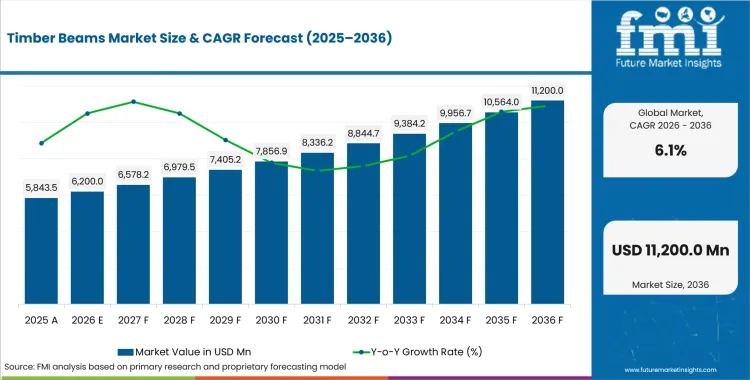
USD 6,200.0 million in 2026 and USD 11,208.4 million by 2036 at a 6.1% CAGR.
Sales in timber beams market are projected to grow at 6.1% CAGR through 2036, driving valuation to USD 11,208.4 million by 2036 from USD 6,200.0 million in 2026. Timber beams are shifting from routine structural components into specification-controlled products used to protect project schedules and building approval quality. Contractors evaluate beam type and supplier service before products enter approved project schedules. FAO reported global wood and paper product exports increased by USD 7 billion to reach USD 486 billion in 2024, giving timber suppliers a stronger forest-product trade base for structural wood programs.
United States building accounts are forecasted to assess beam suppliers led by housing activity and code-ready documentation. Japan accounts are predicted to value seismic design support during engineered timber selection. Building teams need beams connecting structural strength and site readiness with measurable project outcomes. USA Census Bureau reported privately owned housing completions at 1,313,000 units in May 2026, reinforcing demand for structural products aligned with active residential building pipelines. Higher construction activity gives suppliers stronger reasons to assess mass timber construction through product evidence and service documentation.
Buyers compare timber beams led by certification depth and service access across engineers and distributors. Product selection depends on supplier files being able to hold based on delivery planning and site inspection. Commercial decisions rest on beam proof influencing code review and repeat ordering across building programs.
Key Takeaways
-
Demand for timber beams is driven by builders need for installation reliability and engineers' need for structural proof and certification support as span performance records shape supplier evaluation.
-
By sales channel, direct manufacturer is expected to lead with 48.4% share in 2026, backed by technical support and supplier accountability.
-
New construction is the dominant end-use segment, projected to hold 46.0% share in 2026, reflecting early specification and site schedule control.
-
Glulam beams are estimated to lead the beam type segment with with 38.0% share in 2026, driven by span design capability and growing engineered timber acceptance.
-
Direct technical support and supplier documentation carry higher value as code review and site inspection expectations tighten across building cycles.
-
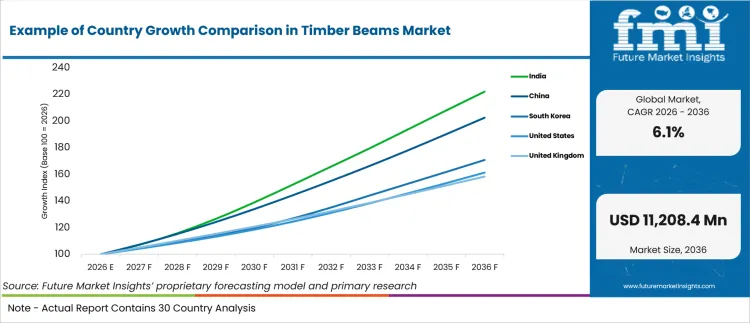
India and China are expected to form the higher-growth country tier, advancing at 8.3% and 7.3% CAGR respectively by 2036, supported by construction-sector expansion and urban renewal needs.
-
Competition centers on Weyerhaeuser, Boise Cascade, SmartLam, Kalesnikoff, Stora Enso, Binderholz, Hasslacher, Mayr-Melnhof Holz, and KLH Massivholz, with vendors differentiating through engineered wood depth and project-ready builder support.
Analyst Perspective
"Market acceptance for timber beams increasingly depends on a supplier's ability to demonstrate structural reliability alongside efficient project execution. Builders and project teams are placing greater confidence in suppliers that provide recognized certifications, clear engineering guidance, and application-specific support. Beyond supplying the product itself, companies that help simplify installation and ensure compliance with structural requirements are better positioned to secure specifications and long-term business."
- Nikhil Kaitwade, Principal Consultant for Industrial Automation at Future Market Insights
How is the Timber Beams Market segmented?
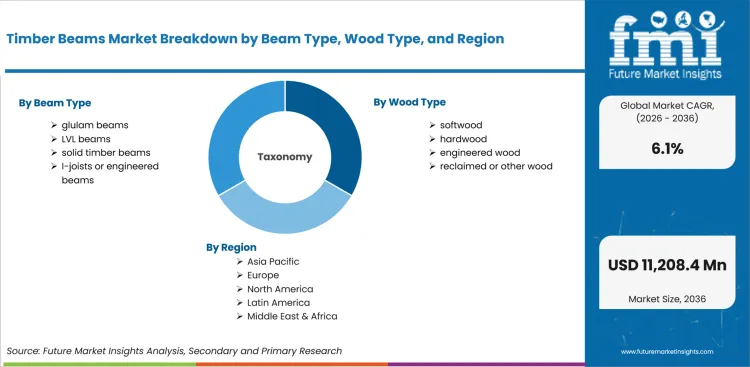
The timber beams industry is segmented by beam type, wood type, application, end use, sales channel and region.
The timber beams market is segmented by beam type, wood type, application, end use, sales channel and region. By beam type, coverage includes glulam beams, LVL beams, solid timber beams and I-joists or engineered beams. By wood type, coverage includes softwood, hardwood, engineered wood and reclaimed or other wood. By application, coverage includes residential construction, commercial buildings, industrial or agricultural buildings and infrastructure or bridges. By end use, coverage includes new construction, renovation or retrofit and prefabricated or modular. By sales channel, coverage includes direct manufacturer, lumber dealers and contractors or builders, with regional coverage across North America, Latin America, Europe, East Asia, South Asia and Pacific and the Middle East and Africa.
Why do glulam beams lead within the beam type segment?
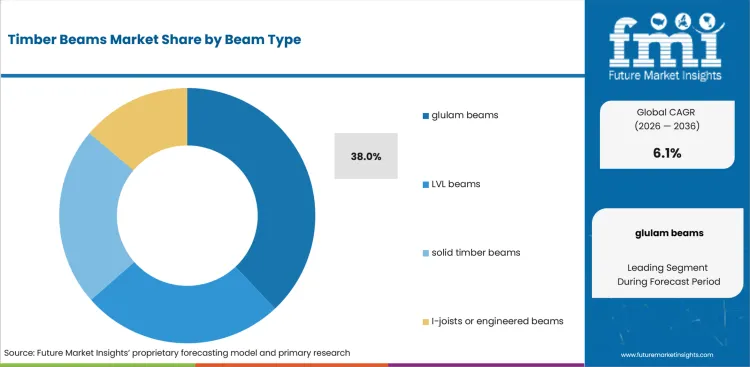
Glulam beams lead due to span control and practical design acceptance. Project teams use glulam beams in structural systems as appearance and engineered consistency are easier to document. USA Forest Service Research and Development reported more than 179 million board feet of lumber were used in mass timber construction in 2024, and another 48 million board feet were used in hybrid light-frame and mass timber construction, supporting glulam relevance across wood building projects.
- Glulam beams are expected to account for 38.0% share in 2026, backed by demand for structural products being able to support long spans and documented project designs. Buyers prefer glulam beams that support architectural layouts and field installation without extra approval burden.
- LVL beams and I-joists remain useful for specific housing and commercial applications. Glulam beams gain selection attention after builders compare span behavior and visible finish requirements during design review.
What supports demand for softwood source choices?
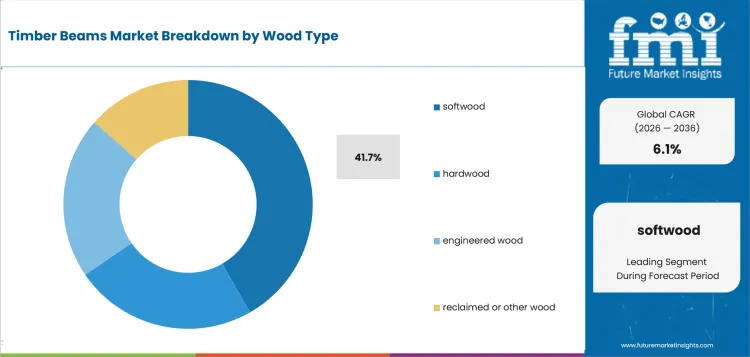
Softwood supports timber beam programs needing workable structural stock and repeatable manufacturing behavior. Beam producers use softwood in products requiring machining control and grading consistency without heavy fabrication disruption. FAO reported industrial roundwood removals rose by 2% to 1.96 billion cubic metres in 2024, reflecting a supply base relevant to structural wood production.
- Softwood is anticipated to hold 41.7% share in 2026, led by beam programs requiring consistent wood grades and practical mill handling. Suppliers gain approval once species quality and product behavior are clear.
- Hardwood and reclaimed wood remain useful in targeted design programs. Softwood options gain attention as buyers connect beam fabrication and structural wood availability with measurable project outcomes.
How do buyers evaluate residential construction within application demand?
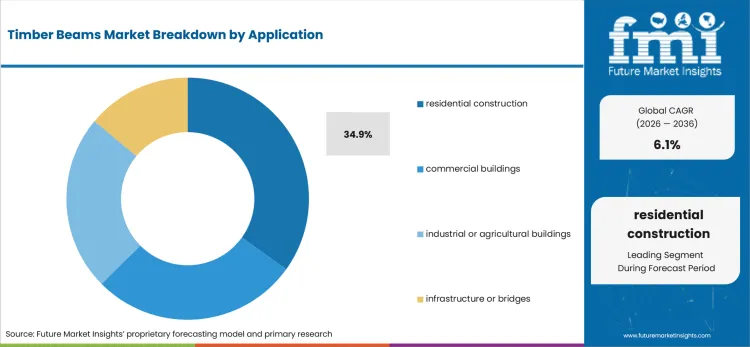
Residential construction generates the main demand pool for timber beams as roof and opening designs are frequent and closely reviewed. Builders use beams in housing projects that require clear product documentation and dependable site availability. CMHC reported year-to-date housing starts of 93,644 units through May 2026, up 3% from the same period in 2025, supporting continued beam use in housing-linked building activity.
- Residential construction is expected to represent 34.9% share in 2026, influenced by housing programs needing repeatable beam performance. Suppliers gain commercial access once product files connect beam selection with builder schedules and structural drawings.
- Commercial buildings and infrastructure programs use more targeted beam strategies. Residential projects often need tighter support as field changes and schedule pressure affect builder income.
Why does new construction guide end use decisions?
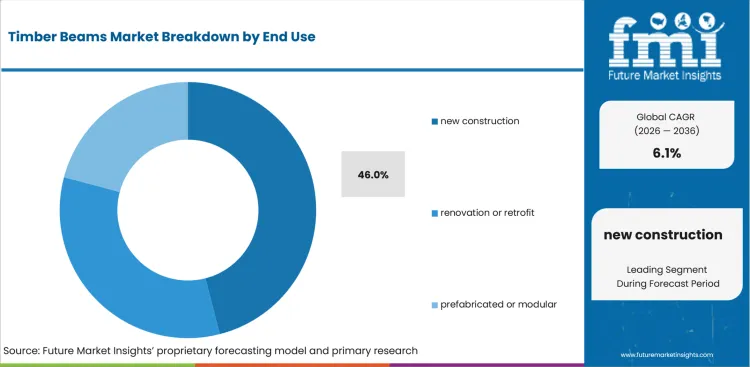
New construction is a direct commercial measure for timber beam suppliers Early design stages require beams that can support approvals and site sequencing, which requires suppliers to connect product evidence with measurable construction outcomes. ONS reported annual construction output in Great Britain increased by 1.8% in 2025 compared with 2024, explaining how new work and repair activity keep structural material suppliers under project-performance review.
- New Construction is projected to capture 46.0% share in 2026, guided by building programs needing beam decisions before site schedules advance. Buyers assess beam systems based on specification files and supplier follow-up.
- Renovation and modular programs remain close evaluation areas. New construction gains attention after project teams link beam use with early design approval and reduced field uncertainty.
How is direct manufacturer positioned within the sales channel segment?
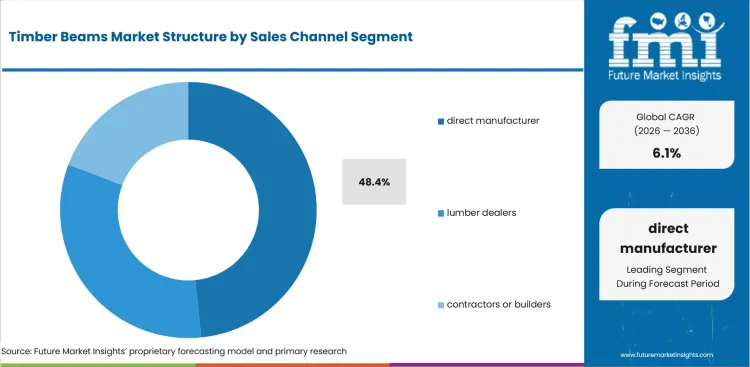
Direct manufacturer supply is central to timber beam buying as technical files and service plans attach to structural building programs. Buyers want supplier accountability during specification review and site performance tracking. Weyerhaeuser previewed 2 engineered wood products at the NAHB International Builders’ Show in February 2026, reflecting how manufacturers are using product systems and builder support to strengthen direct buyer engagement.
- Direct manufacturer is expected to capture 48.4% share in 2026, driven by product approval work completed before commercial project roll-out. Suppliers gain strength by supporting engineers and builders through qualification.
- Lumber dealers remain useful for reach and replenishment. Larger construction programs move toward direct supply after beam performance and documentation are accepted by project decision teams.
What are the drivers, restraints, and opportunities in the Timber Beams Market?
Near-term purchases are shaped by specification validation and construction support outlined below.
- Driver: Building teams need beams improving project predictability and structural documentation.
- Restraint: Adoption can slow if suppliers lack product characterization and installation evidence.
- Opportunity: Modular and prefabricated programs create room for cut-to-size beam packages and technical service support.
Timber beam demand rises as buyers treat beams as project-control tools. Building programs are required to protect design performance and support code documentation. Destatis reported 238,063 dwellings approved in Germany during 2025, reflecting how permit recovery can affect timber beam demand based on new residential projects.
Buyer pressure is higher in construction systems that must handle variable material costs and maintain predictable project records. USA Census Bureau reported May 2026 housing starts at 1,177,000, down 15.4% from April, highlighting why supplier files need delivery proof and cost discipline before buyers accept wider use.
Implementation risk remains a practical constraint for beam programs. Construction and site teams need shared success measures before wider adoption. Kalesnikoff opened a 100,000 sq. ft. modular mass timber facility in June 2025, demonstrating why prefabricated project models are able to create new demand for engineered beams and related prefabricated building system support.
Which country CAGRs are profiled in the timber beams market?
| Country | CAGR |
|---|---|
| India | 8.3% |
| China | 7.3% |
| South Korea | 5.5% |
| United States | 4.9% |
| United Kingdom | 4.7% |
| Germany | 4.3% |
| Japan | 4.1% |
Source: Future Market Insights analysis, 2026.
How do country-level CAGRs compare in the Timber Beams Market?
The country comparison spans 4.2 percentage points and highlights three distinct growth groups across the Timber Beams Market. India and China form the upper growth tier with only 1.0 percentage point separating the two markets. South Korea creates a visible transition into the middle tier, while the United States, the United Kingdom, Germany and Japan remain within a 0.8-point band, reflecting a relatively concentrated lower-growth segment. Countries with expanding residential construction, commercial building activity and greater use of engineered wood products generally demonstrate stronger market growth.
-
India holds the highest position within the comparison as rapid urban development, rising housing construction and increasing acceptance of timber-based structural materials continue to support market expansion.
-
China remains 1.0 percentage point below India and reflects a market where commercial construction, infrastructure projects and growing interest in sustainable building materials sustain demand for timber beams.
-
South Korea stands 1.8 percentage points below China, highlighting the role of modern building practices and increasing use of engineered wood products in residential and commercial developments.
-
The United States remains 0.6 percentage points below South Korea as demand for timber framing, prefabricated construction and renovation projects continues to support market growth.
-
The United Kingdom sits only 0.2 percentage points below the United States, reflecting steady adoption of timber solutions in low-carbon construction and residential building applications.
-
Germany records a CAGR 0.4 percentage points below the United Kingdom, with demand supported by established timber engineering expertise and growing emphasis on sustainable construction practices.
-
Japan remains 0.2 percentage points below Germany, reflecting a mature market where timber beams continue to find application in residential housing, seismic-resilient structures and high-quality wood construction.
Comparable CAGRs can still produce different market entry conditions. Differences in construction activity, building regulations, timber availability and adoption of engineered wood products influence growth patterns and long-term market development. The full report provides country-level CAGR analysis across North America, Latin America, Europe, East Asia, South Asia, Oceania and the Middle East and Africa.
Country-wise Analysis
Country demand in timber beams is expected to be led by construction intensity and building-product modernization. India and China connect timber beam demand with large project systems and expanding construction quality needs. South Korea, United States, United Kingdom, Germany and Japan connect adoption with documentation and tighter specification control. Senior buyers assess which countries can connect supplier evidence with repeatable construction outcomes.
- India is projected to post 8.3% CAGR by 2036, driven by formal construction activity and infrastructure-linked building programs. Press Information Bureau reported construction-sector growth of 9.4% in FY 2024-25, providing beam suppliers a large base for engineered wood and structural product support.
- China is forecast to grow at 7.3% CAGR by 2036, influenced by construction enterprise scale and urban building activity. National Bureau of Statistics reported construction enterprise value added of 8,642.5 billion yuan in 2025, supporting a dense project base for structural wood product qualification.
- South Korea is projected to record 5.5% CAGR through 2036, reflected by concentrated building systems and controlled project documentation. OECD construction-permit data carried by FRED recorded Korea dwelling and residential building permits down 5.23% in 2025, giving suppliers a clear reason to defend service continuity and buyer qualification.
- United States is expected to expand at 4.9% CAGR through 2036, backed by engineered lumber use and builder service needs. USA Census Bureau reported single-family housing starts at 882,000 in May 2026, supporting beam demand across floor and opening applications.
- United Kingdom is forecast to register 4.7% CAGR by 2036, shaped by construction output discipline and supplier documentation. ONS reported new work grew by 1.0% in December 2025, even as monthly construction output declined, promoting demand for materials being able to protect project scheduling.
- Germany is anticipated to grow at 4.3% CAGR by 2036, underpinned by residential permit recovery and building approval control. Destatis reported approved dwellings rose from 215,289 in 2024 to 238,063 in 2025, supporting structural product review in recovering residential programs.
- Japan is expected to post 4.1% CAGR through 2036, aided by quality expectations and post-and-beam construction habits. Canada Wood reported Japan total wooden housing starts at 433,655 units in 2025, giving timber beam suppliers a practical base for service-led structural product programs.
Who are the notable companies in the Timber Beams Market?
Weyerhaeuser, Boise Cascade, SmartLam, Kalesnikoff, Stora Enso, Binderholz, Hasslacher, Mayr-Melnhof Holz and KLH Massivholz are the notable companies influencing timber beams and structural wood support pathways.
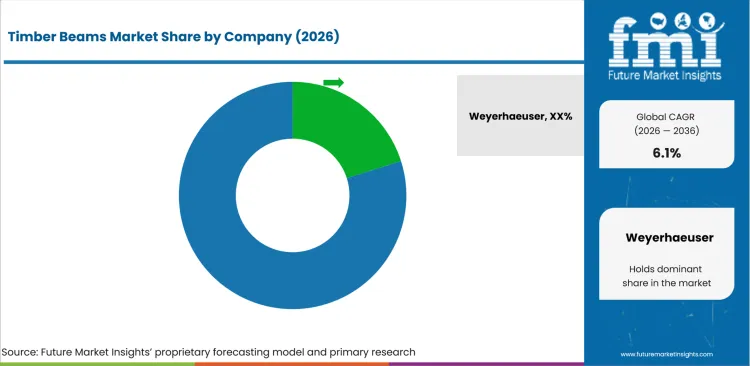
Competition in timber beams is grouped by how buyers want product proof to work. Weyerhaeuser and Boise Cascade are stronger in engineered wood and builder service support. SmartLam and Kalesnikoff are important for mass timber and modular construction pathways. Stora Enso, Binderholz and Hasslacher strengthen competition led by glulam, CLT and structural timber products. Mayr-Melnhof Holz and KLH Massivholz support programs requiring specification guidance and project continuity.
- Weyerhaeuser has an advantage led by engineered lumber and Trus Joist support capabilities. Buyers are able to connect supplier support with structural drawings and residential project risk management.
- Boise Cascade supports buyer review based on engineered wood depth and distribution access. Its product portfolio gives builders a clearer route for LVL beams and I-joist systems.
- SmartLam and Kalesnikoff strengthen competition due to mass timber and prefabricated project positioning. Building programs use such capabilities as factory planning and structural consistency affect commercial outcomes.
- Stora Enso, Binderholz, Hasslacher, Mayr-Melnhof Holz and KLH Massivholz compete based on engineered timber reach and technical advisory support. Buyers compare these companies depending on specification evidence and regional service continuity.
Competitive Benchmarking: Timber Beams Market
| Company | Product Coverage | Technical Service Alignment | Builder or Dealer Integration | Geographic Reach |
|---|---|---|---|---|
| Weyerhaeuser | High | High | High | Global |
| Boise Cascade | High | High | High | Global |
| SmartLam | Strong | Strong | Medium | Regional |
| Kalesnikoff | Strong | Strong | Medium | Regional |
| Stora Enso | High | High | Strong | Global |
| Binderholz | High | Strong | Strong | Global |
| Hasslacher | Strong | Strong | Strong | Global |
| Mayr-Melnhof Holz | Strong | Strong | Strong | Global |
| KLH Massivholz | Medium | Strong | Medium | Regional |
Source: Future Market Insights competitive analysis, 2026.
Key Developments in the Timber Beams Market
- In February 2026, Weyerhaeuser previewed two engineered wood products at the NAHB International Builders’ Show. Product positioning supports builders needing Trus Joist system compatibility and warranty coverage.
- In February 2025, Boise Cascade outlined a USD 75 million Oakdale investment to improve reliable veneer production. Veneer supports Versa-Lam LVL beams and plywood products, making the development highly aligned with timber beam supply.
- In September 2025, Stora Enso reported circular CLT progress through its Build to Rebuild initiative. The development supports structural timber projects seeking reclaimed wood use and scalable construction solutions.
Key Players in the Timber Beams Market
Engineered Wood and Beam Suppliers
- Weyerhaeuser
- Boise Cascade
- SmartLam
Mass Timber and Modular Specialists
- Kalesnikoff
- KLH Massivholz
European Structural Timber Suppliers
- Stora Enso
- Binderholz
- Hasslacher
- Mayr-Melnhof Holz
Timber Beams Market - Report Scope
| Coverage field | Report scope |
|---|---|
| Market breakdown | Timber beams market breakdown by beam type, wood type, application, end use, sales channel and region |
| Market Definition | Structural timber beam inputs and related engineered wood solutions used in residential, commercial, industrial, agricultural, infrastructure, renovation and modular construction programs |
| Regions Covered | North America, Latin America, Europe, East Asia, South Asia and Pacific, Middle East and Africa |
| Countries Covered | United States, China, India, Germany, United Kingdom, Japan, South Korea and 30+ countries |
| Key Companies Profiled | Weyerhaeuser, Boise Cascade, SmartLam, Kalesnikoff, Stora Enso, Binderholz, Hasslacher, Mayr-Melnhof Holz, KLH Massivholz |
| Forecast Period | 2026 to 2036 |
| Approach | Hybrid bottom-up and top-down methodology using beam type, wood type, application demand, end-use intensity, supplier portfolios, sales-channel structure and country-level indicators |
Source: Future Market Insights analysis, 2026.
Timber Beams Market - Research Methodology
| Method | Approach |
|---|---|
| Primary Research | FMI analysts gathered input from manufacturers, service providers, technology developers, distributors, end users, sourcing teams, and subject-matter experts. Interviews examined purchasing decisions, product or service evaluation, adoption barriers, approval requirements, pricing considerations, and expectations for technical or commercial support. Respondents were also asked what evidence is required before a trial, pilot, or initial order develops into regular purchasing. |
| Desk Research | Desk research covered government statistics, regulatory publications, trade data, industry associations, technical literature, standards, company filings, product information, and official corporate announcements. Sources were reviewed for relevance, publication date, geographic coverage, and consistency with the defined market scope. Claims relating to performance, applications, approvals, capacity, investment, and commercial activity were retained only when supported by credible public evidence. |
| Market Sizing and Forecasting | The market model combined the baseline value with historical performance, segment structure, pricing and volume indicators, adoption levels, company participation, and country-level demand conditions. Forecast assumptions considered economic activity, investment trends, regulatory developments, technology adoption, purchasing cycles, supply availability, and barriers to wider market use. Segment and regional estimates were reconciled before the final market total was calculated. |
| Data Validation | Estimates were checked against multiple independent indicators, including public data, company activity, trade patterns, industry developments, and findings from primary interviews. Validation also tested whether products, services, applications, and company revenues fell within the defined market boundaries. Adjacent categories, unsupported claims, overlapping revenues, and activities without direct market relevance were excluded to reduce double counting and maintain consistency across segments and countries. |
Timber Beams Market by Segments
Timber Beams Market segmented by Beam Type:
- Glulam Beams
- LVL Beams
- Solid Timber Beams
- I-Joists / Engineered Beams
Timber Beams Market segmented by Wood Type:
- Softwood
- Hardwood
- Engineered Wood
- Reclaimed / Other Wood
Timber Beams Market segmented by Application:
- Residential Construction
- Commercial Buildings
- Industrial / Agricultural Buildings
- Infrastructure / Bridges
Timber Beams Market segmented by End Use:
- New Construction
- Renovation / Retrofit
- Prefabricated / Modular
Timber Beams Market segmented by Sales Channel:
- Direct Manufacturer
- Lumber Dealers
- Contractors / Builders
Timber Beams Market by Region:
- North America
- United States
- Canada
- Latin America
- Brazil
- Mexico
- Chile
- Rest of Latin America
- Western Europe
- Germany
- United Kingdom
- Italy
- Spain
- France
- Nordic
- BENELUX
- Rest of Western Europe
- Eastern Europe
- Poland
- Hungary
- Balkan and Baltic
- Rest of Eastern Europe
- East Asia
- China
- Japan
- South Korea
- South Asia and Pacific
- India
- ASEAN
- Australia and New Zealand
- Rest of South Asia and Pacific
- Middle East and Africa
- Kingdom of Saudi Arabia
- Other GCC Countries
- Turkiye
- South Africa
- Other African Union
- Rest of Middle East and Africa
Research Sources and Bibliography
- Boise Cascade. (2025, February 21). 2025 capital expenditures. Boise Cascade.
- Canada Mortgage and Housing Corporation. (2026, June 15). Housing starts and construction data for May 2026. Canada Mortgage and Housing Corporation.
- Canada Wood Group. (2026, March 2). 2025 Japan construction starts report year end summary. Canada Wood Group.
- Destatis. (2026, February 18). Building permits for building construction in Germany. German Federal Statistical Office.
- Federal Reserve Bank of St. Louis. (2026, March 20). Permits issued for dwellings and residential buildings for the Republic of Korea. Federal Reserve Economic Data.
- Food and Agriculture Organization of the United Nations. (2026, January 4). Global forest products facts and figures 2024. Food and Agriculture Organization of the United Nations.
- Food and Agriculture Organization of the United Nations. (2025, December 24). Global forest products trade and production show signs of recovery in 2024. Food and Agriculture Organization of the United Nations.
- Kalesnikoff. (2025, June 5). Kalesnikoff opens North America’s first pre-fabrication and modular mass timber facility. Kalesnikoff.
- National Bureau of Statistics of China. (2026, February 28). Statistical communiqué of the People’s Republic of China on the 2025 national economic and social development. National Bureau of Statistics of China.
- Office for National Statistics. (2026, February 12). Construction output in Great Britain: December 2025, new orders and construction output price indices, October to December 2025. Office for National Statistics.
- Press Information Bureau. (2025, May 30). Provisional estimates of real GDP has recorded 6.5% growth rate in FY 2024-25. Government of India.
- Stora Enso. (2025, September 8). Build to Rebuild. Stora Enso.
- USA Census Bureau. (2026, June 16). New residential construction, May 2026. USA Census Bureau.
- USA Forest Service Research and Development. (2026, January). Mass timber. USA Forest Service Research and Development.
- Weyerhaeuser. (2026, February 17). Weyerhaeuser previews new engineered wood products at NAHB International Builders’ Show. Weyerhaeuser.
This bibliography is provided for reader reference and is not exhaustive. The full report contains the complete reference list and detailed citations.
This Report Answers
- What is the expected global value of the timber beams market in 2026 and 2036?
- What CAGR is forecast for the timber beams market during the 2026 to 2036 period?
- Which beam type segment is used to assess glulam timber beam demand in 2026?
- Why do builders and engineers buy controlled timber beam systems?
- How do softwood sources and new construction shape timber beam choices?
- Which countries are compared in the timber beams forecast?
- Which companies compete across engineered wood and structural timber support pathways?
- What beam systems and applications are included within the timber beams definition?
- How does FMI size and forecast timber beam demand across segments and countries?
- What implementation and supplier-selection factors should executives assess?
Frequently Asked Questions
What is driving growth in the timber beams market?
Demand is driven by construction schedule pressure and the need to maintain structural quality across building programs. Buyers are also giving more attention to beams being able to reduce uncertainty during design and site-level performance review.
Why should executives track the timber beams market?
Executives should track this segment since beam approval affects project delivery and supplier accountability. Supplier selection is likely to influence construction reliability and commercial performance across building operations.
What business problem does the timber beams market address?
Timber beams help builders and engineers reduce uncertainty around structural selection and repeatable use in construction projects. The segment also supports buyers requiring clearer links between beam use and project control.
What should sourcing leaders evaluate before selecting suppliers?
Sourcing leaders are likely to compare documentation quality and supply reliability before supplier approval. Technical service and application-specific evidence should also guide supplier review.
What can limit return on investment for buyers?
Return on investment is expected to be delayed if product evidence is weak or beam handling requires site changes. Buyers are anticipated to reduce such risk by phasing approval before wider use.
How can suppliers build executive confidence?
Suppliers build confidence based on verified product data and accountable support during commercial project roll-out. Clear specification files and consistent delivery documentation can strengthen buyer approval.
Which companies lead timber beams market?
Competition is based on Weyerhaeuser and Boise Cascade, driven by engineered lumber support and builder service continuity. Stora Enso, Binderholz and Hasslacher add depth due to glulam and mass timber capability.
What opportunity supports timber beams market?
Engineered timber projects create opportunity for beam suppliers with certification support. Builders favor structural proof and site-ready supply during project approval.
Preview the report firsthand - request a free sample
Get SampleGet the brochure for pricing and purchase details.
Get PDFTable of Content
- Key Takeaways
- Market Size and CAGR
- Top Growth Driver
- Fastest Growing Segment
- Leading Region
- Key Companies
- Emerging Opportunities
- Executive Summary
- Global Market Outlook
- Demand-side Trends
- Supply-side Trends
- Technology Roadmap Analysis
- Analysis and Recommendations
- Analyst Perspective (What is happening? Why now? What should investors know?)
- Key Questions Answered
- How large is the market?
- What is the CAGR?
- What are key trends?
- Which region dominates?
- Who are the leaders?
- Market Overview
- Market Coverage / Taxonomy
- Market Definition / Scope / Limitations
- Research Methodology
- Chapter Orientation
- Analytical Lens and Working Hypotheses
- Market Structure, Signals, and Trend Drivers
- Benchmarking and Cross-market Comparability
- Market Sizing, Forecasting, and Opportunity Mapping
- Research Design and Evidence Framework
- Desk Research Programme (Secondary Evidence)
- Expert Input and Fieldwork (Primary Evidence)
- Tooling, Models, and Reference Databases
- Data Engineering and Model Build
- Quality Assurance and Audit Trail
- Market Background
- Market Dynamics (Drivers, Restraints, Opportunity, Trends)
- Scenario Forecast (Optimistic, Likely, Conservative)
- Impact Analysis
- AI Impact
- Sustainability Impact
- Regulatory Impact
- Technology Impact
- Consumer / Buyer Analysis
- Purchase Drivers
- Adoption Barriers
- Buyer Journey
- Opportunity Map Analysis
- Product Life Cycle Analysis
- Supply Chain Analysis
- Investment Feasibility Matrix
- Value Chain Analysis
- PESTLE and Porter's Analysis
- Regulatory Landscape
- Regional Parent Market Outlook
- Production and Consumption Statistics
- Import and Export Statistics
- Global Market Analysis and Forecast, 2021 to 2036
- Historical Market Size Value (USD Mn) Analysis, 2021 to 2025
- Current and Future Market Size Value (USD Mn) Projections, 2026 to 2036
- Y-o-Y Growth Trend Analysis
- Absolute $ Opportunity Analysis
- Global Market Pricing Analysis, 2021 to 2036
- Global Market Analysis and Forecast, By Beam Type, 2021 to 2036
- Introduction / Key Findings
- Historical Market Size Value (USD Mn) Analysis By Beam Type, 2021 to 2025
- Current and Future Market Size Value (USD Mn) Analysis and Forecast By Beam Type, 2026 to 2036
- glulam beams
- LVL beams
- solid timber beams
- I-joists or engineered beams
- glulam beams
- Y-o-Y Growth Trend Analysis By Beam Type, 2021 to 2025
- Absolute $ Opportunity Analysis By Beam Type, 2026 to 2036
- Global Market Analysis and Forecast, By Wood Type, 2021 to 2036
- Introduction / Key Findings
- Historical Market Size Value (USD Mn) Analysis By Wood Type, 2021 to 2025
- Current and Future Market Size Value (USD Mn) Analysis and Forecast By Wood Type, 2026 to 2036
- softwood
- hardwood
- engineered wood
- reclaimed or other wood
- softwood
- Y-o-Y Growth Trend Analysis By Wood Type, 2021 to 2025
- Absolute $ Opportunity Analysis By Wood Type, 2026 to 2036
- Global Market Analysis and Forecast, By Application, 2021 to 2036
- Introduction / Key Findings
- Historical Market Size Value (USD Mn) Analysis By Application, 2021 to 2025
- Current and Future Market Size Value (USD Mn) Analysis and Forecast By Application, 2026 to 2036
- residential construction
- commercial buildings
- industrial or agricultural buildings
- infrastructure or bridges
- residential construction
- Y-o-Y Growth Trend Analysis By Application, 2021 to 2025
- Absolute $ Opportunity Analysis By Application, 2026 to 2036
- Global Market Analysis and Forecast, By End Use, 2021 to 2036
- Introduction / Key Findings
- Historical Market Size Value (USD Mn) Analysis By End Use, 2021 to 2025
- Current and Future Market Size Value (USD Mn) Analysis and Forecast By End Use, 2026 to 2036
- new construction
- renovation or retrofit
- prefabricated or modular
- new construction
- Y-o-Y Growth Trend Analysis By End Use, 2021 to 2025
- Absolute $ Opportunity Analysis By End Use, 2026 to 2036
- Global Market Analysis and Forecast, By Sales Channel, 2021 to 2036
- Introduction / Key Findings
- Historical Market Size Value (USD Mn) Analysis By Sales Channel, 2021 to 2025
- Current and Future Market Size Value (USD Mn) Analysis and Forecast By Sales Channel, 2026 to 2036
- direct manufacturer
- lumber dealers
- contractors or builders
- direct manufacturer
- Y-o-Y Growth Trend Analysis By Sales Channel, 2021 to 2025
- Absolute $ Opportunity Analysis By Sales Channel, 2026 to 2036
- Global Market Analysis and Forecast, By Region, 2021 to 2036
- Introduction
- Historical Market Size Value (USD Mn) Analysis By Region, 2021 to 2025
- Current Market Size Value (USD Mn) Analysis and Forecast By Region, 2026 to 2036
- North America
- Latin America
- Western Europe
- Eastern Europe
- East Asia
- South Asia and Pacific
- Middle East & Africa
- Market Attractiveness Analysis By Region
- North America Market Analysis and Forecast, By Country, 2021 to 2036
- Historical Market Size Value (USD Mn) Trend Analysis By Market Taxonomy, 2021 to 2025
- Market Size Value (USD Mn) Forecast By Market Taxonomy, 2026 to 2036
- By Country
- USA
- Canada
- By Beam Type
- By Wood Type
- By Application
- By End Use
- By Sales Channel
- By Country
- Market Attractiveness Analysis
- By Country
- By Beam Type
- By Wood Type
- By Application
- By End Use
- By Sales Channel
- Key Takeaways
- Latin America Market Analysis and Forecast, By Country
- Historical Market Size Value (USD Mn) Trend Analysis By Market Taxonomy, 2021 to 2025
- Market Size Value (USD Mn) Forecast By Market Taxonomy, 2026 to 2036
- By Country
- Brazil
- Mexico
- Chile
- Rest of Latin America
- By Beam Type
- By Wood Type
- By Application
- By End Use
- By Sales Channel
- By Country
- Market Attractiveness Analysis
- By Country
- By Beam Type
- By Wood Type
- By Application
- By End Use
- By Sales Channel
- Key Takeaways
- Western Europe Market Analysis and Forecast, By Country
- Historical Market Size Value (USD Mn) Trend Analysis By Market Taxonomy, 2021 to 2025
- Market Size Value (USD Mn) Forecast By Market Taxonomy, 2026 to 2036
- By Country
- Germany
- UK
- Italy
- Spain
- France
- Nordic
- BENELUX
- Rest of Western Europe
- By Beam Type
- By Wood Type
- By Application
- By End Use
- By Sales Channel
- By Country
- Market Attractiveness Analysis
- By Country
- By Beam Type
- By Wood Type
- By Application
- By End Use
- By Sales Channel
- Key Takeaways
- Eastern Europe Market Analysis and Forecast, By Country
- Historical Market Size Value (USD Mn) Trend Analysis By Market Taxonomy, 2021 to 2025
- Market Size Value (USD Mn) Forecast By Market Taxonomy, 2026 to 2036
- By Country
- Russia
- Poland
- Hungary
- Balkan & Baltic
- Rest of Eastern Europe
- By Beam Type
- By Wood Type
- By Application
- By End Use
- By Sales Channel
- By Country
- Market Attractiveness Analysis
- By Country
- By Beam Type
- By Wood Type
- By Application
- By End Use
- By Sales Channel
- Key Takeaways
- East Asia Market Analysis and Forecast, By Country
- Historical Market Size Value (USD Mn) Trend Analysis By Market Taxonomy, 2021 to 2025
- Market Size Value (USD Mn) Forecast By Market Taxonomy, 2026 to 2036
- By Country
- China
- Japan
- South Korea
- By Beam Type
- By Wood Type
- By Application
- By End Use
- By Sales Channel
- By Country
- Market Attractiveness Analysis
- By Country
- By Beam Type
- By Wood Type
- By Application
- By End Use
- By Sales Channel
- Key Takeaways
- South Asia and Pacific Market Analysis and Forecast, By Country
- Historical Market Size Value (USD Mn) Trend Analysis By Market Taxonomy, 2021 to 2025
- Market Size Value (USD Mn) Forecast By Market Taxonomy, 2026 to 2036
- By Country
- India
- ASEAN
- Australia & New Zealand
- Rest of South Asia and Pacific
- By Beam Type
- By Wood Type
- By Application
- By End Use
- By Sales Channel
- By Country
- Market Attractiveness Analysis
- By Country
- By Beam Type
- By Wood Type
- By Application
- By End Use
- By Sales Channel
- Key Takeaways
- Middle East & Africa Market Analysis and Forecast, By Country
- Historical Market Size Value (USD Mn) Trend Analysis By Market Taxonomy, 2021 to 2025
- Market Size Value (USD Mn) Forecast By Market Taxonomy, 2026 to 2036
- By Country
- Kingdom of Saudi Arabia
- Other GCC Countries
- Türkiye
- South Africa
- Other African Union
- Rest of Middle East & Africa
- By Beam Type
- By Wood Type
- By Application
- By End Use
- By Sales Channel
- By Country
- Market Attractiveness Analysis
- By Country
- By Beam Type
- By Wood Type
- By Application
- By End Use
- By Sales Channel
- Key Takeaways
- Key Countries Market Analysis
- USA
- Pricing Analysis
- Market Share Analysis, 2025
- By Beam Type
- By Wood Type
- By Application
- By End Use
- By Sales Channel
- Canada
- Pricing Analysis
- Market Share Analysis, 2025
- By Beam Type
- By Wood Type
- By Application
- By End Use
- By Sales Channel
- Mexico
- Pricing Analysis
- Market Share Analysis, 2025
- By Beam Type
- By Wood Type
- By Application
- By End Use
- By Sales Channel
- Brazil
- Pricing Analysis
- Market Share Analysis, 2025
- By Beam Type
- By Wood Type
- By Application
- By End Use
- By Sales Channel
- Chile
- Pricing Analysis
- Market Share Analysis, 2025
- By Beam Type
- By Wood Type
- By Application
- By End Use
- By Sales Channel
- Germany
- Pricing Analysis
- Market Share Analysis, 2025
- By Beam Type
- By Wood Type
- By Application
- By End Use
- By Sales Channel
- UK
- Pricing Analysis
- Market Share Analysis, 2025
- By Beam Type
- By Wood Type
- By Application
- By End Use
- By Sales Channel
- Italy
- Pricing Analysis
- Market Share Analysis, 2025
- By Beam Type
- By Wood Type
- By Application
- By End Use
- By Sales Channel
- Spain
- Pricing Analysis
- Market Share Analysis, 2025
- By Beam Type
- By Wood Type
- By Application
- By End Use
- By Sales Channel
- France
- Pricing Analysis
- Market Share Analysis, 2025
- By Beam Type
- By Wood Type
- By Application
- By End Use
- By Sales Channel
- India
- Pricing Analysis
- Market Share Analysis, 2025
- By Beam Type
- By Wood Type
- By Application
- By End Use
- By Sales Channel
- ASEAN
- Pricing Analysis
- Market Share Analysis, 2025
- By Beam Type
- By Wood Type
- By Application
- By End Use
- By Sales Channel
- Australia & New Zealand
- Pricing Analysis
- Market Share Analysis, 2025
- By Beam Type
- By Wood Type
- By Application
- By End Use
- By Sales Channel
- China
- Pricing Analysis
- Market Share Analysis, 2025
- By Beam Type
- By Wood Type
- By Application
- By End Use
- By Sales Channel
- Japan
- Pricing Analysis
- Market Share Analysis, 2025
- By Beam Type
- By Wood Type
- By Application
- By End Use
- By Sales Channel
- South Korea
- Pricing Analysis
- Market Share Analysis, 2025
- By Beam Type
- By Wood Type
- By Application
- By End Use
- By Sales Channel
- Russia
- Pricing Analysis
- Market Share Analysis, 2025
- By Beam Type
- By Wood Type
- By Application
- By End Use
- By Sales Channel
- Poland
- Pricing Analysis
- Market Share Analysis, 2025
- By Beam Type
- By Wood Type
- By Application
- By End Use
- By Sales Channel
- Hungary
- Pricing Analysis
- Market Share Analysis, 2025
- By Beam Type
- By Wood Type
- By Application
- By End Use
- By Sales Channel
- Kingdom of Saudi Arabia
- Pricing Analysis
- Market Share Analysis, 2025
- By Beam Type
- By Wood Type
- By Application
- By End Use
- By Sales Channel
- Türkiye
- Pricing Analysis
- Market Share Analysis, 2025
- By Beam Type
- By Wood Type
- By Application
- By End Use
- By Sales Channel
- South Africa
- Pricing Analysis
- Market Share Analysis, 2025
- By Beam Type
- By Wood Type
- By Application
- By End Use
- By Sales Channel
- USA
- Market Structure Analysis
- Competition Dashboard
- Competition Benchmarking
- Market Share Analysis of Top Players
- By Regional
- By Beam Type
- By Wood Type
- By Application
- By End Use
- By Sales Channel
- Emerging Startups
- Innovation Benchmarking
- Competition Analysis
- Competition Deep Dive
- Weyerhaeuser
- Overview
- Product Portfolio
- Profitability by Market Segments
- Sales Footprint
- Strategy Overview
- Marketing Strategy
- Product Strategy
- Channel Strategy
- Boise Cascade
- SmartLam
- Kalesnikoff
- Stora Enso
- Binderholz
- Hasslacher
- Mayr-Melnhof Holz
- KLH Massivholz
- Weyerhaeuser
- Case Studies
- Success Stories
- Recent Developments
- Competition Deep Dive
- Assumptions & Acronyms Used


