

- 2025 (base history)
- USD 3.68 Bn
- 2026 (current)
- USD 3.89 Bn
- 2036 (forecast)
- USD 6.71 Bn
- CAGR (2026–2036)
- 5.6%
How big is the training pet treats market in 2026?
USD 3.89 billion in 2026 and USD 6.71 billion by 2036 at a 5.6% CAGR.
The training pet treats industry value is forecast to grow from USD 3.68 billion in 2025 to USD 6.71 billion by 2036 at 5.6% CAGR as pet owners shift reward snacks into daily obedience, recall, enrichment, and leash-practice routines. Dogs are forecast to represent 82.0% share in 2026 because canine training creates the highest repeat reward frequency. Low-calorie claims are expected to secure 45.0% share in 2026 as repeated feeding raises portion-control scrutiny. The segment order is led by pet type and claim type before product format, distribution channel, and protein source.
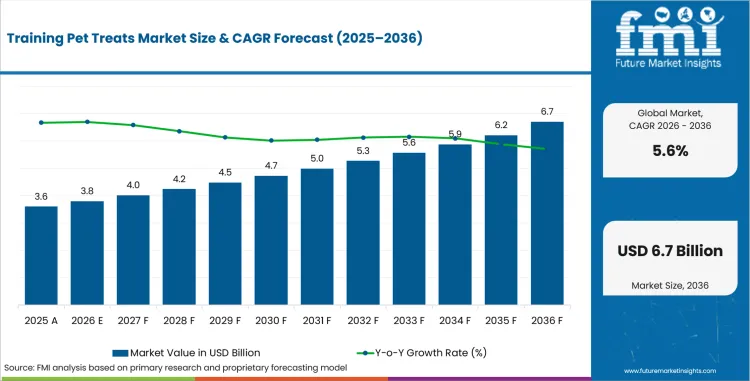
Training Pet Treats Market Overview: Size and Forecast
- 2025 (base history): USD 3.68 billion
- 2026 (current): USD 3.89 billion
- 2036 (forecast): USD 6.71 billion
- CAGR (2026–2036): 5.6%
- Leading Pet Type: Dogs
- Dogs Share in 2026: 82.0%
- Leading Claim Type: Low-Calorie
- Low-Calorie Share in 2026: 45.0%
- Fastest-growing Country: India
- India CAGR: 8.2% by 2036
Summary of the Training Pet Treats Market
- Demand and Growth Drivers
- Pet owners are shifting training rewards from occasional snacks into daily behavior-support products.
- Soft pieces are gaining preference because they are easier to break and feed during repeated exercises.
- Online replenishment supports repeat buying after owners identify a treat texture accepted by their pets.
- Product and Segment View
- Dogs are forecast to represent 82.0% share in 2026, led by obedience, recall, and leash-training routines.
- Low-calorie claims are expected to secure 45.0% share in 2026 as frequent feeding raises portion-control concerns.
- Soft bites are projected to hold 42.0% share in 2026, supported by clean handling and quick chewing.
- Geography and Competitive Outlook
- India is projected to record 8.2% CAGR by 2036, backed by urban dog ownership and packaged pet food adoption.
- China is expected to expand at 7.2% CAGR by 2036 through online discovery and pet service retail.
- Mars Petcare and Nestle Purina compete through broad pet nutrition portfolios and global retail reach.
- General Mills, VAFO Group, and United Petfood focus on premium treats, private-label supply, and regional channel depth.
- Analyst Opinion
- Nandini Roy Choudhury, Principal Consultant for Food and Beverage at FMI, observes, “Training treats are behavior products before they are snack products. Winning brands will design for repeat feeding, clean handling, calorie control, and a taste cue strong enough to hold attention. The strongest commercial position belongs to suppliers that combine evidence-led nutrition, trainer education, and pack formats that work in real sessions.”
Market outlook is supported by measurable companion-animal spending and retail breadth. APPA projected USD 69.7 billion in U.S. pet food and treats sales for 2026, FEDIAF reported 306 million companion animals across Europe in June 2026, and Agriculture and Agri-Food Canada recorded 1,286 new pet food launches in India between January 2020 and December 2025. These figures show how repeat reward buying, premium small-format snacks, and pet snacks and treats industry analysis are becoming closely linked in training-led pet care.
Country-wise CAGR Projections (2026–2036)
India leads growth at 8.2% CAGR through 2036, ahead of China at 7.2%, as urban pet ownership and packaged pet food adoption accelerate demand for training treats.
- India: 8.2% CAGR
- China: 7.2% CAGR
Which factors support expansion in the training pet treats market?
Finished reward treat revenue and repeat training occasions support market value across specialty, e-commerce, and mass retail channels.
- Market value is supported by commercial reward packs before veterinary and training-service channels add incremental sales.
- Supplier pricing reflects protein input, aroma systems, soft texture design, and resealable packaging before promotions affect repeat buying.
- Revenue improves as puppy owners convert a trial pouch into routine reward replenishment.
- Retail trust rises as labels make calorie count, ingredient source, and feeding instructions easier to compare.
Why is the training pet treats market growing?
Pet owners are using small edible rewards more often as training shifts into daily home routines and outdoor behavior practice.
Demand is growing because companion-animal ownership increasingly includes structured care, enrichment, and trainer-led product discovery. UK Pet Food estimated that 62% of United Kingdom households owned a pet in 2026, creating a broad base for reward-led care and routine treat purchases. This changes the commercial role of the category. Treat brands must now deliver products that are clean to handle, sized for repetition, and credible enough for frequent feeding. The same behavior supports low-calorie soft bites, single-protein rewards, and functional pet food industry analysis across specialty and online channels.
How is the training pet treats market segmented?
The training pet treats industry is segmented by pet type, claim type, product format, distribution channel, and protein source.
- Dogs are expected to account for 82.0% share in 2026 because obedience and recall work create daily reward occasions.
- Low-calorie claims are projected to account for 45.0% share in 2026 as frequent feeding raises portion-control concerns.
- Soft bites are projected to secure 42.0% share in 2026, led by quick feeding and strong handling convenience during training sessions.
- Pet specialty is forecast to represent 38.0% share in 2026, guided by staff advice and trainer referrals.
- Poultry meat is anticipated to hold 36.0% share in 2026 since chicken-based recipes offer familiar taste and price balance.
Which pet type leads the training pet treats market?
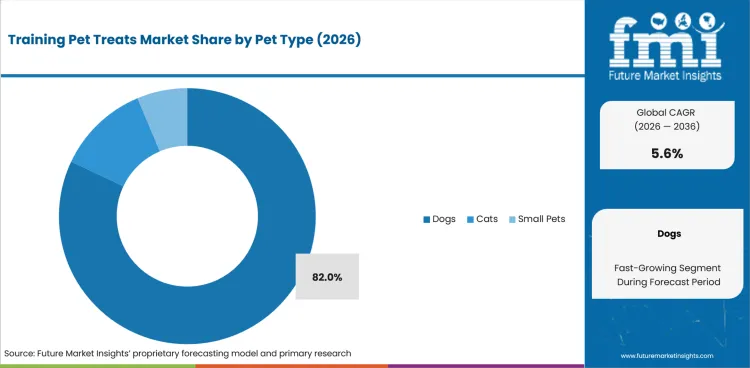
- Dogs are expected to account for 82.0% share in 2026 because canine behavior routines create repeat reward demand.
- Cat and small-pet formats develop through enrichment, clicker training, and smaller specialty purchases.
Which claim type leads the training pet treats market?
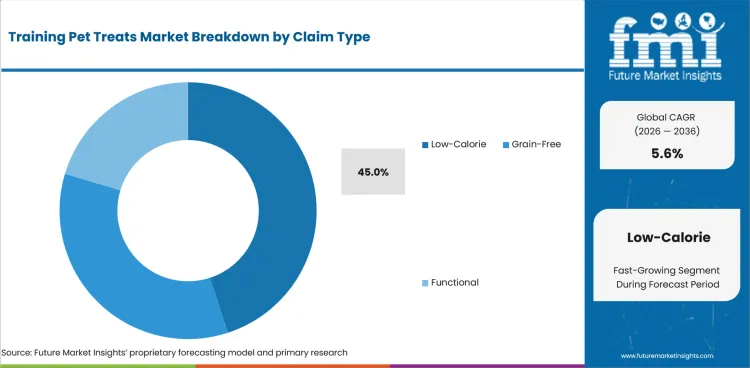
- Low-calorie claims are projected to account for 45.0% share in 2026 as repeated feeding increases calorie scrutiny.
- Single-ingredient and functional claims support premiumization when labeling remains clear and evidence-led.
Why do soft bites lead the training pet treats market?
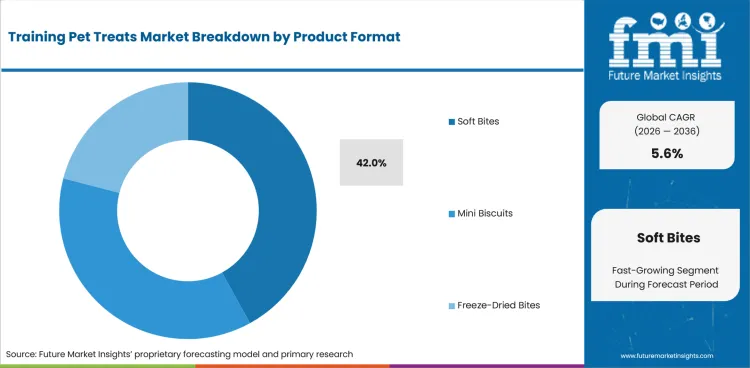
- Soft bites are projected to account for 42.0% share in 2026, influenced by low-crumble handling and quick chewing.
- Mini biscuits retain value when owners need dry shelf-stable rewards for short indoor sessions.
Which distribution channel leads the training pet treats market?
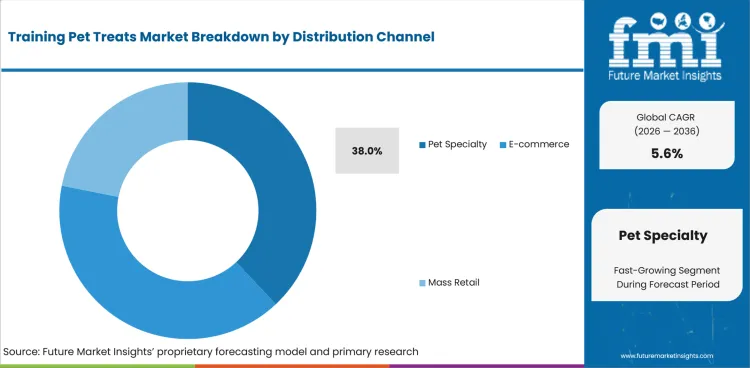
- Pet specialty is forecast to represent 38.0% share in 2026 through advice-led selection and trainer referral influence.
- E-commerce is expected to hold 32.0% share as repeat reward packs suit subscriptions and autoship programs.
Which protein source leads the training pet treats market?
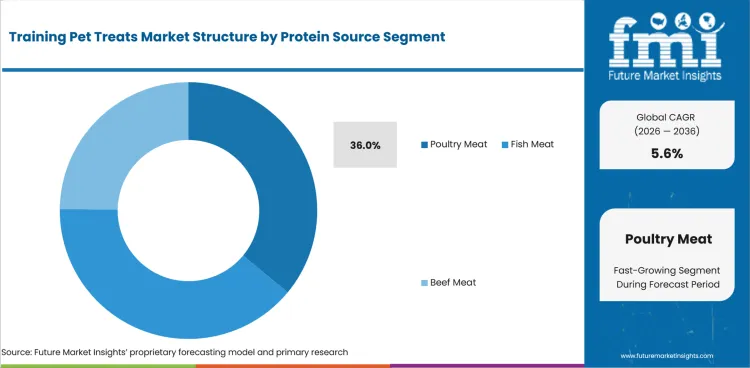
- Poultry meat is anticipated to hold 36.0% share in 2026 through familiar flavor and reliable manufacturing economics.
- Fish, lamb, plant, and novel proteins address sensitivity-led buying when owners seek differentiated reward options.
Poultry-led reward formats also connect with the wider dog food industry analysis because owners often choose treats from trusted dog food brands.
Single-protein and limited-ingredient rewards extend the natural dog treats market outlook when buyers want cleaner reward labels.
Training products remain linked to the broader pet food market outlook since treat purchases usually follow regular food buying routines.
What are the driver, restraints, and opportunities in the training pet treats market?
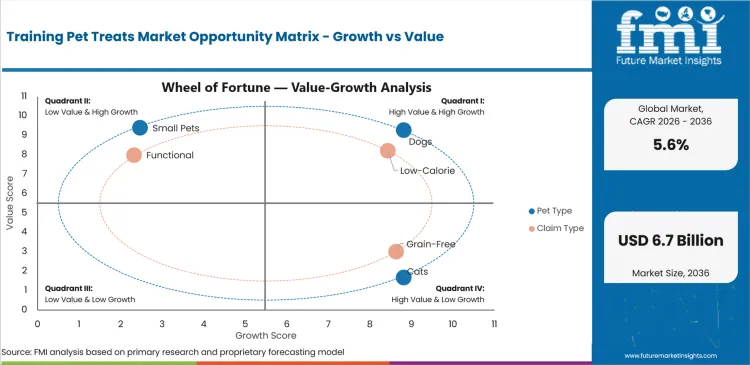
Routine pet training supports demand while input costs and claim controls shape product design.
- Driver: Reward-frequency economics support treat value because one household may use many small pieces across a single training week.
- Restraint: Meat input and pack-cost pressure can narrow margins for brands using poultry-rich or single-protein positioning.
- Opportunity: Retailers can build private-label training ranges around soft bites, mini biscuits, and functional reward packs.
Training Pet Treats Market Demand Outlook
Demand outlook is moving toward small-format products that can support behavior reinforcement without raising overfeeding concerns. AVMA reported that the U.S. pet dog population reached 87.3 million in 2025, creating a large base for obedience, leash, recall, and enrichment reward occasions. This supports daily feeding routines and gives training treat brands room to position small rewards as behavior support rather than indulgent snacks.
Consumer Segmentation and Purchase Behavior Analysis
Purchase behavior is shaped by pet age, training need, channel trust, and feeding caution. The U.S. Bureau of Labor Statistics reported pet food and treats prices rising 1.8% over the year in May 2026, which keeps value packs and transparent calorie information important for repeat purchases. Owners may accept premium pricing when the treat solves a training need, but they are less willing to pay more for vague claims or messy formats.
Voice of Customer and Decision-driver Analysis
Pet owners and trainers compare bite size, aroma, softness, calorie count, and ingredient clarity before buying. FEDIAF reported more than 400 pet food companies and 500 production facilities in Europe in its 2025 facts and figures, showing a broad supplier base able to support private-label and branded reward products. This creates opportunity for differentiated clean-label reward products across premium channels, but it also increases the need for stronger shelf communication.
Which countries are growing fastest in the training pet treats market?
India 8.2% CAGR, China 7.2% CAGR, South Korea 6.7% CAGR, United Kingdom 5.4% CAGR, United States 5.0% CAGR, France 4.9% CAGR, Germany 4.8% CAGR, and Japan 3.8% CAGR through 2036.
.webp "Top Country Growth Comparison Training Pet Treats Market Cagr (2026 2036)")
| Country | CAGR |
|---|---|
| United States | 5.0% |
| United Kingdom | 5.4% |
| Germany | 4.8% |
| France | 4.9% |
| Japan | 3.8% |
| China | 7.2% |
| South Korea | 6.7% |
| India | 8.2% |
Source: Future Market Insights, 2026.
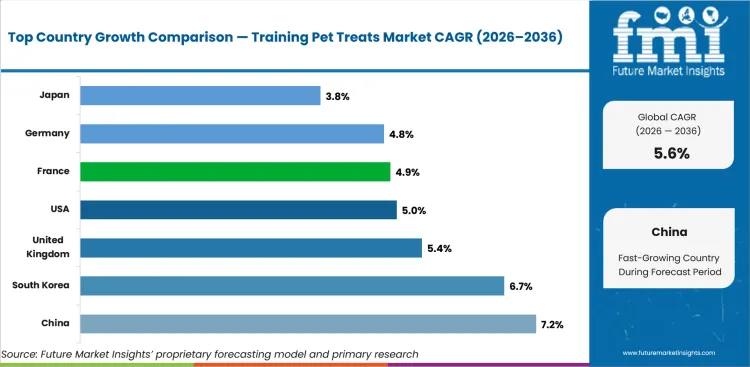
How do country-level CAGRs compare in the training pet treats market?
India leads country growth while Japan records the most cautious expansion outlook among profiled markets.
- India is forecast to record 8.2% CAGR by 2036 as urban pet ownership and packaged pet food use widen.
- China is expected to expand at 7.2% CAGR by 2036 with online retail and pet service networks supporting trial.
- South Korea is projected to grow at 6.7% CAGR through 2036 as premium imported and local products compete online.
- The United Kingdom is estimated to rise at 5.4% CAGR by 2036 with high dog ownership and specialty retail support.
- The United States is expected to advance at 5.0% CAGR by 2036 through established pet spending and national channels.
- France is forecast to grow at 4.9% CAGR by 2036 as grocery visibility and premium ingredient cues support demand.
- Germany is projected to post 4.8% CAGR by 2036 as quality-led buyers compare provenance and price discipline.
- Japan is estimated to increase at 3.8% CAGR by 2036 as premium mix offsets mature dog ownership trends.
How fast is the training pet treats market growing in the United States?
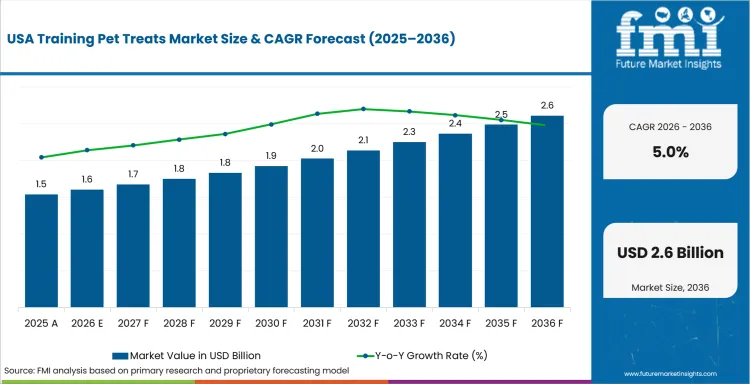
A 5.0% CAGR through 2036 reflects high pet spending and national omnichannel retail access.
Country Market Snapshot Table
| Parameter | Value |
|---|---|
| Market Size in 2025 (Value) | USD 1,112.4 million |
| Market Size in 2026 (Value) | USD 1,168.0 million |
| Market Forecast in 2036 (Value) | USD 1,902.1 million |
| CAGR (2026 to 2036) | 5.0% |
| Years Considered | 2021 to 2036 |
| Base Year | 2025 |
| Forecast Period | 2026 to 2036 |
| Units Considered | Value (USD million) |
| Leading Sub-Region | Northeast and national omnichannel retail networks |
United States Training Pet Treats Market Outlook
United States training pet treat demand is shaped by national pet specialty chains, mass retailers, autoship programs, and trainer-led product discovery. Owners often start with puppy reward packs and reorder the texture that works during leash and recall practice.
Brands must balance aroma strength with calorie control, since American buyers compare ingredient panels and feeding guidance before repeat purchases. Large food groups and specialist treat makers can gain shelf confidence when they offer clean handling and clear use instructions.
Key Growth Drivers
- APPA reported USD 68.3 billion in U.S. pet food and treats sales for 2025, supporting broad trial for reward packs.
- AVMA reported 87.3 million pet dogs in 2025, giving treat brands a large canine training base.
- Autoship programs help owners replenish the soft pieces accepted during puppy and obedience practice.
- Trainer and breeder referrals give trusted reward products a direct route into first-time dog households.
Key Restraints
- BLS reported a median annual wage of USD 38,750 for U.S. animal trainers in May 2024, which can limit paid training frequency for some households.
- Crowded shelves make small brands rely more heavily on search visibility and staff advocacy.
- Meat-rich recipes face margin pressure when poultry and beef inputs move faster than retail prices.
What makes United States unique
The United States is unique because pet treat discovery is split across large chains, autoship platforms, and professional training referrals.
Key Companies
- Mars Petcare
- Nestle Purina PetCare
- General Mills
- Wellness Pet Company
- Spectrum Brands
- United Petfood
Sales & Marketing Channels
- Pet specialty chains
- Mass retail
- E-commerce autoship
- Veterinary clinics
- Dog training centers
- Private-label retail programs
Country Segment Breakdown Table
| Segment | Sub-Segments |
|---|---|
| By Pet Type | Dogs · Cats · Small Pets |
| By Claim Type | Low-Calorie · Grain-Free · Functional · Single-Ingredient |
| By Product Format | Soft Bites · Mini Biscuits · Freeze-Dried Bites · Meat Strips · Functional Chews |
| By Distribution Channel | Pet Specialty · E-commerce · Mass Retail · Veterinary Clinics |
| By Protein Source | Poultry Meat · Fish Meat · Beef Meat · Lamb Meat · Plant Protein · Novel Proteins |
| Key Sub-Regions Covered, National Retail Networks | Northeast · South Atlantic · Midwest · Texas · California · Pacific Northwest |
Frequently Asked Questions
How fast is United States training pet treats market growing?
Demand in the United States is projected to grow at 5.0% CAGR from 2026 to 2036.
Who leads United States training pet treats market?
Mars Petcare, Nestle Purina, General Mills, and Wellness Pet compete through large treat portfolios.
What is driving adoption in United States training pet treats market?
Autoship buying, puppy classes, and national pet specialty access are moving owners toward repeat reward packs.
What is the training pet treats market outlook in the United Kingdom?
A 5.4% CAGR through 2036 is supported by high dog ownership and strong specialty retail influence.
Country Market Snapshot Table
| Parameter | Value |
|---|---|
| Market Size in 2025 (Value) | USD 244.3 million |
| Market Size in 2026 (Value) | USD 257.5 million |
| Market Forecast in 2036 (Value) | USD 435.6 million |
| CAGR (2026 to 2036) | 5.4% |
| Years Considered | 2021 to 2036 |
| Base Year | 2025 |
| Forecast Period | 2026 to 2036 |
| Units Considered | Value (USD million) |
| Leading Sub-Region | London and national pet specialty corridors |
United Kingdom Training Pet Treats Market Outlook
United Kingdom training pet treat demand is shaped by dog ownership, puppy class culture, grocery visibility, and online replenishment. Buyers compare calorie count, ethical sourcing, and pack convenience while choosing everyday reward products.
Specialist retailers can influence first purchase through staff advice and puppy starter ranges. Brands with low-calorie soft bites and transparent ingredients are better placed for repeat buying across premium and value channels.
Key Growth Drivers
- UK Pet Food estimated 15.5 million pet dogs in 2026, creating a large base for reward-led training routines.
- ONS added pet grooming to the 2026 consumer price basket among 27 new items, showing pet services have stronger household-spending visibility.
- Pets at Home, supermarkets, and online retailers help owners compare reward packs across price tiers.
- Puppy classes and breeder advice influence early treat choice before owners move to replenishment packs.
Key Restraints
- ONS reported a 5.4% annual RPI increase for pet care in May 2026, increasing scrutiny of treat pack value.
- Strict claim expectations limit unsupported calming or health language on reward treat packs.
- Cost-conscious shoppers may shift to larger multipacks when household budgets tighten.
What makes United Kingdom unique
The United Kingdom is unique because pet ownership, formal training services, and grocery access reinforce mainstream reward buying.
Key Companies
- Mars Petcare
- Nestle Purina PetCare
- General Mills
- VAFO Group
- United Petfood
- Pets at Home private-label suppliers
Sales & Marketing Channels
- Pet specialty retail
- Grocery retail
- E-commerce subscriptions
- Dog trainer referrals
- Veterinary clinics
- Direct-to-consumer brand sites
Country Segment Breakdown Table
| Segment | Sub-Segments |
|---|---|
| By Pet Type | Dogs · Cats · Small Pets |
| By Claim Type | Low-Calorie · Grain-Free · Functional · Single-Ingredient |
| By Product Format | Soft Bites · Mini Biscuits · Freeze-Dried Bites · Meat Strips · Functional Chews |
| By Distribution Channel | Pet Specialty · E-commerce · Mass Retail · Veterinary Clinics |
| By Protein Source | Poultry Meat · Fish Meat · Beef Meat · Lamb Meat · Plant Protein · Novel Proteins |
| Key Sub-Regions Covered, Pet Specialty Corridors | London · Manchester · Birmingham · Leeds · Glasgow · Bristol |
Frequently Asked Questions
How fast is United Kingdom training pet treats market growing?
Industry value in the United Kingdom is projected to increase at 5.4% CAGR from 2026 to 2036.
Who leads United Kingdom training pet treats market?
Mars Petcare, Nestle Purina, General Mills, VAFO Group, and United Petfood have relevant exposure.
What is driving adoption in United Kingdom training pet treats market?
High dog ownership, puppy training, and pet specialty advice support repeat reward treat purchases.
How is the training pet treats market performing in Germany?
A 4.8% CAGR through 2036 reflects quality-led buying and strong specialist retail discipline.
Country Market Snapshot Table
| Parameter | Value |
|---|---|
| Market Size in 2025 (Value) | USD 221.4 million |
| Market Size in 2026 (Value) | USD 232.0 million |
| Market Forecast in 2036 (Value) | USD 370.6 million |
| CAGR (2026 to 2036) | 4.8% |
| Years Considered | 2021 to 2036 |
| Base Year | 2025 |
| Forecast Period | 2026 to 2036 |
| Units Considered | Value (USD million) |
| Leading Sub-Region | North Rhine-Westphalia and specialist retail clusters |
Germany Training Pet Treats Market Outlook
Germany training pet treat demand is shaped by quality expectations, specialist pet stores, food retail, and online replenishment. Buyers compare recipe transparency, EU production, pack function, and animal welfare cues before choosing reward formats.
Soft bites and mini biscuits can build steady value when they meet price discipline and clear ingredient expectations. Premium formats need credible sourcing and simple communication to stand out in a demanding retail setting.
Key Growth Drivers
- Interzoo reported 10.5 million dogs in Germany in 2024, giving training products a sizable canine base.
- IVH and ZZF reported online pet product sales of about EUR 1,521 million in 2025, supporting digital replenishment for reward packs.
- Specialist stores help owners compare proteins, calories, and training fit before buying.
- Domestic and EU production cues improve trust for premium soft bites and limited-ingredient rewards.
Key Restraints
- IVH and ZZF reported 33.4 million pets in German households in 2025, slightly below the prior 33.9 million level cited for 2024, limiting volume-led expansion.
- Food retail price discipline can narrow margins for premium mini-biscuit formats.
- Sustainability claims require credible sourcing and packaging proof before retailers support wider listing.
What makes Germany unique
Germany is unique because strict buyer expectations and advisory retail culture shape treat selection more than impulse placement.
Key Companies
- VAFO Group
- Mars Petcare
- Nestle Purina PetCare
- Fressnapf private-label suppliers
- United Petfood
- Bewital Petfood
Sales & Marketing Channels
- Specialist pet stores
- Food retail
- Online marketplaces
- Breeder referrals
- Dog sport clubs
- Private-label tenders
Country Segment Breakdown Table
| Segment | Sub-Segments |
|---|---|
| By Pet Type | Dogs · Cats · Small Pets |
| By Claim Type | Low-Calorie · Grain-Free · Functional · Single-Ingredient |
| By Product Format | Soft Bites · Mini Biscuits · Freeze-Dried Bites · Meat Strips · Functional Chews |
| By Distribution Channel | Pet Specialty · E-commerce · Mass Retail · Veterinary Clinics |
| By Protein Source | Poultry Meat · Fish Meat · Beef Meat · Lamb Meat · Plant Protein · Novel Proteins |
| Key Sub-Regions Covered, Specialist Retail Areas | North Rhine-Westphalia · Bavaria · Baden-Württemberg · Berlin · Hamburg · Hesse |
Frequently Asked Questions
How fast is Germany training pet treats market growing?
Demand in Germany is expected to advance at 4.8% CAGR from 2026 to 2036.
Who leads Germany training pet treats market?
VAFO Group, Mars Petcare, Nestle Purina, Fressnapf private-label suppliers, and United Petfood are relevant competitors.
What is driving adoption in Germany training pet treats market?
Ingredient transparency, specialist-store advice, and online replenishment support training reward purchases.
What is the training pet treats market forecast for France?
A 4.9% CAGR through 2036 is supported by grocery access and premium ingredient-led rewards.
Country Market Snapshot Table
| Parameter | Value |
|---|---|
| Market Size in 2025 (Value) | USD 200.2 million |
| Market Size in 2026 (Value) | USD 210.0 million |
| Market Forecast in 2036 (Value) | USD 338.6 million |
| CAGR (2026 to 2036) | 4.9% |
| Years Considered | 2021 to 2036 |
| Base Year | 2025 |
| Forecast Period | 2026 to 2036 |
| Units Considered | Value (USD million) |
| Leading Sub-Region | Ile-de-France and national hypermarket corridors |
France Training Pet Treats Market Outlook
France training pet treat demand is influenced by hypermarket visibility, specialist pet stores, and premium ingredient claims. Owners use treats for bonding, walking rewards, puppy education, and gentle behavior reinforcement.
The market favors products with natural cues, calorie clarity, and pack formats suitable for repeat use. Premium suppliers can gain stronger loyalty when they connect taste with clear feeding guidance.
Key Growth Drivers
- FEDIAF reported 7.6 million dogs in France in its 2025 facts and figures, supporting a stable reward treat user base.
- FEDIAF reported EUR 29.3 billion in European pet food sales in its 2025 facts and figures, giving French suppliers a large regional benchmark.
- Hypermarkets support entry reward packs for first-time dog owners and price-sensitive households.
- Specialist pet shops support low-calorie, single-protein, and natural reward formats.
Key Restraints
- USDA FAS noted in 2026 that France has about 17,000 to 18,000 food processing companies, which reflects a competitive supplier environment around packaged foods and ingredients.
- Private-label competition keeps pressure on mid-tier branded biscuits and basic reward packs.
- Claim wording must avoid unsupported health or behavior promises in premium pet food channels.
What makes France unique
France is unique because grocery scale and premium ingredient cues operate together in reward treat buying.
Key Companies
- Mars Petcare
- Nestle Purina PetCare
- VAFO Group
- United Petfood
- General Mills
- Affinity Petcare
Sales & Marketing Channels
- Hypermarkets
- Pet specialty chains
- Online retail
- Veterinary clinics
- Breeder networks
- Private-label retail buyers
Country Segment Breakdown Table
| Segment | Sub-Segments |
|---|---|
| By Pet Type | Dogs · Cats · Small Pets |
| By Claim Type | Low-Calorie · Grain-Free · Functional · Single-Ingredient |
| By Product Format | Soft Bites · Mini Biscuits · Freeze-Dried Bites · Meat Strips · Functional Chews |
| By Distribution Channel | Pet Specialty · E-commerce · Mass Retail · Veterinary Clinics |
| By Protein Source | Poultry Meat · Fish Meat · Beef Meat · Lamb Meat · Plant Protein · Novel Proteins |
| Key Sub-Regions Covered, Grocery and Specialty Retail Areas | Ile-de-France · Auvergne-Rhone-Alpes · Provence-Alpes-Cote d Azur · Nouvelle-Aquitaine · Occitanie · Hauts-de-France |
Frequently Asked Questions
How fast is France training pet treats market growing?
The France market is projected to grow at 4.9% CAGR from 2026 to 2036.
Who leads France training pet treats market?
Mars Petcare, Nestle Purina, VAFO Group, United Petfood, and General Mills have relevant exposure.
What is driving adoption in France training pet treats market?
Hypermarket reach and premium ingredient cues support reward treat trial and repeat buying.
How fast is Japan training pet treats market growing?
A 3.8% CAGR through 2036 reflects premium mix gains in a mature pet ownership environment.
Country Market Snapshot Table
| Parameter | Value |
|---|---|
| Market Size in 2025 (Value) | USD 157.0 million |
| Market Size in 2026 (Value) | USD 163.0 million |
| Market Forecast in 2036 (Value) | USD 236.6 million |
| CAGR (2026 to 2036) | 3.8% |
| Years Considered | 2021 to 2036 |
| Base Year | 2025 |
| Forecast Period | 2026 to 2036 |
| Units Considered | Value (USD million) |
| Leading Sub-Region | Tokyo and premium home-center corridors |
Japan Training Pet Treats Market Outlook
Japan training pet treat demand is shaped by small-breed ownership, indoor routines, provenance expectations, and premium store presentation. Owners prefer neat pieces that can be fed repeatedly without mess.
Value gains are more dependent on quality and format than on rapid pet population expansion. Domestic trust, clean labels, and careful pack design remain important for premium reward products.
Key Growth Drivers
- Agriculture and Agri-Food Canada reported Japan was the ninth-largest pet food market at US$4.2 billion in 2023, supporting premium reward demand.
- Japan government CPI files list pet foods for dogs and cats as tracked consumer items in 2026, keeping pet food prices visible to households.
- Small-breed ownership supports tiny low-calorie pieces for apartment and indoor training.
- Domestic-origin cues and neat pack formats help premium soft bites gain buyer trust.
Key Restraints
- Japan Pet Food Association survey coverage showed dogs at about 6.82 million in 2025, keeping training treat volume more selective than high-growth markets.
- High quality expectations raise manufacturing, inspection, and packaging costs for premium rewards.
- New product education is slower when owners already rely on familiar food and treat routines.
What makes Japan unique
Japan is unique because premium texture, domestic trust, and small-piece design matter more than large pack volume.
Key Companies
- Mars Petcare
- Nestle Purina PetCare
- Unicharm
- DoggyMan H.A.
- Inaba Petfood
- General Mills
Sales & Marketing Channels
- Pet specialty stores
- Home centers
- Online marketplaces
- Veterinary clinics
- Grooming salons
- Department store pet sections
Country Segment Breakdown Table
| Segment | Sub-Segments |
|---|---|
| By Pet Type | Dogs · Cats · Small Pets |
| By Claim Type | Low-Calorie · Grain-Free · Functional · Single-Ingredient |
| By Product Format | Soft Bites · Mini Biscuits · Freeze-Dried Bites · Meat Strips · Functional Chews |
| By Distribution Channel | Pet Specialty · E-commerce · Mass Retail · Veterinary Clinics |
| By Protein Source | Poultry Meat · Fish Meat · Beef Meat · Lamb Meat · Plant Protein · Novel Proteins |
| Key Sub-Regions Covered, Premium Retail Areas | Tokyo · Osaka · Kanagawa · Aichi · Fukuoka · Hokkaido |
Frequently Asked Questions
How fast is Japan training pet treats market growing?
Japan demand is projected to increase at 3.8% CAGR from 2026 to 2036.
Who leads Japan training pet treats market?
Mars Petcare, Nestle Purina, Unicharm, DoggyMan, and Inaba Petfood have relevant positions.
What is driving adoption in Japan training pet treats market?
Small-breed care, premium textures, and domestic trust support repeat purchase for training rewards.
What is driving training pet treats growth in China?
A 7.2% CAGR through 2036 is supported by urban pet services, digital discovery, and domestic brand competition.
Country Market Snapshot Table
| Parameter | Value |
|---|---|
| Market Size in 2025 (Value) | USD 436.6 million |
| Market Size in 2026 (Value) | USD 468.0 million |
| Market Forecast in 2036 (Value) | USD 936.9 million |
| CAGR (2026 to 2036) | 7.2% |
| Years Considered | 2021 to 2036 |
| Base Year | 2025 |
| Forecast Period | 2026 to 2036 |
| Units Considered | Value (USD million) |
| Leading Sub-Region | Shanghai, Beijing, Chengdu, and Hangzhou pet retail clusters |
China Training Pet Treats Market Outlook
China training pet treat demand is shaped by online content, pet service shops, grooming channels, and premium packaged pet food adoption. Owners in major cities use reward treats during socialization, service visits, and home routines.
Brands must compete across digital platforms and offline service networks. Domestic companies can gain trial through freshness, price, and fast launches, while imported brands retain trust in premium protein formats.
Key Growth Drivers
- USDA FAS reported China urban dog and cat market reached about USD 43.4 billion in 2025, strengthening premium snack demand.
- China Feed Industry Association reported pet food production reached 1.9 million metric tons in 2025, supporting local treat supply depth.
- Tmall, JD.com, and Douyin help new treat brands move from short-video trial to repeat buying.
- Pet service shops create demand for clean-handling rewards used during grooming, boarding, and socialization.
Key Restraints
- USDA FAS reported China pet population growth was below 2.0% in 2025, limiting expansion driven only by new pet counts.
- Lower-tier cities remain more price-sensitive than Shanghai, Beijing, and Shenzhen.
- Imported high-protein treats face stronger local competition from domestic brands with faster online launches.
What makes China unique
China is unique because digital discovery and offline pet service networks work together to accelerate treat trial.
Key Companies
- Mars Petcare
- Nestle Purina PetCare
- Gambol Pet Group
- Yantai China Pet Foods
- Bridge PetCare
- Local online treat brands
Sales & Marketing Channels
- Tmall flagship stores
- JD.com stores
- Douyin commerce
- Pet service shops
- Grooming chains
- Cross-border e-commerce
Country Segment Breakdown Table
| Segment | Sub-Segments |
|---|---|
| By Pet Type | Dogs · Cats · Small Pets |
| By Claim Type | Low-Calorie · Grain-Free · Functional · Single-Ingredient |
| By Product Format | Soft Bites · Mini Biscuits · Freeze-Dried Bites · Meat Strips · Functional Chews |
| By Distribution Channel | Pet Specialty · E-commerce · Mass Retail · Veterinary Clinics |
| By Protein Source | Poultry Meat · Fish Meat · Beef Meat · Lamb Meat · Plant Protein · Novel Proteins |
| Key Sub-Regions Covered, Urban Pet Retail Clusters | Shanghai · Beijing · Guangzhou · Shenzhen · Chengdu · Hangzhou |
Frequently Asked Questions
How fast is China training pet treats market growing?
China demand is projected to expand at 7.2% CAGR from 2026 to 2036.
Who leads China training pet treats market?
Mars Petcare, Nestle Purina, Gambol, Yantai China Pet Foods, and local online brands compete actively.
What is driving adoption in China training pet treats market?
Urban pet services, online content, and premium packaged food buying support training treat adoption.
What is the training pet treats market outlook in South Korea?
A 6.7% CAGR through 2036 reflects premium online buying and imported product trust.
Country Market Snapshot Table
| Parameter | Value |
|---|---|
| Market Size in 2025 (Value) | USD 134.0 million |
| Market Size in 2026 (Value) | USD 143.0 million |
| Market Forecast in 2036 (Value) | USD 273.5 million |
| CAGR (2026 to 2036) | 6.7% |
| Years Considered | 2021 to 2036 |
| Base Year | 2025 |
| Forecast Period | 2026 to 2036 |
| Units Considered | Value (USD million) |
| Leading Sub-Region | Seoul Capital Area and premium online retail nodes |
South Korea Training Pet Treats Market Outlook
South Korea training pet treat demand is shaped by premium online retail, imported brand trust, small households, and pet parenting culture. Owners compare product origin, protein source, and convenience before choosing repeat rewards.
Domestic manufacturers are improving freshness and price competitiveness, while imported brands hold trust in premium nutrition. Training treats can gain when they connect small-bite convenience with clear feeding guidance.
Key Growth Drivers
- Agriculture and Agri-Food Canada reported South Korea pet food retail sales reached US$1.5 billion in 2023, supporting premium snack and treat expansion.
- USDA FAS reported Korean dog and cat food imports were US$307 million in 2023, reflecting strong imported-product participation.
- Mobile commerce and pet platforms help owners reorder accepted treat textures quickly.
- Small urban households support low-odor, clean-handling rewards for indoor training routines.
Key Restraints
- Agriculture and Agri-Food Canada reported South Korea imported US$307.5 million in pet food in 2023, which leaves brands exposed to exchange-rate and logistics pressure.
- Local brands can undercut imported premium rewards when buyers compare price per piece.
- Premium claims require careful translation and label clarity before online reviews support repeat buying.
What makes South Korea unique
South Korea is unique because premium imported trust and fast online comparison shape reward treat competition.
Key Companies
- Mars Petcare
- Nestle Purina PetCare
- General Mills
- CJ CheilJedang Pet Food
- Harim Pet Food
- Local premium treat brands
Sales & Marketing Channels
- Online marketplaces
- Pet specialty shops
- Veterinary clinics
- Grooming salons
- Convenience retail
- Department store pet sections
Country Segment Breakdown Table
| Segment | Sub-Segments |
|---|---|
| By Pet Type | Dogs · Cats · Small Pets |
| By Claim Type | Low-Calorie · Grain-Free · Functional · Single-Ingredient |
| By Product Format | Soft Bites · Mini Biscuits · Freeze-Dried Bites · Meat Strips · Functional Chews |
| By Distribution Channel | Pet Specialty · E-commerce · Mass Retail · Veterinary Clinics |
| By Protein Source | Poultry Meat · Fish Meat · Beef Meat · Lamb Meat · Plant Protein · Novel Proteins |
| Key Sub-Regions Covered, Online and Specialty Retail Clusters | Seoul · Incheon · Gyeonggi · Busan · Daegu · Daejeon |
Frequently Asked Questions
How fast is South Korea training pet treats market growing?
South Korea demand is projected to rise at 6.7% CAGR from 2026 to 2036.
Who leads South Korea training pet treats market?
Mars Petcare, Nestle Purina, General Mills, CJ CheilJedang, and Harim Pet Food have relevant market exposure.
What is driving adoption in South Korea training pet treats market?
Premium online buying, imported brand trust, and clean indoor reward formats support adoption.
Why is India the fastest-growing training pet treats market?
An 8.2% CAGR through 2036 is supported by urban dog ownership, online pet platforms, and packaged pet food adoption.
Country Market Snapshot Table
| Parameter | Value |
|---|---|
| Market Size in 2025 (Value) | USD 89.6 million |
| Market Size in 2026 (Value) | USD 97.0 million |
| Market Forecast in 2036 (Value) | USD 213.6 million |
| CAGR (2026 to 2036) | 8.2% |
| Years Considered | 2021 to 2036 |
| Base Year | 2025 |
| Forecast Period | 2026 to 2036 |
| Units Considered | Value (USD million) |
| Leading Sub-Region | Delhi NCR, Mumbai, Bengaluru, and pet platform corridors |
India Training Pet Treats Market Outlook
India training pet treat demand is shaped by fast urban pet adoption, dog-focused ownership, online pet platforms, and rising branded food use. Reward treats often enter households through puppy training, grooming visits, and e-commerce discovery.
Small-dog ownership supports low-calorie pieces and smaller packs. Brands that combine affordable trial sizes with clean labels and trainer education can build repeat buying in large cities.
Key Growth Drivers
- Agriculture and Agri-Food Canada reported India pet population increased from 28.4 million in 2020 to 39.2 million in 2025, expanding the companion-animal base.
- India Ministry of Food Processing Industries reported dog food sales at USD 620.7 million in 2024, keeping canine rewards central to packaged pet food.
- Online pet platforms and quick-commerce channels make small trial packs easier to discover and reorder.
- Groomers, trainers, and veterinarians influence the first reward treat purchase for new dog owners.
Key Restraints
- Agriculture and Agri-Food Canada estimated India dog food sales at US$540.1 million in 2025, showing the category is still developing compared with mature pet food markets.
- Price sensitivity limits premium freeze-dried rewards outside top urban clusters.
- Heat and storage conditions require strong pack seals and reliable shelf-life communication.
What makes India unique
India is unique because urban dog ownership, online platforms, and early packaged-food adoption converge quickly.
Key Companies
- Mars Petcare
- Nestle Purina PetCare
- Drools Pet Food
- Heads Up For Tails
- Wiggles
- Captain Zack
Sales & Marketing Channels
- Pet specialty stores
- E-commerce platforms
- Quick commerce
- Veterinary clinics
- Grooming salons
- Trainer referrals
Country Segment Breakdown Table
| Segment | Sub-Segments |
|---|---|
| By Pet Type | Dogs · Cats · Small Pets |
| By Claim Type | Low-Calorie · Grain-Free · Functional · Single-Ingredient |
| By Product Format | Soft Bites · Mini Biscuits · Freeze-Dried Bites · Meat Strips · Functional Chews |
| By Distribution Channel | Pet Specialty · E-commerce · Mass Retail · Veterinary Clinics |
| By Protein Source | Poultry Meat · Fish Meat · Beef Meat · Lamb Meat · Plant Protein · Novel Proteins |
| Key Sub-Regions Covered, Urban Pet Retail Clusters | Delhi NCR · Mumbai · Bengaluru · Hyderabad · Pune · Chennai |
Frequently Asked Questions
How fast is India training pet treats market growing?
India demand is projected to grow at 8.2% CAGR from 2026 to 2036.
Who leads India training pet treats market?
Mars Petcare, Nestle Purina, Drools, Heads Up For Tails, Wiggles, and Captain Zack have relevant exposure.
What is driving adoption in India training pet treats market?
Urban dog ownership, online discovery, and trainer-led product education are moving households toward reward treats.
Who are the leading companies in the training pet treats market?
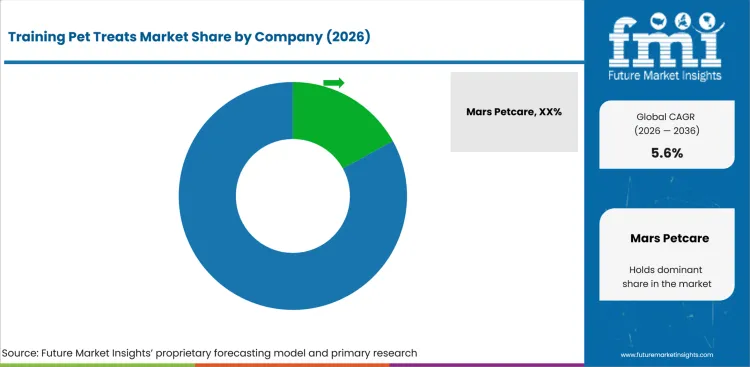
Mars Petcare, Nestle Purina, General Mills, VAFO Group, and United Petfood.
- Established pet food companies hold an advantage through trusted nutrition brands and wide retail placement.
- Specialist treat makers gain shelf space by offering small reward formats with cleaner handling and calorie clarity.
- Private-label producers gain better acceptance when retailers need exclusive soft bite and mini biscuit ranges.
- Retail-ready packaging supports trial through clear protein, calorie, and feeding-frequency information.
Global pet nutrition groups compete by combining product formulation knowledge with shopper trust and channel coverage. Mars Petcare and Nestle Purina hold scale advantages through global pet food portfolios, veterinary credibility, and wide retail relationships. General Mills has expanded its premium pet position through Blue Buffalo, Edgard & Cooper, Cloud Star, and Tiki Pets. These companies can connect treat packs with broader dog food and pet care revenue strategies.
Manufacturing scale has become a competitive separator as reward snacks move beyond small impulse packs into repeat replenishment. United Petfood and private-label suppliers can support retailers that want consistent textures, smaller piece sizes, and price-tiered packs. VAFO Group competes through European brand depth and small-dog treat innovation. Suppliers that can document nutrition intent and pack stability should gain stronger retail confidence.
Smaller and regional players can win through trainer credibility, local ingredient cues, and faster flavor adjustment. Brands with clean labels, low-calorie pieces, and strong aroma have better odds of repeat buying after puppy classes or leash training. Companies relying only on novelty shapes or vague functional claims are expected to face weaker acceptance in regulated and advice-led channels.
How do top training pet treats companies compare?
| Company | Relevance to Market Title | Treat Portfolio Depth | Training Format Fit | Channel Reach | Geographic Footprint |
|---|---|---|---|---|---|
| Mars Petcare | Very High | Very Strong | Strong | Very Strong | Global |
| Nestle Purina PetCare | Very High | Very Strong | Strong | Very Strong | Global |
| General Mills | Very High | Strong | Strong | Very Strong | United States and Europe |
| VAFO Group | High | Strong | Strong | Strong | Europe and export markets |
| United Petfood | High | Strong | Moderate to Strong | Strong | Europe and United States |
| Wellness Pet Company | High | Strong | Strong | Strong | United States |
| Spectrum Brands | Moderate to High | Moderate | Moderate | Strong | North America and Europe |
| Unicharm | Moderate to High | Moderate | Moderate | Strong | Japan and Asia |
| DoggyMan H.A. | High | Strong | Strong | Moderate | Japan |
| Drools Pet Food | High | Strong | Strong | Strong | India |
Source: Future Market Insights competitive analysis, 2026.
Who are the key players in the training pet treats market?
Mars Petcare, Nestle Purina PetCare, General Mills, VAFO Group, and United Petfood are listed with other reward treat suppliers.
Key global companies leading the training pet treats market include:
- Mars Petcare
- Nestle Purina PetCare
- General Mills
- VAFO Group
- United Petfood
- Wellness Pet Company
- Spectrum Brands
- Unicharm
- DoggyMan H.A.
- Drools Pet Food
Key Developments in Training Pet Treats Market
- In May 2026, Mars Petcare and Big Idea Ventures launched the 2026 Global Pet Food Innovation Program with AAK, Buhler, Givaudan, and Ingredion to seek ventures in alternative proteins, fats, oils, and novel ingredients for pet nutrition.
- In June 2025, General Mills announced the U.S. launch of Edgard & Cooper at PetSmart, with dry food, wet food, and treats designed for dogs of all breeds and life stages.
- In May 2025, VAFO Group presented Brit Care Treats for Small Dogs at Zoomark 2025, with products tailored to sensitive digestion and functional small-breed reward needs.
Key Players in the Training Pet Treats Market
Global Pet Nutrition Groups
- Mars Petcare
- Nestle Purina PetCare
- General Mills
- Spectrum Brands
- Unicharm
Treat and Reward Specialists
- VAFO Group
- Wellness Pet Company
- DoggyMan H.A.
- Cloud Star
- Edgard & Cooper
Private-label and Regional Suppliers
- United Petfood
- Drools Pet Food
- Pets at Home private-label suppliers
- Fressnapf private-label suppliers
- Local online pet treat brands
Training Pet Treats Market - Report Scope
| Item | Value |
|---|---|
| Market size by 2036 | USD 6.71 billion |
| Growth rate | 5.6% CAGR from 2026 to 2036 |
| Forecast period | 2026 to 2036 |
| Base year value (2025) | USD 3.68 billion |
| By pet type | Dogs, cats, small pets |
| By claim type | Low-calorie, grain-free, functional, single-ingredient |
| By product format | Soft bites, mini biscuits, freeze-dried bites, meat strips, functional chews |
| By distribution channel | Pet specialty, e-commerce, mass retail, veterinary clinics |
| By protein source | Poultry meat, fish meat, beef meat, lamb meat, plant protein, novel proteins |
| Regions covered | North America, Latin America, Europe, East Asia, South Asia and Pacific, Middle East and Africa |
| Countries covered | United States, United Kingdom, Germany, France, Japan, China, South Korea, India |
| Key companies profiled | Mars Petcare, Nestle Purina, General Mills, VAFO Group, United Petfood, Wellness Pet Company |
| Approach | Bottom-up product-boundary approach using reward treat revenue, channel presence, retail pricing, product positioning, and country-level adoption |
Source: Future Market Insights, 2026.
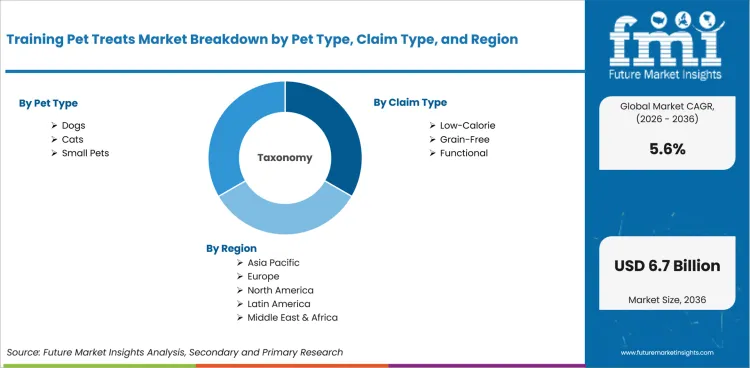
Training Pet Treats Market Breakdown by Pet Type, Claim Type, Product Format, Distribution Channel, Protein Source, and Region
Training Pet Treats Market Segmented by Pet Type:
- Dogs
- Cats
- Small Pets
Training Pet Treats Market Segmented by Claim Type:
- Low-Calorie
- Grain-Free
- Functional
- Single-Ingredient
Training Pet Treats Market Segmented by Product Format:
- Soft Bites
- Mini Biscuits
- Freeze-Dried Bites
- Meat Strips
- Functional Chews
Training Pet Treats Market Segmented by Distribution Channel:
- Pet Specialty
- E-commerce
- Mass Retail
- Veterinary Clinics
Training Pet Treats Market Segmented by Protein Source:
- Poultry Meat
- Fish Meat
- Beef Meat
- Lamb Meat
- Plant Protein
- Novel Proteins
Training Pet Treats Market by Region:
- North America
- Latin America
- Europe
- East Asia
- South Asia and Pacific
- Middle East and Africa
Research Sources and Bibliography
- American Pet Products Association. (2026). Industry trends and stats. American Pet Products Association.
- American Veterinary Medical Association. (2026, May 5). AVMA marks National Pet Week as U.S. pet ownership reaches 77.5 million households. AVMA.
- Agriculture and Agri-Food Canada. (2026, May 13). Sector trend analysis - Pet food trends in India. Government of Canada.
- Agriculture and Agri-Food Canada. (2025, July 2). Sector trend analysis - Pet food in Japan. Government of Canada.
- Agriculture and Agri-Food Canada. (2025, July 2). Sector trend analysis - Pet food trends in South Korea. Government of Canada.
- European Pet Food Industry Federation. (2026, June). Statistics. FEDIAF.
- European Pet Food Industry Federation. (2025, June). FEDIAF publishes 2025 facts and figures. FEDIAF.
- General Mills. (2025, June 23). General Mills accelerates growth with Blue Buffalo expansion into fresh and Edgard & Cooper U.S. launch. General Mills.
- Industrieverband Heimtierbedarf and Zentralverband Zoologischer Fachbetriebe. (2026, May). The German pet market 2025. IVH.
- Interzoo. (2025, May 27). The German pet market 2024: Rising sales in the pet food segment. Interzoo.
- Mars, Incorporated. (2026, May 12). Big Idea Ventures and Mars Petcare launch 2026 Global Pet Food Innovation Program. Mars.
- Ministry of Food Processing Industries. (2025, September). Pet food sector profile. Government of India.
- Office for National Statistics. (2026, March 17). Consumer price inflation basket of goods and services: 2026. Office for National Statistics.
- Office for National Statistics. (2026, June 17). RPI: Percentage change over 12 months - Pet care. Office for National Statistics.
- Statistics Bureau of Japan. (2026, May 29). Consumer price index 2020-base. e-Stat.
- U.S. Bureau of Labor Statistics. (2026, June 11). Consumer price index - May 2026. U.S. Bureau of Labor Statistics.
- U.S. Bureau of Labor Statistics. (2025, April 18). Animal care and service workers. U.S. Bureau of Labor Statistics.
- U.S. Department of Agriculture Foreign Agricultural Service. (2026, April 14). Pet food market update 2026: China. USDA FAS.
- U.S. Department of Agriculture Foreign Agricultural Service. (2024, August 20). South Korea pet food report. USDA FAS.
- U.S. Department of Agriculture Foreign Agricultural Service. (2026, January 23). France food processing ingredients annual. USDA FAS.
- UK Pet Food. (2026). UK pet population 2026. UK Pet Food.
- VAFO Group. (2025, May 9). VAFO leads with innovation at Zoomark 2025. VAFO Group.
This bibliography is provided for reader reference and is not exhaustive. The full report contains the complete reference list and detailed citations.
Training Pet Treats Market - Scope & Definition
| Attribute | Detail |
|---|---|
| Market Definition | Small edible reward treats used for obedience, recall training, enrichment, walking behavior, and behavior reinforcement across companion animals. |
| Functions Covered | Behavior reward, repeat feeding, training reinforcement, positive association, portion-controlled snacking. |
| Applications Covered | Soft bites, mini biscuits, freeze-dried bites, meat strips, and functional reward treats used during pet training and bonding. |
| End-Use Industries | Pet food industry, pet specialty retail, e-commerce pet retail, veterinary retail, professional training services. |
| Grades Covered | Low-calorie, grain-free, functional, single-ingredient, standard reward, and premium protein formats. |
| Inclusions | Commercial training rewards across product formats, protein sources, pet types, distribution channels, claim types, and selected countries. |
| Exclusions | Complete pet meals, large dental chews, prescription diets, toys, collars, clickers, treat-dispensing hardware, and human snacks. |
Training Pet Treats Market - Research Methodology
| Method | Description |
|---|---|
| Primary Research | FMI analyst interviews with treat manufacturers, private-label suppliers, specialty retailers, e-commerce category teams, veterinary channel participants, and dog training professionals. |
| Desk Research | Review of official pet population data, pet food trade information, company development records, trade association statistics, and government data related to pet food and treats. |
| Market Sizing & Forecasting | Bottom-up product-boundary approach using reward treat category value, retail pricing, channel presence, pet type segmentation, and country-level adoption trends. |
| Data Validation | Cross-verification using pet ownership patterns, product launch activity, retail channel rules, manufacturer disclosures, and adjacent pet snack categories. |
This Report Answers
- Market size estimates for 2026 and forecasts through 2036 for the training pet treats market.
- Insights across more than 30 regional and country-level markets.
- Analysis of demand drivers, pet training behavior, usage trends, and purchasing behavior.
- Evaluation of key product formats and sales channels, including specialty retail and online replenishment.
- Assessment of protein source choices, claim positioning, and calorie-control impacts on market development.
- Identification of growth opportunities across soft bites, mini biscuits, freeze-dried pieces, and functional rewards.
- Evaluation of supply chain dynamics, product innovation trends, and distribution channel structures.
- Country-level growth analysis covering the United States, United Kingdom, Germany, France, Japan, China, South Korea, and India.
- Assessment of the competitive landscape, including leading pet treat manufacturers and other market participants.
- Analysis of consumer preferences, market penetration trends, and emerging growth opportunities.
- Regional outlooks across North America, Europe, East Asia, South Asia and Pacific, and other global regions.
- Delivery of market data, forecasts, and supporting analysis in PDF and Excel formats.
Frequently Asked Questions
What is the training pet treats market size in 2026?
The training pet treats market size is anticipated to cross USD 3.89 billion in 2026.
What is the training pet treats market forecast for 2036?
The training pet treats industry revenue is predicted to reach USD 6.71 billion by 2036 as reward-led pet care expands.
What is the training pet treats market CAGR?
The training pet treats sector is projected to expand at 5.6% CAGR from 2026 to 2036.
What segment leads the training pet treats market?
Dogs are likely to capture 82.0% share in 2026 due to frequent obedience, recall, and leash-training use.
What country grows fastest in the training pet treats market?
India is set to record 8.2% CAGR by 2036, driven by urban pet ownership and packaged pet food adoption.
Preview the report firsthand - request a free sample
Get SampleGet the brochure for pricing and purchase details.
Get PDFTable of Content
- Executive Summary
- Global Market Outlook
- Demand to side Trends
- Supply to side Trends
- Technology Roadmap Analysis
- Analysis and Recommendations
- Market Overview
- Market Coverage / Taxonomy
- Market Definition / Scope / Limitations
- Research Methodology
- Chapter Orientation
- Analytical Lens and Working Hypotheses
- Market Structure, Signals, and Trend Drivers
- Benchmarking and Cross-market Comparability
- Market Sizing, Forecasting, and Opportunity Mapping
- Research Design and Evidence Framework
- Desk Research Programme (Secondary Evidence)
- Company Annual and Sustainability Reports
- Peer-reviewed Journals and Academic Literature
- Corporate Websites, Product Literature, and Technical Notes
- Earnings Decks and Investor Briefings
- Statutory Filings and Regulatory Disclosures
- Technical White Papers and Standards Notes
- Trade Journals, Industry Magazines, and Analyst Briefs
- Conference Proceedings, Webinars, and Seminar Materials
- Government Statistics Portals and Public Data Releases
- Press Releases and Reputable Media Coverage
- Specialist Newsletters and Curated Briefings
- Sector Databases and Reference Repositories
- FMI Internal Proprietary Databases and Historical Market Datasets
- Subscription Datasets and Paid Sources
- Social Channels, Communities, and Digital Listening Inputs
- Additional Desk Sources
- Expert Input and Fieldwork (Primary Evidence)
- Primary Modes
- Qualitative Interviews and Expert Elicitation
- Quantitative Surveys and Structured Data Capture
- Blended Approach
- Why Primary Evidence is Used
- Field Techniques
- Interviews
- Surveys
- Focus Groups
- Observational and In-context Research
- Social and Community Interactions
- Stakeholder Universe Engaged
- C-suite Leaders
- Board Members
- Presidents and Vice Presidents
- R&D and Innovation Heads
- Technical Specialists
- Domain Subject-matter Experts
- Scientists
- Physicians and Other Healthcare Professionals
- Governance, Ethics, and Data Stewardship
- Research Ethics
- Data Integrity and Handling
- Primary Modes
- Tooling, Models, and Reference Databases
- Desk Research Programme (Secondary Evidence)
- Data Engineering and Model Build
- Data Acquisition and Ingestion
- Cleaning, Normalisation, and Verification
- Synthesis, Triangulation, and Analysis
- Quality Assurance and Audit Trail
- Market Background
- Market Dynamics
- Drivers
- Restraints
- Opportunity
- Trends
- Scenario Forecast
- Demand in Optimistic Scenario
- Demand in Likely Scenario
- Demand in Conservative Scenario
- Opportunity Map Analysis
- Product Life Cycle Analysis
- Supply Chain Analysis
- Investment Feasibility Matrix
- Value Chain Analysis
- PESTLE and Porter’s Analysis
- Regulatory Landscape
- Regional Parent Market Outlook
- Production and Consumption Statistics
- Import and Export Statistics
- Market Dynamics
- Global Market Analysis 2021 to 2025 and Forecast, 2026 to 2036
- Historical Market Size Value (USD Million) Analysis, 2021 to 2025
- Current and Future Market Size Value (USD Million) Projections, 2026 to 2036
- Y to o to Y Growth Trend Analysis
- Absolute $ Opportunity Analysis
- Global Market Pricing Analysis 2021 to 2025 and Forecast 2026 to 2036
- Global Market Analysis 2021 to 2025 and Forecast 2026 to 2036, By Pet Type
- Introduction / Key Findings
- Historical Market Size Value (USD Million) Analysis By Pet Type , 2021 to 2025
- Current and Future Market Size Value (USD Million) Analysis and Forecast By Pet Type , 2026 to 2036
- Dogs
- Cats
- Small Pets
- Dogs
- Y to o to Y Growth Trend Analysis By Pet Type , 2021 to 2025
- Absolute $ Opportunity Analysis By Pet Type , 2026 to 2036
- Global Market Analysis 2021 to 2025 and Forecast 2026 to 2036, By Claim Type
- Introduction / Key Findings
- Historical Market Size Value (USD Million) Analysis By Claim Type, 2021 to 2025
- Current and Future Market Size Value (USD Million) Analysis and Forecast By Claim Type, 2026 to 2036
- Low-Calorie
- Grain-Free
- Functional
- Low-Calorie
- Y to o to Y Growth Trend Analysis By Claim Type, 2021 to 2025
- Absolute $ Opportunity Analysis By Claim Type, 2026 to 2036
- Global Market Analysis 2021 to 2025 and Forecast 2026 to 2036, By Product Format
- Introduction / Key Findings
- Historical Market Size Value (USD Million) Analysis By Product Format, 2021 to 2025
- Current and Future Market Size Value (USD Million) Analysis and Forecast By Product Format, 2026 to 2036
- Soft Bites
- Mini Biscuits
- Freeze-Dried Bites
- Soft Bites
- Y to o to Y Growth Trend Analysis By Product Format, 2021 to 2025
- Absolute $ Opportunity Analysis By Product Format, 2026 to 2036
- Global Market Analysis 2021 to 2025 and Forecast 2026 to 2036, By Distribution Channel
- Introduction / Key Findings
- Historical Market Size Value (USD Million) Analysis By Distribution Channel, 2021 to 2025
- Current and Future Market Size Value (USD Million) Analysis and Forecast By Distribution Channel, 2026 to 2036
- Pet Specialty
- E-commerce
- Mass Retail
- Pet Specialty
- Y to o to Y Growth Trend Analysis By Distribution Channel, 2021 to 2025
- Absolute $ Opportunity Analysis By Distribution Channel, 2026 to 2036
- Global Market Analysis 2021 to 2025 and Forecast 2026 to 2036, By Protein Source
- Introduction / Key Findings
- Historical Market Size Value (USD Million) Analysis By Protein Source, 2021 to 2025
- Current and Future Market Size Value (USD Million) Analysis and Forecast By Protein Source, 2026 to 2036
- Poultry Meat
- Fish Meat
- Beef Meat
- Poultry Meat
- Y to o to Y Growth Trend Analysis By Protein Source, 2021 to 2025
- Absolute $ Opportunity Analysis By Protein Source, 2026 to 2036
- Global Market Analysis 2021 to 2025 and Forecast 2026 to 2036, By Region
- Introduction
- Historical Market Size Value (USD Million) Analysis By Region, 2021 to 2025
- Current Market Size Value (USD Million) Analysis and Forecast By Region, 2026 to 2036
- North America
- Latin America
- Western Europe
- Eastern Europe
- East Asia
- South Asia and Pacific
- Middle East & Africa
- Market Attractiveness Analysis By Region
- North America Market Analysis 2021 to 2025 and Forecast 2026 to 2036, By Country
- Historical Market Size Value (USD Million) Trend Analysis By Market Taxonomy, 2021 to 2025
- Market Size Value (USD Million) Forecast By Market Taxonomy, 2026 to 2036
- By Country
- USA
- Canada
- Mexico
- By Pet Type
- By Claim Type
- By Product Format
- By Distribution Channel
- By Protein Source
- By Country
- Market Attractiveness Analysis
- By Country
- By Pet Type
- By Claim Type
- By Product Format
- By Distribution Channel
- By Protein Source
- Key Takeaways
- Latin America Market Analysis 2021 to 2025 and Forecast 2026 to 2036, By Country
- Historical Market Size Value (USD Million) Trend Analysis By Market Taxonomy, 2021 to 2025
- Market Size Value (USD Million) Forecast By Market Taxonomy, 2026 to 2036
- By Country
- Brazil
- Chile
- Rest of Latin America
- By Pet Type
- By Claim Type
- By Product Format
- By Distribution Channel
- By Protein Source
- By Country
- Market Attractiveness Analysis
- By Country
- By Pet Type
- By Claim Type
- By Product Format
- By Distribution Channel
- By Protein Source
- Key Takeaways
- Western Europe Market Analysis 2021 to 2025 and Forecast 2026 to 2036, By Country
- Historical Market Size Value (USD Million) Trend Analysis By Market Taxonomy, 2021 to 2025
- Market Size Value (USD Million) Forecast By Market Taxonomy, 2026 to 2036
- By Country
- Germany
- UK
- Italy
- Spain
- France
- Nordic
- BENELUX
- Rest of Western Europe
- By Pet Type
- By Claim Type
- By Product Format
- By Distribution Channel
- By Protein Source
- By Country
- Market Attractiveness Analysis
- By Country
- By Pet Type
- By Claim Type
- By Product Format
- By Distribution Channel
- By Protein Source
- Key Takeaways
- Eastern Europe Market Analysis 2021 to 2025 and Forecast 2026 to 2036, By Country
- Historical Market Size Value (USD Million) Trend Analysis By Market Taxonomy, 2021 to 2025
- Market Size Value (USD Million) Forecast By Market Taxonomy, 2026 to 2036
- By Country
- Russia
- Poland
- Hungary
- Balkan & Baltic
- Rest of Eastern Europe
- By Pet Type
- By Claim Type
- By Product Format
- By Distribution Channel
- By Protein Source
- By Country
- Market Attractiveness Analysis
- By Country
- By Pet Type
- By Claim Type
- By Product Format
- By Distribution Channel
- By Protein Source
- Key Takeaways
- East Asia Market Analysis 2021 to 2025 and Forecast 2026 to 2036, By Country
- Historical Market Size Value (USD Million) Trend Analysis By Market Taxonomy, 2021 to 2025
- Market Size Value (USD Million) Forecast By Market Taxonomy, 2026 to 2036
- By Country
- China
- Japan
- South Korea
- By Pet Type
- By Claim Type
- By Product Format
- By Distribution Channel
- By Protein Source
- By Country
- Market Attractiveness Analysis
- By Country
- By Pet Type
- By Claim Type
- By Product Format
- By Distribution Channel
- By Protein Source
- Key Takeaways
- South Asia and Pacific Market Analysis 2021 to 2025 and Forecast 2026 to 2036, By Country
- Historical Market Size Value (USD Million) Trend Analysis By Market Taxonomy, 2021 to 2025
- Market Size Value (USD Million) Forecast By Market Taxonomy, 2026 to 2036
- By Country
- India
- ASEAN
- Australia & New Zealand
- Rest of South Asia and Pacific
- By Pet Type
- By Claim Type
- By Product Format
- By Distribution Channel
- By Protein Source
- By Country
- Market Attractiveness Analysis
- By Country
- By Pet Type
- By Claim Type
- By Product Format
- By Distribution Channel
- By Protein Source
- Key Takeaways
- Middle East & Africa Market Analysis 2021 to 2025 and Forecast 2026 to 2036, By Country
- Historical Market Size Value (USD Million) Trend Analysis By Market Taxonomy, 2021 to 2025
- Market Size Value (USD Million) Forecast By Market Taxonomy, 2026 to 2036
- By Country
- Kingdom of Saudi Arabia
- Other GCC Countries
- Turkiye
- South Africa
- Other African Union
- Rest of Middle East & Africa
- By Pet Type
- By Claim Type
- By Product Format
- By Distribution Channel
- By Protein Source
- By Country
- Market Attractiveness Analysis
- By Country
- By Pet Type
- By Claim Type
- By Product Format
- By Distribution Channel
- By Protein Source
- Key Takeaways
- Key Countries Market Analysis
- USA
- Pricing Analysis
- Market Share Analysis, 2025
- By Pet Type
- By Claim Type
- By Product Format
- By Distribution Channel
- By Protein Source
- Canada
- Pricing Analysis
- Market Share Analysis, 2025
- By Pet Type
- By Claim Type
- By Product Format
- By Distribution Channel
- By Protein Source
- Mexico
- Pricing Analysis
- Market Share Analysis, 2025
- By Pet Type
- By Claim Type
- By Product Format
- By Distribution Channel
- By Protein Source
- Brazil
- Pricing Analysis
- Market Share Analysis, 2025
- By Pet Type
- By Claim Type
- By Product Format
- By Distribution Channel
- By Protein Source
- Chile
- Pricing Analysis
- Market Share Analysis, 2025
- By Pet Type
- By Claim Type
- By Product Format
- By Distribution Channel
- By Protein Source
- Germany
- Pricing Analysis
- Market Share Analysis, 2025
- By Pet Type
- By Claim Type
- By Product Format
- By Distribution Channel
- By Protein Source
- UK
- Pricing Analysis
- Market Share Analysis, 2025
- By Pet Type
- By Claim Type
- By Product Format
- By Distribution Channel
- By Protein Source
- Italy
- Pricing Analysis
- Market Share Analysis, 2025
- By Pet Type
- By Claim Type
- By Product Format
- By Distribution Channel
- By Protein Source
- Spain
- Pricing Analysis
- Market Share Analysis, 2025
- By Pet Type
- By Claim Type
- By Product Format
- By Distribution Channel
- By Protein Source
- France
- Pricing Analysis
- Market Share Analysis, 2025
- By Pet Type
- By Claim Type
- By Product Format
- By Distribution Channel
- By Protein Source
- India
- Pricing Analysis
- Market Share Analysis, 2025
- By Pet Type
- By Claim Type
- By Product Format
- By Distribution Channel
- By Protein Source
- ASEAN
- Pricing Analysis
- Market Share Analysis, 2025
- By Pet Type
- By Claim Type
- By Product Format
- By Distribution Channel
- By Protein Source
- Australia & New Zealand
- Pricing Analysis
- Market Share Analysis, 2025
- By Pet Type
- By Claim Type
- By Product Format
- By Distribution Channel
- By Protein Source
- China
- Pricing Analysis
- Market Share Analysis, 2025
- By Pet Type
- By Claim Type
- By Product Format
- By Distribution Channel
- By Protein Source
- Japan
- Pricing Analysis
- Market Share Analysis, 2025
- By Pet Type
- By Claim Type
- By Product Format
- By Distribution Channel
- By Protein Source
- South Korea
- Pricing Analysis
- Market Share Analysis, 2025
- By Pet Type
- By Claim Type
- By Product Format
- By Distribution Channel
- By Protein Source
- Russia
- Pricing Analysis
- Market Share Analysis, 2025
- By Pet Type
- By Claim Type
- By Product Format
- By Distribution Channel
- By Protein Source
- Poland
- Pricing Analysis
- Market Share Analysis, 2025
- By Pet Type
- By Claim Type
- By Product Format
- By Distribution Channel
- By Protein Source
- Hungary
- Pricing Analysis
- Market Share Analysis, 2025
- By Pet Type
- By Claim Type
- By Product Format
- By Distribution Channel
- By Protein Source
- Kingdom of Saudi Arabia
- Pricing Analysis
- Market Share Analysis, 2025
- By Pet Type
- By Claim Type
- By Product Format
- By Distribution Channel
- By Protein Source
- Turkiye
- Pricing Analysis
- Market Share Analysis, 2025
- By Pet Type
- By Claim Type
- By Product Format
- By Distribution Channel
- By Protein Source
- South Africa
- Pricing Analysis
- Market Share Analysis, 2025
- By Pet Type
- By Claim Type
- By Product Format
- By Distribution Channel
- By Protein Source
- USA
- Market Structure Analysis
- Competition Dashboard
- Competition Benchmarking
- Market Share Analysis of Top Players
- By Regional
- By Pet Type
- By Claim Type
- By Product Format
- By Distribution Channel
- By Protein Source
- Competition Analysis
- Competition Deep Dive
- Mars Petcare
- Overview
- Product Portfolio
- Profitability by Market Segments (Product/Age /Sales Channel/Region)
- Sales Footprint
- Strategy Overview
- Marketing Strategy
- Product Strategy
- Channel Strategy
- Nestle Purina PetCare
- General Mills
- VAFO Group
- Value (USD Million)ed Petfood
- Wellness Pet Company
- Spectrum Brands
- Mars Petcare
- Competition Deep Dive
- Assumptions & Acronyms Used


