

- Market Size (2026)
- USD 0.8 Bn
- Forecast (2036)
- USD 1.5 Bn
- CAGR (2026 to 2036)
- 6.9%
How big is the natural chew pet treats market in 2026?
USD 0.8 billion in 2026 and USD 1.5 billion by 2036 at a 6.9% CAGR.
The natural chew pet treats industry value is expected to scale from USD 0.7 billion in 2025 to USD 1.5 billion by 2036 at 6.9% CAGR, influenced by rawhide-free shelf selection and longer chewing use in dog households. Long-lasting hard chews are anticipated to represent 55.3% share in 2026, driven by higher unit value and extended use time. Retail dog households are likely to secure 68.9% share in 2026, led by home replenishment and dog-size pack selection.
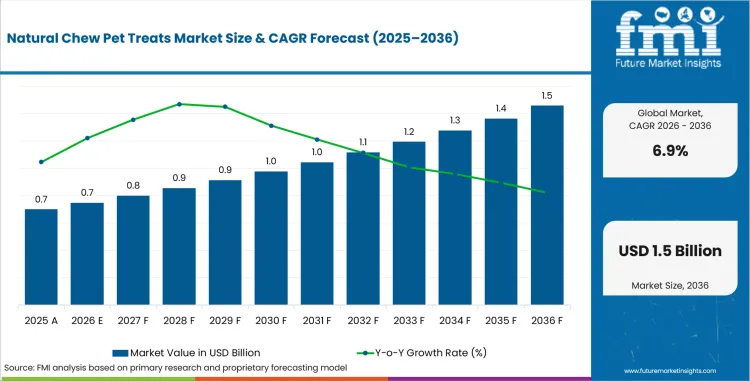
Natural Chew Pet Treats Market Overview: Size and Forecast
- 2026 Market Size: USD 0.8 billion
- 2036 Market Size: USD 1.5 billion
- Forecast CAGR: 6.9% from 2026 to 2036
- Leading Format: Long-lasting Hard Chews
- Long-lasting Hard Chews Share in 2026: 55.3%
- Leading End-use Buyer: Retail Dog Households
- Retail Dog Households Share in 2026: 68.9%
- Fastest-growing Country: Saudi Arabia
- Saudi Arabia CAGR: 8.2% by 2036
Summary of Natural Chew Pet Treats Market
- Demand and Growth Drivers
- Dog owners use natural chews for longer occupation routines inside home reward and enrichment occasions.
- Rawhide-free collagen and cheese formats help brands answer ingredient-panel scrutiny during premium treat selection.
- Pet specialty retailers explain chew hardness and dog-size matching better than general grocery shelves.
- Product and Segment View
- Long-lasting hard chews are forecast to represent 55.3% share in 2026, led by extended chewing time and higher unit pricing.
- Retail dog households are projected to hold 68.9% share in 2026, influenced by monthly treat replenishment and household use control.
- Pet specialty stores are expected to secure 38.4% share in 2026, reflected by advice-led buying and wider chew-wall assortment.
- Geography and Competitive Outlook
- Saudi Arabia is projected to record 8.2% CAGR by 2036, backed by premium pet retail and imported chew assortments.
- GCC excluding Saudi Arabia is expected to expand at 7.9% CAGR by 2036 through UAE specialty retail and expatriate dog ownership.
- Natural Farm and Redbarn compete based on broad natural chew assortments and USA retail availability.
- Himalayan Pet Supply and VAFO Group focus on cheese and collagen chews, while Earth Animal and TDBBS support rawhide-free and bully-stick placement.
- Analyst Opinion
- Nandini Roy Choudhury, Principal Consultant at Future Market Insights, observes, “Natural chew pet treats are shifting from impulse reward to planned dog-care purchase. Buyers already compare chew duration and dog-size suitability. Brands controlling texture and safety documentation are expected to secure stronger repeat listings.”
Contamination control is becoming the main operating pressure for natural chew pet treats as buyers tighten supplier checks around animal-origin products. FDA’s February 2026 Elite Treats recall covered 6-ounce Chicken Chips bags with lot number 24045 and distribution through feed stores in 5 USA states. Lot coding and distributor traceability now carry direct commercial value for feed-store and pet-specialty listings. Label readiness is also becoming a pack approval issue. AAFCO’s 2024 Midyear Committee Report recommended a 6-year enforcement discretion period for the new Model Pet Food and Specialty Pet Food Regulations. Chew suppliers can use that window to revise identity, feeding and claim language before retailer review. Dental-positioned chews face a separate claims filter. VOHC’s May 2026 dog list covers 6 accepted product categories and lists Blue Buffalo Dental Chews with a 2025 award year. Claim-backed placement gives retailers a cleaner split between dental chews and standard long-duration chews. Rawhide-free formulation also needs proof. The rawhide-free highly digestible dog chew patent family states at least 90% digestion within 18 hours, giving suppliers a measurable product-development target.
Why is the natural chew pet treats market growing?
Dog owners are shifting toward chews that combine longer engagement, cleaner pack claims and clearer safety assurance.
Growth is shifting toward natural chew suppliers proving ingredient handling and lot-level discipline. FDA’s November 2024 Gaines Pet Treats recall covered 204 bags of 5-ounce Chicken Chips sold through online retailers and independent pet stores in Alabama, Florida and Georgia. FDA’s November 2024 Carolina Prime Pet recall covered 400 bags of 16-ounce Chicken Chips distributed through Hollywood Feed stores across 19 states. These recalls show why pet specialty buyers are reviewing supplier testing, batch coding and channel traceability before expanding animal-origin chew ranges. Brands aligned with the natural dog treat market are likely to gain stronger placement by linking chew duration with documented safety controls.
Product approval is also becoming more compliance-led as imported and animal-origin chew assortments expand. FDA’s 2025 Foreign Supplier Verification Programs compliance program covers imported human and animal food, making importer verification more important for pet treats and chews. USDA APHIS also lists Canada export certification for thermally processed pet food products containing animal-origin ingredients. Suppliers serving the pet snacks and treats market and dog treats market are expected to improve buyer confidence through certificate-ready supply and verified contaminant controls.
How is the natural chew pet treats market segmented?
The natural chew pet treats industry is segmented by product type, ingredient base, format, sales channel and end-use buyer.
- Long-lasting hard chews are projected to secure 55.3% share in 2026, led by higher use time and premium unit value across dog households.
- Retail dog households are anticipated to hold 68.9% share in 2026 since home replenishment supports routine chew purchase.
- Pet specialty stores are forecast to represent 38.4% share in 2026, guided by staff explanation and wider natural chew ranges.
- Collagen and connective-tissue chews are expected to capture 34.7% share in 2026 due to rawhide-free positioning and digestibility language.
- Bovine collagen and hide-alternative inputs are projected to account for 32.8% share in 2026, reflected by chew texture and established animal-protein supply.
Why do long-lasting hard chews lead the natural chew pet treats market?
Long-lasting hard chews hold 55.3% share in 2026 due to extended use time and simple household storage.
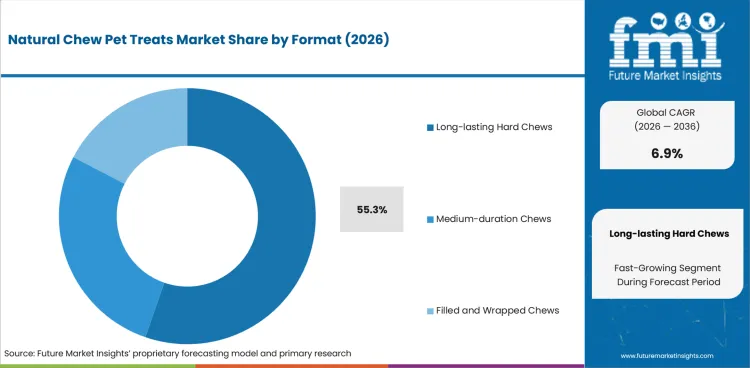
- Long-lasting hard chews are projected to account for 55.3% share in 2026, influenced by higher unit value and clearer use in occupation routines.
- Medium-duration chews gain selective use as softer textures help cautious owners move beyond soft treats.
Which end-use buyer leads the natural chew pet treats market?
Retail dog households hold 68.9% share in 2026, led by home replenishment and dog-size buying discipline.
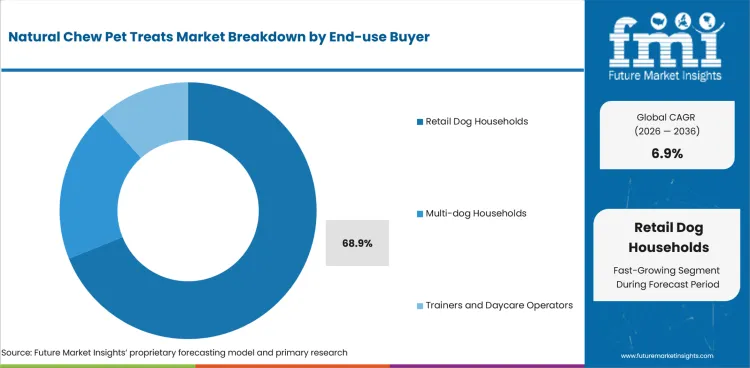
- Retail dog households are anticipated to hold 68.9% share in 2026 through repeat chew use and owner control over treat frequency.
- Trainers and daycare operators gain value through supervised enrichment programs needing controlled chew size and duration.
Which sales channel leads the natural chew pet treats market?
Pet specialty stores hold 38.4% share in 2026 through advice-led comparison and wider chew assortment.
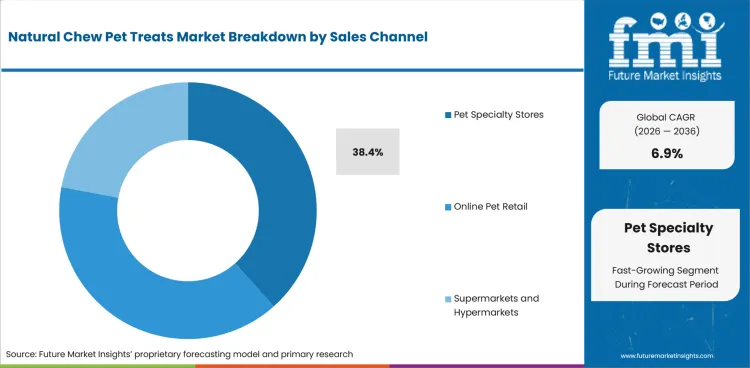
- Pet specialty stores are forecast to secure 38.4% share in 2026, shaped by staff guidance and product-wall comparison.
- Online pet retail gains value among repeat buyers who already know dog-size needs and preferred chew textures.
Which product type leads the natural chew pet treats market?
Collagen and connective-tissue chews lead at 34.7% share in 2026, influenced by rawhide-free positioning and chewing texture.
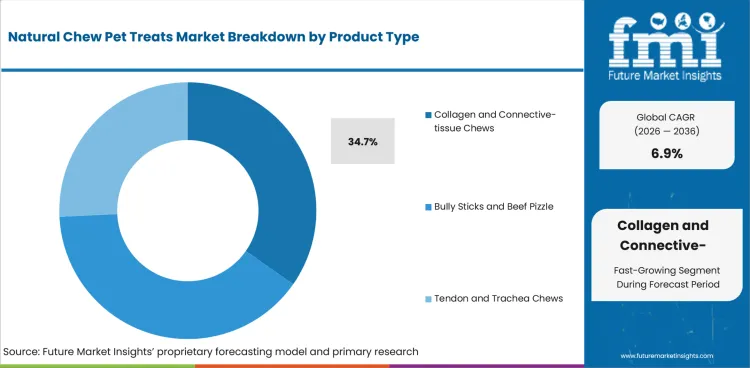
- Collagen and connective-tissue chews are expected to account for 34.7% share in 2026, driven by digestibility language and familiar chewing behavior.
- Bully sticks and beef pizzle retain selective value in premium baskets for buyers seeking single-animal-protein options.
Which ingredient base leads the natural chew pet treats market?
Bovine collagen and hide-alternative inputs lead at 32.8% share in 2026, reflected by chew structure and rawhide replacement.
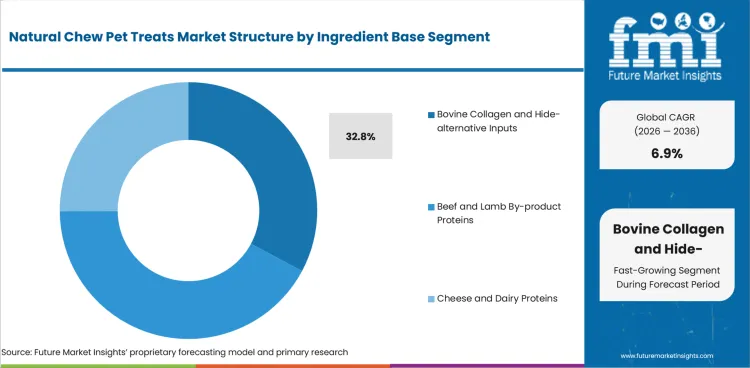
- Bovine collagen and hide-alternative inputs are projected to hold 32.8% share in 2026, led by texture control and established sourcing depth.
- Cheese and dairy proteins gain attention among brands seeking long-duration chews with limited ingredient panels.
What are the drivers, restraints and opportunities in the natural chew pet treats market?
Long chewing use supports purchase and safety scrutiny limits weaker suppliers, while rawhide-free design creates openings for better formats.
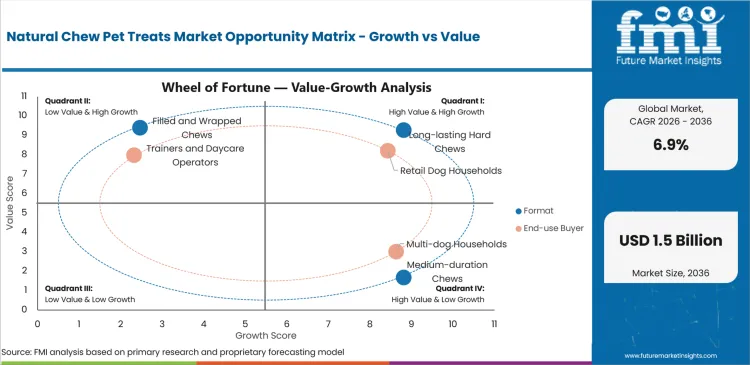
- Driver: Natural chews provide a longer reward occasion than soft treats and help owners manage daily dog enrichment.
- Restraint: Hard-chew injury risk and contamination recalls can slow repeat purchase among cautious owners.
- Opportunity: Collagen and tendon-style formats can convert rawhide concerns into clearer shelf selection.
Demand is moving toward natural chews combining longer use with tighter safety proof. FDA’s October 2025 Foodynamics recall covered freeze-dried pet treats across Raw Dog Barkery, BellePepper Cats, Kanu Pets and What’s In the Bowl brands after Salmonella was found through FDA sampling. The notice listed affected 16 oz. packages and 3 oz. packages, showing why lot discipline and package-level identification matter for animal-origin treat suppliers. Brands serving the pet oral care market can strengthen retail confidence by linking chew texture with documented contaminant controls.
Who buys natural chew pet treats?
Retail dog households and professional pet-care operators form the main buyer base for natural dog chews.
Buyer targeting should reflect both household replenishment and advice-led pet-care environments. Petco’s 2024 annual report stated that the company had about 300 full-service veterinary hospitals and operated more than 1,500 Vetco clinics weekly as of February 1, 2025. Tractor Supply reported 2,502 retail stores at December 28, 2024, including 206 Petsense by Tractor Supply stores. Suppliers linked to the pet care market can position natural chews as a repeat add-on for pet specialty and farm-and-feed channels.
What influences natural chew pet treats purchase decisions?
Chew duration and dog-size safety shape repeat purchase across pet specialty and professional channels.
Purchase decisions are expected to track how clearly brands explain chew function and product suitability. A 2024 Journal of Veterinary Dentistry study found that a honeycomb-shaped daily dental chew reduced calculus by 26.6%, plaque by 14.2% and malodor by 46.71% after 60 consecutive days of use. The finding supports product claims built around measured chewing outcomes instead of general dental language. Producers serving the pet dental health market and veterinary services market can use pack guidance and texture controls to support safer product selection.
Who are the leading companies in the natural chew pet treats market?
Natural Farm, Redbarn, Himalayan Pet Supply and VAFO Group are listed with TDBBS, Earth Animal, Cadet Pet, JR Pet Products, Bubimex and DoggyMan H.A.
- Chew-focused brands hold an advantage due to product duration and texture control.
- Established pet treat companies gain access through grocery relationships and repeat production capacity.
- European specialists build placement based on collagen and rawhide-free chew formats.
- Online suppliers gain acceptance by providing pack count clarity and dog-size filters.
Natural chew pet treat companies compete by combining long chew time with simple ingredient communication. Retailers assess pack price and repeat purchase evidence before assigning more shelf space. Online buyers review dog-size guidance and ingredient origin before reorder. Brands making product use simple are likely to move beyond one-time trial.
Manufacturing depth has become a competitive separator as dehydration and shaping affect chew hardness. Natural Farm and Himalayan Pet Supply compete depending on cheese and natural chew specialization. Redbarn, TDBBS and Cadet Pet use established North American retail access. VAFO Group, Earth Animal, JR Pet Products, Bubimex and DoggyMan H.A. compete based on regional familiarity and rawhide-free positioning.
Smaller and regional players can win through independent pet shops and established online platforms. Larger suppliers gain advantage through stable ingredient sourcing and retailer relationships. Companies with conservative safety communication and defendable pack pricing should gain stronger listing decisions. Brands relying only on novelty shapes are expected to face weaker acceptance in mainstream pet retail.
How do top natural chew pet treats companies compare?
Natural Farm and Redbarn score strongest on chew portfolio depth, while Himalayan Pet Supply and VAFO Group lead specialization in cheese and collagen chews.
| Company | Alignment to Market Title | Natural Chew Portfolio Depth | Texture and Processing Capability | Ingredient and Safety Positioning | Channel Reach | Geographic Footprint |
|---|---|---|---|---|---|---|
| Natural Farm | Very High | Very Strong | Strong | Strong | Strong | United States and Canada |
| Redbarn Pet Products | Very High | Very Strong | Strong | Moderate | Very Strong | North America |
| Himalayan Pet Supply | Very High | Strong | Very Strong | Strong | Strong | North America |
| VAFO Group / Brit Premium by Nature | Very High | Strong | Strong | Strong | Very Strong | Europe and selected exports |
| TDBBS | High | Very Strong | Strong | Moderate | Strong | United States |
| Earth Animal | High | Strong | Strong | Very Strong | Strong | United States and international |
| Cadet Pet | High | Strong | Moderate | Moderate | Strong | United States |
| JR Pet Products | High | Strong | Moderate | Strong | Moderate | United Kingdom |
| Bubimex | High | Moderate | Moderate | Strong | Moderate | Europe |
| DoggyMan H.A. | Moderate | Moderate | Moderate | Moderate | Strong | Japan |
Source: Future Market Insights competitive analysis, 2026.
Who are the key players in the natural chew pet treats market?
Natural Farm, Redbarn and Himalayan Pet Supply are listed with VAFO Group, TDBBS and Earth Animal among other suppliers.
Key global companies leading the natural chew pet treats market include:
- Natural Farm
- Redbarn Pet Products
- Himalayan Pet Supply
- VAFO Group / Brit Premium by Nature
- TDBBS
- Earth Animal
- Cadet Pet
- JR Pet Products
- Bubimex
- DoggyMan H.A.
Key Developments in Natural Chew Pet Treats Market
- In August 2025, VAFO Group introduced Brit Premium by Nature collagen chewable treats in sticks, hollow tubes and waves.
- In March 2024, Natural Farm introduced Himalayan Yak Cheese Chews for retail clients and online sale.
- In October 2025, FDA posted Best Buy Bones’ recall of Nature’s Own Pet Chews Bully Bites after Salmonella findings.
Key Players in the Natural Chew Pet Treats Market
Chew-focused Producers
- Natural Farm
- Redbarn Pet Products
- Himalayan Pet Supply
- TDBBS
- Cadet Pet
Rawhide-free and Collagen Specialists
- VAFO Group / Brit Premium by Nature
- Earth Animal
- JR Pet Products
- Bubimex
Regional and Channel Suppliers
- DoggyMan H.A.
- Pet specialty private-label suppliers
- Imported chew distributors
- Farm and feed store suppliers
Which countries are growing fastest in the natural chew pet treats market?
Saudi Arabia reaches 8.2% CAGR followed by GCC excluding Saudi Arabia at 7.9% through 2036.
.webp "Top Country Growth Comparison Natural Chew Pet Treats Market Cagr (2026 2036)")
| Country | CAGR |
|---|---|
| Saudi Arabia | 8.2% |
| GCC excluding Saudi Arabia | 7.9% |
| South Korea | 7.6% |
| United States | 7.1% |
| Australia | 6.8% |
| Canada | 6.5% |
| European Union | 6.2% |
| United Kingdom | 5.9% |
| Japan | 5.6% |
Source: Future Market Insights, 2026.
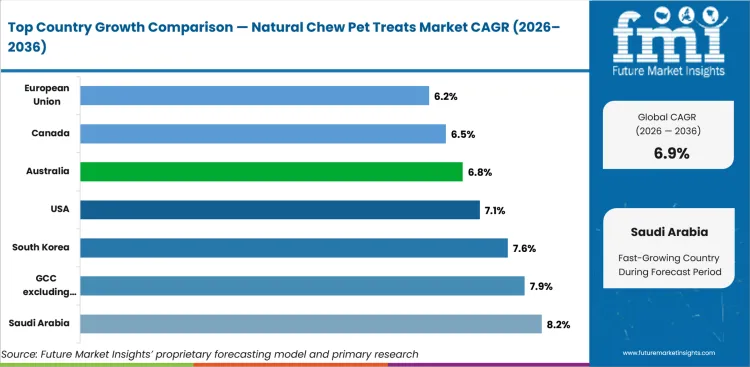
How do country-level CAGRs compare in the natural chew pet treats market?
Saudi Arabia leads country growth while Japan records the most cautious expansion outlook among profiled markets.
- Saudi Arabia is forecast to record 8.2% CAGR by 2036, driven by premium pet retail and imported chew assortment.
- GCC excluding Saudi Arabia is expected to expand at 7.9% CAGR from 2026 to 2036 due to UAE pet specialty stores and expatriate dog ownership.
- South Korea is projected to grow at 7.6% CAGR through 2036 since online pet retail and compact urban ownership support small-pack chews.
- United States is estimated to rise at 7.1% CAGR by 2036 through subscription replenishment and rawhide-free product comparison.
- Australia is expected to advance at 6.8% CAGR over the forecast period, led by high dog ownership and premium pet food spending.
- Canada is forecast to grow at 6.5% CAGR through 2036, influenced by dog treat spending and bilingual retail coverage.
- European Union is projected to post 6.2% CAGR by 2036, backed by multi-country premium pet food networks and traceability demands.
- United Kingdom is expected to increase at 5.9% CAGR by 2036, owing to high dog ownership and dense pet specialty access.
- Japan is expected to expand at 5.6% CAGR by 2036, guided by small-breed formats and careful hard-chew selection.
How fast is the natural chew pet treats market growing in Saudi Arabia?
Industry in Saudi Arabia is set to record 8.2% CAGR by 2036 as premium pet retailers test imported rawhide-free chews with documentation.
Country Market Snapshot Table
| Parameter | Value |
|---|---|
| Market Size in 2025 (Value) | USD 24.6 million |
| Market Size in 2026 (Value) | USD 26.6 million |
| Market Forecast in 2036 (Value) | USD 58.5 million |
| CAGR (2026 to 2036) | 8.2% |
| Years Considered | 2021 to 2036 |
| Base Year | 2025 |
| Forecast Period | 2026 to 2036 |
| Units Considered | Value (USD million) |
| Leading Sub-Region | Riyadh and Jeddah premium retail corridors |
Saudi Arabia Natural Chew Pet Treats Market Outlook
Saudi Arabia natural chew pet treats sector is influenced by imported pet foods and premium stores. Riyadh and Jeddah provide the strongest launch base for bully-style chews and cheese chews.
Retailers are expected to support products with Arabic claims and clear import documentation. Brands with smaller pack sizes and durable textures should gain stronger trial in specialty pet stores.
Key Growth Drivers
- Premium pet stores in Riyadh and Jeddah can expand natural chew assortments from dog food into collagen and cheese chews. USDA FAS reported Saudi pet food sales of USD 275.0 million in 2024.
- Imported dog and cat food availability supports wider chew selection through specialty retailers. OEC reported Saudi Arabia imported USD 65.1 million of retail dog or cat food in 2024.
- Specialty pet stores can explain chew hardness and dog-size matching to owners buying higher-priced dog products.
- Halal-sensitive documentation can support beef collagen and dairy-based chews sold through modern pet stores.
Key Restraints
- Imported chew items can carry higher freight and listing costs, limiting mainstream trial beyond established stores.
- Arabic pack claims and product clearance can slow onboarding before wider retail placement.
- Retail pricing remains sensitive for imported pet goods. GASTAT reported food and beverage prices rose 1.1% in the 2025 annual average CPI.
What makes Saudi Arabia unique
Saudi Arabia differs through premium pet retail corridors and import-led chew assortment.
Key Companies
- Pet Arabia suppliers
- Yummy Pets
- Petzone Saudi Arabia
- Paws and Claws
- Imported natural chew distributors
Sales & Marketing Channels
- Modern pet specialty stores
- Online pet retail
- Veterinary clinics
- Grooming salons
- Premium supermarket pet aisles
- Import distributors
Country Segment Breakdown Table
| Segment | Sub-Segments |
|---|---|
| By Product Type | Collagen and Connective-tissue Chews, Bully Sticks and Beef Pizzle, Tendon and Trachea Chews, Antler and Bone-style Natural Chews, Himalayan Cheese Chews |
| By Ingredient Base | Bovine Collagen and Hide-alternative Inputs, Beef and Lamb By-product Proteins, Cheese and Dairy Proteins, Poultry and Fish Inputs, Mixed Animal Proteins |
| By Format | Long-lasting Hard Chews, Medium-duration Chews, Filled and Wrapped Chews, Braided and Rolled Chews, Dental-shaped Natural Chews |
| By Sales Channel | Pet Specialty Stores, Online Pet Retail, Supermarkets and Hypermarkets, Veterinary and Grooming Channels, Farm and Feed Stores |
| By End-use Buyer | Retail Dog Households, Multi-dog Households, Trainers and Daycare Operators, Groomers and Veterinary Clinics, Gift and Seasonal Buyers |
| Key Sub-Regions Covered, Premium Retail Corridors | Riyadh, Jeddah, Dammam, Khobar, Makkah, Madinah |
Frequently Asked Questions
How fast is Saudi Arabia natural chew pet treats market growing?
Sales in Saudi Arabia are forecast to scale at 8.2% CAGR from 2026 to 2036, guided by premium pet specialty imports.
Who leads Saudi Arabia natural chew pet treats market?
Pet Arabia suppliers, Yummy Pets and imported chew distributors compete through store access and imported assortment depth.
What is driving adoption in Saudi Arabia natural chew pet treats market?
Premium pet retail and rawhide-free imported chews are moving buyers toward longer-duration dog treats.
What is the natural chew pet treats market outlook in GCC excluding Saudi Arabia?
Sector in GCC excluding Saudi Arabia is anticipated to rise at 7.9% CAGR by 2036, supported by UAE pet specialty retail and expatriate dog ownership.
Country Market Snapshot Table
| Parameter | Value |
|---|---|
| Market Size in 2025 (Value) | USD 31.0 million |
| Market Size in 2026 (Value) | USD 33.4 million |
| Market Forecast in 2036 (Value) | USD 71.4 million |
| CAGR (2026 to 2036) | 7.9% |
| Years Considered | 2021 to 2036 |
| Base Year | 2025 |
| Forecast Period | 2026 to 2036 |
| Units Considered | Value (USD million) |
| Leading Sub-Region | UAE and Kuwait imported pet retail corridors |
GCC excluding Saudi Arabia Natural Chew Pet Treats Market Outlook
Industry in GCC excluding Saudi Arabia is shaped by UAE-led imported pet retail and English pack communication. Dubai and Abu Dhabi support premium chew trials before wider Gulf distribution.
Heat exposure increases the need for controlled storage and durable packaging. Suppliers with shelf-stable chews and channel training should gain stronger buyer review.
Key Growth Drivers
- UAE pet retail provides a launch base for imported chews across Dubai and Abu Dhabi. USDA FAS reported UAE pet food sales of USD 219.0 million in 2024.
- Import diversity supports premium dog chew assortment in Gulf stores. WITS reported European Union exports of retail dog or cat food to the UAE at USD 51.1 million in 2024.
- Expatriate dog owners can favor international chew brands with familiar ingredient and feeding language.
- Grooming salons can introduce chew bundles during routine dog-care visits and breed-specific consultations.
Key Restraints
- Imported chew assortments can face higher logistics costs across smaller Gulf markets.
- Heat exposure raises shelf-stability requirements for dairy and animal-protein chews.
- Dog ownership remains smaller than cat ownership in the UAE. TGM Research reported veterinarian services were used by 54.6% of UAE pet-care respondents, keeping safety advice central before hard-chew purchase.
What makes GCC excluding Saudi Arabia unique
GCC excluding Saudi Arabia differs through UAE retail influence and cross-border imported supply.
Key Companies
- Dubai Pet Food
- Pet Corner
- Petzone Kuwait
- Pets Delight
- Imported natural chew suppliers
Sales & Marketing Channels
- Pet specialty chains
- Online pet stores
- Veterinary clinics
- Grooming salons
- Premium supermarkets
- Import distributors
Country Segment Breakdown Table
| Segment | Sub-Segments |
|---|---|
| By Product Type | Collagen and Connective-tissue Chews, Bully Sticks and Beef Pizzle, Tendon and Trachea Chews, Antler and Bone-style Natural Chews, Himalayan Cheese Chews |
| By Ingredient Base | Bovine Collagen and Hide-alternative Inputs, Beef and Lamb By-product Proteins, Cheese and Dairy Proteins, Poultry and Fish Inputs, Mixed Animal Proteins |
| By Format | Long-lasting Hard Chews, Medium-duration Chews, Filled and Wrapped Chews, Braided and Rolled Chews, Dental-shaped Natural Chews |
| By Sales Channel | Pet Specialty Stores, Online Pet Retail, Supermarkets and Hypermarkets, Veterinary and Grooming Channels, Farm and Feed Stores |
| By End-use Buyer | Retail Dog Households, Multi-dog Households, Trainers and Daycare Operators, Groomers and Veterinary Clinics, Gift and Seasonal Buyers |
| Key Sub-Regions Covered, Imported Pet Retail Areas | UAE, Kuwait, Qatar, Bahrain, Oman |
Frequently Asked Questions
How fast is GCC excluding Saudi Arabia natural chew pet treats market growing?
GCC excluding Saudi Arabia is expected to expand at 7.9% CAGR from 2026 to 2036, supported by UAE pet retail access.
Who leads GCC excluding Saudi Arabia natural chew pet treats market?
Dubai Pet Food, Pet Corner, Petzone Kuwait and imported natural chew suppliers compete through premium retail access.
What is driving adoption in GCC excluding Saudi Arabia natural chew pet treats market?
Imported pet specialty assortments and expatriate dog ownership are supporting rawhide-free chew placement.
What is driving natural chew pet treats growth in South Korea?
South Korea is projected to grow at 7.6% CAGR by 2036, backed by online pet retail and small-pack premium dog snacks.
Country Market Snapshot Table
| Parameter | Value |
|---|---|
| Market Size in 2025 (Value) | USD 31.8 million |
| Market Size in 2026 (Value) | USD 34.2 million |
| Market Forecast in 2036 (Value) | USD 71.1 million |
| CAGR (2026 to 2036) | 7.6% |
| Years Considered | 2021 to 2036 |
| Base Year | 2025 |
| Forecast Period | 2026 to 2036 |
| Units Considered | Value (USD million) |
| Leading Sub-Region | Seoul Capital Area |
South Korea Natural Chew Pet Treats Market Outlook
Industry in South Korea is shaped by compact dog ownership and online pet retail. Seoul-based retailers can test small natural chew packs before wider grocery expansion.
Imported premium products compete with domestic dog snack brands on texture and pack size. Brands with softer long-duration formats should gain stronger buyer review.
Key Growth Drivers
- Online pet retail supports repeat orders for small-pack collagen and cheese chews. USDA FAS reported Korean pet food purchases through e-commerce platforms at 63.0% in its August 2024 pet food report.
- Premium pet food scale supports natural chew trial. New Zealand Trade and Enterprise reported South Korea’s pet food market at about USD 1.6 billion in 2024.
- Urban buyers can favor single-piece and small multi-count packs that reduce storage burden.
- Chew assortments can be sorted by dog size to support safer purchase for small breeds.
Key Restraints
- Imported premium chews face margin pressure from freight and exchange-rate changes.
- Small-breed ownership narrows demand for very hard and extra-large chew formats.
- Import competition can pressure local shelf placement. OEC reported South Korea imported USD 611.0 million of animal food in 2025.
What makes South Korea unique
South Korea’s distinction comes from digital pet retail and compact dog-size demand.
Key Companies
- Bow Wow Korea
- Pulmuone pet products
- OURBOX pet retail
- Coupang pet suppliers
- Imported chew brands
- Online pet distributors
Sales & Marketing Channels
- Online marketplaces
- Pet specialty stores
- Department-store pet shops
- Veterinary clinics
- Subscription platforms
- Grooming salons
Country Segment Breakdown Table
| Segment | Sub-Segments |
|---|---|
| By Product Type | Collagen and Connective-tissue Chews, Bully Sticks and Beef Pizzle, Tendon and Trachea Chews, Antler and Bone-style Natural Chews, Himalayan Cheese Chews |
| By Ingredient Base | Bovine Collagen and Hide-alternative Inputs, Beef and Lamb By-product Proteins, Cheese and Dairy Proteins, Poultry and Fish Inputs, Mixed Animal Proteins |
| By Format | Long-lasting Hard Chews, Medium-duration Chews, Filled and Wrapped Chews, Braided and Rolled Chews, Dental-shaped Natural Chews |
| By Sales Channel | Pet Specialty Stores, Online Pet Retail, Supermarkets and Hypermarkets, Veterinary and Grooming Channels, Farm and Feed Stores |
| By End-use Buyer | Retail Dog Households, Multi-dog Households, Trainers and Daycare Operators, Groomers and Veterinary Clinics, Gift and Seasonal Buyers |
| Key Sub-Regions Covered, Online Pet Retail Areas | Seoul, Incheon, Busan, Daegu, Daejeon, Gwangju |
Frequently Asked Questions
How fast is South Korea natural chew pet treats market growing?
South Korea is projected to grow at 7.6% CAGR from 2026 to 2036, guided by online pet retail and premium dog snacks.
Who leads South Korea natural chew pet treats market?
Bow Wow Korea, Pulmuone pet products, Coupang pet suppliers and imported chew brands compete based on online and specialty retail.
What is driving adoption in South Korea natural chew pet treats market?
Small-pack premium dog snacks and digital reordering are supporting natural chew adoption.
How is the natural chew pet treats market performing in the United States?
The market in United States is estimated to rise at 7.1% CAGR by 2036, driven by rawhide-free comparison and subscription-led pet retail.
Country Market Snapshot Table
| Parameter | Value |
|---|---|
| Market Size in 2025 (Value) | USD 198.7 million |
| Market Size in 2026 (Value) | USD 212.8 million |
| Market Forecast in 2036 (Value) | USD 422.5 million |
| CAGR (2026 to 2036) | 7.1% |
| Years Considered | 2021 to 2036 |
| Base Year | 2025 |
| Forecast Period | 2026 to 2036 |
| Units Considered | Value (USD million) |
| Leading Sub-Region | Pacific Coast and Northeast pet specialty clusters |
United States Natural Chew Pet Treats Market Outlook
Demand in the United States is supported by large pet spending and established chew walls in pet specialty retail. Shoppers compare rawhide-free chews against collagen rolls and dental-style natural treats.
Retailers need evidence of repeat purchase before adding more premium chew facings. Brands with dependable safety documentation and clear dog-size guidance should gain better placement.
Key Growth Drivers
- Large pet ownership supports treat depth across pet specialty and online channels. APPA cited 95.0 million USA pet-owning households in its 2026 State of the Industry material.
- Subscription replenishment supports multi-count chew packs. Chewy reported fiscal 2025 net sales of USD 12.6 billion in March 2026.
- Pet specialty staff can guide owners away from oversized or overly hard formats for smaller dogs.
- Rawhide-free product lines can attract buyers comparing collagen and bully-stick alternatives.
Key Restraints
- Premium chews can face price gaps against soft treats and mainstream biscuits.
- Hard chews require clear warnings since aggressive chewers may swallow large pieces.
- Safety scrutiny remains a barrier. FDA reported a June 2024 TDBBS recall covering 3,551 bags of Green Tripe dog treats.
What makes the United States unique
United States conditions are distinct for national pet retail scale and subscription replenishment.
Key Companies
- Redbarn Pet Products
- Natural Farm
- TDBBS
- Earth Animal
- Himalayan Pet Supply
- Cadet Pet
Sales & Marketing Channels
- Pet specialty chains
- Online pet retail
- Mass merchandisers
- Farm and feed stores
- Veterinary clinics
- Club stores
Country Segment Breakdown Table
| Segment | Sub-Segments |
|---|---|
| By Product Type | Collagen and Connective-tissue Chews, Bully Sticks and Beef Pizzle, Tendon and Trachea Chews, Antler and Bone-style Natural Chews, Himalayan Cheese Chews |
| By Ingredient Base | Bovine Collagen and Hide-alternative Inputs, Beef and Lamb By-product Proteins, Cheese and Dairy Proteins, Poultry and Fish Inputs, Mixed Animal Proteins |
| By Format | Long-lasting Hard Chews, Medium-duration Chews, Filled and Wrapped Chews, Braided and Rolled Chews, Dental-shaped Natural Chews |
| By Sales Channel | Pet Specialty Stores, Online Pet Retail, Supermarkets and Hypermarkets, Veterinary and Grooming Channels, Farm and Feed Stores |
| By End-use Buyer | Retail Dog Households, Multi-dog Households, Trainers and Daycare Operators, Groomers and Veterinary Clinics, Gift and Seasonal Buyers |
| Key Sub-Regions Covered, Pet Retail Networks | Pacific Coast, Northeast Corridor, Midwest, Texas, South Atlantic, Mountain States |
Frequently Asked Questions
How fast is United States natural chew pet treats market growing?
Sector in the United States is anticipated to grow at 7.1% CAGR from 2026 to 2036, reflecting pet specialty and online retail access.
Who leads United States natural chew pet treats market?
Redbarn, Natural Farm, TDBBS, Earth Animal and Himalayan Pet Supply compete led by chew assortments and retail distribution.
What is driving adoption in United States natural chew pet treats market?
Rawhide-free comparison and repeat online purchasing are moving owners toward collagen and cheese-based chews.
What is the natural chew pet treats market forecast for Australia?
Sector in Australia is expected to scale at 6.8% CAGR by 2036, backed by high dog ownership and premium pet food spending.
Country Market Snapshot Table
| Parameter | Value |
|---|---|
| Market Size in 2025 (Value) | USD 37.7 million |
| Market Size in 2026 (Value) | USD 40.3 million |
| Market Forecast in 2036 (Value) | USD 77.8 million |
| CAGR (2026 to 2036) | 6.8% |
| Years Considered | 2021 to 2036 |
| Base Year | 2025 |
| Forecast Period | 2026 to 2036 |
| Units Considered | Value (USD million) |
| Leading Sub-Region | New South Wales and Victoria pet retail corridors |
Australia Natural Chew Pet Treats Market Outlook
Industry in Australia is influenced by high household pet ownership and specialty-store advice. Natural chews can enter premium baskets beside food and dental products. Biosecurity documentation shapes imported animal-protein chew access. Suppliers with clear pack sizing and quality controls should gain better store confidence.
Key Growth Drivers
- Dog ownership provides the core buyer base for natural chew replenishment. Animal Medicines Australia reported 7.3 million dogs in 2025.
- Retail dog snacks can benefit from premium pet spending. Agriculture and Agri-Food Canada reported Australia pet food retail sales reached USD 2.9 billion in 2024.
- Independent pet stores can explain chew hardness and ingredient origin to cautious buyers.
- Online subscriptions can support repeat purchase for collagen sticks and yak-style cheese chews.
Key Restraints
- Premium price points can limit trial among households facing higher pet-care costs.
- Imported animal-protein chews require consistent documentation for biosecurity and customs clearance.
- Veterinary cost pressure affects pet-care choices. Animal Medicines Australia reported 12.0% of pet owners required financial assistance for veterinary care in 2025.
What makes Australia unique
Australia stands apart through high dog ownership and strong advice-led pet retail.
Key Companies
- Pet Circle suppliers
- Yummi Pet
- Blackdog Pet Foods
- Rufus & Coco
- Imported chew brands
- Independent pet store suppliers
Sales & Marketing Channels
- Pet specialty stores
- Online pet retail
- Veterinary clinics
- Supermarket pet aisles
- Grooming salons
- Independent pet shops
Country Segment Breakdown Table
| Segment | Sub-Segments |
|---|---|
| By Product Type | Collagen and Connective-tissue Chews, Bully Sticks and Beef Pizzle, Tendon and Trachea Chews, Antler and Bone-style Natural Chews, Himalayan Cheese Chews |
| By Ingredient Base | Bovine Collagen and Hide-alternative Inputs, Beef and Lamb By-product Proteins, Cheese and Dairy Proteins, Poultry and Fish Inputs, Mixed Animal Proteins |
| By Format | Long-lasting Hard Chews, Medium-duration Chews, Filled and Wrapped Chews, Braided and Rolled Chews, Dental-shaped Natural Chews |
| By Sales Channel | Pet Specialty Stores, Online Pet Retail, Supermarkets and Hypermarkets, Veterinary and Grooming Channels, Farm and Feed Stores |
| By End-use Buyer | Retail Dog Households, Multi-dog Households, Trainers and Daycare Operators, Groomers and Veterinary Clinics, Gift and Seasonal Buyers |
| Key Sub-Regions Covered, Specialty Retail Corridors | Sydney, Melbourne, Brisbane, Perth, Adelaide, Canberra |
Frequently Asked Questions
How fast is Australia natural chew pet treats market growing?
Industry in Australia is projected to grow at 6.8% CAGR from 2026 to 2036, guided by high dog ownership and premium pet spending.
Who leads Australia natural chew pet treats market?
Pet Circle suppliers, Yummi Pet, Blackdog Pet Foods and imported chew brands compete due to specialty and online access.
What is driving adoption in Australia natural chew pet treats market?
Pet food spending and advice-led retail are supporting rawhide-free natural chew placement.
What is the natural chew pet treats market outlook in Canada?
Industry in Canada is likely to grow at 6.5% CAGR by 2036, helped by dog treat spending and bilingual retail coverage.
Country Market Snapshot Table
| Parameter | Value |
|---|---|
| Market Size in 2025 (Value) | USD 53.5 million |
| Market Size in 2026 (Value) | USD 57.0 million |
| Market Forecast in 2036 (Value) | USD 107.0 million |
| CAGR (2026 to 2036) | 6.5% |
| Years Considered | 2021 to 2036 |
| Base Year | 2025 |
| Forecast Period | 2026 to 2036 |
| Units Considered | Value (USD million) |
| Leading Sub-Region | Ontario and British Columbia grocery corridors |
Canada Natural Chew Pet Treats Market Outlook
Canada combines pet specialty chains with long-distance distribution and bilingual pack rules. Ontario and British Columbia provide the strongest early retail and online channels.
Premium chews require clear value communication against mainstream treats. Brands with stable supply and bilingual feeding guidance should gain stronger grocery access.
Key Growth Drivers
- Dog treat spending supports natural chew value. Agriculture and Agri-Food Canada reported Canadian pet food retail sales at Can$6.7 billion in 2024.
- Pet ownership scale supports replenishment. CAHI reported Canada had 7.2 million dogs and 8.2 million cats in 2024.
- Pet specialty chains can sort chew walls by dog size and protein source.
- Multi-count packs suit larger suburban households that buy treat stock through monthly trips.
Key Restraints
- Premium natural chews can lose trial against lower-priced biscuits and soft treats.
- Bilingual pack and claim review adds preparation work for imported USA brands.
- Pet-service inflation can shift spending away from premium treats. Statistics Canada reported grocery prices rose 3.5% in 2025, keeping household budgets under review.
What makes Canada unique
Canada’s route is shaped by bilingual labeling and long refrigerated distribution lanes.
Key Companies
- Rollover Premium Pet Food
- Jay’s Raw Pet Foods
- Pet Valu supplier network
- Canadian Naturals
- Imported chew brands
- Regional pet distributors
Sales & Marketing Channels
- Pet specialty chains
- Online pet retail
- Veterinary clinics
- Farm and feed stores
- Grocery pet aisles
- Independent pet stores
Country Segment Breakdown Table
| Segment | Sub-Segments |
|---|---|
| By Product Type | Collagen and Connective-tissue Chews, Bully Sticks and Beef Pizzle, Tendon and Trachea Chews, Antler and Bone-style Natural Chews, Himalayan Cheese Chews |
| By Ingredient Base | Bovine Collagen and Hide-alternative Inputs, Beef and Lamb By-product Proteins, Cheese and Dairy Proteins, Poultry and Fish Inputs, Mixed Animal Proteins |
| By Format | Long-lasting Hard Chews, Medium-duration Chews, Filled and Wrapped Chews, Braided and Rolled Chews, Dental-shaped Natural Chews |
| By Sales Channel | Pet Specialty Stores, Online Pet Retail, Supermarkets and Hypermarkets, Veterinary and Grooming Channels, Farm and Feed Stores |
| By End-use Buyer | Retail Dog Households, Multi-dog Households, Trainers and Daycare Operators, Groomers and Veterinary Clinics, Gift and Seasonal Buyers |
| Key Sub-Regions Covered, Grocery and Pet Retail Areas | Ontario, Quebec, British Columbia, Alberta, Manitoba, Saskatchewan |
Frequently Asked Questions
How fast is Canada natural chew pet treats market growing?
Sector in Canada is forecast at 6.5% CAGR from 2026 to 2036 with dog treat spending and pet specialty support.
Who leads Canada natural chew pet treats market?
Rollover, Jay’s Raw Pet Foods, Pet Valu suppliers and imported chew brands compete based on retail and online access.
What is driving adoption in Canada natural chew pet treats market?
Dog treat spending and bilingual premium retail are moving natural chews into recurring pet baskets.
How is the natural chew pet treats market performing in the European Union?
The market in European Union is projected to post 6.2% CAGR by 2036, owing to premium pet food networks and traceability demands.
Country Market Snapshot Table
| Parameter | Value |
|---|---|
| Market Size in 2025 (Value) | USD 128.8 million |
| Market Size in 2026 (Value) | USD 136.8 million |
| Market Forecast in 2036 (Value) | USD 249.6 million |
| CAGR (2026 to 2036) | 6.2% |
| Years Considered | 2021 to 2036 |
| Base Year | 2025 |
| Forecast Period | 2026 to 2036 |
| Units Considered | Value (USD million) |
| Leading Sub-Region | Germany and France pet retail networks |
European Union Natural Chew Pet Treats Market Outlook
European Union natural chew demand reflects multi-country pet food scale and retailer caution on animal-origin claims. Germany and France provide stronger shelf depth for collagen and cheese chews.
Local languages and traceability documents shape retailer approval. Suppliers need country-specific pack planning and stable animal-protein sourcing.
Key Growth Drivers
- Pet-owning households provide scale for premium chew assortments. FEDIAF reported 140.0 million European households owned pets in June 2026.
- EU export capacity supports animal-protein chew supply and cross-border assortment. WITS reported European Union retail dog or cat food exports of USD 4.2 billion in 2024.
- Collagen and rawhide-free chews can enter premium pet specialty assortments with clearer ingredient origin.
- Local pack translation and animal-protein traceability can improve retailer listing confidence.
Key Restraints
- Cross-country labeling differences raise cost for smaller chew brands seeking EU-wide distribution.
- Raw animal-protein inputs require quality assurance that smaller exporters may not document consistently.
- Animal by-product rules raise compliance work for chew suppliers. The European Commission states that over 20.0 million tonnes of animal by-products arise annually in the EU.
What makes the European Union unique
European Union conditions differ through multi-country retail scale and localized label expectations.
Key Companies
- VAFO Group
- Trixie
- Vitakraft
- Bubimex
- Edgard & Cooper
- AniForte
Sales & Marketing Channels
- Pet specialty chains
- Online pet retail
- Supermarkets
- Veterinary clinics
- Garden centers
- Independent pet shops
Country Segment Breakdown Table
| Segment | Sub-Segments |
|---|---|
| By Product Type | Collagen and Connective-tissue Chews, Bully Sticks and Beef Pizzle, Tendon and Trachea Chews, Antler and Bone-style Natural Chews, Himalayan Cheese Chews |
| By Ingredient Base | Bovine Collagen and Hide-alternative Inputs, Beef and Lamb By-product Proteins, Cheese and Dairy Proteins, Poultry and Fish Inputs, Mixed Animal Proteins |
| By Format | Long-lasting Hard Chews, Medium-duration Chews, Filled and Wrapped Chews, Braided and Rolled Chews, Dental-shaped Natural Chews |
| By Sales Channel | Pet Specialty Stores, Online Pet Retail, Supermarkets and Hypermarkets, Veterinary and Grooming Channels, Farm and Feed Stores |
| By End-use Buyer | Retail Dog Households, Multi-dog Households, Trainers and Daycare Operators, Groomers and Veterinary Clinics, Gift and Seasonal Buyers |
| Key Sub-Regions Covered, Premium Pet Retail Corridors | Germany, France, Netherlands, Spain, Italy, Austria |
Frequently Asked Questions
How fast is European Union natural chew pet treats market growing?
Demand in European Union is ready to rise at 6.2% CAGR from 2026 to 2036m, led by premium pet food support.
Who leads European Union natural chew pet treats market?
VAFO Group, Trixie, Vitakraft, Bubimex and AniForte compete depending on multi-country pet retail access.
What is driving adoption in European Union natural chew pet treats market?
Pet food sales depth and rawhide-free traceability are supporting collagen and tendon-style chew placement.
How is the natural chew pet treats market performing in the United Kingdom?
The market in United Kingdom is projected to post 5.9% CAGR by 2036, helped by high dog ownership and established pet specialty shelves.
Country Market Snapshot Table
| Parameter | Value |
|---|---|
| Market Size in 2025 (Value) | USD 50.2 million |
| Market Size in 2026 (Value) | USD 53.2 million |
| Market Forecast in 2036 (Value) | USD 94.4 million |
| CAGR (2026 to 2036) | 5.9% |
| Years Considered | 2021 to 2036 |
| Base Year | 2025 |
| Forecast Period | 2026 to 2036 |
| Units Considered | Value (USD million) |
| Leading Sub-Region | London and Southeast England |
United Kingdom Natural Chew Pet Treats Market Outlook
United Kingdom natural chew sales are centered on pet specialty and online purchase routines. Discounters and mainstream supermarkets shape price expectations for dog treat packs.
Retail buyers need stronger repeat purchase evidence before expanding hard-chew ranges. Brands with affordable multi-count packs and clear warnings should gain stronger listings.
Key Growth Drivers
- Dog ownership supports treat replenishment. UK Pet Food reported approximately 15.5 million pet dogs in 2026.
- Household dog ownership supports repeat treat baskets. UK Pet Food reported 41.0% of UK households owned a dog in 2026.
- High-street pet chains can compare rawhide-free chews and dental-style natural formats in one aisle.
- Online pet retail can support repeat orders for multi-count packs and subscription bundles.
Key Restraints
- Cost-of-living pressure can push buyers toward smaller packs and occasional purchase.
- Breed and chewing-style variation requires conservative safety messaging on hard products.
- Veterinary cost pressure can redirect household spending away from premium treats. The UK Competition and Markets Authority reported veterinary and other pet services were valued at over GBP 6.7 billion in 2024.
What makes the United Kingdom unique
United Kingdom stands out through dense pet retail access and high dog-owner scrutiny.
Key Companies
- Pooch & Mutt
- JR Pet Products
- Pets at Home private label
- Laughing Dog
- Imported chew brands
- Independent pet suppliers
Sales & Marketing Channels
- Pet specialty chains
- Online pet retail
- Supermarkets
- Veterinary clinics
- Independent pet shops
- Grooming salons
Country Segment Breakdown Table
| Segment | Sub-Segments |
|---|---|
| By Product Type | Collagen and Connective-tissue Chews, Bully Sticks and Beef Pizzle, Tendon and Trachea Chews, Antler and Bone-style Natural Chews, Himalayan Cheese Chews |
| By Ingredient Base | Bovine Collagen and Hide-alternative Inputs, Beef and Lamb By-product Proteins, Cheese and Dairy Proteins, Poultry and Fish Inputs, Mixed Animal Proteins |
| By Format | Long-lasting Hard Chews, Medium-duration Chews, Filled and Wrapped Chews, Braided and Rolled Chews, Dental-shaped Natural Chews |
| By Sales Channel | Pet Specialty Stores, Online Pet Retail, Supermarkets and Hypermarkets, Veterinary and Grooming Channels, Farm and Feed Stores |
| By End-use Buyer | Retail Dog Households, Multi-dog Households, Trainers and Daycare Operators, Groomers and Veterinary Clinics, Gift and Seasonal Buyers |
| Key Sub-Regions Covered, Pet Retail Areas | London, Manchester, Birmingham, Leeds, Glasgow, Bristol |
Frequently Asked Questions
How fast is United Kingdom natural chew pet treats market growing?
Industry in the United Kingdom is projected to increase at 5.9% CAGR from 2026 to 2036 through pet specialty retail.
Who leads United Kingdom natural chew pet treats market?
JR Pet Products, Pooch & Mutt, Pets at Home private label and imported chew suppliers compete depending on retail access.
What is driving adoption in United Kingdom natural chew pet treats market?
High dog ownership and natural treat shelves are supporting rawhide-free chew demand.
What is the natural chew pet treats market forecast for Japan?
Sector in Japan is expected to rise at 5.6% CAGR by 2036, guided by small packs and mild-odor chew formats suited to metro trial.
Country Market Snapshot Table
| Parameter | Value |
|---|---|
| Market Size in 2025 (Value) | USD 30.2 million |
| Market Size in 2026 (Value) | USD 31.9 million |
| Market Forecast in 2036 (Value) | USD 55.0 million |
| CAGR (2026 to 2036) | 5.6% |
| Years Considered | 2021 to 2036 |
| Base Year | 2025 |
| Forecast Period | 2026 to 2036 |
| Units Considered | Value (USD million) |
| Leading Sub-Region | Kanto and Kansai pet specialty corridors |
Japan Natural Chew Pet Treats Market Outlook
Demand in Japan is influenced by small dogs and careful product testing. Buyers compare hardness and piece size against familiar dog snacks before repeat purchase.
Small pack size and clear feeding cues can support early adoption. Suppliers need softer natural chew options suited to compact household storage.
Key Growth Drivers
- Dog treat demand supports premium chew entry in small formats. Agriculture and Agri-Food Canada reported dog treats and mixers as the fastest-growing dog food segment with 5.7% forecast CAGR from 2023 to 2028.
- Pet-owner recognition supports premium care messaging. A 2025 peer-reviewed paper citing the Japan Pet Food Association’s 2024 survey reported dog ownership at 10.2% and cat ownership at 9.6%.
- Compact homes favor smaller packs and lower-odor chews for indoor storage.
- Senior dog care can support softer collagen and tendon-style options instead of very hard bones.
Key Restraints
- Dog population decline can slow volume growth outside premium segments.
- Very hard chews may face caution among owners of small or senior dogs.
- Economy dog food weakness signals price sensitivity. Agriculture and Agri-Food Canada forecast economy wet dog food to decline at 5.2% CAGR from 2023 to 2028.
What makes Japan unique
Japan’s distinct path comes from small-pack discipline and mild-odor expectations.
Key Companies
- DoggyMan H.A.
- Unicharm Pet
- Inaba Petfood
- Petio
- Imported natural chew suppliers
- Premium grocery suppliers
Sales & Marketing Channels
- Pet specialty stores
- Home-center pet aisles
- Online pet retail
- Veterinary clinics
- Department store pet corners
- Supermarket pet aisles
Country Segment Breakdown Table
| Segment | Sub-Segments |
|---|---|
| By Product Type | Collagen and Connective-tissue Chews, Bully Sticks and Beef Pizzle, Tendon and Trachea Chews, Antler and Bone-style Natural Chews, Himalayan Cheese Chews |
| By Ingredient Base | Bovine Collagen and Hide-alternative Inputs, Beef and Lamb By-product Proteins, Cheese and Dairy Proteins, Poultry and Fish Inputs, Mixed Animal Proteins |
| By Format | Long-lasting Hard Chews, Medium-duration Chews, Filled and Wrapped Chews, Braided and Rolled Chews, Dental-shaped Natural Chews |
| By Sales Channel | Pet Specialty Stores, Online Pet Retail, Supermarkets and Hypermarkets, Veterinary and Grooming Channels, Farm and Feed Stores |
| By End-use Buyer | Retail Dog Households, Multi-dog Households, Trainers and Daycare Operators, Groomers and Veterinary Clinics, Gift and Seasonal Buyers |
| Key Sub-Regions Covered, Specialty Retail Areas | Tokyo, Osaka, Yokohama, Nagoya, Fukuoka, Sapporo |
Frequently Asked Questions
How fast is Japan natural chew pet treats market growing?
Industry in Japan is projected at 5.6% CAGR from 2026 to 2036 as pet stores test small-pack natural chews.
Who leads Japan natural chew pet treats market?
DoggyMan H.A., Unicharm Pet, Inaba Petfood and imported premium chew suppliers compete through pet specialty and home-center channels.
What is driving adoption in Japan natural chew pet treats market?
Small-dog ownership and premium snack routines are supporting measured natural chew trial.
Natural Chew Pet Treats Market - Scope & Definition
| Attribute | Detail |
|---|---|
| Market Definition | Finished natural dog chews sold as long-duration treats with animal-protein, collagen, cheese or rawhide-free positioning |
| Functions Covered | Chewing enrichment, reward use, dental-style chewing, occupation during downtime and dog-size treat matching |
| Applications Covered | Household dog treats, training support, daycare enrichment, grooming add-ons, veterinary retail and subscription replenishment |
| End-Use Industries | Pet specialty retail, online pet retail, veterinary services, grooming salons, supermarkets and farm-and-feed retail |
| Grades Covered | Long-lasting hard chews, medium-duration chews, filled chews, wrapped chews and dental-shaped natural chews |
| Inclusions | Collagen chews, bully sticks, pizzle, tendons, trachea, antlers and cheese chews sold as natural chewing treats |
| Exclusions | Soft biscuits, jerky strips, training bites, wet food toppers and conventional rawhide chews lacking natural or rawhide-free positioning |
Natural Chew Pet Treats Market - Research Methodology
| Method | Description |
|---|---|
| Primary Research | FMI analyst interviews with natural chew producers, pet specialty buyers, online pet retailers, importers and contract packers across key markets |
| Desk Research | Review of company announcements, government statistics, association data, FDA recall records and pet industry publications dated 2024 onward |
| Market Sizing & Forecasting | Bottom-up product-boundary approach using eligible SKU revenue, retail pricing, channel presence, product form segmentation and country-level adoption trends |
| Data Validation | Cross-verification using dog population indicators, pet food and treat spending, supplier product availability and pet specialty channel activity checks |
Natural Chew Pet Treats Market - Report Scope
| Parameter | Details |
|---|---|
| Market size by 2036 | USD 1.5 billion |
| Growth rate | 6.9% CAGR from 2026 to 2036 |
| Forecast period | 2026 to 2036 |
| Base year value (2025) | USD 0.7 billion |
| By product type | Collagen and connective-tissue chews, bully sticks and beef pizzle, tendon and trachea chews, antler and bone-style natural chews, Himalayan cheese chews |
| By ingredient base | Bovine collagen and hide-alternative inputs, beef and lamb by-product proteins, cheese and dairy proteins, poultry and fish inputs, mixed animal proteins |
| By format | Long-lasting hard chews, medium-duration chews, filled and wrapped chews, braided and rolled chews, dental-shaped natural chews |
| By sales channel | Pet specialty stores, online pet retail, supermarkets and hypermarkets, veterinary and grooming channels, farm and feed stores |
| By end-use buyer | Retail dog households, multi-dog households, trainers and daycare operators, groomers and veterinary clinics, gift and seasonal buyers |
| Regions covered | North America, Europe, GCC, East Asia, South Asia and Pacific, Middle East and Africa |
| Countries covered | United States, Canada, European Union, United Kingdom, Saudi Arabia, GCC excluding Saudi Arabia, South Korea, Japan, Australia |
| Key companies profiled | Natural Farm, Redbarn, Himalayan Pet Supply, VAFO Group, TDBBS, Earth Animal, Cadet Pet, JR Pet Products |
| Approach | Bottom-up product-boundary approach using eligible SKU revenue, channel presence, retail pricing, product positioning and country-level adoption |
Source: Future Market Insights, 2026.
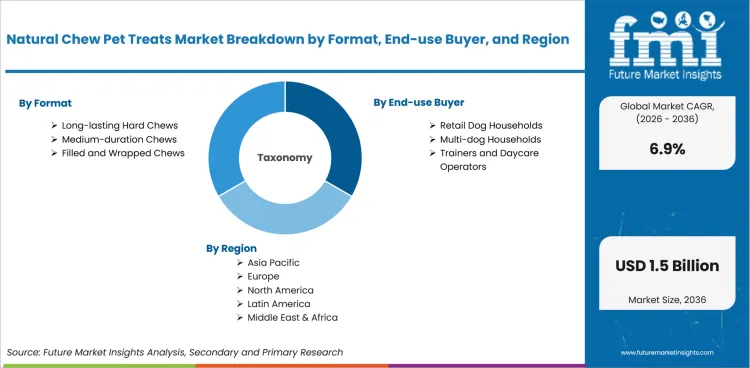
Natural Chew Pet Treats Market Breakdown by Product Type, Ingredient Base, Format, Sales Channel, End-use Buyer, and Region
Natural Chew Pet Treats Market Segmented by Product Type
- Collagen and Connective-tissue Chews
- Bully Sticks and Beef Pizzle
- Tendon and Trachea Chews
- Antler and Bone-style Natural Chews
- Himalayan Cheese Chews
Natural Chew Pet Treats Market Segmented by Ingredient Base
- Bovine Collagen and Hide-alternative Inputs
- Beef and Lamb By-product Proteins
- Cheese and Dairy Proteins
- Poultry and Fish Inputs
- Mixed Animal Proteins
Natural Chew Pet Treats Market Segmented by Format
- Long-lasting Hard Chews
- Medium-duration Chews
- Filled and Wrapped Chews
- Braided and Rolled Chews
- Dental-shaped Natural Chews
Natural Chew Pet Treats Market Segmented by Sales Channel
- Pet Specialty Stores
- Online Pet Retail
- Supermarkets and Hypermarkets
- Veterinary and Grooming Channels
- Farm and Feed Stores
Natural Chew Pet Treats Market Segmented by End-use Buyer
- Retail Dog Households
- Multi-dog Households
- Trainers and Daycare Operators
- Groomers and Veterinary Clinics
- Gift and Seasonal Buyers
Natural Chew Pet Treats Market by Region
- North America
- Latin America
- Europe
- East Asia
- South Asia and Pacific
- Middle East and Africa
This Report Answers
- What is the 2026 value and 2036 forecast for natural chew pet treats market?
- What format is projected to hold the leading share during the forecast period?
- What end-use buyer is expected to account for the leading 2026 share?
- How do rawhide-free claims and dog-size guidance affect adoption?
- What companies compete in natural chew pet treats?
Research Sources and Bibliography
- American Pet Products Association. (2026, March 26). USA pet industry reaches $158 billion in 2025, poised for continued growth in 2026. American Pet Products Association.
- Animal Medicines Australia. (2025, September 18). Pets in Australia: A national survey of pets and people 2025. Animal Medicines Australia.
- Canadian Animal Health Institute. (2025, March 11). Canadian pet population survey highlights the importance of access to veterinary care. Canadian Animal Health Institute.
- Chewy, Inc. (2026, March 25). Chewy announces fiscal fourth quarter and full year 2025 financial results. Chewy Investor Relations.
- Crowder, S. E., Berg, M., Bellows, J., Artzer, M., MacGee, S., & Schultz, L. (2024, May 31). Effectiveness of a daily honeycomb-shaped dental chew in reducing calculus, plaque, gingivitis and malodor in dogs. Journal of Veterinary Dentistry.
- Foodynamics. (2025, October 9). Correction: Foodynamics recalls Raw Dog Barkery, BellePepper Cats, Kanu Pets, and What’s In the Bowl brand freeze-dried pet treats because of possible Salmonella contamination. USA Food and Drug Administration.
- Gaines Pet Treats LLC. (2024, November 22). Gaines Pet Treats LLC voluntarily recalls “Gaines Family Farmstead Chicken Chips” treats for dogs due to possible Salmonella contamination. USA Food and Drug Administration.
- Natural Farm. (2024, March 18). Natural Farm introduces traditional Himalayan Yak Cheese: Handcrafted with care. Natural Farm Pet.
- Petco Health and Wellness Company, Inc. (2025, March 31). Form 10-K for the fiscal year ended February 1, 2025. USA Securities and Exchange Commission.
- Tractor Supply Company. (2025, February 20). Form 10-K for the fiscal year ended December 28, 2024. USA Securities and Exchange Commission.
- USA Department of Agriculture, Animal and Plant Health Inspection Service. (2025, July 30). Canada: Thermally processed pet food products containing animal-origin ingredients. USA Department of Agriculture.
- USA Food and Drug Administration. (2024, June 26). Biological, chemical, and physical contaminants in animal food. USA Food and Drug Administration.
- USA Food and Drug Administration. (2025, August 28). Compliance program 7303.878: Foreign Supplier Verification Programs for importers of food for humans and animals. USA Food and Drug Administration.
- USA Food and Drug Administration. (2025, October 3). Best Buy Bones, Inc. recalls Nature’s Own Pet Chews Bully Bites because of possible Salmonella health risk. USA Food and Drug Administration.
- VAFO Group. (2025, August 19). New collagen chewable treats from Brit Premium by Nature. VAFO Group.
- Veterinary Oral Health Council. (2026, May 29). VOHC accepted products for dogs. Veterinary Oral Health Council.
This bibliography is provided for reader reference and is not exhaustive. The full report contains the complete reference list and detailed citations.
Frequently Asked Questions
What is the natural chew pet treats market size in 2026?
The natural chew pet treats market size is anticipated to cross USD 0.8 billion in 2026.
What is the natural chew pet treats market forecast for 2036?
The natural chew pet treats industry revenue is predicted to reach USD 1.5 billion by 2036 as long-duration chew formats expand.
What is the natural chew pet treats market CAGR?
The natural chew pet treats sector is projected to expand at 6.9% CAGR from 2026 to 2036.
What segment leads the natural chew pet treats market?
Long-lasting hard chews are likely to capture 55.3% share in 2026 due to extended use time and simple household storage.
What country grows fastest in the natural chew pet treats market?
Saudi Arabia is forecast to record 8.2% CAGR by 2036, driven by premium pet retail and imported chew assortments.
Preview the report firsthand - request a free sample
Get SampleGet the brochure for pricing and purchase details.
Get PDFTable of Content
- Executive Summary
- Global Market Outlook
- Demand to side Trends
- Supply to side Trends
- Technology Roadmap Analysis
- Analysis and Recommendations
- Market Overview
- Market Coverage / Taxonomy
- Market Definition / Scope / Limitations
- Research Methodology
- Chapter Orientation
- Analytical Lens and Working Hypotheses
- Market Structure, Signals, and Trend Drivers
- Benchmarking and Cross-market Comparability
- Market Sizing, Forecasting, and Opportunity Mapping
- Research Design and Evidence Framework
- Desk Research Programme (Secondary Evidence)
- Company Annual and Sustainability Reports
- Peer-reviewed Journals and Academic Literature
- Corporate Websites, Product Literature, and Technical Notes
- Earnings Decks and Investor Briefings
- Statutory Filings and Regulatory Disclosures
- Technical White Papers and Standards Notes
- Trade Journals, Industry Magazines, and Analyst Briefs
- Conference Proceedings, Webinars, and Seminar Materials
- Government Statistics Portals and Public Data Releases
- Press Releases and Reputable Media Coverage
- Specialist Newsletters and Curated Briefings
- Sector Databases and Reference Repositories
- FMI Internal Proprietary Databases and Historical Market Datasets
- Subscription Datasets and Paid Sources
- Social Channels, Communities, and Digital Listening Inputs
- Additional Desk Sources
- Expert Input and Fieldwork (Primary Evidence)
- Primary Modes
- Qualitative Interviews and Expert Elicitation
- Quantitative Surveys and Structured Data Capture
- Blended Approach
- Why Primary Evidence is Used
- Field Techniques
- Interviews
- Surveys
- Focus Groups
- Observational and In-context Research
- Social and Community Interactions
- Stakeholder Universe Engaged
- C-suite Leaders
- Board Members
- Presidents and Vice Presidents
- R&D and Innovation Heads
- Technical Specialists
- Domain Subject-matter Experts
- Scientists
- Physicians and Other Healthcare Professionals
- Governance, Ethics, and Data Stewardship
- Research Ethics
- Data Integrity and Handling
- Primary Modes
- Tooling, Models, and Reference Databases
- Desk Research Programme (Secondary Evidence)
- Data Engineering and Model Build
- Data Acquisition and Ingestion
- Cleaning, Normalisation, and Verification
- Synthesis, Triangulation, and Analysis
- Quality Assurance and Audit Trail
- Market Background
- Market Dynamics
- Drivers
- Restraints
- Opportunity
- Trends
- Scenario Forecast
- Demand in Optimistic Scenario
- Demand in Likely Scenario
- Demand in Conservative Scenario
- Opportunity Map Analysis
- Product Life Cycle Analysis
- Supply Chain Analysis
- Investment Feasibility Matrix
- Value Chain Analysis
- PESTLE and Porter’s Analysis
- Regulatory Landscape
- Regional Parent Market Outlook
- Production and Consumption Statistics
- Import and Export Statistics
- Market Dynamics
- Global Market Analysis 2021 to 2025 and Forecast, 2026 to 2036
- Historical Market Size Value (USD Million) Analysis, 2021 to 2025
- Current and Future Market Size Value (USD Million) Projections, 2026 to 2036
- Y to o to Y Growth Trend Analysis
- Absolute $ Opportunity Analysis
- Global Market Pricing Analysis 2021 to 2025 and Forecast 2026 to 2036
- Global Market Analysis 2021 to 2025 and Forecast 2026 to 2036, By Format
- Introduction / Key Findings
- Historical Market Size Value (USD Million) Analysis By Format , 2021 to 2025
- Current and Future Market Size Value (USD Million) Analysis and Forecast By Format , 2026 to 2036
- Long-lasting Hard Chews
- Medium-duration Chews
- Filled and Wrapped Chews
- Long-lasting Hard Chews
- Y to o to Y Growth Trend Analysis By Format , 2021 to 2025
- Absolute $ Opportunity Analysis By Format , 2026 to 2036
- Global Market Analysis 2021 to 2025 and Forecast 2026 to 2036, By End-use Buyer
- Introduction / Key Findings
- Historical Market Size Value (USD Million) Analysis By End-use Buyer, 2021 to 2025
- Current and Future Market Size Value (USD Million) Analysis and Forecast By End-use Buyer, 2026 to 2036
- Retail Dog Households
- Multi-dog Households
- Trainers and Daycare Operators
- Retail Dog Households
- Y to o to Y Growth Trend Analysis By End-use Buyer, 2021 to 2025
- Absolute $ Opportunity Analysis By End-use Buyer, 2026 to 2036
- Global Market Analysis 2021 to 2025 and Forecast 2026 to 2036, By Sales Channel
- Introduction / Key Findings
- Historical Market Size Value (USD Million) Analysis By Sales Channel, 2021 to 2025
- Current and Future Market Size Value (USD Million) Analysis and Forecast By Sales Channel, 2026 to 2036
- Pet Specialty Stores
- Online Pet Retail
- Supermarkets and Hypermarkets
- Pet Specialty Stores
- Y to o to Y Growth Trend Analysis By Sales Channel, 2021 to 2025
- Absolute $ Opportunity Analysis By Sales Channel, 2026 to 2036
- Global Market Analysis 2021 to 2025 and Forecast 2026 to 2036, By Product Type
- Introduction / Key Findings
- Historical Market Size Value (USD Million) Analysis By Product Type, 2021 to 2025
- Current and Future Market Size Value (USD Million) Analysis and Forecast By Product Type, 2026 to 2036
- Collagen and Connective-tissue Chews
- Bully Sticks and Beef Pizzle
- Tendon and Trachea Chews
- Collagen and Connective-tissue Chews
- Y to o to Y Growth Trend Analysis By Product Type, 2021 to 2025
- Absolute $ Opportunity Analysis By Product Type, 2026 to 2036
- Global Market Analysis 2021 to 2025 and Forecast 2026 to 2036, By Ingredient Base
- Introduction / Key Findings
- Historical Market Size Value (USD Million) Analysis By Ingredient Base, 2021 to 2025
- Current and Future Market Size Value (USD Million) Analysis and Forecast By Ingredient Base, 2026 to 2036
- Bovine Collagen and Hide-alternative Inputs
- Beef and Lamb By-product Proteins
- Cheese and Dairy Proteins
- Bovine Collagen and Hide-alternative Inputs
- Y to o to Y Growth Trend Analysis By Ingredient Base, 2021 to 2025
- Absolute $ Opportunity Analysis By Ingredient Base, 2026 to 2036
- Global Market Analysis 2021 to 2025 and Forecast 2026 to 2036, By Region
- Introduction
- Historical Market Size Value (USD Million) Analysis By Region, 2021 to 2025
- Current Market Size Value (USD Million) Analysis and Forecast By Region, 2026 to 2036
- North America
- Latin America
- Western Europe
- Eastern Europe
- East Asia
- South Asia and Pacific
- Middle East & Africa
- Market Attractiveness Analysis By Region
- North America Market Analysis 2021 to 2025 and Forecast 2026 to 2036, By Country
- Historical Market Size Value (USD Million) Trend Analysis By Market Taxonomy, 2021 to 2025
- Market Size Value (USD Million) Forecast By Market Taxonomy, 2026 to 2036
- By Country
- USA
- Canada
- Mexico
- By Format
- By End-use Buyer
- By Sales Channel
- By Product Type
- By Ingredient Base
- By Country
- Market Attractiveness Analysis
- By Country
- By Format
- By End-use Buyer
- By Sales Channel
- By Product Type
- By Ingredient Base
- Key Takeaways
- Latin America Market Analysis 2021 to 2025 and Forecast 2026 to 2036, By Country
- Historical Market Size Value (USD Million) Trend Analysis By Market Taxonomy, 2021 to 2025
- Market Size Value (USD Million) Forecast By Market Taxonomy, 2026 to 2036
- By Country
- Brazil
- Chile
- Rest of Latin America
- By Format
- By End-use Buyer
- By Sales Channel
- By Product Type
- By Ingredient Base
- By Country
- Market Attractiveness Analysis
- By Country
- By Format
- By End-use Buyer
- By Sales Channel
- By Product Type
- By Ingredient Base
- Key Takeaways
- Western Europe Market Analysis 2021 to 2025 and Forecast 2026 to 2036, By Country
- Historical Market Size Value (USD Million) Trend Analysis By Market Taxonomy, 2021 to 2025
- Market Size Value (USD Million) Forecast By Market Taxonomy, 2026 to 2036
- By Country
- Germany
- UK
- Italy
- Spain
- France
- Nordic
- BENELUX
- Rest of Western Europe
- By Format
- By End-use Buyer
- By Sales Channel
- By Product Type
- By Ingredient Base
- By Country
- Market Attractiveness Analysis
- By Country
- By Format
- By End-use Buyer
- By Sales Channel
- By Product Type
- By Ingredient Base
- Key Takeaways
- Eastern Europe Market Analysis 2021 to 2025 and Forecast 2026 to 2036, By Country
- Historical Market Size Value (USD Million) Trend Analysis By Market Taxonomy, 2021 to 2025
- Market Size Value (USD Million) Forecast By Market Taxonomy, 2026 to 2036
- By Country
- Russia
- Poland
- Hungary
- Balkan & Baltic
- Rest of Eastern Europe
- By Format
- By End-use Buyer
- By Sales Channel
- By Product Type
- By Ingredient Base
- By Country
- Market Attractiveness Analysis
- By Country
- By Format
- By End-use Buyer
- By Sales Channel
- By Product Type
- By Ingredient Base
- Key Takeaways
- East Asia Market Analysis 2021 to 2025 and Forecast 2026 to 2036, By Country
- Historical Market Size Value (USD Million) Trend Analysis By Market Taxonomy, 2021 to 2025
- Market Size Value (USD Million) Forecast By Market Taxonomy, 2026 to 2036
- By Country
- China
- Japan
- South Korea
- By Format
- By End-use Buyer
- By Sales Channel
- By Product Type
- By Ingredient Base
- By Country
- Market Attractiveness Analysis
- By Country
- By Format
- By End-use Buyer
- By Sales Channel
- By Product Type
- By Ingredient Base
- Key Takeaways
- South Asia and Pacific Market Analysis 2021 to 2025 and Forecast 2026 to 2036, By Country
- Historical Market Size Value (USD Million) Trend Analysis By Market Taxonomy, 2021 to 2025
- Market Size Value (USD Million) Forecast By Market Taxonomy, 2026 to 2036
- By Country
- India
- ASEAN
- Australia & New Zealand
- Rest of South Asia and Pacific
- By Format
- By End-use Buyer
- By Sales Channel
- By Product Type
- By Ingredient Base
- By Country
- Market Attractiveness Analysis
- By Country
- By Format
- By End-use Buyer
- By Sales Channel
- By Product Type
- By Ingredient Base
- Key Takeaways
- Middle East & Africa Market Analysis 2021 to 2025 and Forecast 2026 to 2036, By Country
- Historical Market Size Value (USD Million) Trend Analysis By Market Taxonomy, 2021 to 2025
- Market Size Value (USD Million) Forecast By Market Taxonomy, 2026 to 2036
- By Country
- Kingdom of Saudi Arabia
- Other GCC Countries
- Turkiye
- South Africa
- Other African Union
- Rest of Middle East & Africa
- By Format
- By End-use Buyer
- By Sales Channel
- By Product Type
- By Ingredient Base
- By Country
- Market Attractiveness Analysis
- By Country
- By Format
- By End-use Buyer
- By Sales Channel
- By Product Type
- By Ingredient Base
- Key Takeaways
- Key Countries Market Analysis
- USA
- Pricing Analysis
- Market Share Analysis, 2025
- By Format
- By End-use Buyer
- By Sales Channel
- By Product Type
- By Ingredient Base
- Canada
- Pricing Analysis
- Market Share Analysis, 2025
- By Format
- By End-use Buyer
- By Sales Channel
- By Product Type
- By Ingredient Base
- Mexico
- Pricing Analysis
- Market Share Analysis, 2025
- By Format
- By End-use Buyer
- By Sales Channel
- By Product Type
- By Ingredient Base
- Brazil
- Pricing Analysis
- Market Share Analysis, 2025
- By Format
- By End-use Buyer
- By Sales Channel
- By Product Type
- By Ingredient Base
- Chile
- Pricing Analysis
- Market Share Analysis, 2025
- By Format
- By End-use Buyer
- By Sales Channel
- By Product Type
- By Ingredient Base
- Germany
- Pricing Analysis
- Market Share Analysis, 2025
- By Format
- By End-use Buyer
- By Sales Channel
- By Product Type
- By Ingredient Base
- UK
- Pricing Analysis
- Market Share Analysis, 2025
- By Format
- By End-use Buyer
- By Sales Channel
- By Product Type
- By Ingredient Base
- Italy
- Pricing Analysis
- Market Share Analysis, 2025
- By Format
- By End-use Buyer
- By Sales Channel
- By Product Type
- By Ingredient Base
- Spain
- Pricing Analysis
- Market Share Analysis, 2025
- By Format
- By End-use Buyer
- By Sales Channel
- By Product Type
- By Ingredient Base
- France
- Pricing Analysis
- Market Share Analysis, 2025
- By Format
- By End-use Buyer
- By Sales Channel
- By Product Type
- By Ingredient Base
- India
- Pricing Analysis
- Market Share Analysis, 2025
- By Format
- By End-use Buyer
- By Sales Channel
- By Product Type
- By Ingredient Base
- ASEAN
- Pricing Analysis
- Market Share Analysis, 2025
- By Format
- By End-use Buyer
- By Sales Channel
- By Product Type
- By Ingredient Base
- Australia & New Zealand
- Pricing Analysis
- Market Share Analysis, 2025
- By Format
- By End-use Buyer
- By Sales Channel
- By Product Type
- By Ingredient Base
- China
- Pricing Analysis
- Market Share Analysis, 2025
- By Format
- By End-use Buyer
- By Sales Channel
- By Product Type
- By Ingredient Base
- Japan
- Pricing Analysis
- Market Share Analysis, 2025
- By Format
- By End-use Buyer
- By Sales Channel
- By Product Type
- By Ingredient Base
- South Korea
- Pricing Analysis
- Market Share Analysis, 2025
- By Format
- By End-use Buyer
- By Sales Channel
- By Product Type
- By Ingredient Base
- Russia
- Pricing Analysis
- Market Share Analysis, 2025
- By Format
- By End-use Buyer
- By Sales Channel
- By Product Type
- By Ingredient Base
- Poland
- Pricing Analysis
- Market Share Analysis, 2025
- By Format
- By End-use Buyer
- By Sales Channel
- By Product Type
- By Ingredient Base
- Hungary
- Pricing Analysis
- Market Share Analysis, 2025
- By Format
- By End-use Buyer
- By Sales Channel
- By Product Type
- By Ingredient Base
- Kingdom of Saudi Arabia
- Pricing Analysis
- Market Share Analysis, 2025
- By Format
- By End-use Buyer
- By Sales Channel
- By Product Type
- By Ingredient Base
- Turkiye
- Pricing Analysis
- Market Share Analysis, 2025
- By Format
- By End-use Buyer
- By Sales Channel
- By Product Type
- By Ingredient Base
- South Africa
- Pricing Analysis
- Market Share Analysis, 2025
- By Format
- By End-use Buyer
- By Sales Channel
- By Product Type
- By Ingredient Base
- USA
- Market Structure Analysis
- Competition Dashboard
- Competition Benchmarking
- Market Share Analysis of Top Players
- By Regional
- By Format
- By End-use Buyer
- By Sales Channel
- By Product Type
- By Ingredient Base
- Competition Analysis
- Competition Deep Dive
- Natural Farm
- Overview
- Product Portfolio
- Profitability by Market Segments (Product/Age /Sales Channel/Region)
- Sales Footprint
- Strategy Overview
- Marketing Strategy
- Product Strategy
- Channel Strategy
- Redbarn Pet Products
- Himalayan Pet Supply
- VAFO Group / Brit Premium by Nature
- TDBBS
- Earth Animal
- Natural Farm
- Competition Deep Dive
- Assumptions & Acronyms Used


