

- Industry Size (2026)
- USD 6283.0 Mn
- Forecast (2036)
- USD 8446.0 Mn
- CAGR (2026 to 2036)
- 3.0%
Truck Wheel Hubs and Hub Bearings Market Forecast and Outlook 2026 to 2036
The truck wheel hubs and hub bearings market is valued at USD 6,283.0 million in 2026 and is projected to reach USD 8,446.0 million by 2036 at a CAGR of 3.0%. Value behavior reflects structural dependence on replacement demand and regulated OEM sourcing rather than rapid expansion in truck production volumes. Consumption concentrates in heavy-duty fleets operating under high axle loads, sustained mileage accumulation, and demanding braking conditions. Revenue formation is anchored to wheel hub assemblies and tapered roller bearing solutions specified for Class 7-8 trucks, where component reliability directly influences safety compliance and uptime economics. Aftermarket activity accounts for a substantial share due to predictable wear cycles, long vehicle service life, and preventive maintenance regimes.
Outlook over the forecast period is shaped by durability expectations, maintenance economics, and constrained substitution potential. Growth remains measured due to mature truck platforms and extended component lifecycles in developed regions. Specification priorities emphasize load-bearing capability, sealing effectiveness, thermal stability, and compatibility with braking and suspension systems. Manufacturing scalability is moderated by precision machining requirements, steel input cost exposure, and quality validation obligations for safety-critical components. Electrification introduces limited incremental design adjustment without altering core volume drivers. Demand progression remains steady, supported by freight utilization intensity, infrastructure-linked truck deployment, and lifecycle-driven replacement rather than structural increases in global truck populations.
Quick Stats for Truck Wheel Hubs and Hub Bearings Market
- Truck Wheel Hubs and Hub Bearings Market Value (2026): USD 6,283.0 million
- Truck Wheel Hubs and Hub Bearings Market Forecast Value (2036): USD 8,446.0 million
- Truck Wheel Hubs and Hub Bearings Market Forecast CAGR 2026 to 2036: 3.0%
- Leading Product Category by Demand Share: Wheel Hub Assemblies
- Fastest-Growing Countries: China, Brazil, USA, Germany, South Korea
- Top Players in Global Demand: SKF, Schaeffler, Timken, NTN, JTEKT, NSK, Dana, Meritor (Cummins), ZF, ILJIN
Truck Wheel Hubs and Hub Bearings Market Key Takeaways
| Metric | Value |
|---|---|
| Market Value (2026) | USD 6,283.0 million |
| Market Forecast Value (2036) | USD 8,446.0 million |
| Forecast CAGR 2026 to 2036 | 3.0% |
Why is the Demand for Truck Wheel Hubs and Hub Bearings Growing?
Demand for truck wheel hubs and hub bearings is increasing as commercial vehicle operations require components that support high reliability under heavy loads and sustained mileage. Fleet planners specify hubs and bearings that meet engineering criteria for load distribution, rotational stability, and durability in varied terrain and climate conditions. Maintenance and repair facilities emphasize replacement parts with precise tolerances and material strength to reduce unscheduled downtime and maintain alignment with safety standards for commercial trucks. Procurement teams assess product certification, supply continuity, and serviceability when selecting components for new vehicle builds and aftermarket support programs.
Transport operators focus on solutions that support predictable wear performance and ease of installation because consistent uptime underpins operational planning and cost control. Expansion of freight activity and long distance haulage reinforces uptake of wheel hubs and bearings that withstand repeated stress cycles and harsh operating environments. Heavy duty truck OEMs and component suppliers collaborate to integrate hubs and bearings with braking and suspension systems that preserve vehicle stability and reduce vibration. Technical training for mechanics on proper installation and inspection procedures enhances component life and supports fleet reliability targets. These operational priorities sustain demand for robust wheel hub and bearing solutions in evolving transport and logistics frameworks.
How Are the Segments Classified in the Truck Wheel Hubs and Hub Bearings Market?
Demand for truck wheel hubs and hub bearings is shaped by axle load intensity, duty cycle severity, and uptime requirements across freight operations. Component reliability influences safety, rolling efficiency, and maintenance intervals under continuous service conditions. Specification decisions reflect thermal management needs, sealing performance, and compatibility with braking systems. Adoption aligns with regulatory oversight on vehicle safety and fleet maintenance practices. Segment classification reflects differentiation by product configuration, vehicle application, and bearing technology. Structure highlights how assembly complexity, vehicle class exposure, and bearing design influence installation frequency, service life expectations, and procurement patterns across heavy and medium-duty transport platforms.
Which Product Category Represents the Largest Share of Demand?
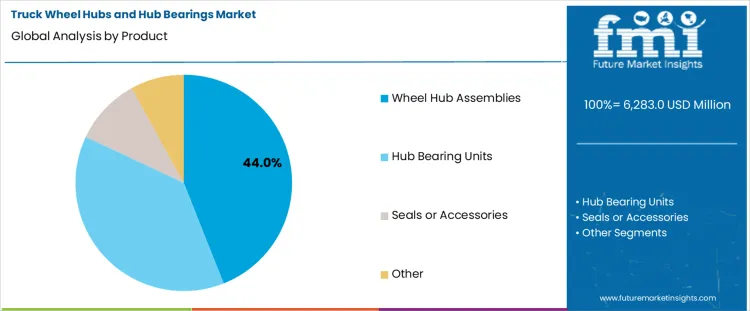
Wheel hub assemblies hold 44.0%, representing the largest share among product categories due to integrated design and service efficiency. Assemblies combine hubs, bearings, and seals into unified units that simplify installation and reduce assembly errors. Fleet operators value reduced downtime and predictable maintenance intervals enabled by preassembled configurations. Thermal stability and alignment accuracy support consistent braking and load distribution performance. Hub bearing units address replacement flexibility with component-level servicing requirements. Seals and accessories support protection and longevity without primary load-bearing responsibility. Product segmentation reflects preference for integrated solutions that streamline service operations and enhance reliability under heavy-duty operating conditions.
Key Points:
- Integrated assemblies simplify installation and maintenance workflows.
- Unified design supports alignment accuracy and thermal stability.
- Other products address component-level servicing and protection needs.
Which Vehicle Segment Accounts for the Highest Share of Demand?
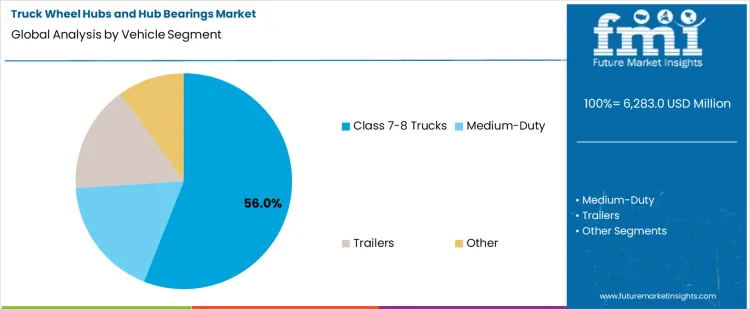
Class 7-8 trucks hold 56.0%, representing the largest share among vehicle segments due to high payload and mileage exposure. These vehicles operate under sustained loads across long-haul and regional freight routes. Wheel hubs and bearings experience continuous stress from weight, braking heat, and road variability. Fleet maintenance strategies emphasize durability to limit roadside failures and service disruptions. Medium-duty trucks and trailers operate with different load profiles and maintenance cycles. Other vehicles contribute lower aggregate intensity. Vehicle segmentation reflects concentration of component demand where operating severity and utilization rates remain highest.
Key Points:
- Heavy-duty trucks impose sustained mechanical and thermal loads.
- High utilization increases replacement and service frequency.
- Other segments operate under less severe duty profiles.
Which Bearing Type Drives the Largest Share of Demand?
Tapered roller bearings hold 54.0%, representing the largest share among bearing types due to load-handling capability. This design supports combined radial and axial loads common in heavy truck operation. Proven durability and heat dissipation characteristics align with braking and axle demands. Compatibility with established hub designs supports widespread use across fleets. Integrated hub units offer maintenance advantages with higher upfront complexity. Ceramic or low-friction options address efficiency-focused applications with limited deployment. Bearing type segmentation reflects reliance on robust, field-proven designs delivering stability, longevity, and predictable performance under heavy commercial service conditions.
Key Points:
- Tapered rollers manage combined load conditions effectively.
- Proven durability supports heavy-duty service requirements.
- Other bearing types address integration or efficiency priorities.
What are the Key Dynamics in the Truck Wheel Hubs and Hub Bearings Market?
Demand for truck wheel hubs and hub bearings reflects critical requirements for load support, rotational stability, and drivetrain reliability in commercial vehicles. Adoption spans heavy-duty trucks, medium-duty trucks, and specialized vocational vehicles. Global scope aligns with freight movement intensity, axle load ratings, and durability expectations under continuous operation. Usage integrates with axle systems, braking assemblies, and suspension architectures governed by safety and performance standards.
How do durability requirements and vehicle utilization patterns shape adoption?
Commercial trucking places sustained radial and axial loads on wheel-end components across long duty cycles. Demand increases where higher gross vehicle weight ratings and extended mileage intervals elevate fatigue resistance requirements. Fleet operators prioritize sealed hub units and advanced bearing designs to reduce lubrication intervals and contamination risk. Heat dissipation capability supports braking performance during downhill hauling and stop-and-go urban delivery. Precision manufacturing improves load distribution and reduces vibration, supporting driver comfort and component life. Compatibility with anti-lock braking and stability systems reinforces adoption. Standardized wheel-end assemblies simplify maintenance planning across mixed fleets, supporting operational consistency.
How do maintenance economics and operating conditions influence market scalability?
Component cost sensitivity remains high due to fleet-scale replacement volumes and uptime priorities. Demand sensitivity rises where premature bearing failure increases roadside service events and downtime penalties. Operating conditions such as dust, moisture, and temperature extremes accelerate wear, affecting lifecycle predictability. Installation quality and torque control influence failure rates, increasing dependence on skilled service networks. Regulatory requirements for axle load compliance constrain design flexibility. Supply chain exposure to steel quality and heat treatment capacity affects consistency. Remanufacturing acceptance varies by region, influencing replacement cycles and limiting uniform scalability.
How Is Demand for Truck Wheel Hubs and Hub Bearings Evolving Globally?
Demand for truck wheel hubs and hub bearings is expanding globally due to sustained freight activity, infrastructure usage, and lifecycle-driven replacement within commercial vehicle fleets. Consumption patterns align with axle load intensity, mileage accumulation, and maintenance practices across logistics, construction, and agricultural transport. OEM demand remains stable, while aftermarket replacement contributes a significant share where vehicle utilization rates are high. Technological improvements in sealing, lubrication, and durability influence replacement cycles. Growth rates in China at 4.0%, Brazil at 3.9%, USA at 2.8%, Germany at 2.6%, and South Korea at 2.4% indicate steady expansion driven by operating intensity and maintenance needs rather than rapid fleet expansion.
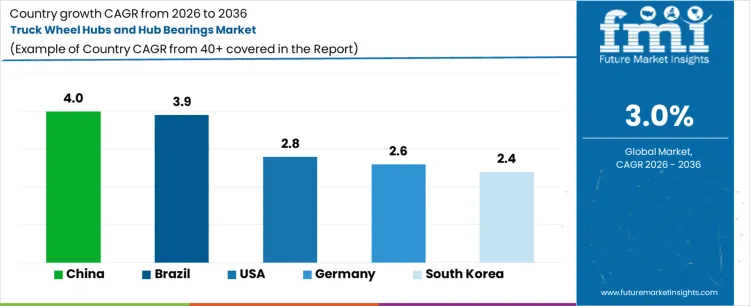
| Country | CAGR (%) |
|---|---|
| China | 4.0% |
| Brazil | 3.9% |
| USA | 2.8% |
| Germany | 2.6% |
| South Korea | 2.4% |
What Is Supporting Truck Wheel Hub and Bearing Demand Growth in China?
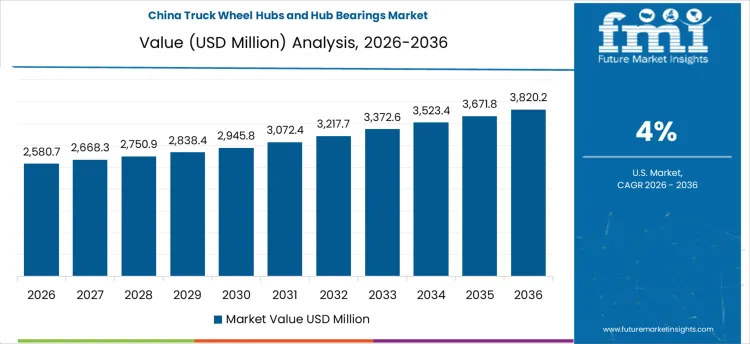
Freight intensity and infrastructure usage are shaping truck wheel hub and hub bearing demand in China, growing at a CAGR of 4.0%. High utilization of medium and heavy-duty trucks accelerates wear on rotating components. Construction material transport and intercity logistics sustain continuous vehicle operation. Domestic truck production supports OEM installation volumes. Enforcement of safety inspections increases replacement of worn hub assemblies. Demand growth remains maintenance-led, reflecting high mileage accumulation rather than expansion in truck population.
- High utilization across freight and construction transport
- Sustained domestic truck manufacturing output
- Wear-driven replacement of rotating components
- Safety inspection enforcement influencing maintenance
Why Is Brazil Experiencing Steady Growth in Truck Wheel Hub Demand?
Long-distance road transport conditions underpin truck wheel hub and bearing demand growth in Brazil at a CAGR of 3.9%. Extended freight routes increase thermal and mechanical stress on hub assemblies. Agricultural commodity logistics sustain heavy truck usage across rural corridors. Limited rail penetration reinforces dependence on road-based freight. Fleet aging contributes to consistent aftermarket replacement. Demand expansion reflects operating conditions and maintenance requirements rather than growth in new truck sales.
- Long-haul freight routes increasing component stress
- Agricultural logistics driving heavy truck utilization
- Road-dominant freight transport structure
- Aging fleet supporting aftermarket demand
How Is the USA Sustaining Demand for Truck Wheel Hubs and Bearings?
High mileage operation across commercial fleets sustains truck wheel hub and hub bearing demand in the USA, expanding at a CAGR of 2.8%. Heavy-duty trucks accumulate substantial annual distances, increasing bearing wear. Aftermarket replacement represents a major demand source due to long vehicle service life. Construction and infrastructure activity supports consistent truck deployment. Fleet operators emphasize preventive maintenance to avoid downtime. Growth remains moderate, aligned with replacement cycles rather than expansion of fleet size.
- High annual mileage in heavy-duty truck fleets
- Strong aftermarket replacement demand
- Construction activity supporting vehicle utilization
- Preventive maintenance focus among fleet operators
What Factors Are Shaping Truck Wheel Hub Demand in Germany?
Mature logistics operations influence truck wheel hub and bearing demand in Germany, growing at a CAGR of 2.6%. Engineering standards and regulated axle loads extend component lifespan. Freight transport relies on well-maintained fleets operating under strict safety norms. Export-driven manufacturing sustains steady logistics movement. Replacement demand remains predictable due to structured maintenance schedules. Growth reflects disciplined fleet management rather than increases in truck deployment.
- Regulated axle loads extending component life
- Structured preventive maintenance practices
- Stable export-driven freight movement
- High engineering standards in vehicle components
Why Is South Korea Showing Controlled Growth in Truck Wheel Hub Demand?
Geographic scale and logistics efficiency define truck wheel hub and bearing demand in South Korea, expanding at a CAGR of 2.4%. Shorter transport distances reduce cumulative bearing wear. High fleet turnover and maintenance discipline limit premature failures. Manufacturing and port logistics support steady truck utilization. Replacement demand arises mainly from scheduled servicing rather than breakdown-related repairs. Growth remains controlled, reflecting efficient logistics networks and limited expansion of heavy-duty truck fleets.
- Shorter transport distances reducing wear intensity
- High maintenance discipline across fleets
- Manufacturing and port logistics activity
- Scheduled replacement within stable fleet sizes
What is the competitive landscape of demand for the truck wheel hubs and hub bearings market globally?
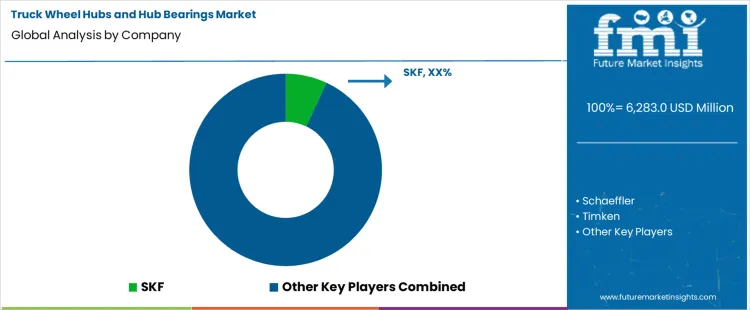
Demand for truck wheel hubs and hub bearings is driven by commercial vehicle production, fleet renewal cycles, and stringent requirements for durability, load capacity, and maintenance intervals. These components support wheel mounting, axial and radial loads, and rotational stability under heavy loads and variable road conditions. Buyers evaluate bearing precision, service life, sealing effectiveness, material quality, and compatibility with braking systems and electronic stability controls. Procurement teams prioritize suppliers with global manufacturing footprints, validated quality systems, adherence to OEM specifications, and strong aftermarket support. Trend in the global market reflects growth of heavy-duty and medium-duty truck segments, emphasis on total cost of ownership, and integration of sensor-ready bearing housings for predictive maintenance.
SKF holds leading positioning through a broad portfolio of heavy vehicle wheel hubs and bearings supported by global production capacity and technical support. Schaeffler supports demand with high-precision hub units and bearing systems optimized for load performance and long service life. Timken contributes heavy-duty bearing and hub assemblies with strong track record in commercial vehicle applications. NTN supplies truck hub and bearing systems with integrated sealing and lubrication solutions tailored to demanding road applications. JTEKT participates with wheel hub bearings and related driveline components backed by engineering support and global logistics. Competitive differentiation depends on bearing durability, precision manufacturing, design robustness, and ability to deliver serviceable aftermarket parts.
Key Players in the Truck Wheel Hubs and Hub Bearings Market
- SKF
- Schaeffler
- Timken
- NTN
- JTEKT
- NSK
- Dana
- Meritor (Cummins)
- ZF
- ILJIN
Scope of the Report
| Items | Values |
|---|---|
| Quantitative Units | USD million |
| Product | Wheel Hub Assemblies; Hub Bearing Units; Seals or Accessories; Other |
| Vehicle Segment | Class 7-8 Trucks; Medium-Duty; Trailers; Other |
| Bearing Type | Tapered Roller Bearings; Integrated Hub Units; Ceramic or Low-Friction; Other |
| Sales Channel | OEM Line-Fit; Aftermarket; Dealer or OES; Other |
| Regions Covered | Asia Pacific, Europe, North America, Latin America, Middle East & Africa |
| Countries Covered | China, Brazil, USA, Germany, South Korea, and 40+ countries |
| Key Companies Profiled | SKF; Schaeffler; Timken; NTN; JTEKT; NSK; Dana; Meritor; ZF; ILJIN |
| Additional Attributes | Dollar sales by product and bearing type; adoption trends for integrated hub bearing units to reduce maintenance and improve uptime in heavy-duty fleets; load capacity, friction loss, and bearing life performance metrics; sealing effectiveness, contamination resistance, and lubrication retention considerations; compatibility with disc and drum brake configurations across truck and trailer axles; compliance with OEM durability standards, axle load regulations, and safety requirements influencing wheel hub and hub bearing selection. |
Truck Wheel Hubs and Hub Bearings Market by Segment
By Product:
- Wheel Hub Assemblies
- Hub Bearing Units
- Seals or Accessories
- Other
By Vehicle Segment:
- Class 7-8 Trucks
- Medium-Duty
- Trailers
- Other
By Bearing Type:
- Tapered Roller Bearings
- Integrated Hub Units
- Ceramic or Low-Friction
- Other
By Sales Channel:
- OEM Line-Fit
- Aftermarket
- Dealer or OES
- Other
By Region:
- Asia Pacific
- China
- Japan
- South Korea
- India
- Australia & New Zealand
- ASEAN
- Rest of Asia Pacific
- Europe
- Germany
- United Kingdom
- France
- Italy
- Spain
- Nordic
- BENELUX
- Rest of Europe
- North America
- United States
- Canada
- Mexico
- Latin America
- Brazil
- Chile
- Rest of Latin America
- Middle East & Africa
- Kingdom of Saudi Arabia
- Other GCC Countries
- Turkey
- South Africa
- Other African Union
- Rest of Middle East & Africa
Bibliography
- International Organization of Motor Vehicle Manufacturers (OICA). (2024). Commercial vehicle production trends and implications for wheel-end component demand. OICA Statistical Publications.
- Society of Automotive Engineers International. (2023). Design, load distribution, and durability of heavy-duty truck wheel hubs and bearings. SAE Technical Papers.
- European Automobile Manufacturers’ Association (ACEA). (2024). Heavy-duty vehicle safety standards, axle load regulations, and wheel-end component requirements. ACEA Industry Reports.
- OECD International Transport Forum. (2024). Road freight transport activity, vehicle utilization, and maintenance-driven component replacement cycles. ITF Transport Outlook.
Frequently Asked Questions
How big is the truck wheel hubs and hub bearings market in 2026?
The global truck wheel hubs and hub bearings market is estimated to be valued at USD 6,283.0 million in 2026.
What will be the size of truck wheel hubs and hub bearings market in 2036?
The market size for the truck wheel hubs and hub bearings market is projected to reach USD 8,443.8 million by 2036.
How much will be the truck wheel hubs and hub bearings market growth between 2026 and 2036?
The truck wheel hubs and hub bearings market is expected to grow at a 3.0% CAGR between 2026 and 2036.
What are the key product types in the truck wheel hubs and hub bearings market?
The key product types in truck wheel hubs and hub bearings market are wheel hub assemblies, hub bearing units, seals or accessories and other.
Which vehicle segment segment to contribute significant share in the truck wheel hubs and hub bearings market in 2026?
In terms of vehicle segment, class 7-8 trucks segment to command 56.0% share in the truck wheel hubs and hub bearings market in 2026.
Preview the report firsthand - request a free sample
Get SampleGet the brochure for pricing and purchase details.
Get PDFTable of Content
- Executive Summary
- Global Market Outlook
- Demand-side Trends
- Supply-side Trends
- Technology Roadmap Analysis
- Analysis and Recommendations
- Market Overview
- Market Coverage / Taxonomy
- Market Definition / Scope / Limitations
- Market Background
- Market Dynamics
- Drivers
- Restraints
- Opportunity
- Trends
- Scenario Forecast
- Demand in Optimistic Scenario
- Demand in Likely Scenario
- Demand in Conservative Scenario
- Opportunity Map Analysis
- Product Life Cycle Analysis
- Supply Chain Analysis
- Investment Feasibility Matrix
- Value Chain Analysis
- PESTLE and Porter’s Analysis
- Regulatory Landscape
- Regional Parent Market Outlook
- Production and Consumption Statistics
- Import and Export Statistics
- Market Dynamics
- Global Market Analysis 2021 to 2025 and Forecast, 2026 to 2036
- Historical Market Size Value (USD Million) Analysis, 2021 to 2025
- Current and Future Market Size Value (USD Million) Projections, 2026 to 2036
- Y-o-Y Growth Trend Analysis
- Absolute $ Opportunity Analysis
- Global Market Pricing Analysis 2021 to 2025 and Forecast 2026 to 2036
- Global Market Analysis 2021 to 2025 and Forecast 2026 to 2036, By Product
- Introduction / Key Findings
- Historical Market Size Value (USD Million) Analysis By Product , 2021 to 2025
- Current and Future Market Size Value (USD Million) Analysis and Forecast By Product , 2026 to 2036
- Wheel Hub Assemblies
- Hub Bearing Value (USD Million)s
- Seals or Accessories
- Other
- Wheel Hub Assemblies
- Y-o-Y Growth Trend Analysis By Product , 2021 to 2025
- Absolute $ Opportunity Analysis By Product , 2026 to 2036
- Global Market Analysis 2021 to 2025 and Forecast 2026 to 2036, By Vehicle Segment
- Introduction / Key Findings
- Historical Market Size Value (USD Million) Analysis By Vehicle Segment, 2021 to 2025
- Current and Future Market Size Value (USD Million) Analysis and Forecast By Vehicle Segment, 2026 to 2036
- Class 7-8 Trucks
- Medium-Duty
- Trailers
- Other
- Class 7-8 Trucks
- Y-o-Y Growth Trend Analysis By Vehicle Segment, 2021 to 2025
- Absolute $ Opportunity Analysis By Vehicle Segment, 2026 to 2036
- Global Market Analysis 2021 to 2025 and Forecast 2026 to 2036, By Bearing Type
- Introduction / Key Findings
- Historical Market Size Value (USD Million) Analysis By Bearing Type, 2021 to 2025
- Current and Future Market Size Value (USD Million) Analysis and Forecast By Bearing Type, 2026 to 2036
- Tapered Roller Bearings
- Integrated Hub Value (USD Million)s
- Ceramic or Low-Friction
- Other
- Tapered Roller Bearings
- Y-o-Y Growth Trend Analysis By Bearing Type, 2021 to 2025
- Absolute $ Opportunity Analysis By Bearing Type, 2026 to 2036
- Global Market Analysis 2021 to 2025 and Forecast 2026 to 2036, By Sales Channel
- Introduction / Key Findings
- Historical Market Size Value (USD Million) Analysis By Sales Channel, 2021 to 2025
- Current and Future Market Size Value (USD Million) Analysis and Forecast By Sales Channel, 2026 to 2036
- OEM Line-Fit
- Aftermarket
- Dealer or OES
- Other
- OEM Line-Fit
- Y-o-Y Growth Trend Analysis By Sales Channel, 2021 to 2025
- Absolute $ Opportunity Analysis By Sales Channel, 2026 to 2036
- Global Market Analysis 2021 to 2025 and Forecast 2026 to 2036, By Region
- Introduction
- Historical Market Size Value (USD Million) Analysis By Region, 2021 to 2025
- Current Market Size Value (USD Million) Analysis and Forecast By Region, 2026 to 2036
- North America
- Latin America
- Western Europe
- Eastern Europe
- East Asia
- South Asia and Pacific
- Middle East & Africa
- Market Attractiveness Analysis By Region
- North America Market Analysis 2021 to 2025 and Forecast 2026 to 2036, By Country
- Historical Market Size Value (USD Million) Trend Analysis By Market Taxonomy, 2021 to 2025
- Market Size Value (USD Million) Forecast By Market Taxonomy, 2026 to 2036
- By Country
- USA
- Canada
- Mexico
- By Product
- By Vehicle Segment
- By Bearing Type
- By Sales Channel
- By Country
- Market Attractiveness Analysis
- By Country
- By Product
- By Vehicle Segment
- By Bearing Type
- By Sales Channel
- Key Takeaways
- Latin America Market Analysis 2021 to 2025 and Forecast 2026 to 2036, By Country
- Historical Market Size Value (USD Million) Trend Analysis By Market Taxonomy, 2021 to 2025
- Market Size Value (USD Million) Forecast By Market Taxonomy, 2026 to 2036
- By Country
- Brazil
- Chile
- Rest of Latin America
- By Product
- By Vehicle Segment
- By Bearing Type
- By Sales Channel
- By Country
- Market Attractiveness Analysis
- By Country
- By Product
- By Vehicle Segment
- By Bearing Type
- By Sales Channel
- Key Takeaways
- Western Europe Market Analysis 2021 to 2025 and Forecast 2026 to 2036, By Country
- Historical Market Size Value (USD Million) Trend Analysis By Market Taxonomy, 2021 to 2025
- Market Size Value (USD Million) Forecast By Market Taxonomy, 2026 to 2036
- By Country
- Germany
- UK
- Italy
- Spain
- France
- Nordic
- BENELUX
- Rest of Western Europe
- By Product
- By Vehicle Segment
- By Bearing Type
- By Sales Channel
- By Country
- Market Attractiveness Analysis
- By Country
- By Product
- By Vehicle Segment
- By Bearing Type
- By Sales Channel
- Key Takeaways
- Eastern Europe Market Analysis 2021 to 2025 and Forecast 2026 to 2036, By Country
- Historical Market Size Value (USD Million) Trend Analysis By Market Taxonomy, 2021 to 2025
- Market Size Value (USD Million) Forecast By Market Taxonomy, 2026 to 2036
- By Country
- Russia
- Poland
- Hungary
- Balkan & Baltic
- Rest of Eastern Europe
- By Product
- By Vehicle Segment
- By Bearing Type
- By Sales Channel
- By Country
- Market Attractiveness Analysis
- By Country
- By Product
- By Vehicle Segment
- By Bearing Type
- By Sales Channel
- Key Takeaways
- East Asia Market Analysis 2021 to 2025 and Forecast 2026 to 2036, By Country
- Historical Market Size Value (USD Million) Trend Analysis By Market Taxonomy, 2021 to 2025
- Market Size Value (USD Million) Forecast By Market Taxonomy, 2026 to 2036
- By Country
- China
- Japan
- South Korea
- By Product
- By Vehicle Segment
- By Bearing Type
- By Sales Channel
- By Country
- Market Attractiveness Analysis
- By Country
- By Product
- By Vehicle Segment
- By Bearing Type
- By Sales Channel
- Key Takeaways
- South Asia and Pacific Market Analysis 2021 to 2025 and Forecast 2026 to 2036, By Country
- Historical Market Size Value (USD Million) Trend Analysis By Market Taxonomy, 2021 to 2025
- Market Size Value (USD Million) Forecast By Market Taxonomy, 2026 to 2036
- By Country
- India
- ASEAN
- Australia & New Zealand
- Rest of South Asia and Pacific
- By Product
- By Vehicle Segment
- By Bearing Type
- By Sales Channel
- By Country
- Market Attractiveness Analysis
- By Country
- By Product
- By Vehicle Segment
- By Bearing Type
- By Sales Channel
- Key Takeaways
- Middle East & Africa Market Analysis 2021 to 2025 and Forecast 2026 to 2036, By Country
- Historical Market Size Value (USD Million) Trend Analysis By Market Taxonomy, 2021 to 2025
- Market Size Value (USD Million) Forecast By Market Taxonomy, 2026 to 2036
- By Country
- Kingdom of Saudi Arabia
- Other GCC Countries
- Turkiye
- South Africa
- Other African Union
- Rest of Middle East & Africa
- By Product
- By Vehicle Segment
- By Bearing Type
- By Sales Channel
- By Country
- Market Attractiveness Analysis
- By Country
- By Product
- By Vehicle Segment
- By Bearing Type
- By Sales Channel
- Key Takeaways
- Key Countries Market Analysis
- USA
- Pricing Analysis
- Market Share Analysis, 2025
- By Product
- By Vehicle Segment
- By Bearing Type
- By Sales Channel
- Canada
- Pricing Analysis
- Market Share Analysis, 2025
- By Product
- By Vehicle Segment
- By Bearing Type
- By Sales Channel
- Mexico
- Pricing Analysis
- Market Share Analysis, 2025
- By Product
- By Vehicle Segment
- By Bearing Type
- By Sales Channel
- Brazil
- Pricing Analysis
- Market Share Analysis, 2025
- By Product
- By Vehicle Segment
- By Bearing Type
- By Sales Channel
- Chile
- Pricing Analysis
- Market Share Analysis, 2025
- By Product
- By Vehicle Segment
- By Bearing Type
- By Sales Channel
- Germany
- Pricing Analysis
- Market Share Analysis, 2025
- By Product
- By Vehicle Segment
- By Bearing Type
- By Sales Channel
- UK
- Pricing Analysis
- Market Share Analysis, 2025
- By Product
- By Vehicle Segment
- By Bearing Type
- By Sales Channel
- Italy
- Pricing Analysis
- Market Share Analysis, 2025
- By Product
- By Vehicle Segment
- By Bearing Type
- By Sales Channel
- Spain
- Pricing Analysis
- Market Share Analysis, 2025
- By Product
- By Vehicle Segment
- By Bearing Type
- By Sales Channel
- France
- Pricing Analysis
- Market Share Analysis, 2025
- By Product
- By Vehicle Segment
- By Bearing Type
- By Sales Channel
- India
- Pricing Analysis
- Market Share Analysis, 2025
- By Product
- By Vehicle Segment
- By Bearing Type
- By Sales Channel
- ASEAN
- Pricing Analysis
- Market Share Analysis, 2025
- By Product
- By Vehicle Segment
- By Bearing Type
- By Sales Channel
- Australia & New Zealand
- Pricing Analysis
- Market Share Analysis, 2025
- By Product
- By Vehicle Segment
- By Bearing Type
- By Sales Channel
- China
- Pricing Analysis
- Market Share Analysis, 2025
- By Product
- By Vehicle Segment
- By Bearing Type
- By Sales Channel
- Japan
- Pricing Analysis
- Market Share Analysis, 2025
- By Product
- By Vehicle Segment
- By Bearing Type
- By Sales Channel
- South Korea
- Pricing Analysis
- Market Share Analysis, 2025
- By Product
- By Vehicle Segment
- By Bearing Type
- By Sales Channel
- Russia
- Pricing Analysis
- Market Share Analysis, 2025
- By Product
- By Vehicle Segment
- By Bearing Type
- By Sales Channel
- Poland
- Pricing Analysis
- Market Share Analysis, 2025
- By Product
- By Vehicle Segment
- By Bearing Type
- By Sales Channel
- Hungary
- Pricing Analysis
- Market Share Analysis, 2025
- By Product
- By Vehicle Segment
- By Bearing Type
- By Sales Channel
- Kingdom of Saudi Arabia
- Pricing Analysis
- Market Share Analysis, 2025
- By Product
- By Vehicle Segment
- By Bearing Type
- By Sales Channel
- Turkiye
- Pricing Analysis
- Market Share Analysis, 2025
- By Product
- By Vehicle Segment
- By Bearing Type
- By Sales Channel
- South Africa
- Pricing Analysis
- Market Share Analysis, 2025
- By Product
- By Vehicle Segment
- By Bearing Type
- By Sales Channel
- USA
- Market Structure Analysis
- Competition Dashboard
- Competition Benchmarking
- Market Share Analysis of Top Players
- By Regional
- By Product
- By Vehicle Segment
- By Bearing Type
- By Sales Channel
- Competition Analysis
- Competition Deep Dive
- SKF
- Overview
- Product Portfolio
- Profitability by Market Segments (Product/Age /Sales Channel/Region)
- Sales Footprint
- Strategy Overview
- Marketing Strategy
- Product Strategy
- Channel Strategy
- Schaeffler
- Timken
- NTN
- JTEKT
- NSK
- Dana
- Meritor (Cummins)
- ZF
- ILJIN
- SKF
- Competition Deep Dive
- Assumptions & Acronyms Used
- Research Methodology


