

- Industry Size (2026)
- USD 4.2 Bn
- Forecast (2036)
- USD 7.8 Bn
- CAGR (2026 to 2036)
- 6.4%
Truck Mounted Concrete Mixer Market Size, Market Forecast and Outlook By FMI
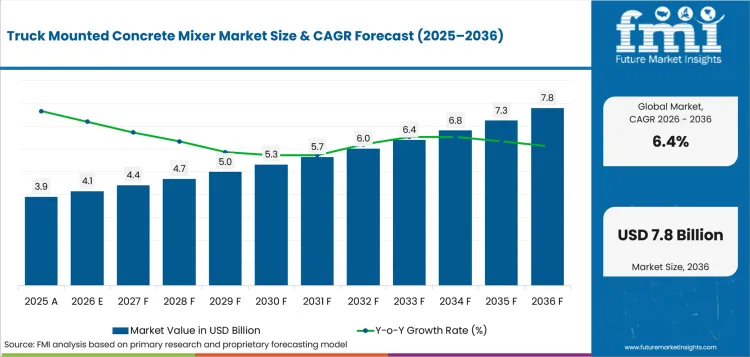
The truck mounted concrete mixer market is projected to expand from USD 3.9 billion in 2025 to USD 7.8 billion by 2036 at 6.4% CAGR. Steel drums are forecast to account for 72.6% share in 2026. Hydraulic drive is projected at 68.4% share. Commercial construction is forecast at 61.2% share as timed pours make mixer uptime central to site schedules.
Key Takeaways, Market Size, and Forecast
| Metric | Value |
|---|---|
| Market Size (2026) | USD 4.2 Billion |
| Market Size (2036) | USD 7.8 Billion |
| Forecast CAGR | 6.4% from 2026 to 2036 |
| Leading Drum Material | Steel Drums |
| Steel Drums Share In 2026 | 72.6% |
| Leading Drive Type | Hydraulic Drive |
| Hydraulic Drive Share In 2026 | 68.4% |
| Fastest-Growing Country | India |
| India CAGR | 8.2% by 2036 |
Summary of Truck Mounted Concrete Mixer Market
- Demand and Growth Drivers
- Ready-mix producers are renewing mixer fleets as drum wear affects concrete quality and discharge timing.
- Urban contractors are comparing drum capacity and site access before adding delivery units.
- Electric drum drive interest is rising as city delivery fleets face noise and emission limits.
- Product and Segment View
- Steel drums are expected to represent 72.6% share in 2026, influenced by abrasive concrete favoring proven drum shells.
- Hydraulic drive is forecast to account for 68.4% share in 2026, led by service networks understanding pump systems.
- Commercial construction is projected to hold 61.2% share in 2026 due to timed pours needing dependable supply.
- Geography and Competitive Outlook
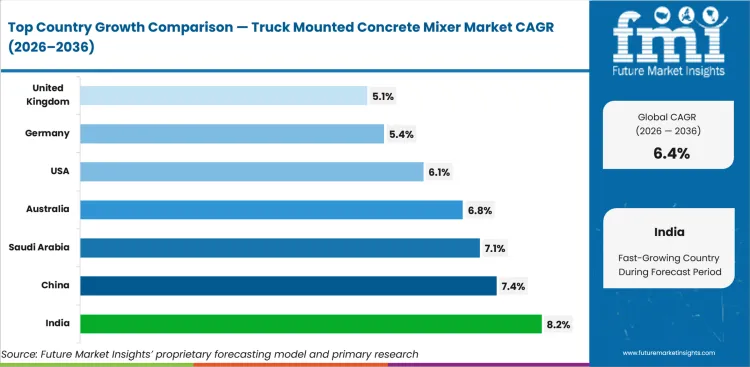
- India is projected to record 8.2% CAGR by 2036, reflected by cement capacity and road work supporting mixer buying.
- China is forecast at 7.4% CAGR by 2036, driven by public works and local machinery supply supporting replacement demand.
- Liebherr Group and SCHWING Stetter compete based on mixer engineering and service reach.
- SANY Group and CIFA S.p.A. compete depending on electric mixer work and concrete equipment breadth.
- Analyst Opinion
- Nikhil Kaitwade, Principal Consultant for Industrial Automation at FMI, observes, “Truck mixer buying is moving from drum capacity alone toward uptime and service proof. Fleet owners now compare drum wear, hydraulic repair, and chassis fit before adding units. Suppliers with local parts access and electric mixer evidence should gain repeat orders from ready-mix producers.”
- Truck Mounted Concrete Mixer Market Value Analysis
- Market value is tied to ready-mix output before project count shapes truck use.
- Supplier pricing reflects drum durability before chassis cost affects delivered value.
- Revenue improves as fleets replace old transit mixers with medium capacity systems.
- System trust rises as service teams reduce washout issues and hydraulic downtime.
Concrete delivery fleets now need trucks carrying enough concrete and reach busy sites with less downtime. Replacement buying is moving beyond drum volume alone as fleet owners look at full route performance. ADVANCE’s FDCB500 supports a capacity-first upgrade path with a 32-foot outer bridge length and nine-yard federal bridge capacity. Such design gives ready-mix producers a clearer way to raise delivered volume without changing batching plants. Electric mixer adoption is gaining a clearer business case for city delivery routes with fixed plant-to-site distance. Renault Trucks and Schwing-Stetter built the E-Tech C 10x4 with 10 m³ concrete capacity and four daily trips of 35 km. Mercedes-Benz Trucks stated that the eArocs 400 concrete mixer offers 414 kWh installed battery capacity and up to 200 km range without intermediate charging. Fleet buyers will compare payload and charging needs before shifting from diesel mixers to electric units.
Truck Mounted Concrete Mixer Market Definition
Truck mounted concrete mixers are truck-based rotating drum systems used to transport and mix ready-mix concrete between batching plants and jobsites. Scope covers transit mixers, volumetric mixers, agitator mixers, and pump mixer formats sold as mounted systems.
Truck Mounted Concrete Mixer Market Inclusions
Market scope covers all commercially traded truck mounted concrete mixer products categorized by mixer type, including transit mixers, volumetric mixers, agitator mixers, and pump mixers; mixer capacity, including below 6 m³, 6 to 8 m³, 8 to 10 m³, and above 10 m³; drive type, including hydraulic drive, electric drive, hybrid drive, and mechanical drive; drum material, including steel drums, alloy drums, and composite drums; and end users, including commercial construction, infrastructure contractors, ready-mix producers, and rental operators. Revenue scope covers 2026 to 2036. The key stakeholders include truck mounted concrete mixer manufacturers, truck chassis suppliers, drum and hydraulic component makers, electric drive suppliers, ready-mix concrete companies, construction contractors, infrastructure developers, rental operators, fleet service providers, dealers, distributors, and transport safety regulators.
Truck Mounted Concrete Mixer Market Exclusions
Scope excludes stationary batching plants and standalone concrete pumps. General construction trucks are excluded unless sold with a concrete mixing system. Used mixer resale value is outside scope.
Truck Mounted Concrete Mixer Market Research Methodology
- Primary Research: Future Market Insights analysts reviewed ready-mix producer checks and dealer feedback across construction regions.
- Desk Research: Official concrete output data and company releases supported demand checks.
- Market Sizing and Forecasting: Forecast values used mixer fleet replacement and country construction activity.
- Data Validation: Checks compared 2026 value with 2036 value and tested CAGR consistency across seven countries.
Why is the Truck Mounted Concrete Mixer Market Growing?
- Ready-mix producers are replacing older mixer fleets to protect concrete quality and discharge timing.
- Urban construction favors medium capacity drums that balance payload limits with restricted site access.
- Electric mixer trials are creating a cleaner delivery route for dense city projects.
Truck mixer demand is moving toward dependable drum systems and documented service plans. CIFA introduced the Magnum MK35H with a 35-meter carbon boom at Bauma 2025. SANY Global said an electric mixer trial gained Australian Design Rules approval in December 2024. Suppliers tied to smart construction equipment can convert interest into orders only with service proof and chassis support.
Market Segmentation Analysis
- Transit mixers are expected to represent 48.7% share in 2026 as batching fleets prefer continuous drum movement during delivery.
- Medium capacity mixers are projected to hold 54.3% share in 2026 as 6 to 8 m³ drums suit urban routes.
- Hydraulic drive is forecast to secure 68.4% share in 2026 as service teams understand pump and motor repair.
- Steel drums are expected to account for 72.6% share in 2026 as abrasive concrete loads need durable drum shells.
- Commercial construction is projected to capture 61.2% share in 2026 as timed pours need dependable scheduling.
The truck mounted concrete mixer market is divided into groups based on mixer type, mixer capacity, drive type, drum material, end user, and region. Mixer type includes transit mixers, volumetric mixers, agitator mixers, and pump mixers. Mixer capacity covers below 6 m³, 6 to 8 m³, 8 to 10 m³, and above 10 m³. Drive type analysis includes hydraulic drive, electric drive, hybrid drive, and mechanical drive. Drum material coverage includes steel drums, alloy drums, and composite drums. End user analysis includes commercial construction, infrastructure contractors, ready-mix producers, and rental operators.
Insights into Truck Mounted Concrete Mixer Market by Mixer Type
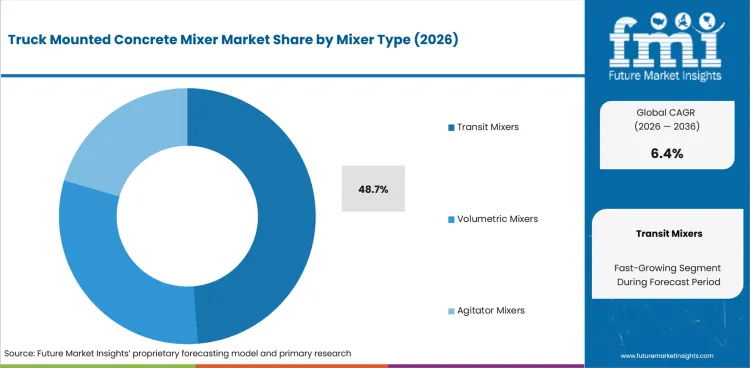
- Transit mixers are projected to account for 48.7% share in 2026 led by ready-mix plants favoring standard delivery fleets.
- Volumetric mixers gain use for contractors needing on-site batching flexibility across repair work.
Insights into Truck Mounted Concrete Mixer Market by Mixer Capacity
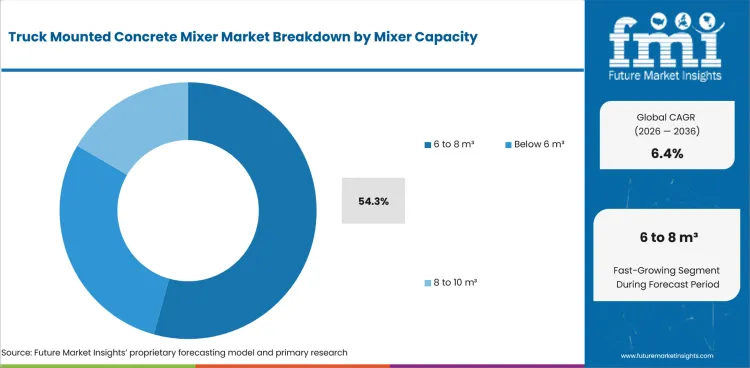
- Medium capacity mixers are forecast to hold 54.3% share in 2026, driven by 6 to 8 m³ drums balancing payload and route access.
- Above 10 m³ mixers serve large infrastructure pours needing fewer trips between batching plants and sites.
Insights into Truck Mounted Concrete Mixer Market by Drive Type
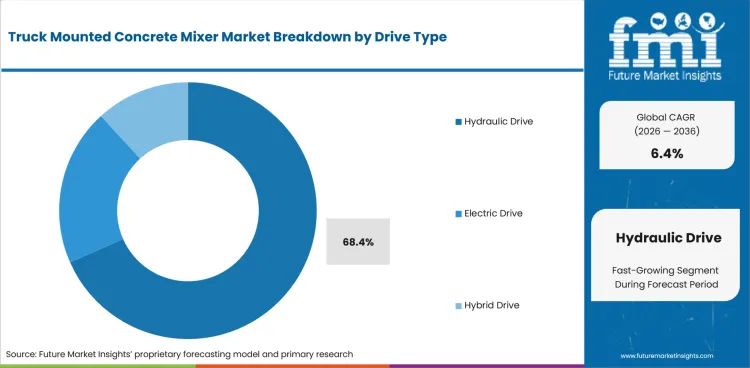
- Hydraulic drive is projected to account for 68.4% share in 2026, influenced by service teams understanding pump maintenance.
- Electric drive gains attention as urban concrete delivery faces noise and emission pressure.
Insights into Truck Mounted Concrete Mixer Market by Drum Material
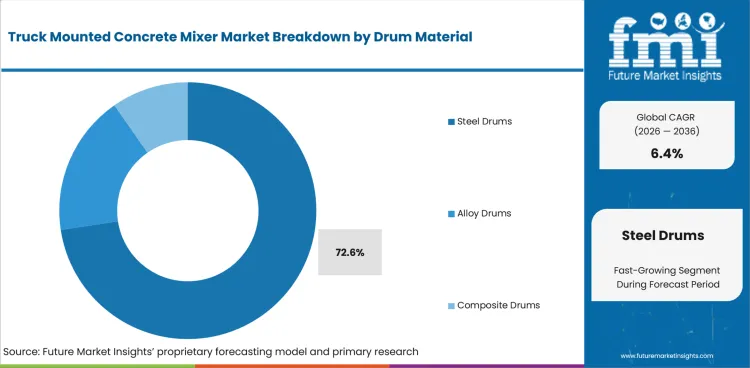
- Steel drums are forecast to represent 72.6% share in 2026, reflected by abrasive loads needing durable shell material.
- Alloy drums support weight reduction for fleets trying to improve payload efficiency.
Insights into Truck Mounted Concrete Mixer Market by End User
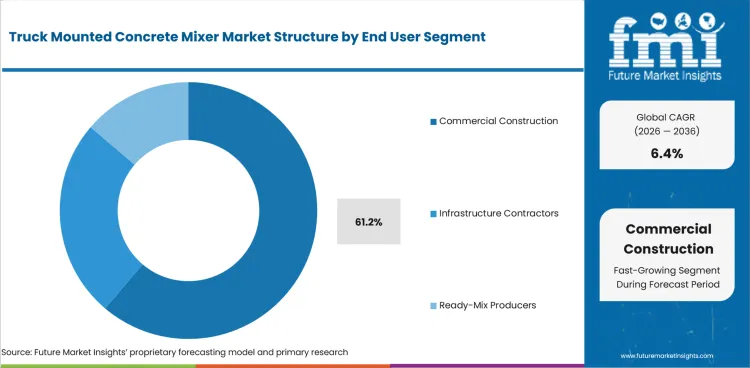
- Commercial construction is projected to hold 61.2% share in 2026 as urban projects need timed concrete supply.
- Infrastructure contractors create high-value orders for fleets working on road and bridge pours.
Truck Mounted Concrete Mixer Market Drivers, Restraints and Opportunities
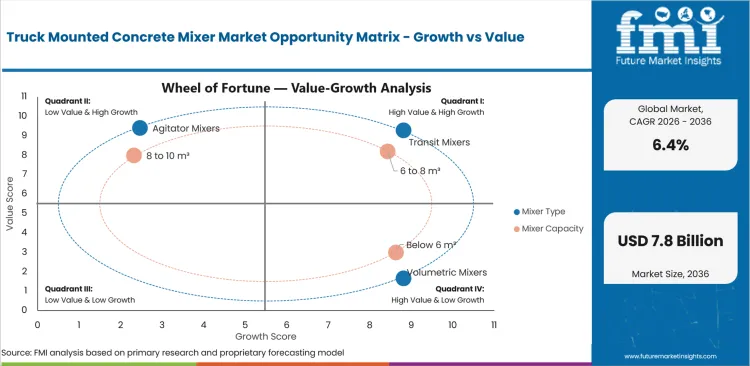
- Driver: Ready-mix fleets are prioritizing truck mixers with higher drum capacity and stronger local mounting support.
- Restraint: Smaller concrete producers can delay purchases when chassis fitment and service planning raise upfront buying risk.
- Opportunity: Capacity-specific mixer packages can help dealers convert city and infrastructure demand into planned fleet renewal.
Fleet renewal is moving toward larger capacity truck mixers as concrete producers look for fewer trips and better delivery control. Liebherr-Mischtechnik reported in April 2025 that Emirates Motor Company Commercial Vehicles ordered 150 Liebherr HTM 1304 truck mixers in 2025, and more than 500 Liebherr truck mixers had been delivered to the United Arab Emirates through the same cooperation since 2017. It also states demand increased for truck mixers able to hold higher liquid concrete capacity, supporting the outlook for larger drum systems and chassis-integrated supply. Suppliers linked with construction equipment finance and smart construction equipment can use staged financing and fleet monitoring to reduce purchase friction for ready-mix producers.
Buyer Identification and Procurement Structure Analysis
Ready-mix producers and large contractors are expected to remain the core buyers of truck mounted concrete mixers. Equipment selection is moving toward jobsite access and payload economics. CIFA’s December 2025 truck mixer guide separates compact models at 4 to 7 m³, medium models at 8 to 10 m³, and large models at 10 to 15 m³. This shows why buying decisions are shifting from drum size alone to route planning and delivery frequency. OEMs and body builders can gain more orders by matching mixer dimensions with chassis availability and local operating rules.
After-sales Service and Lifecycle Cost Analysis
After-sales value is becoming a stronger factor as fleet owners focus on downtime control and concrete quality. CIFA’s October 2025 maintenance guidance identifies 3 daily checks for truck mixers covering drum cleaning and safety device inspection. Poor cleaning can reduce drum capacity and increase internal wear. Hydraulic neglect can cause slow drum movement and unexpected breakdowns. Service contracts and planned maintenance can reduce repair shocks while protecting residual value across ready-mix fleets.
Competitive Landscape and Strategic Positioning
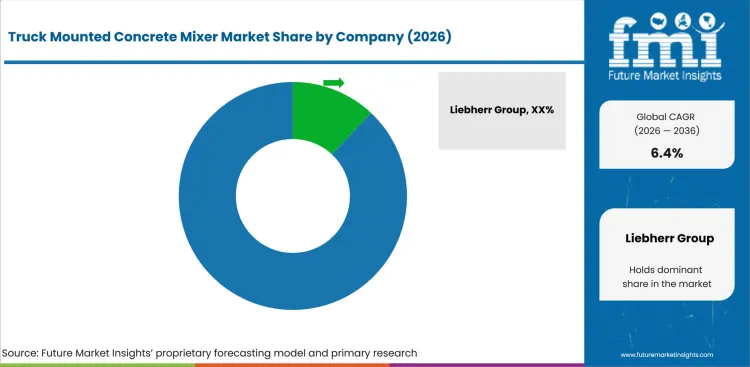
- Mixer engineering firms hold an advantage led by drum durability and chassis mounting depth.
- Electric mixer developers gain orders as city concrete fleets test quieter delivery equipment.
- Dealer networks strengthen repeat sales by reducing hydraulic repair delays and drum service downtime.
- Concrete equipment specialists support adoption by pairing mixers with pumps and placing systems.
Competitive structure is led by mixer engineering firms and China-based concrete equipment suppliers. Liebherr Group and SCHWING Stetter hold strong positions in transit mixers built for ready-mix delivery fleets. SANY Group and XCMG Group compete through wider construction machinery supply and electric mixer work. CIFA S.p.A. and Putzmeister serve higher-value applications through mixer-pump systems and urban concrete delivery equipment. Shantui Janeoo competes through concrete machinery depth for project-based fleet demand.
Channel strength now carries the same weight as product breadth. Direct brand websites allow model guidance and service control. Construction equipment dealers need stock covering medium capacity mixers and hydraulic drive systems. Adjacent spending across construction equipment finance and smart construction equipment can create bundled orders for ready-mix producers replacing older mixer fleets.
Key Companies in the Truck Mounted Concrete Mixer Market
Competitive structure is differentiated by mixer engineering firms, electric mixer developers, and concrete equipment specialists.
- Mixer Engineering Firms: Liebherr Group and SCHWING Stetter compete through drum durability and dealer support.
- Electric Mixer Developers: SANY Group and CIFA S.p.A. compete through electric drive work and urban delivery use.
- Concrete Equipment Specialists: Putzmeister and XCMG Group compete through mixer-pump systems and adjacent concrete machinery.
Competitive Benchmarking: Truck Mounted Concrete Mixer Market
| Company | Drum Engineering Depth | Truck Mixer Portfolio | Electric Mixer Focus | Service Channel Reach | Geographic Footprint |
|---|---|---|---|---|---|
| Liebherr Group | Very Strong | Very Strong | Strong | Very Strong | Global |
| SCHWING Stetter | Very Strong | Strong | Moderate | Very Strong | Global |
| SANY Group | Strong | Very Strong | Very Strong | Very Strong | Global |
| CIFA S.p.A. | Strong | Strong | Very Strong | Strong | Europe and Global |
| Putzmeister | Moderate | Strong | Strong | Strong | Global |
| XCMG Group | Strong | Very Strong | Strong | Strong | Asia and Global |
| Shantui Janeoo | Moderate | Strong | Moderate | Moderate | China and Asia |
Source: Future Market Insights competitive analysis, 2026.
Key Developments in Truck Mounted Concrete Mixer Market
- In April 2025, CIFA presented the Magnum MK35H concrete mixer-pump at Bauma 2025 with a 35-meter carbon boom.
- In October 2025, CIFA described its Energya E9 and E10 electric truck mixers with 9 m³ and 10 m³ drum formats based on Battery Electric Equipment technology.
- In May 2026, Scania, Unicon, and Liebherr-Mischtechnik demonstrated a fully electric concrete transport solution with an integrated electric concrete mixer system.
Key Players in the Truck Mounted Concrete Mixer Market
- Liebherr Group
- SCHWING Stetter
- SANY Group
- CIFA S.p.A.
- Putzmeister
- XCMG Group
- Shantui Janeoo
Analysis of Truck Mounted Concrete Mixer Market by Key Countries
.webp "Top Country Growth Comparison Truck Mounted Concrete Mixer Market Cagr (2026 2036)")
| Country | CAGR |
|---|---|
| India | 8.2% |
| China | 7.4% |
| Saudi Arabia | 7.1% |
| Australia | 6.8% |
| United States | 6.1% |
| Germany | 5.4% |
| United Kingdom | 5.1% |
Source: Future Market Insights, 2026.
Growth Outlook for Truck Mounted Concrete Mixer Market in India
Infrastructure fleet expansion center · 2026 to 2036
Country Market Snapshot Table
| Parameter | Value |
|---|---|
| Market Size in 2025 (Value) | USD 434.4 million |
| Market Size in 2026 (Value) | USD 470.0 million |
| Market Forecast in 2036 (Value) | USD 1,033.6 million |
| CAGR (2026-2036) | 8.2% |
| Years Considered | 2021-2036 |
| Base Year | 2025 |
| Forecast Period | 2026-2036 |
| Units Considered | Value (USD million) |
| Leading Sub-Region | Maharashtra and National Capital Region construction corridor |
India Truck Mounted Concrete Mixer Market Outlook
India truck mounted concrete mixer demand is tied to road work and urban ready-mix growth. Fleet owners need locally serviceable drums with flexible capacity.
Concrete delivery is moving toward organized batching in larger cities. Local truck chassis supply keeps mixer body mounting within domestic dealer networks.
Key Growth Drivers
- Urban concrete delivery needs more ready-mix dispatch capacity. India Brand Equity Foundation stated FY26 cement output is expected near 490 million tonnes, giving mixer fleets a larger material flow.
- Local mounting programs can draw from a deep truck platform pool. Society of Indian Automobile Manufacturers reported 1.08 million commercial vehicle sales in FY 2025-26, allowing mixer bodies to move through domestic chassis channels.
- Cement makers are preparing for larger infrastructure dispatches. India Brand Equity Foundation cited 150 to 160 million tonnes of planned cement capacity additions during FY25 to FY28, creating more loading points near project corridors.
- National cement capacity keeps batching networks supplied across major states. Cement Manufacturers Association listed 668 million tonnes of installed capacity in March 2025, supporting long-term ready-mix expansion.
Key Restraints
- Small contractors can stretch truck life during funding pressure. Society of Indian Automobile Manufacturers reported 0.96 million commercial vehicle sales during April 2024 to March 2025, keeping fleet financing central to mixer orders.
- Dealer planning can become uneven across cement-heavy states. Cement Manufacturers Association indicated 17 companies held 85.0% of installed capacity in 2025, reflecting mixer brands needing stronger local coverage.
- Plant expansion can arrive before truck orders. FY25 cement output reached 453.0 million tonnes before the higher FY26 view, leading fleets to wait for confirmed dispatch growth.
What makes India unique
India is unique as infrastructure work and ready-mix conversion create room for local mixer body builders.
Key Companies
- Liebherr Group
- SCHWING Stetter
- SANY Group
- CIFA S.p.A.
- Putzmeister
- XCMG Group
- Shantui Janeoo
Sales & Marketing Channels
- Dealer counters
- Direct brand websites
- Ready-mix fleet suppliers
- Construction equipment distributors
- Rental fleet channels
- Concrete plant service partners
Country Segment Breakdown Table
| Segment | Sub-Segments |
|---|---|
| By Mixer Type | Transit Mixers · Volumetric Mixers · Agitator Mixers · Pump Mixers |
| By Mixer Capacity | Below 6 m³ · 6 to 8 m³ · 8 to 10 m³ · Above 10 m³ |
| By Drive Type | Hydraulic Drive · Electric Drive · Hybrid Drive · Mechanical Drive |
| By Drum Material | Steel Drums · Alloy Drums · Composite Drums |
| By End User | Commercial Construction · Infrastructure Contractors · Ready-Mix Producers · Rental Operators |
| Key Sub-Regions Covered, States / Construction Regions | Maharashtra · Delhi NCR · Karnataka · Gujarat · Tamil Nadu · Telangana |
Frequently Asked Questions
How fast is India truck mounted concrete mixer market growing?
India truck mounted concrete mixer market is predicted to grow at 8.2% CAGR during the forecast period.
Who leads India truck mounted concrete mixer market?
Liebherr Group, SCHWING Stetter, and SANY Group compete through service-backed mixer supply.
What is driving adoption in India truck mounted concrete mixer market?
Construction activity and ready-mix delivery needs are supporting demand for durable mixer trucks.
Demand Outlook for Truck Mounted Concrete Mixer Market in China
Urban batching and concrete machinery center · 2026 to 2036
Country Market Snapshot Table
| Parameter | Value |
|---|---|
| Market Size in 2025 (Value) | USD 782.1 million |
| Market Size in 2026 (Value) | USD 840.0 million |
| Market Forecast in 2036 (Value) | USD 1,715.2 million |
| CAGR (2026-2036) | 7.4% |
| Years Considered | 2021-2036 |
| Base Year | 2025 |
| Forecast Period | 2026-2036 |
| Units Considered | Value (USD million) |
| Leading Sub-Region | Yangtze River Delta and Greater Bay Area construction corridor |
China Truck Mounted Concrete Mixer Market Outlook
China truck mounted concrete mixer demand is shaped by dense batching fleets and local machinery supply. Producers need high drum uptime across city delivery routes.
Public works and urban renewal keep concrete logistics active even with weaker property development. Equipment makers can serve fleets replacing older drums with service-backed units.
Key Growth Drivers
- City batching routes keep mixer utilization high in major construction clusters. National Bureau of Statistics of China reported 147.75 million tons of cement output in October 2025, showing a large load pool for mixer fleets.
- Public project activity gives concrete equipment suppliers a replacement window. The State Council of the People’s Republic of China reported fixed-asset investment at 10.27 trillion yuan in Q1 2026, supporting construction equipment planning.
- Truck body mounting benefits from national vehicle output depth. National Bureau of Statistics of China reported 3.28 million motor vehicles produced in October 2025, giving mixer manufacturers a broad chassis base.
- Concrete machinery supply can draw on domestic special-purpose equipment capability. Official industrial data showed special-purpose machinery manufacturing grew 0.7% year on year in October 2025, keeping local production channels active.
Key Restraints
- Property weakness can delay fleet expansion for residential batching routes. National Bureau of Statistics of China reported 2025 real estate development investment at 8.28 trillion yuan, down 17.2% year on year.
- New building starts can reduce short-term concrete dispatches. Official 2025 data put newly started building floor space at 587.70 million square meters, down 20.4% from the prior year.
- Developer funding pressure can slow mixer purchases tied to housing work. National Bureau of Statistics of China reported 2025 real estate enterprise funds at 9.31 trillion yuan, down 13.4% year on year.
What makes China unique
China is unique as large cement output and domestic machinery depth support mixer fleet replacement despite property pressure.
Key Companies
- Liebherr Group
- SCHWING Stetter
- SANY Group
- CIFA S.p.A.
- Putzmeister
- XCMG Group
- Shantui Janeoo
Sales & Marketing Channels
- Dealer counters
- Direct brand websites
- Ready-mix fleet suppliers
- Construction equipment distributors
- Rental fleet channels
- Concrete plant service partners
Country Segment Breakdown Table
| Segment | Sub-Segments |
|---|---|
| By Mixer Type | Transit Mixers · Volumetric Mixers · Agitator Mixers · Pump Mixers |
| By Mixer Capacity | Below 6 m³ · 6 to 8 m³ · 8 to 10 m³ · Above 10 m³ |
| By Drive Type | Hydraulic Drive · Electric Drive · Hybrid Drive · Mechanical Drive |
| By Drum Material | Steel Drums · Alloy Drums · Composite Drums |
| By End User | Commercial Construction · Infrastructure Contractors · Ready-Mix Producers · Rental Operators |
| Key Sub-Regions Covered, States / Construction Regions | Shanghai · Guangdong · Jiangsu · Zhejiang · Shandong · Sichuan |
Frequently Asked Questions
How fast is China truck mounted concrete mixer market growing?
China truck mounted concrete mixer market is predicted to grow at 7.4% CAGR during the forecast period.
Who leads China truck mounted concrete mixer market?
Liebherr Group, SCHWING Stetter, and SANY Group compete through service-backed mixer supply.
What is driving adoption in China truck mounted concrete mixer market?
Construction activity and ready-mix delivery needs are supporting demand for durable mixer trucks.
Sales Outlook for Truck Mounted Concrete Mixer Market in Saudi Arabia
Giga-project concrete delivery center · 2026 to 2036
Country Market Snapshot Table
| Parameter | Value |
|---|---|
| Market Size in 2025 (Value) | USD 294.1 million |
| Market Size in 2026 (Value) | USD 315.0 million |
| Market Forecast in 2036 (Value) | USD 626.6 million |
| CAGR (2026-2036) | 7.1% |
| Years Considered | 2021-2036 |
| Base Year | 2025 |
| Forecast Period | 2026-2036 |
| Units Considered | Value (USD million) |
| Leading Sub-Region | Riyadh and Makkah construction corridor |
Saudi Arabia Truck Mounted Concrete Mixer Market Outlook
Saudi Arabia truck mounted concrete mixer demand is supported by large project work and urban construction. Fleet buyers need reliable drum systems for hot-weather concrete delivery.
Construction financing and project execution support replacement demand. Suppliers need service teams and parts access near major city corridors.
Key Growth Drivers
- Large project activity supports steady concrete delivery needs. Data Saudi reported construction real gross domestic product rose 4.0% in Q4 2025, giving mixer suppliers a direct activity signal.
- Construction contractors have access to deeper bank funding. Data Saudi listed SAR 146.7 billion in construction commercial bank credit during April 2026, supporting financed equipment purchases.
- Private construction activity gives equipment sellers a larger addressable fleet. Data Saudi recorded SAR 470.6 billion in construction operating revenue for 2024, showing a sizable customer pool.
- Equipment financing can support non-retail fleet renewal. Data Saudi reported SAR 8.5 billion in finance company credit to construction non-retail users in 2025, marking a stronger channel for mixer funding.
Key Restraints
- Cost movement can pressure concrete delivery margins in active cities. General Authority for Statistics Saudi Arabia reported the construction cost index rose 1.0% year on year in November 2025, affecting purchase timing.
- Hot-weather operation raises service expectations for hydraulic systems. Data Saudi showed construction sector operating expenses at SAR 183.0 billion in 2024, keeping cost control central for fleet owners.
- Project funding can be uneven across contractors. Data Saudi recorded SAR 91.4 billion of construction foreign direct investment stock in 2024, so local fleet orders can vary by project financing strength.
What makes Saudi Arabia unique
Saudi Arabia is unique as large project corridors and heat conditions raise demand for durable mixer fleets.
Key Companies
- Liebherr Group
- SCHWING Stetter
- SANY Group
- CIFA S.p.A.
- Putzmeister
- XCMG Group
- Shantui Janeoo
Sales & Marketing Channels
- Dealer counters
- Direct brand websites
- Ready-mix fleet suppliers
- Construction equipment distributors
- Rental fleet channels
- Concrete plant service partners
Country Segment Breakdown Table
| Segment | Sub-Segments |
|---|---|
| By Mixer Type | Transit Mixers · Volumetric Mixers · Agitator Mixers · Pump Mixers |
| By Mixer Capacity | Below 6 m³ · 6 to 8 m³ · 8 to 10 m³ · Above 10 m³ |
| By Drive Type | Hydraulic Drive · Electric Drive · Hybrid Drive · Mechanical Drive |
| By Drum Material | Steel Drums · Alloy Drums · Composite Drums |
| By End User | Commercial Construction · Infrastructure Contractors · Ready-Mix Producers · Rental Operators |
| Key Sub-Regions Covered, States / Construction Regions | Riyadh · Makkah · Eastern Province · Madinah · Tabuk · Qassim |
Frequently Asked Questions
How fast is Saudi Arabia truck mounted concrete mixer market growing?
Saudi Arabia truck mounted concrete mixer market is anticipated to scale at 7.1% CAGR during the forecast period.
Who leads Saudi Arabia truck mounted concrete mixer market?
Liebherr Group, SCHWING Stetter, and SANY Group compete through service-backed mixer supply.
What is driving adoption in Saudi Arabia truck mounted concrete mixer market?
Construction activity and ready-mix delivery needs are supporting demand for durable mixer trucks.
Demand Analysis for Truck Mounted Concrete Mixer Market in Australia
Urban concrete fleet and electric mixer trial center · 2026 to 2036
Country Market Snapshot Table
| Parameter | Value |
|---|---|
| Market Size in 2025 (Value) | USD 224.7 million |
| Market Size in 2026 (Value) | USD 240.0 million |
| Market Forecast in 2036 (Value) | USD 463.3 million |
| CAGR (2026-2036) | 6.8% |
| Years Considered | 2021-2036 |
| Base Year | 2025 |
| Forecast Period | 2026-2036 |
| Units Considered | Value (USD million) |
| Leading Sub-Region | New South Wales and Victoria urban construction corridor |
Australia Truck Mounted Concrete Mixer Market Outlook
Australia truck mounted concrete mixer demand is guided by urban building work and strict road operation needs. Producers need drums that match local chassis and depot service limits.
Electric mixer trials are adding a new route for city concrete delivery. Suppliers can gain by proving battery range and drum performance under local road rules.
Key Growth Drivers
- Urban building activity keeps concrete delivery fleets active. Australian Bureau of Statistics reported 179,420 dwellings commenced in the year to December 2025, supporting continued mixer utilization.
- Apartment and townhouse work creates frequent short-haul delivery needs. Australian Bureau of Statistics recorded 27,286 new other residential commencements during December quarter 2025, favoring compact urban mixer scheduling.
- Commercial building work supports higher value concrete deliveries. Australian Bureau of Statistics put non-residential building work done at 19.67 billion Australian dollars in December quarter 2025, giving fleet owners project depth.
- Electric mixer trials are moving beyond display units. SANY Global said Australia’s first road-registered 100% electric concrete truck mixer trial gained Australian Design Rules approval in December 2024.
Key Restraints
- Housing starts can create uneven mixer utilization by region. Australian Bureau of Statistics showed total dwelling commencements fell 0.4% in December quarter 2025, with depot expansion remaining selective.
- New house work has a softer near-term profile. Official data placed new private sector house commencements at 25,035 in December quarter 2025, down 1.3% from the prior quarter.
- Fleet electrification needs proof before wider rollout. SANY Global described the electric mixer as a trial unit in December 2024, leading large fleets to wait for operating results.
What makes Australia unique
Australia is unique as road-approved electric mixer trials and urban building work shape fleet renewal.
Key Companies
- Liebherr Group
- SCHWING Stetter
- SANY Group
- CIFA S.p.A.
- Putzmeister
- XCMG Group
- Shantui Janeoo
Sales & Marketing Channels
- Dealer counters
- Direct brand websites
- Ready-mix fleet suppliers
- Construction equipment distributors
- Rental fleet channels
- Concrete plant service partners
Country Segment Breakdown Table
| Segment | Sub-Segments |
|---|---|
| By Mixer Type | Transit Mixers · Volumetric Mixers · Agitator Mixers · Pump Mixers |
| By Mixer Capacity | Below 6 m³ · 6 to 8 m³ · 8 to 10 m³ · Above 10 m³ |
| By Drive Type | Hydraulic Drive · Electric Drive · Hybrid Drive · Mechanical Drive |
| By Drum Material | Steel Drums · Alloy Drums · Composite Drums |
| By End User | Commercial Construction · Infrastructure Contractors · Ready-Mix Producers · Rental Operators |
| Key Sub-Regions Covered, States / Construction Regions | New South Wales · Victoria · Queensland · Western Australia · South Australia · Tasmania |
Frequently Asked Questions
How fast is Australia truck mounted concrete mixer market growing?
Australia truck mounted concrete mixer market is projected to rise at 6.8% CAGR during the forecast period.
Who leads Australia truck mounted concrete mixer market?
Liebherr Group, SCHWING Stetter, and SANY Group compete through service-backed mixer supply.
What is driving adoption in Australia truck mounted concrete mixer market?
Construction activity and ready-mix delivery needs are supporting demand for durable mixer trucks.
Sales Analysis for Truck Mounted Concrete Mixer Market in United States
Large ready-mix replacement fleet center · 2026 to 2036
Country Market Snapshot Table
| Parameter | Value |
|---|---|
| Market Size in 2025 (Value) | USD 697.5 million |
| Market Size in 2026 (Value) | USD 740.0 million |
| Market Forecast in 2036 (Value) | USD 1,337.0 million |
| CAGR (2026-2036) | 6.1% |
| Years Considered | 2021-2036 |
| Base Year | 2025 |
| Forecast Period | 2026-2036 |
| Units Considered | Value (USD million) |
| Leading Sub-Region | Texas and California ready-mix corridor |
United States Truck Mounted Concrete Mixer Market Outlook
United States truck mounted concrete mixer demand is influenced by large ready-mix output and replacement fleets. Producers need dependable drums and fast service access.
Fleet owners compare hydraulic repair access and drum wear life before adding units. Dealer reach can decide supplier selection for multi-plant producers.
Key Growth Drivers
- National ready-mix volume keeps replacement demand sizable. National Ready Mixed Concrete Association estimated 372.0 million cubic yards of United States ready-mixed concrete output in 2025, keeping mixer fleets active.
- Winter output still creates concrete truck use in major markets. National Ready Mixed Concrete Association estimated December 2025 ready-mix output at 25.1 million cubic yards, supporting year-round service needs.
- Spring delivery raises fleet utilization for producers. The same association estimated April 2025 ready-mix output at 33.2 million cubic yards, pushing dealers to time replacement offers around busy months.
- Producer membership gives suppliers a clear sales route. National Ready Mixed Concrete Association stated producer members generate more than half of United States ready-mixed concrete output, creating a concentrated channel.
Key Restraints
- Annual output softness can delay large fleet purchases. National Ready Mixed Concrete Association estimated 2025 production was 1.7% lower than 2024, resulting in fleet managers extending old drums.
- Early-year weakness can affect order confidence. Ready-mixed concrete output through April 2025 was 5.5% below the same period in 2024, making replacement timing more cautious.
- Seasonal delivery swings require careful inventory planning. December 2025 production rose only 0.5% from December 2024, so dealers need tighter quarter-by-quarter stocking.
What makes United States unique
United States is unique due to large ready-mix output and deep service channels for replacement fleets.
Key Companies
- Liebherr Group
- SCHWING Stetter
- SANY Group
- CIFA S.p.A.
- Putzmeister
- XCMG Group
- Shantui Janeoo
Sales & Marketing Channels
- Dealer counters
- Direct brand websites
- Ready-mix fleet suppliers
- Construction equipment distributors
- Rental fleet channels
- Concrete plant service partners
Country Segment Breakdown Table
| Segment | Sub-Segments |
|---|---|
| By Mixer Type | Transit Mixers · Volumetric Mixers · Agitator Mixers · Pump Mixers |
| By Mixer Capacity | Below 6 m³ · 6 to 8 m³ · 8 to 10 m³ · Above 10 m³ |
| By Drive Type | Hydraulic Drive · Electric Drive · Hybrid Drive · Mechanical Drive |
| By Drum Material | Steel Drums · Alloy Drums · Composite Drums |
| By End User | Commercial Construction · Infrastructure Contractors · Ready-Mix Producers · Rental Operators |
| Key Sub-Regions Covered, States / Construction Regions | Texas · California · Florida · Illinois · Ohio · Pennsylvania |
Frequently Asked Questions
How fast is United States truck mounted concrete mixer market growing?
United States truck mounted concrete mixer market is set to increase at 6.1% CAGR during the forecast period.
Who leads United States truck mounted concrete mixer market?
Liebherr Group, SCHWING Stetter, and SANY Group compete through service-backed mixer supply.
What is driving adoption in United States truck mounted concrete mixer market?
Construction activity and ready-mix delivery needs are supporting demand for durable mixer trucks.
Growth Outlook for Truck Mounted Concrete Mixer Market in Germany
Precision mixer engineering and ready-mix service center · 2026 to 2036
Country Market Snapshot Table
| Parameter | Value |
|---|---|
| Market Size in 2025 (Value) | USD 246.7 million |
| Market Size in 2026 (Value) | USD 260.0 million |
| Market Forecast in 2036 (Value) | USD 439.9 million |
| CAGR (2026-2036) | 5.4% |
| Years Considered | 2021-2036 |
| Base Year | 2025 |
| Forecast Period | 2026-2036 |
| Units Considered | Value (USD million) |
| Leading Sub-Region | Bavaria and North Rhine-Westphalia construction machinery corridor |
Germany Truck Mounted Concrete Mixer Market Outlook
Germany truck mounted concrete mixer demand is led by ready-mix producers with strict engineering expectations. Fleet buyers need proven drum wear life and documented service support.
Road access and emission rules push suppliers toward efficient drive systems. Mixer brands can gain through durable drums and reliable dealer repair.
Key Growth Drivers
- Civil construction activity gives mixer fleets a recovery signal. German Federal Statistical Office listed March 2026 main construction production at 99.3 on the 2021 index, supporting measured fleet renewal.
- Monthly output improvement helps equipment sellers restart conversations. German Federal Statistical Office reported a 5.2% year-on-year gain in main construction production for March 2026.
- Building approvals point to future concrete need. German Federal Statistical Office listed 17,605 permits for new dwellings in March 2026, giving ready-mix suppliers an order pipeline signal.
- Construction cost approvals can support premium equipment scrutiny. Official building cost estimates for new residential and non-residential approvals reached 7.77 billion euros in March 2026, raising total cost focus.
Key Restraints
- Winter softness can hold back mixer orders. German Federal Statistical Office reported main construction production fell 8.0% year on year in February 2026, leading purchases to shift later.
- Monthly volatility creates caution for dealers. January 2026 non-adjusted main construction output declined 17.2% year on year, making inventory placement harder.
- Trend-cycle pressure keeps fleet owners selective. The March 2026 main construction trend-cycle index stood at 89.0 with a 0.2% monthly decline, so suppliers need service-based selling.
What makes Germany unique
Germany is unique as engineering standards and concrete quality expectations raise reliability demands for mixer fleets.
Key Companies
- Liebherr Group
- SCHWING Stetter
- SANY Group
- CIFA S.p.A.
- Putzmeister
- XCMG Group
- Shantui Janeoo
Sales & Marketing Channels
- Dealer counters
- Direct brand websites
- Ready-mix fleet suppliers
- Construction equipment distributors
- Rental fleet channels
- Concrete plant service partners
Country Segment Breakdown Table
| Segment | Sub-Segments |
|---|---|
| By Mixer Type | Transit Mixers · Volumetric Mixers · Agitator Mixers · Pump Mixers |
| By Mixer Capacity | Below 6 m³ · 6 to 8 m³ · 8 to 10 m³ · Above 10 m³ |
| By Drive Type | Hydraulic Drive · Electric Drive · Hybrid Drive · Mechanical Drive |
| By Drum Material | Steel Drums · Alloy Drums · Composite Drums |
| By End User | Commercial Construction · Infrastructure Contractors · Ready-Mix Producers · Rental Operators |
| Key Sub-Regions Covered, States / Construction Regions | Bavaria · North Rhine-Westphalia · Baden-Württemberg · Lower Saxony · Hesse · Berlin |
Frequently Asked Questions
How fast is Germany truck mounted concrete mixer market growing?
Germany truck mounted concrete mixer market is predicted to grow at 5.4% CAGR during the forecast period.
Who leads Germany truck mounted concrete mixer market?
Liebherr Group, SCHWING Stetter, and SANY Group compete through service-backed mixer supply.
What is driving adoption in Germany truck mounted concrete mixer market?
Construction activity and ready-mix delivery needs are supporting demand for durable mixer trucks.
Demand Outlook for Truck Mounted Concrete Mixer Market in United Kingdom
Low-volume concrete recovery and regulated city delivery center · 2026 to 2036
Country Market Snapshot Table
| Parameter | Value |
|---|---|
| Market Size in 2025 (Value) | USD 138.0 million |
| Market Size in 2026 (Value) | USD 145.0 million |
| Market Forecast in 2036 (Value) | USD 238.4 million |
| CAGR (2026-2036) | 5.1% |
| Years Considered | 2021-2036 |
| Base Year | 2025 |
| Forecast Period | 2026-2036 |
| Units Considered | Value (USD million) |
| Leading Sub-Region | London and Midlands ready-mix corridor |
United Kingdom Truck Mounted Concrete Mixer Market Outlook
United Kingdom truck mounted concrete mixer demand is reflected by weak ready-mix volumes and selective fleet replacement. Fleet owners need cost control before adding units.
Urban sites still require reliable discharge and compact access. Suppliers can gain through smaller drums and clear maintenance terms.
Key Growth Drivers
- Existing concrete output keeps replacement orders alive. Mineral Products Association reported 11.9 million cubic metres of ready-mix sales across Q3 2024 to Q2 2025, keeping mixers in use.
- Quarterly ready-mix sales preserve urban delivery routes. Mineral Products Association put Q2 2025 ready-mix concrete volume at 2.7 million m³, supporting maintenance-led fleet renewal.
- Low material volumes can shift buyers toward service-backed replacement. Mineral Products Association said asphalt volumes over the last four quarters reached the lowest level in a decade, increasing caution around large purchases.
- Concrete fleet needs continue despite weak building materials demand. Mineral Products Association reported aggregates and mortar sales also fell during Q2 2025, making repair-linked mixer offers more practical.
Key Restraints
- Market softness can delay new mixer orders. Mineral Products Association reported ready-mix volumes dropped 11.5% in Q2 2025, so producers may protect cash before replacing trucks.
- Historical lows reduce purchase confidence for fleet owners. Mineral Products Association said annual concrete volume in Britain was at the weakest level since 1963, raising pressure on leasing options.
- Business confidence can slow tender timing. The same industry release connected weak concrete volumes with softer confidence in August 2025, making fleet renewal more dependent on housebuilding recovery.
What makes United Kingdom unique
United Kingdom is unique as weak concrete volumes make fleet replacement selective and service-focused.
Key Companies
- Liebherr Group
- SCHWING Stetter
- SANY Group
- CIFA S.p.A.
- Putzmeister
- XCMG Group
- Shantui Janeoo
Sales & Marketing Channels
- Dealer counters
- Direct brand websites
- Ready-mix fleet suppliers
- Construction equipment distributors
- Rental fleet channels
- Concrete plant service partners
Country Segment Breakdown Table
| Segment | Sub-Segments |
|---|---|
| By Mixer Type | Transit Mixers · Volumetric Mixers · Agitator Mixers · Pump Mixers |
| By Mixer Capacity | Below 6 m³ · 6 to 8 m³ · 8 to 10 m³ · Above 10 m³ |
| By Drive Type | Hydraulic Drive · Electric Drive · Hybrid Drive · Mechanical Drive |
| By Drum Material | Steel Drums · Alloy Drums · Composite Drums |
| By End User | Commercial Construction · Infrastructure Contractors · Ready-Mix Producers · Rental Operators |
| Key Sub-Regions Covered, States / Construction Regions | London · Midlands · North West England · Yorkshire · Scotland · Wales |
Frequently Asked Questions
How fast is United Kingdom truck mounted concrete mixer market growing?
United Kingdom truck mounted concrete mixer market is expecetd to expanding at 5.1% CAGR during the forecast period.
Who leads United Kingdom truck mounted concrete mixer market?
Liebherr Group, SCHWING Stetter, and SANY Group compete through service-backed mixer supply.
What is driving adoption in United Kingdom truck mounted concrete mixer market?
Construction activity and ready-mix delivery needs are supporting demand for durable mixer trucks.
Market Report Scope
| Item | Value |
|---|---|
| Market size by 2036 | USD 7.8 billion |
| Growth rate | 6.4% CAGR (2026-2036) |
| Forecast period | 2026 to 2036 |
| Base year value (2026) | USD 4.2 billion |
| By mixer type | Transit mixers, volumetric mixers, agitator mixers, pump mixers |
| By mixer capacity | Below 6 m³, 6 to 8 m³, 8 to 10 m³, above 10 m³ |
| By drive type | Hydraulic drive, electric drive, hybrid drive, mechanical drive |
| By drum material | Steel drums, alloy drums, composite drums |
| By end user | Commercial construction, infrastructure contractors, ready-mix producers, rental operators |
| Regions covered | North America, Latin America, Europe, Asia Pacific, Middle East and Africa |
| Countries covered | United States, China, India, Germany, Australia, United Kingdom, Saudi Arabia |
| Key companies profiled | Liebherr Group, SCHWING Stetter, SANY Group, CIFA S.p.A., Putzmeister, XCMG Group, Shantui Janeoo |
| Approach | Bottom-up mixer fleet replacement checks with ready-mix output and country construction indicators |
Source: Future Market Insights competitive analysis, 2026.
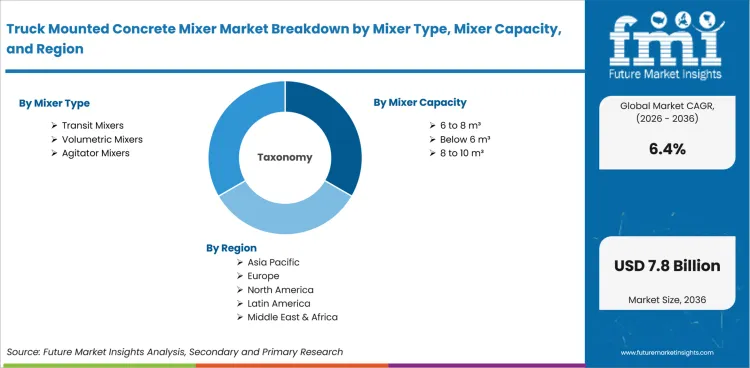
Truck Mounted Concrete Mixer Market Breakdown by Mixer Type, Mixer Capacity, Drive Type, Drum Material, End User, and Region
By Mixer Type:
- Transit Mixers
- Volumetric Mixers
- Agitator Mixers
- Pump Mixers
By Mixer Capacity:
- Below 6 m³
- 6 to 8 m³
- 8 to 10 m³
- Above 10 m³
By Drive Type:
- Hydraulic Drive
- Electric Drive
- Hybrid Drive
- Mechanical Drive
By Drum Material:
- Steel Drums
- Alloy Drums
- Composite Drums
By End User:
- Commercial Construction
- Infrastructure Contractors
- Ready-Mix Producers
- Rental Operators
By Region:
- North America
- Latin America
- Europe
- Asia Pacific
- Middle East and Africa
Research Sources and Bibliography
- ADVANCE. (2026, January 13). ADVANCE to introduce FDCB500 concrete mixer at World of Concrete 2026. Terex.
- Renault Trucks. (2025). Renault Trucks and Schwing-Stetter unveil an innovative solution for decarbonised concrete transport.
- Daimler Truck. (2025, April 7). Robust, powerful – and now also all-electric: Mercedes-Benz Trucks presents the new eArocs 400 at bauma 2025.
- Volvo Trucks. (2025, February 20). Volvo Trucks at Bauma: New trucks and technologies supporting the journey towards zero emissions.
- Australian Bureau of Statistics. (2026, April 8). Building activity, Australia, December 2025.
- CIFA S.p.A. (2025, April 7). CIFA presents the new Magnum MK35H with carbon boom at Bauma 2025: The “large” and lightweight concrete mixer-pump.
- CIFA S.p.A. (2025, October 14). Truck mixers: The 3 essential checks for proper maintenance.
- CIFA S.p.A. (2025, October 31). CIFA Energya electric mixer: E9 & E10: Sustainability and productivity.
- CIFA S.p.A. (2025, December 12). Truck mixer dimensions: CIFA guide for selection and models.
- Data Saudi. (2026). Construction sector indicators.
- Federal Statistical Office of Germany. (2026, May 7). Production index in main construction industry.
- Federal Statistical Office of Germany. (2026, March). Construction and housing short-term indicators.
- India Brand Equity Foundation. (2025, November). Cement infographic November 2025.
- Mineral Products Association. (2025, August 4). Concrete market plumbs new depths as business confidence weakens.
- National Bureau of Statistics of China. (2025, November 15). Industrial production operation in October 2025.
- National Bureau of Statistics of China. (2026, January 20). Investment in real estate development for 2025.
- National Ready Mixed Concrete Association. (2026). Ready mixed concrete production statistics updated through December 2025.
- National Ready Mixed Concrete Association. (2025). Ready mixed concrete production statistics updated through April 2025.
- SANY Global. (2024, December 23). Holcim and Putzmeister Oceania announce trial of 100% electric SANY eMixer.
- Society of Indian Automobile Manufacturers. (2026, April 14). Auto industry performance of Q4 (Jan–March 2026) & FY 2025–26.
- The State Council of the People’s Republic of China. (2026, April 16). China’s fixed-asset investment up 1.7 percent in Q1.
- Liebherr. (2025, April 7). At Bauma: Liebherr-Mischtechnik GmbH celebrates partnership with EMC.
Bibliography uses current English public body, industry association, company, and sector sources.
This Report Answers
- What is the 2026 value and 2036 forecast for truck mounted concrete mixer?
- What mixer capacity is projected to hold the leading share during the forecast period?
- What drum material is expected to account for the leading 2026 share?
- How do electric drum drives affect truck mounted concrete mixer buying?
- What companies compete in truck mounted concrete mixer supply?
Frequently Asked Questions
What is the truck mounted concrete mixer market size in 2026?
The truck mounted concrete mixer market is expected to cross USD 4.2 billion in 2026 as ready-mix fleet replacement expands.
What is the forecast value of truck mounted concrete mixer by 2036?
Market value is forecast to reach USD 7.8 billion by 2036 as producers adopt durable concrete delivery trucks.
What is the forecast CAGR for truck mounted concrete mixer?
Truck mounted concrete mixer demand is projected to expand at 6.4% CAGR from 2026 to 2036 across ready-mix fleets.
What mixer capacity leads truck mounted concrete mixer demand?
Medium capacity mixers are expected to garner 54.3% share in 2026 due to payload balance and city delivery needs.
What drum material leads truck mounted concrete mixer demand?
Steel drums are forecast to account for 72.6% share in 2026 as abrasive concrete loads need durable drum shells.
Preview the report firsthand - request a free sample
Get SampleGet the brochure for pricing and purchase details.
Get PDFTable of Content
- Executive Summary
- Global Market Outlook
- Demand to side Trends
- Supply to side Trends
- Technology Roadmap Analysis
- Analysis and Recommendations
- Market Overview
- Market Coverage / Taxonomy
- Market Definition / Scope / Limitations
- Research Methodology
- Chapter Orientation
- Analytical Lens and Working Hypotheses
- Market Structure, Signals, and Trend Drivers
- Benchmarking and Cross-market Comparability
- Market Sizing, Forecasting, and Opportunity Mapping
- Research Design and Evidence Framework
- Desk Research Programme (Secondary Evidence)
- Company Annual and Sustainability Reports
- Peer-reviewed Journals and Academic Literature
- Corporate Websites, Product Literature, and Technical Notes
- Earnings Decks and Investor Briefings
- Statutory Filings and Regulatory Disclosures
- Technical White Papers and Standards Notes
- Trade Journals, Industry Magazines, and Analyst Briefs
- Conference Proceedings, Webinars, and Seminar Materials
- Government Statistics Portals and Public Data Releases
- Press Releases and Reputable Media Coverage
- Specialist Newsletters and Curated Briefings
- Sector Databases and Reference Repositories
- FMI Internal Proprietary Databases and Historical Market Datasets
- Subscription Datasets and Paid Sources
- Social Channels, Communities, and Digital Listening Inputs
- Additional Desk Sources
- Expert Input and Fieldwork (Primary Evidence)
- Primary Modes
- Qualitative Interviews and Expert Elicitation
- Quantitative Surveys and Structured Data Capture
- Blended Approach
- Why Primary Evidence is Used
- Field Techniques
- Interviews
- Surveys
- Focus Groups
- Observational and In-context Research
- Social and Community Interactions
- Stakeholder Universe Engaged
- C-suite Leaders
- Board Members
- Presidents and Vice Presidents
- R&D and Innovation Heads
- Technical Specialists
- Domain Subject-matter Experts
- Scientists
- Physicians and Other Healthcare Professionals
- Governance, Ethics, and Data Stewardship
- Research Ethics
- Data Integrity and Handling
- Primary Modes
- Tooling, Models, and Reference Databases
- Desk Research Programme (Secondary Evidence)
- Data Engineering and Model Build
- Data Acquisition and Ingestion
- Cleaning, Normalisation, and Verification
- Synthesis, Triangulation, and Analysis
- Quality Assurance and Audit Trail
- Market Background
- Market Dynamics
- Drivers
- Restraints
- Opportunity
- Trends
- Scenario Forecast
- Demand in Optimistic Scenario
- Demand in Likely Scenario
- Demand in Conservative Scenario
- Opportunity Map Analysis
- Product Life Cycle Analysis
- Supply Chain Analysis
- Investment Feasibility Matrix
- Value Chain Analysis
- PESTLE and Porter’s Analysis
- Regulatory Landscape
- Regional Parent Market Outlook
- Production and Consumption Statistics
- Import and Export Statistics
- Market Dynamics
- Global Market Analysis 2021 to 2025 and Forecast, 2026 to 2036
- Historical Market Size Value (USD Million) Analysis, 2021 to 2025
- Current and Future Market Size Value (USD Million) Projections, 2026 to 2036
- Y to o to Y Growth Trend Analysis
- Absolute $ Opportunity Analysis
- Global Market Pricing Analysis 2021 to 2025 and Forecast 2026 to 2036
- Global Market Analysis 2021 to 2025 and Forecast 2026 to 2036, By Mixer Type
- Introduction / Key Findings
- Historical Market Size Value (USD Million) Analysis By Mixer Type , 2021 to 2025
- Current and Future Market Size Value (USD Million) Analysis and Forecast By Mixer Type , 2026 to 2036
- Transit Mixers
- Volumetric Mixers
- Agitator Mixers
- Transit Mixers
- Y to o to Y Growth Trend Analysis By Mixer Type , 2021 to 2025
- Absolute $ Opportunity Analysis By Mixer Type , 2026 to 2036
- Global Market Analysis 2021 to 2025 and Forecast 2026 to 2036, By Mixer Capacity
- Introduction / Key Findings
- Historical Market Size Value (USD Million) Analysis By Mixer Capacity, 2021 to 2025
- Current and Future Market Size Value (USD Million) Analysis and Forecast By Mixer Capacity, 2026 to 2036
- 6 to 8 m³
- Below 6 m³
- 8 to 10 m³
- 6 to 8 m³
- Y to o to Y Growth Trend Analysis By Mixer Capacity, 2021 to 2025
- Absolute $ Opportunity Analysis By Mixer Capacity, 2026 to 2036
- Global Market Analysis 2021 to 2025 and Forecast 2026 to 2036, By Drive Type
- Introduction / Key Findings
- Historical Market Size Value (USD Million) Analysis By Drive Type, 2021 to 2025
- Current and Future Market Size Value (USD Million) Analysis and Forecast By Drive Type, 2026 to 2036
- Hydraulic Drive
- Electric Drive
- Hybrid Drive
- Hydraulic Drive
- Y to o to Y Growth Trend Analysis By Drive Type, 2021 to 2025
- Absolute $ Opportunity Analysis By Drive Type, 2026 to 2036
- Global Market Analysis 2021 to 2025 and Forecast 2026 to 2036, By Drum Material
- Introduction / Key Findings
- Historical Market Size Value (USD Million) Analysis By Drum Material, 2021 to 2025
- Current and Future Market Size Value (USD Million) Analysis and Forecast By Drum Material, 2026 to 2036
- Steel Drums
- Alloy Drums
- Composite Drums
- Steel Drums
- Y to o to Y Growth Trend Analysis By Drum Material, 2021 to 2025
- Absolute $ Opportunity Analysis By Drum Material, 2026 to 2036
- Global Market Analysis 2021 to 2025 and Forecast 2026 to 2036, By End User
- Introduction / Key Findings
- Historical Market Size Value (USD Million) Analysis By End User, 2021 to 2025
- Current and Future Market Size Value (USD Million) Analysis and Forecast By End User, 2026 to 2036
- Commercial Construction
- Infrastructure Contractors
- Ready-Mix Producers
- Commercial Construction
- Y to o to Y Growth Trend Analysis By End User, 2021 to 2025
- Absolute $ Opportunity Analysis By End User, 2026 to 2036
- Global Market Analysis 2021 to 2025 and Forecast 2026 to 2036, By Region
- Introduction
- Historical Market Size Value (USD Million) Analysis By Region, 2021 to 2025
- Current Market Size Value (USD Million) Analysis and Forecast By Region, 2026 to 2036
- North America
- Latin America
- Western Europe
- Eastern Europe
- East Asia
- South Asia and Pacific
- Middle East & Africa
- Market Attractiveness Analysis By Region
- North America Market Analysis 2021 to 2025 and Forecast 2026 to 2036, By Country
- Historical Market Size Value (USD Million) Trend Analysis By Market Taxonomy, 2021 to 2025
- Market Size Value (USD Million) Forecast By Market Taxonomy, 2026 to 2036
- By Country
- USA
- Canada
- Mexico
- By Mixer Type
- By Mixer Capacity
- By Drive Type
- By Drum Material
- By End User
- By Country
- Market Attractiveness Analysis
- By Country
- By Mixer Type
- By Mixer Capacity
- By Drive Type
- By Drum Material
- By End User
- Key Takeaways
- Latin America Market Analysis 2021 to 2025 and Forecast 2026 to 2036, By Country
- Historical Market Size Value (USD Million) Trend Analysis By Market Taxonomy, 2021 to 2025
- Market Size Value (USD Million) Forecast By Market Taxonomy, 2026 to 2036
- By Country
- Brazil
- Chile
- Rest of Latin America
- By Mixer Type
- By Mixer Capacity
- By Drive Type
- By Drum Material
- By End User
- By Country
- Market Attractiveness Analysis
- By Country
- By Mixer Type
- By Mixer Capacity
- By Drive Type
- By Drum Material
- By End User
- Key Takeaways
- Western Europe Market Analysis 2021 to 2025 and Forecast 2026 to 2036, By Country
- Historical Market Size Value (USD Million) Trend Analysis By Market Taxonomy, 2021 to 2025
- Market Size Value (USD Million) Forecast By Market Taxonomy, 2026 to 2036
- By Country
- Germany
- UK
- Italy
- Spain
- France
- Nordic
- BENELUX
- Rest of Western Europe
- By Mixer Type
- By Mixer Capacity
- By Drive Type
- By Drum Material
- By End User
- By Country
- Market Attractiveness Analysis
- By Country
- By Mixer Type
- By Mixer Capacity
- By Drive Type
- By Drum Material
- By End User
- Key Takeaways
- Eastern Europe Market Analysis 2021 to 2025 and Forecast 2026 to 2036, By Country
- Historical Market Size Value (USD Million) Trend Analysis By Market Taxonomy, 2021 to 2025
- Market Size Value (USD Million) Forecast By Market Taxonomy, 2026 to 2036
- By Country
- Russia
- Poland
- Hungary
- Balkan & Baltic
- Rest of Eastern Europe
- By Mixer Type
- By Mixer Capacity
- By Drive Type
- By Drum Material
- By End User
- By Country
- Market Attractiveness Analysis
- By Country
- By Mixer Type
- By Mixer Capacity
- By Drive Type
- By Drum Material
- By End User
- Key Takeaways
- East Asia Market Analysis 2021 to 2025 and Forecast 2026 to 2036, By Country
- Historical Market Size Value (USD Million) Trend Analysis By Market Taxonomy, 2021 to 2025
- Market Size Value (USD Million) Forecast By Market Taxonomy, 2026 to 2036
- By Country
- China
- Japan
- South Korea
- By Mixer Type
- By Mixer Capacity
- By Drive Type
- By Drum Material
- By End User
- By Country
- Market Attractiveness Analysis
- By Country
- By Mixer Type
- By Mixer Capacity
- By Drive Type
- By Drum Material
- By End User
- Key Takeaways
- South Asia and Pacific Market Analysis 2021 to 2025 and Forecast 2026 to 2036, By Country
- Historical Market Size Value (USD Million) Trend Analysis By Market Taxonomy, 2021 to 2025
- Market Size Value (USD Million) Forecast By Market Taxonomy, 2026 to 2036
- By Country
- India
- ASEAN
- Australia & New Zealand
- Rest of South Asia and Pacific
- By Mixer Type
- By Mixer Capacity
- By Drive Type
- By Drum Material
- By End User
- By Country
- Market Attractiveness Analysis
- By Country
- By Mixer Type
- By Mixer Capacity
- By Drive Type
- By Drum Material
- By End User
- Key Takeaways
- Middle East & Africa Market Analysis 2021 to 2025 and Forecast 2026 to 2036, By Country
- Historical Market Size Value (USD Million) Trend Analysis By Market Taxonomy, 2021 to 2025
- Market Size Value (USD Million) Forecast By Market Taxonomy, 2026 to 2036
- By Country
- Kingdom of Saudi Arabia
- Other GCC Countries
- Turkiye
- South Africa
- Other African Union
- Rest of Middle East & Africa
- By Mixer Type
- By Mixer Capacity
- By Drive Type
- By Drum Material
- By End User
- By Country
- Market Attractiveness Analysis
- By Country
- By Mixer Type
- By Mixer Capacity
- By Drive Type
- By Drum Material
- By End User
- Key Takeaways
- Key Countries Market Analysis
- USA
- Pricing Analysis
- Market Share Analysis, 2025
- By Mixer Type
- By Mixer Capacity
- By Drive Type
- By Drum Material
- By End User
- Canada
- Pricing Analysis
- Market Share Analysis, 2025
- By Mixer Type
- By Mixer Capacity
- By Drive Type
- By Drum Material
- By End User
- Mexico
- Pricing Analysis
- Market Share Analysis, 2025
- By Mixer Type
- By Mixer Capacity
- By Drive Type
- By Drum Material
- By End User
- Brazil
- Pricing Analysis
- Market Share Analysis, 2025
- By Mixer Type
- By Mixer Capacity
- By Drive Type
- By Drum Material
- By End User
- Chile
- Pricing Analysis
- Market Share Analysis, 2025
- By Mixer Type
- By Mixer Capacity
- By Drive Type
- By Drum Material
- By End User
- Germany
- Pricing Analysis
- Market Share Analysis, 2025
- By Mixer Type
- By Mixer Capacity
- By Drive Type
- By Drum Material
- By End User
- UK
- Pricing Analysis
- Market Share Analysis, 2025
- By Mixer Type
- By Mixer Capacity
- By Drive Type
- By Drum Material
- By End User
- Italy
- Pricing Analysis
- Market Share Analysis, 2025
- By Mixer Type
- By Mixer Capacity
- By Drive Type
- By Drum Material
- By End User
- Spain
- Pricing Analysis
- Market Share Analysis, 2025
- By Mixer Type
- By Mixer Capacity
- By Drive Type
- By Drum Material
- By End User
- France
- Pricing Analysis
- Market Share Analysis, 2025
- By Mixer Type
- By Mixer Capacity
- By Drive Type
- By Drum Material
- By End User
- India
- Pricing Analysis
- Market Share Analysis, 2025
- By Mixer Type
- By Mixer Capacity
- By Drive Type
- By Drum Material
- By End User
- ASEAN
- Pricing Analysis
- Market Share Analysis, 2025
- By Mixer Type
- By Mixer Capacity
- By Drive Type
- By Drum Material
- By End User
- Australia & New Zealand
- Pricing Analysis
- Market Share Analysis, 2025
- By Mixer Type
- By Mixer Capacity
- By Drive Type
- By Drum Material
- By End User
- China
- Pricing Analysis
- Market Share Analysis, 2025
- By Mixer Type
- By Mixer Capacity
- By Drive Type
- By Drum Material
- By End User
- Japan
- Pricing Analysis
- Market Share Analysis, 2025
- By Mixer Type
- By Mixer Capacity
- By Drive Type
- By Drum Material
- By End User
- South Korea
- Pricing Analysis
- Market Share Analysis, 2025
- By Mixer Type
- By Mixer Capacity
- By Drive Type
- By Drum Material
- By End User
- Russia
- Pricing Analysis
- Market Share Analysis, 2025
- By Mixer Type
- By Mixer Capacity
- By Drive Type
- By Drum Material
- By End User
- Poland
- Pricing Analysis
- Market Share Analysis, 2025
- By Mixer Type
- By Mixer Capacity
- By Drive Type
- By Drum Material
- By End User
- Hungary
- Pricing Analysis
- Market Share Analysis, 2025
- By Mixer Type
- By Mixer Capacity
- By Drive Type
- By Drum Material
- By End User
- Kingdom of Saudi Arabia
- Pricing Analysis
- Market Share Analysis, 2025
- By Mixer Type
- By Mixer Capacity
- By Drive Type
- By Drum Material
- By End User
- Turkiye
- Pricing Analysis
- Market Share Analysis, 2025
- By Mixer Type
- By Mixer Capacity
- By Drive Type
- By Drum Material
- By End User
- South Africa
- Pricing Analysis
- Market Share Analysis, 2025
- By Mixer Type
- By Mixer Capacity
- By Drive Type
- By Drum Material
- By End User
- USA
- Market Structure Analysis
- Competition Dashboard
- Competition Benchmarking
- Market Share Analysis of Top Players
- By Regional
- By Mixer Type
- By Mixer Capacity
- By Drive Type
- By Drum Material
- By End User
- Competition Analysis
- Competition Deep Dive
- Liebherr Group
- Overview
- Product Portfolio
- Profitability by Market Segments (Product/Age /Sales Channel/Region)
- Sales Footprint
- Strategy Overview
- Marketing Strategy
- Product Strategy
- Channel Strategy
- SCHWING Stetter
- SANY Group
- CIFA S.p.A.
- Putzmeister
- XCMG Group
- Shantui Janeoo
- Liebherr Group
- Competition Deep Dive
- Assumptions & Acronyms Used


