

- Industry Size (2026)
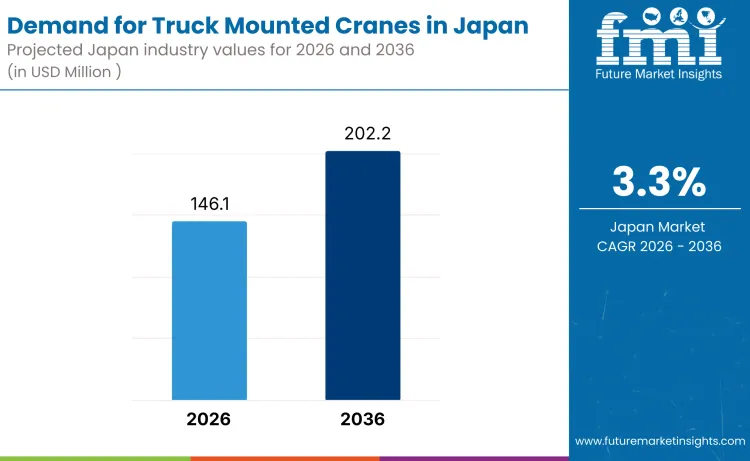
- USD 146.1 Mn
- Forecast (2036)
- USD 202.2 Mn
- CAGR (2026 to 2036)
- 3.3%
Demand for Truck Mounted Cranes in Japan 2026 to 2036
Demand for truck mounted cranes in Japan is valued at USD 146.1 million in 2026 and is projected to reach USD 202.2 million by 2036, reflecting a CAGR of 3.3%. Demand advances through ongoing urban infrastructure maintenance, disaster preparedness upgrades, and utility service operations requiring compact, road-compliant lifting solutions. Space-constrained worksites and stringent safety standards favor precise load control and reliable vehicle integration across municipal and industrial projects.
Stiff boom cranes lead product-type usage because rigid boom architecture delivers predictable lifting behavior, strong vertical reach, and high positional accuracy. Operators prefer stiff boom configurations for utility pole handling, bridge maintenance, and equipment placement where controlled movement and stability are essential. Enhancements in hydraulic efficiency, load-moment control, and chassis compatibility support consistent performance within Japanese regulatory limits.
Quick Stats for Demand for Truck Mounted Cranes in Japan
- Japan Truck Mounted Cranes Sales Value (2026): USD 146.1 million
- Japan Truck Mounted Cranes Forecast Value (2036): USD 202.2 million
- Japan Truck Mounted Cranes Forecast CAGR (2026 to 2036): 3.3%
- Leading Product Type in Japan Demand: Stiff Boom Cranes
- Key Growth Regions in Japan Demand: Kyushu & Okinawa, Kanto, Kansai, Chubu, Tohoku
- Top Players in Japan Demand: Tadano, Kobelco Construction Machinery, Sumitomo Heavy Industries, Kato Works, Hitachi Sumitomo Heavy Industries Construction Crane Co., Ltd.
Kyushu & Okinawa, Kanto, Kansai, Chubu, and Tohoku represent key growth regions driven by regional infrastructure upkeep, port and logistics activity, and resilience-focused construction. Tadano, Kobelco Construction Machinery, Sumitomo Heavy Industries, Kato Works, and Hitachi Sumitomo Heavy Industries Construction Crane Co., Ltd. anchor competitive activity through Japan-specific engineering, compact crane designs, and service networks aligned with local compliance requirements and high uptime expectations.
Japan Truck Mounted Cranes Key Takeaways
| Metric | Value |
|---|---|
| Japan Truck Mounted Cranes Sales Value (2026) | USD 146.1 million |
| Japan Truck Mounted Cranes Forecast Value (2036) | USD 202.2 million |
| Japan Truck Mounted Cranes Forecast CAGR (2026-2036) | 3.3% |
How Are the Segments Classified in the Demand for Truck Mounted Cranes in Japan?
Demand for truck mounted cranes in Japan is shaped by urban infrastructure density, space-constrained worksites, and stringent operational safety requirements. Buyers assess lifting precision, vehicle integration, maneuverability, and compliance with Japanese road and equipment regulations. Adoption patterns reflect strong use in utilities, construction maintenance, and municipal services, where compact operation, reliability, and controlled load handling are essential across densely populated and regulation-intensive environments.
Which Product Type Accounts for the Largest Share of Demand in Japan?
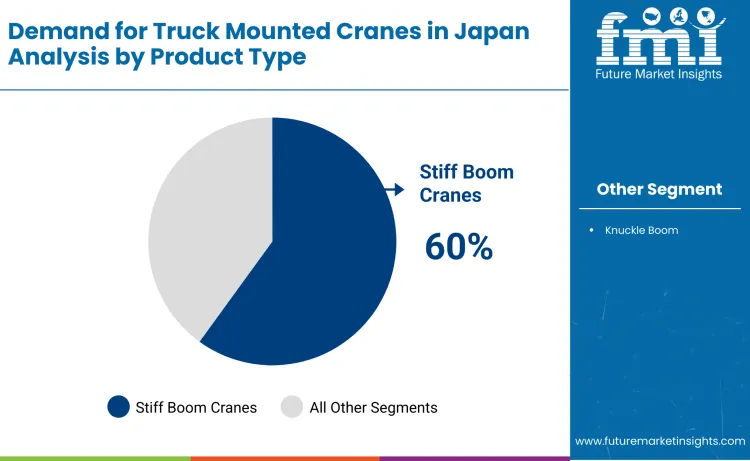
Stiff boom cranes hold 60%, making them the leading product-type segment in Japan. These cranes provide high structural rigidity, predictable lifting behavior, and strong vertical reach suited to controlled lifting tasks. Usage is common in infrastructure maintenance, utility servicing, and construction activities requiring stable load handling. Knuckle boom cranes hold 40%, supporting applications in narrow streets and confined urban spaces where articulated movement improves positioning accuracy. Product-type distribution reflects stronger reliance on stiff boom cranes due to operational simplicity, load stability, and alignment with Japan’s safety-focused lifting practices.
Key Points:
- Stiff boom cranes dominate due to load stability and rigid structure.
- Straight boom design supports controlled lifting in regulated environments.
- Knuckle boom cranes serve confined and precision placement needs.
Which Drive Type Accounts for the Largest Share of Demand in Japan?
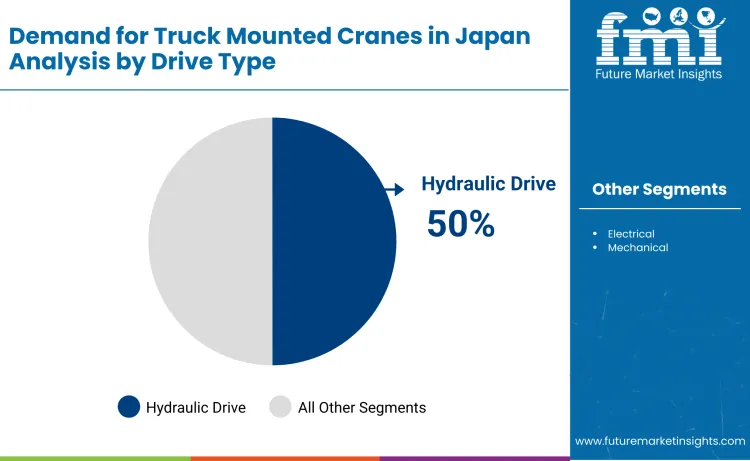
Hydraulic drive systems hold 50.0%, making them the leading drive segment in Japan. Hydraulic systems deliver smooth motion control, high power density, and reliable performance across variable operating conditions. These attributes support precision lifting required in urban construction and utility operations. Electrical drive systems hold 35.0%, reflecting growing interest in reduced noise levels and improved energy efficiency within city environments. Mechanical drive systems hold 15.0%, serving legacy equipment and simpler operational requirements. Drive-type distribution reflects preference for hydraulics due to proven reliability and fine control under Japan’s operational constraints.
Key Points:
- Hydraulic drives lead due to precision and reliability advantages.
- Electrical systems support quieter urban operation requirements.
- Mechanical drives persist in limited, legacy use cases.
What are the Key Dynamics in the Truck Mounted Cranes Industry in Japan?
Demand increases as Japan maintains continuous infrastructure renewal, disaster preparedness, and urban redevelopment activity. Truck mounted cranes support lifting requirements in road maintenance, utility works, port operations, and compact construction sites. Usage aligns with Japan’s dense urban layout, aging infrastructure, and high frequency maintenance schedules. Procurement remains steady across municipal contractors, utility operators, and equipment rental companies serving metropolitan and regional prefectures.
How do urban density, infrastructure maintenance, and disaster response need drive demand in Japan?
Japan’s compact cities and narrow road networks favor truck mounted cranes that combine mobility with precise lifting capability. Municipal authorities use these cranes for bridge repair, road resurfacing, and public facility maintenance. Electric power and telecom utilities deploy truck mounted cranes for pole installation, cable maintenance, and rapid restoration after typhoons and earthquakes. Port and logistics operators use cranes for container handling and equipment positioning in constrained terminals. Aging infrastructure increases frequency of maintenance work rather than large greenfield projects. Earthquake preparedness policies emphasize availability of mobile lifting equipment for emergency response, sustaining consistent demand across prefectural and private operators.
How do regulatory compliance, labor constraints, and cost pressures influence demand stability?
Japan enforces strict vehicle weight limits, safety inspections, and operator certification requirements, influencing crane configuration and procurement choices. Compliance with emission standards affects engine selection and fleet renewal timing. Skilled operator shortages raise labor costs and encourage preference for user-friendly crane systems. High equipment acquisition costs limit ownership among small contractors, increasing reliance on rental fleets. Urban permitting requirements restrict crane size and operating hours. Maintenance standards require regular inspection and documentation, adding operating overhead. Demand remains stable where reliability, compact design, and compliance with Japanese safety norms justify investment within construction, utility, and public works sectors.
How Is Demand for Truck Mounted Cranes in Japan Evolving by Region?
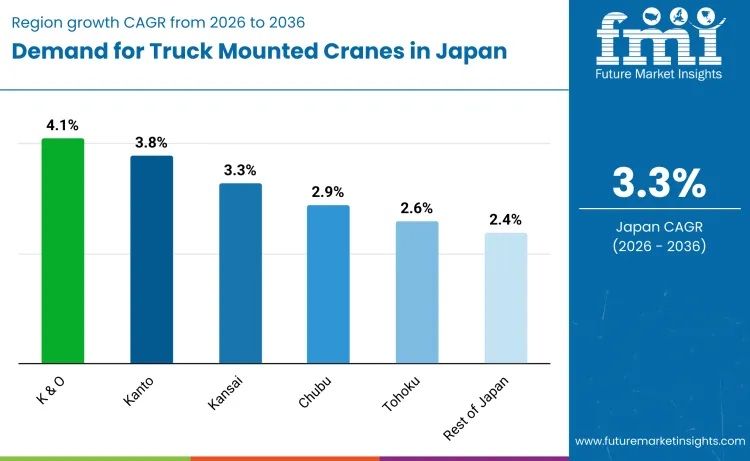
Demand for truck mounted cranes in Japan is increasing due to infrastructure renewal, disaster-prevention projects, and preference for mobile lifting equipment suited to space-constrained sites. Kyushu and Okinawa lead with a 4.1% CAGR, supported by port upgrades and disaster recovery work. Kanto follows at 3.8%, driven by urban redevelopment and utility maintenance. Kansai records a 3.3% CAGR, shaped by industrial retrofits and transport infrastructure projects. Chubu shows a 2.9% CAGR, reflecting manufacturing maintenance demand. Tohoku posts 2.6%, supported by reconstruction activity. Rest of Japan records 2.4%, reflecting steady replacement demand. Regional variation reflects project intensity, urban density, and fleet utilization across Japan.
| Region | CAGR (2026-2036) |
|---|---|
| Kyushu & Okinawa | 4.1% |
| Kanto | 3.8% |
| Kansai | 3.3% |
| Chubu | 2.9% |
| Tohoku | 2.6% |
| Rest of Japan | 2.4% |
How is Kyushu and Okinawa driving demand for Truck Mounted Cranes in Japan?
Kyushu and Okinawa drive demand through infrastructure reinforcement, port development, and disaster-resilience projects. Region’s CAGR of 4.1% reflects frequent use of truck mounted cranes for bridge repairs, coastal protection, and logistics facility upgrades. Geographic exposure to typhoons increases emphasis on rapid-response lifting equipment. Utility operators deploy truck mounted cranes for power line restoration and water infrastructure maintenance. Contractors favor compact cranes with high mobility suitable for island logistics and narrow road networks. Public investment in resilience programs supports consistent equipment utilization. Demand remains project-driven, with preference for reliable hydraulic systems and quick deployment capability.
- Disaster recovery and resilience infrastructure projects
- Port and coastal facility upgrades
- Utility maintenance and emergency response usage
- Preference for compact and mobile crane units
How is Kanto driving demand for Truck Mounted Cranes in Japan?
Kanto demand is shaped by dense urban development, aging infrastructure, and continuous construction activity. Region’s CAGR of 3.8% reflects extensive use of truck mounted cranes in high-rise maintenance, road rehabilitation, and utility upgrades. Limited job-site space increases reliance on mobile cranes with precise load control. Municipal projects emphasize safety compliance and noise control. Fleet operators invest in modern cranes with advanced stability systems and telematics. Demand aligns with ongoing urban redevelopment and transport network maintenance rather than new large-scale construction.
- Urban redevelopment and infrastructure maintenance
- Space-constrained job-site requirements
- Strong focus on safety and operational precision
- Continuous utilization across metropolitan projects
How is Kansai driving demand for Truck Mounted Cranes in Japan?
Kansai demand reflects industrial concentration, commercial redevelopment, and transport infrastructure upkeep. Region’s CAGR of 3.3% is supported by use of truck mounted cranes in factory maintenance, warehouse construction, and rail-related projects. Industrial operators value cranes offering moderate lifting capacity and operational efficiency. Redevelopment of commercial districts sustains demand for flexible lifting solutions. Procurement decisions emphasize durability and compatibility with existing fleet standards. Growth remains steady, linked to industrial activity and regional infrastructure programs.
- Industrial facility maintenance and upgrades
- Commercial redevelopment projects
- Rail and transport infrastructure support
- Demand for durable mid-capacity cranes
How is Chubu driving demand for Truck Mounted Cranes in Japan?
Chubu demand is anchored in manufacturing activity and industrial maintenance. Region’s CAGR of 2.9% reflects use of truck mounted cranes in automotive plants, machinery factories, and logistics hubs. Equipment relocation, line maintenance, and facility expansion support steady crane utilization. Manufacturers prioritize reliability and minimal downtime. Demand favors standardized crane models supporting predictable maintenance schedules. Growth remains moderate, driven by replacement cycles and incremental industrial investment.
- Automotive and machinery manufacturing support
- Equipment relocation and plant maintenance
- Emphasis on reliability and uptime
- Replacement-driven fleet demand
How is Tohoku driving demand for Truck Mounted Cranes in Japan?
Tohoku demand is influenced by reconstruction activity, infrastructure reinforcement, and regional development programs. Region’s CAGR of 2.6% reflects continued use of truck mounted cranes in public works, bridge reinforcement, and rural infrastructure projects. Geographic dispersion increases need for mobile lifting solutions. Contractors favor cranes capable of operating in varied terrain and weather conditions. Public-sector projects provide stable, though moderate, demand growth.
- Reconstruction and public works activity
- Rural and dispersed infrastructure projects
- Need for terrain-capable mobile cranes
- Stable public-sector driven demand
How is Rest of Japan driving demand for Truck Mounted Cranes in Japan?
Rest of Japan shows steady demand driven by routine infrastructure maintenance and fleet replacement. Region’s CAGR of 2.4% reflects use of truck mounted cranes in municipal services, small-scale construction, and utility operations. Demand is cost-sensitive and focused on proven equipment. Local contractors emphasize ease of maintenance and long service life. Growth remains limited, aligned with replacement demand rather than expansion.
- Municipal and small-scale construction usage
- Utility maintenance applications
- Cost-focused procurement behavior
- Replacement-driven market stability
What is the competitive landscape of demand for truck mounted cranes in Japan?
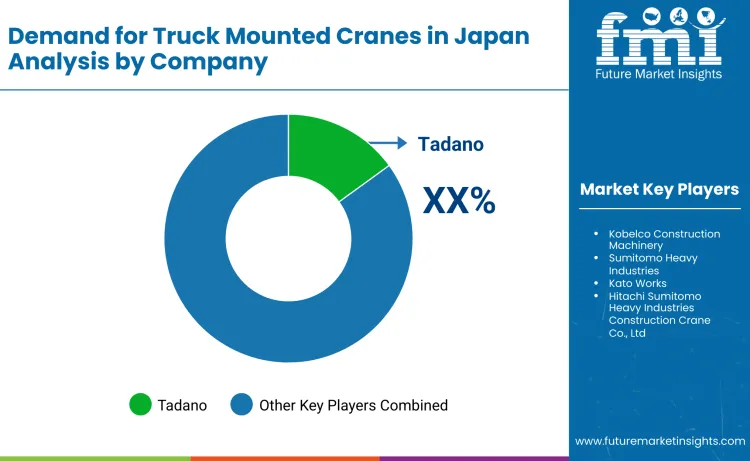
Demand for truck mounted cranes in Japan is shaped by infrastructure renewal, urban construction, utility maintenance, and manufacturing site logistics. Applications require compact dimensions, precise boom control, reliable hydraulic systems, and compliance with Japan’s strict vehicle and road-use regulations. Buyers evaluate lifting capacity, chassis compatibility, maneuverability on narrow streets, and preventative maintenance support. Procurement teams prioritize suppliers with domestic assembly, certified service networks, and parts availability across regions. Trend in Japan reflects ongoing investment in quake-resilient structures, heightened focus on construction safety, and preference for high uptime through robust aftermarket support.
Tadano operates a dominant position through extensive Japanese manufacturing, R&D, and dealer networks supporting truck mounted cranes across large-scale construction and infrastructure projects. Kobelco Construction Machinery supplies truck cranes with advanced hydraulic controls and compact designs suited to Japan’s urban sites. Sumitomo Heavy Industries participates with integrated lifting solutions leveraging domestic engineering and chassis compatibility. Kato Works maintains visibility through truck-mounted and all-terrain cranes specified for tight jobsite conditions and precision handling. Hitachi Sumitomo Heavy Industries Construction Crane Co., Ltd. supports demand with licensed crane solutions and regional service capability. Competitive positioning in Japan reflects local production excellence, adherence to Japanese Safety Standards, rapid parts supply, and deep service networks facilitating high-frequency operational requirements.
Key Players in Japan Truck Mounted Cranes Demand
- Tadano
- Kobelco Construction Machinery
- Sumitomo Heavy Industries
- Kato Works
- Hitachi Sumitomo Heavy Industries Construction Crane Co., Ltd.
Scope of the Report
| Items | Values |
|---|---|
| Quantitative Units | USD million |
| Product Type | Stiff Boom Cranes; Knuckle Boom |
| Drive | Hydraulic Drive Systems; Electrical; Mechanical |
| Regions Covered | Kyushu & Okinawa; Kanto; Kansai; Chubu; Tohoku; Rest of Japan |
| Key Companies Profiled | Tadano; Kobelco Construction Machinery; Sumitomo Heavy Industries; Kato Works; Hitachi Sumitomo Heavy Industries Construction Crane Co., Ltd. |
| Additional Attributes | Dollar sales by product type and drive system; regional CAGR variations across industrial and infrastructure-intensive regions; demand trends linked to construction equipment replacement cycles; adoption patterns for hydraulic versus electric systems; regulatory influence on emissions compliance and safety standards within Japan’s lifting equipment sector. |
Japan Truck Mounted Cranes Demand by Segments
Product Type:
- Stiff Boom Cranes
- Knuckle Boom
Drive:
- Hydraulic Drive Systems
- Electrical
- Mechanical
Region:
- Kyushu & Okinawa
- Kanto
- Kansai
- Chubu
- Tohoku
- Rest of Japan
Frequently Asked Questions
How big is the demand for truck mounted cranes in Japan in 2026?
The demand for truck mounted cranes in Japan is estimated to be valued at USD 146.1 million in 2026.
What will be the size of truck mounted cranes demand in Japan in 2036?
The demand size for truck mounted cranes in Japan is projected to reach USD 202.2 million by 2036.
How much will the demand for truck mounted cranes in Japan grow between 2026 and 2036?
The demand for truck mounted cranes in Japan is expected to grow at a 3.3% CAGR between 2026 and 2036.
What are the key product types in the truck mounted cranes demand in Japan?
The key product types in truck mounted cranes demand in Japan include stiff boom cranes and articulated boom cranes.
Which drive segment is expected to contribute a significant share in the truck mounted cranes demand in Japan in 2026?
In terms of drive, hydraulic drive systems are expected to command 50.0% share in the truck mounted cranes demand in Japan in 2026.
Preview the report firsthand - request a free sample
Get SampleGet the brochure for pricing and purchase details.
Get PDFTable of Content
- Executive Summary
- Japan Market Outlook
- Demand Side Trends
- Supply Side Trends
- Infrastructure, Safety, and Regulatory Landscape
- Analysis and Recommendations
- Market Overview
- Market Coverage and Taxonomy
- Market Definition Scope and Limitations
- Market Background
- Market Dynamics
- Drivers
- Restraints
- Opportunities
- Trends
- Scenario Forecast
- Demand in Optimistic Scenario
- Demand in Likely Scenario
- Demand in Conservative Scenario
- Opportunity Map Analysis
- Equipment and Product Life Cycle Analysis
- Construction and Utility Value Chain Analysis
- Investment Feasibility Matrix
- PESTLE and Porter Analysis
- Safety Standards and Regulatory Compliance Framework
- Regional Parent Market Outlook
- Rental Fleet and Contractor Utilization Analysis
- Japan Truck Mounted Cranes Demand Analysis 2020 to 2024 and Forecast 2025 to 2035
- Historical Demand Value USD Million Analysis 2020 to 2024
- Current and Future Demand Value USD Million Projections 2025 to 2035
- Year on Year Growth Trend Analysis
- Absolute Dollar Opportunity Analysis
- Japan Truck Mounted Cranes Pricing Analysis 2020 to 2024 and Forecast 2025 to 2035
- Japan Truck Mounted Cranes Demand Analysis 2020 to 2024 and Forecast 2025 to 2035 By Product Type
- Introduction and Key Findings
- Historical Demand Value USD Million Analysis by Product Type 2020 to 2024
- Current and Future Demand Value USD Million Analysis and Forecast by Product Type 2025 to 2035
- Stiff Boom Cranes
- Knuckle Boom Cranes
- Year on Year Growth Trend Analysis by Product Type
- Absolute Dollar Opportunity Analysis by Product Type
- Japan Truck Mounted Cranes Demand Analysis 2020 to 2024 and Forecast 2025 to 2035 By Drive Type
- Introduction and Key Findings
- Historical Demand Value USD Million Analysis by Drive Type 2020 to 2024
- Current and Future Demand Value USD Million Analysis and Forecast by Drive Type 2025 to 2035
- Hydraulic Drive Systems
- Electrical Drive Systems
- Mechanical Drive Systems
- Year on Year Growth Trend Analysis by Drive Type
- Absolute Dollar Opportunity Analysis by Drive Type
- Japan Truck Mounted Cranes Demand Analysis 2020 to 2024 and Forecast 2025 to 2035 By Region
- Kyushu and Okinawa
- Kanto
- Kansai
- Chubu
- Tohoku
- Rest of Japan
- Market Structure Analysis
- Competition Dashboard
- Competition Benchmarking
- Market Share Analysis of Key Players
- By Product Type
- By Drive Type
- By Region
- Competition Analysis
- Competition Deep Dive
- Tadano
- Kobelco Construction Machinery
- Sumitomo Heavy Industries
- Kato Works
- Hitachi Sumitomo Heavy Industries Construction Crane
- Assumptions and Acronyms Used
- Research Methodology


