

- Industry Size (2026)
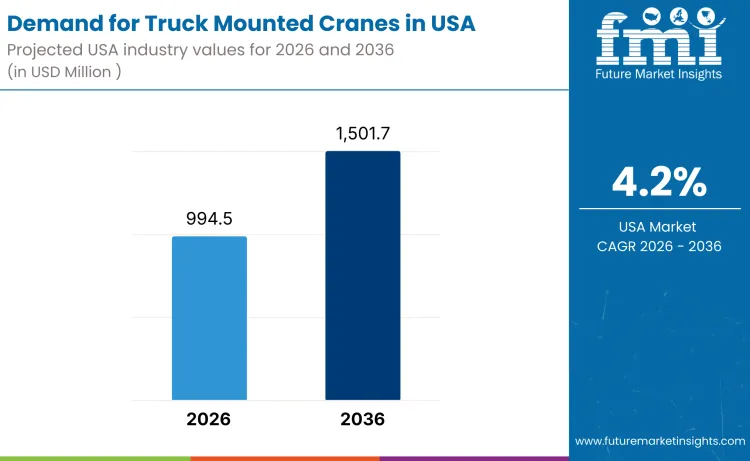
- USD 994.5 Mn
- Forecast (2036)
- USD 1501.7 Mn
- CAGR (2026 to 2036)
- 4.2%
Demand for Truck Mounted Cranes in USA 2026 to 2036
Demand for truck mounted cranes in USA is valued at USD 994.5 million in 2026 and is projected to reach USD 1,501.7 million by 2036, reflecting a CAGR of 4.2%. Demand grows due to sustained activity in infrastructure maintenance, utility installation, energy projects, and urban construction requiring mobile lifting solutions with rapid setup. Fleet renewal programs and preference for versatile equipment that reduces site downtime further support adoption across contractor and rental segments.
Stiff boom cranes lead product-type usage because rigid boom designs deliver higher lifting precision, improved load control, and suitability for frequent short-cycle operations. These cranes perform effectively in utility pole handling, equipment placement, and maintenance tasks where reach accuracy and stability are critical. Advances in hydraulic systems, load-moment indicators, and chassis integration enhance safety and operational efficiency.
Quick Stats for Demand for Truck Mounted Cranes in USA
- USA Truck Mounted Cranes Sales Value (2026): USD 994.5 million
- USA Truck Mounted Cranes Forecast Value (2036): USD 1,501.7 million
- USA Truck Mounted Cranes Forecast CAGR (2026 to 2036): 4.2%
- Leading Product Type in USA Demand: Stiff boom cranes
- Leading Drive Type in USA Demand: Hydraulic drive systems
- Key Growth Regions in USA Demand: West USA, South USA, Northeast USA, Midwest USA
- Top Players in USA Demand: Manitex International, Terex Utilities, Palfinger USA, National Crane, Elliott Equipment Company
West USA, South USA, Northeast USA, and Midwest USA represent key growth regions supported by transportation upgrades, power grid investments, and construction activity across industrial and municipal projects. Manitex International, Terex Utilities, Palfinger USA, National Crane, and Elliott Equipment Company anchor competitive activity through expanded crane capacities, telematics-enabled fleet management, and service networks aligned with uptime requirements across USA lifting and service operations.
USA Truck Mounted Cranes Key Takeaways
| Metric | Value |
|---|---|
| USA Truck Mounted Cranes Sales Value (2026) | USD 994.5 million |
| USA Truck Mounted Cranes Forecast Value (2036) | USD 1,501.7 million |
| USA Truck Mounted Cranes Forecast CAGR (2026 to 2036) | 4.2% |
How Are the Segments Classified in the Demand for Truck Mounted Cranes in the USA?
Demand for truck mounted cranes in the USA is shaped by infrastructure maintenance activity, utility servicing needs, and mobile lifting requirements across construction and industrial operations. Buyers evaluate lifting capacity, reach control, vehicle integration, and compliance with USA safety standards. Adoption patterns reflect preference for crane systems that balance load performance, operational reliability, and compatibility with diverse jobsite conditions across urban and remote environments.
Which Product Type Accounts for the Largest Share of Demand in the USA?
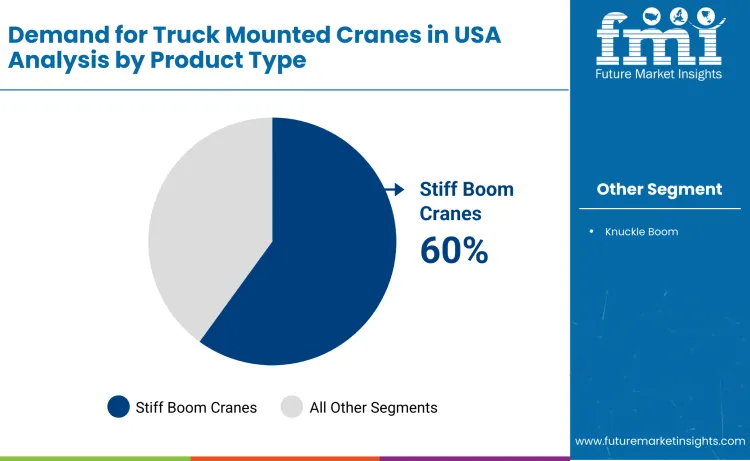
Stiff boom cranes hold 60.0%, making them the leading product-type segment in the USA. These cranes provide high lifting capacity, structural rigidity, and predictable load control suited for construction, utilities, and material-handling tasks. Straight boom design supports vertical lifting and extended reach with simplified operation and maintenance. Knuckle boom cranes hold 40.0%, offering articulated movement for confined spaces and precision placement. Product-type distribution reflects stronger demand for stiff boom cranes due to load stability, ease of training, and suitability for heavy-duty USA applications.
Key Points:
- Stiff boom cranes lead due to high lifting capacity and rigidity.
- Straight boom design supports predictable load control.
- Knuckle boom cranes serve space-constrained and precision tasks.
Which Drive Type Accounts for the Largest Share of Demand in the USA?
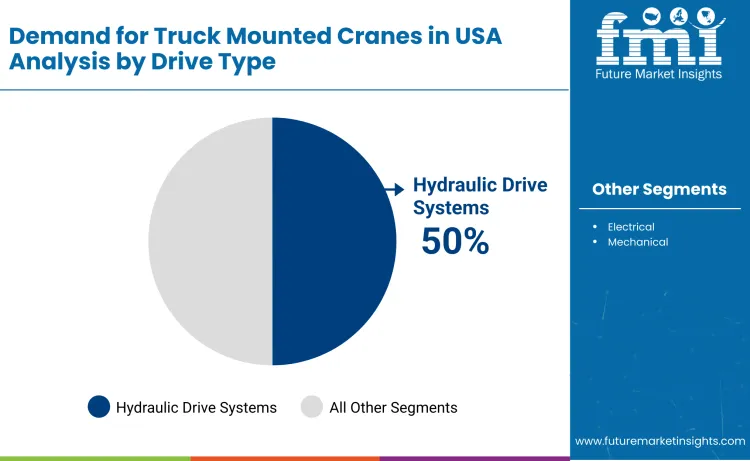
Hydraulic drive systems hold 50.0%, making them the leading drive segment in the USA. Hydraulic systems deliver high power density, smooth load handling, and reliable performance under variable operating conditions. These systems integrate effectively with truck power take-off configurations used widely across USA fleets. Electrical drive systems hold 35.0%, supporting lower-noise operation and alignment with electrification trends. Mechanical drives hold 15.0%, serving legacy applications with simpler control requirements. Drive-type distribution reflects dominance of hydraulics due to proven reliability and load-handling capability.
Key Points:
- Hydraulic drives dominate due to power density and reliability.
- Electrical systems support quieter and energy-efficient operation.
- Mechanical drives persist in legacy and low-complexity uses.
What are the Key Dynamics in the Truck Mounted Cranes Industry in USA?
Demand increases as construction, utilities, logistics, and infrastructure maintenance activities expand across USA. Truck mounted cranes support lifting and placement tasks requiring mobility, rapid setup, and access to dispersed job sites. Usage aligns with road and bridge maintenance, power distribution work, oil and gas servicing, and equipment rental operations. Federal infrastructure funding, urban redevelopment, and utility grid upgrades sustain steady procurement across major industrial regions.
How do infrastructure spending and field service requirements drive demand for truck mounted cranes in USA?
Infrastructure programs focused on highways, bridges, ports, and public facilities increase need for mobile lifting equipment. Utility companies deploy truck mounted cranes for pole setting, transformer installation, and emergency restoration work. Construction contractors value mobility that reduces need for separate transport and setup. Oil and gas service providers use cranes for equipment handling in dispersed field locations. Rental fleets expand inventories to meet short-term project demand across multiple sectors. Compact and medium-capacity cranes gain adoption in urban projects with space constraints. Compliance with DOT transport rules and OSHA lifting standards shapes equipment specification across USA operations.
How do equipment costs, regulatory compliance, and operational constraints influence demand stability?
Capital investment for higher-capacity cranes affects purchasing decisions among small contractors. Compliance with emissions regulations influences engine selection and fleet upgrades. Operator certification and training requirements increase labour-related costs. Urban job sites impose axle load limits and permitting requirements that restrict crane size. Maintenance needs and downtime planning influence fleet utilization rates. Fuel price volatility affects operating expenses for transport-intensive equipment. Alternative lifting solutions such as all-terrain cranes compete in high-capacity applications. Demand remains stable where mobility, versatility, and rapid deployment provide operational advantages within USA construction, utility, and service industries.
How Is Demand for Truck Mounted Cranes in USA Evolving by Region?
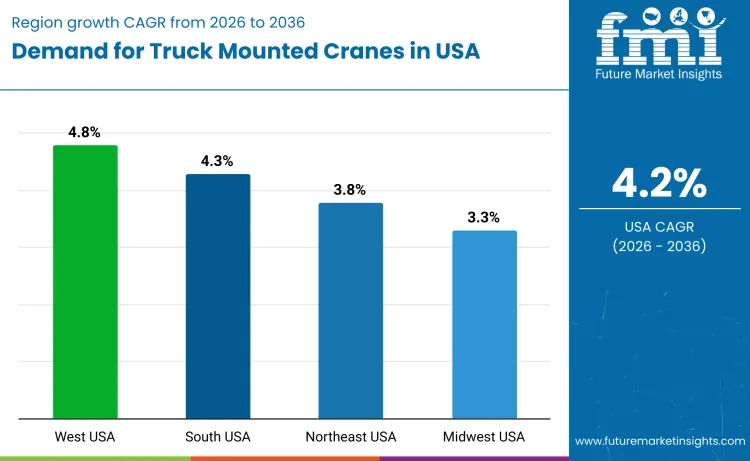
Demand for truck mounted cranes in the USA is rising due to infrastructure rehabilitation, utility network expansion, and preference for mobile lifting solutions across construction and maintenance activities. West USA leads with a 4.8% CAGR, supported by infrastructure upgrades, renewable energy projects, and urban construction constraints. South USA follows at 4.3%, driven by utility expansion, oil and gas maintenance, and commercial construction. Northeast USA records a 3.8% CAGR, shaped by bridge rehabilitation, urban utility work, and space-limited job sites. Midwest USA posts a 3.3% CAGR, reflecting steady demand from industrial maintenance, agriculture-related logistics, and replacement of aging fleets. Regional variation reflects infrastructure age, project mix, and fleet utilization intensity across the USA.
| Region | CAGR (2026 to 2036) |
|---|---|
| West USA | 4.8% |
| South USA | 4.3% |
| Northeast USA | 3.8% |
| Midwest USA | 3.3% |
How is West USA driving demand for Truck Mounted Cranes?
West USA demand is influenced by infrastructure modernization, renewable installations, and dense urban construction environments. The region’s CAGR of 4.8% reflects strong use of truck mounted cranes for bridge repairs, transit projects, and wind and solar component handling. Contractors favor cranes offering higher lifting capacities with compact footprints to operate in congested urban areas. Utility companies deploy truck mounted cranes for transmission-line upgrades and substation maintenance across remote and coastal terrains. Preference is visible for articulated and telescopic models with advanced load-moment indicators and stability systems. Fleet investment aligns with regulatory safety standards and productivity requirements.
- Infrastructure rehabilitation and transit construction usage
- Renewable energy installation and maintenance support
- Demand for compact, high-capacity crane configurations
- Adoption of advanced safety and stability technologies
How is South USA driving demand for Truck Mounted Cranes?
South USA demand is driven by broad geographic coverage, utility network growth, and energy-sector activity. The region’s CAGR of 4.3% reflects extensive use of truck mounted cranes in power distribution, telecommunications tower servicing, and oil and gas facility maintenance. Warm climate enables year-round construction, increasing equipment utilization rates. Contractors value cranes with rapid setup, longer reach, and durability under continuous operation. Fleet operators prioritize standardized models to simplify maintenance and operator training. Demand remains volume-oriented, supported by ongoing commercial development and infrastructure expansion.
- Utility and telecom network installation and servicing
- Oil and gas facility maintenance applications
- Year-round construction supporting high utilization
- Preference for standardized, durable crane fleets
How is Northeast USA driving demand for Truck Mounted Cranes?
Northeast USA demand reflects aging infrastructure, dense urban environments, and regulatory-driven maintenance programs. The region’s CAGR of 3.8% is supported by use of truck mounted cranes in bridge retrofits, water and sewer upgrades, and urban building renovation projects. Limited site access increases reliance on mobile lifting solutions capable of operating in confined spaces. Municipal agencies and contractors emphasize compliance with safety, emissions, and noise regulations. Demand favors mid-capacity cranes with precise control systems and efficient powertrains suitable for urban deployment.
- Bridge and municipal infrastructure rehabilitation
- Urban construction with space constraints
- Regulatory compliance influencing equipment selection
- Demand for precise, mid-capacity crane solutions
How is Midwest USA driving demand for Truck Mounted Cranes?
Midwest USA demand is steady and replacement-driven, reflecting industrial maintenance, agricultural logistics, and manufacturing support activities. The region’s CAGR of 3.3% reflects use of truck mounted cranes in factory maintenance, equipment relocation, and farm-related infrastructure projects. Fleet owners prioritize reliability, ease of maintenance, and cost efficiency. Seasonal construction cycles influence purchasing decisions, with emphasis on long service life and parts availability. Demand growth remains moderate, supported by gradual fleet modernization and replacement of older hydraulic crane units.
- Industrial and manufacturing maintenance applications
- Agricultural and rural infrastructure support
- Replacement-driven fleet modernization
- Cost-efficient, reliable crane configurations
What is the competitive landscape of demand for truck mounted cranes in the USA?
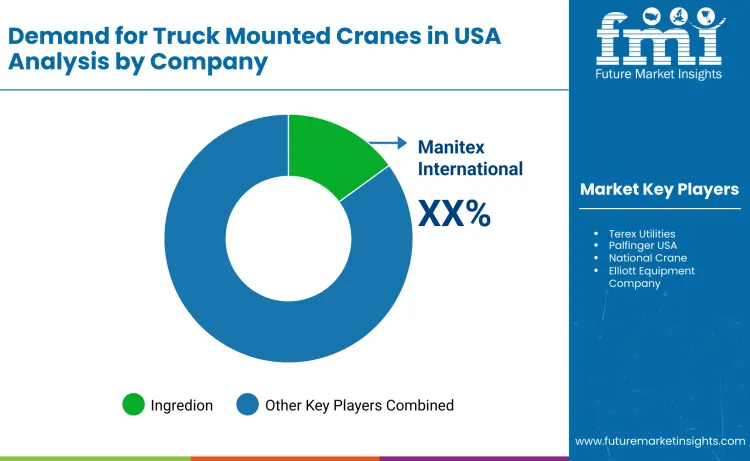
Demand for truck mounted cranes in the USA is driven by construction activity, utility maintenance, oil and gas servicing, logistics handling, and municipal operations requiring mobile lifting capability. Applications require reliable load charts, hydraulic stability, outreach precision, and compliance with USA highway and safety regulations. Buyers evaluate lifting capacity, boom configuration, control systems, chassis compatibility, and serviceability across varied jobsite conditions. Procurement teams prioritize suppliers with domestic assembly, dealer coverage, parts availability, and operator training support. Trend in the USA market reflects infrastructure spending, utility grid upgrades, and preference for versatile lifting solutions that reduce mobilization time.
Manitex International maintains extensive USA operations supplying telescopic and knuckleboom truck cranes used across construction and rental fleets. Terex Utilities supports demand with truck-mounted and digger derrick platforms specified for electric utility and telecommunications work. Palfinger USA operates manufacturing and service facilities delivering knuckleboom cranes adopted by logistics, waste, and construction operators. National Crane, part of the Manitowoc portfolio, supplies hydraulic truck cranes widely used by rental houses and contractors. Elliott Equipment Company serves utility and infrastructure users with truck-mounted cranes and material-handling solutions engineered for durability and field service. Competitive positioning in the USA reflects lifting performance, domestic support infrastructure, regulatory compliance, and adaptability to multiple vocational applications.
Key Players in USA Truck Mounted Cranes Demand
- Manitex International
- Terex Utilities
- Palfinger USA
- National Crane
- Elliott Equipment Company
Scope of the Report
| Items | Values |
|---|---|
| Quantitative Units | USD million |
| Product Type | Stiff Boom Cranes; Knuckle Boom Cranes |
| Drive | Hydraulic Drive Systems; Electrical; Mechanical |
| Regions Covered | West USA; South USA; Northeast USA; Midwest USA |
| Key Companies Profiled | Manitex International; Terex Utilities; Palfinger USA; National Crane; Elliott Equipment Company |
| Additional Attributes | Dollar sales by crane type and drive system; demand patterns linked to construction, utilities, and infrastructure activity; preference trends for hydraulic systems due to load control and reliability; fleet replacement cycles among rental operators; safety compliance and lifting-capacity regulations shaping procurement decisions. |
USA Truck Mounted Cranes Demand by Segments
Product Type:
- Stiff Boom Cranes
- Knuckle Boom
Drive:
- Hydraulic Drive Systems
- Electrical
- Mechanical
Region:
- West USA
- South USA
- Northeast USA
- Midwest USA
Frequently Asked Questions
How big is the demand for truck mounted cranes in USA in 2026?
The demand for truck mounted cranes in USA is estimated to be valued at USD 994.5 million in 2026.
What will be the size of truck mounted cranes demand in USA in 2036?
The demand size for truck mounted cranes in USA is projected to reach USD 1,501.7 million by 2036.
How much will the demand for truck mounted cranes in USA grow between 2026 and 2036?
The demand for truck mounted cranes in USA is expected to grow at a 4.2% CAGR between 2026 and 2036.
What are the key product types in the truck mounted cranes demand in USA?
The key product types in truck mounted cranes demand in USA include stiff boom cranes and articulated boom cranes.
Which drive segment is expected to contribute a significant share in the truck mounted cranes demand in USA in 2026?
In terms of drive, hydraulic drive systems are expected to command 50.0% share in the truck mounted cranes demand in USA in 2026.
Preview the report firsthand - request a free sample
Get SampleGet the brochure for pricing and purchase details.
Get PDFTable of Content
- Executive Summary
- USA Market Outlook
- Demand Side Trends
- Supply Side Trends
- Construction and Utility Equipment Regulatory Landscape
- Analysis and Recommendations
- Market Overview
- Market Coverage and Taxonomy
- Market Definition Scope and Limitations
- Market Background
- Market Dynamics
- Drivers
- Restraints
- Opportunities
- Trends
- Scenario Forecast
- Demand in Optimistic Scenario
- Demand in Likely Scenario
- Demand in Conservative Scenario
- Opportunity Map Analysis
- Product Life Cycle Analysis
- Supply Chain Analysis
- Investment Feasibility Matrix
- Value Chain Analysis
- PESTLE and Porter Analysis
- Safety and Transport Regulatory Framework
- Regional Parent Market Outlook
- Production and Consumption Statistics
- Import and Export Statistics
- USA Truck Mounted Cranes Demand Analysis 2020 to 2024 and Forecast 2025 to 2035
- Historical Market Size Value USD Million Analysis 2020 to 2024
- Current and Future Market Size Value USD Million Projections 2025 to 2035
- Year on Year Growth Trend Analysis
- Absolute Dollar Opportunity Analysis
- USA Truck Mounted Cranes Pricing Analysis 2020 to 2024 and Forecast 2025 to 2035
- USA Truck Mounted Cranes Demand Analysis 2020 to 2024 and Forecast 2025 to 2035 By Product Type
- Introduction and Key Findings
- Historical Market Size Value USD Million Analysis by Product Type 2020 to 2024
- Current and Future Market Size Value USD Million Analysis and Forecast by Product Type 2025 to 2035
- Stiff Boom Cranes
- Knuckle Boom Cranes
- Year on Year Growth Trend Analysis by Product Type
- Absolute Dollar Opportunity Analysis by Product Type
- USA Truck Mounted Cranes Demand Analysis 2020 to 2024 and Forecast 2025 to 2035 By Drive Type
- Introduction and Key Findings
- Historical Market Size Value USD Million Analysis by Drive Type 2020 to 2024
- Current and Future Market Size Value USD Million Analysis and Forecast by Drive Type 2025 to 2035
- Hydraulic Drive Systems
- Electrical Drive Systems
- Mechanical Drive Systems
- Year on Year Growth Trend Analysis by Drive Type
- Absolute Dollar Opportunity Analysis by Drive Type
- USA Truck Mounted Cranes Demand Analysis 2020 to 2024 and Forecast 2025 to 2035 By Region
- West USA
- South USA
- Northeast USA
- Midwest USA
- Market Structure Analysis
- Competition Dashboard
- Competition Benchmarking
- Market Share Analysis of Key Players
- By Product Type
- By Drive Type
- By Region
- Competition Analysis
- Competition Deep Dive
- Manitex International
- Terex Utilities
- Palfinger USA
- National Crane
- Elliott Equipment Company
- Assumptions and Acronyms Used
- Research Methodology


