

- Industry Size (2026)
- USD 7.6 Bn
- Forecast (2036)
- USD 20.4 Bn
- CAGR (2026 to 2036)
- 10.40%
Turn-Based Strategy Games Market Forecast and Outlook 2026 to 2036
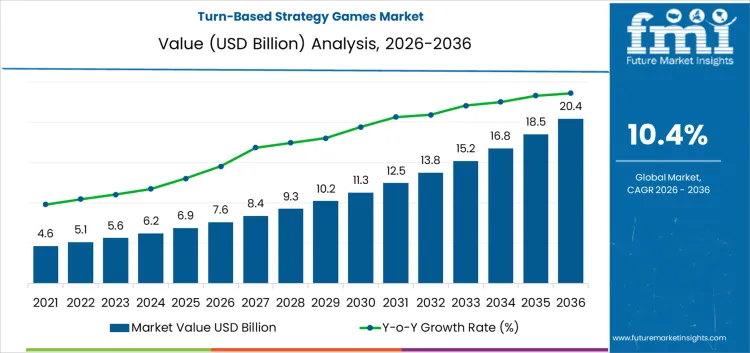
The turn-based strategy games market is projected to reach USD 7.6 billion in 2026 and USD 20.4 billion by 2036, expanding at a CAGR of 10.40%. This genre holds strategic value within the broader gaming ecosystem due to its influence on monetization architecture, player retention strategies, and genre diversification for platform holders and publishers. Control points in this space include content cadence, in-game progression pacing, and system compatibility. Turn-based formats allow developers to regulate player flow through campaign design, unlock structures, and seasonal updates, offering more predictable engagement patterns than reflex-based genres. Dependency rests on user segments that value strategy, planning, and asynchronous gameplay over reaction time, insulating the genre from volatility in competitive streaming-driven titles. Strategic trade-offs emerge between depth and accessibility. Developers must balance complex mechanics with mobile-first interfaces or console-based ergonomics. As subscription services and cross-platform engines scale, publishers treat turn-based IPs as anchor content that sustains user interest beyond single-session formats.
Quick Stats for Turn-Based Strategy Games Market
- Turn-Based Strategy Games Market Value (2026): USD 7.6 Billion
- Turn-Based Strategy Games Market Forecast Value (2036): USD 20.4 Billion
- Turn-Based Strategy Games Market Forecast CAGR 2026 to 2036: 10.40%
- Leading Platform in Turn-Based Strategy Games Market: Mobile (42% share)
- Leading End User in Turn-Based Strategy Games Market: Adults (50% share)
- Key Growth Regions in Turn-Based Strategy Games Market: Asia Pacific, North America, Europe
- Top Key Players in Turn-Based Strategy Games Market: Firaxis Games; Paradox Interactive; SEGA (Creative Assembly / Amplitude Studios); 2K Games; Square Enix Holdings Co., Ltd.; Slitherine Ltd.; Ubisoft Entertainment SA; Subset Games
Turn-Based Strategy Games Market Key Takeaways
| Metric | Value |
|---|---|
| Turn-Based Strategy Games Market Value (2026) | USD 7.6 Billion |
| Turn-Based Strategy Games Market Forecast Value (2036) | USD 20.4 Billion |
| Turn-Based Strategy Games Market Forecast CAGR 2026 to 2036 | 10.40% |
Why is the Turn-Based Strategy Games Market Growing Significantly?
The turn-based strategy games market is expanding due to rising interest in immersive gaming experiences that emphasize strategy, planning, and tactical decision-making. Players increasingly seek games that allow thoughtful gameplay rather than real-time reflex-based action. The growth of digital distribution platforms, mobile gaming, and online multiplayer features has made turn-based strategy games more accessible to a global audience.
Technological advancements are supporting growth in the turn-based strategy games market. High-quality graphics, AI-driven opponent behavior, cross-platform compatibility, and cloud-based multiplayer integration are enhancing user engagement and retention. Developers are leveraging analytics and feedback to design complex game mechanics that appeal to both casual and competitive players, encouraging longer playtime and higher monetization.
Expanding gamer demographics and increasing esports recognition are also driving adoption in the turn-based strategy games market. Rising smartphone penetration, faster internet connectivity, and interest from younger audiences support broader participation. Game publishers are investing in franchises, downloadable content, and in-game purchases to increase engagement. Combined, enhanced gameplay features, wider accessibility, and demographic growth are sustaining robust expansion of the market over the forecast period.
What Does The Segment Overview Indicate About The Turn-Based Strategy Games Market?
The turn-based strategy games market is segmented by platform and end user, highlighting gameplay preferences across device types and age demographics. Mobile platforms lead the segment with an estimated 42% share, reflecting high user engagement through smartphones and tablets. PC and console segments remain strong among dedicated gamers, while emerging platforms add niche access. Adults form the largest end-user group with approximately 50% share, driven by long-term engagement, in-game spending capacity, and preference for strategic depth. Teenagers and kids contribute to growth through casual play and entry-level exposure to the genre.
Why Do Mobile Platforms Hold The Leading Share In The Turn-Based Strategy Games Market?
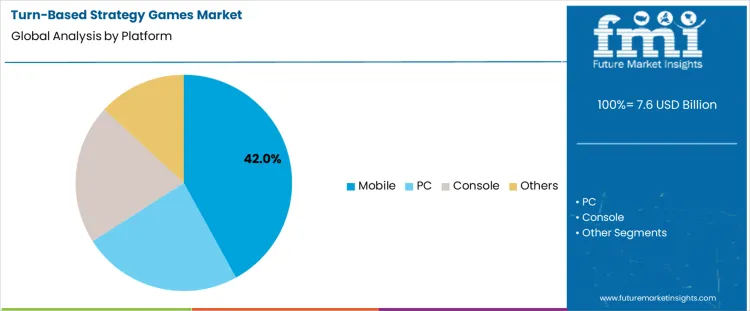
Mobile platforms account for the leading 42% share in the turn-based strategy games market due to their accessibility, global reach, and increasing hardware capability. The mobile format supports bite-sized gameplay, asynchronous turns, and simplified controls, making it ideal for casual and on-the-go users. Titles designed for mobile often feature in-app purchases, social connectivity, and daily progression rewards, boosting engagement. Demand is shaped by regional preferences, with high uptake in Asia-Pacific and Latin America. Game publishers benefit from lower development costs and larger user bases compared to traditional platforms. As mobile gaming continues to expand across income levels and age groups, it maintains dominance in user acquisition and play frequency within the turn-based strategy segment.
How Do Adults Drive End-User Demand In The Turn-Based Strategy Games Market?
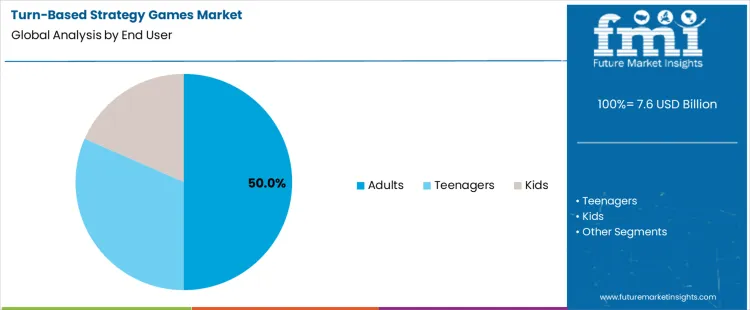
Adults lead the end-user segment in the turn-based strategy games market with a dominant 50% share, as they exhibit sustained interest in deep gameplay mechanics, progression systems, and strategic planning. This demographic includes working professionals and older gamers who seek thoughtful, non-realtime gaming experiences. Many adult players invest in premium content, season passes, and tactical expansion packs, contributing significantly to monetization. Demand variation is influenced by platform preference PC and mobile dominate adult engagement, with consoles appealing to niche segments. Adults also participate in online communities, tournaments, and user-generated content platforms, strengthening long-term ecosystem involvement. Their higher average spending and brand loyalty continue to make them the most commercially important segment for game publishers.
What Gameplay Preferences Are Fueling Growth in the Turn-Based Strategy Games Market?
The turn-based strategy games market is expanding as players seek deeper tactical experiences, thoughtful pacing, and replayable scenarios. Unlike real-time genres, turn-based formats allow for deliberate decision-making, which appeals to competitive and casual players alike. Increasing adoption across consoles, PCs, and mobile devices is driving broader audience reach. Single-player campaign depth, branching outcomes, and asynchronous multiplayer support are enhancing long-term engagement. Franchises like Civilization, XCOM, and Fire Emblem maintain strong retention due to strategic complexity and community-driven mod ecosystems. The rise of indie development and crowdfunding is also enabling innovation in niche sub-genres, expanding variety within the global player base.
Why Are Cross-Platform Capabilities and Story Depth Increasing Demand?
Cross-platform support and narrative-driven content are accelerating adoption in the turn-based strategy games market. Players now expect seamless progression across PC, mobile, and console environments, especially in multiplayer or roguelike formats. Cloud gaming services and subscription bundles are expanding discoverability for genre newcomers. Storytelling has also become central, with character development, moral decision paths, and campaign branching enhancing emotional investment. Franchises that blend tactical combat with role-playing elements such as Into the Breach or Triangle Strategy are performing well among players seeking narrative agency. Hybrid design models are enabling developers to draw in broader demographics while retaining core strategy-focused audiences.
What Constraints Are Slowing Expansion of This Genre?
The turn-based strategy games market faces constraints from limited mainstream visibility and long development cycles. High complexity deters casual players unfamiliar with tactical planning or rulesets, narrowing audience reach. Monetization remains challenging, as many games lack in-game economies or cosmetics compared to other genres. Traditional turn-based pacing is less suited for esports or live-streamed formats, reducing marketing opportunities. Extensive AI scripting, level balancing, and scenario testing increase development time. Many titles remain limited to PC-first audiences, as some mechanics do not translate well to mobile or controller-based interfaces without significant redesign. These factors restrict mass-market scalability despite niche loyalty.
What is the Country-Wise Growth Outlook for the Turn-Based Strategy Games Market?
The turn-based strategy games market is expanding steadily, supported by increasing mobile adoption, cross-platform monetization, and rising interest in tactical gameplay. China leads with a CAGR of 12.0%, driven by high mobile penetration and a strong domestic developer ecosystem. India follows at 11.2% CAGR as localized games and in-app monetization models scale quickly across mid-core audiences. South Korea records a 10.5% CAGR due to integration of tactical RPGs and franchise-based strategy titles on mobile and PC. The USA grows at 10.0% CAGR through console-based strategy IPs and indie game expansion. Japan shows a 9.5% CAGR, supported by deep-rooted interest in tactical RPGs and growing crossover with anime-based strategy formats.
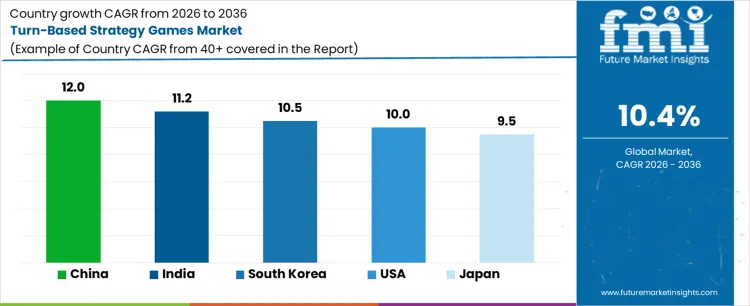
| Country | CAGR |
|---|---|
| China | 12.0% |
| India | 11.2% |
| South Korea | 10.5% |
| USA | 10.0% |
| Japan | 9.5% |
Why Is China Leading Growth in the Turn-Based Strategy Games Market?
Demand for the turn-based strategy games in China is growing at a CAGR of 12.0%, supported by the expansion of mobile-first gameplay, domestic IP adaptation, and strong player loyalty to tactics-focused formats. Chinese studios are building advanced monetization systems around collectible units, competitive ladder mechanics, and time-based turn events. Turn-based formats are frequently blended with RPG and war simulation systems, creating deep engagement loops for mid-core and hardcore gamers. Success of localized and historical strategy themes boosts replay value and session times. Growth is further accelerated by live ops integration, social battle systems, and native mini-game platforms within Tencent and NetEase ecosystems. Game publishers also invest in AI-driven opponents, multi-angle battlefield views, and asynchronous multiplayer features. Regulatory limitations on playtime encourage strategic depth over reflex-driven gameplay, which aligns well with the genre.
What Is Driving Growth in India's Turn-Based Strategy Games Market?
Sales for the turn-based strategy games in India are expanding at a CAGR of 11.2%, driven by rising smartphone penetration, regional content preferences, and monetization through ad-supported gameplay. Indian studios are increasingly experimenting with hybrid genres that combine tactical decision-making with card battlers and historical narratives. Mobile-first users engage with offline-capable formats, slower tactical loops, and modular PvE campaigns. Localized themes based on mythology or modern conflict zones gain popularity across Tier I and Tier II urban segments. Developers focus on data-light, storage-optimized apps with simplified user interfaces and real-time decision cues. Monetization is centered around rewarded ads, battle pass subscriptions, and time-unlocked in-game currency. Casual users gradually shift into structured gameplay environments through challenge-based progression and social PvP options. Turn-based formats are gaining traction in edutainment titles and defense simulation games promoted through student and youth networks.
Why Is South Korea Expanding Its Turn-Based Strategy Games Market?
Demand for the turn-based strategy games in South Korea is growing at a CAGR of 10.5%, supported by the popularity of tactics-based RPGs, franchise spin-offs, and high engagement in PvP-focused mobile games. South Korean publishers specialize in combining visual storytelling with grid-based combat systems optimized for touch interfaces. Cultural alignment with competitive turn mechanics supports strong retention in tournament-driven formats. Established console IPs have been successfully adapted for mobile and browser-based ecosystems with layered gacha systems and limited-turn battles. Players show preference for stylized character rosters, combo mechanics, and vertical team-building strategies. Developers focus on story-linked campaigns, evolving seasonal arcs, and balance-tuned unit meta to retain whales and mid-core spenders. Integration with Kakao Games and Naver platforms helps increase exposure, while real-time global PvP ladders support cross-border engagement.
What Is Supporting Growth in the USA’s Turn-Based Strategy Games Market?
Sales for the turn-based strategy games in the USA are increasing at a CAGR of 10.0%, driven by premium indie development, console-based tactical RPG success, and long-term engagement with IP-rich franchises. USA audiences favor high-production-value games with turn mechanics that allow deeper planning, campaign management, and time-controlled session play. Developers in the indie and mid-tier segment use crowdfunding, seasonal content updates, and retro-inspired formats to revive grid-based and hex-based gameplay. Games like XCOM, Fire Emblem, and Civilization have set benchmarks for design, inspiring newer projects with roguelike elements, permadeath, and customizable squads. App Store and Steam storefronts offer visibility to turn-based games as a distinct category with strong ratings and community reviews. Monetization is largely upfront purchase or DLC-based, though hybrid mobile entries now include season passes and cosmetic upgrades.
Why Is Japan Maintaining Its Position in Turn-Based Strategy Game Development?
Demand for the turn-based strategy games in Japan is growing at a CAGR of 9.5%, supported by long-standing player affinity for tactical RPGs, anime-themed mechanics, and serialized campaign progression. Japanese developers lead in character-centric formats where strategy is tied to emotional investment, voice acting, and narrative arcs. Turn-based games remain popular on handheld and mobile devices, particularly those using grid or lane-based combat with character synergy bonuses. Classic franchises continue to release new entries with multi-platform support, while newer developers focus on 3D battlefields and limited-time PvE events. Monetization is largely gacha-driven, with collectible heroes, weapon banners, and costume variants sustaining top-grossing performance. Players are accustomed to daily login bonuses, multi-currency economies, and challenge-based event maps that reinforce long-term play.
How Are Leading Companies Competing And Differentiating In The Turn-Based Strategy Games Market?
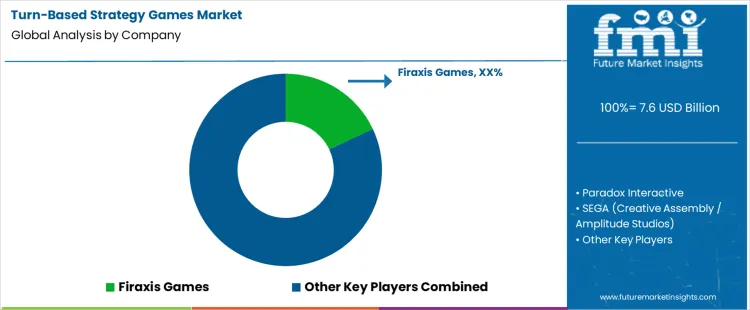
Competition in the turn-based strategy games market is being shaped by gameplay depth, narrative richness, and player engagement mechanics. Firaxis Games is being positioned around historically themed strategy titles, with product materials highlighting layered tactical decision-making, AI sophistication, and replayability. Paradox Interactive is being differentiated through grand strategy simulations, emphasizing complex political, economic, and military systems with long-term campaign planning. SEGA, via Creative Assembly and Amplitude Studios, focuses on visually rich worlds, faction diversity, and layered battle systems that appeal to both casual and hardcore players.
Content expansion and player customization are being leveraged by 2K Games, Square Enix Holdings Co., Ltd., and Slitherine Ltd. 2K Games emphasizes scenario variety, multiplayer options, and mod support, highlighting longevity and strategic experimentation. Square Enix focuses on story-driven campaigns integrated with strategic mechanics, with product brochures highlighting immersive worlds and character-driven strategy. Slitherine Ltd. markets specialized war simulations and niche historical scenarios, emphasizing authenticity, scenario depth, and tactical challenge.
A different competitive angle is being pursued by Ubisoft Entertainment SA and Subset Games. Ubisoft leverages hybrid mechanics combining turn-based strategy with real-time elements and approachable tutorials, aiming to broaden audience reach. Subset Games positions its titles around compact, high-intensity campaigns with innovative mechanics and streamlined interfaces. Across the market, differentiation is being driven by complexity, narrative integration, and strategic diversity, with product materials translating gameplay mechanics into unique player experiences and engagement value.
Key Players in Turn-Based Strategy Games Market
- Firaxis Games
- Paradox Interactive
- SEGA (Creative Assembly / Amplitude Studios)
- 2K Games
- Square Enix Holdings Co., Ltd.
- Slitherine Ltd.
- Ubisoft Entertainment SA
- Subset Games
Scope of Report
| Attributes | Description |
|---|---|
| Quantitative Unit | USD Billion |
| Platforms | Mobile, PC, Console, Others |
| End Users | Adults, Teenagers, Kids |
| Regions Covered | Asia Pacific, Europe, North America, Latin America, Middle East & Africa |
| Countries Covered | China, Japan, South Korea, India, Australia & New Zealand, ASEAN, Rest of Asia Pacific, Germany, United Kingdom, France, Italy, Spain, Nordic, BENELUX, Rest of Europe, United States, Canada, Mexico, Brazil, Chile, Rest of Latin America, Kingdom of Saudi Arabia, Other GCC Countries, Turkey, South Africa, Other African Union, Rest of Middle East & Africa |
| Key Companies Profiled | Firaxis Games, Paradox Interactive, SEGA (Creative Assembly / Amplitude Studios), 2K Games, Square Enix Holdings Co., Ltd., Slitherine Ltd., Ubisoft Entertainment SA, Subset Games |
| Additional Attributes | Market revenue by platform and end-user segments; regional adoption trends in APAC, North America, and Europe; mobile vs PC vs console penetration; user demographics analysis (adults, teenagers, kids); competitive landscape insights; forecasted market growth and CAGR over 2026-2036; emerging market trends and consumer behavior in turn-based strategy gaming. |
Turn-Based Strategy Games Market by Key Segments
Platform:
- Mobile
- PC
- Console
- Others
End User:
- Adults
- Teenagers
- Kids
Region:
- Asia Pacific
- China
- Japan
- South Korea
- India
- Australia & New Zealand
- ASEAN
- Rest of Asia Pacific
- Europe
- Germany
- United Kingdom
- France
- Italy
- Spain
- Nordic
- BENELUX
- Rest of Europe
- North America
- United States
- Canada
- Mexico
- Latin America
- Brazil
- Chile
- Rest of Latin America
- Middle East & Africa
- Kingdom of Saudi Arabia
- Other GCC Countries
- Turkey
- South Africa
- Other African Union
- Rest of Middle East & Africa
Bibliography
- Department for Culture, Media and Sport. (2023). Video games research framework. UK Government.
- Entertainment Software Association. (2024). Essential Facts About the USA Video Game Industry 2024. ESA.
- Entertainment Software Association. (2025). 2025 Essential Facts About the USA Video Game Industry. ESA.
- University of York / Department for Culture, Media and Sport partnership. (2023). Launch of new government guide on video games research. UK Government press release.
- Square Enix Holdings Co., Ltd. (2025). Final Fantasy Tactics: The Ivalice Chronicles – Official Announcement. Retrieved from Square Enix investor relations and official press channels.
Frequently Asked Questions
How big is the turn-based strategy games market in 2026?
The global turn-based strategy games market is estimated to be valued at USD 7.6 billion in 2026.
What will be the size of turn-based strategy games market in 2036?
The market size for the turn-based strategy games market is projected to reach USD 20.4 billion by 2036.
How much will be the turn-based strategy games market growth between 2026 and 2036?
The turn-based strategy games market is expected to grow at a 10.4% CAGR between 2026 and 2036.
What are the key product types in the turn-based strategy games market?
The key product types in turn-based strategy games market are mobile, pc, console and others.
Which end user segment to contribute significant share in the turn-based strategy games market in 2026?
In terms of end user, adults segment to command 50.0% share in the turn-based strategy games market in 2026.
Preview the report firsthand - request a free sample
Get SampleGet the brochure for pricing and purchase details.
Get PDFTable of Content
- Executive Summary
- Global Market Outlook
- Demand-side Trends
- Supply-side Trends
- Technology Roadmap Analysis
- Analysis and Recommendations
- Market Overview
- Market Coverage / Taxonomy
- Market Definition / Scope / Limitations
- Market Background
- Market Dynamics
- Drivers
- Restraints
- Opportunity
- Trends
- Scenario Forecast
- Demand in Optimistic Scenario
- Demand in Likely Scenario
- Demand in Conservative Scenario
- Opportunity Map Analysis
- Product Life Cycle Analysis
- Supply Chain Analysis
- Investment Feasibility Matrix
- Value Chain Analysis
- PESTLE and Porter’s Analysis
- Regulatory Landscape
- Regional Parent Market Outlook
- Production and Consumption Statistics
- Import and Export Statistics
- Market Dynamics
- Global Market Analysis 2021 to 2025 and Forecast, 2026 to 2036
- Historical Market Size Value (USD Million) Analysis, 2021 to 2025
- Current and Future Market Size Value (USD Million) Projections, 2026 to 2036
- Y-o-Y Growth Trend Analysis
- Absolute $ Opportunity Analysis
- Global Market Pricing Analysis 2021 to 2025 and Forecast 2026 to 2036
- Global Market Analysis 2021 to 2025 and Forecast 2026 to 2036, By Platform
- Introduction / Key Findings
- Historical Market Size Value (USD Million) Analysis By Platform, 2021 to 2025
- Current and Future Market Size Value (USD Million) Analysis and Forecast By Platform, 2026 to 2036
- Mobile
- PC
- Console
- Others
- Mobile
- Y-o-Y Growth Trend Analysis By Platform, 2021 to 2025
- Absolute $ Opportunity Analysis By Platform, 2026 to 2036
- Global Market Analysis 2021 to 2025 and Forecast 2026 to 2036, By End User
- Introduction / Key Findings
- Historical Market Size Value (USD Million) Analysis By End User, 2021 to 2025
- Current and Future Market Size Value (USD Million) Analysis and Forecast By End User, 2026 to 2036
- Adults
- Teenagers
- Kids
- Adults
- Y-o-Y Growth Trend Analysis By End User, 2021 to 2025
- Absolute $ Opportunity Analysis By End User, 2026 to 2036
- Global Market Analysis 2021 to 2025 and Forecast 2026 to 2036, By Region
- Introduction
- Historical Market Size Value (USD Million) Analysis By Region, 2021 to 2025
- Current Market Size Value (USD Million) Analysis and Forecast By Region, 2026 to 2036
- North America
- Latin America
- Western Europe
- Eastern Europe
- East Asia
- South Asia and Pacific
- Middle East & Africa
- Market Attractiveness Analysis By Region
- North America Market Analysis 2021 to 2025 and Forecast 2026 to 2036, By Country
- Historical Market Size Value (USD Million) Trend Analysis By Market Taxonomy, 2021 to 2025
- Market Size Value (USD Million) Forecast By Market Taxonomy, 2026 to 2036
- By Country
- USA
- Canada
- Mexico
- By Platform
- By End User
- By Country
- Market Attractiveness Analysis
- By Country
- By Platform
- By End User
- Key Takeaways
- Latin America Market Analysis 2021 to 2025 and Forecast 2026 to 2036, By Country
- Historical Market Size Value (USD Million) Trend Analysis By Market Taxonomy, 2021 to 2025
- Market Size Value (USD Million) Forecast By Market Taxonomy, 2026 to 2036
- By Country
- Brazil
- Chile
- Rest of Latin America
- By Platform
- By End User
- By Country
- Market Attractiveness Analysis
- By Country
- By Platform
- By End User
- Key Takeaways
- Western Europe Market Analysis 2021 to 2025 and Forecast 2026 to 2036, By Country
- Historical Market Size Value (USD Million) Trend Analysis By Market Taxonomy, 2021 to 2025
- Market Size Value (USD Million) Forecast By Market Taxonomy, 2026 to 2036
- By Country
- Germany
- UK
- Italy
- Spain
- France
- Nordic
- BENELUX
- Rest of Western Europe
- By Platform
- By End User
- By Country
- Market Attractiveness Analysis
- By Country
- By Platform
- By End User
- Key Takeaways
- Eastern Europe Market Analysis 2021 to 2025 and Forecast 2026 to 2036, By Country
- Historical Market Size Value (USD Million) Trend Analysis By Market Taxonomy, 2021 to 2025
- Market Size Value (USD Million) Forecast By Market Taxonomy, 2026 to 2036
- By Country
- Russia
- Poland
- Hungary
- Balkan & Baltic
- Rest of Eastern Europe
- By Platform
- By End User
- By Country
- Market Attractiveness Analysis
- By Country
- By Platform
- By End User
- Key Takeaways
- East Asia Market Analysis 2021 to 2025 and Forecast 2026 to 2036, By Country
- Historical Market Size Value (USD Million) Trend Analysis By Market Taxonomy, 2021 to 2025
- Market Size Value (USD Million) Forecast By Market Taxonomy, 2026 to 2036
- By Country
- China
- Japan
- South Korea
- By Platform
- By End User
- By Country
- Market Attractiveness Analysis
- By Country
- By Platform
- By End User
- Key Takeaways
- South Asia and Pacific Market Analysis 2021 to 2025 and Forecast 2026 to 2036, By Country
- Historical Market Size Value (USD Million) Trend Analysis By Market Taxonomy, 2021 to 2025
- Market Size Value (USD Million) Forecast By Market Taxonomy, 2026 to 2036
- By Country
- India
- ASEAN
- Australia & New Zealand
- Rest of South Asia and Pacific
- By Platform
- By End User
- By Country
- Market Attractiveness Analysis
- By Country
- By Platform
- By End User
- Key Takeaways
- Middle East & Africa Market Analysis 2021 to 2025 and Forecast 2026 to 2036, By Country
- Historical Market Size Value (USD Million) Trend Analysis By Market Taxonomy, 2021 to 2025
- Market Size Value (USD Million) Forecast By Market Taxonomy, 2026 to 2036
- By Country
- Kingdom of Saudi Arabia
- Other GCC Countries
- Turkiye
- South Africa
- Other African Union
- Rest of Middle East & Africa
- By Platform
- By End User
- By Country
- Market Attractiveness Analysis
- By Country
- By Platform
- By End User
- Key Takeaways
- Key Countries Market Analysis
- USA
- Pricing Analysis
- Market Share Analysis, 2025
- By Platform
- By End User
- Canada
- Pricing Analysis
- Market Share Analysis, 2025
- By Platform
- By End User
- Mexico
- Pricing Analysis
- Market Share Analysis, 2025
- By Platform
- By End User
- Brazil
- Pricing Analysis
- Market Share Analysis, 2025
- By Platform
- By End User
- Chile
- Pricing Analysis
- Market Share Analysis, 2025
- By Platform
- By End User
- Germany
- Pricing Analysis
- Market Share Analysis, 2025
- By Platform
- By End User
- UK
- Pricing Analysis
- Market Share Analysis, 2025
- By Platform
- By End User
- Italy
- Pricing Analysis
- Market Share Analysis, 2025
- By Platform
- By End User
- Spain
- Pricing Analysis
- Market Share Analysis, 2025
- By Platform
- By End User
- France
- Pricing Analysis
- Market Share Analysis, 2025
- By Platform
- By End User
- India
- Pricing Analysis
- Market Share Analysis, 2025
- By Platform
- By End User
- ASEAN
- Pricing Analysis
- Market Share Analysis, 2025
- By Platform
- By End User
- Australia & New Zealand
- Pricing Analysis
- Market Share Analysis, 2025
- By Platform
- By End User
- China
- Pricing Analysis
- Market Share Analysis, 2025
- By Platform
- By End User
- Japan
- Pricing Analysis
- Market Share Analysis, 2025
- By Platform
- By End User
- South Korea
- Pricing Analysis
- Market Share Analysis, 2025
- By Platform
- By End User
- Russia
- Pricing Analysis
- Market Share Analysis, 2025
- By Platform
- By End User
- Poland
- Pricing Analysis
- Market Share Analysis, 2025
- By Platform
- By End User
- Hungary
- Pricing Analysis
- Market Share Analysis, 2025
- By Platform
- By End User
- Kingdom of Saudi Arabia
- Pricing Analysis
- Market Share Analysis, 2025
- By Platform
- By End User
- Turkiye
- Pricing Analysis
- Market Share Analysis, 2025
- By Platform
- By End User
- South Africa
- Pricing Analysis
- Market Share Analysis, 2025
- By Platform
- By End User
- USA
- Market Structure Analysis
- Competition Dashboard
- Competition Benchmarking
- Market Share Analysis of Top Players
- By Regional
- By Platform
- By End User
- Competition Analysis
- Competition Deep Dive
- Firaxis Games
- Overview
- Product Portfolio
- Profitability by Market Segments (Product/Age /Sales Channel/Region)
- Sales Footprint
- Strategy Overview
- Marketing Strategy
- Product Strategy
- Channel Strategy
- Paradox Interactive
- SEGA (Creative Assembly / Amplitude Studios)
- 2K Games
- Square Enix Holdings Co., Ltd.
- Slitherine Ltd.
- Ubisoft Entertainment SA
- Subset Games
- Firaxis Games
- Competition Deep Dive
- Assumptions & Acronyms Used
- Research Methodology


