

- Market Size (2026)
- USD 795.8 Mn
- Forecast (2036)
- USD 1235.9 Mn
- CAGR (2026 to 2036)
- 4.5%
How big is Turn Signal Relay Market in 2026?
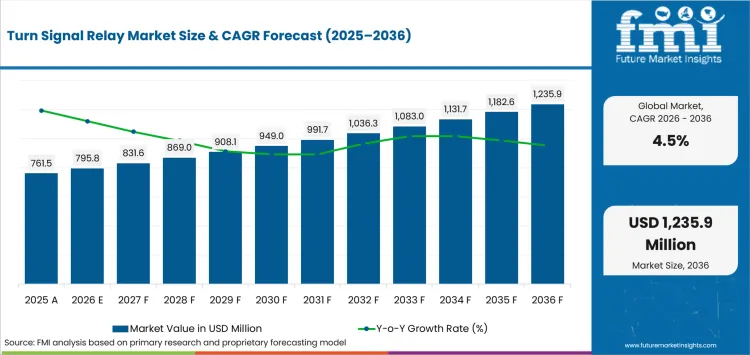
USD 795.8 million in 2026 and USD 1235.9 million by 2036 at a 4.5% CAGR.
Demand for turn signal relays is forecast to rise at a 4.5% CAGR between 2026 and 2036, increasing market value from USD 795.8 million to USD 1235.9 million. A substantial share of demand comes from vehicles where the turn or hazard flasher remains a separate, replaceable component. Purchases are typically triggered by a failed relay, irregular indicator cadence or a lighting change that disrupts the electrical load expected by the original system.
The replacement opportunity varies considerably by vehicle design. Older passenger cars and motorcycles often retain standalone flasher relays, while some trailers and commercial vehicles use similar serviceable setups. Newer vehicles are moving these functions into body-control and lighting-control modules, gradually reducing the role of discrete relays. This makes application accuracy increasingly important, with suppliers needing to match voltage, terminal layout and lamp-load requirements to individual vehicle configurations.
Key Takeaways
- Turn and hazard indicators are safety-critical functions, creating recurring replacement demand wherever vehicles still use a separately serviceable flasher relay.
- Electronic flashers are expected to account for 34.0% of Relay Type demand in 2026. Their lead reflects better control over flash timing, fault detection, and compatibility with lower-load lighting systems.
- The 12 V category is projected to hold 61.0% of Voltage demand in 2026, supported by its widespread use across passenger cars, motorcycles, and other light-vehicle applications.
- Passenger cars are set to represent 37.0% of Vehicle Type demand in 2026. Their installed base supports replacement demand across many makes, model years and vehicle generations.
- Aftermarket replacement is forecast to contribute 48.0% of Sales Channel demand in 2026, as purchases commonly follow a signaling fault during the vehicle service life.
- Incandescent lighting is expected to retain 33.0% of Application demand in 2026. A sizeable legacy fleet continues to use conventional bulb loads and discrete flasher systems, even as LED adoption expands.
- Greater integration of turn-signal control into body and lighting electronics is reducing the number of discrete relays used in newer vehicles. At the same time, LED retrofits are creating a more specialized opportunity for electronic flashers designed to handle lower electrical loads.
- HELLA, Bosch, Denso, Omron Automotive, Standard Motor Products, Littelfuse, TE Connectivity, Mitsuba, Novita Technologies, and ACDelco compete through different strengths, ranging from vehicle-specific flasher coverage and OEM electrical engineering to broad relay portfolios and aftermarket distribution.
Analyst Perspective
"The market is splitting into two service realities. Legacy vehicles still reward precise relay fitment and dependable aftermarket availability, while newer platforms move signaling logic into software-managed controllers. Suppliers that map both sides of that transition can protect replacement revenue without overstocking applications that are disappearing from new vehicle architectures."
- Nikhil Kaitwade, Principal Consultant, Future Market Insights
How is the turn signal relay market segmented?
The market is segmented by Relay Type, Voltage, Vehicle Type, Sales Channel, Application and Region.
Relay Type separates electronic, electromechanical and application-specific flasher designs. Voltage determines basic electrical compatibility, while Vehicle Type captures connector, duty-cycle and packaging differences. Sales Channel distinguishes factory sourcing from service replacement, retail and catalog routes. Application separates conventional incandescent circuits from LED conversion, trailer lighting and hazard-warning use. These dimensions converge at fitment because the correct part must match the vehicle architecture and lamp load at the same time.
Why does incandescent lighting lead the Application category?
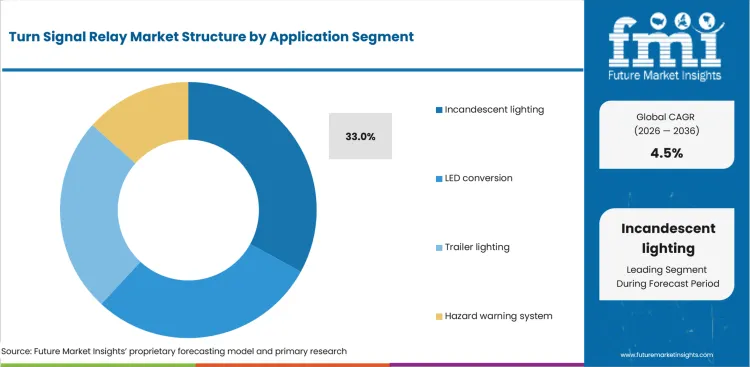
A large installed fleet still uses circuits designed around the current draw of conventional bulbs. In those systems, flash cadence and lamp-out behavior can be closely tied to load. LED replacement can therefore create hyperflash unless the relay or circuit is adapted. The broader shift in automotive lighting does not instantly remove this legacy base; it creates a compatibility boundary between conventional, mixed-lamp and fully integrated LED architectures.
- Incandescent lighting is forecast to account for 33.0% of Application demand in 2026 because many serviceable vehicles were designed around conventional lamp loads and discrete flasher behavior.
- Mitsuba listed LED turn-signal lamp systems on several motorcycle models announced from July to December 2025, showing active LED migration alongside a continuing legacy replacement base.
Why do electronic flashers lead the Relay Type category?
Electronic flashers can control timing and switching more consistently than thermal designs and can be configured for diagnostic or lower-current loads. Their role overlaps with the wider evolution of automotive relays toward compact, application-specific switching. The category remains serviceable in many legacy and replacement applications even as some newer vehicles move signaling logic into electronic control units.
- Based on Relay Type, electronic flashers are forecast to account for 34.0% of demand in 2026 because controlled switching supports fault indication, stable cadence and compatibility across a wider set of lamp loads.
- FORVIA HELLA reported in July 2026 that a lighting ECU entering series production in China can centrally manage direction-indicator functions, illustrating the shift toward electronic control of signaling behavior.
Why does 12 V lead the Voltage category?
The 12 V segment sits at the center of passenger-car and motorcycle service demand. These vehicle classes include many older applications that still use replaceable turn and hazard flashers, while supplier catalogs commonly separate 12 V from 24 V heavy-duty fitments. Incorrect voltage selection can cause immediate functional or durability problems, making system voltage an early compatibility check in replacement purchasing.
- The 12 V category is forecast to account for 61.0% of Voltage demand in 2026 because passenger cars and many motorcycles use 12 V electrical systems and generate substantial replacement fitment depth.
- INEGI reported that Mexico produced 3.95 million light vehicles in 2025, reinforcing the scale of the light-vehicle ecosystem that supports 12 V electrical components and service parts.
Why do passenger cars lead the Vehicle Type category?
Passenger cars combine fleet scale with dealer, independent-repair and retail access. The large number of makes and model years creates a deep application map for service parts, while used-vehicle transfers and inspection events create repeat repair touchpoints. The same fleet is also experiencing a gradual migration toward integrated automotive electronics, which means suppliers need to distinguish model years that still use a removable flasher from those controlled by body electronics.
- Passenger cars are forecast to account for 37.0% of Vehicle Type demand in 2026 because fleet scale and service-channel depth create extensive replacement demand.
- Destatis reported in July 2026 that about 49.5 million passenger cars were registered in Germany at the start of the year, demonstrating the scale of a mature serviceable fleet.
Why does aftermarket replacement lead the Sales Channel category?
Turn signal relays are usually replaced when a fault becomes visible, so demand is closely tied to routine vehicle servicing rather than discretionary upgrades. Older vehicles generate repeated repair opportunities as they move through inspections, resale and workshop visits. Retail and catalog channels are well suited to these purchases because the component is relatively inexpensive and can often be replaced without any involvement from the original vehicle manufacturer.
- Aftermarket replacement is forecast to account for 48.0% of Sales Channel demand in 2026. New-vehicle programs still create OEM demand, but the aftermarket benefits from the much broader pool of vehicles already in service that continue to use a discrete flasher relay.
- France illustrates this dynamic. The country recorded 5.53 million used passenger-car transactions in 2025, while the average passenger car was 11.5 years old at the start of the year. That combination creates frequent inspection and repair occasions, supporting demand for serviceable electrical components such as turn signal relays.
What are the drivers, restraints and opportunities in the Turn Signal Relay Market?
A large serviceable vehicle base supports recurring replacement, electronic integration reduces discrete-relay use on newer platforms, and LED conversion creates a focused opportunity for load-compatible flashers.
- Driver: Required turn and hazard signaling functions create recurring repair demand across vehicles that retain a separately serviceable flasher.
- Restraint: Body, lighting and zonal electronic controllers increasingly absorb flashing logic, reducing the number of new platforms that use a stand-alone relay.
- Opportunity: LED conversions and mixed-lamp applications create demand for electronic flashers that correct low-current load mismatch and hyperflash in legacy circuits.
The installed vehicle base supports replacement demand. The USA Federal Highway Administration reported 297.5 million registered motor vehicles in 2024, while NHTSA has reiterated the required role of hazard-warning signaling on covered vehicles under FMVSS No. 108. Where the architecture uses a discrete flasher, a failure can create an immediate safety or inspection issue and trigger a replacement purchase.
A restraint comes from migration away from removable devices toward integrated body-control and lighting architectures. FORVIA HELLA reported in July 2026 that a new lighting ECU can manage direction-indicator functions centrally, while TE Connectivity has highlighted software-defined and zonal vehicle electronics. As control moves into a module, a lighting fault may no longer be solved by swapping a stand-alone flasher.
A focused opportunity sits at the boundary between legacy wiring and LED upgrades. Suppliers can use application catalogs to identify vehicles that retain the original relay socket but require a lower-current electronic flasher after conversion. Retrofit demand depends on clear guidance for voltage, terminal layout and lamp load so installers can avoid repeat service failures.
Which country CAGRs are profiled in the Turn Signal Relay Market?
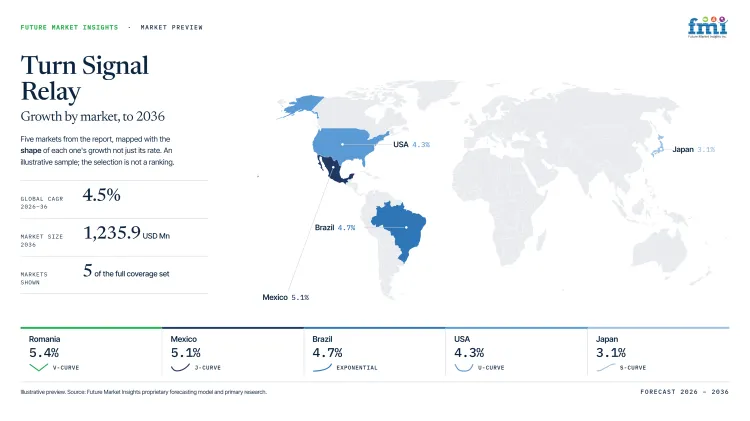
| Country | CAGR |
|---|---|
| Romania | 5.4% |
| USA | 4.3% |
| Japan | 3.1% |
| Mexico | 5.1% |
| Brazil | 4.7% |
| Germany | 3.6% |
| France | 4.0% |
How do country-level CAGRs compare in the Turn Signal Relay Market?
Country growth rates span 2.3 percentage points from Romania at 5.4% to Japan at 3.1% from 2026 to 2036. Romania, Mexico and Brazil form the upper growth band, the USA and France sit in a middle range, and Germany and Japan expand more slowly. These rates indicate pacing rather than absolute market size. Fleet age, discrete-relay penetration, inspection practices, production activity and local parts access determine the revenue opportunity behind each percentage.
- Romania is projected at 5.4% CAGR, supported by repair activity where lighting and signaling defects can trigger technical-service work.
- USA is projected at 4.3% CAGR, supported by a large installed vehicle base and established professional, retail and do-it-yourself replacement channels.
- Japan is projected at 3.1% CAGR as precise fitment remains relevant while integrated electronics reduce some stand-alone relay applications.
- Mexico is projected at 5.1% CAGR, combining replacement demand with a high-volume light-vehicle production ecosystem and substantial light-truck exposure.
- Brazil is projected at 4.7% CAGR, supported by a broad vehicle population and regional service networks that require reliable cross-reference coverage.
- Germany is projected at 3.6% CAGR. A large passenger-car base supports service activity while newer vehicle electronics absorb more lighting-control functions.
- France is projected at 4.0% CAGR as used-car turnover and vehicle age create recurring service touchpoints for legacy electrical components.
Regional coverage spans North America, Latin America, Western Europe, Eastern Europe, East Asia, South Asia and Pacific, and the Middle East and Africa.
Country-wise Analysis
- Romania offers a more repair-intensive picture than a pure fleet-size story would suggest. Turn Signal Relay demand is expected to grow at a 5.4% CAGR from 2026 to 2036. In roadside technical checks carried out during 2025, the Romanian Automotive Register found that lighting-signaling faults accounted for 24.11% of the nonconformities identified. Because the inspections were selective, the figure should be read as a signal of repair activity among checked vehicles rather than a measure of the entire national fleet. For workshops and parts suppliers, that places greater value on legacy fitment depth and clear electrical specifications.
- In the USA, the scale of the vehicle parc does much of the work. The Federal Highway Administration counted 297.5 million registered motor vehicles in 2024, giving the aftermarket a deep base of vehicles that can generate replacement demand over time. NHTSA requirements under FMVSS No. 108 keep signaling performance relevant from a compliance standpoint as well. Against this backdrop, demand is forecast to rise at 4.3% CAGR through 2036. The harder part for suppliers is not market access, but application accuracy across a wide spread of model years and lighting architectures.
- Japan presents a different mix. AIRIA reported 83.18 million vehicles in use at the end of 2025, but a mature fleet does not automatically translate into rapid relay growth. Demand is forecast to expand at 3.1% CAGR from 2026 to 2036 as newer vehicles continue shifting lighting functions into integrated electronics. Replacement opportunities remain meaningful in domestic passenger vehicles and motorcycles, where precise fitment and compatibility still matter.
- Mexico combines a strong production base with an active replacement market. INEGI reported 3.95 million light vehicles produced in 2025, and light trucks represented 77.2% of that output. This gives suppliers exposure to a broad range of electrical applications, particularly where 12 V systems dominate. Turn Signal Relay demand is expected to increase at 5.1% CAGR through 2036, with local inventory and deeper light-truck coverage likely to matter more than a one-size-fits-all catalog approach.
- Brazil’s opportunity is shaped by breadth of vehicle types and the practical difficulty of getting the application match right. Turn Signal Relay demand is forecast to rise at 4.7% CAGR from 2026 to 2036. Senatran’s national fleet data provides the installed-base context, while CONTRAN Resolution 1024/2026 updated the framework governing vehicle signaling and lighting systems. In a market with wide vehicle diversity, reliable cross-referencing and regional availability can make a direct difference to replacement efficiency.
- Germany has a large serviceable base, but the architecture transition is more visible. About 49.5 million passenger cars were registered at the start of 2026, according to Destatis. That supports continued replacement activity in older vehicles, even as newer models move lighting functions into body or domain electronics. Demand is forecast to grow at 3.6% CAGR through 2036, with the remaining opportunity concentrated in serviceable model years and applications that still use discrete relays.
- France sits somewhere between a mature replacement market and a steadily integrating vehicle electronics base. The country recorded 5.53 million used passenger-car transactions in 2025, while the average passenger car was 11.5 years old at the start of that year. Both factors create repeat repair occasions across older vehicles. Turn Signal Relay demand is forecast to expand at 4.0% CAGR from 2026 to 2036, although suppliers increasingly need to distinguish legacy flasher systems from newer lighting architectures where the function is built into a larger control module.
Who are the notable companies in the Turn Signal Relay Market?
HELLA, Bosch, Denso, Omron Automotive, Standard Motor Products, Littelfuse, TE Connectivity, Mitsuba, Novita Technologies, and ACDelco.
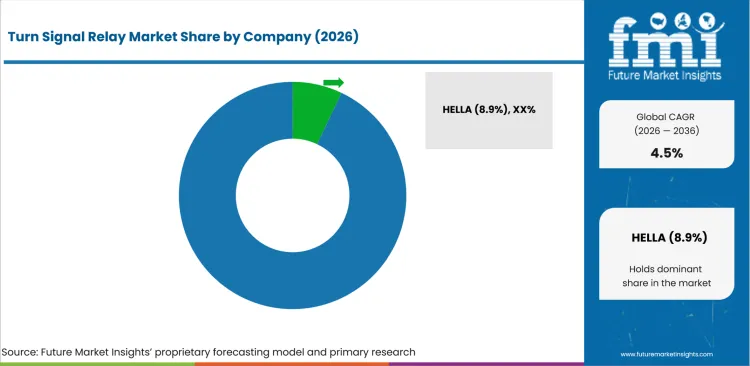
Competition separates into direct flasher coverage, broad automotive electrical portfolios and OEM-oriented control expertise. HELLA, Standard Motor Products, Novita Technologies and ACDelco are visible in service replacement. Bosch, Denso, Littelfuse and TE Connectivity bring wider switching, power-distribution or electrical-system capability. Omron Automotive and Mitsuba add OEM relay engineering, with Mitsuba also active in motorcycle electrical and signaling systems. The decisive commercial factors are fitment accuracy, voltage and load breadth, and route-to-market access.
Flasher and service-replacement specialists include HELLA, Standard Motor Products, Novita Technologies and ACDelco, with activity across hazard or turn-signal applications and replacement catalog routes.
Broad relay and power-distribution suppliers include Bosch, Denso, Littelfuse and TE Connectivity, supporting wider automotive electrical architectures across vehicle classes and voltage requirements.
OEM electronics and two-wheeler relay specialists include Omron Automotive and Mitsuba, with Mitsuba also participating in motorcycle lighting systems.
Competitive Benchmarking: Turn Signal Relay Market
| Company | Turn / hazard flasher relevance | Voltage & electrical breadth | Replacement channel access | Primary reach |
|---|---|---|---|---|
| HELLA | Dedicated flasher units and lighting-system expertise | 12 V and commercial-vehicle electrical applications | Strong aftermarket and workshop distribution | Europe, Americas and Asia-Pacific |
| Bosch | Automotive relay and electrical-component coverage | Broad low-voltage vehicle systems | Strong aftermarket and service channels | Global |
| Denso | OEM relay and electrical-system capability | Passenger and commercial vehicle electrical systems | Strong service-part presence in major markets | Japan, Asia, Americas and Europe |
| Omron Automotive | Automotive relay engineering | Low-voltage switching and control applications | Primarily OEM-oriented access | Japan, Asia and global OEM programs |
| Standard Motor Products | Vehicle-control and replacement electrical categories | Broad passenger-vehicle application coverage | Strong North American aftermarket with expanding European reach | North America and Europe |
| Littelfuse | Relays and circuit-protection portfolio | Broad current, voltage and protection capability | Distributor and aftermarket access | Americas, Europe and Asia-Pacific |
| TE Connectivity | Automotive relays, connectivity and ECU infrastructure | Broad low-voltage and zonal electrical architectures | OEM and distributor channels | Global |
| Mitsuba | Automotive relays plus motorcycle lighting systems | Passenger and two-wheeler electrical applications | OEM-led with regional service exposure | Japan, Asia and Americas |
| Novita Technologies | Turn and hazard flasher specialization | Application-specific 12 V and heavy-duty coverage | Strong aftermarket distribution | North America |
| ACDelco | Vehicle-specific flasher and electrical service parts | Passenger and light-truck replacement applications | GM dealer and broader service channels | North America and selected global markets |
The benchmark compares product relevance, electrical breadth and channel access rather than assigning a single supplier rank. A company with broad relay capability can still have narrower turn-signal fitment than a flasher specialist, while a service-focused supplier can capture replacement demand without deep participation in integrated lighting controllers.
Key Developments in the Turn Signal Relay Market
- In July 2026, FORVIA HELLA moved a new headlamp lighting ECU into series production in China. The controller can manage direction-indicator functions through a software-led architecture, illustrating how signaling control is moving from stand-alone switching toward integrated lighting electronics on newer platforms.
- In February 2026, Mitsuba reported relay fitments on newly announced passenger vehicles and LED turn-signal lamp systems on several motorcycle models introduced during the second half of 2025. The update shows continued relay participation alongside the migration toward integrated LED signaling.
- In October 2025, TE Connectivity introduced an inside-device connectivity portfolio for automotive ECUs and next-generation vehicle architectures. The portfolio supports software-defined and zonal electronics, which are relevant to the migration of lighting and signaling functions into centralized control modules.
- In July 2025, Standard Motor Products released new part numbers across 35 product categories in its Vehicle Control and Temperature Control businesses. The expansion added new late-model applications and strengthened the application-catalog model that aftermarket electrical suppliers rely on to capture model-specific replacement demand.
Key Players in the Turn Signal Relay Market
Flasher and Service-Replacement Specialists
- HELLA
- Standard Motor Products
- Novita Technologies
- ACDelco
Broad Relay and Power-Distribution Suppliers
- Bosch
- Denso
- Littelfuse
- TE Connectivity
OEM Electronics and Two-Wheeler Relay Specialists
- Omron Automotive
- Mitsuba
Turn Signal Relay Market - Report Scope
| Coverage field | Report scope |
|---|---|
| Market breakdown | Relay Type; Voltage; Vehicle Type; Sales Channel; Application |
| Quantitative Units | USD Million |
| Market Definition | Revenue includes turn-signal and hazard flasher relay units sold within the defined relay, voltage, vehicle, channel and application categories. Complete downstream vehicle value, lamp assemblies, body-control modules, wiring harnesses and adjacent electrical products are excluded unless revenue relates to a separately sold turn-signal relay. |
| Regions Covered | North America; Latin America; Western Europe; Eastern Europe; East Asia; South Asia and Pacific; Middle East and Africa |
| Countries Covered | Romania; USA; Japan; Mexico; Brazil; Germany; France; and additional countries across the covered regions |
| Key Companies | HELLA, Bosch, Denso, Omron Automotive, Standard Motor Products, Littelfuse, TE Connectivity, Mitsuba, Novita Technologies, and ACDelco |
| Forecast Period | 2026 to 2036 |
| Approach | Market sizing reconciles serviceable relay demand with vehicle population, production, voltage architecture, application fitment, replacement cycles, channel activity and the share of vehicles that retain separately replaceable flashers. |
Turn Signal Relay Market - Research Methodology
| Method | Approach |
|---|---|
| Primary Research | FMI engages manufacturers, distributors, repair-channel participants, fleet-maintenance teams, automotive electrical specialists and procurement professionals to understand fitment behavior, replacement triggers, channel economics and technology migration. |
| Desk Research | Research reviews government vehicle statistics, safety and lighting regulations, company filings, first-party product information, distributor catalogs and technical standards relevant to turn and hazard flasher functions. |
| Market Sizing and Forecasting | Sizing considers vehicle population, new-vehicle production, replacement cycles, relay type, voltage architecture, application mix, channel pricing and the share of platforms that retain separately serviceable flashers. Forecast assumptions also account for LED migration and electronic integration. |
| Data Validation | Validation reconciles vehicle population, production, relay fitment and channel activity against the defined market scope. Downstream vehicle value, lamp assemblies and controller revenue remain outside the market unless tied to a separately sold turn-signal relay, reducing overlap between OEM and aftermarket routes. |
Turn Signal Relay Market by Segments
Turn Signal Relay Market segmented by Relay Type:
- Electronic flashers
- Electromechanical flashers
- LED-compatible relays
- Motorcycle turn relays
- Heavy-duty flasher relays
Turn Signal Relay Market segmented by Voltage:
- 12 V
- 24 V
- Multi-voltage
- Specialty low-current
Turn Signal Relay Market segmented by Vehicle Type:
- Passenger cars
- Motorcycles
- Commercial vehicles
- Trailers
- Off-highway vehicles
Turn Signal Relay Market segmented by Sales Channel:
- Aftermarket replacement
- OEM direct
- Auto parts retailers
- E-commerce/catalog
Turn Signal Relay Market segmented by Application:
- Incandescent lighting
- LED conversion
- Trailer lighting
- Hazard warning system
Turn Signal Relay Market by Region:
- North America
- United States
- Canada
- Latin America
- Brazil
- Mexico
- Argentina
- Chile
- Western Europe
- Germany
- France
- United Kingdom
- Italy
- Spain
- Benelux
- Nordics
- Eastern Europe
- Poland
- Czech Republic
- Romania
- Hungary
- East Asia
- China
- Japan
- South Korea
- South Asia and Pacific
- India
- ASEAN
- Australia and New Zealand
- Middle East and Africa
- GCC Countries
- South Africa
- Türkiye
- Israel
Research Sources and Bibliography
- Registrul Auto Roman (2026, February 12). Results of 2025 Roadside Technical-Control Actions.
- USA Department of Transportation, Federal Highway Administration (2026). Highway Statistics 2024, Table VM-1.
- USA Department of Transportation, National Highway Traffic Safety Administration (2025, July 22). FMVSS No. 108 Interpretation on Hazard-Warning Signal Requirements.
- Automobile Inspection & Registration Information Association, Japan (2026, March 10). Vehicle ownership at the end of December 2025.
- Japan Ministry of Land, Infrastructure, Transport and Tourism (2026, March 31). Road Vehicle Safety Standards.
- Instituto Nacional de Estadistica y Geografia, Mexico (2026, January 9). Light Vehicle Automotive Industry, December 2025.
- Brazil Ministry of Transport, Senatran (2026, March 30 update). Vehicle Fleet 2025.
- Brazil Ministry of Transport, CONTRAN (2026, July 1). Resolution 1024/2026 Amending Vehicle Signaling and Lighting Specifications.
- Statistisches Bundesamt (2026, July). Passenger-Car Density and Registered Fleet, 2026.
- Service des donnees et etudes statistiques, France (2026, February 11). 2025 Vehicle Registration Data.
- Service des donnees et etudes statistiques, France (2025, September 19). 39.7 Million Cars in Circulation in France at January 1, 2025.
- FORVIA HELLA (2026, July 14). Headlamp lighting ECU enters mass production in China.
- Mitsuba Corporation (2026, February 10). Briefing on Results for 3Q FY March 2026.
- TE Connectivity (2025, October 2). Automotive ECU connectivity portfolio for software-defined and zonal architectures.
- Standard Motor Products (2025, July 7). New part numbers released across 35 product categories.
This bibliography is provided for reader reference and is not exhaustive. The full report contains the complete reference list and detailed citations.
This Report Answers
- How large is the Turn Signal Relay Market in 2026 and 2036?
- Which vehicle-service conditions support recurring turn signal relay demand?
- Which Relay Type segment accounts for the leading 2026 share?
- How does the 12 V category shape replacement fitment?
- Why do passenger cars create broad service demand?
- How does aftermarket replacement shape the route to market?
- How do country growth conditions differ across Romania, USA, Japan, Mexico, Brazil, Germany and France?
- Which companies serve flasher-specific replacement, broad relay portfolios and OEM electrical systems?
Frequently Asked Questions
How big is the turn signal relay market in 2026?
USD 795.8 million represents the Turn Signal Relay Market value in 2026. Demand is forecast to reach USD 1,235.9 million by 2036 as replacement activity continues across vehicles that retain separately serviceable turn and hazard flashers.
What is the CAGR of the turn signal relay market from 2026 to 2036?
A 4.5% CAGR is projected for the Turn Signal Relay Market between 2026 and 2036. Growth reflects recurring service demand, continued fitment across legacy vehicle platforms and specialized replacement needs created by LED conversion.
Which Relay Type segment is projected to account for 34.0% of the turn signal relay market?
Electronic flashers are projected to account for 34.0% of Relay Type demand in 2026. Controlled switching supports stable flash cadence, fault indication and compatibility with lamp loads that differ from conventional thermal-flasher applications.
How much will the turn signal relay market add between 2026 and 2036?
USD 440.1 million is expected to be added to the Turn Signal Relay Market between 2026 and 2036, taking market value from USD 795.8 million to USD 1,235.9 million over the forecast period.
Which companies are active in the turn signal relay market?
Ten companies active in the Turn Signal Relay Market include HELLA, Bosch, Denso, Omron Automotive, Standard Motor Products, Littelfuse, TE Connectivity, Mitsuba, Novita Technologies and ACDelco. Their roles span direct flasher replacement, broader relay systems and OEM electrical engineering.
Preview the report firsthand - request a free sample
Get SampleGet the brochure for pricing and purchase details.
Get PDFTable of Content
- Key Takeaways
- Market Size and CAGR
- Top Growth Driver
- Fastest Growing Segment
- Leading Region
- Key Companies
- Emerging Opportunities
- Executive Summary
- Global Market Outlook
- Demand-side Trends
- Supply-side Trends
- Technology Roadmap Analysis
- Analysis and Recommendations
- Analyst Perspective (What is happening? Why now? What should investors know?)
- Key Questions Answered
- How large is the market?
- What is the CAGR?
- What are key trends?
- Which region dominates?
- Who are the leaders?
- Market Overview
- Market Coverage / Taxonomy
- Market Definition / Scope / Limitations
- Research Methodology
- Chapter Orientation
- Analytical Lens and Working Hypotheses
- Market Structure, Signals, and Trend Drivers
- Benchmarking and Cross-market Comparability
- Market Sizing, Forecasting, and Opportunity Mapping
- Research Design and Evidence Framework
- Desk Research Programme (Secondary Evidence)
- Expert Input and Fieldwork (Primary Evidence)
- Tooling, Models, and Reference Databases
- Data Engineering and Model Build
- Quality Assurance and Audit Trail
- Market Background
- Market Dynamics (Drivers, Restraints, Opportunity, Trends)
- Scenario Forecast (Optimistic, Likely, Conservative)
- Impact Analysis
- AI Impact
- Sustainability Impact
- Regulatory Impact
- Technology Impact
- Consumer / Buyer Analysis
- Purchase Drivers
- Adoption Barriers
- Buyer Journey
- Opportunity Map Analysis
- Product Life Cycle Analysis
- Supply Chain Analysis
- Investment Feasibility Matrix
- Value Chain Analysis
- PESTLE and Porter's Analysis
- Regulatory Landscape
- Regional Parent Market Outlook
- Production and Consumption Statistics
- Import and Export Statistics
- Global Market Analysis and Forecast, 2021 to 2036
- Historical Market Size Value (USD Million) Analysis, 2021 to 2025
- Current and Future Market Size Value (USD Million) Projections, 2026 to 2036
- Y-o-Y Growth Trend Analysis
- Absolute $ Opportunity Analysis
- Global Market Pricing Analysis, 2021 to 2036
- Global Market Analysis and Forecast, By Relay Type, 2021 to 2036
- Introduction / Key Findings
- Historical Market Size Value (USD Million) Analysis By Relay Type, 2021 to 2025
- Current and Future Market Size Value (USD Million) Analysis and Forecast By Relay Type, 2026 to 2036
- Electronic flashers
- Electromechanical flashers
- LED-compatible relays
- Motorcycle turn relays
- Heavy-duty flasher relays
- Electronic flashers
- Y-o-Y Growth Trend Analysis By Relay Type, 2021 to 2025
- Absolute $ Opportunity Analysis By Relay Type, 2026 to 2036
- Global Market Analysis and Forecast, By Voltage, 2021 to 2036
- Introduction / Key Findings
- Historical Market Size Value (USD Million) Analysis By Voltage, 2021 to 2025
- Current and Future Market Size Value (USD Million) Analysis and Forecast By Voltage, 2026 to 2036
- 12 V
- 24 V
- Multi-voltage
- Specialty low-current
- 12 V
- Y-o-Y Growth Trend Analysis By Voltage, 2021 to 2025
- Absolute $ Opportunity Analysis By Voltage, 2026 to 2036
- Global Market Analysis and Forecast, By Vehicle Type, 2021 to 2036
- Introduction / Key Findings
- Historical Market Size Value (USD Million) Analysis By Vehicle Type, 2021 to 2025
- Current and Future Market Size Value (USD Million) Analysis and Forecast By Vehicle Type, 2026 to 2036
- Passenger cars
- Motorcycles
- Commercial vehicles
- Trailers
- Off-highway vehicles
- Passenger cars
- Y-o-Y Growth Trend Analysis By Vehicle Type, 2021 to 2025
- Absolute $ Opportunity Analysis By Vehicle Type, 2026 to 2036
- Global Market Analysis and Forecast, By Sales Channel, 2021 to 2036
- Introduction / Key Findings
- Historical Market Size Value (USD Million) Analysis By Sales Channel, 2021 to 2025
- Current and Future Market Size Value (USD Million) Analysis and Forecast By Sales Channel, 2026 to 2036
- Aftermarket replacement
- OEM direct
- Auto parts retailers
- E-commerce/catalog
- Aftermarket replacement
- Y-o-Y Growth Trend Analysis By Sales Channel, 2021 to 2025
- Absolute $ Opportunity Analysis By Sales Channel, 2026 to 2036
- Global Market Analysis and Forecast, By Application, 2021 to 2036
- Introduction / Key Findings
- Historical Market Size Value (USD Million) Analysis By Application, 2021 to 2025
- Current and Future Market Size Value (USD Million) Analysis and Forecast By Application, 2026 to 2036
- Incandescent lighting
- LED conversion
- Trailer lighting
- Hazard warning system
- Incandescent lighting
- Y-o-Y Growth Trend Analysis By Application, 2021 to 2025
- Absolute $ Opportunity Analysis By Application, 2026 to 2036
- Global Market Analysis and Forecast, By Region, 2021 to 2036
- Introduction
- Historical Market Size Value (USD Million) Analysis By Region, 2021 to 2025
- Current Market Size Value (USD Million) Analysis and Forecast By Region, 2026 to 2036
- North America
- Latin America
- Western Europe
- Eastern Europe
- East Asia
- South Asia and Pacific
- Middle East & Africa
- Market Attractiveness Analysis By Region
- North America Market Analysis and Forecast, By Country, 2021 to 2036
- Historical Market Size Value (USD Million) Trend Analysis By Market Taxonomy, 2021 to 2025
- Market Size Value (USD Million) Forecast By Market Taxonomy, 2026 to 2036
- By Country
- USA
- Canada
- By Relay Type
- By Voltage
- By Vehicle Type
- By Sales Channel
- By Application
- By Country
- Market Attractiveness Analysis
- By Country
- By Relay Type
- By Voltage
- By Vehicle Type
- By Sales Channel
- By Application
- Key Takeaways
- Latin America Market Analysis and Forecast, By Country
- Historical Market Size Value (USD Million) Trend Analysis By Market Taxonomy, 2021 to 2025
- Market Size Value (USD Million) Forecast By Market Taxonomy, 2026 to 2036
- By Country
- Brazil
- Mexico
- Chile
- Rest of Latin America
- By Relay Type
- By Voltage
- By Vehicle Type
- By Sales Channel
- By Application
- By Country
- Market Attractiveness Analysis
- By Country
- By Relay Type
- By Voltage
- By Vehicle Type
- By Sales Channel
- By Application
- Key Takeaways
- Western Europe Market Analysis and Forecast, By Country
- Historical Market Size Value (USD Million) Trend Analysis By Market Taxonomy, 2021 to 2025
- Market Size Value (USD Million) Forecast By Market Taxonomy, 2026 to 2036
- By Country
- Germany
- UK
- Italy
- Spain
- France
- Nordic
- BENELUX
- Rest of Western Europe
- By Relay Type
- By Voltage
- By Vehicle Type
- By Sales Channel
- By Application
- By Country
- Market Attractiveness Analysis
- By Country
- By Relay Type
- By Voltage
- By Vehicle Type
- By Sales Channel
- By Application
- Key Takeaways
- Eastern Europe Market Analysis and Forecast, By Country
- Historical Market Size Value (USD Million) Trend Analysis By Market Taxonomy, 2021 to 2025
- Market Size Value (USD Million) Forecast By Market Taxonomy, 2026 to 2036
- By Country
- Russia
- Poland
- Hungary
- Balkan & Baltic
- Rest of Eastern Europe
- By Relay Type
- By Voltage
- By Vehicle Type
- By Sales Channel
- By Application
- By Country
- Market Attractiveness Analysis
- By Country
- By Relay Type
- By Voltage
- By Vehicle Type
- By Sales Channel
- By Application
- Key Takeaways
- East Asia Market Analysis and Forecast, By Country
- Historical Market Size Value (USD Million) Trend Analysis By Market Taxonomy, 2021 to 2025
- Market Size Value (USD Million) Forecast By Market Taxonomy, 2026 to 2036
- By Country
- China
- Japan
- South Korea
- By Relay Type
- By Voltage
- By Vehicle Type
- By Sales Channel
- By Application
- By Country
- Market Attractiveness Analysis
- By Country
- By Relay Type
- By Voltage
- By Vehicle Type
- By Sales Channel
- By Application
- Key Takeaways
- South Asia and Pacific Market Analysis and Forecast, By Country
- Historical Market Size Value (USD Million) Trend Analysis By Market Taxonomy, 2021 to 2025
- Market Size Value (USD Million) Forecast By Market Taxonomy, 2026 to 2036
- By Country
- India
- ASEAN
- Australia & New Zealand
- Rest of South Asia and Pacific
- By Relay Type
- By Voltage
- By Vehicle Type
- By Sales Channel
- By Application
- By Country
- Market Attractiveness Analysis
- By Country
- By Relay Type
- By Voltage
- By Vehicle Type
- By Sales Channel
- By Application
- Key Takeaways
- Middle East & Africa Market Analysis and Forecast, By Country
- Historical Market Size Value (USD Million) Trend Analysis By Market Taxonomy, 2021 to 2025
- Market Size Value (USD Million) Forecast By Market Taxonomy, 2026 to 2036
- By Country
- Kingdom of Saudi Arabia
- Other GCC Countries
- Türkiye
- South Africa
- Other African Union
- Rest of Middle East & Africa
- By Relay Type
- By Voltage
- By Vehicle Type
- By Sales Channel
- By Application
- By Country
- Market Attractiveness Analysis
- By Country
- By Relay Type
- By Voltage
- By Vehicle Type
- By Sales Channel
- By Application
- Key Takeaways
- Key Countries Market Analysis
- USA
- Pricing Analysis
- Market Share Analysis, 2025
- By Relay Type
- By Voltage
- By Vehicle Type
- By Sales Channel
- By Application
- Canada
- Pricing Analysis
- Market Share Analysis, 2025
- By Relay Type
- By Voltage
- By Vehicle Type
- By Sales Channel
- By Application
- Mexico
- Pricing Analysis
- Market Share Analysis, 2025
- By Relay Type
- By Voltage
- By Vehicle Type
- By Sales Channel
- By Application
- Brazil
- Pricing Analysis
- Market Share Analysis, 2025
- By Relay Type
- By Voltage
- By Vehicle Type
- By Sales Channel
- By Application
- Chile
- Pricing Analysis
- Market Share Analysis, 2025
- By Relay Type
- By Voltage
- By Vehicle Type
- By Sales Channel
- By Application
- Germany
- Pricing Analysis
- Market Share Analysis, 2025
- By Relay Type
- By Voltage
- By Vehicle Type
- By Sales Channel
- By Application
- UK
- Pricing Analysis
- Market Share Analysis, 2025
- By Relay Type
- By Voltage
- By Vehicle Type
- By Sales Channel
- By Application
- Italy
- Pricing Analysis
- Market Share Analysis, 2025
- By Relay Type
- By Voltage
- By Vehicle Type
- By Sales Channel
- By Application
- Spain
- Pricing Analysis
- Market Share Analysis, 2025
- By Relay Type
- By Voltage
- By Vehicle Type
- By Sales Channel
- By Application
- France
- Pricing Analysis
- Market Share Analysis, 2025
- By Relay Type
- By Voltage
- By Vehicle Type
- By Sales Channel
- By Application
- India
- Pricing Analysis
- Market Share Analysis, 2025
- By Relay Type
- By Voltage
- By Vehicle Type
- By Sales Channel
- By Application
- ASEAN
- Pricing Analysis
- Market Share Analysis, 2025
- By Relay Type
- By Voltage
- By Vehicle Type
- By Sales Channel
- By Application
- Australia & New Zealand
- Pricing Analysis
- Market Share Analysis, 2025
- By Relay Type
- By Voltage
- By Vehicle Type
- By Sales Channel
- By Application
- China
- Pricing Analysis
- Market Share Analysis, 2025
- By Relay Type
- By Voltage
- By Vehicle Type
- By Sales Channel
- By Application
- Japan
- Pricing Analysis
- Market Share Analysis, 2025
- By Relay Type
- By Voltage
- By Vehicle Type
- By Sales Channel
- By Application
- South Korea
- Pricing Analysis
- Market Share Analysis, 2025
- By Relay Type
- By Voltage
- By Vehicle Type
- By Sales Channel
- By Application
- Russia
- Pricing Analysis
- Market Share Analysis, 2025
- By Relay Type
- By Voltage
- By Vehicle Type
- By Sales Channel
- By Application
- Poland
- Pricing Analysis
- Market Share Analysis, 2025
- By Relay Type
- By Voltage
- By Vehicle Type
- By Sales Channel
- By Application
- Hungary
- Pricing Analysis
- Market Share Analysis, 2025
- By Relay Type
- By Voltage
- By Vehicle Type
- By Sales Channel
- By Application
- Kingdom of Saudi Arabia
- Pricing Analysis
- Market Share Analysis, 2025
- By Relay Type
- By Voltage
- By Vehicle Type
- By Sales Channel
- By Application
- Türkiye
- Pricing Analysis
- Market Share Analysis, 2025
- By Relay Type
- By Voltage
- By Vehicle Type
- By Sales Channel
- By Application
- South Africa
- Pricing Analysis
- Market Share Analysis, 2025
- By Relay Type
- By Voltage
- By Vehicle Type
- By Sales Channel
- By Application
- USA
- Market Structure Analysis
- Competition Dashboard
- Competition Benchmarking
- Market Share Analysis of Top Players
- By Regional
- By Relay Type
- By Voltage
- By Vehicle Type
- By Sales Channel
- By Application
- Emerging Startups
- Innovation Benchmarking
- Competition Analysis
- Competition Deep Dive
- HELLA (8.9%)
- Overview
- Product Portfolio
- Profitability by Market Segments
- Sales Footprint
- Strategy Overview
- Marketing Strategy
- Product Strategy
- Channel Strategy
- Bosch
- Denso
- Omron Automotive
- Standard Motor Products
- Littelfuse
- TE Connectivity
- Mitsuba
- Novita Technologies
- ACDelco
- HELLA (8.9%)
- Case Studies
- Success Stories
- Recent Developments
- Competition Deep Dive
- Assumptions & Acronyms Used


