

- Market Size (2026)
- USD 751.5 Mn
- Forecast (2036)
- USD 2440.4 Mn
- CAGR (2026 to 2036)
- 12.5%
How big is Two-Phase AI Cooling Condenser Control Systems Market in 2026?
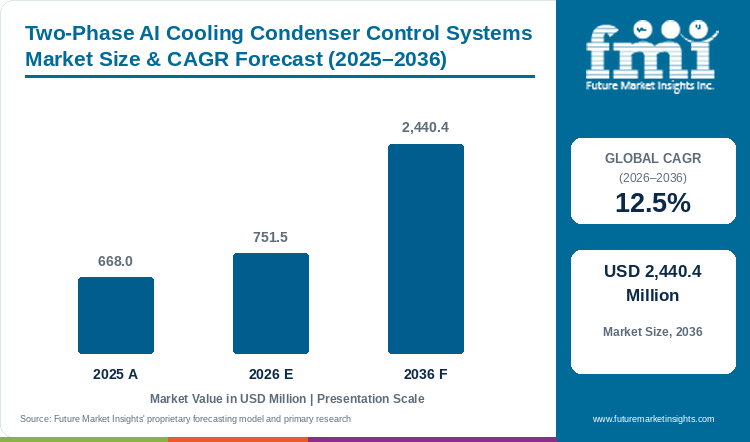
The market was valued at USD 668.0 Million in 2025 and is expected to reach USD 751.5 Million in 2026, with growth at a 12.5% CAGR from 2026 to 2036 taking its value to USD 2,440.4 Million by 2036.
A two-phase loop needs controlled condensation as compute demand changes, with startup and rapid load transitions presenting different conditions from a steady operating point. The condenser package must work within the secondary system’s heat-rejection limits, making the complete thermal arrangement central to qualification. Buyers also need compatible fluids, maintainable equipment and clear responsibility across primary and facility-side loops, because a substitution can change a previously accepted configuration. Saudi Arabian and UAE conditions illustrate why dry-cooler performance and fallback need a site-specific assessment rather than catalog assumptions. Other locations likewise require the selected architecture to match available plant. Revenue follows qualifying control assemblies and associated sensing or regulation functions in released designs, excluding complete cooling plants and components without that role. AI capacity announcements provide context but do not by themselves establish a two-phase control order. [5]
Key Market Trends & Insights
- Direct-to-chip liquid cooling holds 44.0% of cooling architecture in 2026, requiring condensed fluid to return under specified conditions as processor demand changes.
- Dry coolers represent 29.0% of heat rejection / secondary loop in 2026, with suitability dependent on local ambient conditions and the temperature approach needed by the condenser.
- 251–500 kW holds 34.0% of rack density in 2026, where changes in vapor fraction and return pressure need to be assessed alongside the secondary plant response.
- Hyperscale AI holds 48.0% of data center type in 2026, extending qualification to repeat deployments, monitoring and the maintenance parts needed to preserve the accepted design.
Regional Highlights
- Saudi Arabia has the highest profiled CAGR at 14.2% during 2026–2036.
- The next two profiled growth rates are UAE at 13.8% and South Korea at 13.5% over the same period.
Market Size & Forecast
| Metric | Value |
|---|---|
| 2025 market value | USD 668.0 Million |
| 2026 market estimate | USD 751.5 Million |
| 2036 market forecast | USD 2,440.4 Million |
| Forecast CAGR, 2026–2036 | 12.5% |
The market covers condenser-control assemblies and associated sensing, flow, pressure and regulation functions for two-phase AI cooling. Complete cooling plants and components without the specified condenser-control role are excluded.
Condenser-control requirements follow the thermal consequences of data-center power, including rapid changes in load and the available heat-rejection margin.
Infrastructure readiness and acceptance
| Documented operating context | Source |
|---|---|
| Accelsius introduced its NeuCool IR150 integrated two-phase cooling rack at NVIDIA GTC in March 2026. | [1] |
| ZutaCore announced a 240 kW waterless AI-cooling sidecar in August 2025. | [2] |
| ZutaCore and Valeo announced commercial production of cooling distribution units compatible with ZutaCore’s two-phase direct-to-chip cooling in January 2025. | [3] |
| Munters and ZutaCore described collaboration on waterless two-phase cooling infrastructure. | [4] |
Analyst Perspective
Condenser behavior needs to be demonstrated across the intended load range with the secondary heat-rejection system it will use. Clear responsibility for fluids, component changes and facility interfaces helps an owner maintain the accepted configuration, while seasonal limits and fallback behavior make the operating boundary understandable to the service team.
- Nikhil Kaitwade, Principal Analyst at Future Market Insights
How is the two-phase AI cooling condenser control systems market segmented?
Cooling Architecture covers Direct-to-chip liquid cooling, Rear-door heat exchangers, Immersion cooling and Hybrid air-liquid systems. Heat Rejection / Secondary Loop covers Dry coolers, Chillers, Cooling towers / evaporative, Facility water loop / district interface and Hybrid systems. Rack Density covers 251–500 kW, 100–250 kW, Below 100 kW and Above 500 kW. Data Center Type covers Hyperscale AI, Colocation AI, Enterprise AI/HPC and Research / sovereign compute. Route to Market covers Cooling OEM direct, MEP / EPC integrator, Server / rack OEM bundle and Service & retrofit channel.
Connection to data-center infrastructure management gives operators a way to relate pressure or temperature excursions to the broader facility operating state.
Why does Direct-to-chip liquid cooling lead cooling architecture demand?
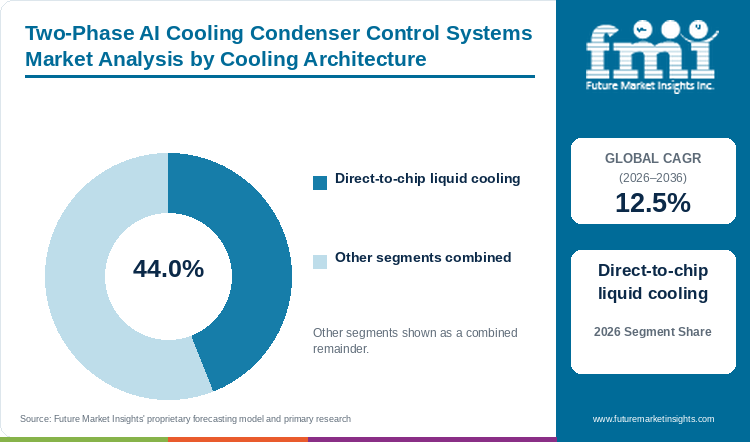
Direct-to-chip liquid cooling: 44.0% of cooling architecture in 2026.
Within the two-phase designs covered here, direct-to-chip evaporation places the heat-transfer process close to the processor, requiring the condenser to return fluid under stable conditions as loads change. The response needs to be assessed with the secondary cooling system, since a component specification cannot establish the complete circuit’s operating range. Other architectures use different fluid-management arrangements, so buyers need evidence for the selected loop rather than transferring a result across unlike designs. ASHRAE’s integrated-design framework likewise treats power and cooling as related design decisions. [7]
- The Direct-to-chip liquid cooling segment accounts for 44.0% of cooling architecture in 2026.
- Changes in processor load need to be tested against the response of the complete loop rather than only the condenser's steady-state capacity.
Why do Dry coolers lead heat rejection / secondary loop demand?
Dry coolers: 29.0% of heat rejection / secondary loop in 2026.
Dry coolers reject heat to outdoor air without routine evaporative water use, while suitability depends on maintaining the required temperature approach in demanding weather. Fan speed and secondary flow need coordination with condenser conditions, with a chiller or hybrid path considered where dry rejection cannot meet the duty. A defined response at the normal path’s limit makes water avoidance part of a dependable site design instead of treating it as sufficient proof of thermal performance.
- The Dry coolers segment accounts for 29.0% of heat rejection / secondary loop in 2026.
- The secondary-loop specification should state when additional heat rejection is required and how the controller signals that condition to the operator.
What are the drivers, restraints, and opportunities in the two-phase AI cooling condenser control systems market?
Two-phase loads require stable condensation control
A selected two-phase design needs controlled condensation across partial load and transitions as well as its maximum rating, with the controller working within condenser and facility-plant limits. Buyers therefore qualify a defined thermal arrangement rather than infer the same requirement from any increase in AI capacity. A project using another architecture may have different control needs despite a similar compute load.
Fluid compatibility and pressure behavior complicate validation
Fluid compatibility, pressure behavior and the facility’s supply-temperature range need assessment within the selected heat-rejection arrangement, with seals and charge management adding two-phase requirements. Hot weather or a component change can alter an earlier nominal result, so evidence needs to cover intended transitions and maintenance. If the secondary system cannot meet the duty, qualification may require more equipment or a revised design rather than further controller adjustment.
Modular heat rejection can ease selected retrofit projects
An integrated package can make control responsibility and service access easier to define. This is useful where dense compute is being connected to cooling infrastructure already present at the facility. The supplier should state seasonal limits and expose the information needed by the site's supervisory system. A climate-specific assessment remains necessary before modular construction can simplify repeat orders. The opportunity is a maintainable assembly with known boundaries. It should not be presented as a way to remove every restriction imposed by the secondary cooling plant or the receiving building. Schneider Electric’s guidance addresses specification, installation and operating challenges for direct liquid cooling. [6]
The adjacent AI cooling diagnostics discipline supports investigation of unstable two-phase operation without replacing the control system’s own protection functions.
Which country and market CAGRs are profiled for two-phase AI cooling condenser control systems?
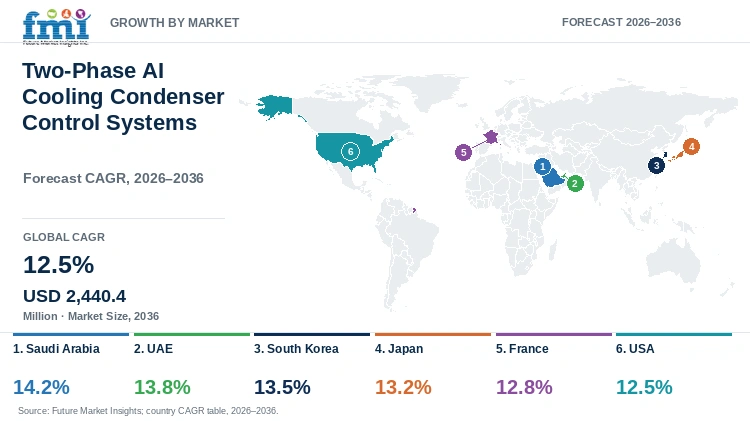
| Country | CAGR |
|---|---|
| Saudi Arabia | 14.2% |
| UAE | 13.8% |
| South Korea | 13.5% |
| Japan | 13.2% |
| France | 12.8% |
| USA | 12.5% |
Country-wise Analysis
Saudi Arabia
- High ambient heat in Saudi Arabia can reduce the conditions under which dry rejection meets condenser requirements, making representative capacity and water-use evidence useful before selection. The fastest profiled forecast is a 14.2% CAGR from 2026 to 2036, with hybrid fallback and response to pressure excursions included in qualification. This connects control behavior with the load and weather the installation will face.
UAE
- Extreme outdoor conditions need to enter UAE mechanical specifications through fan operation and secondary-loop temperature before control orders can proceed. Within the 13.8% CAGR forecast for 2026 to 2036, phased acceptance also needs to retain the agreed fluid and component specification. Reviewing maintenance substitutions against that baseline helps prevent an untested compatibility change after the original loop has passed.
South Korea
- South Korean compute procurement needs compatibility between rack designs and mechanical controls, with understandable monitoring and maintenance procedures for local evaluators. The 13.5% CAGR forecast for 2026 to 2036 accompanies projects combining imported assemblies and domestic integration. A clear secondary-loop boundary tells operators when more rejection is required and which party must respond when processor-side and facility systems have different owners.
Japan
- Japanese sites may use different outdoor-air or water arrangements, making the accepted condenser dependent on location, fluid approval and rack architecture. Japan is forecast to grow at a 13.2% CAGR from 2026 to 2036 as qualification addresses startup and recovery alongside nominal operation. Evidence of behavior when the usual rejection path is unavailable gives the owner a useful boundary for operation.
France
- French condenser packages need to fit wider plant operation and efficiency requirements, with staff able to identify the conditions limiting heat removal and the response to an abnormal event. France’s 12.8% CAGR forecast for 2026 to 2036 sits alongside that qualification work. Electricity availability can affect economics, while dependable rejection across the specified range remains a separate thermal requirement.
USA
- American projects may combine several suppliers under established mechanical approval procedures, requiring agreed ownership of sensors and alarms. The market’s forecast is a 12.5% CAGR from 2026 to 2036, with the rack heat-load map matched to site rejection before acceptance. Changes in fluid or density then need review against the accepted boundaries rather than relying on an individual component claim.
Who are the notable companies in the two-phase AI cooling condenser control systems market?
Accelsius; ZutaCore; Parker Hannifin; Munters; Valeo
Complete cooling-system providers and thermal-component specialists offer different portions of the condenser-control solution. Buyers should establish the scope of each offer before comparing capability. A strong component result does not by itself demonstrate that the full loop is ready for operation.
Competitive Benchmarking: Two-Phase AI Cooling Condenser Control Systems Market
| Participant | Commercial focus | Buyer qualification priority |
|---|---|---|
| Accelsius | Two-phase direct-to-chip cooling | Pressure control and integrated validation |
| ZutaCore | Two-phase cooling systems | Heat rejection and operating envelope |
| Parker Hannifin | Thermal and fluid-control components | Fluid compatibility and control response |
| Munters | Heat rejection and cooling infrastructure | Condenser integration and ambient limits |
| Valeo | Thermal systems and heat-rejection units | Manufacturing consistency and system interfaces |
Key Developments in the Two-Phase AI Cooling Condenser Control Systems Market
- Accelsius introduced its NeuCool IR150 integrated two-phase cooling rack at NVIDIA GTC in March 2026. [1]
- ZutaCore announced a 240 kW waterless AI-cooling sidecar in August 2025. [2]
Key Players in the Two-Phase AI Cooling Condenser Control Systems Market
- Accelsius
- ZutaCore
- Parker Hannifin
- Munters
- Valeo
Two-Phase AI Cooling Condenser Control Systems Market - Report Scope
| Coverage field | Report scope |
|---|---|
| Market breakdown | Cooling Architecture; Heat Rejection / Secondary Loop; Rack Density; Data Center Type; Route to Market; Region |
| Quantitative unit | USD Million |
| Market definition | The market covers condenser-control assemblies and associated sensing, flow, pressure and regulation functions for two-phase AI cooling. Complete cooling plants and components without the specified condenser-control role are excluded. |
| Regions covered | North America; Latin America; Western Europe; Eastern Europe; East Asia; South Asia and Pacific; Middle East and Africa |
| Countries / markets profiled | Saudi Arabia; UAE; South Korea; Japan; France; USA |
| Key companies profiled | Accelsius; ZutaCore; Parker Hannifin; Munters; Valeo |
| Base year / forecast period | 2026 / 2026–2036 |
| Estimate coverage | 2025 and 2026 market estimates; 2036 forecast; segment shares and country / market CAGRs. |
Two-Phase AI Cooling Condenser Control Systems Market - Research Methodology
| Method | Application |
|---|---|
| Market definition | The analysis follows the stated product or service boundary and distinguishes direct category revenue from adjacent activities. |
| Secondary research | Official technical, regulatory, research and company publications provide the documented operating context and recent developments cited in this report. |
| Forecast and segmentation | Market estimates, segment shares and geographic forecasts are presented as analytical estimates within the stated commercial scope. |
| Competitive assessment | Participants are compared by their relevant products or services, commercial role and buyer qualification requirements. |
| Interpretation | The assessment considers purchasing conditions and the scope of the documented product, service or performance claim. |
Two-Phase AI Cooling Condenser Control Systems Market by Segments
Cooling Architecture
- Direct-to-chip liquid cooling
- Rear-door heat exchangers
- Immersion cooling
- Hybrid air-liquid systems
Heat Rejection / Secondary Loop
- Dry coolers
- Chillers
- Cooling towers / evaporative
- Facility water loop / district interface
- Hybrid systems
Rack Density
- 251–500 kW
- 100–250 kW
- Below 100 kW
- Above 500 kW
Data Center Type
- Hyperscale AI
- Colocation AI
- Enterprise AI/HPC
- Research / sovereign compute
Route to Market
- Cooling OEM direct
- MEP / EPC integrator
- Server / rack OEM bundle
- Service & retrofit channel
Two-Phase AI Cooling Condenser Control Systems Market by Region
- North America
- United States
- Canada
- Latin America
- Brazil
- Mexico
- Argentina
- Chile
- Western Europe
- Germany
- France
- United Kingdom
- Italy
- Spain
- Benelux
- Nordics
- Eastern Europe
- Poland
- Czech Republic
- Romania
- Hungary
- East Asia
- China
- Japan
- South Korea
- South Asia and Pacific
- India
- ASEAN
- Australia and New Zealand
- Middle East and Africa
- GCC Countries
- South Africa
- Türkiye
- Israel
Research Sources and Bibliography
- [1] Accelsius. (2026, March 16). Accelsius Makes NVIDIA GTC Debut with NeuCool IR150.
- [2] ZutaCore. (2025, August 5). ZutaCore Announces a 240kW Two-Phase Sidecar Solution at the OCP APAC Summit.
- [3] ZutaCore. (2025, January 6). Valeo Enters Commercial Production with Cooling Distribution Units Compatible with ZutaCore.
- [4] ZutaCore. (2024, September 17). ZutaCore and Munters Join Forces to Deliver a Waterless Data Center Architecture for AI Factories.
- [5] Future Market Insights. (2026). Two-Phase AI Cooling Condenser Control Systems Market: Global industry analysis and opportunity assessment, 2026–2036.
- [6] Schneider Electric. (2025, August 6). Direct Liquid Cooling System Challenges in Data Centers.
- [7] ASHRAE. (n.d.). Integrated Design Principles: AI Data Center Energy Performance Framework.
This Report Answers
- How large is the two-phase AI cooling condenser control systems market in 2026?
- What value and CAGR are forecast through 2036?
- Which cooling architecture segment leads in 2026?
- Which heat rejection / secondary loop segment has the largest share?
- Which profiled country or market has the fastest forecast growth?
- Which participants are covered in the competitive assessment?
Frequently Asked Questions
How large is the two-phase AI cooling condenser control systems market in 2026?
The market was valued at USD 668.0 Million in 2025 and is expected to reach USD 751.5 Million in 2026.
What value and CAGR are forecast through 2036?
The market is projected to reach USD 2,440.4 Million by 2036, with a 12.5% CAGR during 2026–2036.
Which cooling architecture segment leads in 2026?
The Direct-to-chip liquid cooling segment accounts for 44.0% of cooling architecture in 2026.
Which heat rejection / secondary loop segment has the largest share?
The Dry coolers segment accounts for 29.0% of heat rejection / secondary loop in 2026.
Which profiled country or market has the fastest forecast growth?
Saudi Arabia has the highest profiled CAGR at 14.2% during 2026–2036.
Which participants are covered in the competitive assessment?
The assessment covers Accelsius, ZutaCore, Parker Hannifin, Munters and Valeo.
Preview the report firsthand - request a free sample
Get SampleGet the brochure for pricing and purchase details.
Get PDFTable of Content
- Key Takeaways
- Market Size and CAGR
- Top Growth Driver
- Fastest Growing Segment
- Leading Region
- Key Companies
- Emerging Opportunities
- Executive Summary
- Global Market Outlook
- Demand-side Trends
- Supply-side Trends
- Technology Roadmap Analysis
- Analysis and Recommendations
- Analyst Perspective (What is happening? Why now? What should investors know?)
- Key Questions Answered
- How large is the market?
- What is the CAGR?
- What are key trends?
- Which region dominates?
- Who are the leaders?
- Market Overview
- Market Coverage / Taxonomy
- Market Definition / Scope / Limitations
- Research Methodology
- Chapter Orientation
- Analytical Lens and Working Hypotheses
- Market Structure, Signals, and Trend Drivers
- Benchmarking and Cross-market Comparability
- Market Sizing, Forecasting, and Opportunity Mapping
- Research Design and Evidence Framework
- Desk Research Programme (Secondary Evidence)
- Expert Input and Fieldwork (Primary Evidence)
- Tooling, Models, and Reference Databases
- Data Engineering and Model Build
- Quality Assurance and Audit Trail
- Market Background
- Market Dynamics (Drivers, Restraints, Opportunity, Trends)
- Scenario Forecast (Optimistic, Likely, Conservative)
- Impact Analysis
- AI Impact
- Sustainability Impact
- Regulatory Impact
- Technology Impact
- Consumer / Buyer Analysis
- Purchase Drivers
- Adoption Barriers
- Buyer Journey
- Opportunity Map Analysis
- Product Life Cycle Analysis
- Supply Chain Analysis
- Investment Feasibility Matrix
- Value Chain Analysis
- PESTLE and Porter's Analysis
- Regulatory Landscape
- Regional Parent Market Outlook
- Production and Consumption Statistics
- Import and Export Statistics
- Global Market Analysis and Forecast, 2021 to 2036
- Historical Market Size Value (USD Million) Analysis, 2021 to 2025
- Current and Future Market Size Value (USD Million) Projections, 2026 to 2036
- Y-o-Y Growth Trend Analysis
- Absolute $ Opportunity Analysis
- Global Market Pricing Analysis, 2021 to 2036
- Global Market Analysis and Forecast, By Cooling Architecture, 2021 to 2036
- Introduction / Key Findings
- Historical Market Size Value (USD Million) Analysis By Cooling Architecture, 2021 to 2025
- Current and Future Market Size Value (USD Million) Analysis and Forecast By Cooling Architecture, 2026 to 2036
- Direct-to-chip liquid cooling
- Rear-door heat exchangers
- Immersion cooling
- Hybrid air-liquid systems
- Y-o-Y Growth Trend Analysis By Cooling Architecture, 2021 to 2025
- Absolute $ Opportunity Analysis By Cooling Architecture, 2026 to 2036
- Global Market Analysis and Forecast, By Heat Rejection / Secondary Loop, 2021 to 2036
- Introduction / Key Findings
- Historical Market Size Value (USD Million) Analysis By Heat Rejection / Secondary Loop, 2021 to 2025
- Current and Future Market Size Value (USD Million) Analysis and Forecast By Heat Rejection / Secondary Loop, 2026 to 2036
- Dry coolers
- Chillers
- Cooling towers / evaporative
- Facility water loop / district interface
- Hybrid systems
- Y-o-Y Growth Trend Analysis By Heat Rejection / Secondary Loop, 2021 to 2025
- Absolute $ Opportunity Analysis By Heat Rejection / Secondary Loop, 2026 to 2036
- Global Market Analysis and Forecast, By Rack Density, 2021 to 2036
- Introduction / Key Findings
- Historical Market Size Value (USD Million) Analysis By Rack Density, 2021 to 2025
- Current and Future Market Size Value (USD Million) Analysis and Forecast By Rack Density, 2026 to 2036
- 251–500 kW
- 100–250 kW
- Below 100 kW
- Above 500 kW
- Y-o-Y Growth Trend Analysis By Rack Density, 2021 to 2025
- Absolute $ Opportunity Analysis By Rack Density, 2026 to 2036
- Global Market Analysis and Forecast, By Data Center Type, 2021 to 2036
- Introduction / Key Findings
- Historical Market Size Value (USD Million) Analysis By Data Center Type, 2021 to 2025
- Current and Future Market Size Value (USD Million) Analysis and Forecast By Data Center Type, 2026 to 2036
- Hyperscale AI
- Colocation AI
- Enterprise AI/HPC
- Research / sovereign compute
- Y-o-Y Growth Trend Analysis By Data Center Type, 2021 to 2025
- Absolute $ Opportunity Analysis By Data Center Type, 2026 to 2036
- Global Market Analysis and Forecast, By Route to Market, 2021 to 2036
- Introduction / Key Findings
- Historical Market Size Value (USD Million) Analysis By Route to Market, 2021 to 2025
- Current and Future Market Size Value (USD Million) Analysis and Forecast By Route to Market, 2026 to 2036
- Cooling OEM direct
- MEP / EPC integrator
- Server / rack OEM bundle
- Service & retrofit channel
- Y-o-Y Growth Trend Analysis By Route to Market, 2021 to 2025
- Absolute $ Opportunity Analysis By Route to Market, 2026 to 2036
- Global Market Analysis and Forecast, By Region, 2021 to 2036
- Introduction
- Historical Market Size Value (USD Million) Analysis By Region, 2021 to 2025
- Current Market Size Value (USD Million) Analysis and Forecast By Region, 2026 to 2036
- North America
- Latin America
- Western Europe
- Eastern Europe
- East Asia
- South Asia and Pacific
- Middle East and Africa
- Market Attractiveness Analysis By Region
- North America Market Analysis and Forecast, By Country, 2021 to 2036
- Historical Market Size Value (USD Million) Trend Analysis By Market Taxonomy, 2021 to 2025
- Market Size Value (USD Million) Forecast By Market Taxonomy, 2026 to 2036
- By Country
- United States
- Canada
- By Cooling Architecture
- By Heat Rejection / Secondary Loop
- By Rack Density
- By Data Center Type
- By Route to Market
- By Country
- Market Attractiveness Analysis
- By Country
- By Cooling Architecture
- By Heat Rejection / Secondary Loop
- By Rack Density
- By Data Center Type
- By Route to Market
- Key Takeaways
- Latin America Market Analysis and Forecast, By Country
- Historical Market Size Value (USD Million) Trend Analysis By Market Taxonomy, 2021 to 2025
- Market Size Value (USD Million) Forecast By Market Taxonomy, 2026 to 2036
- By Country
- Brazil
- Mexico
- Argentina
- Chile
- By Cooling Architecture
- By Heat Rejection / Secondary Loop
- By Rack Density
- By Data Center Type
- By Route to Market
- By Country
- Market Attractiveness Analysis
- By Country
- By Cooling Architecture
- By Heat Rejection / Secondary Loop
- By Rack Density
- By Data Center Type
- By Route to Market
- Key Takeaways
- Western Europe Market Analysis and Forecast, By Country
- Historical Market Size Value (USD Million) Trend Analysis By Market Taxonomy, 2021 to 2025
- Market Size Value (USD Million) Forecast By Market Taxonomy, 2026 to 2036
- By Country
- Germany
- France
- United Kingdom
- Italy
- Spain
- Benelux
- Nordics
- By Cooling Architecture
- By Heat Rejection / Secondary Loop
- By Rack Density
- By Data Center Type
- By Route to Market
- By Country
- Market Attractiveness Analysis
- By Country
- By Cooling Architecture
- By Heat Rejection / Secondary Loop
- By Rack Density
- By Data Center Type
- By Route to Market
- Key Takeaways
- Eastern Europe Market Analysis and Forecast, By Country
- Historical Market Size Value (USD Million) Trend Analysis By Market Taxonomy, 2021 to 2025
- Market Size Value (USD Million) Forecast By Market Taxonomy, 2026 to 2036
- By Country
- Poland
- Czech Republic
- Romania
- Hungary
- By Cooling Architecture
- By Heat Rejection / Secondary Loop
- By Rack Density
- By Data Center Type
- By Route to Market
- By Country
- Market Attractiveness Analysis
- By Country
- By Cooling Architecture
- By Heat Rejection / Secondary Loop
- By Rack Density
- By Data Center Type
- By Route to Market
- Key Takeaways
- East Asia Market Analysis and Forecast, By Country
- Historical Market Size Value (USD Million) Trend Analysis By Market Taxonomy, 2021 to 2025
- Market Size Value (USD Million) Forecast By Market Taxonomy, 2026 to 2036
- By Country
- China
- Japan
- South Korea
- By Cooling Architecture
- By Heat Rejection / Secondary Loop
- By Rack Density
- By Data Center Type
- By Route to Market
- By Country
- Market Attractiveness Analysis
- By Country
- By Cooling Architecture
- By Heat Rejection / Secondary Loop
- By Rack Density
- By Data Center Type
- By Route to Market
- Key Takeaways
- South Asia and Pacific Market Analysis and Forecast, By Country
- Historical Market Size Value (USD Million) Trend Analysis By Market Taxonomy, 2021 to 2025
- Market Size Value (USD Million) Forecast By Market Taxonomy, 2026 to 2036
- By Country
- India
- ASEAN
- Australia and New Zealand
- By Cooling Architecture
- By Heat Rejection / Secondary Loop
- By Rack Density
- By Data Center Type
- By Route to Market
- By Country
- Market Attractiveness Analysis
- By Country
- By Cooling Architecture
- By Heat Rejection / Secondary Loop
- By Rack Density
- By Data Center Type
- By Route to Market
- Key Takeaways
- Middle East and Africa Market Analysis and Forecast, By Country
- Historical Market Size Value (USD Million) Trend Analysis By Market Taxonomy, 2021 to 2025
- Market Size Value (USD Million) Forecast By Market Taxonomy, 2026 to 2036
- By Country
- GCC Countries
- South Africa
- Türkiye
- Israel
- By Cooling Architecture
- By Heat Rejection / Secondary Loop
- By Rack Density
- By Data Center Type
- By Route to Market
- By Country
- Market Attractiveness Analysis
- By Country
- By Cooling Architecture
- By Heat Rejection / Secondary Loop
- By Rack Density
- By Data Center Type
- By Route to Market
- Key Takeaways
- Key Countries Market Analysis
- United States
- Pricing Analysis
- Market Share Analysis, 2025
- By Cooling Architecture
- By Heat Rejection / Secondary Loop
- By Rack Density
- By Data Center Type
- By Route to Market
- Canada
- Pricing Analysis
- Market Share Analysis, 2025
- By Cooling Architecture
- By Heat Rejection / Secondary Loop
- By Rack Density
- By Data Center Type
- By Route to Market
- Mexico
- Pricing Analysis
- Market Share Analysis, 2025
- By Cooling Architecture
- By Heat Rejection / Secondary Loop
- By Rack Density
- By Data Center Type
- By Route to Market
- Brazil
- Pricing Analysis
- Market Share Analysis, 2025
- By Cooling Architecture
- By Heat Rejection / Secondary Loop
- By Rack Density
- By Data Center Type
- By Route to Market
- Chile
- Pricing Analysis
- Market Share Analysis, 2025
- By Cooling Architecture
- By Heat Rejection / Secondary Loop
- By Rack Density
- By Data Center Type
- By Route to Market
- Germany
- Pricing Analysis
- Market Share Analysis, 2025
- By Cooling Architecture
- By Heat Rejection / Secondary Loop
- By Rack Density
- By Data Center Type
- By Route to Market
- United Kingdom
- Pricing Analysis
- Market Share Analysis, 2025
- By Cooling Architecture
- By Heat Rejection / Secondary Loop
- By Rack Density
- By Data Center Type
- By Route to Market
- Italy
- Pricing Analysis
- Market Share Analysis, 2025
- By Cooling Architecture
- By Heat Rejection / Secondary Loop
- By Rack Density
- By Data Center Type
- By Route to Market
- Spain
- Pricing Analysis
- Market Share Analysis, 2025
- By Cooling Architecture
- By Heat Rejection / Secondary Loop
- By Rack Density
- By Data Center Type
- By Route to Market
- France
- Pricing Analysis
- Market Share Analysis, 2025
- By Cooling Architecture
- By Heat Rejection / Secondary Loop
- By Rack Density
- By Data Center Type
- By Route to Market
- India
- Pricing Analysis
- Market Share Analysis, 2025
- By Cooling Architecture
- By Heat Rejection / Secondary Loop
- By Rack Density
- By Data Center Type
- By Route to Market
- ASEAN
- Pricing Analysis
- Market Share Analysis, 2025
- By Cooling Architecture
- By Heat Rejection / Secondary Loop
- By Rack Density
- By Data Center Type
- By Route to Market
- Australia and New Zealand
- Pricing Analysis
- Market Share Analysis, 2025
- By Cooling Architecture
- By Heat Rejection / Secondary Loop
- By Rack Density
- By Data Center Type
- By Route to Market
- China
- Pricing Analysis
- Market Share Analysis, 2025
- By Cooling Architecture
- By Heat Rejection / Secondary Loop
- By Rack Density
- By Data Center Type
- By Route to Market
- Japan
- Pricing Analysis
- Market Share Analysis, 2025
- By Cooling Architecture
- By Heat Rejection / Secondary Loop
- By Rack Density
- By Data Center Type
- By Route to Market
- South Korea
- Pricing Analysis
- Market Share Analysis, 2025
- By Cooling Architecture
- By Heat Rejection / Secondary Loop
- By Rack Density
- By Data Center Type
- By Route to Market
- Poland
- Pricing Analysis
- Market Share Analysis, 2025
- By Cooling Architecture
- By Heat Rejection / Secondary Loop
- By Rack Density
- By Data Center Type
- By Route to Market
- Hungary
- Pricing Analysis
- Market Share Analysis, 2025
- By Cooling Architecture
- By Heat Rejection / Secondary Loop
- By Rack Density
- By Data Center Type
- By Route to Market
- Türkiye
- Pricing Analysis
- Market Share Analysis, 2025
- By Cooling Architecture
- By Heat Rejection / Secondary Loop
- By Rack Density
- By Data Center Type
- By Route to Market
- South Africa
- Pricing Analysis
- Market Share Analysis, 2025
- By Cooling Architecture
- By Heat Rejection / Secondary Loop
- By Rack Density
- By Data Center Type
- By Route to Market
- Saudi Arabia
- Pricing Analysis
- Market Share Analysis, 2025
- By Cooling Architecture
- By Heat Rejection / Secondary Loop
- By Rack Density
- By Data Center Type
- By Route to Market
- UAE
- Pricing Analysis
- Market Share Analysis, 2025
- By Cooling Architecture
- By Heat Rejection / Secondary Loop
- By Rack Density
- By Data Center Type
- By Route to Market
- United States
- Market Structure Analysis
- Competition Dashboard
- Competition Benchmarking
- Market Share Analysis of Top Players
- By Regional
- By Cooling Architecture
- By Heat Rejection / Secondary Loop
- By Rack Density
- By Data Center Type
- By Route to Market
- Emerging Startups
- Innovation Benchmarking
- Competition Analysis
- Competition Deep Dive
- Accelsius
- Overview
- Product Portfolio
- Profitability by Market Segments
- Sales Footprint
- Strategy Overview
- Marketing Strategy
- Product Strategy
- Channel Strategy
- ZutaCore
- Parker Hannifin
- Munters
- Valeo
- Accelsius
- Case Studies
- Success Stories
- Recent Developments
- Competition Deep Dive
- Assumptions & Acronyms Used


