

- Market Size (2026)
- USD 210.0 Mn
- Forecast (2036)
- USD 420.9 Mn
- CAGR (2026 to 2036)
- 7.2%
How big is the control cabinet thermal management monitoring market in 2026?
USD 210.0 million in 2026 and USD 420.9 million by 2036 at a 7.2% CAGR.
The control cabinet thermal management monitoring industry value is forecast to grow from USD 195.9 million in 2025 to USD 420.9 million by 2036 at 7.2% CAGR as factories connect cabinet temperature, humidity, cooling status and door alarms with plant uptime systems. Wired monitoring is forecast to represent 54.0% share in 2026 because plants prefer deterministic cabinet signals and established I/O wiring. Discrete automation is expected to secure 47.0% share in 2026, led by machine builders specifying cabinet protection before equipment shipment.
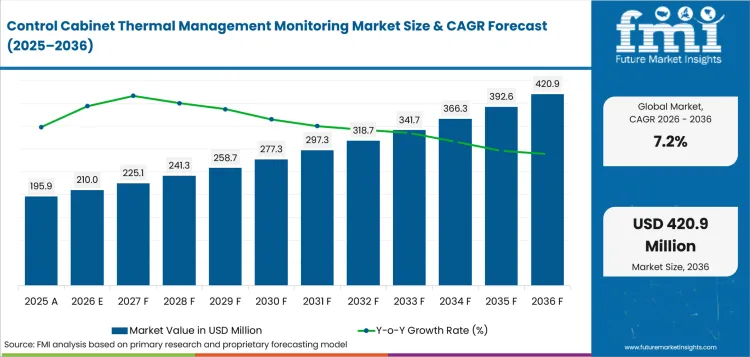
Control Cabinet Thermal Management Monitoring Market Overview: Size and Forecast
- 2026 Market Size: USD 210.0 million
- 2036 Market Size: USD 420.9 million
- Forecast CAGR: 7.2% from 2026 to 2036
- Leading Connectivity: Wired Monitoring
- Wired Monitoring Share in 2026: 54.0%
- Leading Deployment: Discrete Automation
- Discrete Automation Share in 2026: 47.0%
- Fastest-growing Country: China
- China CAGR: 8.3% by 2036
Summary of the Control Cabinet Thermal Management Monitoring Market
- Demand and Growth Drivers
- Factories are adding more cabinet sensors to reduce unplanned trips caused by temperature drift, condensation and blocked airflow.
- Machine builders are giving more attention to enclosure alarms that can be checked before shipment and repeated across standard panel designs.
- Maintenance teams are extending remote operations by routing cabinet climate warnings into PLC, HMI and supervisory systems.
- Product and Segment View
- Wired monitoring is forecast to represent 54.0% share in 2026, led by deterministic alarm routing and trusted cabinet wiring practices.
- Discrete automation is projected to hold 47.0% share in 2026, influenced by machine-level cabinets and packaged equipment designs.
- Controllers are expected to secure 38.0% share in 2026, supported by local thresholds and cabinet-level cooling control.
- Geography and Competitive Outlook
- China is projected to record 8.3% CAGR by 2036, backed by high robot installations and electronics production density.
- India is expected to expand at 8.1% CAGR by 2036 as automation spreads across mid-sized factories and panel builders.
- Rittal and Schneider Electric compete through enclosure climate portfolios and design tools.
- Turck, STEGO and Pfannenberg focus on compact sensors, heaters, filters and cabinet thermal control products.
- Analyst Opinion
- Nikhil Kaitwade, Principal Consultant at Future Market Insights for industrial domain, observes, “Control cabinet thermal management monitoring is now an uptime discipline rather than a cabinet accessory decision. Buyers want proof that a panel can warn them before heat, humidity or door access damages drives and controllers. Vendors with cooling hardware alone will struggle when plants also need alarm output, software fit and service documentation. The strongest suppliers will combine monitored climate control, repeatable panel engineering and network-safe alarm integration.”
Market adoption is being shaped by denser factory automation, stricter connected-device review and more energy-aware enclosure cooling. IFR reported 542,000 industrial robot installations in 2024, while the operational robot stock reached 4.66 million units. CISA released 10 industrial control system advisories on August 7, 2025, showing why connected cabinet devices need cleaner access control. Rittal stated in March 2024 that its Blue e+ Filter Fan EC design can increase cool air movement by 40% and reduce energy costs by 60%. Suppliers that combine alarm reliability, cooling efficiency and network-safe commissioning should gain stronger specification support.
Which factors support expansion in the control cabinet thermal management monitoring market?
Connected enclosure climate revenue and cabinet retrofit services support market value across automated industrial plants.
- Market value is supported by controllers, sensors, engineering software and services used inside automated control cabinets.
- Supplier pricing reflects cabinet heat-load complexity before wiring, software and commissioning services add incremental revenue.
- Revenue improves as factories convert simple cooling devices into monitored thermal control systems with alarm output.
- Customer trust rises as cabinet data makes temperature, humidity, airflow and door events easier to compare across lines.
Why is the Control Cabinet Thermal Management Monitoring Market growing?
Cabinet heat faults are becoming harder to tolerate as drives, controllers and network modules sit closer together inside smaller panels.
Growth outlook has become more structured as cabinet monitoring moves from local thermostats into plant-wide reliability programs. IFR reported that Asia accounted for 74% of industrial robot deployments in 2024, while Europe represented 16% and the Americas 9%. That automation split shows why cabinet monitoring demand follows dense factory regions and global machinery flows. Rittal’s March 2024 Blue e+ Filter Fan EC material points to 175 to 1,160 m³/h airflow coverage, giving enclosure engineers a defined cooling range for monitored panels. Turck’s March 2024 IMX12-CCM relaunch extended cabinet guard use across -25 °C to 70 °C environments, supporting remote I/O cabinets and hot plant areas. These factors make thermal monitoring a practical uptime layer for machine control and industrial automation market outlook programs.
How is the Control Cabinet Thermal Management Monitoring Market segmented?
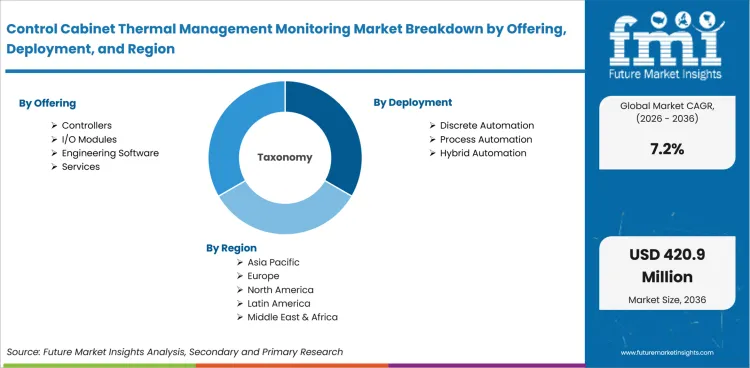
The control cabinet thermal management monitoring industry is segmented by offering, deployment, application, end-use industry, and connectivity.
- Controllers is projected to secure 38.0% share in 2026, led by controllers need local thresholds, alarms and cooling decisions before data moves into plant software.
- Discrete Automation is projected to secure 47.0% share in 2026, led by machine builders specify cabinet protection during cabinet design and commissioning.
- Machine Control is projected to secure 35.0% share in 2026, led by machine stoppage risk is directly connected to cabinet heat, humidity and door status.
- Automotive is projected to secure 29.0% share in 2026, led by automotive lines use dense welding, assembly and motion cabinets where downtime is costly.
- Wired Monitoring is projected to secure 54.0% share in 2026, led by wired alarm and I/O connections remain preferred for deterministic cabinet signals and easier commissioning.
Why does controllers lead the control cabinet thermal management monitoring market?
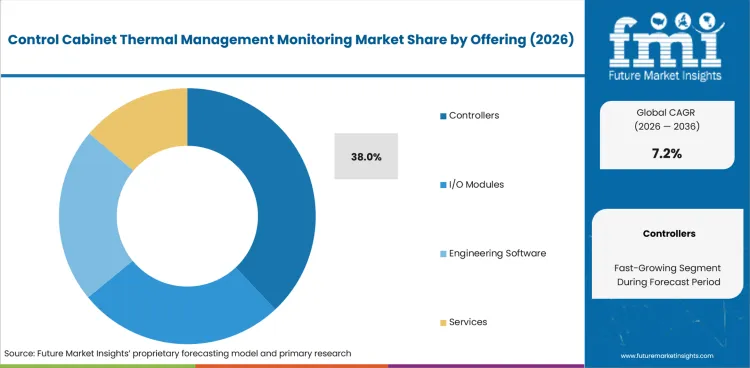
- Controllers is projected to account for 38.0% share in 2026, influenced by controllers need local thresholds, alarms and cooling decisions before data moves into plant software.
- Controller choice often depends on protocol fit and cabinet alarm accuracy, with adjacent demand visible across the industrial automation market outlook as plants connect monitoring signals with wider factory systems.
Why does discrete automation lead the control cabinet thermal management monitoring market?
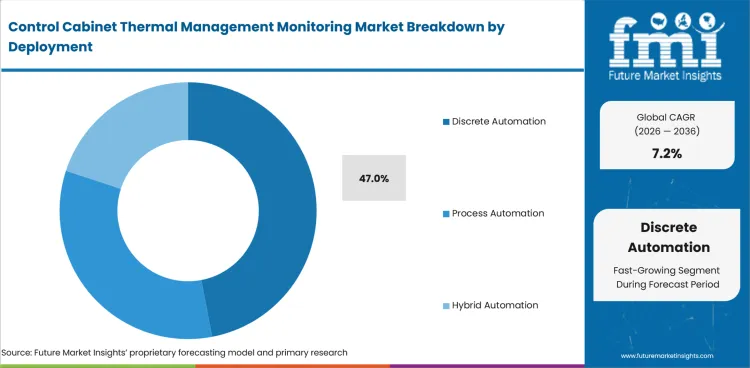
- Discrete Automation is projected to account for 47.0% share in 2026, influenced by machine builders specify cabinet protection during cabinet design and commissioning.
- Discrete automation users compare cabinet alarms with panel layouts and commissioning time, linking thermal monitoring with the smart factory market outlook across machine-level modernization programs.
Why does machine control lead the control cabinet thermal management monitoring market?
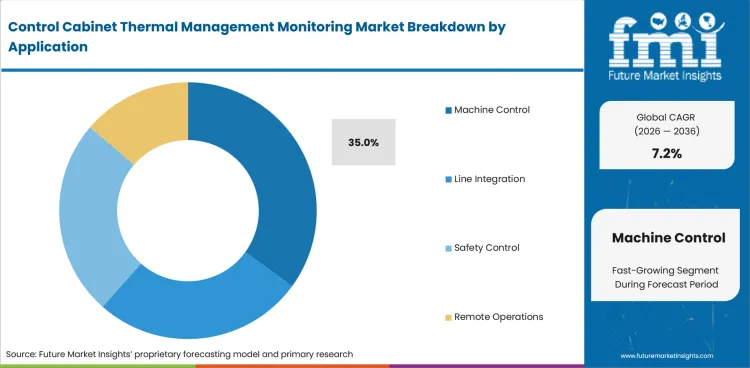
- Machine Control is projected to account for 35.0% share in 2026, influenced by machine stoppage risk is directly connected to cabinet heat, humidity and door status.
- Machine control buyers connect cabinet monitoring with drives and safety panels, making enclosure reliability relevant to the motion control centers market outlook in dense production lines.
Why does automotive lead the control cabinet thermal management monitoring market?
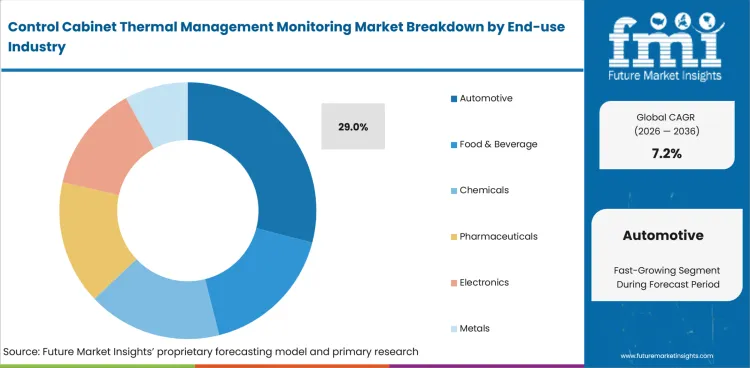
- Automotive is projected to account for 29.0% share in 2026, influenced by automotive lines use dense welding, assembly and motion cabinets where downtime is costly.
- Automotive plants use robot controllers and line cabinets together, which links thermal monitoring with the motion control software in robotics market outlook as assembly lines become more sensor-rich.
Why does wired monitoring lead the control cabinet thermal management monitoring market?
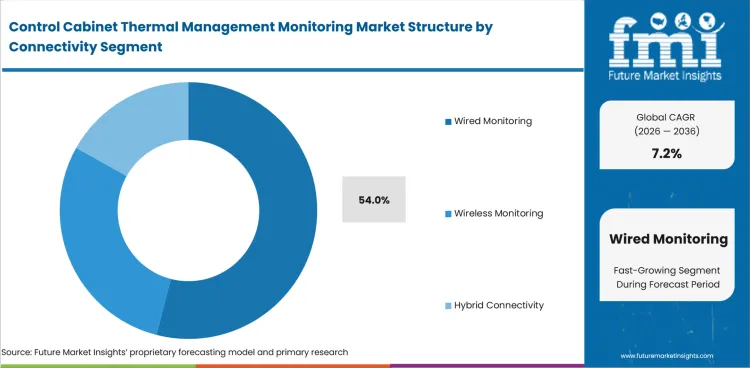
- Wired Monitoring is projected to account for 54.0% share in 2026, influenced by wired alarm and I/O connections remain preferred for deterministic cabinet signals and easier commissioning.
- Wired monitoring is preferred when cabinet signals must move cleanly into PLC and edge systems, supporting the industrial IoT market outlook without adding unnecessary wireless validation work.
What are the driver, restraints, and opportunities in the Control Cabinet Thermal Management Monitoring Market?
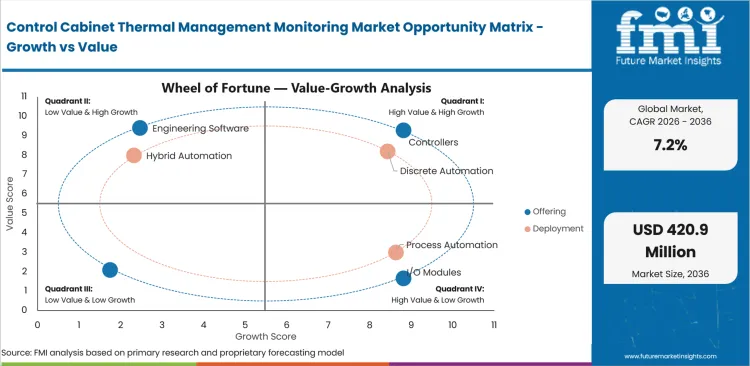
Cabinet uptime and cooling control support demand while cyber review and refrigerant rules limit faster deployment.
- Driver: Plants want early cabinet warnings before thermal drift damages drives, power supplies and communication modules.
- Restraint: Connected cabinet devices need cybersecurity review before alarm data enters industrial networks.
- Opportunity: Retrofit services can add sensors and controller logic to older cabinets without full enclosure replacement.
Cabinet Uptime Alarm Economics
Cabinet monitoring grows when buyers can link an alarm with avoided downtime and longer component life. IFR reported 4.66 million industrial robots in operational use worldwide in 2024, showing the scale of automation hardware now relying on cabinet electronics. Temperature, humidity and door sensors give maintenance teams earlier warnings before drive faults or communication failures stop a machine. This supports monitored control cabinet upgrades across robotics, electronics and automotive lines.
Connected Device Qualification and OT Security
Network approval remains a restraint because cabinet sensors increasingly connect with PLCs, gateways and supervisory systems. CISA’s August 2025 release of 10 industrial control system advisories shows that automation buyers must evaluate device security before broad connection. Cabinet monitoring suppliers therefore need clear access-control guidance, documented firmware practices and simple alarm-routing options. Vendors that reduce cybersecurity review work are better positioned for multi-site adoption.
Retrofit Cooling and Energy Optimization
Retrofit services create opportunity because many cabinets need monitoring before operators justify full replacement. Rittal stated that its Blue e+ Filter Fan EC design can reduce energy costs by 60% in its stated product context. Sensors and controllers help plants avoid full-speed cooling during lower heat loads and make service intervals easier to plan. This improves the value case for cabinet audits, filter upgrades and controlled fan programs.
Which countries are growing fastest in the Control Cabinet Thermal Management Monitoring Market?
China 8.3% CAGR, India 8.1% CAGR, South Korea 7.8% CAGR, United States 7.4% CAGR, Germany 7.1% CAGR, Japan 6.8% CAGR, France 6.6% CAGR, and United Kingdom 6.3% CAGR through 2036.
.webp "Top Country Growth Comparison Control Cabinet Thermal Management Monitoring Market Cagr (2026 2036)")
| Country | CAGR |
|---|---|
| United States | 7.4% |
| United Kingdom | 6.3% |
| Germany | 7.1% |
| France | 6.6% |
| Japan | 6.8% |
| China | 8.3% |
| South Korea | 7.8% |
| India | 8.1% |
Source: Future Market Insights, 2026.
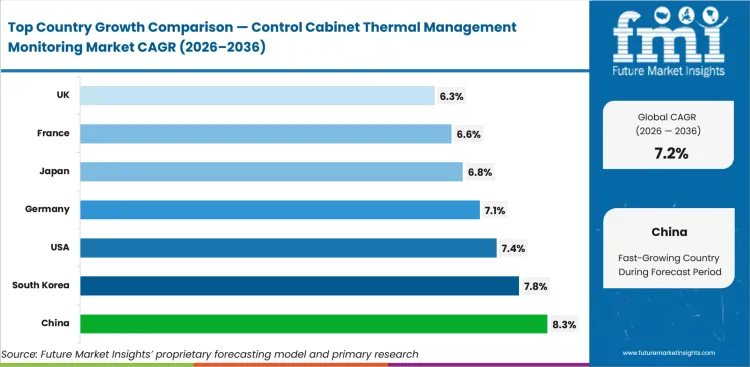
How do country-level CAGRs compare in the Control Cabinet Thermal Management Monitoring Market?
China leads country growth while the United Kingdom records the most measured expansion outlook among profiled markets.
- China is forecast to record 8.3% CAGR by 2036 as automation density and cabinet service needs shape demand.
- India is forecast to record 8.1% CAGR by 2036 as automation density and cabinet service needs shape demand.
- South Korea is forecast to record 7.8% CAGR by 2036 as automation density and cabinet service needs shape demand.
- United States is forecast to record 7.4% CAGR by 2036 as automation density and cabinet service needs shape demand.
- Germany is forecast to record 7.1% CAGR by 2036 as automation density and cabinet service needs shape demand.
- Japan is forecast to record 6.8% CAGR by 2036 as automation density and cabinet service needs shape demand.
- France is forecast to record 6.6% CAGR by 2036 as automation density and cabinet service needs shape demand.
- United Kingdom is forecast to record 6.3% CAGR by 2036 as automation density and cabinet service needs shape demand.
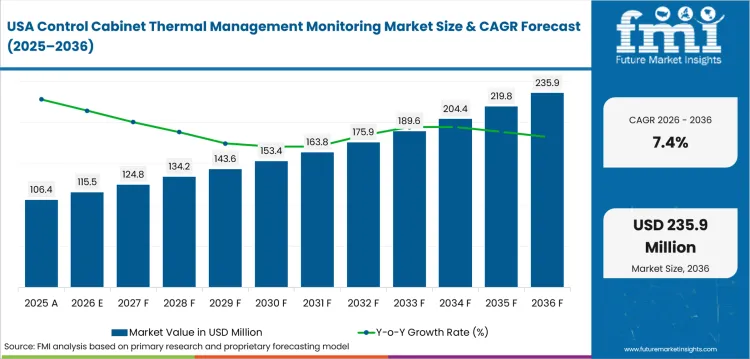
How fast is the control cabinet thermal management monitoring market growing in United States?
A 7.4% CAGR through 2036 reflects automation density, cabinet service demand and plant reliability priorities in United States.
Country Market Snapshot Table
| Parameter | Value |
|---|---|
| Market Size in 2025 (Value) | USD 51.2 million |
| Market Size in 2026 (Value) | USD 55.0 million |
| Market Forecast in 2036 (Value) | USD 112.3 million |
| CAGR (2026 to 2036) | 7.4% |
| Years Considered | 2021 to 2036 |
| Base Year | 2025 |
| Forecast Period | 2026 to 2036 |
| Units Considered | Value (USD million) |
| Leading Sub-Region | South and Midwest automation corridors |
United States Control Cabinet Thermal Management Monitoring Market Outlook
United States demand is shaped by automation maturity, cabinet retrofit needs and the need to protect drives, power supplies and network modules inside industrial enclosures. Buyers are expected to favor monitoring systems that are easy to commission and practical for maintenance teams.
Suppliers with local support, clear documentation and compatible alarm outputs should gain better access to panel builders and plant engineering teams. Country adoption will stay linked to cabinet failure history, automation investment and service coverage rather than basic cooling hardware alone.
Key Growth Drivers
- Industrial robot density supports more cabinet monitoring projects. IFR reported 34,200 industrial robot installations in the United States in 2024.
- Factory order strength keeps panel builders active. The U.S. Census Bureau reported new manufactured-goods orders of USD 662.7 billion in April 2026.
- Distributor-led MRO programs support retrofit sensors when older panels show heat alarms and humidity problems during multi-shift production.
- Automotive and logistics automation users prefer cabinet alarms that can be routed into existing PLC and maintenance dashboards.
Key Restraints
- Brownfield panels can lack spare DIN rail space for extra sensors and I/O modules.
- Cybersecurity approval can slow networked cabinet devices. CISA released 10 industrial control system advisories on August 7, 2025.
- Retrofit spending may be delayed when plants cannot quantify avoided cabinet failure costs before approval.
What makes United States unique
The United States is unique due to its mix of OEM design-in demand and large distributor-led retrofit channels.
Key Companies
- Rittal North America LLC
- nVent HOFFMAN
- Schneider Electric USA
- Turck USA
- STEGO Inc.
- Pfannenberg USA
- Phoenix Contact USA
Sales & Marketing Channels
- Direct enterprise sales
- Panel builder partnerships
- MRO distributor networks
- System integrator programs
- OEM design-in routes
- Automation catalog channels
Country Segment Breakdown Table
| Segment | Sub-Segments |
|---|---|
| By Offering | Controllers · I/O Modules · Engineering Software · Services |
| By Deployment | Discrete Automation · Process Automation · Hybrid Automation |
| By Application | Machine Control · Line Integration · Safety Control · Remote Operations |
| By End-use Industry | Automotive · Food & Beverage · Chemicals · Pharmaceuticals · Electronics · Metals |
| By Connectivity | Wired Monitoring · Wireless Monitoring · Hybrid Connectivity |
| Key Sub-Regions Covered, Industrial Automation Clusters | South Atlantic · Midwest · Texas · California · Great Lakes · Pacific Northwest |
Frequently Asked Questions
How fast is United States control cabinet thermal management monitoring market growing?
Demand in the United States is set to expand at 7.4% CAGR from 2026 to 2036, guided by automation retrofit demand.
Who leads United States control cabinet thermal management monitoring market?
Rittal, nVent HOFFMAN, Schneider Electric, Turck, STEGO, and Pfannenberg compete through enclosure climate control and automation channels.
What is driving adoption in United States control cabinet thermal management monitoring market?
Factory automation, MRO retrofits and networked cabinet alarms are moving buyers toward monitored enclosure climate systems.
How fast is the control cabinet thermal management monitoring market growing in United Kingdom?
A 6.3% CAGR through 2036 reflects automation density, cabinet service demand and plant reliability priorities in United Kingdom.
Country Market Snapshot Table
| Parameter | Value |
|---|---|
| Market Size in 2025 (Value) | USD 8.5 million |
| Market Size in 2026 (Value) | USD 9.0 million |
| Market Forecast in 2036 (Value) | USD 16.6 million |
| CAGR (2026 to 2036) | 6.3% |
| Years Considered | 2021 to 2036 |
| Base Year | 2025 |
| Forecast Period | 2026 to 2036 |
| Units Considered | Value (USD million) |
| Leading Sub-Region | London, Midlands, and national integrator corridors |
United Kingdom Control Cabinet Thermal Management Monitoring Market Outlook
United Kingdom demand is shaped by automation maturity, cabinet retrofit needs and the need to protect drives, power supplies and network modules inside industrial enclosures. Buyers are expected to favor monitoring systems that are easy to commission and practical for maintenance teams.
Suppliers with local support, clear documentation and compatible alarm outputs should gain better access to panel builders and plant engineering teams. Country adoption will stay linked to cabinet failure history, automation investment and service coverage rather than basic cooling hardware alone.
Key Growth Drivers
- Factory automation continues to require cabinet protection. IFR placed United Kingdom industrial robot installations near 2,500 units in 2024.
- Manufacturing output supported cabinet refresh projects. ONS reported manufacturing output increased 0.9% in the fourth quarter of 2025.
- Food processing sites need humidity checks in washdown-adjacent areas where cabinet condensation can shorten drive and sensor life.
- Machine builders use compact cabinet protection for export-focused panels that must work across varied operating environments.
Key Restraints
- Small manufacturers may defer cabinet monitoring upgrades without visible payback from repeated fault events.
- Production volatility can slow retrofit approvals. ONS reported 9 of 13 manufacturing subsectors fell over the three months to July 2025.
- Network approval steps can delay remote cabinet alarm projects when IT and plant engineering teams share responsibility.
What makes United Kingdom unique
The United Kingdom is distinct for service-led retrofit demand rather than very large greenfield automation volume.
Key Companies
- Schneider Electric UK
- Rittal UK
- nVent HOFFMAN UK
- Pfannenberg UK
- STEGO UK
- Phoenix Contact UK
- Turck Banner UK
Sales & Marketing Channels
- Control panel builders
- Specialist automation integrators
- Food plant engineering contractors
- Distributor-led MRO supply
- OEM export panel design
- Service retrofit programs
Country Segment Breakdown Table
| Segment | Sub-Segments |
|---|---|
| By Offering | Controllers · I/O Modules · Engineering Software · Services |
| By Deployment | Discrete Automation · Process Automation · Hybrid Automation |
| By Application | Machine Control · Line Integration · Safety Control · Remote Operations |
| By End-use Industry | Automotive · Food & Beverage · Chemicals · Pharmaceuticals · Electronics · Metals |
| By Connectivity | Wired Monitoring · Wireless Monitoring · Hybrid Connectivity |
| Key Sub-Regions Covered, Industrial Automation Clusters | London · Birmingham · Manchester · Leeds · Glasgow · Bristol |
Frequently Asked Questions
How fast is United Kingdom control cabinet thermal management monitoring market growing?
Industry in the United Kingdom is forecast to rise at 6.3% CAGR from 2026 to 2036 through retrofit-led cabinet monitoring.
Who leads United Kingdom control cabinet thermal management monitoring market?
Schneider Electric, Rittal, nVent HOFFMAN, Pfannenberg, and STEGO compete through panel builders and distributor routes.
What is driving adoption in United Kingdom control cabinet thermal management monitoring market?
Service-led retrofits, food processing requirements and compact machinery panels are supporting monitored cabinet climate systems.
How fast is the control cabinet thermal management monitoring market growing in Germany?
A 7.1% CAGR through 2036 reflects automation density, cabinet service demand and plant reliability priorities in Germany.
Country Market Snapshot Table
| Parameter | Value |
|---|---|
| Market Size in 2025 (Value) | USD 20.5 million |
| Market Size in 2026 (Value) | USD 22.0 million |
| Market Forecast in 2036 (Value) | USD 43.7 million |
| CAGR (2026 to 2036) | 7.1% |
| Years Considered | 2021 to 2036 |
| Base Year | 2025 |
| Forecast Period | 2026 to 2036 |
| Units Considered | Value (USD million) |
| Leading Sub-Region | Bavaria, Baden-Württemberg, and North Rhine-Westphalia machinery clusters |
Germany Control Cabinet Thermal Management Monitoring Market Outlook
Germany demand is shaped by automation maturity, cabinet retrofit needs and the need to protect drives, power supplies and network modules inside industrial enclosures. Buyers are expected to favor monitoring systems that are easy to commission and practical for maintenance teams.
Suppliers with local support, clear documentation and compatible alarm outputs should gain better access to panel builders and plant engineering teams. Country adoption will stay linked to cabinet failure history, automation investment and service coverage rather than basic cooling hardware alone.
Key Growth Drivers
- Machine engineering depth supports design-in cabinet monitoring. IFR reported 26,982 industrial robot installations in Germany in 2024.
- Manufacturing scale sustains high-value cabinet projects. World Bank data placed Germany manufacturing value added at about USD 843.7 billion in the latest official indicator snapshot.
- Engineering tool integration supports repeatable cabinet thermal design when enclosure sizing, heat load and airflow documentation are required.
- Automotive and machinery exporters prefer suppliers that can document temperature limits and enclosure protection for customer acceptance.
Key Restraints
- Buyers expect strong technical proof before adding connected devices inside standardized machinery programs.
- Industrial softness can slow panel modernization approvals. Destatis reported that German industrial production fell 1.9% month on month in June 2025 and reached its lowest level since May 2020.
- Premium product qualification can take longer when machinery builders must preserve existing panel certifications.
What makes Germany unique
Germany is unique because cabinet climate control is often treated as an engineering specification before a maintenance issue appears.
Key Companies
- Rittal GmbH & Co. KG
- STEGO Elektrotechnik GmbH
- Pfannenberg Group
- Phoenix Contact GmbH
- Turck GmbH
- Siemens AG
- Schneider Electric Germany
Sales & Marketing Channels
- Machine builder design teams
- Panel engineering software routes
- Direct industrial sales
- Automation distributors
- OEM export channels
- Cabinet audit services
Country Segment Breakdown Table
| Segment | Sub-Segments |
|---|---|
| By Offering | Controllers · I/O Modules · Engineering Software · Services |
| By Deployment | Discrete Automation · Process Automation · Hybrid Automation |
| By Application | Machine Control · Line Integration · Safety Control · Remote Operations |
| By End-use Industry | Automotive · Food & Beverage · Chemicals · Pharmaceuticals · Electronics · Metals |
| By Connectivity | Wired Monitoring · Wireless Monitoring · Hybrid Connectivity |
| Key Sub-Regions Covered, Industrial Automation Clusters | Bavaria · Baden-Württemberg · North Rhine-Westphalia · Lower Saxony · Hesse · Saxony |
Frequently Asked Questions
How fast is Germany control cabinet thermal management monitoring market growing?
Sales in Germany are expected to grow at 7.1% CAGR from 2026 to 2036, supported by machinery and automotive automation.
Who leads Germany control cabinet thermal management monitoring market?
Rittal, STEGO, Pfannenberg, Phoenix Contact, Turck and Siemens compete through engineering and enclosure channels.
What is driving adoption in Germany control cabinet thermal management monitoring market?
Machine exports and engineering software workflows are pushing cabinet climate monitoring into early panel design.
How fast is the control cabinet thermal management monitoring market growing in France?
A 6.6% CAGR through 2036 reflects automation density, cabinet service demand and plant reliability priorities in France.
Country Market Snapshot Table
| Parameter | Value |
|---|---|
| Market Size in 2025 (Value) | USD 9.4 million |
| Market Size in 2026 (Value) | USD 10.0 million |
| Market Forecast in 2036 (Value) | USD 18.9 million |
| CAGR (2026 to 2036) | 6.6% |
| Years Considered | 2021 to 2036 |
| Base Year | 2025 |
| Forecast Period | 2026 to 2036 |
| Units Considered | Value (USD million) |
| Leading Sub-Region | Île-de-France, Auvergne-Rhône-Alpes, and northern industrial corridors |
France Control Cabinet Thermal Management Monitoring Market Outlook
France demand is shaped by automation maturity, cabinet retrofit needs and the need to protect drives, power supplies and network modules inside industrial enclosures. Buyers are expected to favor monitoring systems that are easy to commission and practical for maintenance teams.
Suppliers with local support, clear documentation and compatible alarm outputs should gain better access to panel builders and plant engineering teams. Country adoption will stay linked to cabinet failure history, automation investment and service coverage rather than basic cooling hardware alone.
Key Growth Drivers
- Factory modernization supports cabinet alarm upgrades. IFR reported about 4,900 industrial robot installations in France in 2024.
- Industrial scale gives enclosure suppliers a meaningful retrofit base. World Bank data placed France manufacturing value added near USD 302.3 billion in the latest official indicator snapshot.
- Pharmaceutical and food plants need cabinet alarms near validated process areas with cleaning, heat and humidity exposure.
- Energy-focused retrofits favor monitored cooling because operators want fewer oversized fans and more targeted climate control.
Key Restraints
- Capital approval can favor targeted cabinet retrofits over full modernization in multi-site industrial groups.
- Refrigerant selection adds compliance work. The revised EU fluorinated-gas framework replaced Regulation 517/2014 with Regulation 2024/573.
- Plants may avoid networked cabinet devices unless cybersecurity roles are clear before alarm data leaves the panel.
What makes France unique
France is distinct for cabinet monitoring demand tied to regulated industries and selective energy-focused retrofit work.
Key Companies
- Schneider Electric France
- Rittal France
- Pfannenberg France
- STEGO France
- Phoenix Contact France
- Turck France
- Legrand Group
Sales & Marketing Channels
- Electrical integrator channels
- Plant engineering teams
- Regulated industry contractors
- National distributor networks
- Retrofit service programs
- OEM machinery partners
Country Segment Breakdown Table
| Segment | Sub-Segments |
|---|---|
| By Offering | Controllers · I/O Modules · Engineering Software · Services |
| By Deployment | Discrete Automation · Process Automation · Hybrid Automation |
| By Application | Machine Control · Line Integration · Safety Control · Remote Operations |
| By End-use Industry | Automotive · Food & Beverage · Chemicals · Pharmaceuticals · Electronics · Metals |
| By Connectivity | Wired Monitoring · Wireless Monitoring · Hybrid Connectivity |
| Key Sub-Regions Covered, Industrial Automation Clusters | Paris region · Lyon · Lille · Toulouse · Marseille · Nantes |
Frequently Asked Questions
How fast is France control cabinet thermal management monitoring market growing?
Demand in France is projected to advance at 6.6% CAGR from 2026 to 2036 through regulated industry retrofits.
Who leads France control cabinet thermal management monitoring market?
Schneider Electric, Rittal, Pfannenberg, STEGO, Phoenix Contact, and Legrand compete through industrial electrical channels.
What is driving adoption in France control cabinet thermal management monitoring market?
Regulated production, energy-cost control and cabinet retrofit audits are supporting monitored enclosure climate systems.
How fast is the control cabinet thermal management monitoring market growing in Japan?
A 6.8% CAGR through 2036 reflects automation density, cabinet service demand and plant reliability priorities in Japan.
Country Market Snapshot Table
| Parameter | Value |
|---|---|
| Market Size in 2025 (Value) | USD 16.9 million |
| Market Size in 2026 (Value) | USD 18.0 million |
| Market Forecast in 2036 (Value) | USD 34.8 million |
| CAGR (2026 to 2036) | 6.8% |
| Years Considered | 2021 to 2036 |
| Base Year | 2025 |
| Forecast Period | 2026 to 2036 |
| Units Considered | Value (USD million) |
| Leading Sub-Region | Tokyo, Osaka, Nagoya, and precision machinery corridors |
Japan Control Cabinet Thermal Management Monitoring Market Outlook
Japan demand is shaped by automation maturity, cabinet retrofit needs and the need to protect drives, power supplies and network modules inside industrial enclosures. Buyers are expected to favor monitoring systems that are easy to commission and practical for maintenance teams.
Suppliers with local support, clear documentation and compatible alarm outputs should gain better access to panel builders and plant engineering teams. Country adoption will stay linked to cabinet failure history, automation investment and service coverage rather than basic cooling hardware alone.
Key Growth Drivers
- Compact automation supports cabinet reliability needs. IFR reported 44,500 industrial robot installations in Japan in 2024.
- Installed automation depth creates a large service base. IFR reported about 450,500 operational industrial robots in Japan in 2024.
- Machinery OEMs standardize cabinet components across product families, making qualified thermal monitoring devices repeatable across builds.
- Electronics plants use compact panels where heat density and cable crowding create a stronger need for local alarms.
Key Restraints
- Supplier qualification can take longer than in retrofit-driven markets because machine builders protect existing approvals.
- Industrial output swings can delay cabinet retrofit approvals. METI reported December 2025 production down 0.1% from the previous month and shipments down 1.7%.
- Compact panel layouts can limit space for extra wiring when monitoring is added after commissioning.
What makes Japan unique
Japan is unique for compact cabinet designs that reward small, reliable and well-documented monitoring devices.
Key Companies
- Rittal Japan
- Schneider Electric Japan
- Phoenix Contact Japan
- Turck Japan
- Omron Corporation
- Mitsubishi Electric Corporation
- Fuji Electric Co. Ltd.
Sales & Marketing Channels
- Machinery OEM design teams
- Industrial distributors
- Automotive automation integrators
- Electronics plant engineering teams
- Service replacement channels
- Factory automation catalogs
Country Segment Breakdown Table
| Segment | Sub-Segments |
|---|---|
| By Offering | Controllers · I/O Modules · Engineering Software · Services |
| By Deployment | Discrete Automation · Process Automation · Hybrid Automation |
| By Application | Machine Control · Line Integration · Safety Control · Remote Operations |
| By End-use Industry | Automotive · Food & Beverage · Chemicals · Pharmaceuticals · Electronics · Metals |
| By Connectivity | Wired Monitoring · Wireless Monitoring · Hybrid Connectivity |
| Key Sub-Regions Covered, Industrial Automation Clusters | Tokyo · Osaka · Yokohama · Nagoya · Fukuoka · Sapporo |
Frequently Asked Questions
How fast is Japan control cabinet thermal management monitoring market growing?
Sector in Japan is projected to rise at 6.8% CAGR from 2026 to 2036 through compact automation and precision machinery demand.
Who leads Japan control cabinet thermal management monitoring market?
Rittal Japan, Schneider Electric Japan, Phoenix Contact Japan, Omron, Mitsubishi Electric, and Fuji Electric compete through automation channels.
What is driving adoption in Japan control cabinet thermal management monitoring market?
Robot-heavy production, compact panels and precision machinery quality requirements are supporting cabinet climate monitoring.
How fast is the control cabinet thermal management monitoring market growing in China?
A 8.3% CAGR through 2036 reflects automation density, cabinet service demand and plant reliability priorities in China.
Country Market Snapshot Table
| Parameter | Value |
|---|---|
| Market Size in 2025 (Value) | USD 44.3 million |
| Market Size in 2026 (Value) | USD 48.0 million |
| Market Forecast in 2036 (Value) | USD 106.5 million |
| CAGR (2026 to 2036) | 8.3% |
| Years Considered | 2021 to 2036 |
| Base Year | 2025 |
| Forecast Period | 2026 to 2036 |
| Units Considered | Value (USD million) |
| Leading Sub-Region | Yangtze River Delta, Greater Bay Area, and electronics automation clusters |
China Control Cabinet Thermal Management Monitoring Market Outlook
China demand is shaped by automation maturity, cabinet retrofit needs and the need to protect drives, power supplies and network modules inside industrial enclosures. Buyers are expected to favor monitoring systems that are easy to commission and practical for maintenance teams.
Suppliers with local support, clear documentation and compatible alarm outputs should gain better access to panel builders and plant engineering teams. Country adoption will stay linked to cabinet failure history, automation investment and service coverage rather than basic cooling hardware alone.
Key Growth Drivers
- Robot scale creates large cabinet populations. IFR reported 295,000 industrial robot installations in China in 2024.
- Manufacturing breadth supports high-volume panel demand. World Bank data placed China manufacturing value added at about USD 4.66 trillion in 2024.
- Electronics and battery plants need thermal protection for dense control panels with drives, power supplies and network switches.
- Local panel builders can scale repeat cabinet monitoring designs quickly when specifications are standardized across production lines.
Key Restraints
- Price pressure can limit advanced monitoring in mid-tier factories where basic thermostats are accepted as first upgrades.
- Payment cycles can slow retrofit service expansion. China’s statistics agency reported accounts receivable of industrial enterprises at 28.40 trillion yuan at the end of November 2025, up 5.5% year on year.
- Supplier fragmentation can make service consistency harder across provinces and large multi-site automation projects.
What makes China unique
China is unique because very high automation volume creates both premium digital projects and price-led cabinet monitoring demand.
Key Companies
- Rittal China
- Schneider Electric China
- Phoenix Contact China
- Turck China
- Pfannenberg China
- Siemens China
- Chint Group
Sales & Marketing Channels
- Local panel builders
- Automation integrator networks
- Direct key-account sales
- OEM machinery channels
- Industrial e-commerce routes
- Battery plant project channels
Country Segment Breakdown Table
| Segment | Sub-Segments |
|---|---|
| By Offering | Controllers · I/O Modules · Engineering Software · Services |
| By Deployment | Discrete Automation · Process Automation · Hybrid Automation |
| By Application | Machine Control · Line Integration · Safety Control · Remote Operations |
| By End-use Industry | Automotive · Food & Beverage · Chemicals · Pharmaceuticals · Electronics · Metals |
| By Connectivity | Wired Monitoring · Wireless Monitoring · Hybrid Connectivity |
| Key Sub-Regions Covered, Industrial Automation Clusters | Shanghai · Shenzhen · Guangzhou · Suzhou · Beijing · Chongqing |
Frequently Asked Questions
How fast is China control cabinet thermal management monitoring market growing?
China is forecast to post 8.3% CAGR from 2026 to 2036 as automation scale increases monitored cabinet demand.
Who leads China control cabinet thermal management monitoring market?
Rittal China, Schneider Electric China, Phoenix Contact China, Turck China, Pfannenberg, Siemens, and Chint compete across industrial channels.
What is driving adoption in China control cabinet thermal management monitoring market?
Robot installations, electronics production and repeat panel-builder programs are moving buyers toward cabinet condition monitoring.
How fast is the control cabinet thermal management monitoring market growing in South Korea?
A 7.8% CAGR through 2036 reflects automation density, cabinet service demand and plant reliability priorities in South Korea.
Country Market Snapshot Table
| Parameter | Value |
|---|---|
| Market Size in 2025 (Value) | USD 13.0 million |
| Market Size in 2026 (Value) | USD 14.0 million |
| Market Forecast in 2036 (Value) | USD 29.7 million |
| CAGR (2026 to 2036) | 7.8% |
| Years Considered | 2021 to 2036 |
| Base Year | 2025 |
| Forecast Period | 2026 to 2036 |
| Units Considered | Value (USD million) |
| Leading Sub-Region | Seoul capital area, Gyeonggi, and semiconductor industrial corridors |
South Korea Control Cabinet Thermal Management Monitoring Market Outlook
South Korea demand is shaped by automation maturity, cabinet retrofit needs and the need to protect drives, power supplies and network modules inside industrial enclosures. Buyers are expected to favor monitoring systems that are easy to commission and practical for maintenance teams.
Suppliers with local support, clear documentation and compatible alarm outputs should gain better access to panel builders and plant engineering teams. Country adoption will stay linked to cabinet failure history, automation investment and service coverage rather than basic cooling hardware alone.
Key Growth Drivers
- Automation intensity supports cabinet monitoring. IFR reported about 30,600 industrial robot installations in South Korea in 2024.
- Industrial electronics scale gives suppliers a strong installed base. World Bank data placed Korean manufacturing value added near USD 499.2 billion in the latest official indicator snapshot.
- Semiconductor-linked production raises sensitivity to cabinet reliability because power, motion and communication errors can disrupt yield-sensitive processes.
- Electronics automation favors compact monitoring and remote alarms when plant engineers compare many cabinets across high-density lines.
Key Restraints
- Supplier approval can be difficult when device data enters plant networks and must pass plant cybersecurity review.
- Investment timing can delay new cabinet projects. South Korea’s Ministry of Data and Statistics reported the equipment investment index fell 3.6% month on month in December 2025.
- Compact electronics lines leave limited cabinet space for added monitoring hardware unless it fits existing DIN rail layouts.
What makes South Korea unique
South Korea is unique for advanced electronics clusters that qualify compact monitoring devices through strict vendor approval systems.
Key Companies
- Rittal Korea
- Schneider Electric Korea
- Phoenix Contact Korea
- Turck Korea
- LS Electric
- Hyundai Electric
- Pfannenberg Korea
Sales & Marketing Channels
- Approved vendor lists
- Plant engineering teams
- Electronics automation integrators
- Semiconductor facility contractors
- Industrial distributors
- OEM machinery suppliers
Country Segment Breakdown Table
| Segment | Sub-Segments |
|---|---|
| By Offering | Controllers · I/O Modules · Engineering Software · Services |
| By Deployment | Discrete Automation · Process Automation · Hybrid Automation |
| By Application | Machine Control · Line Integration · Safety Control · Remote Operations |
| By End-use Industry | Automotive · Food & Beverage · Chemicals · Pharmaceuticals · Electronics · Metals |
| By Connectivity | Wired Monitoring · Wireless Monitoring · Hybrid Connectivity |
| Key Sub-Regions Covered, Industrial Automation Clusters | Seoul · Incheon · Suwon · Busan · Ulsan · Daegu |
Frequently Asked Questions
How fast is South Korea control cabinet thermal management monitoring market growing?
Demand in South Korea is set to grow at 7.8% CAGR from 2026 to 2036, shaped by electronics and semiconductor automation.
Who leads South Korea control cabinet thermal management monitoring market?
Rittal Korea, Schneider Electric Korea, Phoenix Contact Korea, Turck Korea, LS Electric, and Hyundai Electric compete through approved vendor channels.
What is driving adoption in South Korea control cabinet thermal management monitoring market?
Electronics, semiconductor and automotive automation sites are increasing the need for compact cabinet condition monitoring.
How fast is the control cabinet thermal management monitoring market growing in India?
A 8.1% CAGR through 2036 reflects automation density, cabinet service demand and plant reliability priorities in India.
Country Market Snapshot Table
| Parameter | Value |
|---|---|
| Market Size in 2025 (Value) | USD 11.1 million |
| Market Size in 2026 (Value) | USD 12.0 million |
| Market Forecast in 2036 (Value) | USD 26.1 million |
| CAGR (2026 to 2036) | 8.1% |
| Years Considered | 2021 to 2036 |
| Base Year | 2025 |
| Forecast Period | 2026 to 2036 |
| Units Considered | Value (USD million) |
| Leading Sub-Region | Gujarat, Maharashtra, Tamil Nadu, Karnataka, and northern industrial corridors |
India Control Cabinet Thermal Management Monitoring Market Outlook
India demand is shaped by automation maturity, cabinet retrofit needs and the need to protect drives, power supplies and network modules inside industrial enclosures. Buyers are expected to favor monitoring systems that are easy to commission and practical for maintenance teams.
Suppliers with local support, clear documentation and compatible alarm outputs should gain better access to panel builders and plant engineering teams. Country adoption will stay linked to cabinet failure history, automation investment and service coverage rather than basic cooling hardware alone.
Key Growth Drivers
- Factory automation is expanding from large plants into mid-sized facilities. IFR reported a record 9,100 industrial robot installations in India in 2024.
- Manufacturing scale supports cabinet upgrades. World Bank data placed India manufacturing value added near USD 493.0 billion in the latest official indicator snapshot.
- Automotive, electronics and food processing investments create cabinet environments where heat, dust and humidity need closer control.
- Panel builder channels can introduce monitoring during cabinet fabrication rather than waiting for heat faults after installation.
Key Restraints
- Cost-sensitive buyers may delay premium monitoring until repeated trips prove the cost of cabinet failure.
- Industrial unevenness can delay smaller retrofit approvals. India’s IIP growth slowed to 0.4% in October 2025 from 4.0% in September 2025.
- Network maturity can slow remote alarm adoption when plants still separate maintenance records from automation data.
What makes India unique
India is unique due to faster automation diffusion across mid-sized plants and a rising base of panel builders.
Key Companies
- Rittal India
- Schneider Electric India
- Phoenix Contact India
- Turck India
- STEGO India
- Siemens India
- L&T Electrical & Automation
Sales & Marketing Channels
- Panel builder networks
- Automation integrator programs
- Electrical distributor channels
- OEM machinery suppliers
- Factory modernization projects
- MRO retrofit suppliers
Country Segment Breakdown Table
| Segment | Sub-Segments |
|---|---|
| By Offering | Controllers · I/O Modules · Engineering Software · Services |
| By Deployment | Discrete Automation · Process Automation · Hybrid Automation |
| By Application | Machine Control · Line Integration · Safety Control · Remote Operations |
| By End-use Industry | Automotive · Food & Beverage · Chemicals · Pharmaceuticals · Electronics · Metals |
| By Connectivity | Wired Monitoring · Wireless Monitoring · Hybrid Connectivity |
| Key Sub-Regions Covered, Industrial Automation Clusters | Mumbai · Pune · Chennai · Bengaluru · Ahmedabad · Delhi NCR |
Frequently Asked Questions
How fast is India control cabinet thermal management monitoring market growing?
India is expected to expand at 8.1% CAGR from 2026 to 2036 as factory automation moves into more mid-sized plants.
Who leads India control cabinet thermal management monitoring market?
Rittal India, Schneider Electric India, Phoenix Contact India, Turck India, STEGO, Siemens India, and L&T compete through panel and automation channels.
What is driving adoption in India control cabinet thermal management monitoring market?
Mid-sized automation projects, panel builder growth and humidity-sensitive factories are supporting monitored cabinet thermal systems.
Who are the leading companies in the Control Cabinet Thermal Management Monitoring Market?
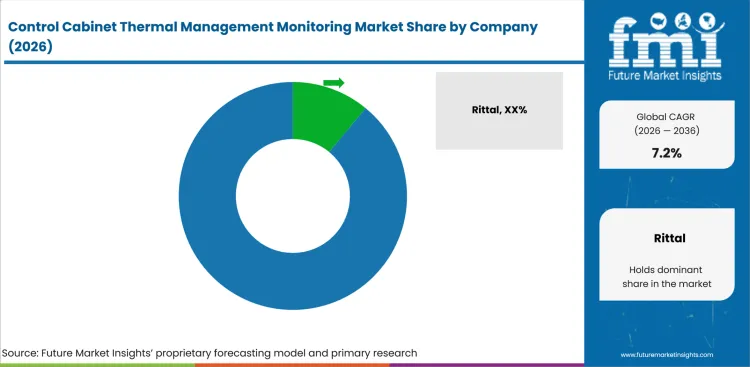
Rittal, nVent HOFFMAN, Schneider Electric, Turck and STEGO lead the control cabinet thermal management monitoring market.
- Established enclosure climate suppliers hold an advantage through cabinet cooling portfolios and global industrial service coverage.
- Automation suppliers gain specification support when cabinet alarms connect cleanly with PLC, HMI and supervisory systems.
- Specialist thermal control vendors compete through compact heaters, thermostats, hygrostats, filter fans and cabinet condition sensors.
- Panel builders prefer suppliers that provide repeatable documentation, easy wiring and field support during retrofit work.
Competition is shaped by the ability to combine enclosure climate hardware with reliable monitoring and plant-ready alarm output. Rittal, nVent HOFFMAN and Schneider Electric compete through broad cabinet platforms, cooling devices and engineering tools. Turck, STEGO and Pfannenberg compete through focused cabinet sensors, heating products, filter fans and thermal control devices. Buyers compare suppliers on thermal proof, installation simplicity and support for cabinet audits before approving multi-site programs.
Design-in access has become an important separator because machine builders want cabinet climate protection specified before shipment. Suppliers that can support panel layout, heat-load calculation and documented commissioning gain stronger repeat demand. Cabinet monitoring also connects with automation controllers, industrial I/O and plant software, so vendors with clear integration paths can reduce engineering work for customers.
Regional competition varies by country because cabinet retrofit demand follows different plant service models. Germany and Japan favor qualified components with strong documentation, while China and India require broader channel reach and price discipline. South Korea favors compact products that can pass approved-vendor review in electronics and semiconductor plants. Suppliers with monitored cooling, proven alarm logic and local service coverage are expected to hold the strongest position.
How do top control cabinet thermal management monitoring companies compare?
Rittal and Schneider Electric score strongest on system breadth while Turck and STEGO score highly on focused cabinet condition monitoring.
| Company | Relevance to Market Title | Thermal Monitoring Portfolio | Cabinet Climate Capability | Industrial Automation Fit | Geographic Footprint |
|---|---|---|---|---|---|
| Rittal | Very High | Very Strong | Very Strong | Strong | Global |
| nVent HOFFMAN | Very High | Strong | Very Strong | Moderate to Strong | Global |
| Schneider Electric | Very High | Strong | Strong | Very Strong | Global |
| Turck | Very High | Very Strong | Moderate | Very Strong | Global |
| STEGO | High | Strong | Very Strong | Moderate | Global |
| Pfannenberg | High | Moderate | Very Strong | Moderate | Global |
| Phoenix Contact | High | Strong | Moderate | Very Strong | Global |
| Siemens | Moderate to High | Moderate | Moderate | Very Strong | Global |
| Eaton | Moderate to High | Moderate | Strong | Strong | Global |
| ABB | Moderate to High | Moderate | Moderate | Very Strong | Global |
Source: Future Market Insights competitive analysis, 2026.
Who are the key players in the Control Cabinet Thermal Management Monitoring Market?
Rittal, nVent HOFFMAN and Schneider Electric are listed with Turck and STEGO among other suppliers.
Key global companies leading the control cabinet thermal management monitoring market include:
- Rittal GmbH & Co. KG
- nVent HOFFMAN
- Schneider Electric SE
- Turck GmbH & Co. KG
- STEGO Elektrotechnik GmbH
- Pfannenberg Group
- Phoenix Contact GmbH & Co. KG
- Siemens AG
- Eaton Corporation
- ABB Ltd.
Key Developments in Control Cabinet Thermal Management Monitoring Market
- In March 2024, Rittal highlighted the Blue e+ Filter Fan EC enclosure cooling unit with real-time temperature control, 40% greater cool air movement and 60% lower energy cost in the stated product context.
- In March 2024, Turck fully updated its IMX12-CCM control cabinet guard with haptic pushbuttons and an improved -25 °C to 70 °C operating range for remote I/O cabinets.
- In August 2024, nVent agreed to sell its Thermal Management business for USD 1.7 billion while continuing to focus its electrical connection and protection portfolio around enclosure solutions.
Key Players in the Control Cabinet Thermal Management Monitoring Market
Enclosure Climate Specialists
- Rittal GmbH & Co. KG
- nVent HOFFMAN
- Pfannenberg Group
- STEGO Elektrotechnik GmbH
Automation Control and Software Suppliers
- Schneider Electric SE
- Phoenix Contact GmbH & Co. KG
- Siemens AG
- ABB Ltd.
Cabinet Condition Monitoring Specialists
- Turck GmbH & Co. KG
- Eaton Corporation
- Omron Corporation
- Mitsubishi Electric Corporation
Control Cabinet Thermal Management Monitoring Market - Report Scope
| Parameter | Details |
|---|---|
| Forecast period | 2026 to 2036 |
| Historical period | 2021 to 2025 |
| Quantitative unit | Revenue in USD million |
| By offering | Controllers, I/O modules, engineering software, services |
| By deployment | Discrete automation, process automation, hybrid automation |
| By application | Machine control, line integration, safety control, remote operations |
| By end-use industry | Automotive, food and beverage, chemicals, pharmaceuticals, electronics, metals |
| By connectivity | Wired monitoring, wireless monitoring, hybrid connectivity |
| Regions covered | North America, Latin America, Europe, East Asia, South Asia and Pacific, Middle East and Africa |
| Countries covered | United States, United Kingdom, Germany, France, Japan, China, South Korea, India |
| Key companies profiled | Rittal, nVent HOFFMAN, Schneider Electric, Turck, STEGO, Pfannenberg, Phoenix Contact, Siemens, Eaton, ABB |
| Approach | Bottom-up cabinet-boundary approach using cabinet population, system price bands, automation intensity, retrofit demand and country-level adoption |
Source: Future Market Insights, 2026.
Control Cabinet Thermal Management Monitoring Market Breakdown by Offering, Deployment, Application, End-use Industry, Connectivity, and Region
Control Cabinet Thermal Management Monitoring Market Segmented by Offering:
- Controllers
- I/O Modules
- Engineering Software
- Services
Control Cabinet Thermal Management Monitoring Market Segmented by Deployment:
- Discrete Automation
- Process Automation
- Hybrid Automation
Control Cabinet Thermal Management Monitoring Market Segmented by Application:
- Machine Control
- Line Integration
- Safety Control
- Remote Operations
Control Cabinet Thermal Management Monitoring Market Segmented by End-use Industry:
- Automotive
- Food & Beverage
- Chemicals
- Pharmaceuticals
- Electronics
- Metals
Control Cabinet Thermal Management Monitoring Market Segmented by Connectivity:
- Wired Monitoring
- Wireless Monitoring
- Hybrid Connectivity
Control Cabinet Thermal Management Monitoring Market by Region:
- North America
- Latin America
- Europe
- East Asia
- South Asia and Pacific
- Middle East and Africa
Research Sources and Bibliography
- Cybersecurity and Infrastructure Security Agency. (2025, August 7). CISA releases ten Industrial Control Systems advisories.
- Destatis. (2025, August 7). Production in June 2025: -1.9% on the previous month.
- European Union. (2024, February 20). Regulation (EU) 2024/573 of the European Parliament and of the Council on fluorinated greenhouse gases.
- International Federation of Robotics. (2025, September 25). World Robotics 2025 report: Global robot demand in factories doubles over 10 years.
- International Federation of Robotics. (2025). World Robotics 2025: Industrial robots executive summary.
- Ministry of Data and Statistics, Republic of Korea. (2026, January 30). Monthly Industrial Statistics, December 2025.
- Ministry of Economy, Trade and Industry. (2026, January 30). Indices of Industrial Production: Preliminary Report for December 2025.
- National Bureau of Statistics of China. (2025, December 28). The profit of industrial enterprises above the designated size from January to November in 2025.
- National Institute of Standards and Technology. (2026). U.S. manufacturing economy.
- nVent Electric plc. (2024, August 1). nVent announces agreement to sell Thermal Management business.
- Office for National Statistics. (2025, September 12). Index of Production, UK: July 2025.
- Office for National Statistics. (2026, February 12). Index of Production, UK: December 2025.
- Press Information Bureau. (2025, December 1). India’s Index of industrial production records growth of 0.4% in October 2025.
- Rittal. (2024, March 20). 3 ways the Blue e+ Filter Fan simplifies industrial enclosure cooling.
- Rittal. (2025). Rittal + Eplan innovations 2025.
- Turck. (2024, March 14). Monitoring control cabinet climate with IMX12-CCM.
- U.S. Bureau of Economic Analysis. (2026, April 9). GDP by industry.
- U.S. Census Bureau. (2026, June 3). Monthly full report on manufacturers’ shipments, inventories, and orders.
- World Bank. (2026). Manufacturing, value added (current US$). World Development Indicators.
- This bibliography is provided for reader reference and is not exhaustive. The full report contains the complete reference list and detailed citations.
Control Cabinet Thermal Management Monitoring Market - Scope & Definition
| Attribute | Detail |
|---|---|
| Market Definition | Systems that monitor and control temperature, humidity, airflow, cooling status and door conditions inside industrial control cabinets. |
| Functions Covered | Cabinet temperature sensing, humidity monitoring, cooling status checks, airflow alarms, door monitoring, local control and remote alarm routing. |
| Applications Covered | Machine control, line integration, safety control and remote operations across industrial automation environments. |
| End-Use Industries | Automotive, food and beverage, chemicals, pharmaceuticals, electronics, metals and other automated manufacturing plants. |
| Grades Covered | Controllers, I/O modules, engineering software, services, wired monitoring, wireless monitoring and hybrid connectivity formats. |
| Inclusions | Cabinet sensors, thermal alarms, enclosure cooling controls, fan and heater controls, cabinet condition monitoring and industrial channel services. |
| Exclusions | Room HVAC, data center cooling, household electrical panels, non-industrial thermostats and standalone enclosures sold without monitoring functions. |
Control Cabinet Thermal Management Monitoring Market - Research Methodology
| Method | Description |
|---|---|
| Primary Research | FMI analyst interviews with machine builders, plant maintenance teams, panel builders and control system integrators across key markets. |
| Desk Research | Review of product documents, company catalogs, standards references, robot installation data, industrial production statistics and OT security guidance. |
| Market Sizing & Forecasting | Bottom-up modelling using cabinet population, system price bands, automation intensity, retrofit demand and country-level adoption trends. |
| Data Validation | Cross-verification using company portfolios, country automation indicators, channel fit and related industrial control system adoption signals. |
This Report Answers
- Market size estimates for 2026 and forecasts through 2036 for the control cabinet thermal management monitoring market.
- Insights across regional and country-level markets covering automation intensity and cabinet service demand.
- Analysis of demand drivers, cabinet uptime needs, cooling energy control and retrofit service opportunities.
- Evaluation of leading segments across offering, deployment, application, end-use industry and connectivity.
- Assessment of country-level restraints including industrial output volatility, qualification cycles and retrofit approval barriers.
- Identification of competitive positioning across enclosure climate specialists and automation control suppliers.
- Evaluation of company developments, cabinet monitoring product updates and thermal management portfolio shifts.
- Country-level growth analysis covering the United States, United Kingdom, Germany, France, Japan, China, South Korea and India.
- Assessment of the competitive landscape including leading cabinet climate control and cabinet condition monitoring suppliers.
- Analysis of market penetration trends and emerging opportunities across monitored cabinet cooling and remote alarms.
Frequently Asked Questions
What is the growth prospect for control cabinet thermal management monitoring?
Demand for control cabinet thermal management monitoring is expected to rise as factories connect enclosure climate data with uptime systems.
Which companies are expected to shape the control cabinet thermal management monitoring market?
Rittal, nVent HOFFMAN, Schneider Electric, Turck, STEGO, Pfannenberg and Phoenix Contact are expected to shape supplier competition.
Why are manufacturers investing in control cabinet thermal management monitoring?
Manufacturers are investing in cabinet monitoring to reduce heat faults, protect drives and support remote maintenance decisions.
Why are panel builder channels important in the control cabinet thermal management monitoring market?
Panel builder channels support early design-in because cabinet climate protection can be specified before equipment shipment.
Which product formats are gaining attention in control cabinet thermal management monitoring?
Controllers, cabinet condition monitoring devices, smart filter fans and humidity sensors are gaining attention across automated plants.
How do regulations influence control cabinet thermal monitoring adoption?
Regulations influence adoption through OT cybersecurity review, refrigerant compliance and documented equipment safety requirements.
Why is cabinet climate data important for automated plants?
Cabinet climate data is important because heat, humidity and airflow faults can damage drives, power supplies and communication modules.
What role does retrofit service play in this market?
Retrofit service helps older cabinets gain monitoring, alarms and cooling control without a full enclosure replacement.
How do remote operations support cabinet monitoring demand?
Remote operations support demand by allowing maintenance teams to check cabinet conditions before sending technicians to the line.
Preview the report firsthand - request a free sample
Get SampleGet the brochure for pricing and purchase details.
Get PDFTable of Content
- Key Takeaways
- Market Size and CAGR
- Top Growth Driver
- Fastest Growing Segment
- Leading Region
- Key Companies
- Emerging Opportunities
- Executive Summary
- Global Market Outlook
- Demand-side Trends
- Supply-side Trends
- Technology Roadmap Analysis
- Analysis and Recommendations
- Analyst Perspective (What is happening? Why now? What should investors know?)
- Key Questions Answered
- How large is the market?
- What is the CAGR?
- What are key trends?
- Which region dominates?
- Who are the leaders?
- Market Overview
- Market Coverage / Taxonomy
- Market Definition / Scope / Limitations
- Research Methodology
- Chapter Orientation
- Analytical Lens and Working Hypotheses
- Market Structure, Signals, and Trend Drivers
- Benchmarking and Cross-market Comparability
- Market Sizing, Forecasting, and Opportunity Mapping
- Research Design and Evidence Framework
- Desk Research Programme (Secondary Evidence)
- Expert Input and Fieldwork (Primary Evidence)
- Tooling, Models, and Reference Databases
- Data Engineering and Model Build
- Quality Assurance and Audit Trail
- Market Background
- Market Dynamics (Drivers, Restraints, Opportunity, Trends)
- Scenario Forecast (Optimistic, Likely, Conservative)
- Impact Analysis
- AI Impact
- Sustainability Impact
- Regulatory Impact
- Technology Impact
- Consumer / Buyer Analysis
- Purchase Drivers
- Adoption Barriers
- Buyer Journey
- Opportunity Map Analysis
- Product Life Cycle Analysis
- Supply Chain Analysis
- Investment Feasibility Matrix
- Value Chain Analysis
- PESTLE and Porter's Analysis
- Regulatory Landscape
- Regional Parent Market Outlook
- Production and Consumption Statistics
- Import and Export Statistics
- Global Market Analysis and Forecast, 2021 to 2036
- Historical Market Size Value (USD Million) Analysis, 2021 to 2025
- Current and Future Market Size Value (USD Million) Projections, 2026 to 2036
- Y-o-Y Growth Trend Analysis
- Absolute $ Opportunity Analysis
- Global Market Pricing Analysis, 2021 to 2036
- Global Market Analysis and Forecast, By Offering, 2021 to 2036
- Introduction / Key Findings
- Historical Market Size Value (USD Million) Analysis By Offering, 2021 to 2025
- Current and Future Market Size Value (USD Million) Analysis and Forecast By Offering, 2026 to 2036
- Controllers
- I/O Modules
- Engineering Software
- Services
- Controllers
- Y-o-Y Growth Trend Analysis By Offering, 2021 to 2025
- Absolute $ Opportunity Analysis By Offering, 2026 to 2036
- Global Market Analysis and Forecast, By Deployment, 2021 to 2036
- Introduction / Key Findings
- Historical Market Size Value (USD Million) Analysis By Deployment, 2021 to 2025
- Current and Future Market Size Value (USD Million) Analysis and Forecast By Deployment, 2026 to 2036
- Discrete Automation
- Process Automation
- Hybrid Automation
- Discrete Automation
- Y-o-Y Growth Trend Analysis By Deployment, 2021 to 2025
- Absolute $ Opportunity Analysis By Deployment, 2026 to 2036
- Global Market Analysis and Forecast, By Application, 2021 to 2036
- Introduction / Key Findings
- Historical Market Size Value (USD Million) Analysis By Application, 2021 to 2025
- Current and Future Market Size Value (USD Million) Analysis and Forecast By Application, 2026 to 2036
- Machine Control
- Line Integration
- Safety Control
- Remote Operations
- Machine Control
- Y-o-Y Growth Trend Analysis By Application, 2021 to 2025
- Absolute $ Opportunity Analysis By Application, 2026 to 2036
- Global Market Analysis and Forecast, By End-use Industry, 2021 to 2036
- Introduction / Key Findings
- Historical Market Size Value (USD Million) Analysis By End-use Industry, 2021 to 2025
- Current and Future Market Size Value (USD Million) Analysis and Forecast By End-use Industry, 2026 to 2036
- Automotive
- Food & Beverage
- Chemicals
- Pharmaceuticals
- Electronics
- Metals
- Automotive
- Y-o-Y Growth Trend Analysis By End-use Industry, 2021 to 2025
- Absolute $ Opportunity Analysis By End-use Industry, 2026 to 2036
- Global Market Analysis and Forecast, By Connectivity, 2021 to 2036
- Introduction / Key Findings
- Historical Market Size Value (USD Million) Analysis By Connectivity, 2021 to 2025
- Current and Future Market Size Value (USD Million) Analysis and Forecast By Connectivity, 2026 to 2036
- Wired Monitoring
- Wireless Monitoring
- Hybrid Connectivity
- Wired Monitoring
- Y-o-Y Growth Trend Analysis By Connectivity, 2021 to 2025
- Absolute $ Opportunity Analysis By Connectivity, 2026 to 2036
- Global Market Analysis and Forecast, By Region, 2021 to 2036
- Introduction
- Historical Market Size Value (USD Million) Analysis By Region, 2021 to 2025
- Current Market Size Value (USD Million) Analysis and Forecast By Region, 2026 to 2036
- North America
- Latin America
- Western Europe
- Eastern Europe
- East Asia
- South Asia and Pacific
- Middle East & Africa
- Market Attractiveness Analysis By Region
- North America Market Analysis and Forecast, By Country, 2021 to 2036
- Historical Market Size Value (USD Million) Trend Analysis By Market Taxonomy, 2021 to 2025
- Market Size Value (USD Million) Forecast By Market Taxonomy, 2026 to 2036
- By Country
- USA
- Canada
- Mexico
- By Offering
- By Deployment
- By Application
- By End-use Industry
- By Connectivity
- By Country
- Market Attractiveness Analysis
- By Country
- By Offering
- By Deployment
- By Application
- By End-use Industry
- By Connectivity
- Key Takeaways
- Latin America Market Analysis and Forecast, By Country
- Historical Market Size Value (USD Million) Trend Analysis By Market Taxonomy, 2021 to 2025
- Market Size Value (USD Million) Forecast By Market Taxonomy, 2026 to 2036
- By Country
- Brazil
- Chile
- Rest of Latin America
- By Offering
- By Deployment
- By Application
- By End-use Industry
- By Connectivity
- By Country
- Market Attractiveness Analysis
- By Country
- By Offering
- By Deployment
- By Application
- By End-use Industry
- By Connectivity
- Key Takeaways
- Western Europe Market Analysis and Forecast, By Country
- Historical Market Size Value (USD Million) Trend Analysis By Market Taxonomy, 2021 to 2025
- Market Size Value (USD Million) Forecast By Market Taxonomy, 2026 to 2036
- By Country
- Germany
- UK
- Italy
- Spain
- France
- Nordic
- BENELUX
- Rest of Western Europe
- By Offering
- By Deployment
- By Application
- By End-use Industry
- By Connectivity
- By Country
- Market Attractiveness Analysis
- By Country
- By Offering
- By Deployment
- By Application
- By End-use Industry
- By Connectivity
- Key Takeaways
- Eastern Europe Market Analysis and Forecast, By Country
- Historical Market Size Value (USD Million) Trend Analysis By Market Taxonomy, 2021 to 2025
- Market Size Value (USD Million) Forecast By Market Taxonomy, 2026 to 2036
- By Country
- Russia
- Poland
- Hungary
- Balkan & Baltic
- Rest of Eastern Europe
- By Offering
- By Deployment
- By Application
- By End-use Industry
- By Connectivity
- By Country
- Market Attractiveness Analysis
- By Country
- By Offering
- By Deployment
- By Application
- By End-use Industry
- By Connectivity
- Key Takeaways
- East Asia Market Analysis and Forecast, By Country
- Historical Market Size Value (USD Million) Trend Analysis By Market Taxonomy, 2021 to 2025
- Market Size Value (USD Million) Forecast By Market Taxonomy, 2026 to 2036
- By Country
- China
- Japan
- South Korea
- By Offering
- By Deployment
- By Application
- By End-use Industry
- By Connectivity
- By Country
- Market Attractiveness Analysis
- By Country
- By Offering
- By Deployment
- By Application
- By End-use Industry
- By Connectivity
- Key Takeaways
- South Asia and Pacific Market Analysis and Forecast, By Country
- Historical Market Size Value (USD Million) Trend Analysis By Market Taxonomy, 2021 to 2025
- Market Size Value (USD Million) Forecast By Market Taxonomy, 2026 to 2036
- By Country
- India
- ASEAN
- Australia & New Zealand
- Rest of South Asia and Pacific
- By Offering
- By Deployment
- By Application
- By End-use Industry
- By Connectivity
- By Country
- Market Attractiveness Analysis
- By Country
- By Offering
- By Deployment
- By Application
- By End-use Industry
- By Connectivity
- Key Takeaways
- Middle East & Africa Market Analysis and Forecast, By Country
- Historical Market Size Value (USD Million) Trend Analysis By Market Taxonomy, 2021 to 2025
- Market Size Value (USD Million) Forecast By Market Taxonomy, 2026 to 2036
- By Country
- Kingdom of Saudi Arabia
- Other GCC Countries
- Türkiye
- South Africa
- Other African Union
- Rest of Middle East & Africa
- By Offering
- By Deployment
- By Application
- By End-use Industry
- By Connectivity
- By Country
- Market Attractiveness Analysis
- By Country
- By Offering
- By Deployment
- By Application
- By End-use Industry
- By Connectivity
- Key Takeaways
- Key Countries Market Analysis
- USA
- Pricing Analysis
- Market Share Analysis, 2025
- By Offering
- By Deployment
- By Application
- By End-use Industry
- By Connectivity
- Canada
- Pricing Analysis
- Market Share Analysis, 2025
- By Offering
- By Deployment
- By Application
- By End-use Industry
- By Connectivity
- Mexico
- Pricing Analysis
- Market Share Analysis, 2025
- By Offering
- By Deployment
- By Application
- By End-use Industry
- By Connectivity
- Brazil
- Pricing Analysis
- Market Share Analysis, 2025
- By Offering
- By Deployment
- By Application
- By End-use Industry
- By Connectivity
- Chile
- Pricing Analysis
- Market Share Analysis, 2025
- By Offering
- By Deployment
- By Application
- By End-use Industry
- By Connectivity
- Germany
- Pricing Analysis
- Market Share Analysis, 2025
- By Offering
- By Deployment
- By Application
- By End-use Industry
- By Connectivity
- UK
- Pricing Analysis
- Market Share Analysis, 2025
- By Offering
- By Deployment
- By Application
- By End-use Industry
- By Connectivity
- Italy
- Pricing Analysis
- Market Share Analysis, 2025
- By Offering
- By Deployment
- By Application
- By End-use Industry
- By Connectivity
- Spain
- Pricing Analysis
- Market Share Analysis, 2025
- By Offering
- By Deployment
- By Application
- By End-use Industry
- By Connectivity
- France
- Pricing Analysis
- Market Share Analysis, 2025
- By Offering
- By Deployment
- By Application
- By End-use Industry
- By Connectivity
- India
- Pricing Analysis
- Market Share Analysis, 2025
- By Offering
- By Deployment
- By Application
- By End-use Industry
- By Connectivity
- ASEAN
- Pricing Analysis
- Market Share Analysis, 2025
- By Offering
- By Deployment
- By Application
- By End-use Industry
- By Connectivity
- Australia & New Zealand
- Pricing Analysis
- Market Share Analysis, 2025
- By Offering
- By Deployment
- By Application
- By End-use Industry
- By Connectivity
- China
- Pricing Analysis
- Market Share Analysis, 2025
- By Offering
- By Deployment
- By Application
- By End-use Industry
- By Connectivity
- Japan
- Pricing Analysis
- Market Share Analysis, 2025
- By Offering
- By Deployment
- By Application
- By End-use Industry
- By Connectivity
- South Korea
- Pricing Analysis
- Market Share Analysis, 2025
- By Offering
- By Deployment
- By Application
- By End-use Industry
- By Connectivity
- Russia
- Pricing Analysis
- Market Share Analysis, 2025
- By Offering
- By Deployment
- By Application
- By End-use Industry
- By Connectivity
- Poland
- Pricing Analysis
- Market Share Analysis, 2025
- By Offering
- By Deployment
- By Application
- By End-use Industry
- By Connectivity
- Hungary
- Pricing Analysis
- Market Share Analysis, 2025
- By Offering
- By Deployment
- By Application
- By End-use Industry
- By Connectivity
- Kingdom of Saudi Arabia
- Pricing Analysis
- Market Share Analysis, 2025
- By Offering
- By Deployment
- By Application
- By End-use Industry
- By Connectivity
- Türkiye
- Pricing Analysis
- Market Share Analysis, 2025
- By Offering
- By Deployment
- By Application
- By End-use Industry
- By Connectivity
- South Africa
- Pricing Analysis
- Market Share Analysis, 2025
- By Offering
- By Deployment
- By Application
- By End-use Industry
- By Connectivity
- USA
- Market Structure Analysis
- Competition Dashboard
- Competition Benchmarking
- Market Share Analysis of Top Players
- By Regional
- By Offering
- By Deployment
- By Application
- By End-use Industry
- By Connectivity
- Emerging Startups
- Innovation Benchmarking
- Competition Analysis
- Competition Deep Dive
- Rittal
- Overview
- Product Portfolio
- Profitability by Market Segments (Product/Region/Sales Channel)
- Sales Footprint
- Strategy Overview
- Marketing Strategy
- Product Strategy
- Channel Strategy
- nVent HOFFMAN
- Schneider Electric
- Turck
- STEGO
- Pfannenberg
- Phoenix Contact
- Siemens
- Eaton
- ABB
- Rittal
- Case Studies
- Success Stories
- Recent Developments
- Competition Deep Dive
- Assumptions & Acronyms Used


