

- Industry Size (2026)
- USD 0.59 Bn
- Forecast (2036)
- USD 1.54 Bn
- CAGR (2026 to 2036)
- 10.0%
Biobased Biodegradable Plastic Outlook in the UK 2026 to 2036
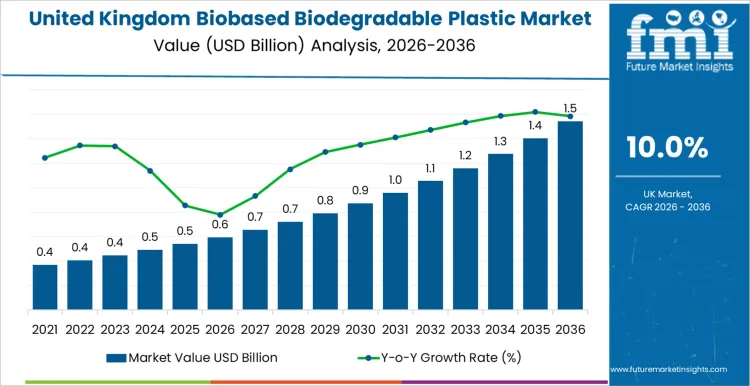
The biobased biodegradable plastic ecosystem in the UK is projected to reach USD 0.59 billion in 2026. Demand is expected to rise to USD 1.54 billion by 2036, expanding at a 10.0% CAGR. This expansion is shaped by how packaging owners, consumer brands, and industrial converters are reframing materials as compliance infrastructure. Polymer selection is no longer only about unit cost and performance.
It is equally about disposal outcomes, claim accuracy, supply security, and how quickly a product portfolio can shift away from conventional fossil-derived plastics without triggering downtime or quality drift in converting operations. For company leaders and commercial teams, demand is coming from a mix of brand protection and procurement discipline.
Retailers and end customers expect credible sustainability improvements that are explained clearly, defended with evidence, and delivered at scale. For resin producers and technology partners, growth depends on dependable quality, fit with existing processing equipment, and practical options across packaging formats, fibres, healthcare materials, and agriculture applications.
Quick Stats for Biobased Biodegradable Plastic Demand in the UK
- Biobased Biodegradable Plastic Valuation in the UK (2026): USD 0.59 billion
- Biobased Biodegradable Plastic Forecast Valuation in the UK (2036): USD 1.54 billion
- Biobased Biodegradable Plastic Forecast CAGR (2026 to 2036): 10.0%
- Leading Regional Growth: England (11.0%)
- Leading Product Type: Polyester (39% share)
- Leading Application: Packaging (40.0% share)
- Key Companies Profiled: NatureWorks LLC; BASF SE; TotalEnergies Corbion; Novamont S.p.A; Mitsubishi Chemical Corporation
Why is the UK a High-Intent Adoption Hub for Biobased Biodegradable Plastic?
The UK is a high-intent adoption environment because packaging economics now include direct policy-linked cost exposure. The UK Plastic Packaging Tax applies when plastic packaging components contain less than 30% recycled plastic, pushing material owners to reassess designs and sourcing structures. For many brand owners, this creates a real incentive to examine alternatives that improve sustainability narratives while preserving packaging performance in distribution.
Single-use restrictions also shape material choices, particularly in food-service items where compliance expectations are visible and enforcement risk is reputationally significant. UK government guidance lists bans and restrictions on defined single-use plastic items, including certain cutlery and polystyrene food containers. This type of policy pressure supports biobased biodegradable materials in packaging and serviceware where end users demand “better than conventional” options that still meet durability needs.
Scale-up conditions are improving, which strengthens buyer confidence. European Bioplastics projects global bioplastics production capacity rising from around 2.47 million tonnes in 2024 to approximately 5.73 million tonnes in 2029, reflecting broader expansion of industrial readiness. As supply depth improves, UK converters gain more viable options across multiple resin types and blends.
Many procurement teams align portfolio planning with the biobased biodegradable plastics outlook when building long-term sourcing scenarios for packaging and industrial materials. Product teams also benchmark material substitution strategies against the broader bioplastics outlook to prioritise applications where adoption friction is lowest.
How is Demand Segmented by Product Type and Application?
The UK landscape is shaped by practical performance needs and application realities. Buyers are not choosing one polymer for every use case. They select materials that fit specific packaging structures, process conditions, and disposal expectations.
Why is Polyester the preferred Starting Point for Scalable Adoption across High-volume Uses?
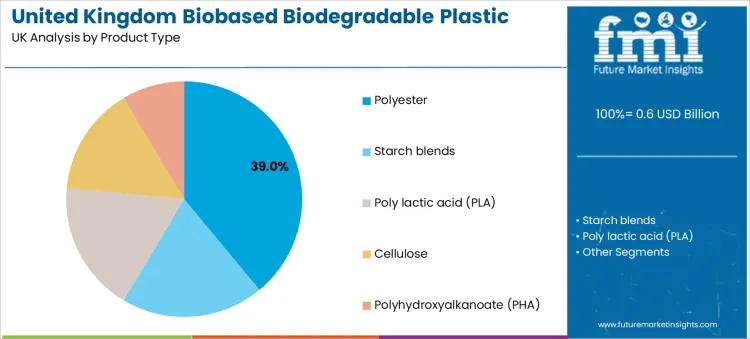
Polyester-based solutions hold a 39% share, making them the leading product type in the UK. This reflects a strong preference for polymers that can balance toughness, heat resistance, and reliable converting behaviour. Polyester-based biodegradable plastics are assessed for packaging where strength and stability cannot be compromised.
They are also considered in fibres where mechanical performance and durability influence end-product value. For stakeholders managing large SKU portfolios, polyester-based materials are treated as a practical bridge option. They can enable measurable sustainability improvements while keeping production lines stable.
This matters for large packaging converters where even small disruptions can become expensive at scale. Polymer selection work in this segment often runs alongside technical evaluation of adjacent bio-based inputs such as bio-based polyethylene, especially for packaging layers where softness, seal performance, or flexibility must remain consistent.
Why does Packaging represent the Largest Application Pocket for this Industry in the UK?
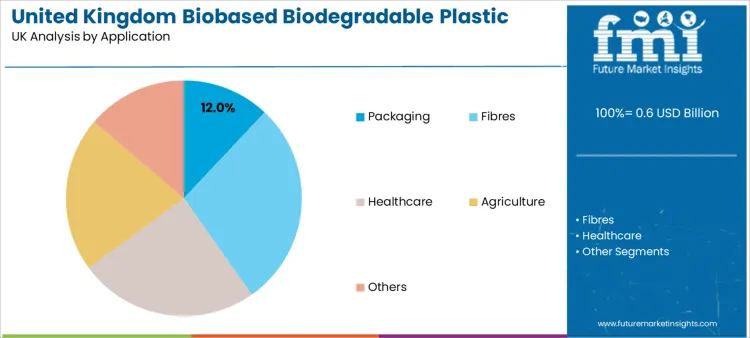
Packaging accounts for a 40.0% share, placing it at the centre of demand. Brands favour packaging applications because the impact is visible, measurable, and easier to scale across high-volume product lines.
Packaging also provides a clear route for supplier partnerships, since converters can run trials, validate line performance, and execute structured rollouts across plants. The packaging segment is shaped by brand trust and claims discipline. Businesses need to show that sustainability messaging aligns with real material behaviour and end-of-life pathways.
Many product teams focus on compostability requirements for selected formats, since EN 13432 defines minimum requirements for packaging intended for industrial composting. Packaging decisions in this category often sit beside wider demand for biodegradable paper and plastic packaging, particularly where retailers want consistent sustainability language across packaging families.
What are the Dynamics, Restraints, Opportunities, and Threats Shaping this Sector?
How are Regulations and Corporate Packaging Governance driving Consistent Demand?
Demand is driven by a clear shift from voluntary sustainability positioning to compliance-linked material governance. The Plastic Packaging Tax creates a tangible cost driver for packaging owners that do not meet recycled content thresholds. This reinforces board-level focus on packaging redesign, supplier diversification, and improved claims substantiation.
In parallel, single-use restrictions push businesses to reduce reliance on conventional plastics in food-service and takeaway environments. Government guidance outlines bans and restrictions for specific items, shaping material substitution decisions in high-visibility applications.
These forces support biobased biodegradable plastics where they solve a practical problem: offering a more sustainable profile while keeping packaging performance acceptable for transport, shelf life, and customer experience.
What holds Adoption back even when Sustainability demand is High?
Two restraints stand out. The first is end-of-life uncertainty. Compostable and biodegradable claims can create confusion if collection systems and disposal behaviour do not align with the product design. Businesses take a cautious approach when the risk of customer misunderstanding is high.
The second is operational fit. Many packaging lines run at high speed with tight tolerances. If a material introduces sealing inconsistency, heat sensitivity, or mechanical fragility, adoption slows. Buyers expect suppliers to provide trial support, processing parameters, and stable product specifications.
Where are the Strongest Opportunities emerging for Brands and Polymer Suppliers?
Packaging remains the most scalable opportunity because it allows multi-SKU conversion with measurable impact. Foodservice also offers strong potential, driven by visible policy pressure and consumer preference for more sustainable options. Agriculture applications create additional pockets of growth, especially for mulch films and horticulture formats where disposal issues are persistent in conventional plastics.
Innovation opportunities also exist upstream in feedstock and precursor development. Companies investing in long-term capability often track advances such as renewable bioplastic building blocks for packaging and personal care to support better material performance and improved economics.
Film-based packaging is another meaningful route, especially where flexible packaging volume is high and brands want improved sustainability positioning. This supports adoption in areas linked to biodegradable films used across retail, food, and distribution needs.
What threats can disrupt momentum for this category in the UK?
Supply volatility is a major threat. Feedstock constraints, processing bottlenecks, and demand spikes can create pricing instability. Another threat is reputational risk from ambiguous claims. If materials are positioned incorrectly, brands can face backlash, delisting, or regulatory scrutiny.
Businesses respond by strengthening documentation, verifying standards alignment, and limiting high-visibility claims to products that can be supported with credible evidence. EN 13432 remains central to industrial compostability expectations for packaging, shaping how companies select materials for compostable positioning.
How is Demand Evolving across Key Regions in the UK?
Regional demand differs based on industrial concentration, packaging conversion activity, and proximity to large consumer goods supply chains. Forecast growth rates from 2026 to 2036 are as follows:
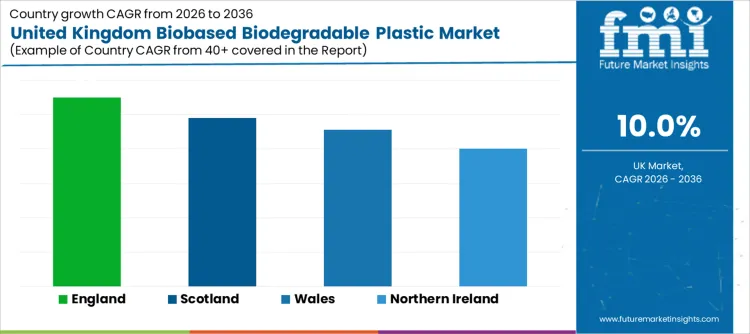
| Region | CAGR (2026-2036) |
|---|---|
| England | 11.0% |
| Scotland | 9.8% |
| Wales | 9.1% |
| Northern Ireland | 8.0% |
How is England leading adoption through Packaging Scale and Converter Activity?
Demand for biobased biodegradable plastics in England is forecasted to advance at an 11.0% CAGR. The density of brand owners, packaging converters, and distribution infrastructure supports growth.
Large-scale packaging programmes are more common, and supplier onboarding tends to move faster when trial capacity and technical resources are strong. England also benefits from broader retail supply chains that prioritise packaging improvements across high-volume product ranges.
England-based material transitions often expand alongside related sustainability initiatives such as plant-based plastic alternatives, especially where brands want clearer renewable narratives in consumer-facing packaging.
How is Scotland building demand through targeted adoption and stronger emphasis on claims integrity?
Scotland grows at 9.8%, shaped by practical adoption in applications where sustainability outcomes can be communicated clearly and supported operationally. Stakeholders tend to prioritise reliability and end-of-life credibility, focusing on material choices that fit existing manufacturing conditions while keeping customer guidance simple.
What is shaping Wales as it scales packaging and agriculture-linked materials selection?
A 9.1% CAGR is anticipated for the biobased biodegradable plastic landscape in Wales, supported by packaging conversion work and agriculture-related use cases where biodegradability narratives can be valuable. End-users often focus on predictable performance and stable supply, selecting materials that fit operational constraints rather than chasing novelty.
Why is Northern Ireland adopting with staged expansion and value assurance?
The biobased biodergadable plastic industry Northern Ireland grows at an 8.0% CAGR, reflecting measured adoption where cost control, supplier reliability, and application fit guide expansion. Businesses often scale through specific product lines first, then widen adoption once performance stability and supply confidence are proven.
What defines the Competitive Landscape in the UK?
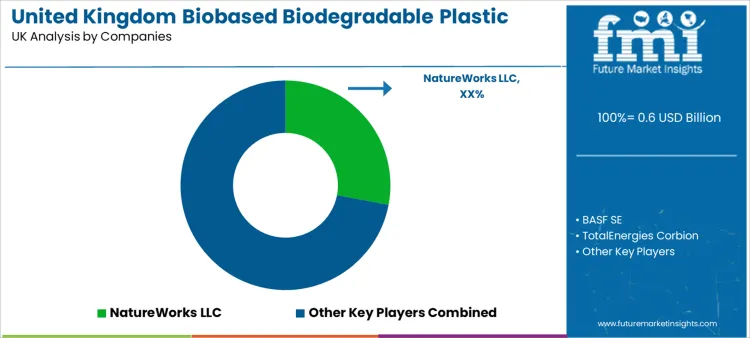
Competition is shaped by polymer performance, application support, supply reliability, and clarity of documentation. Buyers expect resin suppliers to provide more than product availability. They want trial guidance, stable specifications, and support for converting performance across packaging, fibres, healthcare materials, and agriculture formats.
NatureWorks LLC is recognised for PLA capabilities and scale support across compostable materials. BASF SE competes through broad materials expertise and application support for converters. TotalEnergies Corbion brings strength in PLA development and scaling capacity. Novamont S.p.A holds positioning in biodegradable polymer portfolios with application-led focus. Mitsubishi Chemical Corporation supports wide-ranging material capabilities and industrial partnering potential.
Winning strategies in the UK depend on how effectively suppliers help customers translate sustainability intent into operational reality. Buyers reward partners that reduce trial risk, support claims governance, and maintain stable supply even as adoption rises.
Key Industry Participants
- NatureWorks LLC
- BASF SE
- TotalEnergies Corbion
- Novamont S.p.A
- Mitsubishi Chemical Corporation
Scope of Report
| Items | Values |
|---|---|
| Quantitative Units | USD Billion |
| Product Type | Polyester; Starch blends; Poly lactic acid (PLA); Cellulose; Polyhydroxyalkanoate (PHA) |
| Application | Packaging; Fibres; Healthcare; Agriculture; Others |
| Regions Covered | England; Scotland; Wales; Northern Ireland |
| Key Companies Profiled | NatureWorks LLC; BASF SE; TotalEnergies Corbion; Novamont S.p.A; Mitsubishi Chemical Corporation |
Biobased Biodegradable Plastic Industry in the UK by Key Segments
By Product Type:
- Polyester
- Starch blends
- Poly lactic acid (PLA)
- Cellulose
- Polyhydroxyalkanoate (PHA)
By Application:
- Packaging
- Fibres
- Healthcare
- Agriculture
- Others
By Region:
- England
- Scotland
- Wales
- Northern Ireland
Bibliography
- European Bioplastics. (2024). Bioplastics market development update 2024.
- European Bioplastics. (n.d.). EN 13432: Industrial composting requirements for packaging (background document).
- HM Government. (2024). Single-use plastics bans and restrictions.
- HM Government. (2022). Plastic Packaging Tax: steps to take.
Frequently Asked Questions
How big is the demand for biobased biodegradable plastic in uk in 2026?
The demand for biobased biodegradable plastic in uk is estimated to be valued at USD 0.6 billion in 2026.
What will be the size of biobased biodegradable plastic in uk in 2036?
The market size for the biobased biodegradable plastic in uk is projected to reach USD 1.5 billion by 2036.
How much will be the demand for biobased biodegradable plastic in uk growth between 2026 and 2036?
The demand for biobased biodegradable plastic in uk is expected to grow at a 10.0% CAGR between 2026 and 2036.
What are the key product types in the biobased biodegradable plastic in uk?
The key product types in biobased biodegradable plastic in uk are polyester, starch blends, poly lactic acid (pla), cellulose and polyhydroxyalkanoate (pha).
Which application segment is expected to contribute significant share in the biobased biodegradable plastic in uk in 2026?
In terms of application, packaging segment is expected to command 0.0% share in the biobased biodegradable plastic in uk in 2026.
Preview the report firsthand - request a free sample
Get SampleGet the brochure for pricing and purchase details.
Get PDFTable of Content
- Executive Summary
- UK Market Outlook
- Demand-side Trends
- Supply-side Trends
- Technology Roadmap Analysis
- Analysis and Recommendations
- Market Overview
- Market Coverage / Taxonomy
- Market Definition / Scope / Limitations
- Market Background
- Market Dynamics
- Drivers
- Restraints
- Opportunity
- Trends
- Scenario Forecast
- Demand in Optimistic Scenario
- Demand in Likely Scenario
- Demand in Conservative Scenario
- Opportunity Map Analysis
- Product Life Cycle Analysis
- Supply Chain Analysis
- Investment Feasibility Matrix
- Value Chain Analysis
- PESTLE and Porter’s Analysis
- Regulatory Landscape
- Regional Parent Market Outlook
- Production and Consumption Statistics
- Import and Export Statistics
- Market Dynamics
- UK Market Analysis 2021 to 2025 and Forecast, 2026 to 2036
- Historical Market Size Value (USD Million) Analysis, 2021 to 2025
- Current and Future Market Size Value (USD Million) Projections, 2026 to 2036
- Y-o-Y Growth Trend Analysis
- Absolute $ Opportunity Analysis
- UK Market Pricing Analysis 2021 to 2025 and Forecast 2026 to 2036
- UK Market Analysis 2021 to 2025 and Forecast 2026 to 2036, By Product Type
- Introduction / Key Findings
- Historical Market Size Value (USD Million) Analysis By Product Type , 2021 to 2025
- Current and Future Market Size Value (USD Million) Analysis and Forecast By Product Type , 2026 to 2036
- Polyester
- Starch blends
- Poly lactic acid (PLA)
- Cellulose
- Polyhydroxyalkanoate (PHA)
- Polyester
- Y-o-Y Growth Trend Analysis By Product Type , 2021 to 2025
- Absolute $ Opportunity Analysis By Product Type , 2026 to 2036
- UK Market Analysis 2021 to 2025 and Forecast 2026 to 2036, By Application
- Introduction / Key Findings
- Historical Market Size Value (USD Million) Analysis By Application, 2021 to 2025
- Current and Future Market Size Value (USD Million) Analysis and Forecast By Application, 2026 to 2036
- Packaging
- Fibres
- Healthcare
- Agriculture
- Others
- Packaging
- Y-o-Y Growth Trend Analysis By Application, 2021 to 2025
- Absolute $ Opportunity Analysis By Application, 2026 to 2036
- Market Structure Analysis
- Competition Dashboard
- Competition Benchmarking
- Market Share Analysis of Top Players
- By Regional
- By Product Type
- By Application
- Competition Analysis
- Competition Deep Dive
- NatureWorks LLC
- Overview
- Product Portfolio
- Profitability by Market Segments (Product/Age /Sales Channel/Region)
- Sales Footprint
- Strategy Overview
- Marketing Strategy
- Product Strategy
- Channel Strategy
- BASF SE
- TotalEnergies Corbion
- Novamont S.p.A
- Mitsubishi Chemical Corporation
- NatureWorks LLC
- Competition Deep Dive
- Assumptions & Acronyms Used
- Research Methodology


