

- Industry Size (2026)
- USD 3 Bn
- Forecast (2036)
- USD 4.7 Bn
- CAGR (2026 to 2036)
- 4.6%
Demand for Nutritive Sweetener in United Kingdom Forecast and Outlook 2026 to 2036
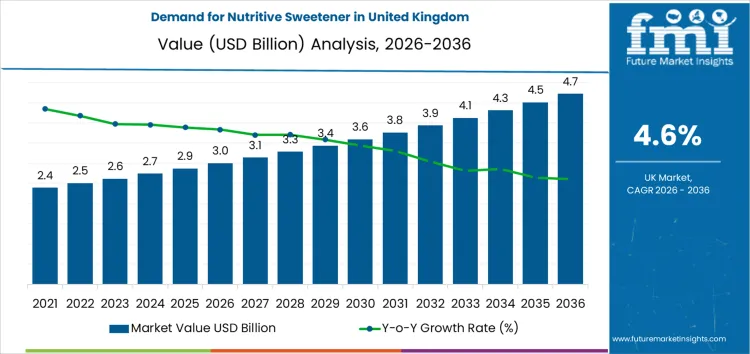
The nutritive sweetener market in the United Kingdom is projected to grow from USD 3 billion in 2026 to USD 4.7 billion by 2036, at a CAGR of 4.6%. This market occupies a significant position within the broader food and beverage industry, influencing product formulations and consumer choices across various sectors, including processed foods, beverages, and dietary supplements. Nutritive sweeteners play a pivotal role in providing functional sweetness with nutritional benefits, catering to the growing demand for healthier, lower-calorie alternatives.
Despite being a relatively niche segment, its competitive weight is increasing as consumer awareness of health and wellness drives innovation. Companies within this space are facing growing pressure to adapt to changing dietary trends, as well as tightening regulations on sugar content. The industry is moderately competitive, with both established players and new entrants striving to capture market share by offering differentiated products that meet evolving consumer demands for taste and health benefits.
Quick Stats for the Demand for Nutritive Sweetener in United Kingdom
- Nutritive Sweetener in United Kingdom Value (2026): USD 3 billion
- Nutritive Sweetener in United Kingdom Forecast Value (2036): USD 4.7 billion
- Nutritive Sweetener in United Kingdom Forecast CAGR (2026 to 2036): 4.6%
- Nutritive Sweetener in United Kingdom Leading Segment: Conventional (90% share)
- Key Growth Regions of Nutritive Sweetener in United Kingdom: England
- Top Players of Nutritive Sweetener in United Kingdom: Tate & Lyle, Cargill Inc., Archer Daniels Midland, Ingredion Incorporated, Roquette
What is the Growth Forecast for Nutritive Sweetener in United Kingdom through 2036?
The demand for nutritive sweeteners in the United Kingdom is expected to rise from USD 3 billion in 2026 to USD 4.7 billion by 2036, reflecting a compound annual growth rate (CAGR) of 4.6%. Between 2026 and 2031, the industry will experience steady growth, increasing from USD 3 billion to USD 3.8 billion. From 2031 to 2036, the demand will continue to rise, reaching USD 4.7 billion by the end of the forecast period.
The early vs. late growth curve comparison indicates that the industry will witness a more pronounced acceleration in the early years of the forecast period, from 2026 to 2031, as the food and beverage industry increasingly incorporates nutritive sweeteners into new product lines. The pace of growth will moderate slightly after 2031, as the industry reaches a more mature phase, reflecting a steady but sustainable demand for these sweeteners as consumer trends stabilize and product innovation slows.
Key Takeaways for Demand for Nutritive Sweetener in United Kingdom
| Metric | Value |
|---|---|
| Industry Sales Value (2026) | USD 3 billion |
| Industry Forecast Value (2036) | USD 4.7 billion |
| Industry Forecast CAGR (2026 to 2036) | 4.6% |
Why is Demand for Nutritive Sweetener in United Kingdom Growing?
Demand for nutritive sweetener in the United Kingdom has increased from historical levels as consumer preferences and food industry practices changed. Historically, nutritive sweeteners such as sucrose and fructose were widely used in bakery, confectionery, and beverage products where traditional sugar provided sweetness and functional properties like texture and preservation. Over recent years, the UK food and beverage sector experienced shifts toward clean label formulations and ingredient simplification, prompting manufacturers to explore nutritive alternatives that align with consumer expectations for transparency and perceived naturalness.
Retailers and brand owners expanded product portfolios that include ingredients like sugar alcohols and certain plant derived sweeteners that still provide caloric sweetness while meeting cleaner labelling goals. This repositioning was supported by rising awareness of nutrition and ingredient sourcing among UK consumers, which encouraged food producers to invest in ingredient solutions that balance sweetness with consumer perception of quality. Such developments anchored growth in the nutritive sweetener segment by linking traditional caloric sweetening approaches with evolving formulation strategies.
Looking ahead, demand for nutritive sweetener in the United Kingdom is expected to continue progressing as food industry responses to health trends and regulatory influences shape product formulation. Clean label reformulation programs and increased use of natural ingredient alternatives are projected to sustain expansion of nutritive sweetener use across multiple categories. Growth rates are expected to be supported by sustained consumer interest in products that balance sweetness with recognizable ingredients, particularly in segments such as beverages, bakery, and confectionery where taste remains a priority. In addition, broader sugar reduction initiatives and public health emphasis on reducing excess sugar consumption will influence how manufacturers source and deploy nutritive sweeteners within recipes. As food producers innovate with ingredient blends that combine functionality, taste, and simpler labelling, the role of nutritive sweeteners in UK product formulations is likely to remain significant.
What Are the Key Segments in the Demand for Nutritive Sweetener in the United Kingdom?
Demand for nutritive sweeteners in the United Kingdom is driven by nature and distribution channel. Conventional sweeteners lead the nature segment with 90% of the industry share, while indirect sales dominate the distribution channel segment at 50%. Other distribution channels, such as direct sales, store-based retailing, hypermarkets, supermarkets, convenience stores, and discount stores, also contribute to the industry. These trends reflect consumer preferences and the increasing demand for sweeteners in food and beverage products across various retail formats.
What Is the Nature Segment of Demand for Nutritive Sweetener in the United Kingdom?
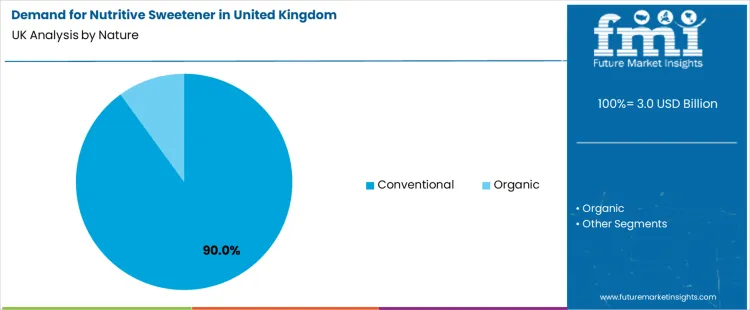
The nature segment for nutritive sweeteners in the United Kingdom is primarily led by conventional sweeteners, which capture 90% of the industry share. Conventional sweeteners, such as sucrose, glucose, and high-fructose corn syrup, continue to dominate the industry due to their cost-effectiveness, widespread availability, and well-established usage in food and beverage products. These sweeteners are favored by manufacturers for their ability to provide consistent sweetness and functionality in a wide variety of applications, including baked goods, beverages, sauces, and confectionery. Conventional sweeteners also benefit from being produced at scale, which helps maintain their position as the most economical option for large-scale food production.
Organic sweeteners, while accounting for a smaller portion of the industry, are gaining traction due to the increasing consumer preference for organic and clean-label products. Organic sweeteners, such as organic cane sugar, maple syrup, and agave nectar, are marketed as healthier alternatives and are especially popular among consumers who prioritize natural and sustainable ingredients. Despite the growing interest in organic options, the demand for conventional sweeteners remains strong, driven by their affordability and widespread use across industries. The trend toward organic sweeteners reflects broader consumer shifts toward health-conscious choices, but conventional sweeteners remain dominant in the UK market.
What Is the Distribution Channel Segment of Demand for Nutritive Sweetener in the United Kingdom?
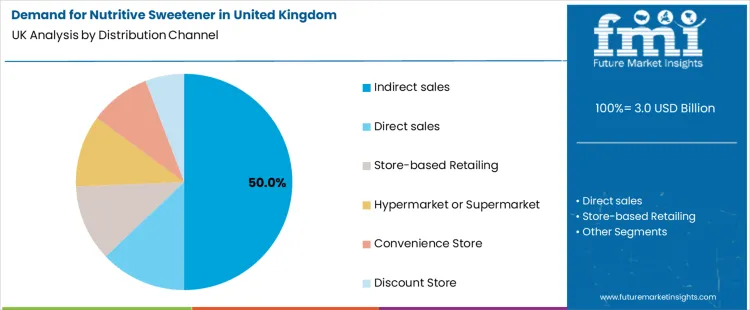
The distribution channel segment for nutritive sweeteners in the United Kingdom is predominantly led by indirect sales, which account for 50% of the industry share. Indirect sales involve wholesalers, distributors, and suppliers that provide sweeteners to food manufacturers, retailers, and foodservice providers. This channel is crucial for ensuring the steady supply of sweeteners to large-scale producers of packaged food and beverages, where cost-efficiency and bulk purchasing are key factors. Indirect sales are favored by businesses looking to secure large quantities of sweeteners at competitive prices. Direct sales follow as another important channel, particularly for manufacturers who sell sweeteners directly to large-scale clients or specialized sectors. Direct sales allow for more tailored agreements and relationships with customers, offering advantages in terms of price negotiation and logistics.
Store-based retailing, which includes hypermarkets, supermarkets, convenience stores, and discount stores, represents a significant portion of the industry, catering to individual consumers who purchase sweeteners for home use. Hypermarkets and supermarkets dominate this retail space, providing a wide range of sweetener products to meet varying consumer preferences. Convenience stores and discount stores, while smaller in share, cater to consumers seeking quick, accessible options at lower prices. The diverse range of distribution channels reflects the broad use of nutritive sweeteners across various sectors, from large-scale manufacturing to individual consumer purchases, driven by both price sensitivity and increasing demand for healthier alternatives.
What is the Demand for Nutritive Sweetener in the United Kingdom?
Demand for nutritive sweeteners in the United Kingdom is shaped by consumption of sugar and alternative caloric sweeteners in food and beverage products. Nutritive sweeteners include sucrose, glucose, fructose, high fructose syrups, and certain sugar alcohols that provide energy and sweetening functionality. Food manufacturers use these ingredients in confectionery, bakery, dairy, beverages, and processed foods to meet taste and formulation requirements. Consumer purchase patterns, seasonal demand for sweet products, and reformulation practices influence volume uptake. Demand reflects a balance between traditional sugar use and reformulation efforts that consider health guidance without eliminating sweetening roles.
What are the Key Drivers for Nutritive Sweetener Demand in the United Kingdom?
Several factors drive demand for nutritive sweeteners in the United Kingdom. Established consumption habits for sweetened products sustain baseline utilization in foods and beverages. Product formulations that require specific functional properties, such as bulk, mouthfeel, and browning in baked goods, support continued use of caloric sweeteners. The beverage sector’s demand for palatability in soft drinks, juices, and flavoured drinks contributes significantly. Pricing and supply reliability of sugar and alternative sweetening carbohydrates influence procurement decisions by manufacturers. Consumer segments that prioritise taste and energy content in products, including indulgence and comfort foods, reinforce demand dynamics in the industry.
What are the Restraints on Nutritive Sweetener Demand in the United Kingdom?
Despite ongoing use, demand for nutritive sweeteners in the United Kingdom faces restraints. Public health recommendations that encourage reduced sugar intake to address obesity and metabolic disease influence product reformulation away from traditional caloric sweeteners. Retailer and food service commitments to lower added sugar content in product lines can reduce reliance on nutritive sweeteners. Price volatility in global sugar markets affects cost structures for manufacturers and may suppress volume purchases when alternative ingredients are available. Consumer shifts toward lower calorie or zero calorie sweetening options constrain growth in segments where caloric reduction is a priority. Regulatory labelling requirements that highlight sugar content also impact product positioning and formulation strategy.
What are the Key Trends in Nutritive Sweetener Demand in the United Kingdom?
Key trends in the United Kingdom’s nutritive sweetener demand include incremental reformulation that blends caloric sweeteners with reduced calorie alternatives to maintain taste while lowering total sugar. Development of ingredient systems that provide bulk and sweetness with lower glycaemic impact reflects innovation in formulation science. Food manufacturers are adjusting recipes to align with voluntary sugar reduction targets while retaining consumer acceptance. Demand patterns also show segmentation by product category, with some traditional products maintaining higher sugar content due to consumer expectations. Industry interest in sustainably sourced sweeteners and transparency in ingredient origin supports procurement decisions in supply chains.
What is the Country-Wise Demand for Nutritive Sweeteners in the United Kingdom?
The country-wise demand for nutritive sweeteners in the United Kingdom shows varying levels of adoption across its regions. England leads the industry, driven by its large food, beverage, and pharmaceutical sectors, where nutritive sweeteners are increasingly used as healthier alternatives to sugar. Scotland, Wales, and Northern Ireland also exhibit strong demand, fueled by the growing focus on healthier lifestyles, low-calorie foods, and the shift towards functional ingredients. As consumer awareness about sugar's impact on health rises, the demand for nutritive sweeteners is expected to grow across all regions. England remains the dominant market, but steady growth is anticipated in other regions as health-conscious consumers drive demand for sweetener alternatives.
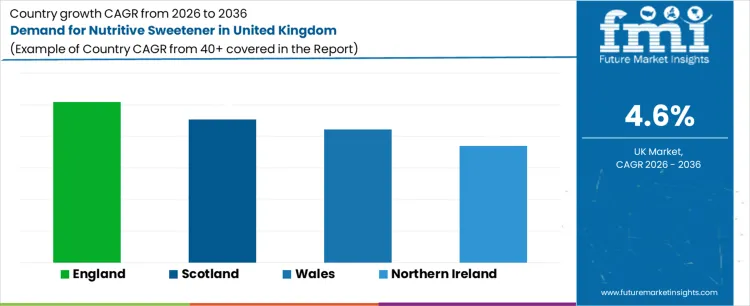
| Country | CAGR (2026 to 2036) |
|---|---|
| England | 5.1% |
| Scotland | 4.5% |
| Wales | 4.2% |
| Northern Ireland | 3.7% |
What is Driving the Demand for Nutritive Sweeteners in England?
The demand for nutritive sweeteners in England is projected to grow at a CAGR of 5.1% from 2026 to 2036. England’s large and diverse food, beverage, and pharmaceutical sectors are the key drivers of this demand. As consumers become more health-conscious and aware of the negative impacts of excessive sugar consumption, the demand for sugar alternatives like nutritive sweeteners is on the rise. Nutritive sweeteners are gaining popularity in the production of low-calorie and sugar-free food and beverages, especially in the soft drink and confectionery industries. Additionally, the growing focus on functional ingredients and the health benefits they offer is further driving the adoption of nutritive sweeteners. Government initiatives to reduce sugar intake, coupled with the increasing prevalence of diabetes and obesity, are expected to continue fueling demand for these sweeteners in England over the next decade.
How is the Demand for Nutritive Sweeteners Performing in Scotland?
In Scotland, the demand for nutritive sweeteners is expected to grow at a CAGR of 4.5% from 2026 to 2036. The growing awareness of the health risks associated with excessive sugar consumption is a key factor driving the demand for nutritive sweeteners in Scotland. As Scottish consumers become more focused on reducing their sugar intake and improving their overall health, the demand for healthier sweetening alternatives is increasing. Nutritive sweeteners, which provide fewer calories than sugar while maintaining a similar taste, are becoming more widely used in the food and beverage industries. Scotland’s food processing industry is also incorporating these sweeteners into a variety of products, including drinks, snacks, and baked goods. As the region continues to embrace healthier lifestyles, the adoption of nutritive sweeteners is expected to rise steadily, contributing to continued market growth.
What Are the Growth Drivers for Nutritive Sweeteners in Wales?
The demand for nutritive sweeteners in Wales is projected to grow at a CAGR of 4.2% through 2036. Similar to other regions, the growing focus on reducing sugar intake and the increasing demand for healthier food and beverages are driving the adoption of nutritive sweeteners in Wales. As consumers become more health-conscious, the demand for low-calorie, sugar-free, and functional foods continues to rise. Nutritive sweeteners are particularly popular in the production of beverages and packaged food products, where they serve as healthier alternatives to traditional sugars. Additionally, Wales’ growing commitment to sustainability and healthier eating habits is contributing to the rise in demand for sweeteners made from natural sources. As the industry for functional foods expands, the demand for nutritive sweeteners in Wales is expected to increase, driven by both consumer trends and industry needs.
What is the Outlook for Nutritive Sweeteners Demand in Northern Ireland?
Northern Ireland’s demand for nutritive sweeteners is expected to grow at a CAGR of 3.7% from 2026 to 2036. While Northern Ireland represents the smallest market in the United Kingdom, the demand for nutritive sweeteners is steadily increasing. As health concerns related to sugar consumption continue to rise, more consumers in Northern Ireland are turning to sweetener alternatives in their food and beverages. The growing demand for low-calorie and sugar-free products in the food and beverage industries is contributing to the increase in demand for nutritive sweeteners. Additionally, the rise of functional foods, where nutritive sweeteners are used to enhance taste without compromising nutritional benefits, is helping to drive this market. Although the industry size is smaller compared to other regions, the growing focus on healthier lifestyles and sugar reduction initiatives ensures continued growth in the demand for nutritive sweeteners in Northern Ireland.
What is the Competitive Landscape for Demand for Nutritive Sweetener in the United Kingdom?
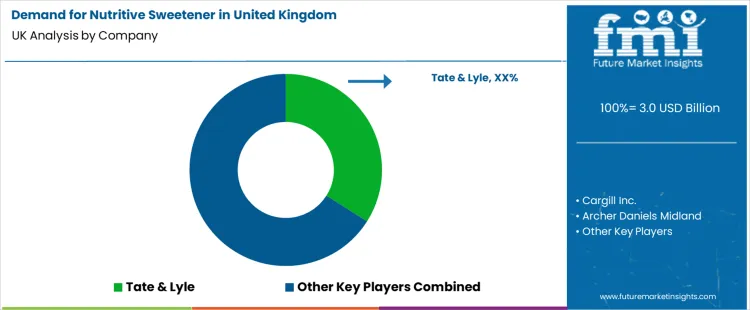
Demand for nutritive sweetener in the United Kingdom is driven by food and beverage formulation, confectionery production, bakery products, and beverage manufacturing. Procurement teams specify sweeteners based on sweetness intensity, solubility, caloric contribution, and processing stability. Tate & Lyle is positioned as a leading supplier, with product brochures that detail sugar and syrup grades, documented sweetness profiles, and recommended use rates in finished products. Technical sheets from Tate & Lyle are referenced by formulation scientists and buyers to match ingredient performance with processing conditions. Cargill Inc. competes with ranges of nutritive sweeteners supported by documented attributes that include viscosity data for syrups, sugar crystal distributions, and handling guidelines. Decision makers in the United Kingdom refer to Cargill’s materials when aligning supplier offerings with manufacturing requirements.
Archer Daniels Midland’s documented portfolio includes sweeteners produced for bulk and specialty food segments, with brochures listing nutrient content values, particle size ranges, and documented compliance with quality standards. Ingredion Incorporated supplies nutritive sweetening solutions with technical literature focused on functional performance, documented solubility curves, and recommended storage conditions. Roquette participates with ingredient systems that are supported by specification material describing crystallization behavior, sweetness equivalence charts, and stability under heat and shear. Procurement cycles in the United Kingdom are influenced by production schedules and product launch timelines that require documented nutrient data and documented performance under defined processing environments.
Buyers compare documented supplier materials to ensure alignment with quality standards, regulatory requirements, and finished product specifications. Lead times, supply reliability, and documented handling instructions are outlined in official brochures and technical guides, forming part of tender evaluations and contractual agreements. Technical teams consult detailed specifications to reconcile ingredient selection with formulation targets, anchoring decisions in measurable material attributes rather than subjective criteria. Competitive activity is grounded in documented product data and documented supply terms provided by key nutritive sweetener suppliers.
Key Players of the Demand for Nutritive Sweetener in United Kingdom
- Tate & Lyle
- Cargill Inc.
- Archer Daniels Midland
- Ingredion Incorporated
- Roquette
Scope of the Report
| Items | Values |
|---|---|
| Quantitative Units (2026) | USD Billion |
| Product Type | Fructose, Sucrose, Corn Sugar, Honey, High Fructose Corn Syrup |
| Nature | Conventional, Organic |
| End Use | Food Processing, Household or Retail, Bakery, Confectionery, Beverages, Pharmaceuticals |
| Distribution Channel | Indirect Sales, Direct Sales, Store-based Retailing, Hypermarket or Supermarket, Convenience Store, Discount Store |
| Companies | Tate & Lyle, Cargill Inc., Archer Daniels Midland, Ingredion Incorporated, Roquette |
| Regions Covered | United Kingdom |
| Countries Covered | England, Scotland, Wales, Northern Ireland |
| Additional Attributes | Dollar by sales by product type, nature, end use, and distribution channel. Includes market trends towards healthier sweetener options, cost-effectiveness, and the role of nutritive sweeteners in various food and beverage applications. |
Demand for Nutritive Sweetener in United Kingdom
Product Type
- Fructose
- Sucrose
- Corn Sugar
- Honey
- High Fructose Corn Syrup
Nature
- Conventional
- Organic
End Use
- Food Processing
- Household or Retail
- Bakery
- Confectionery
- Beverages
- Pharmaceuticals
Distribution Channel
- Indirect sales
- Direct sales
- Store-based Retailing
- Hypermarket or Supermarket
- Convenience Store
- Discount Store
Countries
- England
- Scotland
- Wales
- Northern Ireland
Bibliography
- House of Lords Library. (2024, May 21). Eating less sugar: Reformulating food and drink products and government policy. House of Lords Library.
- Office for Health Improvement and Disparities. (2025, July 9). Sugar, salt and calorie reduction and reformulation. Department of Health and Social Care.
- Office for National Statistics. (2025, December 17). CPI weights 01: Food and non-alcoholic beverages (Series ID: CHZR). Office for National Statistics.
Frequently Asked Questions
How big is the demand for nutritive sweetener in United Kingdom in 2026?
The demand for nutritive sweetener in United Kingdom is estimated to be valued at USD 3.0 billion in 2026.
What will be the size of nutritive sweetener in United Kingdom in 2036?
The market size for the nutritive sweetener in United Kingdom is projected to reach USD 4.7 billion by 2036.
How much will be the demand for nutritive sweetener in United Kingdom growth between 2026 and 2036?
The demand for nutritive sweetener in United Kingdom is expected to grow at a 4.6% CAGR between 2026 and 2036.
What are the key product types in the nutritive sweetener in United Kingdom?
The key product types in nutritive sweetener in United Kingdom are fructose, sucrose, corn sugar, honey and high fructose corn syrup.
Which nature segment is expected to contribute significant share in the nutritive sweetener in United Kingdom in 2026?
In terms of nature, conventional segment is expected to command 90.0% share in the nutritive sweetener in United Kingdom in 2026.
Preview the report firsthand - request a free sample
Get SampleGet the brochure for pricing and purchase details.
Get PDFTable of Content
- Executive Summary
- UK Market Outlook
- Demand-side Trends
- Supply-side Trends
- Technology Roadmap Analysis
- Analysis and Recommendations
- Market Overview
- Market Coverage / Taxonomy
- Market Definition / Scope / Limitations
- Market Background
- Market Dynamics
- Drivers
- Restraints
- Opportunity
- Trends
- Scenario Forecast
- Demand in Optimistic Scenario
- Demand in Likely Scenario
- Demand in Conservative Scenario
- Opportunity Map Analysis
- Product Life Cycle Analysis
- Supply Chain Analysis
- Investment Feasibility Matrix
- Value Chain Analysis
- PESTLE and Porter’s Analysis
- Regulatory Landscape
- Regional Parent Market Outlook
- Production and Consumption Statistics
- Import and Export Statistics
- Market Dynamics
- UK Market Analysis 2021 to 2025 and Forecast, 2026 to 2036
- Historical Market Size Value (USD Million) Analysis, 2021 to 2025
- Current and Future Market Size Value (USD Million) Projections, 2026 to 2036
- Y-o-Y Growth Trend Analysis
- Absolute $ Opportunity Analysis
- UK Market Pricing Analysis 2021 to 2025 and Forecast 2026 to 2036
- UK Market Analysis 2021 to 2025 and Forecast 2026 to 2036, By Product Type
- Introduction / Key Findings
- Historical Market Size Value (USD Million) Analysis By Product Type , 2021 to 2025
- Current and Future Market Size Value (USD Million) Analysis and Forecast By Product Type , 2026 to 2036
- Fructose
- Sucrose
- Corn Sugar
- Honey
- High Fructose Corn Syrup
- Fructose
- Y-o-Y Growth Trend Analysis By Product Type , 2021 to 2025
- Absolute $ Opportunity Analysis By Product Type , 2026 to 2036
- UK Market Analysis 2021 to 2025 and Forecast 2026 to 2036, By Nature
- Introduction / Key Findings
- Historical Market Size Value (USD Million) Analysis By Nature, 2021 to 2025
- Current and Future Market Size Value (USD Million) Analysis and Forecast By Nature, 2026 to 2036
- Conventional
- Organic
- Conventional
- Y-o-Y Growth Trend Analysis By Nature, 2021 to 2025
- Absolute $ Opportunity Analysis By Nature, 2026 to 2036
- UK Market Analysis 2021 to 2025 and Forecast 2026 to 2036, By End Use
- Introduction / Key Findings
- Historical Market Size Value (USD Million) Analysis By End Use, 2021 to 2025
- Current and Future Market Size Value (USD Million) Analysis and Forecast By End Use, 2026 to 2036
- Food Processing
- Household or Retail
- Bakery
- Confectionery
- Beverages
- Pharmaceuticals
- Food Processing
- Y-o-Y Growth Trend Analysis By End Use, 2021 to 2025
- Absolute $ Opportunity Analysis By End Use, 2026 to 2036
- UK Market Analysis 2021 to 2025 and Forecast 2026 to 2036, By Distribution Channel
- Introduction / Key Findings
- Historical Market Size Value (USD Million) Analysis By Distribution Channel, 2021 to 2025
- Current and Future Market Size Value (USD Million) Analysis and Forecast By Distribution Channel, 2026 to 2036
- Indirect sales
- Direct sales
- Store-based Retailing
- Hypermarket or Supermarket
- Convenience Store
- Discount Store
- Indirect sales
- Y-o-Y Growth Trend Analysis By Distribution Channel, 2021 to 2025
- Absolute $ Opportunity Analysis By Distribution Channel, 2026 to 2036
- Market Structure Analysis
- Competition Dashboard
- Competition Benchmarking
- Market Share Analysis of Top Players
- By Regional
- By Product Type
- By Nature
- By End Use
- By Distribution Channel
- Competition Analysis
- Competition Deep Dive
- Tate & Lyle
- Overview
- Product Portfolio
- Profitability by Market Segments (Product/Age /Sales Channel/Region)
- Sales Footprint
- Strategy Overview
- Marketing Strategy
- Product Strategy
- Channel Strategy
- Cargill Inc.
- Archer Daniels Midland
- Ingredion Incorporated
- Roquette
- Tate & Lyle
- Competition Deep Dive
- Assumptions & Acronyms Used
- Research Methodology


