

- Industry Size (2026)
- USD 574.3 Mn
- Forecast (2036)
- USD 1192.4 Mn
- CAGR (2026 to 2036)
- 7.6%
Demand for Plant Derived Analgesics in United Kingdom Forecast and Outlook 2026 to 2036
The plant derived analgesics market in the United Kingdom is expected to grow from USD 574.3 million in 2026 to USD 1,192.4 million by 2036, at a CAGR of 7.6%. Commercial realities in this market require companies to navigate a challenging landscape of pricing discipline, buyer leverage, and volume predictability. As consumer demand for natural alternatives increases, competition in the segment is likely to intensify, putting pressure on pricing strategies. Larger buyers, such as pharmacies and health retailers, may gain greater leverage, demanding lower prices or more favorable terms. Volume predictability remains a concern, as market fluctuations driven by seasonal factors or shifts in consumer preferences can impact long-term forecasts. Suppliers must balance the need for competitive pricing with the increasing demand for high-quality, effective products. Market participants that can maintain consistent quality, manage supply chain risks, and deliver cost-effective solutions will likely position themselves for sustainable growth.
Quick Stats for the Demand for Plant Derived Analgesics in United Kingdom
- Plant Derived Analgesics in United Kingdom Value (2026): USD 574.3 million
- Plant Derived Analgesics in United Kingdom Forecast Value (2036): USD 1,192.4 million
- Plant Derived Analgesics in United Kingdom Forecast CAGR (2026 to 2036): 7.6%
- Plant Derived Analgesics in United Kingdom Leading Segment: Tablets (40.4% share)
- Key Growth Regions of Plant Derived Analgesics in United Kingdom: England
- Top Players of Plant Derived Analgesics in United Kingdom: Pfizer Inc., Mallinckrodt Pharmaceuticals, Teva Pharmaceuticals, Johnson & Johnson, NOW® Foods
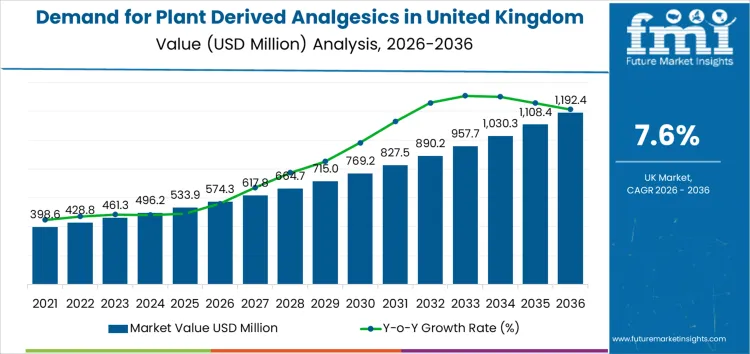
What is the Growth Forecast for Plant Derived Analgesics in United Kingdom through 2036?
Demand for plant-derived analgesics in the United Kingdom is expected to grow strongly throughout the forecast period, supported by rising consumer preference for natural, wellness-oriented pain relief options. Wider adoption is being driven by increasing awareness of botanical ingredients, growing trust in plant-based formulations, and stronger retail and online availability across OTC and wellness channels. As consumers become more cautious about long-term use of conventional painkillers, interest in natural alternatives continues to expand across age groups and lifestyle segments.
Breakpoint analysis suggests the segment will move through a clear acceleration phase during the middle of the forecast period. Early growth is expected to come from gradual adoption and repeat purchases among health-conscious consumers. As awareness deepens and product ranges broaden, momentum strengthens further, supported by improved product positioning, better clinical communication, and continued innovation in herbal extracts and blends. In the later years, plant-derived analgesics are expected to transition from niche wellness products into more mainstream pain management choices, enabling faster and more sustained demand expansion across the UK.
Key Takeaways for Demand for Plant Derived Analgesics in United Kingdom
| Metric | Value |
|---|---|
| Industry Sales Value (2026) | USD 574.3 million |
| Industry Forecast Value (2036) | USD 1,192.4 million |
| Industry Forecast CAGR (2026 to 2036) | 7.6% |
Why is Demand for Plant Derived Analgesics in United Kingdom Growing?
Demand for plant derived analgesics in the United Kingdom has risen as healthcare providers, formulators, and consumers explore alternatives to traditional synthetic pain relief agents. Historically, herbal and botanical remedies played a supplementary role in pain management, often confined to niche markets or complementary medicine practices. Over recent years, UK pharmaceutical firms and natural product manufacturers expanded use of plant derived analgesic ingredients such as willow bark derived salicin and certain essential oil extracts that exhibit pain modulating properties. These ingredients found application in topical gels, balms, and consumer wellness products where manufacturers sought formulations perceived as gentler by end users. Retailers and healthcare practitioners observed that products featuring recognisable botanical sources resonated with segments of the population seeking options with profiles that differ from conventional non steroidal anti inflammatory drugs. Ingredient sourcing teams adjusted procurement strategies to secure reliable plant extract supplies that meet regulatory standards for purity and consistency, supporting integration into broader product lines.
Looking ahead, demand for plant derived analgesics in the United Kingdom is expected to continue increasing as industry participants refine product positioning and meet evolving regulatory and consumer expectations. Growth will be influenced by research and clinical interest in botanically sourced pain relief mechanisms that can complement or, in certain contexts, reduce reliance on synthetic analgesics. Companies targeting the over the counter and natural health product markets will assess plant derived analgesic ingredients based on evidence of efficacy, standardisation of bioactive compounds, and supply chain transparency. Retail channels including health focused outlets and pharmacies will shape demand patterns based on consumer education and product availability. Suppliers that can provide consistent quality, traceability, and regulatory compliance documentation for botanical actives will be better positioned to support UK manufacturers. Continued attention to formulation science, safety profiling, and clear labelling will influence how plant derived analgesics are adopted in mainstream and niche segments of pain management.
What Are the Key Segments in the Demand for Plant-Derived Analgesics in the United Kingdom?
Demand for plant-derived analgesics in the United Kingdom is shaped by product type and formulation type. Morphine leads the product type segment with 28%, while tablets dominate the formulation type segment with 40.4%. Other product types such as codeine, salicin, cannabinoids (CBD), and curcumin, along with various formulations like capsules, creams, injectable forms, and oils, also contribute significantly. These segments reflect the growing interest in plant-based pain relief options, driven by both the increasing demand for natural remedies and the expanding availability of plant-derived analgesics across different formats.
What Is the Product Type Segment of Demand for Plant-Derived Analgesics in the United Kingdom?
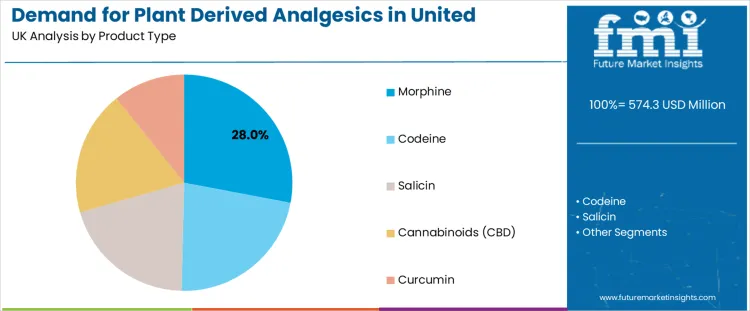
The product type segment for plant-derived analgesics in the United Kingdom is predominantly led by morphine, which accounts for 28% of the industry share. Morphine, although traditionally derived from the opium poppy, is widely used for its potent pain-relieving properties. Its use continues to be prevalent in both acute and chronic pain management, particularly in clinical settings where severe pain relief is needed, such as post-surgery recovery and cancer care. Despite the focus on more natural alternatives, morphine remains a critical component of analgesic treatment due to its well-documented efficacy and availability in various formulations, including injectable and oral forms.
Codeine follows as another major product type, primarily used for its mild to moderate pain-relieving properties. Codeine is commonly found in combination with other medications, such as paracetamol, and is available in oral formulations, making it a preferred choice for managing moderate pain in both prescription and over-the-counter markets. Salicin, a naturally occurring compound in willow bark, is gaining traction as a plant-derived analgesic due to its anti-inflammatory and pain-relieving effects. It is often used in herbal and alternative medicine markets, though its share of the overall analgesic market remains smaller compared to opioids like morphine. Cannabinoids (CBD) and curcumin are emerging as promising natural alternatives in the pain management market. CBD, particularly in the form of oils and creams, is widely used for its potential anti-inflammatory and analgesic effects, while curcumin, derived from turmeric, is gaining popularity for its natural anti-inflammatory properties. As consumer preference shifts toward natural and plant-based remedies, the demand for these products is expected to grow, driven by increased awareness of their potential health benefits.
What Is the Formulation Type Segment of Demand for Plant-Derived Analgesics in the United Kingdom?
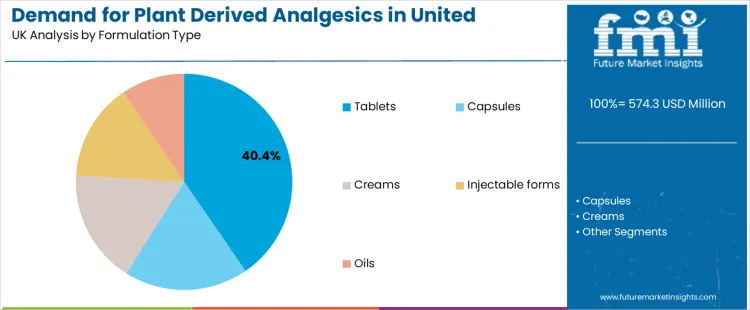
The formulation type segment for plant-derived analgesics in the United Kingdom is primarily dominated by tablets, which account for 40.4% of the industry share. Tablets are the most commonly used formulation for analgesics, offering convenience, ease of administration, and precise dosing. This format is particularly popular for products like codeine, salicin, and morphine, where regular and consistent pain management is required. Tablets also benefit from their long shelf life, portability, and widespread acceptance, making them a preferred option for consumers and healthcare providers. Capsules follow as another significant segment, offering a similar benefit to tablets but often with the advantage of easier digestion and slower-release formulations. Capsules are commonly used for codeine, curcumin, and cannabinoids (CBD), where controlled release of the active ingredients can improve effectiveness and minimize side effects.
Creams and oils, while representing a smaller share, are growing in popularity due to their ability to provide targeted relief for localized pain. Creams, often containing cannabinoids or curcumin, are widely used for conditions such as joint pain or muscle soreness, where direct application to the skin can offer more immediate relief. Oils, especially those containing CBD or curcumin, are also used both topically and orally, with the flexibility of application methods contributing to their increasing use. Injectable forms of analgesics, though the smallest segment, continue to be used in clinical settings for fast, effective pain relief, particularly for products like morphine. The demand for different formulations reflects the diverse preferences and needs of consumers and healthcare providers, with tablets remaining the dominant choice due to their practicality, followed by a growing interest in topical and alternative formulations. As the trend toward plant-derived and natural pain relief solutions continues, the variety of available formulations is expected to expand, offering more options to address both systemic and localized pain management.
What are the Key Dynamics in the Demand for Plant Derived Analgesics in the United Kingdom?
Demand for plant derived analgesics in the United Kingdom is influenced by shifting healthcare preferences toward natural origin products, regulatory landscapes for herbal medicines, and consumer concern about opioid side effects. Plant derived analgesics include compounds extracted from sources such as willow bark (salicin), devil’s claw (harpagoside), turmeric (curcumin), and other botanicals with pain relief properties. Procurement patterns respond to product positioning in pharmacies, wellness retailers, and online platforms. Healthcare professionals and consumers alike weigh perceived safety, clinical evidence, and formulation quality when selecting botanical analgesic solutions. Overall demand is shaped by prevention oriented health behaviours, self care trends, and integration into multi modal pain management strategies.
What are the Key Drivers for Plant Derived Analgesics Demand in the United Kingdom?
Several factors are driving demand for plant derived analgesics in the United Kingdom. Consumer awareness of side effects associated with synthetic painkillers and long term NSAID use motivates interest in alternatives with natural labels. Growth in the nutraceutical, functional food, and supplement markets creates retail and institutional channels for botanically sourced analgesic formulations. Healthcare practitioners and integrative medicine proponents increasingly recommend herbal options for mild to moderate pain management, reinforcing professional endorsement. Market entry of scientifically substantiated extracts with standardised active content improves supplier credibility and supports broader adoption. Online retail expansion and direct to consumer education resources make it easier for buyers to discover and source these products.
What are the Restraints on Plant Derived Analgesics Demand in the United Kingdom?
Despite interest, the industry for plant derived analgesics in the United Kingdom faces several constraints. Regulatory frameworks governing herbal medicines and food supplements require compliance with safety, quality, and labelling standards that can be resource intensive for manufacturers and smaller suppliers. Variation in clinical evidence supporting efficacy across different botanicals creates uncertainty among healthcare providers and consumers, slowing mainstream adoption in formal medical settings. Price competition from established synthetic analgesics and branded OTC painkillers can limit market penetration, particularly where natural alternatives are positioned at premium price points. Consumer hesitation based on perceived lower potency or slower onset of action may also temper demand.
What are the Key Trends in Plant Derived Analgesics Demand in the United Kingdom?
Key trends influencing demand for plant derived analgesics in the United Kingdom include increased investment in standardised extract development and evidence generation to support health claims. Suppliers are focusing on traceability and authenticated sourcing of botanicals to meet retailer and regulatory requirements for quality assurance. Formulation innovation is evident in delivery formats such as capsules, tinctures, topical gels, and functional beverages that appeal to diverse consumer needs and usage occasions. Collaboration between botanical ingredient specialists, pain management clinicians, and research institutions is helping to bridge gaps in clinical data and expand product credibility. Sustainability in supply chains and ethical sourcing practices are also becoming differentiators for buyers and brands in the competitive botanical analgesic landscape.
What is the Country-Wise Demand for Plant-Derived Analgesics in the United Kingdom?
The country-wise demand for plant-derived analgesics in the United Kingdom shows significant regional variation, with England leading the industry. The growing interest in natural and alternative pain relief solutions is driving the demand for plant-derived analgesics, particularly among consumers seeking herbal, plant-based, and non-pharmaceutical remedies. England’s large healthcare and wellness sectors, coupled with increasing consumer preference for natural ingredients, are key factors contributing to the high demand. Scotland, Wales, and Northern Ireland follow with steady growth, supported by rising awareness of the benefits of plant-based analgesics and the growing popularity of holistic health practices. As the shift toward sustainable and natural pain relief options continues, demand for plant-derived analgesics is expected to grow across all regions, with England remaining the dominant market due to its larger population and healthcare infrastructure.
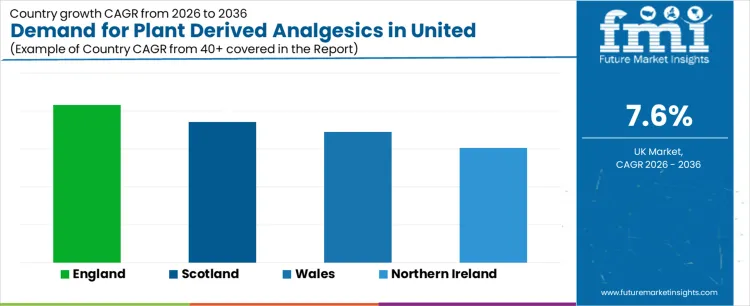
| Country | CAGR (2026 to 2036) |
|---|---|
| England | 8.3% |
| Scotland | 7.4% |
| Wales | 6.9% |
| Northern Ireland | 6.1% |
What is Driving the Demand for Plant-Derived Analgesics in England?
The demand for plant-derived analgesics in England is projected to grow at a CAGR of 8.3% from 2026 to 2036. England’s demand is primarily driven by the increasing consumer focus on natural and holistic health practices. As people become more conscious of the side effects associated with synthetic painkillers, plant-derived alternatives are gaining popularity. Analgesics derived from plants such as turmeric, ginger, and cannabidiol (CBD) are becoming increasingly favored for their perceived safety, effectiveness, and fewer side effects. England’s robust healthcare system, alongside the growing wellness industry, is further contributing to the rise in demand. The expanding availability of plant-based analgesics through pharmacies, health stores, and online platforms ensures widespread access for consumers. Additionally, the growing trend toward sustainability and environmentally friendly products is supporting the shift toward plant-derived analgesics in both retail and healthcare sectors.
How is the Demand for Plant-Derived Analgesics Performing in Scotland?
In Scotland, the demand for plant-derived analgesics is expected to grow at a CAGR of 7.4% from 2026 to 2036. As Scottish consumers increasingly prioritize health and wellness, plant-based pain relief products are seeing rising adoption. The growing awareness of the benefits of natural remedies, particularly in managing chronic pain and inflammation, is driving this demand. Products like CBD oil, turmeric-based supplements, and arnica creams are becoming widely used in Scotland’s wellness market. Additionally, the expanding retail and e-commerce infrastructure in Scotland is making plant-derived analgesics more accessible to consumers. The Scottish healthcare sector’s growing focus on integrative and alternative medicine is contributing to this shift, with many individuals opting for plant-derived solutions over traditional pharmaceuticals. As natural health products become more mainstream, the demand for plant-derived analgesics in Scotland is set to increase steadily.
What Are the Growth Drivers for Plant-Derived Analgesics in Wales?
The demand for plant-derived analgesics in Wales is projected to grow at a CAGR of 6.9% through 2036. The increasing adoption of plant-based wellness solutions is a key driver of this growth. As more consumers in Wales turn to natural remedies for pain management, plant-derived analgesics are becoming a preferred choice. The demand is particularly strong among those seeking relief from chronic pain, arthritis, and muscle aches. The availability of plant-based options in local pharmacies and wellness stores, alongside growing awareness of their benefits, is contributing to the increased consumption of plant-derived analgesics. Furthermore, the rise of holistic health practices in Wales, with an emphasis on sustainability and natural ingredients, is driving the industry. As consumers become more informed about the safety and efficacy of plant-based pain relief, the demand for these products is expected to continue growing across Wales.
What is the Outlook for Plant-Derived Analgesics Demand in Northern Ireland?
Northern Ireland’s demand for plant-derived analgesics is expected to grow at a CAGR of 6.1% from 2026 to 2036. Although Northern Ireland represents the smallest market for plant-based analgesics in the United Kingdom, the demand is steadily increasing, driven by rising awareness of the benefits of natural pain relief solutions. The use of plant-derived analgesics, particularly CBD oil, turmeric, and other herbal remedies, is gaining traction among consumers looking for alternatives to traditional pain medications. The growth of the health and wellness sector in Northern Ireland, along with increased access to plant-based products through pharmacies and online retailers, is contributing to this trend. Additionally, as the region’s focus on sustainability and environmentally conscious products continues to grow, the adoption of plant-derived analgesics is expected to rise steadily, contributing to the overall growth of the industry in Northern Ireland.
What is the Competitive Landscape for Demand for Plant Derived Analgesics in the United Kingdom?
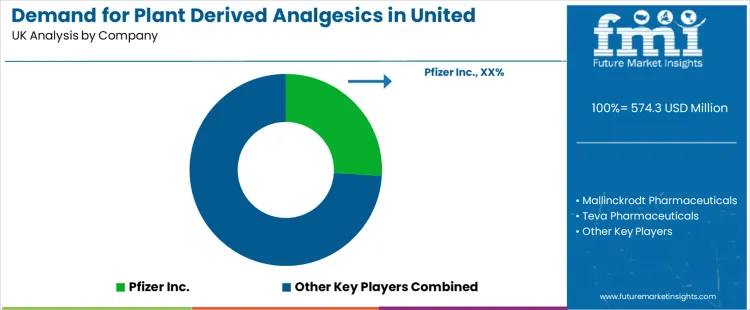
Demand for plant derived analgesics in the United Kingdom is influenced by consumer preference for botanical formulations, clinical guidance on pain management, and retail pharmacy assortment strategies. Procurement professionals evaluate ingredient provenance, documented pharmacological activity, and standardised extract specifications when aligning product selection with regulatory compliance and therapeutic expectations. Pfizer Inc. is positioned as a leading supplier with documented formulations that incorporate plant-based active compounds alongside traditional analgesic agents. Technical briefs from Pfizer describe documented efficacy data, documented formulation stability, and documented safety profiles used by healthcare procurement teams to align product choice with clinical pain management protocols. Mallinckrodt Pharmaceuticals competes with documented plant derived analgesic offerings characterised by standardised dosing and documented pharmacokinetics. Brochures supplied by Mallinckrodt list documented extraction methods, documented bioavailability figures, and documented compatibility with co-administered therapies that inform hospital and clinic purchasing decisions.
Teva Pharmaceuticals supplies botanical analgesic formulations supported by specification sheets detailing documented active ingredient concentrations, documented dissolution profiles, and documented tolerability data. Buyers in the United Kingdom review these documents when reconciling efficacy expectations with regulatory standards for over-the-counter availability. Johnson & Johnson provides documented product lines that include botanical pain relief solutions with materials outlining documented sensory profiles, documented onset of action values, and documented compliance with UK labeling requirements. NOW® Foods participates from the nutraceutical and wellness segment, offering plant derived analgesic products with technical literature that lists documented sourcing standards, documented functional test results, and documented usage guidance that assist natural health retailers and e-commerce category teams. Retail and institutional buyers compare documented performance metrics, documented stability figures, and documented supply terms during procurement cycles. Lead times, documented quality control certifications, and documented post-market support services are factored into selection criteria. Competitive activity in the UK plant derived analgesic market is grounded in measurable specifications and documented supply commitments that guide decision-making among manufacturers, healthcare procurement teams, and retail buyers.
Key Players of the Demand for Plant Derived Analgesics in United Kingdom
- Pfizer Inc.
- Mallinckrodt Pharmaceuticals
- Teva Pharmaceuticals
- Johnson & Johnson
- NOW® Foods
Scope of the Report
| Items | Values |
|---|---|
| Quantitative Units (2026) | USD Million |
| Product Type | Morphine, Codeine, Salicin, Cannabinoids (CBD), Curcumin |
| Formulation Type | Tablets, Capsules, Creams, Injectable Forms, Oils |
| Application | Chronic Pain Management, Acute Pain Relief, Post-Surgical Pain, Neuropathic Pain |
| Sales Channel | Hospitals, Clinics, Retail Sales, Online Sales, Hypermarket & Supermarket |
| Companies | Pfizer Inc., Mallinckrodt Pharmaceuticals, Teva Pharmaceuticals, Johnson & Johnson, NOW® Foods |
| Regions Covered | United Kingdom |
| Countries Covered | England, Scotland, Wales, Northern Ireland |
| Additional Attributes | Dollar by sales by product type, formulation type, application, and sales channel. Includes market trends towards natural pain management, cost-effectiveness, and the role of plant-derived analgesics in the healthcare sector. |
Key Segments of Demand for Plant Derived Analgesics in United Kingdom
Product Type:
- Morphine
- Codeine
- Salicin
- Cannabinoids (CBD)
- Curcumin
Formulation Type:
- Tablets
- Capsules
- Creams
- Injectable forms
- Oils
Application:
- Chronic pain management
- Acute pain relief
- Post-surgical pain
- Neuropathic pain
Sales Channel:
- Hospitals
- Clinics
- Retail sales
- Online sales
- Hypermarket & supermarket
Countries:
- England
- Scotland
- Wales
- Northern Ireland
Bibliography
- Department of Health and Social Care. (2024). Policy framework for herbal medicines, traditional remedies, and non-prescription analgesics in the United Kingdom. UK Government.
- Medicines and Healthcare products Regulatory Agency. (2024). Herbal medicinal products and traditional herbal registration: Safety, quality, and efficacy guidance. MHRA.
- National Institute for Health and Care Excellence. (2024). Pain management: Evidence‑based use of pharmacological and non‑pharmacological interventions. NICE.
Frequently Asked Questions
How big is the demand for plant derived analgesics in United Kingdom in 2026?
The demand for plant derived analgesics in the United Kingdom is estimated to be valued at USD 574.3 million in 2026.
What will be the size of plant derived analgesics in United Kingdom in 2036?
The market size for the plant derived analgesics in United Kingdom is projected to reach USD 1,192.4 million by 2036.
How much will be the demand for plant derived analgesics in United Kingdom growth between 2026 and 2036?
The demand for plant derived analgesics in the United Kingdom is expected to grow at a 7.6% CAGR between 2026 and 2036.
What are the key product types in the plant derived analgesics in United Kingdom?
The key product types in plant derived analgesics in the United Kingdom are morphine, codeine, salicin, cannabinoids (CBD), and curcumin.
Which formulation type segment is expected to contribute significant share in the plant derived analgesics in united kingdom in 2026?
In terms of formulation type, tablets segment is expected to command 40.4% share in the plant derived analgesics in the United Kingdom in 2026.
Preview the report firsthand - request a free sample
Get SampleGet the brochure for pricing and purchase details.
Get PDFTable of Content
- Executive Summary
- UK Market Outlook
- Demand-side Trends
- Supply-side Trends
- Technology Roadmap Analysis
- Analysis and Recommendations
- Market Overview
- Market Coverage / Taxonomy
- Market Definition / Scope / Limitations
- Market Background
- Market Dynamics
- Drivers
- Restraints
- Opportunity
- Trends
- Scenario Forecast
- Demand in Optimistic Scenario
- Demand in Likely Scenario
- Demand in Conservative Scenario
- Opportunity Map Analysis
- Product Life Cycle Analysis
- Supply Chain Analysis
- Investment Feasibility Matrix
- Value Chain Analysis
- PESTLE and Porter’s Analysis
- Regulatory Landscape
- Regional Parent Market Outlook
- Production and Consumption Statistics
- Import and Export Statistics
- Market Dynamics
- UK Market Analysis 2021 to 2025 and Forecast, 2026 to 2036
- Historical Market Size Value (USD Million) Analysis, 2021 to 2025
- Current and Future Market Size Value (USD Million) Projections, 2026 to 2036
- Y-o-Y Growth Trend Analysis
- Absolute $ Opportunity Analysis
- UK Market Pricing Analysis 2021 to 2025 and Forecast 2026 to 2036
- UK Market Analysis 2021 to 2025 and Forecast 2026 to 2036, By Product Type
- Introduction / Key Findings
- Historical Market Size Value (USD Million) Analysis By Product Type , 2021 to 2025
- Current and Future Market Size Value (USD Million) Analysis and Forecast By Product Type , 2026 to 2036
- Morphine
- Codeine
- Salicin
- Cannabinoids (CBD)
- Curcumin
- Morphine
- Y-o-Y Growth Trend Analysis By Product Type , 2021 to 2025
- Absolute $ Opportunity Analysis By Product Type , 2026 to 2036
- UK Market Analysis 2021 to 2025 and Forecast 2026 to 2036, By Formulation Type
- Introduction / Key Findings
- Historical Market Size Value (USD Million) Analysis By Formulation Type, 2021 to 2025
- Current and Future Market Size Value (USD Million) Analysis and Forecast By Formulation Type, 2026 to 2036
- Tablets
- Capsules
- Creams
- Injectable forms
- Oils
- Tablets
- Y-o-Y Growth Trend Analysis By Formulation Type, 2021 to 2025
- Absolute $ Opportunity Analysis By Formulation Type, 2026 to 2036
- UK Market Analysis 2021 to 2025 and Forecast 2026 to 2036, By Application
- Introduction / Key Findings
- Historical Market Size Value (USD Million) Analysis By Application, 2021 to 2025
- Current and Future Market Size Value (USD Million) Analysis and Forecast By Application, 2026 to 2036
- Chronic pain management
- Acute pain relief
- Post-surgical pain
- Neuropathic pain
- Chronic pain management
- Y-o-Y Growth Trend Analysis By Application, 2021 to 2025
- Absolute $ Opportunity Analysis By Application, 2026 to 2036
- UK Market Analysis 2021 to 2025 and Forecast 2026 to 2036, By Sales Channel
- Introduction / Key Findings
- Historical Market Size Value (USD Million) Analysis By Sales Channel, 2021 to 2025
- Current and Future Market Size Value (USD Million) Analysis and Forecast By Sales Channel, 2026 to 2036
- Hospitals
- Clinics
- Retail sales
- Online sales
- Hypermarket & supermarket
- Hospitals
- Y-o-Y Growth Trend Analysis By Sales Channel, 2021 to 2025
- Absolute $ Opportunity Analysis By Sales Channel, 2026 to 2036
- Market Structure Analysis
- Competition Dashboard
- Competition Benchmarking
- Market Share Analysis of Top Players
- By Regional
- By Product Type
- By Formulation Type
- By Application
- By Sales Channel
- Competition Analysis
- Competition Deep Dive
- Pfizer Inc.
- Overview
- Product Portfolio
- Profitability by Market Segments (Product/Age /Sales Channel/Region)
- Sales Footprint
- Strategy Overview
- Marketing Strategy
- Product Strategy
- Channel Strategy
- Mallinckrodt Pharmaceuticals
- Teva Pharmaceuticals
- Johnson & Johnson
- NOW® Foods
- Pfizer Inc.
- Competition Deep Dive
- Assumptions & Acronyms Used
- Research Methodology


