

- Industry Size (2026)
- USD 1.5 Bn
- Forecast (2036)
- USD 3.5 Bn
- CAGR (2026 to 2036)
- 8.9%
Vapour Booster Pump Market Forecast and Outlook 2026 to 2036
The vapour booster pump market is projected to grow from USD 1.5 billion in 2026 to USD 3.5 billion by 2036, representing an 8.9% CAGR. The economic role of these systems sits inside high vacuum process chains rather than in general utility pumping. Semiconductor fabrication, coating lines, and scientific instrumentation depend on stable pressure ranges where throughput and yield are sensitive to evacuation speed. Capacity planning follows tool installation schedules and process node transitions more than plant headcount or floor space growth. Regions with dense clusters of vacuum intensive manufacturing, notably East Asia, parts of North America, and Western Europe, account for a disproportionate share of demand.
Specification control and process qualification govern purchasing behavior in this segment. Once a pump configuration is validated with a given chamber and process recipe, it becomes part of a locked equipment set to avoid requalification risk. Service intervals, contamination control, and uptime guarantees carry more weight than initial purchase price. Smaller users typically enter through system integrators rather than direct equipment programs. Local service coverage and spare availability influence supplier choice. The Vapour Booster Pump Market expands through the scaling of vacuum dependent production lines and research infrastructure, not through broad replacement of conventional mechanical pumping systems.
Quick Stats for Vapour Booster Pump Market
- Vapour Booster Pump Market Value (2026): USD 1.5 billion
- Vapour Booster Pump Market Forecast Value (2036): USD 3.5 billion
- Vapour Booster Pump Market Forecast CAGR 2026 to 2036: 8.9%
- Leading Type in Vapour Booster Pump Market: Vapour booster pumps (standard)
- Key Growth Regions in Vapour Booster Pump Market: Asia Pacific, North America, Europe
- Top Players in Vapour Booster Pump Market: Atlas Copco, Edwards Vacuum (part of Atlas Copco), Pfeiffer Vacuum (Busch Group), Leybold GmbH, ULVAC, Shimadzu Corporation

What is the Growth Forecast for Vapour Booster Pump Market through 2036?
Vapour booster pumps are being specified more often because modern vacuum processes are scaling in chamber size and sensitivity, not simply in the number of installations. In 2020-2021, when the market sits around USD 0.8 to 0.9 billion, demand is still concentrated in semiconductors, thin-film coating, metallurgy, and research systems where high vacuum performance is already essential. By 2023, spending moves to about USD 1.1 billion and reaches roughly USD 1.2 billion in 2024 as fabs and coating lines expand capacity and push existing vacuum stacks closer to their throughput limits. The step to about USD 1.5 billion by 2026 marks the point where vapour booster pumps are no longer treated as optional performance add-ons but are specified as standard upstream stages to control pump-down time and stabilize large chambers.
As tool sizes and process loads continue to increase, the market reaches around USD 1.8 billion by 2028 and about USD 2.2 billion by 2030, supported by both new fab installations and retrofits of existing vacuum systems that have become bottlenecks. By 2032, spending advances to roughly USD 2.7 billion as higher-capacity tools and multi-chamber lines require more booster stages per process line. The move to around USD 3.0-3.2 billion during 2033-2034 reflects a growing share of replacement and performance-driven upgrades. Approaching about USD 3.4 to 3.5 billion by 2035-2036, growth is dominated by higher pumping speed requirements, larger rated units, and more pumps per line rather than by an increase in the number of end users. The market remains capital-intensive and process-critical, with purchasing decisions centered on reliability, integration into complex vacuum architectures, and long operating life rather than on initial equipment price.
Vapour Booster Pump Market Key Takeaways
| Metric | Value |
|---|---|
| Market Value (2026) | USD 1.5 billion |
| Forecast Value (2036) | USD 3.5 billion |
| Forecast CAGR 2026 to 2036 | 8.9% |
How Is the Vapour Booster Pump Market Enhancing Vacuum System Performance?
Vapour booster pumps are increasingly adopted to improve vacuum throughput, reduce pump-down time, and efficiently handle vapor loads in industrial and process systems. Historically, vacuum operations relied on single-stage or standard mechanical pumps, which struggled with low pumping speed, extended evacuation periods, and high vapor condensation loads. Modern vapour booster pumps integrate multi-stage compression, optimized impeller design, and corrosion-resistant materials to accelerate evacuation, maintain high throughput, and manage significant vapor loads without compromising vacuum stability. Process engineers, chemical plant operators, and refrigeration system designers prioritize pumping capacity, vapor load tolerance, and operational reliability. Early adoption focused on chemical processing and refrigeration plants, while current demand spans pharmaceutical production, vacuum coating, and industrial vacuum systems, driven by high-efficiency evacuation and process stability requirements. Throughput capacity, pump-down speed, and vapor handling capability influence supplier selection.
Optimizing vacuum performance, minimizing process downtime, and ensuring stable vapor management are central to market growth. Compared with conventional vacuum pumps, vapour booster systems emphasize higher volumetric throughput, reduced pump-down time, and effective vapor compression, enabling consistent vacuum levels under challenging process conditions. Cost structures depend on pump design, impeller efficiency, and vapor-handling capabilities, concentrating margins among suppliers delivering high-performance, reliable solutions. Operators adopt vapour booster pumps to accelerate system evacuation, handle condensable vapors efficiently, and maintain consistent vacuum conditions. By 2036, these pumps are expected to become standard in industrial vacuum applications, supporting rapid pump-down, high vapor load handling, and reliable vacuum system operation.
What Factors Are Shaping the Demand for Vapour Booster Pump Market, Segment wise by Product Type and End Use Industry, in 2026?
The Vapour Booster Pump Market in 2026 is segmented by product type and by end use industry. By product category, demand in the Vapour Booster Pump Market is divided into vapour booster pumps, dry vacuum booster pumps, liquid ring vapour boosters, and oil sealed vapour booster pumps, each designed for different vapor loads, contamination tolerance, and operating pressure ranges. By end use, demand in the vapour booster pump sector is organized around chemical processing, pharmaceutical manufacturing, semiconductor and electronics, and food and beverage, which differ in cleanliness requirements, duty cycles, and tolerance for process interruptions. These segments show how equipment selection in the Vapour Booster Pump Market balances throughput, reliability, and process compatibility.
Why Do Standard Vapour Booster Pumps Lead Product Demand in the Vapour Booster Pump Market?

Standard vapour booster pumps account for about 48% of demand in the Vapour Booster Pump Market in 2026 because they offer the broadest operating envelope for handling high vapor loads in industrial vacuum systems. Many chemical and process plants require rapid removal of large volumes of vapor without excessive compression ratios. In the Vapour Booster Pump Market, these pumps are often installed as part of multi stage vacuum systems where they increase overall throughput without changing base pump selection. Their design is well understood, and maintenance practices are established across many industries. This combination of versatility, proven reliability, and system level impact keeps standard vapour booster pumps as the most widely specified product type.
Dry, liquid ring, and oil sealed variants in the Vapour Booster Pump Market serve more specialized roles. Dry vacuum boosters are chosen where contamination must be avoided. Liquid ring boosters tolerate condensable vapors but involve higher utility consumption. Oil sealed units offer stable performance but raise concerns about backstreaming and maintenance. These options are critical in specific processes, yet their narrower suitability windows limit their share compared with general purpose vapour booster designs in the Vapour Booster Pump Market.
Why Does Chemical Processing Dominate End Use Demand in the Vapour Booster Pump Market?

Chemical processing represents about 42% of demand in the Vapour Booster Pump Market in 2026 because chemical plants operate many evaporation, distillation, and drying steps that generate large and continuous vapor flows. Maintaining stable vacuum levels in these processes directly affects product quality and throughput. In the Vapour Booster Pump Market, unplanned downtime in chemical facilities is costly, which supports investment in robust and often redundant pumping systems. Expansion projects and debottlenecking initiatives also regularly include vacuum system upgrades. These factors explain why chemical processing remains the largest end use segment.
Pharmaceutical, semiconductor, and food industries in the Vapour Booster Pump Market follow different investment patterns. Pharmaceutical plants prioritize cleanliness and validation, which slows equipment changes. Semiconductor facilities require very clean and controlled environments, but total installation counts are limited to fab scale. Food and beverage applications use vacuum systems selectively rather than across entire plants. These sectors are important, but none matches the combination of scale, continuity, and process dependence found in chemical processing, which keeps it as the primary demand driver in the Vapour Booster Pump Market.
How Are the Key Dynamics Reshaping the Vapour Booster Pump Market?
The category is being shaped by vacuum performance demands, cautious integration barriers, and the gradual move toward standardized vacuum system architectures. Vapour booster pumps are used where very low pressures and high pumping speeds are required, but they are rarely bought alone. Adoption depends on how they fit into complete vacuum lines and processes. At the same time, operators want fewer, proven configurations to simplify operation and maintenance. This creates a market where growth comes from being specified into new or upgraded vacuum systems rather than from frequent standalone replacements, and where platform acceptance matters more than incremental performance claims.
Why Are High Vacuum Performance Needs Driving Demand?
Demand is anchored in processes that depend on fast evacuation and stable low pressure. In coating, metallurgy, semiconductor processing, and research equipment, vapour booster pumps increase throughput by reducing pump down time and maintaining operating pressure windows. Shorter cycle times and more stable vacuum directly improve productivity and process repeatability. Once a process line is designed around a certain pumping configuration, the booster becomes part of the performance envelope and is reused across similar systems. Volume then follows equipment production and capacity expansion rather than discretionary retrofits or maintenance driven swaps.
What Is Slowing Wider Adoption of Vapour Booster Pumps?
The main barrier is integration complexity and operating discipline. Vapour boosters require correct backing pumps, cooling, and control sequencing. Mistakes can lead to contamination, backstreaming, or damage. They also involve warm up time and specific maintenance routines, which some plants prefer to avoid. For lower vacuum requirements, simpler dry or mechanical systems are sufficient and easier to operate. Retrofitting existing lines is risky because of piping and control changes. These factors keep use concentrated in high end or specialized applications and limit penetration into more general vacuum duties.
How Are Standard Vacuum Platforms Changing Procurement?
The trend is toward system level standardization. Equipment builders and large plants increasingly define approved vacuum train configurations that are reused across tools and sites. Vapour booster pumps that are part of these reference designs benefit from repeat orders without being re-evaluated each time. Procurement shifts to framework agreements and long term service contracts. Documentation, compatibility, and service support become selection criteria alongside performance. Over time, success depends on being embedded in standard vacuum architectures rather than competing only on individual pump specifications.
What is the Demand for Vapour Booster Pumps by Country?
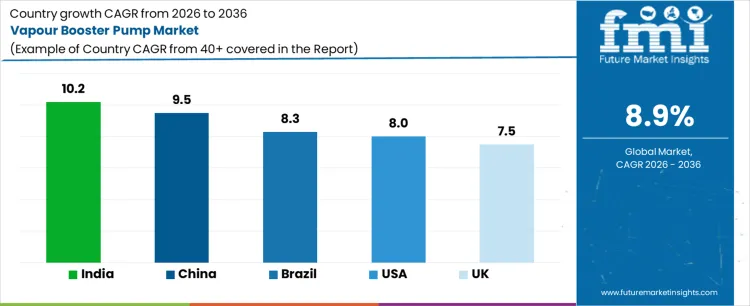
| Country | CAGR (%) |
|---|---|
| US | 8.0% |
| UK | 7.5% |
| China | 9.5% |
| India | 10.2% |
| Brazil | 8.3% |
Demand for vapour booster pumps is rising as chemical, pharmaceutical, and industrial manufacturers adopt efficient pumping solutions to enhance process performance, maintain flow rates, and improve operational reliability. India leads with a 10.2% CAGR, driven by expansion of industrial production, chemical processing facilities, and increasing adoption of booster pump systems. China follows at 9.5%, supported by growing industrial operations and high-volume process requirements. Brazil records 8.3% growth, shaped by adoption in manufacturing and chemical processing plants. The US grows at 8.0%, influenced by replacement demand and process optimization initiatives. The UK shows 7.5% CAGR, reflecting steady adoption of vapour booster pumps across industrial and commercial applications.
How is the United States experiencing growth in the vapour booster pump market?
United States is experiencing growth at a CAGR of 8%, driven by chemical processing, oil and gas, and industrial manufacturing facilities in Texas, Louisiana, and California. Installed base size and predictable replacement cycles encourage steady adoption of high-performance vapour booster pumps. Industry concentration among refineries, petrochemical plants, and industrial operators anchors demand. Investments focus on pump efficiency, reliability under high-temperature conditions, and integration with existing processing systems. Growth reflects rising industrial output, demand for operational efficiency, and compliance with safety and environmental regulations.
- Chemical, oil, and industrial sectors drive adoption.
- Industrial clusters concentrate demand.
- Efficiency and reliability guide investment.
- Replacement cycles support recurring adoption.
How is the United Kingdom witnessing growth in the vapour booster pump market?
United Kingdom is witnessing growth at a CAGR of 7.5%, supported by exposure to export markets and global industrial cycles in London, Aberdeen, and Manchester. Refineries and chemical plants adopt vapour booster pumps that meet both domestic and international standards. Market concentration is moderate, anchored by major industrial operators. Investments focus on corrosion resistance, energy efficiency, and system compatibility. Growth reflects the need for high-performance pumping solutions that optimize production and reduce operational costs.
- Chemical and refinery industries drive adoption.
- Urban industrial hubs concentrate demand.
- Corrosion resistance and energy efficiency guide investment.
- Export exposure influences procurement.
How is China experiencing growth in the vapour booster pump market?
China is experiencing growth at a CAGR of 9.5%, fueled by industrial clusters in Shanghai, Jiangsu, and Guangdong where chemical, petrochemical, and refinery facilities require high-capacity vapour booster pumps. Industry concentration is high in urban manufacturing zones, with rapid replacement cycles supporting adoption. Investments focus on energy efficiency, high reliability, and integration with large-scale process lines. Growth reflects the country’s industrial expansion, increasing production capacity, and emphasis on efficient and safe fluid handling solutions.
- Chemical, petrochemical, and refinery clusters drive adoption.
- Urban industrial zones concentrate demand.
- Energy efficiency and reliability guide investment.
- Rapid replacement cycles accelerate adoption.
How is India witnessing growth in the vapour booster pump market?
India is experiencing growth at a CAGR of 10.2%, supported by capital intensity and payback expectations in industrial facilities across Maharashtra, Gujarat, and Tamil Nadu. Refineries, chemical plants, and process industries prioritize high-efficiency vapour booster pumps with predictable returns. Urban industrial hubs concentrate demand, and investments focus on long-lasting, low-maintenance equipment that minimizes operational risk. Growth reflects increasing industrial output, modernization of process plants, and adoption of efficient pumping technologies to reduce energy consumption.
- Refineries and process industries drive adoption.
- Urban industrial hubs concentrate demand.
- Low-maintenance and efficient pumps guide investment.
- Payback expectations influence procurement.
How is Brazil experiencing growth in the vapour booster pump market?
Brazil is experiencing growth at a CAGR of 8.3%, driven by chemical, petrochemical, and energy sectors in São Paulo, Rio de Janeiro, and Paraná. Sensitivity to operational risk encourages adoption of reliable vapour booster pumps with consistent performance under industrial conditions. Market concentration exists in urban industrial zones, while regional dispersion allows broader adoption. Investments focus on durability, energy efficiency, and compliance with local regulations. Growth reflects the need for safe, dependable pumping solutions in industrial and refinery operations.
- Chemical, petrochemical, and energy sectors drive adoption.
- Urban industrial hubs concentrate demand.
- Durability and energy efficiency guide investment.
- Operational risk sensitivity supports adoption.
How Are Suppliers Enhancing Performance and Reliability Across Vacuum Systems?

Manufacturers in the vapour booster pump market differentiate through pumping speed, ultimate vacuum level, and integration with broader vacuum systems. Atlas-Copco supplies vapour booster pumps engineered for robust performance in semiconductor, coating, and industrial vacuum applications, with emphasis on smooth gas load handling and thermal stability. Edwards-Vacuum, now part of Atlas-Copco, offers complementary booster stages that improve overall system throughput while maintaining clean operation for research and high-vacuum processes. Pfeiffer-Vacuum develops pumps with precision-machined rotors and seals to deliver stable vacuum profiles, supported by modular control interfaces. Leybold-GmbH supplies integrated booster solutions with focus on reliability under continuous duty and ease of service. ULVAC provides advanced booster pumps engineered for uniform pressure control in thin-film deposition and analytical equipment.
Shimadzu-Corporation supplies booster units optimized for laboratory and analytical vacuum systems, prioritizing low vibration and clean exhaust characteristics. Other regional and niche suppliers contribute pumps tailored to specific equipment form factors or regulatory environments. Key differentiators include maximum pumping speed, compatibility with backing pumps, resistance to corrosive or condensable vapours, and integration with digital control and monitoring platforms. Adoption reflects demand across semiconductor manufacturing, surface treatment, freeze-drying, and research laboratories where consistent vacuum performance supports product quality and process reproducibility. Suppliers that combine proven mechanical design, service networks, and application support maintain relevance as users prioritize uptime, efficiency, and predictable vacuum behavior under varied load conditions.
Key Players in the Vapour Booster Pump Market
- Atlas Copco
- Edwards Vacuum (part of Atlas Copco)
- Pfeiffer Vacuum
- Leybold GmbH
- ULVAC
- Shimadzu Corporation
Scope of the Report
| Items | Values |
|---|---|
| Quantitative Units (2026) | USD billion |
| Product Type | Vapour booster pumps, Dry vacuum booster pumps, Liquid ring vapour boosters, Oil-sealed vapour booster pumps |
| End-Use Industry | Chemical processing, Pharmaceutical manufacturing, Semiconductor and electronics, Food and beverage |
| Regions Covered | Asia Pacific, Europe, North America, Latin America, Middle East & Africa |
| Countries Covered | China, Japan, South Korea, India, Australia & New Zealand, ASEAN, Germany, United Kingdom, France, Italy, Spain, Nordic, BENELUX, United States, Canada, Mexico, Brazil, Chile, Saudi Arabia, Turkey, South Africa, and other regional markets |
| Key Companies Profiled | Atlas Copco, Edwards Vacuum (Atlas Copco), Pfeiffer Vacuum, Leybold GmbH, ULVAC, Shimadzu Corporation |
| Additional Attributes | Dollar by sales by product type and end use; standard vapour booster pumps and chemical processing as leading segments; demand driven by semiconductor, coating, and vacuum-intensive processes; growth shaped by equipment installations, system upgrades, and higher chamber sizes; procurement influenced by system integration, reliability, service coverage, and standard vacuum platform architectures. |
Vapour Booster Pump Market Segmentation
Product Type:
- Vapour booster pumps
- Dry vacuum booster pumps
- Liquid ring vapour boosters
- Oil-sealed vapour booster pumps
End-Use Industry:
- Chemical processing
- Pharmaceutical manufacturing
- Semiconductor and electronics
- Food and beverage
Region
- Asia Pacific
- China
- Japan
- South Korea
- India
- Australia & New Zealand
- ASEAN
- Rest of Asia Pacific
- Europe
- Germany
- United Kingdom
- France
- Italy
- Spain
- Nordic
- BENELUX
- Rest of Europe
- North America
- United States
- Canada
- Mexico
- Latin America
- Brazil
- Chile
- Rest of Latin America
- Middle East & Africa
- Kingdom of Saudi Arabia
- Other GCC Countries
- Turkey
- South Africa
- Other African Union
- Rest of Middle East & Africa
Bibliography
- Atlas Copco. (2025). ZRS vacuum booster pumps sales brochure. Atlas Copco.
- Edwards Vacuum. (2024). EH mechanical booster pumps product data sheet. Edwards Vacuum.
- Pfeiffer Vacuum. (2025). A 100 and A 200 L multi stage Roots vacuum pumps product leaflet. Pfeiffer Vacuum.
- Leybold. (2024). RUVAC WH and WHU Roots pumps product brochure. Leybold.
Frequently Asked Questions
How big is the vapour booster pump market in 2026?
The global vapour booster pump market is estimated to be valued at USD 1.5 billion in 2026.
What will be the size of vapour booster pump market in 2036?
The market size for the vapour booster pump market is projected to reach USD 3.5 billion by 2036.
How much will be the vapour booster pump market growth between 2026 and 2036?
The vapour booster pump market is expected to grow at a 8.9% CAGR between 2026 and 2036.
What are the key product types in the vapour booster pump market?
The key product types in vapour booster pump market are vapour booster pumps , dry vacuum booster pumps, liquid ring vapour boosters and oil‑sealed vapour booster pumps.
Which end‑use industry segment to contribute significant share in the vapour booster pump market in 2026?
In terms of end‑use industry, chemical processing segment to command 42.0% share in the vapour booster pump market in 2026.
Preview the report firsthand - request a free sample
Get SampleGet the brochure for pricing and purchase details.
Get PDFTable of Content
- Executive Summary
- Global Market Outlook
- Demand-side Trends
- Supply-side Trends
- Technology Roadmap Analysis
- Analysis and Recommendations
- Market Overview
- Market Coverage / Taxonomy
- Market Definition / Scope / Limitations
- Market Background
- Market Dynamics
- Drivers
- Restraints
- Opportunity
- Trends
- Scenario Forecast
- Demand in Optimistic Scenario
- Demand in Likely Scenario
- Demand in Conservative Scenario
- Opportunity Map Analysis
- Product Life Cycle Analysis
- Supply Chain Analysis
- Investment Feasibility Matrix
- Value Chain Analysis
- PESTLE and Porter’s Analysis
- Regulatory Landscape
- Regional Parent Market Outlook
- Production and Consumption Statistics
- Import and Export Statistics
- Market Dynamics
- Global Market Analysis 2021 to 2025 and Forecast, 2026 to 2036
- Historical Market Size Value (USD Million) Analysis, 2021 to 2025
- Current and Future Market Size Value (USD Million) Projections, 2026 to 2036
- Y-o-Y Growth Trend Analysis
- Absolute $ Opportunity Analysis
- Global Market Pricing Analysis 2021 to 2025 and Forecast 2026 to 2036
- Global Market Analysis 2021 to 2025 and Forecast 2026 to 2036, By Product Type
- Introduction / Key Findings
- Historical Market Size Value (USD Million) Analysis By Product Type, 2021 to 2025
- Current and Future Market Size Value (USD Million) Analysis and Forecast By Product Type, 2026 to 2036
- Vapour booster pumps
- Dry vacuum booster pumps
- Liquid ring vapour boosters
- Oil‑sealed vapour booster pumps
- Vapour booster pumps
- Y-o-Y Growth Trend Analysis By Product Type, 2021 to 2025
- Absolute $ Opportunity Analysis By Product Type, 2026 to 2036
- Global Market Analysis 2021 to 2025 and Forecast 2026 to 2036, By End‑Use Industry
- Introduction / Key Findings
- Historical Market Size Value (USD Million) Analysis By End‑Use Industry, 2021 to 2025
- Current and Future Market Size Value (USD Million) Analysis and Forecast By End‑Use Industry, 2026 to 2036
- Chemical processing
- Pharmaceutical manufacturing
- Semiconductor and electronics
- Food and beverage
- Chemical processing
- Y-o-Y Growth Trend Analysis By End‑Use Industry, 2021 to 2025
- Absolute $ Opportunity Analysis By End‑Use Industry, 2026 to 2036
- Global Market Analysis 2021 to 2025 and Forecast 2026 to 2036, By Region
- Introduction
- Historical Market Size Value (USD Million) Analysis By Region, 2021 to 2025
- Current Market Size Value (USD Million) Analysis and Forecast By Region, 2026 to 2036
- North America
- Latin America
- Western Europe
- Eastern Europe
- East Asia
- South Asia and Pacific
- Middle East & Africa
- Market Attractiveness Analysis By Region
- North America Market Analysis 2021 to 2025 and Forecast 2026 to 2036, By Country
- Historical Market Size Value (USD Million) Trend Analysis By Market Taxonomy, 2021 to 2025
- Market Size Value (USD Million) Forecast By Market Taxonomy, 2026 to 2036
- By Country
- USA
- Canada
- Mexico
- By Product Type
- By End‑Use Industry
- By Country
- Market Attractiveness Analysis
- By Country
- By Product Type
- By End‑Use Industry
- Key Takeaways
- Latin America Market Analysis 2021 to 2025 and Forecast 2026 to 2036, By Country
- Historical Market Size Value (USD Million) Trend Analysis By Market Taxonomy, 2021 to 2025
- Market Size Value (USD Million) Forecast By Market Taxonomy, 2026 to 2036
- By Country
- Brazil
- Chile
- Rest of Latin America
- By Product Type
- By End‑Use Industry
- By Country
- Market Attractiveness Analysis
- By Country
- By Product Type
- By End‑Use Industry
- Key Takeaways
- Western Europe Market Analysis 2021 to 2025 and Forecast 2026 to 2036, By Country
- Historical Market Size Value (USD Million) Trend Analysis By Market Taxonomy, 2021 to 2025
- Market Size Value (USD Million) Forecast By Market Taxonomy, 2026 to 2036
- By Country
- Germany
- UK
- Italy
- Spain
- France
- Nordic
- BENELUX
- Rest of Western Europe
- By Product Type
- By End‑Use Industry
- By Country
- Market Attractiveness Analysis
- By Country
- By Product Type
- By End‑Use Industry
- Key Takeaways
- Eastern Europe Market Analysis 2021 to 2025 and Forecast 2026 to 2036, By Country
- Historical Market Size Value (USD Million) Trend Analysis By Market Taxonomy, 2021 to 2025
- Market Size Value (USD Million) Forecast By Market Taxonomy, 2026 to 2036
- By Country
- Russia
- Poland
- Hungary
- Balkan & Baltic
- Rest of Eastern Europe
- By Product Type
- By End‑Use Industry
- By Country
- Market Attractiveness Analysis
- By Country
- By Product Type
- By End‑Use Industry
- Key Takeaways
- East Asia Market Analysis 2021 to 2025 and Forecast 2026 to 2036, By Country
- Historical Market Size Value (USD Million) Trend Analysis By Market Taxonomy, 2021 to 2025
- Market Size Value (USD Million) Forecast By Market Taxonomy, 2026 to 2036
- By Country
- China
- Japan
- South Korea
- By Product Type
- By End‑Use Industry
- By Country
- Market Attractiveness Analysis
- By Country
- By Product Type
- By End‑Use Industry
- Key Takeaways
- South Asia and Pacific Market Analysis 2021 to 2025 and Forecast 2026 to 2036, By Country
- Historical Market Size Value (USD Million) Trend Analysis By Market Taxonomy, 2021 to 2025
- Market Size Value (USD Million) Forecast By Market Taxonomy, 2026 to 2036
- By Country
- India
- ASEAN
- Australia & New Zealand
- Rest of South Asia and Pacific
- By Product Type
- By End‑Use Industry
- By Country
- Market Attractiveness Analysis
- By Country
- By Product Type
- By End‑Use Industry
- Key Takeaways
- Middle East & Africa Market Analysis 2021 to 2025 and Forecast 2026 to 2036, By Country
- Historical Market Size Value (USD Million) Trend Analysis By Market Taxonomy, 2021 to 2025
- Market Size Value (USD Million) Forecast By Market Taxonomy, 2026 to 2036
- By Country
- Kingdom of Saudi Arabia
- Other GCC Countries
- Turkiye
- South Africa
- Other African Union
- Rest of Middle East & Africa
- By Product Type
- By End‑Use Industry
- By Country
- Market Attractiveness Analysis
- By Country
- By Product Type
- By End‑Use Industry
- Key Takeaways
- Key Countries Market Analysis
- USA
- Pricing Analysis
- Market Share Analysis, 2025
- By Product Type
- By End‑Use Industry
- Canada
- Pricing Analysis
- Market Share Analysis, 2025
- By Product Type
- By End‑Use Industry
- Mexico
- Pricing Analysis
- Market Share Analysis, 2025
- By Product Type
- By End‑Use Industry
- Brazil
- Pricing Analysis
- Market Share Analysis, 2025
- By Product Type
- By End‑Use Industry
- Chile
- Pricing Analysis
- Market Share Analysis, 2025
- By Product Type
- By End‑Use Industry
- Germany
- Pricing Analysis
- Market Share Analysis, 2025
- By Product Type
- By End‑Use Industry
- UK
- Pricing Analysis
- Market Share Analysis, 2025
- By Product Type
- By End‑Use Industry
- Italy
- Pricing Analysis
- Market Share Analysis, 2025
- By Product Type
- By End‑Use Industry
- Spain
- Pricing Analysis
- Market Share Analysis, 2025
- By Product Type
- By End‑Use Industry
- France
- Pricing Analysis
- Market Share Analysis, 2025
- By Product Type
- By End‑Use Industry
- India
- Pricing Analysis
- Market Share Analysis, 2025
- By Product Type
- By End‑Use Industry
- ASEAN
- Pricing Analysis
- Market Share Analysis, 2025
- By Product Type
- By End‑Use Industry
- Australia & New Zealand
- Pricing Analysis
- Market Share Analysis, 2025
- By Product Type
- By End‑Use Industry
- China
- Pricing Analysis
- Market Share Analysis, 2025
- By Product Type
- By End‑Use Industry
- Japan
- Pricing Analysis
- Market Share Analysis, 2025
- By Product Type
- By End‑Use Industry
- South Korea
- Pricing Analysis
- Market Share Analysis, 2025
- By Product Type
- By End‑Use Industry
- Russia
- Pricing Analysis
- Market Share Analysis, 2025
- By Product Type
- By End‑Use Industry
- Poland
- Pricing Analysis
- Market Share Analysis, 2025
- By Product Type
- By End‑Use Industry
- Hungary
- Pricing Analysis
- Market Share Analysis, 2025
- By Product Type
- By End‑Use Industry
- Kingdom of Saudi Arabia
- Pricing Analysis
- Market Share Analysis, 2025
- By Product Type
- By End‑Use Industry
- Turkiye
- Pricing Analysis
- Market Share Analysis, 2025
- By Product Type
- By End‑Use Industry
- South Africa
- Pricing Analysis
- Market Share Analysis, 2025
- By Product Type
- By End‑Use Industry
- USA
- Market Structure Analysis
- Competition Dashboard
- Competition Benchmarking
- Market Share Analysis of Top Players
- By Regional
- By Product Type
- By End‑Use Industry
- Competition Analysis
- Competition Deep Dive
- Atlas Copco
- Overview
- Product Portfolio
- Profitability by Market Segments (Product/Age /Sales Channel/Region)
- Sales Footprint
- Strategy Overview
- Marketing Strategy
- Product Strategy
- Channel Strategy
- Edwards Vacuum (part of Atlas Copco)
- Pfeiffer Vacuum
- Leybold GmbH
- ULVAC
- Baker Hughes (formerly COVAL)
- Shimadzu Corporation
- Atlas Copco
- Competition Deep Dive
- Assumptions & Acronyms Used
- Research Methodology


