

- Industry Size (2026)
- USD 740.0 Mn
- Forecast (2036)
- USD 1325.2 Mn
- CAGR (2026 to 2036)
- 6.0%
Sanitary Diaphragm Pump Market Forecast and Outlook 2026 to 2036
The sanitary diaphragm pump market is expected to grow from USD 740.0 million in 2026 to USD 1,325.2 million by 2036, reflecting a CAGR of 6.0%. Sanitary diaphragm pumps are increasingly treated as validation-critical assets in regulated processing environments, which elevates execution risk for both buyers and suppliers. Adoption momentum is supported by expansion of hygienic manufacturing capacity, yet it is moderated by long qualification cycles, documentation requirements, and sensitivity to audit outcomes. Switching costs remain high once a pump is validated within a process line, creating vendor stickiness but also slowing competitive displacement.
Economic sensitivity is uneven: large pharmaceutical and export-focused food processors continue investing through cycles, while smaller operators delay upgrades due to higher upfront costs and integration complexity. Supply reliability, elastomer availability, and service responsiveness influence procurement confidence, particularly in emerging markets. Growth remains steady but disciplined, shaped by careful capital allocation, regulatory scrutiny, and a strong preference for proven, low-risk solutions over rapid technology shifts.
Quick Stats for Sanitary Diaphragm Pump Market
- Sanitary Diaphragm Pump Market Value (2026): USD 740.0 Million
- Sanitary Diaphragm Pump Market Forecast Value (2036): USD 1,325.2 Million
- Sanitary Diaphragm Pump Market Forecast CAGR 2026 to 2036: 6.0%
- Leading Technology in Sanitary Diaphragm Pump Market: Air-Operated Double Diaphragm (AODD) Pumps (58% share)
- Key Growth Regions in Sanitary Diaphragm Pump Market: Asia Pacific, Europe, North America, Latin America, Middle East & Africa
- Top Key Players in Sanitary Diaphragm Pump Market: PSG (Wilden/Sandpiper), Graco, Verderair (Verder Group), Ingersoll Rand (ARO), Yamada, Tapflo, Bürkert, Alfa Laval, AxFlow, Sani-Matic

Sanitary Diaphragm Pump Market Key Takeaways
| Metric | Value |
|---|---|
| Sanitary Diaphragm Pump Market Value (2026) | USD 740.0 Million |
| Sanitary Diaphragm Pump Market Forecast Value (2036) | USD 1,325.2 Million |
| Sanitary Diaphragm Pump Market Forecast CAGR 2026 to 2036 | 6.0% |
How Are Hygienic Processing Standards and Validation Requirements Driving the Sanitary Diaphragm Pump Market?
The sanitary diaphragm pump market is expanding as food, beverage, pharmaceutical, and biotechnology manufacturers strengthen hygiene, contamination control, and validation practices. These pumps are widely specified for transferring shear-sensitive, viscous, and particulate-laden fluids while maintaining complete product isolation. For manufacturers and system integrators, demand is closely linked to applications where cleanability, gentle handling, and zero leakage are mandatory rather than optional performance attributes.
Procurement decisions are increasingly shaped by regulatory compliance and clean-in-place compatibility. End users prioritize pumps designed to meet EHEDG, 3-A, and FDA requirements, with smooth internal surfaces, minimal dead zones, and diaphragm materials compatible with aggressive cleaning agents. Features such as drainability, ease of disassembly, and validation documentation are influencing supplier selection, particularly in pharmaceutical and aseptic food processing environments. Vendors that can support IQ/OQ documentation and hygienic design audits gain a clear advantage during qualification.
Operational flexibility and lifecycle economics are further supporting market growth. Sanitary diaphragm pumps are valued for their ability to handle frequent product changeovers, variable flow conditions, and intermittent operation without compromising hygiene. Expansion of biopharmaceutical manufacturing, ready-to-drink beverages, and specialty food production is increasing demand for reliable, low-maintenance transfer solutions. For suppliers, competitive advantage increasingly depends on application engineering expertise, diaphragm material innovation, and global service capability positioning sanitary diaphragm pumps as a critical component of validated, hygienic processing systems.
How is The Sanitary Diaphragm Pump Market Structured by Technology and End Use?
The sanitary diaphragm pump market is segmented by technology and end use, reflecting differences in hygiene requirements, fluid characteristics, and operational flexibility across processing industries. By technology, air-operated double diaphragm pumps represent the leading category due to their simple design, intrinsic safety, and suitability for hygienic environments. Other technologies include electric diaphragm pumps, metering diaphragm pumps, and niche diaphragm variants designed for precise dosing and continuous operation. By end use, food and beverage processing accounts for the largest demand, followed by pharmaceutical & biotech, dairy processing, cosmetics & personal care, and beverage brewing, where contamination control and cleanability are mandatory.
Why Do Air-Operated Double Diaphragm (AODD) Pumps Lead Technology Adoption in the Sanitary Diaphragm Pump Market?
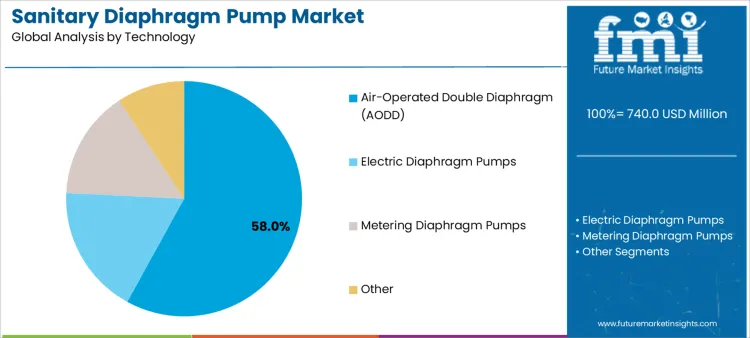
Air-Operated Double Diaphragm (AODD) pumps hold 58% share of the sanitary diaphragm pump market due to their versatility, ease of maintenance, and ability to handle a broad range of fluid viscosities and flow rates. AODD pumps are especially valued in industries requiring stringent hygiene standards, such as food & beverage and pharmaceuticals, because they ensure safe, contaminant-free fluid transfer. Their ability to run dry, self-prime, and adjust to fluctuating pressures makes them an ideal choice for processes that demand flexibility, reliability, and minimal downtime. AODD pumps are cost-effective and robust, which makes them a reliable option for both small-scale and large-scale operations. These operational and economic benefits explain their dominant position in the market.
Why Does Food & Beverage Processing Dominate End-Use Demand In The Sanitary Diaphragm Pump Market?

The food & beverage industry accounts for 34% share of the sanitary diaphragm pump market because it requires pumps that maintain the highest standards of hygiene and fluid handling. In food production lines for liquids, sauces, and ingredients, diaphragm pumps, particularly AODD models, are necessary for ensuring precise, clean, and efficient transfer of fluids. These pumps offer the flexibility to handle varying viscosities while minimizing the risk of contamination, which is critical in maintaining product integrity. Furthermore, their ability to self-prime and operate without complex controls makes them ideal for high-volume processes in beverage production, dairy processing, and food manufacturing. These factors explain why food & beverage remains the largest end-use segment for sanitary diaphragm pumps.
What Are The Key Dynamics Of The Sanitary Diaphragm Pump Market?
The sanitary diaphragm pump market is driven by demand for contamination-free fluid handling solutions in sectors such as food and beverage, pharmaceuticals, cosmetics, biotechnology, and dairy processing. Sanitary diaphragm pumps enable gentle, leak-free transfer of viscous, shear-sensitive, particulate-laden, and sterile fluids while meeting hygiene and cleanability requirements. For pump manufacturers and suppliers, material traceability (food-grade stainless steel, elastomers), clean-in-place (CIP) compatibility, regulatory compliance, and ease of maintenance strongly influence purchasing decisions. Expansion of processing facilities, stringent sanitation standards, and emphasis on operational uptime are central to market growth.
How Are Technology And Hygiene Trends Shaping Adoption In This Market?
Technology and hygiene trends are shaping the sanitary diaphragm pump market through advanced sealing technologies, enhanced material finishes, and integration with process control systems. Improvements in elastomer compounds and surface treatments reduce adhesion and facilitate rapid cleaning cycles while extending component life. Integration of sensors and digital interfaces enables remote monitoring of vibration, flow rate, and seal integrity, supporting condition-based maintenance programs that reduce unplanned downtime. Modular designs with quick-change diaphragms simplify servicing and lower total cost of ownership. For suppliers, offering pumps engineered for specific applications such as aseptic transfer, CIP service, or high-viscosity fluid handling enhances differentiation and strengthens relationships with end users.
Why Do Cost, Regulatory, And Process Integration Challenges Restrain Market Growth?
Cost, regulatory, and process integration challenges restrain the sanitary diaphragm pump market because high-performance, hygienic designs inherently incur higher manufacturing and validation costs compared with general-purpose pumps. Compliance with food and pharmaceutical grade standards including material certification, surface finish requirements, and documentation for audits increases engineering and production effort. Integration with existing process piping, control systems, and automation frameworks often requires custom engineering, which extends project timelines and increases capital expenditure. Smaller processors may defer upgrades due to budget constraints, limiting broader penetration of advanced sanitary pumps in cost-sensitive segments.
What is the Country-Level for the Sanitary Diaphragm Pump Market?
The sanitary diaphragm pump market is expanding as hygienic fluid handling requirements increase across food & beverage, pharmaceuticals, biotechnology, and personal care manufacturing. These electric pumps are valued for gentle product handling, contamination-free operation, and compatibility with clean-in-place and sterilize-in-place processes. Growth varies by country based on expansion of hygienic processing facilities, regulatory compliance requirements, and investment in modern manufacturing infrastructure. Faster-growing markets are driven by new plant installations and export-oriented production, while more mature regions see demand from capacity upgrades and process standardization. Market value is shaped by pump reliability, ease of cleaning, material compatibility, and long service life. For suppliers, competitiveness depends on hygienic design expertise, certification compliance, and strong local service support.
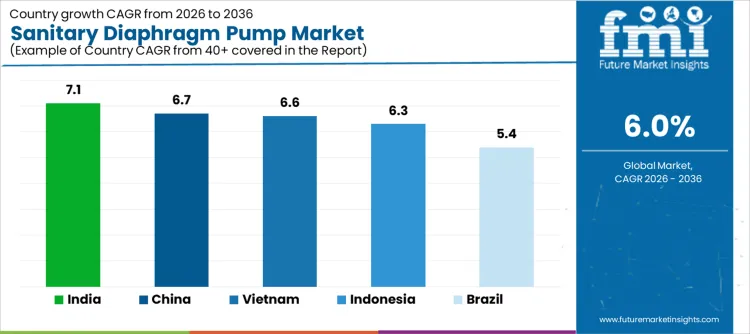
| Country | CAGR (%) |
|---|---|
| India | 7.1 |
| China | 6.7 |
| Vietnam | 6.6 |
| Indonesia | 6.3 |
| Brazil | 5.4 |
Why Is India Emerging As A High-Growth Market For Sanitary Diaphragm Pumps?
Demand for sanitary diaphragm pump in India is growing at a CAGR of 7.1% during 2026-2036, driven by rapid expansion of food processing, pharmaceutical manufacturing, and biotechnology facilities. Increasing focus on hygienic production for domestic consumption and export markets is accelerating adoption of contamination-free fluid handling equipment. Sanitary diaphragm pumps are widely used for transferring viscous, shear-sensitive, and particulate-laden fluids in compliance-driven environments. Buyers prioritize hygienic design, compatibility with CIP/SIP systems, and affordability. Demand is strongest in Greenfield plants and capacity expansions, where modern process layouts are being implemented from the design stage. Procurement cycles are relatively short, with preference for suppliers offering localized manufacturing, quick delivery, and responsive technical support.
How Is China Sustaining Strong Demand For Sanitary Diaphragm Pumps?
Sale of sanitary diaphragm pump in China is expanding at a CAGR of 6.7% during 2026-2036, supported by large-scale food, beverage, pharmaceutical, and personal care manufacturing operations. Hygienic processing requirements are increasing as manufacturers upgrade facilities to meet domestic quality standards and export requirements. Sanitary diaphragm pumps are favored for their gentle handling and ability to process diverse fluid types. Buyers emphasize throughput capacity, material quality, and long service life. Local manufacturing plays a significant role in meeting demand, supporting cost control and supply availability. Procurement decisions favor suppliers with proven compliance credentials and strong integration with automated process lines. Replacement demand is also growing as older pumps are phased out. China represents a volume-driven market where competitiveness depends on manufacturing scale, standardized designs, and reliable performance across high-capacity production environments.
Why Is Vietnam Gaining Momentum In Sanitary Diaphragm Pump Adoption?
Vietnam’s sanitary diaphragm pump market is growing at a CAGR of 6.6% during 2026-2036, driven by rapid development of food processing, beverage bottling, and pharmaceutical manufacturing for export markets. Adoption is primarily project-led, with pumps specified during construction of new hygienic facilities. Buyers focus on reliability, ease of cleaning, and compliance with international hygienic standards. Imported pumps dominate supply, often selected through EPC contractors managing plant construction. Market value is supported by foreign direct investment, industrial zone expansion, and rising demand for processed food and healthcare products. Supplier success depends on strong EPC relationships, competitive pricing, and commissioning support. Vietnam represents an emerging market where growth is closely tied to industrial project pipelines and export-oriented manufacturing expansion.
What Is Driving Steady Growth Of Sanitary Diaphragm Pumps In Indonesia?
Demand for sanitary diaphragm pump in Indonesia is expanding at a CAGR of 6.3% during 2026-2036, supported by growing food, beverage, and pharmaceutical industries serving domestic demand. These pumps are increasingly adopted to improve hygiene and product quality in processing operations. Buyers prioritize durability, corrosion resistance, and ease of maintenance due to challenging operating environments. Demand is split between new installations and gradual upgrades of existing plants. Procurement decisions favor suppliers with local service capability and proven performance. Market value is driven by industrial growth, modernization of processing facilities, and rising consumer standards. Indonesia represents a balanced growth market where success depends on system robustness, service responsiveness, and long-term operational support.
How Is Brazil Maintaining Moderate Growth In The Sanitary Diaphragm Pump Market?
Sale of sanitary diaphragm pump in Brazil is growing at a CAGR of 5.4% during the forecast period, shaped by steady demand from food processing, dairy, beverage, and pharmaceutical sectors. Adoption is driven by compliance with hygiene standards and efforts to improve process efficiency. Buyers emphasize cost control, reliability, and compatibility with existing processing equipment. Imported and locally assembled pumps both play roles in supply. Procurement decisions are influenced by distributor reach and aftersales support. Market value is driven by incremental plant upgrades and replacement demand. Brazil represents a stable market where growth is gradual and supplier success depends on competitive pricing, dependable service, and consistent product quality.
How Are Suppliers Competing in the Sanitary Diaphragm Pump Market?
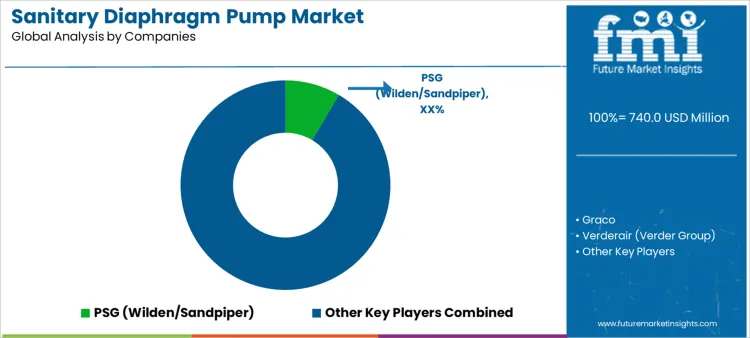
Competition in the sanitary diaphragm pump market is defined by hygienic compliance, cleanability, and reliable low-shear fluid transfer for food, beverage, pharmaceutical, and biotech operations. End users prioritize pumps that meet global sanitary standards, support CIP/SIP cycles, and deliver consistent performance without risk of contamination or product degradation.
Global pump manufacturers lead high-specification applications. PSG, through its Wilden and Sandpiper brands, positions its sanitary diaphragm pumps around proven air-operated designs with validated elastomers and polished internal geometries. Graco competes by emphasizing repeatable performance, FDA-compliant wetted materials, and ease of disassembly for validation-driven environments. Ingersoll Rand, via the ARO portfolio, focuses on robust air distribution systems and consistent flow control suited for continuous sanitary duty.
European and Japanese suppliers add differentiation through precision engineering and system integration. Verderair, Tapflo, and Yamada highlight compact footprints, standardized hygienic connections, and energy-efficient operation. Bürkert and Alfa Laval strengthen their positioning by integrating diaphragm pumps within complete sanitary flow and valve systems. Distributors and specialists such as AxFlow and Sani-Matic compete through application engineering and turnkey hygienic system support.
Key Players in Sanitary Diaphragm Pump Market
- PSG (Wilden/Sandpiper)
- Graco
- Verderair (Verder Group)
- Ingersoll Rand (ARO)
- Yamada
- Tapflo
- Bürkert
- Alfa Laval
- AxFlow
- Sani-Matic
Scope of the Report
| Attribute | Details |
|---|---|
| Market Size Unit | USD Million |
| Technology Covered | Air-Operated Double Diaphragm (AODD), Electric Diaphragm Pumps, Metering Diaphragm Pumps, Other Diaphragm Pump Technologies |
| End-Use Covered | Food & Beverage, Pharmaceutical & Biotech, Dairy Processing, Cosmetics & Personal Care, Beverage Brewing |
| Countries Covered | China, Japan, South Korea, India, Australia & New Zealand, ASEAN, Rest of Asia Pacific, Germany, United Kingdom, France, Italy, Spain, Nordic, BENELUX, Rest of Europe, United States, Canada, Mexico, Brazil, Chile, Rest of Latin America, Kingdom of Saudi Arabia, Other GCC Countries, Turkey, South Africa, Other African Union, Rest of Middle East & Africa |
| Regions Covered | Asia Pacific, Europe, North America, Latin America, Middle East & Africa |
| Key Companies Profiled | PSG (Wilden/Sandpiper), Graco, Verderair (Verder Group), Ingersoll Rand (ARO), Yamada, Tapflo, Bürkert, Alfa Laval, AxFlow, Sani-Matic |
| Additional Attributes | Dollar sales by technology and end use are evaluated across hygienic fluid-handling applications. The scope includes analysis of sanitary design standards, CIP/SIP compatibility, elastomer materials, flow accuracy, regulatory compliance, OEM versus aftermarket demand, and replacement cycles. Country-level market sizing reflects adoption across food, beverage, pharmaceutical, dairy, and personal care processing facilities. |
Sanitary Diaphragm Pump Market by Key Segments
Technology
- Air-Operated Double Diaphragm (AODD)
- Electric Diaphragm Pumps
- Metering Diaphragm Pumps
- Other
End Use
- Sub-Segment
- Food & Beverage
- Pharmaceutical & Biotech
- Dairy Processing
- Cosmetics & Personal Care
- Beverage Brewing
Region:
- Asia Pacific
- China
- Japan
- South Korea
- India
- Australia & New Zealand
- ASEAN
- Rest of Asia Pacific
- Europe
- Germany
- United Kingdom
- France
- Italy
- Spain
- Nordic
- BENELUX
- Rest of Europe
- North America
- United States
- Canada
- Mexico
- Latin America
- Brazil
- Chile
- Rest of Latin America
- Middle East & Africa
- Kingdom of Saudi Arabia
- Other GCC Countries
- Turkey
- South Africa
- Other African Union
- Rest of Middle East & Africa
Bibliography
- European Hygienic Engineering & Design Group (EHEDG). (2025, March 28). GL 17 and GL 39: EHEDG Working Groups update. EHEDG.
- European Hygienic Engineering & Design Group (EHEDG). (2023, December). GL 2: A method for assessing the in-place cleanability of food processing equipment (4th ed.). EHEDG.
- Food and Agriculture Organization of the United Nations. (2023). Hygienic design of equipment for the food and beverage industry. Food and Agriculture Organization of the United Nations.
- European Commission. (2023). Guidance document on the application of hygienic design requirements under Regulation (EC) No 852/2004 on the hygiene of foodstuffs. European Union.
- World Health Organization. (2023). Water safety and sanitation in food and beverage processing facilities. World Health Organization.
Frequently Asked Questions
How big is the sanitary diaphragm pump market in 2026?
The global sanitary diaphragm pump market is estimated to be valued at USD 740.0 in 2026.
What will be the size of sanitary diaphragm pump market in 2036?
The market size for the sanitary diaphragm pump market is projected to reach USD 1,325.2 by 2036.
How much will be the sanitary diaphragm pump market growth between 2026 and 2036?
The sanitary diaphragm pump market is expected to grow at a 6.0% CAGR between 2026 and 2036.
What are the key product types in the sanitary diaphragm pump market?
The key product types in sanitary diaphragm pump market are air-operated double diaphragm (aodd), electric diaphragm pumps, metering diaphragm pumps and other.
Which end use segment to contribute significant share in the sanitary diaphragm pump market in 2026?
In terms of end use, sub-segment segment to command 34.0% share in the sanitary diaphragm pump market in 2026.
Preview the report firsthand - request a free sample
Get SampleGet the brochure for pricing and purchase details.
Get PDFTable of Content
- Executive Summary
- Global Market Outlook
- Demand-side Trends
- Supply-side Trends
- Technology Roadmap Analysis
- Analysis and Recommendations
- Market Overview
- Market Coverage / Taxonomy
- Market Definition / Scope / Limitations
- Market Background
- Market Dynamics
- Drivers
- Restraints
- Opportunity
- Trends
- Scenario Forecast
- Demand in Optimistic Scenario
- Demand in Likely Scenario
- Demand in Conservative Scenario
- Opportunity Map Analysis
- Product Life Cycle Analysis
- Supply Chain Analysis
- Investment Feasibility Matrix
- Value Chain Analysis
- PESTLE and Porter’s Analysis
- Regulatory Landscape
- Regional Parent Market Outlook
- Production and Consumption Statistics
- Import and Export Statistics
- Market Dynamics
- Global Market Analysis 2021 to 2025 and Forecast, 2026 to 2036
- Historical Market Size Value (USD Million) Analysis, 2021 to 2025
- Current and Future Market Size Value (USD Million) Projections, 2026 to 2036
- Y-o-Y Growth Trend Analysis
- Absolute $ Opportunity Analysis
- Global Market Pricing Analysis 2021 to 2025 and Forecast 2026 to 2036
- Global Market Analysis 2021 to 2025 and Forecast 2026 to 2036, By Technology
- Introduction / Key Findings
- Historical Market Size Value (USD Million) Analysis By Technology , 2021 to 2025
- Current and Future Market Size Value (USD Million) Analysis and Forecast By Technology , 2026 to 2036
- Air-Operated Double Diaphragm (AODD)
- Electric Diaphragm Pumps
- Metering Diaphragm Pumps
- Other
- Air-Operated Double Diaphragm (AODD)
- Y-o-Y Growth Trend Analysis By Technology , 2021 to 2025
- Absolute $ Opportunity Analysis By Technology , 2026 to 2036
- Global Market Analysis 2021 to 2025 and Forecast 2026 to 2036, By End Use
- Introduction / Key Findings
- Historical Market Size Value (USD Million) Analysis By End Use, 2021 to 2025
- Current and Future Market Size Value (USD Million) Analysis and Forecast By End Use, 2026 to 2036
- Sub-Segment
- Food & Beverage
- Pharmaceutical & Biotech
- Dairy Processing
- Cosmetics & Personal Care
- Beverage Brewing
- Sub-Segment
- Y-o-Y Growth Trend Analysis By End Use, 2021 to 2025
- Absolute $ Opportunity Analysis By End Use, 2026 to 2036
- Global Market Analysis 2021 to 2025 and Forecast 2026 to 2036, By Region
- Introduction
- Historical Market Size Value (USD Million) Analysis By Region, 2021 to 2025
- Current Market Size Value (USD Million) Analysis and Forecast By Region, 2026 to 2036
- North America
- Latin America
- Western Europe
- Eastern Europe
- East Asia
- South Asia and Pacific
- Middle East & Africa
- Market Attractiveness Analysis By Region
- North America Market Analysis 2021 to 2025 and Forecast 2026 to 2036, By Country
- Historical Market Size Value (USD Million) Trend Analysis By Market Taxonomy, 2021 to 2025
- Market Size Value (USD Million) Forecast By Market Taxonomy, 2026 to 2036
- By Country
- USA
- Canada
- Mexico
- By Technology
- By End Use
- By Country
- Market Attractiveness Analysis
- By Country
- By Technology
- By End Use
- Key Takeaways
- Latin America Market Analysis 2021 to 2025 and Forecast 2026 to 2036, By Country
- Historical Market Size Value (USD Million) Trend Analysis By Market Taxonomy, 2021 to 2025
- Market Size Value (USD Million) Forecast By Market Taxonomy, 2026 to 2036
- By Country
- Brazil
- Chile
- Rest of Latin America
- By Technology
- By End Use
- By Country
- Market Attractiveness Analysis
- By Country
- By Technology
- By End Use
- Key Takeaways
- Western Europe Market Analysis 2021 to 2025 and Forecast 2026 to 2036, By Country
- Historical Market Size Value (USD Million) Trend Analysis By Market Taxonomy, 2021 to 2025
- Market Size Value (USD Million) Forecast By Market Taxonomy, 2026 to 2036
- By Country
- Germany
- UK
- Italy
- Spain
- France
- Nordic
- BENELUX
- Rest of Western Europe
- By Technology
- By End Use
- By Country
- Market Attractiveness Analysis
- By Country
- By Technology
- By End Use
- Key Takeaways
- Eastern Europe Market Analysis 2021 to 2025 and Forecast 2026 to 2036, By Country
- Historical Market Size Value (USD Million) Trend Analysis By Market Taxonomy, 2021 to 2025
- Market Size Value (USD Million) Forecast By Market Taxonomy, 2026 to 2036
- By Country
- Russia
- Poland
- Hungary
- Balkan & Baltic
- Rest of Eastern Europe
- By Technology
- By End Use
- By Country
- Market Attractiveness Analysis
- By Country
- By Technology
- By End Use
- Key Takeaways
- East Asia Market Analysis 2021 to 2025 and Forecast 2026 to 2036, By Country
- Historical Market Size Value (USD Million) Trend Analysis By Market Taxonomy, 2021 to 2025
- Market Size Value (USD Million) Forecast By Market Taxonomy, 2026 to 2036
- By Country
- China
- Japan
- South Korea
- By Technology
- By End Use
- By Country
- Market Attractiveness Analysis
- By Country
- By Technology
- By End Use
- Key Takeaways
- South Asia and Pacific Market Analysis 2021 to 2025 and Forecast 2026 to 2036, By Country
- Historical Market Size Value (USD Million) Trend Analysis By Market Taxonomy, 2021 to 2025
- Market Size Value (USD Million) Forecast By Market Taxonomy, 2026 to 2036
- By Country
- India
- ASEAN
- Australia & New Zealand
- Rest of South Asia and Pacific
- By Technology
- By End Use
- By Country
- Market Attractiveness Analysis
- By Country
- By Technology
- By End Use
- Key Takeaways
- Middle East & Africa Market Analysis 2021 to 2025 and Forecast 2026 to 2036, By Country
- Historical Market Size Value (USD Million) Trend Analysis By Market Taxonomy, 2021 to 2025
- Market Size Value (USD Million) Forecast By Market Taxonomy, 2026 to 2036
- By Country
- Kingdom of Saudi Arabia
- Other GCC Countries
- Turkiye
- South Africa
- Other African Union
- Rest of Middle East & Africa
- By Technology
- By End Use
- By Country
- Market Attractiveness Analysis
- By Country
- By Technology
- By End Use
- Key Takeaways
- Key Countries Market Analysis
- USA
- Pricing Analysis
- Market Share Analysis, 2025
- By Technology
- By End Use
- Canada
- Pricing Analysis
- Market Share Analysis, 2025
- By Technology
- By End Use
- Mexico
- Pricing Analysis
- Market Share Analysis, 2025
- By Technology
- By End Use
- Brazil
- Pricing Analysis
- Market Share Analysis, 2025
- By Technology
- By End Use
- Chile
- Pricing Analysis
- Market Share Analysis, 2025
- By Technology
- By End Use
- Germany
- Pricing Analysis
- Market Share Analysis, 2025
- By Technology
- By End Use
- UK
- Pricing Analysis
- Market Share Analysis, 2025
- By Technology
- By End Use
- Italy
- Pricing Analysis
- Market Share Analysis, 2025
- By Technology
- By End Use
- Spain
- Pricing Analysis
- Market Share Analysis, 2025
- By Technology
- By End Use
- France
- Pricing Analysis
- Market Share Analysis, 2025
- By Technology
- By End Use
- India
- Pricing Analysis
- Market Share Analysis, 2025
- By Technology
- By End Use
- ASEAN
- Pricing Analysis
- Market Share Analysis, 2025
- By Technology
- By End Use
- Australia & New Zealand
- Pricing Analysis
- Market Share Analysis, 2025
- By Technology
- By End Use
- China
- Pricing Analysis
- Market Share Analysis, 2025
- By Technology
- By End Use
- Japan
- Pricing Analysis
- Market Share Analysis, 2025
- By Technology
- By End Use
- South Korea
- Pricing Analysis
- Market Share Analysis, 2025
- By Technology
- By End Use
- Russia
- Pricing Analysis
- Market Share Analysis, 2025
- By Technology
- By End Use
- Poland
- Pricing Analysis
- Market Share Analysis, 2025
- By Technology
- By End Use
- Hungary
- Pricing Analysis
- Market Share Analysis, 2025
- By Technology
- By End Use
- Kingdom of Saudi Arabia
- Pricing Analysis
- Market Share Analysis, 2025
- By Technology
- By End Use
- Turkiye
- Pricing Analysis
- Market Share Analysis, 2025
- By Technology
- By End Use
- South Africa
- Pricing Analysis
- Market Share Analysis, 2025
- By Technology
- By End Use
- USA
- Market Structure Analysis
- Competition Dashboard
- Competition Benchmarking
- Market Share Analysis of Top Players
- By Regional
- By Technology
- By End Use
- Competition Analysis
- Competition Deep Dive
- PSG (Wilden/Sandpiper)
- Overview
- Product Portfolio
- Profitability by Market Segments (Product/Age /Sales Channel/Region)
- Sales Footprint
- Strategy Overview
- Marketing Strategy
- Product Strategy
- Channel Strategy
- Graco
- Verderair (Verder Group)
- Ingersoll Rand (ARO)
- Yamada
- Tapflo
- Bürkert
- Alfa Laval
- AxFlow
- Sani-Matic
- PSG (Wilden/Sandpiper)
- Competition Deep Dive
- Assumptions & Acronyms Used
- Research Methodology


