

- Market Size (2026)
- USD 108.5 Mn
- Forecast (2036)
- USD 249.8 Mn
- CAGR (2026 to 2036)
- 8.7%
How big is Ventilator-Weaning Nutrition Market in 2026?
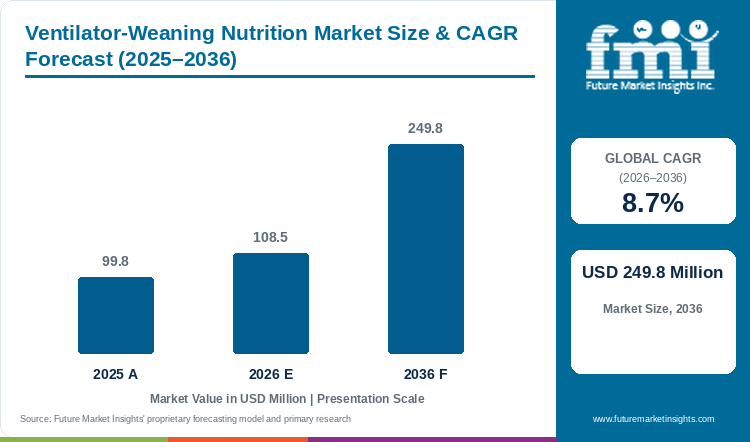
The ventilator-weaning nutrition market is estimated at USD 99.8 million in 2025 and is projected to reach USD 108.5 million in 2026. Sales of ventilator-weaning nutrition are forecast to grow at an 8.7% CAGR and reach USD 249.8 million by 2036.
Longer ventilation among older patients is raising the need for planned weaning diets. Hospitals and home suppliers bought an estimated USD 99.8 million of ventilator-weaning nutrition in 2025, and the ventilator-weaning nutrition market is projected to reach USD 108.5 million in 2026 and USD 249.8 million by 2036 on an 8.7% CAGR. Critical care volumes give the market a large and steady starting point. For example, ICNARC counted 222,377 admissions to 286 adult critical care units in England, Wales and Northern Ireland over April 2024 to March 2025, and 40% of patients on organ support received advanced respiratory support.[1] Most are fed by tube first and moved to oral intake as breathing recovers, so each weaning episode creates a run of nutrition orders.
South Korean demand is projected to rise 9.1% a year through 2036, 2.1 points over the 7% expected for Japan. Behind this, the 2025 census in South Korea counted 10.72 million residents aged 65 or older, 20.7% of the population.[2] As a result, a rising share of older patients in Korean intensive care units is likely to lengthen weaning episodes and add feeding days per stay. By contrast, Japan starts from an older, settled base with ICU feeding protocols in place.
Hospital formularies are likely to channel 45.2% of 2026 purchasing route sales, in FMI's estimate. As a result, suppliers covering tube feed, sip feed and protein module will keep each patient through recovery.
Key Market Trends & Insights
- High-fat low-carbohydrate pulmonary formulas are likely to stay first in product type, on 52.1% of 2026 sales, as intensivists use them for selected patients with carbon dioxide retention.
- Active weaning trials are likely to lead by stage, with 48.7% of 2026 demand, as feeds are changed during spontaneous breathing trials. Research is tying nutrition to mobility in this phase. Alongside this, Fresenius Kabi funded a EUR 250,000 multicenter trial of personalised nutrition with early mobilisation in ventilated ICU patients in September 2025.[3] Trials of this kind may raise protein targets during weaning and add volume per patient.
- Tube feeding covers the first phase of care, and enteral tube feeds are projected at 49.7% of 2026 route sales against about 33.5% for oral nutritional supplements.
- Within care settings, intensive care units will hold 45% in 2026, and long-term acute care hospitals an estimated 26.3%.
- Nutrition committees list most feeds, and formulary purchase is forecast at 45.2% of purchasing route sales in 2026. Home supply faces tighter payer checks, however. On the payer side, CMS put the 2024 improper payment rate for Medicare enteral nutrition claims at 23.8%.[4] Claim errors at that rate slow the move of weaning patients onto home enteral supply and keep volume inside hospitals for longer.
Regional Highlights
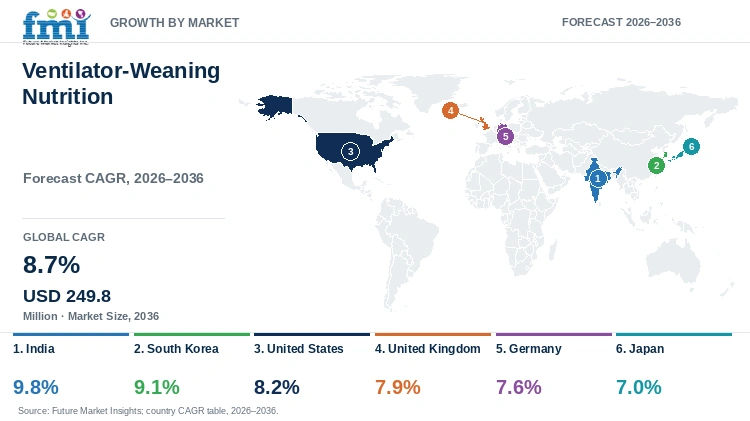
- Indian demand is likely to grow quickest, by 9.8% a year against the 8.7% global CAGR, as private ICUs add beds.
- South Korea is second at 9.1% on an ageing ICU intake, and the United States is projected at 8.2% under close claim checks. Large public ICU systems in the United Kingdom (7.9%) and Germany (7.6%) grow more slowly, and Japan, at 7%, is slowest.
- German ICU capacity is large and already well supplied. German hospitals ran about 26,000 intensive care beds in 2024 across 1,841 hospitals, Deutsches Ärzteblatt reported on 6 November 2025, citing Destatis.[5] A bed base of that size keeps German orders high in volume, though growth comes mostly from replacement and protocol change.
Market Size & Forecast
Table 1: Market Size and Forecast for the Ventilator-Weaning Nutrition Market (USD million and percentage), 2025 to 2036
| Metric | Value |
|---|---|
| 2025 Market Size | USD 99.8 million |
| Estimated Market Size in 2026 | USD 108.5 million |
| Projected Market Size by 2036 | USD 249.8 million |
| CAGR, 2026 to 2036 | 8.7% |
| Added Revenue, 2026 to 2036 | USD 141.3 million |
| Market Expansion Multiple | 2.3x |
Home supply is the hardest stage of ventilator-weaning nutrition to grow, as payer checks tighten. For instance, Medicare pays for one month of enteral nutrients at most per delivery, and insufficient documentation caused 48.8% of improper enteral payments in the 2024 reporting period.[4] Each refill therefore rides on paperwork as much as on clinical need. By comparison, all tube and sip feeding grows at a gentler pace, and the enteral nutrition market expands on a projected 6.1% CAGR. FMI estimates that weaning programs will add USD 141.3 million to the ventilator-weaning nutrition market by 2036, a 2.3-fold rise on the 2026 figure. Even so, denied home claims are the main risk to the later years of that outlook.
Feeding Protocols, Mobility Trials and Home Supply
Research is linking nutrition with physical recovery during ventilation. For example, Fresenius Kabi named Dr. Hannah Wozniak of University Hospitals Geneva the JUMPstart award winner at the 2025 ESPEN congress, with EUR 250,000 for a randomised trial of tailored nutrition and early mobilisation in mechanically ventilated ICU patients.[3] The trial follows patients beyond the ICU into physical function and quality of life. Results of this kind shape protein targets that hospital formularies set for weaning patients.
Supply after discharge is a separate test. In one move, Danone completed the acquisition of a majority stake in Kate Farms on 1 July 2025, and Kate Farms joined Nutricia, Real Food Blends and Functional Formularies in one US medical nutrition business serving hospitals, home, online and retail.[6] One business across hospital and home lets Danone keep a patient on the same brand after transfer. At the same time, CMS reported a 23.8% improper payment rate for enteral nutrition in 2024, or USD 31.1 million in projected improper payments.[4] Claim errors at that level slow home volume, so suppliers that help with payer paperwork keep more patients on product after transfer.
Table 2: Protocol, Payment and Capacity Indicators for the Ventilator-Weaning Nutrition Market (research, claims and beds), 2024 to 2026
| Indicator | Data Point | Relevance | Source |
|---|---|---|---|
| ICNARC Case Mix Programme, 2024-25 | 222,377 admissions; 40% of organ-support patients on advanced respiratory support | Ventilated patient pool in the United Kingdom | [1] |
| Fresenius Kabi JUMPstart award, September 2025 | EUR 250,000 for a ventilated ICU nutrition trial | Evidence for weaning protein targets | [3] |
| CMS enteral nutrition compliance, February 2026 | 23.8% improper payment rate in 2024 | Home enteral supply after discharge | [4] |
| Destatis hospital data, November 2025 | About 26,000 ICU beds in 2024 | ICU capacity in Germany | [5] |
| Fresenius Kabi Gurugram R&D, June 2025 | Expanded enteral nutrition R&D center opened | Product development for Asian hospitals | [7] |
| Nestlé Health Science, 2025 | 3.2% organic growth | Medical nutrition supplier momentum | [8] |
Analyst Perspective
“Continuity from the ventilator to the ward is the deciding test in ventilator-weaning nutrition. A patient started on one maker's tube feed in intensive care often stays with that maker's supplement after extubation, as long as the next ward stocks the product. I expect protein-dense formats spanning tube and sip use to gain share, building a steadier bridge from ICU orders to home supply.”
- Anurag Sharma, Principal Consultant, Future Market Insights.
How is the ventilator-weaning nutrition market segmented?
The market is segmented into product type, weaning stage, feeding route, care setting, purchasing route, and region. High-fat low-carbohydrate pulmonary formulas are expected to lead product type with 52.1% share in 2026, and active weaning trials lead weaning stage with 48.7%.
By product type: high-fat low-carbohydrate pulmonary formulas, energy-dense fluid-restricted feeds, high-protein weaning formulas, and others.
By weaning stage: active weaning trials, post-extubation recovery, and prolonged tracheostomy weaning.
By feeding route: enteral tube feeds, oral nutritional supplements, and protein modules.
By care setting: intensive care units, long-term acute care hospitals, specialist weaning centers, and others.
By purchasing route: hospital formulary purchase, group purchasing contracts, public tenders, and home enteral supply.
By region: ventilated adult patients in North America, Latin America, Western Europe, Eastern Europe, East Asia, South Asia and Pacific, and Middle East and Africa.
Why do high-fat low-carbohydrate pulmonary formulas lead ventilator-weaning nutrition sales by product type?
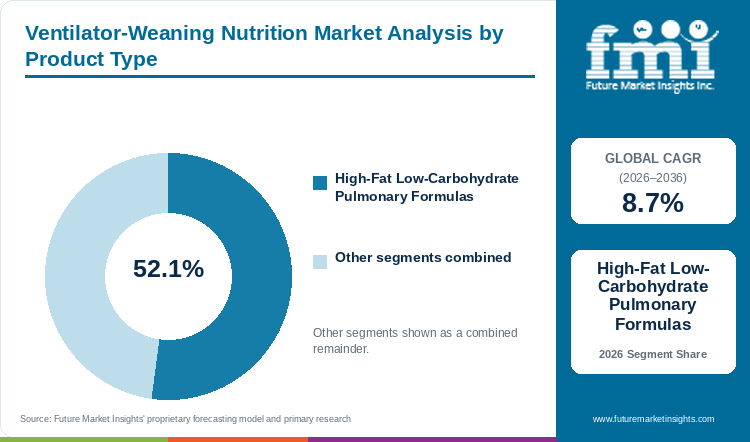
High-fat low-carbohydrate pulmonary formulas are expected to lead product type sales with 52.1% share in 2026, ahead of energy-dense fluid-restricted feeds at about 22.4% and high-protein weaning formulas at an estimated 18.3%.
Table 3: Product Type Share for the Ventilator-Weaning Nutrition Market (percentage share), 2026
| Product Type | Estimated Share (2026) |
|---|---|
| High-Fat Low-Carbohydrate Pulmonary Formulas | 52.1% |
| Energy-Dense Fluid-Restricted Feeds | 22.4% |
| High-Protein Weaning Formulas | 18.3% |
| Others | 7.2% |
| Total | 100.0% |
Table 4: Product Type Leadership and Market Growth for the Ventilator-Weaning Nutrition Market (segment and CAGR percentage), 2026 to 2036
| Metric | Value |
|---|---|
| Global CAGR (2026 to 2036) | 8.7% |
| Leading Segment | High-Fat Low-Carbohydrate Pulmonary Formulas |
High-fat low-carbohydrate pulmonary formulas are expected to lead product type, holding 52.1% of 2026 sales, since respiratory units list a pulmonary feed for patients with carbon dioxide retention and a long history of chronic lung disease. Behind pulmonary formulas, energy-dense fluid-restricted feeds, about 22.4%, suit patients on fluid limits with heart or kidney strain, a narrower group. High-protein weaning formulas, near 18.3%, target muscle loss, and dietitians often add a protein module to a standard feed in place of a full switch. Others, an estimated 7.2%, include immune-modulating and peptide feeds. In a related field, wasting in chronic lung patients overlaps with weaning cases, and the respiratory cachexia nutrition market is projected at an 8.4% CAGR. Over the forecast period, pulmonary formulas will keep the lead, with protein-dense feeds gaining as ICU teams raise protein targets.
- Pulmonary tube feeds and pulmonary sip feeds for chronic lung patients make up most of the leading group.
- Suppliers are developing enteral products closer to Asian demand. Fresenius Kabi opened an expanded enteral nutrition R&D center in Gurugram, India, on 26 June 2025.[7] Local development lowers the cost of specialty feeds for Indian ICUs.
What keeps active weaning trials ahead in ventilator-weaning nutrition by weaning stage?
Active weaning trials are projected to lead weaning stage sales with 48.7% share in 2026, with post-extubation recovery at about 30.6% and prolonged tracheostomy weaning near 20.7%.
Table 5: Weaning Stage Share for the Ventilator-Weaning Nutrition Market (percentage share), 2026
| Weaning Stage | Estimated Share (2026) |
|---|---|
| Active Weaning Trials | 48.7% |
| Post-Extubation Recovery | 30.6% |
| Prolonged Tracheostomy Weaning | 20.7% |
| Total | 100.0% |
Active weaning trials are projected to stay first by stage in 2026, at 48.7%, as feed changes cluster in the days when sedation is lowered and spontaneous breathing trials begin. After that, post-extubation recovery, about 30.6%, moves patients to sip feeds and supplements once swallowing is checked, and volumes per patient fall. By comparison, prolonged tracheostomy weaning, near 20.7%, involves fewer patients over weeks or months in specialist units. Each extra ventilated bed adds weaning episodes, so growth of the ventilator market feeds this stage. For reference, ICNARC reported that 40% of organ-support patients in 2024-25 received advanced respiratory support.[1] With that share on ventilators, most long critical care stays include a weaning step. Active trials will keep the lead as ICUs shorten time to the first breathing trial.
- Spontaneous breathing trials, sedation holds and ventilator step-downs define the active weaning phase.
- Weaning nutrition continues well after the ICU. Average critical care stay in the ICNARC 2024-25 report was 6 days, and acute hospital stay 20 days.[1] A hospital stay three times longer than the ICU stay shifts much of the feeding volume to post-extubation products.
Why do enteral tube feeds lead ventilator-weaning nutrition sales by feeding route?
Enteral tube feeds are likely to lead feeding route sales with 49.7% share in 2026, ahead of oral nutritional supplements at about 33.5% and protein modules at roughly 16.8%.
Table 6: Feeding Route Share for the Ventilator-Weaning Nutrition Market (percentage share), 2026
| Feeding Route | Estimated Share (2026) |
|---|---|
| Enteral Tube Feeds | 49.7% |
| Oral Nutritional Supplements | 33.5% |
| Protein Modules | 16.8% |
| Total | 100.0% |
By route, enteral tube feeds will hold the lead in 2026 with 49.7% of sales, as a patient with a breathing tube cannot eat or drink by mouth. Later, oral nutritional supplements, about 33.5%, take over after extubation and swallow assessment, and each patient drinks fewer calories by mouth at first. Alongside both, protein modules, near 16.8%, are added to tube feeds or drinks to reach protein targets without extra volume. Some patients cannot absorb tube feeds and receive intravenous nutrition, and the parenteral nutrition market, which lies outside this market, grows on a projected 6.5% CAGR. Suppliers are lining up tube and oral brands under one roof. On the supplier side, Danone now runs Nutricia, Kate Farms, Real Food Blends and Functional Formularies as one US business.[6] A single business across formats lets Danone move a patient from tube feed to oral drink without a brand change. Tube feeds will hold the lead, and supplements will gain as more patients leave the ICU breathing unaided.
- The enteral group spans polymeric, energy-dense and pulmonary tube feeds.
- US home tube feeding is bought in short cycles. Medicare limits each enteral nutrient delivery to a one-month supply.[4] Monthly deliveries create frequent reorder points, and each one carries claim risk.
Why do intensive care units lead ventilator-weaning nutrition sales by care setting?
Intensive care units are estimated to lead care setting sales with 45% share in 2026, with long-term acute care hospitals at about 26.3% and specialist weaning centers near 18.4%.
Table 7: Care Setting Share for the Ventilator-Weaning Nutrition Market (percentage share), 2026
| Care Setting | Estimated Share (2026) |
|---|---|
| Intensive Care Units | 45% |
| Long-Term Acute Care Hospitals | 26.3% |
| Specialist Weaning Centers | 18.4% |
| Others | 10.3% |
| Total | 100.0% |
Intensive care units are estimated to lead the setting split at 45% for 2026, since ventilation starts there and nutrition support teams write the first feeding plan. Long-term acute care hospitals, about 26.3%, take patients who fail early weaning, and stays run for weeks. Specialist weaning centers, near 18.4%, are fewer and run inside large hospital groups. Others, about 10.3%, include high-dependency units and home ventilation services. Bed capacity sets the ceiling for ICU orders. To illustrate, Germany ran about 26,000 intensive care beds in 2024.[5] A bed base of that size makes German ICUs a large single buyer group in Europe. Pumps and giving sets fall outside this market, and the enteral feeding devices market measures that hardware. Through 2036, ICUs will stay ahead, with long-term acute care growing as older patients wean more slowly.
- Medical, surgical and respiratory ICUs account for most intensive care demand.
- Hospital activity in Germany is rising again. German hospitals treated 17.5 million inpatient cases in 2024, up 2% on 2023.[5] More inpatient cases bring more ICU admissions and weaning episodes.
Why does hospital formulary purchase lead ventilator-weaning nutrition sales by purchasing route?
Hospital formulary purchase is forecast to lead purchasing route sales with 45.2% share in 2026, ahead of group purchasing contracts at about 24.6% and public tenders at an estimated 17.1%.
Table 8: Purchasing Route Share for the Ventilator-Weaning Nutrition Market (percentage share), 2026
| Purchasing Route | Estimated Share (2026) |
|---|---|
| Hospital Formulary Purchase | 45.2% |
| Group Purchasing Contracts | 24.6% |
| Public Tenders | 17.1% |
| Home Enteral Supply | 13.1% |
| Total | 100.0% |
In 2026, hospital formulary purchase is forecast to lead purchasing routes on 45.2%, as nutrition committees approve each pulmonary or protein feed and pharmacy stocks the listed codes. Meanwhile, group purchasing contracts, about 24.6%, cover US hospital networks and pull price down for standard feeds. Public tenders, near 17.1%, serve single-payer systems in Europe and Asia, and award cycles run for years. Home enteral supply, an estimated 13.1%, starts after discharge and faces Medicare documentation rules.[4] Those rules make home supply the slowest route to scale. In addition, Nestlé is merging Nestlé Health Science into the Nutrition business to be run locally through the Zones, a change that will reshape account teams.[8] In the years ahead, formulary purchase will keep the lead, and home supply will grow as more patients leave hospital on a tube.
- ICU pharmacies, nutrition committees and ward stock systems run most formulary purchasing.
- Claim paperwork is the main hurdle for US home feeds. Insufficient documentation accounted for 48.8% of improper Medicare enteral payments in 2024.[4] Suppliers that help homecare providers file complete claims keep more of the refills.
What are the drivers, restraints, and opportunities in the ventilator-weaning nutrition market?
Structured ICU feeding and early rehabilitation keep demand for ventilator-weaning nutrition growing. Patient tolerance, formulary approval and home claim rules limit specialty feeds, and products spanning tube and oral use open new sales.
- Driver: ICU teams now plan protein and energy delivery alongside breathing trials and mobility, which turns nutrition into a scheduled part of weaning.
- Restraint: Specialty feeds suit only selected patients, and each product needs to clear tolerance checks, committee review and payer paperwork before regular use.
- Opportunity: Ranges spanning tube feed, sip feed and protein module let one supplier follow a patient from ventilator to home.
Structured ICU Feeding Supports Steady Orders
Protocols linking feeding with rehabilitation are spreading, and planned weaning nutrition is gaining with them. As a sign of this, Fresenius Kabi awarded EUR 250,000 in September 2025 to a multicenter trial testing tailored nutrition with early mobilisation in ventilated ICU patients.[3] Funding of this kind builds the evidence ICU teams need to write nutrition into weaning protocols. In volume terms, ICNARC data show 222,377 critical care admissions in 2024-25.[1] In turn, protocol-driven units order feeds on schedule, which steadies demand.
Paperwork and Tolerance Limit Specialty Feeds
Key challenges in the ventilator-weaning nutrition market start after the ICU. In the US, CMS reported a 23.8% improper payment rate for Medicare enteral nutrition in 2024, with insufficient documentation behind 48.8% of improper payments and medical necessity behind 27.6%.[4] Denied claims delay home refills, which slows the shift of weaning patients to home supply. Within the hospital, feed tolerance and kidney function narrow the use of specialty formulas. As a result, suppliers face the double task of clinical fit and claim support.
Tube-to-Oral Ranges Open New Sales
Demand for ventilator-weaning nutrition beyond the ICU is opening up as care moves to wards and homes. Among suppliers, Danone combined Nutricia, Kate Farms, Real Food Blends and Functional Formularies in July 2025, serving hospitals, home, online and retail.[6] A combined business of that kind can stay with a patient from hospital to home. In FMI's estimate, post-extubation recovery and prolonged tracheostomy weaning together account for 51.3% of 2026 stage sales. Consequently, suppliers with linked tube and oral products will gain those later stages.
Which country CAGRs are profiled in the ventilator-weaning nutrition market?
Table 9: Country CAGR Comparison for the Ventilator-Weaning Nutrition Market (CAGR percentage), 2026 to 2036
| Country | CAGR (2026 to 2036) |
|---|---|
| India | 9.8% |
| South Korea | 9.1% |
| United States | 8.2% |
| United Kingdom | 7.9% |
| Germany | 7.6% |
| Japan | 7% |
How do country-level CAGRs compare in the ventilator-weaning nutrition market?
Indian ICU nutrition is moving from imports toward local development. Fresenius Kabi opened an expanded enteral nutrition R&D center in Gurugram on 26 June 2025.[7] FMI places India ahead of every other country at 9.8%, as private ICU expansion and local product work push the rate ahead of the 8.7% global CAGR. Second, South Korea, at 9.1%, adds older ICU patients each year. Below that, the United States grows at 8.2%, with home enteral claims under close review. Under fixed hospital budgets, the British rate is 7.9% and the German one 7.6%. Last of all, Japan grows slowest, at 7%, from settled ICU feeding practice.
- Private hospital groups in Indian cities are adding ICU beds, and local enteral R&D lowers feed costs. Suppliers with Indian development centres can price specialty feeds for that market.
- Older Korean ICU patients take longer to wean, adding feeding days per stay, and suppliers working with tertiary hospital nutrition support teams in Seoul gain the first listing.
- Medicare paperwork decides how fast US weaning patients move to home tube feeds. Suppliers that help homecare providers complete claims hold more of the post-discharge volume.
- In the United Kingdom, national audit and framework buying keep feed choice centralised and price-led, which favours full-range suppliers on NHS frameworks.
- German ICUs are numerous and well stocked, so growth comes from protocol updates more than new beds. Central purchasing groups reward suppliers able to serve weaning units across a hospital chain.
- Settled feeding protocols in Japanese ICUs leave little room for new products, though longer weaning among very old patients adds feeding days and opens a gap for compact protein formats.
Full report country CAGRs cover: two fast-growing Asian rates, four mature-system rates from 8.2% down to 7%, and regional coverage of the remaining standard countries.
Country-wise Analysis
India Ventilator-Weaning Nutrition Market Outlook (2026 to 2036)
India builds from a small ICU nutrition base, and sales of ventilator-weaning nutrition in India are forecast to rise on a 9.8% CAGR. On the research side, Fresenius Kabi said the Gurugram center has advanced laboratories and specialised infrastructure for enteral nutrition, set to take on new projects from the third quarter.[7] Local development should shorten the path from global formulas to versions priced for Indian hospitals. For now, private hospital ICUs in large cities buy most commercial feeds, and a small base keeps growth high.
Key takeaway: India gains from a small base as private ICUs expand, and local product work lets suppliers meet Indian price points.
South Korea Ventilator-Weaning Nutrition Market Outlook (2026 to 2036)
South Korea is expected to see a 9.1% CAGR for weaning feeds, as older admissions lengthen ICU stays. On the demographic side, the Kyunghyang Shinmun reported on 28 July 2026 that the 2025 census counted 10.72 million residents aged 65 or older, 20.7% of the population.[2] Alongside this, many tertiary hospitals in Seoul run nutrition support teams in ICUs, which turns a larger older population into more planned weaning diets.
Key takeaway: Korean demand rises with the age of ICU patients, and hospital nutrition teams in Seoul set the brand choice for the rest of the stay.
United States Ventilator-Weaning Nutrition Market Outlook (2026 to 2036)
Long-term acute care hospitals and home supply shape the United States, and FMI estimates an 8.2% CAGR there. On claims, CMS updated the enteral nutrition compliance tip on 11 February 2026, reporting a 23.8% improper payment rate and USD 31.1 million in projected improper payments for 2024.[4] Improper payment rates of that size keep homecare providers cautious about new specialty feeds. Meanwhile, Danone's combined US medical nutrition business now reaches hospitals and homes under one roof.[6] Even so, claim rules hold back the pace of home volume.
Key takeaway: US growth comes from long-term acute care and home supply, and claim accuracy now decides how much of that home volume a supplier keeps.
United Kingdom Ventilator-Weaning Nutrition Market Outlook (2026 to 2036)
Growth in the United Kingdom is likely to run at 7.9%, with critical care closely audited. For instance, ICNARC's 2024-25 report covered 286 adult critical care units and 222,377 admissions, with 88.5% of patients surviving to critical care discharge.[1] High survival to discharge means more patients reach the ward stage and need oral supplements. On purchasing, NHS trusts buy feeds through national frameworks, and price competition keeps growth moderate.
Key takeaway: British volume is large but bought centrally, so suppliers compete for framework places on price and range.
Germany Ventilator-Weaning Nutrition Market Outlook (2026 to 2036)
FMI's forecast for Germany is a 7.6% CAGR. For context, Destatis data reported by Deutsches Ärzteblatt on 6 November 2025 show 1,841 hospitals, about 26,000 intensive care beds and 17.5 million inpatient cases in 2024.[5] Within that base, specialist weaning units run inside many larger hospitals and buy feeds through central purchasing, so a single central contract can cover many weaning beds.
Key takeaway: German orders are high in volume and steady, with central purchasing groups choosing feeds for whole hospital chains.
Japan Ventilator-Weaning Nutrition Market Outlook (2026 to 2036)
FMI expects demand in Japan to rise 1.7 points slower than the global CAGR of 8.7%, at 7%. On ageing, the Statistics Bureau counted 12.88 million residents aged 80 or older on 15 September 2026, 10.5% of the population.[9] Japanese ICUs already run settled feeding protocols, so growth comes mainly from older patients and longer weaning.
Key takeaway: Japanese growth comes from longer weaning in very old patients more than from new ICU capacity, which favours protein-dense compact feeds.
Who are the notable companies in the ventilator-weaning nutrition market?
Abbott, Nestlé Health Science, Danone Nutricia, Fresenius Kabi, B. Braun, Medtrition and Victus are the profiled companies.
Top companies operating in the ventilator-weaning nutrition market include pulmonary formula brands, hospital nutrition platforms and protein module makers. Among the formula brands, Nestlé Health Science reported 3.2% organic growth for 2025 and CHF 6,551 million of sales.[8] Growth on that base gives Nestlé the scale to defend pulmonary formula listings. On the platform side, Fresenius Kabi is funding ventilated-patient nutrition research and expanding enteral R&D in India.[3][7] Research funding keeps Fresenius Kabi close to the teams that write ICU protocols. Meanwhile, Danone Nutricia gained US home and hospital reach through Kate Farms.[6] Home reach counts for more as patients leave hospital still on a tube. FMI also counts Abbott, B. Braun, Medtrition and Victus.
- Pulmonary and respiratory formula brands: Abbott, Nestlé Health Science and Danone Nutricia.
- Hospital clinical nutrition platforms: Fresenius Kabi and B. Braun.
- Protein module and specialty feed makers: Medtrition and Victus.
Competitive Benchmarking: Ventilator-Weaning Nutrition Market
Table 10: Competitive Benchmarking for the Ventilator-Weaning Nutrition Market (qualitative ratings), 2026
| Company | Tube Feeds | Oral Supplements | ICU Research | Recent Activity |
|---|---|---|---|---|
| Fresenius Kabi | High | High | High | High |
| Danone Nutricia | High | High | Low | Medium |
| Nestlé Health Science | Medium | High | Low | High |
| Abbott | High | High | Low | Low |
| B. Braun | High | Medium | Low | Low |
Ratings set the companies side by side on tube feeds, oral supplements, ICU research and recent activity.
Key Developments in the Ventilator-Weaning Nutrition Market
- Nestlé said on 19 February 2026 that Nestlé Health Science will be merged into the Nutrition business and run through the Zones, which will change how hospital accounts are served.[8]
- CMS updated Medicare enteral nutrition compliance figures for the 2024 reporting period on 11 February 2026, keeping claim accuracy in focus for home suppliers.[4]
- Destatis figures published by Deutsches Ärzteblatt on 6 November 2025 put German hospital ICU beds at about 26,000 for 2024, a large and stable buyer base.[5]
- On 15 September 2025, Fresenius Kabi announced a EUR 250,000 JUMPstart award for a ventilated ICU nutrition and mobility trial, a step toward firmer protein targets in weaning.[3]
- Kate Farms became part of the Danone US medical nutrition business on 1 July 2025, next to Nutricia, Real Food Blends and Functional Formularies, widening Danone reach into home feeding.[6]
- In Gurugram, India, Fresenius Kabi opened an expanded enteral nutrition R&D center on 26 June 2025; for Indian ICUs this means locally developed feeds.[7]
Key Players in the Ventilator-Weaning Nutrition Market
Pulmonary and Respiratory Formula Brands
- Abbott
- Nestlé Health Science
- Danone Nutricia
Hospital Clinical Nutrition Platforms
- Fresenius Kabi
- B. Braun
Protein Module and Specialty Feed Makers
- Medtrition
- Victus
Ventilator-Weaning Nutrition Market - Report Scope
Table 11: Report Scope for the Ventilator-Weaning Nutrition Market (coverage fields and definitions), 2026 to 2036
| Coverage field | Report scope |
|---|---|
| Market breakdown | Product type; weaning stage; feeding route; care setting; purchasing route; region |
| Quantitative units | USD million |
| Market definition | Enteral and oral medical nutrition products used for adult patients during and after weaning from mechanical ventilation, covering pulmonary, energy-dense and high-protein formulas, tube feeds, oral nutritional supplements and protein modules bought by hospitals, purchasing groups, public tenders and home enteral suppliers. Ventilators, feeding pumps and sets, parenteral nutrition, drugs and care services are excluded. |
| Regions covered | North America; Latin America; Western Europe; Eastern Europe; East Asia; South Asia and Pacific; Middle East and Africa |
| Countries covered | United States; Canada; Brazil; Mexico; Argentina; Chile; Germany; France; United Kingdom; Italy; Spain; Benelux; Nordics; Poland; Czech Republic; Romania; Hungary; China; Japan; South Korea; India; ASEAN; Australia and New Zealand; GCC Countries; South Africa; Türkiye; Israel |
| Key companies profiled | Abbott, Nestlé Health Science, Danone Nutricia, Fresenius Kabi, B. Braun, Medtrition, Victus |
| Forecast period | 2026 to 2036 |
Ventilator-Weaning Nutrition Market - Research Methodology
Table 12: Research Methodology for the Ventilator-Weaning Nutrition Market (research methods and approach), 2026 edition
| Method | Approach |
|---|---|
| Data Sources | Critical care audit reports, payer compliance data, hospital statistics and medical nutrition company releases. |
| Desk Research | Desk research covers ICU admissions, ventilation rates, enteral claim rules, feeding trials and supplier moves. |
| Market Sizing and Forecasting | Sizing starts from the 2026 base of USD 108.5 million and the 8.7% CAGR for 2026 to 2036. |
| Data Validation | Figures are cross-checked across company, industry and government sources. |
Ventilator-Weaning Nutrition Market by Segments
Ventilator-Weaning Nutrition Market segmented by Product Type:
- High-Fat Low-Carbohydrate Pulmonary Formulas
- Energy-Dense Fluid-Restricted Feeds
- High-Protein Weaning Formulas
- Others
Ventilator-Weaning Nutrition Market segmented by Weaning Stage:
- Active Weaning Trials
- Post-Extubation Recovery
- Prolonged Tracheostomy Weaning
Ventilator-Weaning Nutrition Market segmented by Feeding Route:
- Enteral Tube Feeds
- Oral Nutritional Supplements
- Protein Modules
Ventilator-Weaning Nutrition Market segmented by Care Setting:
- Intensive Care Units
- Long-Term Acute Care Hospitals
- Specialist Weaning Centers
- Others
Ventilator-Weaning Nutrition Market segmented by Purchasing Route:
- Hospital Formulary Purchase
- Group Purchasing Contracts
- Public Tenders
- Home Enteral Supply
Ventilator-Weaning Nutrition Market by Region
- North America
- United States
- Canada
- Latin America
- Brazil
- Mexico
- Argentina
- Chile
- Western Europe
- Germany
- France
- United Kingdom
- Italy
- Spain
- Benelux
- Nordics
- Eastern Europe
- Poland
- Czech Republic
- Romania
- Hungary
- East Asia
- China
- Japan
- South Korea
- South Asia and Pacific
- India
- ASEAN
- Australia and New Zealand
- Middle East and Africa
- GCC Countries
- South Africa
- Türkiye
- Israel
Research Sources and Bibliography
- [1] Intensive Care National Audit & Research Centre. (2026, May). Case Mix Programme Public Report 2024-25: Public Summary. https://www.icnarc.org/wp-content/uploads/2026/05/Public-Summary-CMP-2024-25.pdf
- [2] The Kyunghyang Shinmun. (2026, July 28). An era with 10 million people aged 65 and over has begun. https://www.khan.co.kr/en/article/202607281403017
- [3] Fresenius Kabi. (2025, September 15). JUMPstart Clinical Nutrition Award winner announced at ESPEN congress. https://www.fresenius-kabi.com/tw/news/jumpstart-clinical-nutrition-winner-announced-at-espen
- [4] Centers for Medicare & Medicaid Services. (2026, February 11). Medicare Provider Compliance Tips: Enteral Nutrition. https://www.cms.gov/training-education/medicare-learning-networkr-mln/compliance/medicare-provider-compliance-tips/enteral-nutrition
- [5] Deutsches Ärzteblatt. (2025, November 6). Krankenhäuser verzeichnen deutlichen Personalaufwuchs. https://www.aerzteblatt.de/news/krankenhauser-verzeichnen-deutlichen-personalaufwuchs
- [6] Danone. (2025, July 1). Danone completes the acquisition of Kate Farms, enhancing its U.S. specialized nutrition offerings. https://www.danone.com/newsroom/press-releases/kate-farms-acquisition.html
- [7] Fresenius Kabi. (2025, June 26). New R&D center in India strengthens Fresenius Kabi's innovation network. https://www.fresenius-kabi.com/news/new-r-and-d-center-india
- [8] Nestlé S.A. (2026, February 19). Full-year results 2025. https://www.nestle.com/media/pressreleases/allpressreleases/full-year-results-2025
- [9] Statistics Bureau of Japan. (2026, September 20). Statistical Topics No. 149: Elderly People in Japan from Statistics. https://www.stat.go.jp/data/topics/pdf/topics149.pdf
This bibliography is provided for reader reference. The full report contains the complete reference list and detailed citations.
This Report Answers
- How big is the ventilator-weaning nutrition market during 2026?
- What market size is projected by 2036?
- Which product type holds notable share?
- Which weaning stage holds notable share?
- Which countries have notable growth?
- Which companies are notable in the market?
Frequently Asked Questions
How large is the ventilator-weaning nutrition market expected in 2026?
The ventilator-weaning nutrition market is expected to reach USD 108.5 million in 2026, against an estimated USD 99.8 million in 2025. FMI projects sales of ventilator-weaning nutrition at USD 249.8 million by 2036.
What CAGR is projected for the ventilator-weaning nutrition market through 2036?
Demand for ventilator-weaning nutrition is projected to grow at an 8.7% CAGR through 2036. ICU feeding protocols, older ventilated patients and tube-to-oral product ranges support that growth.
Which product type holds a notable market share in 2026?
High-fat low-carbohydrate pulmonary formulas are expected to lead with 52.1% share in 2026. Energy-dense fluid-restricted feeds follow at about 22.4%.
Which weaning stage holds a notable market share in 2026?
Active weaning trials will lead with 48.7% share in 2026. Post-extubation recovery holds an estimated 30.6%.
Which country has a notable expansion outlook through 2036?
FMI projects India to grow fastest, at 9.8%. South Korea follows at 9.1%.
Who are the key companies in the ventilator-weaning nutrition market?
Abbott, Nestlé Health Science and Danone Nutricia lead the pulmonary formula group, and Fresenius Kabi and B. Braun lead the hospital platforms. Medtrition and Victus complete the profiled companies.
Preview the report firsthand - request a free sample
Get SampleGet the brochure for pricing and purchase details.
Get PDFTable of Content
- Key Takeaways
- Market Size and CAGR
- Top Growth Driver
- Fastest Growing Segment
- Leading Region
- Key Companies
- Emerging Opportunities
- Executive Summary
- Global Market Outlook
- Demand-side Trends
- Supply-side Trends
- Technology Roadmap Analysis
- Analysis and Recommendations
- Analyst Perspective (What is happening? Why now? What should investors know?)
- Key Questions Answered
- How large is the market?
- What is the CAGR?
- What are key trends?
- Which region dominates?
- Who are the leaders?
- Market Overview
- Market Coverage / Taxonomy
- Market Definition / Scope / Limitations
- Research Methodology
- Chapter Orientation
- Analytical Lens and Working Hypotheses
- Market Structure, Signals, and Trend Drivers
- Benchmarking and Cross-market Comparability
- Market Sizing, Forecasting, and Opportunity Mapping
- Research Design and Evidence Framework
- Desk Research Programme (Secondary Evidence)
- Expert Input and Fieldwork (Primary Evidence)
- Tooling, Models, and Reference Databases
- Data Engineering and Model Build
- Quality Assurance and Audit Trail
- Market Background
- Market Dynamics (Drivers, Restraints, Opportunity, Trends)
- Scenario Forecast (Optimistic, Likely, Conservative)
- Impact Analysis
- AI Impact
- Sustainability Impact
- Regulatory Impact
- Technology Impact
- Consumer / Buyer Analysis
- Purchase Drivers
- Adoption Barriers
- Buyer Journey
- Opportunity Map Analysis
- Product Life Cycle Analysis
- Supply Chain Analysis
- Investment Feasibility Matrix
- Value Chain Analysis
- PESTLE and Porter's Analysis
- Regulatory Landscape
- Regional Parent Market Outlook
- Production and Consumption Statistics
- Import and Export Statistics
- Global Market Analysis and Forecast, 2021 to 2036
- Historical Market Size Value (USD Million) Analysis, 2021 to 2025
- Current and Future Market Size Value (USD Million) Projections, 2026 to 2036
- Y-o-Y Growth Trend Analysis
- Absolute $ Opportunity Analysis
- Global Market Pricing Analysis, 2021 to 2036
- Global Market Analysis and Forecast, By Product Type, 2021 to 2036
- Introduction / Key Findings
- Historical Market Size Value (USD Million) Analysis By Product Type, 2021 to 2025
- Current and Future Market Size Value (USD Million) Analysis and Forecast By Product Type, 2026 to 2036
- High-Fat Low-Carbohydrate Pulmonary Formulas
- Energy-Dense Fluid-Restricted Feeds
- High-Protein Weaning Formulas
- Others
- Y-o-Y Growth Trend Analysis By Product Type, 2021 to 2025
- Absolute $ Opportunity Analysis By Product Type, 2026 to 2036
- Global Market Analysis and Forecast, By Weaning Stage, 2021 to 2036
- Introduction / Key Findings
- Historical Market Size Value (USD Million) Analysis By Weaning Stage, 2021 to 2025
- Current and Future Market Size Value (USD Million) Analysis and Forecast By Weaning Stage, 2026 to 2036
- Active Weaning Trials
- Post-Extubation Recovery
- Prolonged Tracheostomy Weaning
- Y-o-Y Growth Trend Analysis By Weaning Stage, 2021 to 2025
- Absolute $ Opportunity Analysis By Weaning Stage, 2026 to 2036
- Global Market Analysis and Forecast, By Feeding Route, 2021 to 2036
- Introduction / Key Findings
- Historical Market Size Value (USD Million) Analysis By Feeding Route, 2021 to 2025
- Current and Future Market Size Value (USD Million) Analysis and Forecast By Feeding Route, 2026 to 2036
- Enteral Tube Feeds
- Oral Nutritional Supplements
- Protein Modules
- Y-o-Y Growth Trend Analysis By Feeding Route, 2021 to 2025
- Absolute $ Opportunity Analysis By Feeding Route, 2026 to 2036
- Global Market Analysis and Forecast, By Care Setting, 2021 to 2036
- Introduction / Key Findings
- Historical Market Size Value (USD Million) Analysis By Care Setting, 2021 to 2025
- Current and Future Market Size Value (USD Million) Analysis and Forecast By Care Setting, 2026 to 2036
- Intensive Care Units
- Long-Term Acute Care Hospitals
- Specialist Weaning Centers
- Others
- Y-o-Y Growth Trend Analysis By Care Setting, 2021 to 2025
- Absolute $ Opportunity Analysis By Care Setting, 2026 to 2036
- Global Market Analysis and Forecast, By Purchasing Route, 2021 to 2036
- Introduction / Key Findings
- Historical Market Size Value (USD Million) Analysis By Purchasing Route, 2021 to 2025
- Current and Future Market Size Value (USD Million) Analysis and Forecast By Purchasing Route, 2026 to 2036
- Hospital Formulary Purchase
- Group Purchasing Contracts
- Public Tenders
- Home Enteral Supply
- Y-o-Y Growth Trend Analysis By Purchasing Route, 2021 to 2025
- Absolute $ Opportunity Analysis By Purchasing Route, 2026 to 2036
- Global Market Analysis and Forecast, By Region, 2021 to 2036
- Introduction
- Historical Market Size Value (USD Million) Analysis By Region, 2021 to 2025
- Current Market Size Value (USD Million) Analysis and Forecast By Region, 2026 to 2036
- North America
- Latin America
- Western Europe
- Eastern Europe
- East Asia
- South Asia and Pacific
- Middle East and Africa
- Market Attractiveness Analysis By Region
- North America Market Analysis and Forecast, By Country, 2021 to 2036
- Historical Market Size Value (USD Million) Trend Analysis By Market Taxonomy, 2021 to 2025
- Market Size Value (USD Million) Forecast By Market Taxonomy, 2026 to 2036
- By Country
- United States
- Canada
- By Product Type
- By Weaning Stage
- By Feeding Route
- By Care Setting
- By Purchasing Route
- By Country
- Market Attractiveness Analysis
- By Country
- By Product Type
- By Weaning Stage
- By Feeding Route
- By Care Setting
- By Purchasing Route
- Key Takeaways
- Latin America Market Analysis and Forecast, By Country
- Historical Market Size Value (USD Million) Trend Analysis By Market Taxonomy, 2021 to 2025
- Market Size Value (USD Million) Forecast By Market Taxonomy, 2026 to 2036
- By Country
- Brazil
- Mexico
- Argentina
- Chile
- By Product Type
- By Weaning Stage
- By Feeding Route
- By Care Setting
- By Purchasing Route
- By Country
- Market Attractiveness Analysis
- By Country
- By Product Type
- By Weaning Stage
- By Feeding Route
- By Care Setting
- By Purchasing Route
- Key Takeaways
- Western Europe Market Analysis and Forecast, By Country
- Historical Market Size Value (USD Million) Trend Analysis By Market Taxonomy, 2021 to 2025
- Market Size Value (USD Million) Forecast By Market Taxonomy, 2026 to 2036
- By Country
- Germany
- France
- United Kingdom
- Italy
- Spain
- Benelux
- Nordics
- By Product Type
- By Weaning Stage
- By Feeding Route
- By Care Setting
- By Purchasing Route
- By Country
- Market Attractiveness Analysis
- By Country
- By Product Type
- By Weaning Stage
- By Feeding Route
- By Care Setting
- By Purchasing Route
- Key Takeaways
- Eastern Europe Market Analysis and Forecast, By Country
- Historical Market Size Value (USD Million) Trend Analysis By Market Taxonomy, 2021 to 2025
- Market Size Value (USD Million) Forecast By Market Taxonomy, 2026 to 2036
- By Country
- Poland
- Czech Republic
- Romania
- Hungary
- By Product Type
- By Weaning Stage
- By Feeding Route
- By Care Setting
- By Purchasing Route
- By Country
- Market Attractiveness Analysis
- By Country
- By Product Type
- By Weaning Stage
- By Feeding Route
- By Care Setting
- By Purchasing Route
- Key Takeaways
- East Asia Market Analysis and Forecast, By Country
- Historical Market Size Value (USD Million) Trend Analysis By Market Taxonomy, 2021 to 2025
- Market Size Value (USD Million) Forecast By Market Taxonomy, 2026 to 2036
- By Country
- China
- Japan
- South Korea
- By Product Type
- By Weaning Stage
- By Feeding Route
- By Care Setting
- By Purchasing Route
- By Country
- Market Attractiveness Analysis
- By Country
- By Product Type
- By Weaning Stage
- By Feeding Route
- By Care Setting
- By Purchasing Route
- Key Takeaways
- South Asia and Pacific Market Analysis and Forecast, By Country
- Historical Market Size Value (USD Million) Trend Analysis By Market Taxonomy, 2021 to 2025
- Market Size Value (USD Million) Forecast By Market Taxonomy, 2026 to 2036
- By Country
- India
- ASEAN
- Australia and New Zealand
- By Product Type
- By Weaning Stage
- By Feeding Route
- By Care Setting
- By Purchasing Route
- By Country
- Market Attractiveness Analysis
- By Country
- By Product Type
- By Weaning Stage
- By Feeding Route
- By Care Setting
- By Purchasing Route
- Key Takeaways
- Middle East and Africa Market Analysis and Forecast, By Country
- Historical Market Size Value (USD Million) Trend Analysis By Market Taxonomy, 2021 to 2025
- Market Size Value (USD Million) Forecast By Market Taxonomy, 2026 to 2036
- By Country
- GCC Countries
- South Africa
- Türkiye
- Israel
- By Product Type
- By Weaning Stage
- By Feeding Route
- By Care Setting
- By Purchasing Route
- By Country
- Market Attractiveness Analysis
- By Country
- By Product Type
- By Weaning Stage
- By Feeding Route
- By Care Setting
- By Purchasing Route
- Key Takeaways
- Key Countries Market Analysis
- United States
- Pricing Analysis
- Market Share Analysis, 2025
- By Product Type
- By Weaning Stage
- By Feeding Route
- By Care Setting
- By Purchasing Route
- Canada
- Pricing Analysis
- Market Share Analysis, 2025
- By Product Type
- By Weaning Stage
- By Feeding Route
- By Care Setting
- By Purchasing Route
- Mexico
- Pricing Analysis
- Market Share Analysis, 2025
- By Product Type
- By Weaning Stage
- By Feeding Route
- By Care Setting
- By Purchasing Route
- Brazil
- Pricing Analysis
- Market Share Analysis, 2025
- By Product Type
- By Weaning Stage
- By Feeding Route
- By Care Setting
- By Purchasing Route
- Chile
- Pricing Analysis
- Market Share Analysis, 2025
- By Product Type
- By Weaning Stage
- By Feeding Route
- By Care Setting
- By Purchasing Route
- Germany
- Pricing Analysis
- Market Share Analysis, 2025
- By Product Type
- By Weaning Stage
- By Feeding Route
- By Care Setting
- By Purchasing Route
- United Kingdom
- Pricing Analysis
- Market Share Analysis, 2025
- By Product Type
- By Weaning Stage
- By Feeding Route
- By Care Setting
- By Purchasing Route
- Italy
- Pricing Analysis
- Market Share Analysis, 2025
- By Product Type
- By Weaning Stage
- By Feeding Route
- By Care Setting
- By Purchasing Route
- Spain
- Pricing Analysis
- Market Share Analysis, 2025
- By Product Type
- By Weaning Stage
- By Feeding Route
- By Care Setting
- By Purchasing Route
- France
- Pricing Analysis
- Market Share Analysis, 2025
- By Product Type
- By Weaning Stage
- By Feeding Route
- By Care Setting
- By Purchasing Route
- India
- Pricing Analysis
- Market Share Analysis, 2025
- By Product Type
- By Weaning Stage
- By Feeding Route
- By Care Setting
- By Purchasing Route
- ASEAN
- Pricing Analysis
- Market Share Analysis, 2025
- By Product Type
- By Weaning Stage
- By Feeding Route
- By Care Setting
- By Purchasing Route
- Australia and New Zealand
- Pricing Analysis
- Market Share Analysis, 2025
- By Product Type
- By Weaning Stage
- By Feeding Route
- By Care Setting
- By Purchasing Route
- China
- Pricing Analysis
- Market Share Analysis, 2025
- By Product Type
- By Weaning Stage
- By Feeding Route
- By Care Setting
- By Purchasing Route
- Japan
- Pricing Analysis
- Market Share Analysis, 2025
- By Product Type
- By Weaning Stage
- By Feeding Route
- By Care Setting
- By Purchasing Route
- South Korea
- Pricing Analysis
- Market Share Analysis, 2025
- By Product Type
- By Weaning Stage
- By Feeding Route
- By Care Setting
- By Purchasing Route
- Poland
- Pricing Analysis
- Market Share Analysis, 2025
- By Product Type
- By Weaning Stage
- By Feeding Route
- By Care Setting
- By Purchasing Route
- Hungary
- Pricing Analysis
- Market Share Analysis, 2025
- By Product Type
- By Weaning Stage
- By Feeding Route
- By Care Setting
- By Purchasing Route
- Türkiye
- Pricing Analysis
- Market Share Analysis, 2025
- By Product Type
- By Weaning Stage
- By Feeding Route
- By Care Setting
- By Purchasing Route
- South Africa
- Pricing Analysis
- Market Share Analysis, 2025
- By Product Type
- By Weaning Stage
- By Feeding Route
- By Care Setting
- By Purchasing Route
- United States
- Market Structure Analysis
- Competition Dashboard
- Competition Benchmarking
- Market Share Analysis of Top Players
- By Regional
- By Product Type
- By Weaning Stage
- By Feeding Route
- By Care Setting
- By Purchasing Route
- Emerging Startups
- Innovation Benchmarking
- Competition Analysis
- Competition Deep Dive
- Fresenius Kabi
- Overview
- Product Portfolio
- Profitability by Market Segments
- Sales Footprint
- Strategy Overview
- Marketing Strategy
- Product Strategy
- Channel Strategy
- Danone Nutricia
- Nestlé Health Science
- Abbott
- B. Braun
- Medtrition
- Victus
- Fresenius Kabi
- Case Studies
- Success Stories
- Recent Developments
- Competition Deep Dive
- Assumptions & Acronyms Used


