

- Market Size (2026)
- USD 2.5 Bn
- Forecast (2036)
- USD 5.2 Bn
- CAGR (2026 to 2036)
- 7.7%
How big is the Vessel Fleet Monitoring Systems Market in 2026?
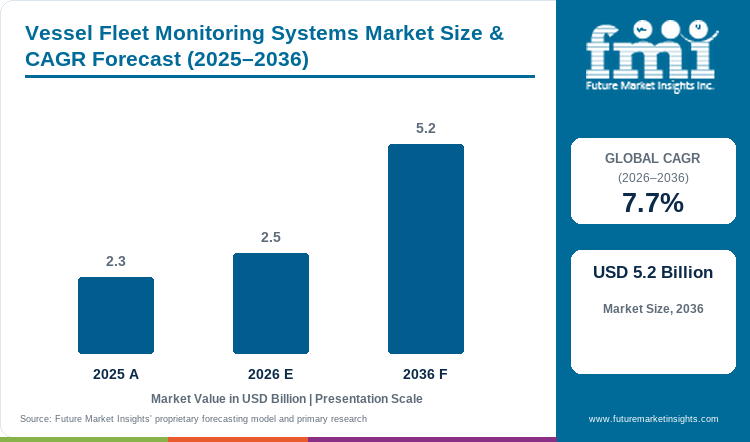
USD 2.5 Billion in 2026 and USD 5.2 Billion by 2036 at a 7.7% CAGR.
Demand for Vessel Fleet Monitoring Systems is estimated at USD 2.5 Billion in 2026 and is forecast to reach USD 5.2 Billion by 2036, growing at a CAGR of 7.7%. The market was valued at USD 2.3 Billion in 2025. Fleet monitoring is moving beyond position reporting because shore teams increasingly need vessel location to be connected with fuel use, machinery condition and safety status. The International Maritime Organization adopted mandatory technical and operational carbon-intensity measures in June 2021, reinforcing the value of reliable operational records for covered ships. Buyers therefore compare systems on the quality of the vessel data they collect and how easily that data can support maintenance, dispatch, compliance and operating decisions.
Adoption differs by fleet and jurisdiction. Mexico has extended satellite monitoring to smaller fishing vessels, Brazil is modernizing its PREPS tracking framework, and Norway uses automatic tracking within Svalbard position-reporting rules. NOAA Fisheries maintains a current list of type-approved vessel monitoring units in the USA, while dense port activity in the Netherlands raises the value of reliable vessel-to-shore data exchange. These conditions favor different hardware and connectivity designs. A purchase follows when the system can integrate with installed marine electronics, maintain coverage on the operating route and meet the applicable reporting or cybersecurity requirement.
Key Takeaways
- The market is estimated at USD 2.5 Billion in 2026 and is forecast to reach USD 5.2 Billion by 2036 at a 7.7% CAGR.
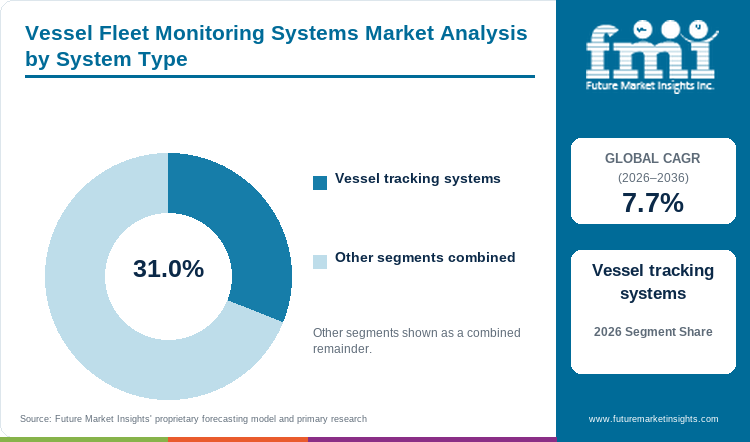
- Vessel tracking systems are projected to account for 31.0% of System Type demand in 2026.
- Commercial workboats are estimated at 26.0% of Fleet Type demand in 2026.
- Cellular is forecast to hold 24.0% of Connectivity demand in 2026.
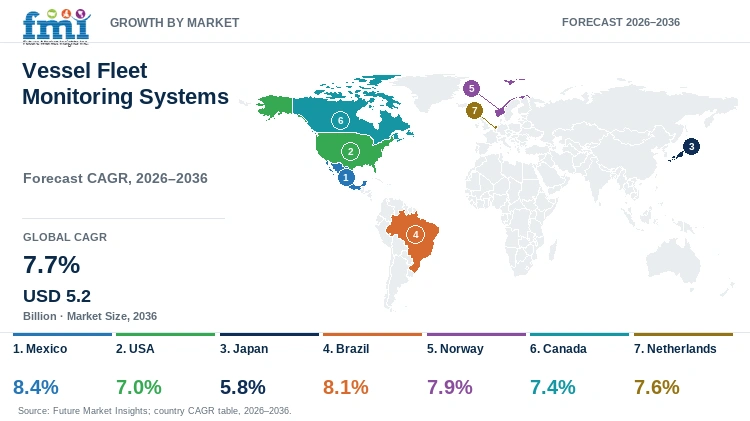
- Mexico records the highest country CAGR shown at 8.4% from 2026 to 2036, followed by Brazil at 8.1% and Norway at 7.9%.
- Retrofit integration and cybersecurity can slow deployment because mixed-age fleets use different sensor buses and bridge systems.
- Current competition spans maritime connectivity, onboard marine electronics and fleet-performance software, with stronger vessel-specific evidence from companies such as Viasat, Iridium, Garmin, Navico Group, Kongsberg Maritime and Wärtsilä.
Analyst Perspective
Fleet monitoring creates value only when collected data changes an operating decision. The strongest systems reduce the integration burden across mixed vessel types, preserve connectivity across the intended route and turn onboard signals into actions that shore teams can use consistently. Connectivity by itself is not enough if the data remains disconnected from maintenance, dispatch or compliance workflows.
- Sudip saha, Principal Analyst at Future Market Insights
How is the Vessel Fleet Monitoring Systems Market segmented?
The Vessel Fleet Monitoring Systems Market is segmented by System Type, Fleet Type, Connectivity, Deployment, Sales Channel and Region.
System Type identifies the operating problem being monitored, such as position, machinery condition or compliance. Fleet Type reflects duty cycle and vessel environment. Connectivity defines how data moves between vessel and shore. Deployment shows whether the offer combines onboard hardware with recurring software, while Sales Channel identifies who integrates and supports the solution. The same fleet may use different configurations across harbor craft, fishing vessels and offshore assets.
Why do Vessel tracking systems lead the System Type category?
Vessel tracking systems form the common location layer for route oversight, geofencing and exception analysis. Position gives shore teams the context needed to interpret fuel, engine or safety events and is also central to regulated vessel-monitoring programs. The use case overlaps with the broader vessel tracking market, where continuous visibility and route history are core functions.
- Vessel tracking systems hold a 31.0% share in 2026 because position data is the common reference for route oversight, geofencing and compliance workflows.
- ORBCOMM continues to offer a Vessel Monitoring System terminal application for satellite-based tracking and regulatory reporting, while its former AIS data-services business was transferred to S&P Global Market Intelligence following the 2025 acquisition.
Why do Commercial workboats lead the Fleet Type category?
Commercial workboats operate as productive assets, so downtime and route uncertainty have a direct operating cost. Tugboats and other working vessels benefit when shore teams can see position, equipment condition and safety status without waiting for manual reports. The onboard stack sits within the wider marine electronics market, where sensors and integrated bridge systems provide the data layer used by remote monitoring platforms.
- Commercial workboats hold a 26.0% share in 2026 because operators need position, machinery and safety visibility across high-utilization vessels.
- Iridium launched Certus GMDSS in December 2024, combining GMDSS services with LRIT, SSAS and broadband connectivity through a single satellite platform.
Why does Cellular lead the Connectivity category?
Cellular connectivity works well for vessels that spend substantial time near ports, inland waterways or populated coastlines. It can move frequent telemetry without the service profile of always-on satellite communication, although fleets that operate beyond mobile coverage still need satellite or hybrid fallback. This tradeoff is closely related to the maritime satellite communication market, where offshore coverage remains the critical value proposition.
- Cellular holds a 24.0% share in 2026 because coastal and port-connected fleets can use existing mobile networks for frequent telemetry at a lower operating burden.
- Garmin currently maintains OnDeck cellular coverage for its marine remote-connectivity platform, illustrating the continuing role of 3G/4G links in near-shore vessel monitoring.
How does Hardware + SaaS support the Deployment category?
Many vessel-monitoring deployments require an onboard gateway plus recurring software. The hardware collects or normalizes vessel signals, while the software provides alerts, dashboards and device management for shore teams. This packaging resembles the broader fleet management market, but vessel systems have additional marine integration and route-coverage requirements.
- Garmin OnDeck combines an onboard hub with remote application access and a subscription service, showing the commercial logic of pairing marine hardware with recurring monitoring software.
How do Fleet solution providers shape the Sales Channel category?
Fleet solution providers are important when a buyer wants one party to coordinate terminals, sensors, connectivity and software across different vessel types. Marine retrofits can involve several electronics generations, so installation and lifecycle support become part of the buying decision. Satellite communication providers remain important where route coverage is the main constraint, while marine electronics dealers have an advantage when the project begins with onboard hardware.
- ORBCOMM launched the SKYWAVE Connect partner program in April 2025 to give solution providers and integrators access to devices, satellite and cellular services and subscription-based commercial models.
What are the drivers, restraints and opportunities in the Vessel Fleet Monitoring Systems Market?
Regulatory reporting and operating visibility support demand, while retrofit integration and cyber requirements slow deployment. Hybrid connectivity creates room for managed fleet-monitoring services.
- Driver: Regulatory reporting and operating-cost control are increasing the value of continuous vessel data.
- Restraint: Legacy electronics and cybersecurity requirements can extend approval and retrofit timelines.
- Opportunity: Hybrid cellular-satellite connectivity can maintain one monitoring workflow across coastal and offshore routes.
The main demand mechanism is the need to connect operating evidence with management action. IMO carbon-intensity requirements have increased the value of reliable operational records for covered ships, while fisheries authorities continue to use vessel monitoring for position reporting. A fleet gains more value when route history can be connected with fuel, machinery or compliance data. These use cases also overlap with the wider marine communication market, where dependable ship-to-shore data exchange is a core requirement.
The main restraint appears during integration and cybersecurity review. Mixed-age vessels may use different sensor buses, engine interfaces and bridge electronics, so a retrofit has to collect useful data without disrupting safety-critical systems. The USA Coast Guard final cybersecurity rule for the marine transportation system became effective on July 16, 2025 and requires covered owners and operators to implement cybersecurity plans and controls. Requirements of this kind increase the documentation and approval burden for new connected equipment.
The clearest opportunity is a managed hybrid architecture that treats route coverage as variable. Cellular can carry frequent telemetry in port and near shore, while satellite keeps essential tracking and alerts available offshore. In July 2026, Inmarsat Maritime, a Viasat company, announced a fleetwide NexusWave rollout with Hapag-Lloyd after onboard trials. The commercial implication is that buyers will standardize multi-network connectivity when the service proves reliable enough to support operational applications across the fleet.
Which country CAGRs are compared in the Vessel Fleet Monitoring Systems Market?
| Country | CAGR |
|---|---|
| Mexico | 8.4% |
| USA | 7.0% |
| Japan | 5.8% |
| Brazil | 8.1% |
| Norway | 7.9% |
| Canada | 7.4% |
| Netherlands | 7.6% |
How do country-level CAGRs compare in the Vessel Fleet Monitoring Systems Market?
The country growth rates shown span 2.6 percentage points from Mexico at 8.4% to Japan at 5.8% from 2026 to 2036. Mexico, Brazil and Norway form the faster-growth group. The Netherlands, Canada and USA follow at 7.6%, 7.4% and 7.0%, while Japan records 5.8%. These rates compare forecast pace rather than absolute market size.
- Mexico at 8.4% is 0.3 percentage points above Brazil at 8.1%. Mexico is extending satellite tracking to smaller fishing vessels, while Brazil is modernizing the PREPS program.
- Brazil at 8.1% is 0.2 percentage points above Norway at 7.9%. Norway starts from a more mature automatic-tracking environment, so replacement and integration depth matter more than first-time digitization.
- Norway at 7.9% is 0.3 percentage points above the Netherlands at 7.6%. Norway places a higher premium on remote-route resilience, while Dutch demand is closely tied to dense port and inland-vessel workflows.
- The Netherlands, Canada and USA record 7.6%, 7.4% and 7.0%, followed by Japan at 5.8%. Certification, interoperability and channel support influence how quickly these markets convert forecast demand into installed systems.
CAGR measures forecast expansion, not current revenue. Commercial opportunity also depends on fleet composition, installed electronics, replacement cycles and the share of operating routes that require satellite coverage.
Country-wise Analysis
- Mexico: Satellite tracking is extending to smaller fishing vessels. Demand for Vessel Fleet Monitoring Systems in Mexico is forecast to expand at 8.4% CAGR from 2026 to 2036. CONAPESCA stated in July 2025 that the program aimed to reach 850 tracking devices on smaller vessels in the Upper Gulf of California. A January 2026 update reported 848 vessels already monitored. Suppliers need rugged terminals and service models that fit fragmented small-vessel fleets.
- USA: Adoption combines regulated fishing VMS with broader workboat and offshore monitoring. Demand for Vessel Fleet Monitoring Systems in USA is forecast to expand at 7.0% CAGR from 2026 to 2036. NOAA Fisheries updated its list of type-approved VMS units in July 2026, showing that device approval remains a practical purchasing condition in regulated fisheries. Suppliers need approved hardware where required and modular integration across mixed vessel electronics.
- Japan: Operators work within a mature marine-electronics environment where reliability and bridge-system interoperability are high purchasing thresholds. Demand for Vessel Fleet Monitoring Systems in Japan is forecast to expand at 5.8% CAGR from 2026 to 2036. Japan Coast Guard traffic services continue to use AIS-enabled navigation information in constrained waterways. Suppliers need localized technical support and proven marine-network integration.
- Brazil: Fishing-monitoring demand is supported by modernization of the national PREPS satellite-tracking framework. Demand for Vessel Fleet Monitoring Systems in Brazil is forecast to expand at 8.1% CAGR from 2026 to 2036. Brazil's Ministry of Fisheries and Aquaculture held a technical workshop in June 2026 as part of the effort to modernize PREPS. Suppliers need satellite or hybrid coverage and local support for regulatory configuration and maintenance.
- Norway: Automatic tracking is already integrated into position-reporting rules in demanding operating areas. Demand for Vessel Fleet Monitoring Systems in Norway is forecast to expand at 7.9% CAGR from 2026 to 2036. The Norwegian Coastal Administration states that vessels tracked by LRIT, AIS Class A, VMS or functioning AIS Class B are exempt from manual Svalbard position reporting. Suppliers compete on reliability, interoperability and cyber-secure ship-to-shore data exchange.
- Canada: Fishing fleets purchase monitoring against fishery-specific rules and remote coastal coverage requirements. Demand for Vessel Fleet Monitoring Systems in Canada is forecast to expand at 7.4% CAGR from 2026 to 2036. DFO requires approved VMS in multiple commercial fisheries, with some programs using five-minute reporting intervals. Suppliers need compliant devices and managed connectivity that reduces configuration work for operators.
- Netherlands: Dense port and inland-waterway traffic raises the value of timely vessel-to-shore data. Demand for Vessel Fleet Monitoring Systems in the Netherlands is forecast to expand at 7.6% CAGR from 2026 to 2036. The Port of Rotterdam reported 27,384 seagoing vessel calls and 93,680 inland-vessel calls in 2025. Suppliers need API-ready platforms and reliable integration with port and traffic-management workflows.
Who are the notable companies in the Vessel Fleet Monitoring Systems Market?
ORBCOMM, Viasat (Inmarsat Maritime), Iridium, Garmin, Navico Group, Kongsberg Maritime and Wärtsilä are notable companies covered in this market.
Competition spans connectivity providers, marine-electronics companies and fleet-performance platforms. ORBCOMM participates through satellite and hybrid IoT connectivity plus vessel-monitoring terminal applications. Viasat, through Inmarsat Maritime, and Iridium compete where remote coverage and ship-to-shore communications are central. Garmin and Navico Group operate closer to onboard electronics. Kongsberg Maritime and Wärtsilä provide vessel-data, fleet-management and performance platforms that connect onboard systems with shore operations. The practical buying criteria are integration depth, route coverage, cybersecurity and the usefulness of fleet analytics after installation.
- Maritime connectivity and tracking: ORBCOMM, Viasat (Inmarsat Maritime) and Iridium compete through vessel monitoring, satellite communications and remote coverage.
- Onboard marine electronics: Garmin and Navico Group compete through sensors, vessel networks, displays and integrated monitoring interfaces.
- Fleet-performance platforms: Kongsberg Maritime and Wärtsilä compete through vessel-data integration, fleet management, voyage optimization and shore-side analytics.
Competitive Benchmarking: Vessel Fleet Monitoring Systems Market
| Company | Onboard / Vessel Integration | Remote Connectivity | Fleet Analytics / Remote Operations | Geographic Reach |
|---|---|---|---|---|
| ORBCOMM | VMS terminal applications and connected asset hardware | Hybrid satellite-cellular connectivity through SKYWAVE | Position reporting, geofencing and remote monitoring applications | Global industrial IoT and maritime customer base |
| Viasat (Inmarsat Maritime) | Fleet Data and Fleet Edge connect onboard operational data | Fleet Xpress and NexusWave maritime connectivity | Fleet Data supports vessel data collection and fleet performance analysis | Global maritime coverage |
| Iridium | GMDSS, LRIT and SSAS services integrate with vessel safety workflows | Global LEO satellite network | Remote safety and communications visibility | Global, including high-latitude routes |
| Garmin | OnDeck and NMEA 2000 integration connect onboard sensors | Cellular remote connectivity for OnDeck | Remote status, alerts and vessel monitoring | Global marine retail and dealer channels |
| Navico Group | Simrad sensors, displays, radar and vessel-network integration | Connectivity depends on the installed communication path | Onboard monitoring and control through integrated marine electronics | Global marine OEM and dealer channels |
| Kongsberg Maritime | Vessel Insight and K-Fleet integrate vessel and operational data | Uses secure ship-to-cloud connectivity within its digital platform | Fleet management, vessel performance and voyage applications | Global maritime support network |
| Wärtsilä | FOS combines navigational, technical and operational vessel data | Ship-to-shore connectivity supports onboard and onshore workflows | Tracking, performance, route optimization and CII monitoring | Global marine customer and service network |
Benchmarking basis: the table records current documented capability rather than assigning unsupported High, Medium or Low scores. Onboard / Vessel Integration reflects marine hardware or vessel-data integration. Remote Connectivity reflects documented ship-to-shore network capability. Fleet Analytics / Remote Operations covers current monitoring, fleet-management or performance applications. Geographic Reach reflects the supplier's documented maritime or support footprint.
Key Developments in the Vessel Fleet Monitoring Systems Market
- In October 2025, Simrad Marine Electronics, a Navico Group brand, launched AutoCaptain. The system combines propulsion integration, camera inputs and real-time monitoring through a Simrad display. Its relevance is the deeper integration of vessel sensors and control data inside connected marine-electronics platforms.
- In December 2024, Iridium launched Certus GMDSS, combining GMDSS functions with LRIT, SSAS and broadband connectivity. The service reduces the number of separate communications functions a vessel may need to support for safety and remote connectivity.
- In January 2026, SKYWAVE, an ORBCOMM company, launched the ST 4000 hybrid satellite-cellular IoT module. The product automatically combines satellite reach with cellular connectivity, supporting the market shift toward hybrid network designs where route coverage changes during operation.
- In July 2026, Inmarsat Maritime, a Viasat company, secured a fleetwide rollout of NexusWave across Hapag-Lloyd after onboard trials. The managed bonded-connectivity service is designed for resilient fleet communications and data-driven operational applications.
Key Players in the Vessel Fleet Monitoring Systems Market
Maritime Connectivity and Vessel Monitoring
- ORBCOMM
- Viasat (Inmarsat Maritime)
- Iridium
Onboard Marine Electronics
- Garmin
- Navico Group
Fleet Performance and Vessel Data Platforms
- Kongsberg Maritime
- Wärtsilä
Vessel Fleet Monitoring Systems Market - Report Scope
| Coverage field | Report scope |
|---|---|
| Market breakdown | System Type; Fleet Type; Connectivity; Deployment; Sales Channel |
| Quantitative Units | USD Billion |
| Market Definition | Revenue includes vessel and fleet tracking hardware, monitoring gateways, fleet-monitoring software, recurring SaaS, monitoring-specific connectivity, integration and managed monitoring services sold within the defined segmentation universe. Vessel sales, freight revenue, unrelated marine operations and generic communications services are excluded. |
| Regions Covered | North America; Latin America; Western Europe; Eastern Europe; East Asia; South Asia and Pacific; Middle East and Africa |
| Countries Covered | Mexico; USA; Japan; Brazil; Norway; Canada; Netherlands; more than twenty-five additional countries in the full report |
| Key Companies Covered | ORBCOMM; Viasat (Inmarsat Maritime); Iridium; Garmin; Navico Group; Kongsberg Maritime; Wärtsilä |
| Forecast Period | 2026 to 2036 |
| Approach | Primary and secondary research with market triangulation across vessel deployment, connectivity, software and service revenue. |
Vessel Fleet Monitoring Systems Market - Research Methodology
| Method | Approach |
|---|---|
| Primary Research | FMI analysts gather input from vessel-monitoring suppliers, marine electronics channels, connectivity providers and fleet operators. Interviews examine purchase triggers, retrofit constraints, integration requirements, service models and renewal behavior. |
| Desk Research | Desk research covers maritime regulations, fisheries monitoring rules, port and traffic-management information, company filings, product documentation and first-party announcements relevant to the defined market. |
| Market Sizing and Forecasting | Market sizing combines vessel deployment, hardware and software revenue, recurring connectivity and service attachment with country adoption conditions. Forecast assumptions consider regulatory reporting, operating-cost pressure, connectivity availability and integration friction. |
| Data Validation | Market estimates are compared across independent public indicators and primary interviews. Products are checked against the market definition to avoid double counting generic communications, unrelated vessel operations and non-marine telematics. |
Vessel Fleet Monitoring Systems Market by Segments
Vessel Fleet Monitoring Systems Market segmented by System Type:
- Vessel tracking systems
- Fuel and engine monitoring
- Condition monitoring
- Crew safety monitoring
- Compliance reporting platforms
Vessel Fleet Monitoring Systems Market segmented by Fleet Type:
- Commercial workboats
- Fishing fleets
- Ferries
- Offshore support fleets
- Leisure charter fleets
Vessel Fleet Monitoring Systems Market segmented by Connectivity:
- Cellular
- Satellite
- AIS-based
- Hybrid communications
- Port Wi-Fi
Vessel Fleet Monitoring Systems Market segmented by Deployment:
- Hardware + SaaS
- Software only
- OEM embedded
- Managed service
Vessel Fleet Monitoring Systems Market segmented by Sales Channel:
- Fleet solution providers
- Satellite communication providers
- Marine electronics dealers
- Direct SaaS platform
Vessel Fleet Monitoring Systems Market by Region:
- North America
- United States
- Canada
- Latin America
- Brazil
- Mexico
- Argentina
- Chile
- Western Europe
- Germany
- France
- United Kingdom
- Italy
- Spain
- Benelux
- Nordics
- Eastern Europe
- Poland
- Czech Republic
- Romania
- Hungary
- East Asia
- China
- Japan
- South Korea
- South Asia and Pacific
- India
- ASEAN
- Australia and New Zealand
- Middle East and Africa
- GCC Countries
- South Africa
- Türkiye
- Israel
Research Sources and Bibliography
- International Maritime Organization (2021, June 17). Further shipping GHG emission reduction measures adopted.
- USA Coast Guard / Federal Register (2025, January 17). Cybersecurity in the Marine Transportation System.
- NOAA Fisheries (2026, July 2). NOAA Fisheries Type-Approved VMS Units.
- CONAPESCA (2025, July 22). Satellite monitoring of smaller fishing vessels in the Upper Gulf of California.
- CONAPESCA (2026, January 5). 2025 sustainable-fishing program results, including satellite monitoring coverage.
- Ministério da Pesca e Aquicultura (2026, May 4). Technical workshop on fishing-vessel tracking and PREPS modernization.
- Fisheries and Oceans Canada. Vessel Monitoring System requirements and fishery management measures.
- Norwegian Coastal Administration (2025, February 4). Simplified Requirements for Position Reporting at Svalbard.
- Japan Coast Guard (2025). Kurushima Kaikyo Vessel Traffic Service Center navigation-safety information.
- Port of Rotterdam Authority (2026, February 3). Nautical annual figures 2025.
- ORBCOMM (2026). Vessel Monitoring System terminal application and SKYWAVE hybrid connectivity documentation.
- Viasat / Inmarsat Maritime (2026, July 7). Hapag-Lloyd Commits to Fleetwide Inmarsat NexusWave Roll-Out.
- Iridium Communications (2024, December 11). Launch of Iridium Certus GMDSS.
- Garmin. OnDeck remote connectivity and coverage documentation.
- Brunswick Corporation / Simrad Marine Electronics (2025, October 7). Simrad AutoCaptain launch.
- Kongsberg Maritime. Digital Solutions, K-Fleet and Vessel Insight documentation.
- Wärtsilä. Fleet Optimisation Solution documentation.
This bibliography is provided for reader reference and is not exhaustive. The full report contains the complete reference list and detailed citations.
This Report Answers
- What is the Vessel Fleet Monitoring Systems Market size in 2026 and what value is forecast for 2036?
- Which regulatory, safety and operating pressures support demand for vessel fleet monitoring systems?
- Why do Vessel tracking systems hold the leading position within System Type?
- How do Commercial workboats influence monitoring demand across the Fleet Type category?
- Why does Cellular hold the leading position within Connectivity?
- How do growth rates differ across Mexico, USA, Japan, Brazil, Norway, Canada and Netherlands from 2026 to 2036?
- Which companies compete through maritime connectivity, onboard electronics or fleet-performance platforms?
- How do retrofit integration, cybersecurity and route-dependent connectivity limit adoption?
- What should fleet operations and procurement leaders evaluate before selecting a vessel fleet monitoring system?
Frequently Asked Questions
What is driving growth in the Vessel Fleet Monitoring Systems Market?
Growth is driven by the need to connect vessel position with operating and compliance data across shore and onboard teams. Regulated tracking, fuel control and maintenance visibility make continuous telemetry more useful than manual status reporting.
Who are the key players in the Vessel Fleet Monitoring Systems Market?
Key companies include ORBCOMM, Viasat through Inmarsat Maritime, Iridium, Garmin, Navico Group, Kongsberg Maritime and Wärtsilä. Their positions differ across connectivity, onboard marine integration and fleet-performance software.
What notable restraint affects the Vessel Fleet Monitoring Systems Market?
Retrofit integration is a central restraint because mixed-age vessels can use different sensor buses and bridge electronics. Cybersecurity requirements can add documentation and approval work before connected equipment is deployed fleetwide.
Why should executives track the Vessel Fleet Monitoring Systems Market?
The market affects fleet visibility and asset uptime while supporting cost control and compliance workflows. Monitoring architecture also changes the vendor relationship because recurring software and connectivity continue after the initial installation.
What business problem does the Vessel Fleet Monitoring Systems Market address?
Vessel fleet monitoring systems reduce the gap between what happens onboard and what shore teams can act on. They connect position and vessel-condition data to alerts, reports and operating decisions across multiple vessels.
What should fleet operations leaders evaluate in the Vessel Fleet Monitoring Systems Market?
Fleet operations leaders should test marine integration depth, route coverage, network fallback and cybersecurity documentation. They should also confirm that the platform can normalize useful data across mixed vessel types without forcing unnecessary replacement of working onboard electronics.
What limits return on investment in the Vessel Fleet Monitoring Systems Market?
Return on investment weakens when retrofit work and connectivity subscriptions are not matched by daily use of the collected data. Buyers improve returns when alerts are tied to maintenance, dispatch, fuel control or compliance actions that staff can execute consistently.
What supports long-term commercial confidence in the Vessel Fleet Monitoring Systems Market?
Long-term demand is supported by durable needs for vessel visibility, safety and regulatory reporting. Hybrid connectivity and integrated hardware-plus-software models broaden the number of fleets that can maintain monitoring across different operating routes. Key Players
Preview the report firsthand - request a free sample
Get SampleGet the brochure for pricing and purchase details.
Get PDFTable of Content
- Key Takeaways
- Market Size and CAGR
- Top Growth Driver
- Fastest Growing Segment
- Leading Region
- Key Companies
- Emerging Opportunities
- Executive Summary
- Global Market Outlook
- Demand-side Trends
- Supply-side Trends
- Technology Roadmap Analysis
- Analysis and Recommendations
- Analyst Perspective (What is happening? Why now? What should investors know?)
- Key Questions Answered
- How large is the market?
- What is the CAGR?
- What are key trends?
- Which region dominates?
- Who are the leaders?
- Market Overview
- Market Coverage / Taxonomy
- Market Definition / Scope / Limitations
- Research Methodology
- Chapter Orientation
- Analytical Lens and Working Hypotheses
- Market Structure, Signals, and Trend Drivers
- Benchmarking and Cross-market Comparability
- Market Sizing, Forecasting, and Opportunity Mapping
- Research Design and Evidence Framework
- Desk Research Programme (Secondary Evidence)
- Expert Input and Fieldwork (Primary Evidence)
- Tooling, Models, and Reference Databases
- Data Engineering and Model Build
- Quality Assurance and Audit Trail
- Market Background
- Market Dynamics (Drivers, Restraints, Opportunity, Trends)
- Scenario Forecast (Optimistic, Likely, Conservative)
- Impact Analysis
- AI Impact
- Sustainability Impact
- Regulatory Impact
- Technology Impact
- Consumer / Buyer Analysis
- Purchase Drivers
- Adoption Barriers
- Buyer Journey
- Opportunity Map Analysis
- Product Life Cycle Analysis
- Supply Chain Analysis
- Investment Feasibility Matrix
- Value Chain Analysis
- PESTLE and Porter's Analysis
- Regulatory Landscape
- Regional Parent Market Outlook
- Production and Consumption Statistics
- Import and Export Statistics
- Global Market Analysis and Forecast, 2021 to 2036
- Historical Market Size Value (USD Billion) Analysis, 2021 to 2025
- Current and Future Market Size Value (USD Billion) Projections, 2026 to 2036
- Y-o-Y Growth Trend Analysis
- Absolute $ Opportunity Analysis
- Global Market Pricing Analysis, 2021 to 2036
- Global Market Analysis and Forecast, By System Type, 2021 to 2036
- Introduction / Key Findings
- Historical Market Size Value (USD Billion) Analysis By System Type, 2021 to 2025
- Current and Future Market Size Value (USD Billion) Analysis and Forecast By System Type, 2026 to 2036
- Vessel tracking systems
- Fuel and engine monitoring
- Condition monitoring
- Crew safety monitoring
- Compliance reporting platforms
- Y-o-Y Growth Trend Analysis By System Type, 2021 to 2025
- Absolute $ Opportunity Analysis By System Type, 2026 to 2036
- Global Market Analysis and Forecast, By Fleet Type, 2021 to 2036
- Introduction / Key Findings
- Historical Market Size Value (USD Billion) Analysis By Fleet Type, 2021 to 2025
- Current and Future Market Size Value (USD Billion) Analysis and Forecast By Fleet Type, 2026 to 2036
- Commercial workboats
- Fishing fleets
- Ferries
- Offshore support fleets
- Leisure charter fleets
- Y-o-Y Growth Trend Analysis By Fleet Type, 2021 to 2025
- Absolute $ Opportunity Analysis By Fleet Type, 2026 to 2036
- Global Market Analysis and Forecast, By Connectivity, 2021 to 2036
- Introduction / Key Findings
- Historical Market Size Value (USD Billion) Analysis By Connectivity, 2021 to 2025
- Current and Future Market Size Value (USD Billion) Analysis and Forecast By Connectivity, 2026 to 2036
- Cellular
- Satellite
- AIS-based
- Hybrid communications
- Port Wi-Fi
- Y-o-Y Growth Trend Analysis By Connectivity, 2021 to 2025
- Absolute $ Opportunity Analysis By Connectivity, 2026 to 2036
- Global Market Analysis and Forecast, By Deployment, 2021 to 2036
- Introduction / Key Findings
- Historical Market Size Value (USD Billion) Analysis By Deployment, 2021 to 2025
- Current and Future Market Size Value (USD Billion) Analysis and Forecast By Deployment, 2026 to 2036
- Hardware + SaaS
- Software only
- OEM embedded
- Managed service
- Y-o-Y Growth Trend Analysis By Deployment, 2021 to 2025
- Absolute $ Opportunity Analysis By Deployment, 2026 to 2036
- Global Market Analysis and Forecast, By Sales Channel, 2021 to 2036
- Introduction / Key Findings
- Historical Market Size Value (USD Billion) Analysis By Sales Channel, 2021 to 2025
- Current and Future Market Size Value (USD Billion) Analysis and Forecast By Sales Channel, 2026 to 2036
- Fleet solution providers
- Satellite communication providers
- Marine electronics dealers
- Direct SaaS platform
- Y-o-Y Growth Trend Analysis By Sales Channel, 2021 to 2025
- Absolute $ Opportunity Analysis By Sales Channel, 2026 to 2036
- Global Market Analysis and Forecast, By Region, 2021 to 2036
- Introduction
- Historical Market Size Value (USD Billion) Analysis By Region, 2021 to 2025
- Current Market Size Value (USD Billion) Analysis and Forecast By Region, 2026 to 2036
- North America
- Latin America
- Western Europe
- Eastern Europe
- East Asia
- South Asia and Pacific
- Middle East and Africa
- Market Attractiveness Analysis By Region
- North America Market Analysis and Forecast, By Country, 2021 to 2036
- Historical Market Size Value (USD Billion) Trend Analysis By Market Taxonomy, 2021 to 2025
- Market Size Value (USD Billion) Forecast By Market Taxonomy, 2026 to 2036
- By Country
- United States
- Canada
- By System Type
- By Fleet Type
- By Connectivity
- By Deployment
- By Sales Channel
- By Country
- Market Attractiveness Analysis
- By Country
- By System Type
- By Fleet Type
- By Connectivity
- By Deployment
- By Sales Channel
- Key Takeaways
- Latin America Market Analysis and Forecast, By Country
- Historical Market Size Value (USD Billion) Trend Analysis By Market Taxonomy, 2021 to 2025
- Market Size Value (USD Billion) Forecast By Market Taxonomy, 2026 to 2036
- By Country
- Brazil
- Mexico
- Argentina
- Chile
- By System Type
- By Fleet Type
- By Connectivity
- By Deployment
- By Sales Channel
- By Country
- Market Attractiveness Analysis
- By Country
- By System Type
- By Fleet Type
- By Connectivity
- By Deployment
- By Sales Channel
- Key Takeaways
- Western Europe Market Analysis and Forecast, By Country
- Historical Market Size Value (USD Billion) Trend Analysis By Market Taxonomy, 2021 to 2025
- Market Size Value (USD Billion) Forecast By Market Taxonomy, 2026 to 2036
- By Country
- Germany
- France
- United Kingdom
- Italy
- Spain
- Benelux
- Nordics
- By System Type
- By Fleet Type
- By Connectivity
- By Deployment
- By Sales Channel
- By Country
- Market Attractiveness Analysis
- By Country
- By System Type
- By Fleet Type
- By Connectivity
- By Deployment
- By Sales Channel
- Key Takeaways
- Eastern Europe Market Analysis and Forecast, By Country
- Historical Market Size Value (USD Billion) Trend Analysis By Market Taxonomy, 2021 to 2025
- Market Size Value (USD Billion) Forecast By Market Taxonomy, 2026 to 2036
- By Country
- Poland
- Czech Republic
- Romania
- Hungary
- By System Type
- By Fleet Type
- By Connectivity
- By Deployment
- By Sales Channel
- By Country
- Market Attractiveness Analysis
- By Country
- By System Type
- By Fleet Type
- By Connectivity
- By Deployment
- By Sales Channel
- Key Takeaways
- East Asia Market Analysis and Forecast, By Country
- Historical Market Size Value (USD Billion) Trend Analysis By Market Taxonomy, 2021 to 2025
- Market Size Value (USD Billion) Forecast By Market Taxonomy, 2026 to 2036
- By Country
- China
- Japan
- South Korea
- By System Type
- By Fleet Type
- By Connectivity
- By Deployment
- By Sales Channel
- By Country
- Market Attractiveness Analysis
- By Country
- By System Type
- By Fleet Type
- By Connectivity
- By Deployment
- By Sales Channel
- Key Takeaways
- South Asia and Pacific Market Analysis and Forecast, By Country
- Historical Market Size Value (USD Billion) Trend Analysis By Market Taxonomy, 2021 to 2025
- Market Size Value (USD Billion) Forecast By Market Taxonomy, 2026 to 2036
- By Country
- India
- ASEAN
- Australia and New Zealand
- By System Type
- By Fleet Type
- By Connectivity
- By Deployment
- By Sales Channel
- By Country
- Market Attractiveness Analysis
- By Country
- By System Type
- By Fleet Type
- By Connectivity
- By Deployment
- By Sales Channel
- Key Takeaways
- Middle East and Africa Market Analysis and Forecast, By Country
- Historical Market Size Value (USD Billion) Trend Analysis By Market Taxonomy, 2021 to 2025
- Market Size Value (USD Billion) Forecast By Market Taxonomy, 2026 to 2036
- By Country
- GCC Countries
- South Africa
- Türkiye
- Israel
- By System Type
- By Fleet Type
- By Connectivity
- By Deployment
- By Sales Channel
- By Country
- Market Attractiveness Analysis
- By Country
- By System Type
- By Fleet Type
- By Connectivity
- By Deployment
- By Sales Channel
- Key Takeaways
- Key Countries Market Analysis
- United States
- Pricing Analysis
- Market Share Analysis, 2025
- By System Type
- By Fleet Type
- By Connectivity
- By Deployment
- By Sales Channel
- Canada
- Pricing Analysis
- Market Share Analysis, 2025
- By System Type
- By Fleet Type
- By Connectivity
- By Deployment
- By Sales Channel
- Mexico
- Pricing Analysis
- Market Share Analysis, 2025
- By System Type
- By Fleet Type
- By Connectivity
- By Deployment
- By Sales Channel
- Brazil
- Pricing Analysis
- Market Share Analysis, 2025
- By System Type
- By Fleet Type
- By Connectivity
- By Deployment
- By Sales Channel
- Chile
- Pricing Analysis
- Market Share Analysis, 2025
- By System Type
- By Fleet Type
- By Connectivity
- By Deployment
- By Sales Channel
- Germany
- Pricing Analysis
- Market Share Analysis, 2025
- By System Type
- By Fleet Type
- By Connectivity
- By Deployment
- By Sales Channel
- United Kingdom
- Pricing Analysis
- Market Share Analysis, 2025
- By System Type
- By Fleet Type
- By Connectivity
- By Deployment
- By Sales Channel
- Italy
- Pricing Analysis
- Market Share Analysis, 2025
- By System Type
- By Fleet Type
- By Connectivity
- By Deployment
- By Sales Channel
- Spain
- Pricing Analysis
- Market Share Analysis, 2025
- By System Type
- By Fleet Type
- By Connectivity
- By Deployment
- By Sales Channel
- France
- Pricing Analysis
- Market Share Analysis, 2025
- By System Type
- By Fleet Type
- By Connectivity
- By Deployment
- By Sales Channel
- India
- Pricing Analysis
- Market Share Analysis, 2025
- By System Type
- By Fleet Type
- By Connectivity
- By Deployment
- By Sales Channel
- ASEAN
- Pricing Analysis
- Market Share Analysis, 2025
- By System Type
- By Fleet Type
- By Connectivity
- By Deployment
- By Sales Channel
- Australia and New Zealand
- Pricing Analysis
- Market Share Analysis, 2025
- By System Type
- By Fleet Type
- By Connectivity
- By Deployment
- By Sales Channel
- China
- Pricing Analysis
- Market Share Analysis, 2025
- By System Type
- By Fleet Type
- By Connectivity
- By Deployment
- By Sales Channel
- Japan
- Pricing Analysis
- Market Share Analysis, 2025
- By System Type
- By Fleet Type
- By Connectivity
- By Deployment
- By Sales Channel
- South Korea
- Pricing Analysis
- Market Share Analysis, 2025
- By System Type
- By Fleet Type
- By Connectivity
- By Deployment
- By Sales Channel
- Poland
- Pricing Analysis
- Market Share Analysis, 2025
- By System Type
- By Fleet Type
- By Connectivity
- By Deployment
- By Sales Channel
- Hungary
- Pricing Analysis
- Market Share Analysis, 2025
- By System Type
- By Fleet Type
- By Connectivity
- By Deployment
- By Sales Channel
- Türkiye
- Pricing Analysis
- Market Share Analysis, 2025
- By System Type
- By Fleet Type
- By Connectivity
- By Deployment
- By Sales Channel
- South Africa
- Pricing Analysis
- Market Share Analysis, 2025
- By System Type
- By Fleet Type
- By Connectivity
- By Deployment
- By Sales Channel
- Norway
- Pricing Analysis
- Market Share Analysis, 2025
- By System Type
- By Fleet Type
- By Connectivity
- By Deployment
- By Sales Channel
- Netherlands
- Pricing Analysis
- Market Share Analysis, 2025
- By System Type
- By Fleet Type
- By Connectivity
- By Deployment
- By Sales Channel
- United States
- Market Structure Analysis
- Competition Dashboard
- Competition Benchmarking
- Market Share Analysis of Top Players
- By Regional
- By System Type
- By Fleet Type
- By Connectivity
- By Deployment
- By Sales Channel
- Emerging Startups
- Innovation Benchmarking
- Competition Analysis
- Competition Deep Dive
- ORBCOMM
- Overview
- Product Portfolio
- Profitability by Market Segments
- Sales Footprint
- Strategy Overview
- Marketing Strategy
- Product Strategy
- Channel Strategy
- Viasat (Inmarsat Maritime)
- Iridium
- Garmin
- Navico Group
- Kongsberg Maritime
- Wärtsilä
- ORBCOMM
- Case Studies
- Success Stories
- Recent Developments
- Competition Deep Dive
- Assumptions & Acronyms Used


