

- Industry Size (2026)
- USD 1.2 Bn
- Forecast (2036)
- USD 1.9 Bn
- CAGR (2026 to 2036)
- 4.9%
Wire Wound Variable Resistors Market Forecast and Outlook 2026 to 2036
The wire wound variable resistors market grows from USD 1.2 billion in 2026 to USD 1.9 billion by 2036, representing a CAGR of 4.90%. Demand remains concentrated in industrial equipment, test benches, rail electronics, and heavy power control applications where thermal stability and load tolerance are critical. Adoption patterns stay uneven because many consumer and low power circuits have shifted to alternative adjustment methods. Certification requirements for power handling, insulation, and endurance testing shape vendor positioning, since compliance cost and documentation depth vary by end use sector. Manufacturers with in house winding, ceramic processing, and testing capacity retain an advantage in regulated applications.
Over the period, regional growth differs according to the mix of heavy industry, infrastructure investment, and maintenance driven demand. Markets with strong rail, power, and process industries sustain steadier consumption, while others rely mainly on repair and calibration activity. Local standards, military specifications, and transport authority approvals influence which designs are accepted in each geography. Price sensitivity exists, yet qualification barriers limit rapid supplier switching. Distribution remains closely tied to industrial component specialists and project based procurement. The category expands through slow, application specific penetration rather than through broad diffusion into mass electronics production.
Quick Stats of the Wire Wound Variable Resistors Market
- Wire Wound Variable Resistors Market Value (2026): USD 1.2 billion
- Wire Wound Variable Resistors Forecast Value (2036): USD 1.9 billion
- Wire Wound Variable Resistors Forecast CAGR 2026 to 2036: 4.9%
- Leading Construction Style in Wire Wound Variable Resistors Market: Adjustable Wire Wound Potentiometers (41 % share)
- Leading Application in Wire Wound Variable Resistors Market: Industrial Controls (44 % share)
- Key Growth Regions in Wire Wound Variable Resistors Market: India, China, Brazil, USA, UK
- Top Players in Wire Wound Variable Resistors Market: TT Electronics, Vishay Intertechnology, Bourns, Ohmite Manufacturing, Panasonic, Taiyo Yuden, KOA Speer Technologies
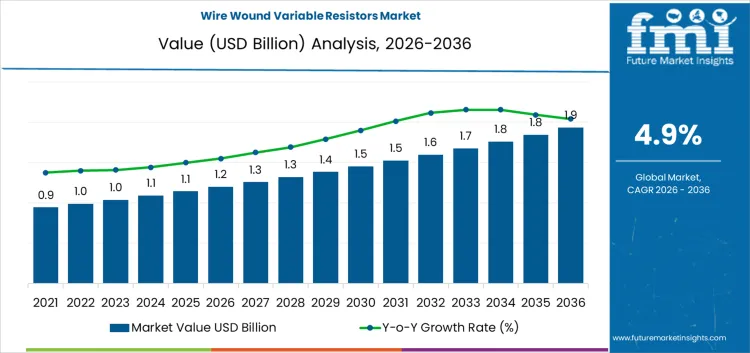
What is the Growth Forecast for Wire Wound Variable Resistors Market through 2036?
Between 2026 and 2031, the wire wound variable resistors market is projected to grow from USD 1.2 billion along a path consistent with a 4.9% CAGR, reflecting its position as a mature but still functionally necessary component category. Demand is sustained by applications where mechanical adjustment, high power handling, and predictable thermal behavior remain preferable to fully digital control. Industrial controls and power equipment continue to specify these components for calibration, load setting, and manual tuning functions. Growth in this phase is incremental and tied to equipment production volumes rather than to architectural change in electronics. Purchasing decisions emphasize long-term stability, tolerance control, and reliability under heat and vibration rather than miniaturization or integration.
From 2031 to 2036, the market is expected to reach USD 1.9 billion, with expansion continuing to follow the installed base of industrial, automotive, and instrumentation equipment. While many consumer devices move toward software-based control, certain environments still require tactile or hardware-level adjustment for safety, certification, or maintenance reasons. Precision trimmers and high-power rheostats retain roles in testing, commissioning, and specialized power applications. The category benefits more from equipment replacement and incremental capacity growth than from new use cases. Competitive positioning depends on manufacturing consistency, materials quality, and qualification history, favoring suppliers such as TT Electronics, Vishay Intertechnology, Bourns, Ohmite Manufacturing, Panasonic, Taiyo Yuden, and KOA Speer Technologies.
Wire Wound Variable Resistors Market Key Takeaways
| Metric | Value |
|---|---|
| Market Value (2026) | USD 1.2 billion |
| Forecast Value (2036) | USD 1.9 billion |
| Forecast CAGR 2026 to 2036 | 4.9% |
How Are Wire Wound Variable Resistors Enabling Precision in Electronic Circuits?
Wire wound variable resistors are increasingly adopted to provide adjustable resistance, precise current control, and reliable performance in electronic and industrial applications. Historically, fixed resistors limited flexibility in circuit tuning, calibration, and load management, requiring additional components or redesigns. Modern wire wound variable resistors incorporate high-conductivity wire, thermally stable cores, and precision adjustment mechanisms to ensure accuracy, durability, and high power handling. Electronic equipment manufacturers, industrial automation providers, and test equipment suppliers prioritize stability, tolerance, and operational lifespan. Early adoption focused on industrial and laboratory applications, while current demand spans power supplies, audio equipment, motor control systems, and renewable energy inverters, driven by the need for precise adjustment, reliability, and robust performance. Power rating, resistance range, and thermal stability influence supplier selection.
Increasing demand for precise electronic control, industrial automation, and power management solutions is shaping market growth. Compared with fixed resistors, wire wound variable resistors emphasize adjustability, high power tolerance, and thermal resilience for accurate circuit performance. Cost structures depend on conductor material, winding precision, and quality control, concentrating margins among suppliers capable of delivering reliable, high-performance components. Manufacturers adopt these resistors to achieve precise tuning, optimize circuit efficiency, and extend device lifespan. By 2036, wire wound variable resistors are expected to remain standard in industrial, electronic, and renewable energy applications, supporting precision control, reliability, and robust performance in advanced electrical systems.
What Factors Are Shaping the Demand for Wire Wound Variable Resistors by Construction Style and Use Case in 2026?
The wire wound variable resistors market in 2026 is segmented by product type and by application. By construction style, demand is divided into adjustable wire wound potentiometers, rheostats, slider wire wound resistors, and precision wire wound trimmers, each offering different adjustment ranges, power handling capability, and mechanical form factors. By application, demand is organized around industrial controls, consumer electronics, automotive systems, and power supplies or instrumentation, which differ in duty cycle, environmental stress, and calibration requirements. These segments reflect how designers balance robustness, adjustment stability, and cost when specifying components that must provide repeatable resistance changes under electrical and mechanical load.
Why Do Adjustable Wire Wound Potentiometers Hold the Largest Share?
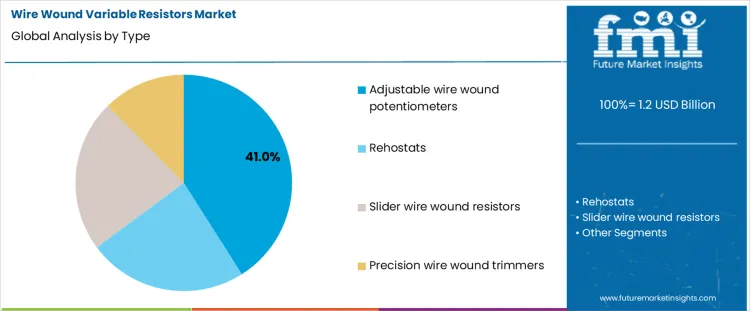
Adjustable wire wound potentiometers account for about 41% of demand in 2026, reflecting their versatility across a wide range of control and calibration tasks. These components can handle higher power levels than many film based alternatives while still offering smooth, continuous adjustment. Their mechanical construction tolerates vibration and temperature variation better than more delicate trimming devices, which makes them suitable for factory and field environments. Designers also value their predictable resistance behavior over long operating periods. In many legacy systems, circuit layouts and service procedures are already built around these parts, which reinforces repeat purchasing. This combination of power handling, durability, and design familiarity sustains their leading position in the overall variable resistor category.
Rheostats, slider designs, and precision trimmers serve more specialized roles. Rheostats are used where current control and dissipation matter more than fine adjustment, which limits their presence to specific circuits. Slider wire wound resistors support user interfaces or test setups, yet their exposed tracks increase wear and contamination risk. Precision trimmers focus on calibration tasks inside equipment and are not intended for frequent adjustment. These products are essential in their niches, but their narrower usage patterns and lower unit counts keep their aggregate demand below that of general purpose adjustable potentiometers.
Why Does Industrial Controls Represent the Largest Application Segment?
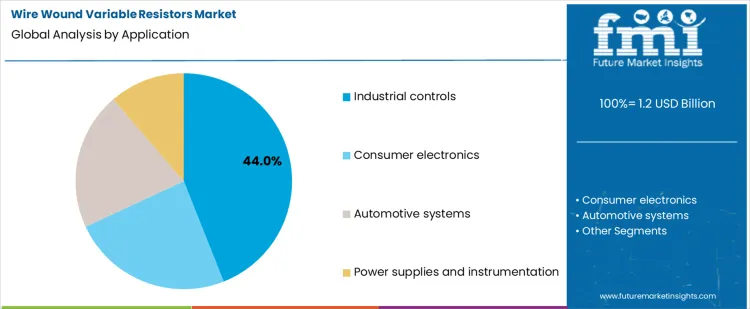
Industrial controls represent about 44% of demand in 2026 because factories and process plants continue to rely on adjustable analog elements in many control and monitoring systems. Variable resistors are used for set point adjustment, signal scaling, and manual override functions in environments where reliability and electrical robustness matter more than compact size. Equipment in these settings often remains in service for decades, which sustains replacement and maintenance demand for compatible components. The operating conditions also favor wire wound designs that can dissipate heat and tolerate electrical stress. This long equipment life and steady maintenance cycle concentrate a large share of overall demand in industrial control applications.
Consumer electronics, automotive systems, and instrumentation follow different adoption patterns. In consumer products, digital interfaces and software control reduce the need for manual adjustment components. Automotive systems increasingly integrate electronic calibration and sealed modules, which limits adjustable parts accessible to users. Power supplies and instrumentation still require precise trimming, yet volumes are lower and more tied to specific product lines. These segments remain important, but their combined usage does not match the continuous, infrastructure like demand generated by industrial control equipment.
Why Are Equipment Longevity and Fail Safe Control Requirements Sustaining the Wire Wound Variable Resistors Market through 2036?
Demand persists because certain systems still require simple, robust ways to dissipate power and adjust current without relying on software. In industrial drives, test benches, rail equipment, and power supplies, wire wound variable resistors are used for load testing, calibration, and coarse control where heat tolerance and mechanical reliability matter more than precision. Many of these installations have service lives measured in decades, and replacements must match proven designs. Once specified into a panel or rig, the component remains part of the architecture. This ties volume more to maintenance and retrofit activity than to new equipment cycles or consumer electronics trends.
What Size, Efficiency, and Integration Limits Are Constraining Wider Adoption in Modern Designs?
Constraints come from how electronics are evolving. Wire wound units are bulky, generate heat, and waste energy by design, which conflicts with compact, efficiency driven equipment goals. Digital control and solid state alternatives offer finer adjustment, remote control, and smaller footprints. Designers also prefer components that integrate easily into surface mount or modular assemblies, which these parts do not. In many applications, they survive only where ruggedness or power handling is non-negotiable. Price competition is strong because specifications are well understood and alternatives exist. These factors steadily narrow the range of new designs that still specify this technology.
How Are Test Equipment Needs and Power Electronics Architectures Redefining Their Role?
The category is not disappearing, but it is being repositioned. Growth areas are concentrated in test, burn in, and commissioning environments where controllable resistive loads are required and energy recovery is secondary. Some suppliers are focusing on modular resistor banks and integrated load boxes rather than standalone panel parts. At the same time, in power electronics development, engineers use them as safe, predictable elements during early stage validation before closing control loops. The role shifts away from permanent control components toward temporary or supporting infrastructure for testing, setup, and fault simulation across industrial and transportation equipment programs.
What is the Demand for Wire Wound Variable Resistors by Country?
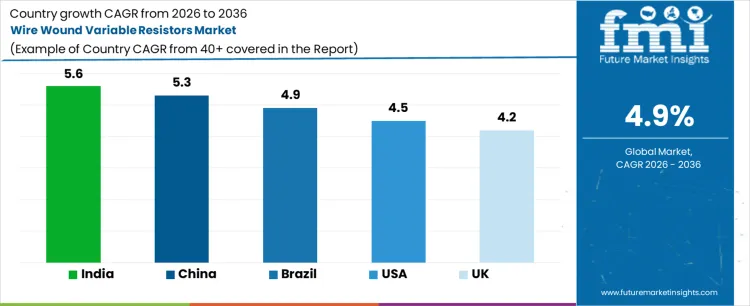
| Country | CAGR (%) |
|---|---|
| USA | 4.5 |
| UK | 4.2 |
| China | 5.3 |
| India | 5.6 |
| Brazil | 4.9 |
Demand for wire wound variable resistors is rising as electronic manufacturers adopt precise, reliable components for industrial, automotive, and consumer electronics applications. India leads with a 5.6% CAGR, driven by expanding electronics manufacturing, adoption of automation systems, and growing industrial and automotive sectors. China follows at 5.3%, supported by large-scale electronics production, industrial automation, and export-oriented manufacturing. Brazil records 4.9% growth, shaped by rising demand in automotive and electrical equipment industries. The USA grows at 4.5%, influenced by replacement demand and integration in precision electronic applications. The UK shows 4.2% CAGR, reflecting steady adoption in industrial electronics and consumer devices.
How is the United States experiencing growth in the wire wound variable resistors market?
United States is experiencing growth at a CAGR of 4.5%, driven by demand from electronics manufacturing, industrial automation, and automotive sectors. Wire wound variable resistors are used in precise current control, voltage regulation, and calibration applications, optimized for reliability, thermal stability, and high-power performance. Demand is concentrated in electronics hubs such as Silicon Valley, Austin, and Detroit, where high-precision industrial and automotive electronics production is concentrated. Investments focus on material quality, performance consistency, and compliance with UL and IEEE standards. Growth reflects rising adoption of industrial automation, precision electronics, and upgrades in legacy manufacturing systems.
- Industrial automation drives adoption.
- Resistors optimize thermal stability and precision.
- Electronics and automotive hubs concentrate demand.
- Material quality and standards compliance guide investment.
How is the United Kingdom witnessing growth in the wire wound variable resistors market?
United Kingdom is witnessing growth at a CAGR of 4.2%, supported by expanding electronics, automotive, and renewable energy applications in London, Birmingham, and Manchester. Wire wound variable resistors are optimized for high reliability, precise current control, and temperature tolerance. Demand is concentrated in industrial electronics facilities, R&D centers, and automotive component manufacturers. Investments prioritize material performance, durability, and adherence to UK and European electrical standards. Growth reflects modernization of industrial electronics, development of smart energy systems, and increasing focus on high-precision electrical components.
- Electronics and renewable energy drive adoption.
- Resistors enhance current control and reliability.
- Industrial and R&D centers concentrate demand.
- Material performance and regulatory compliance guide investment.
How is China experiencing growth in the wire wound variable resistors market?
China is experiencing growth at a CAGR of 5.3%, fueled by expansion of consumer electronics, industrial automation, and automotive electronics in regions such as Shenzhen, Shanghai, and Suzhou. Wire wound variable resistors are optimized for high-power applications, temperature stability, and precise current regulation. Demand is concentrated in electronics manufacturing zones, automotive component plants, and industrial automation hubs. Investments focus on material quality, product reliability, and compliance with national electrical and safety standards. Growth reflects China’s increasing production of high-precision electronics, modernization of industrial plants, and rising domestic and export demand.
- Consumer electronics and automotive production drive adoption.
- Resistors optimize power handling and current precision.
- Electronics and industrial hubs concentrate demand.
- Material quality and regulatory compliance guide investment.
How is India witnessing growth in the wire wound variable resistors market?
India is witnessing growth at a CAGR of 5.6%, supported by growth in automotive electronics, industrial automation, and renewable energy sectors in Pune, Bengaluru, and Gurugram. Wire wound variable resistors are optimized for durability, thermal stability, and precise voltage and current control. Demand is concentrated in industrial electronics hubs, automotive component factories, and R&D centers. Investments prioritize material performance, product consistency, and compliance with national and international electrical standards. Growth reflects rising industrial automation, modernization of manufacturing infrastructure, and increasing demand for reliable electronic components.
- Industrial and automotive electronics drive adoption.
- Resistors enhance durability and voltage control.
- Manufacturing and R&D hubs concentrate demand.
- Material performance and standards compliance guide investment.
How is Brazil experiencing growth in the wire wound variable resistors market?
Brazil is experiencing growth at a CAGR of 4.9%, driven by expansion of industrial automation, automotive electronics, and consumer electronics sectors in São Paulo, Rio de Janeiro, and Paraná. Wire wound variable resistors are optimized for thermal stability, high-power handling, and reliable current regulation. Demand is concentrated in electronics factories, industrial automation facilities, and automotive component manufacturers. Investments focus on product durability, material quality, and adherence to national electrical and safety standards. Growth reflects rising industrial modernization, adoption of automation technologies, and increasing domestic electronics production.
- Industrial automation and automotive sectors drive adoption.
- Resistors optimize thermal stability and current regulation.
- Electronics and manufacturing hubs concentrate demand.
- Product durability and regulatory compliance guide investment.
Who Competes in the Wire Wound Variable Resistors Market and What Defines Their Capabilities?
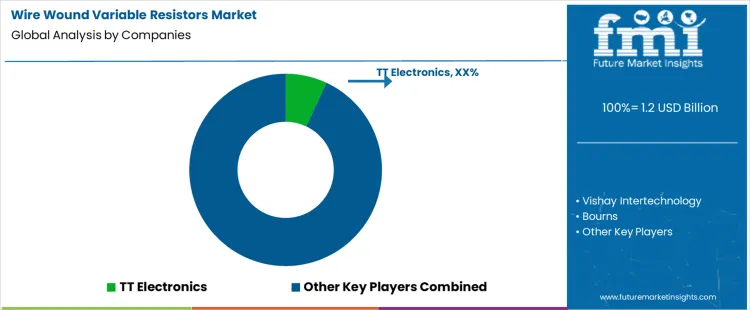
Competition in the wire wound variable resistors market is shaped by power handling, resistance range precision, and reliability under thermal and mechanical stress. TT Electronics supplies wire wound potentiometers and rheostats engineered for stable performance in industrial controls, communications equipment, and test systems. Vishay Intertechnology provides variable resistors with wide resistance ranges and robust construction suited to power electronics, lighting, and aerospace applications. Bourns offers wire wound designs optimized for precise adjustment, long service life, and consistent electrical characteristics under repeated cycling. Ohmite Manufacturing delivers high power variable resistors capable of handling elevated currents and heat, with enclosures designed for durability in harsh environments. Panasonic supplies wire wound components integrated with precision adjustment mechanisms tailored for industrial and consumer electronics.
Taiyo Yuden provides compact wire wound variable resistors with stable resistance values for high frequency and signal integrity sensitive circuits. KOA Speer Technologies offers wire wound potentiometers and adjustable resistive elements designed for powertrain, instrumentation, and industrial applications requiring tight tolerances. Other regional and specialty suppliers produce wire wound resistors for niche applications such as laboratory instrumentation or heavy machinery controls. Competitive differentiation arises from rated power capacity, resistance tolerance, thermal coefficient, mechanical adjustment quality, and long term stability under load. Suppliers that document reliability, detailed specifications, and compliance with relevant industry standards retain relevance across automotive, industrial automation, and electronics sectors.
Key Players in the Wire Wound Variable Resistors Market
- TT Electronics
- Vishay Intertechnology
- Bourns
- Ohmite Manufacturing
- Panasonic
- Taiyo Yuden
- KOA Speer Technologies
Scope of the Report
| Items | Values |
|---|---|
| Quantitative Units (2026) | USD billion |
| Type | Adjustable Wire Wound Potentiometers, Rheostats, Slider Wire Wound Resistors, Precision Wire Wound Trimmers |
| Application | Industrial Controls, Consumer Electronics, Automotive Systems, Power Supplies and Instrumentation |
| Regions Covered | Asia Pacific, Europe, North America, Latin America, Middle East & Africa |
| Countries Covered | China, Japan, South Korea, India, Australia & New Zealand, ASEAN, Germany, United Kingdom, France, Italy, Spain, Nordic, BENELUX, United States, Canada, Mexico, Brazil, Chile, Saudi Arabia, Turkey, South Africa, and other regional markets |
| Key Companies Profiled | TT Electronics, Vishay Intertechnology, Bourns, Ohmite Manufacturing, Panasonic, Taiyo Yuden, KOA Speer Technologies |
| Additional Attributes | Dollar sales by type and application, adjustable wire wound potentiometers forming the largest product segment due to versatility, power handling, and durability, industrial controls representing the largest application segment because of long equipment lifecycles and maintenance driven demand, market growth tied to industrial equipment production, replacement, and calibration activity rather than mass electronics adoption, strong influence of certification requirements, military and transport standards, and endurance testing on supplier qualification, demand concentrated in rail, power, test benches, and heavy industrial equipment, distribution linked to industrial component specialists and project procurement, and competitive positioning based on manufacturing consistency, materials quality, and long qualification history rather than cost alone. |
Wire Wound Variable Resistors Market Segmentation
Type:
- Adjustable wire wound potentiometers
- Rehostats
- Slider wire wound resistors
- Precision wire wound trimmers
Application:
- Industrial controls
- Consumer electronics
- Automotive systems
- Power supplies and instrumentation
Region
Asia Pacific
- China
- Japan
- South Korea
- India
- Australia & New Zealand
- ASEAN
- Rest of Asia Pacific
Europe
- Germany
- United Kingdom
- France
- Italy
- Spain
- Nordic
- BENELUX
- Rest of Europe
North America
- United States
- Canada
- Mexico
Latin America
- Brazil
- Chile
- Rest of Latin America
Middle East & Africa
- Kingdom of Saudi Arabia
- Other GCC Countries
- Turkey
- South Africa
- Other African Union
- Rest of Middle East & Africa
Bibliography
- International Electrotechnical Commission. (2023). IEC 60115-1: Fixed resistors for use in electronic equipment - Part 1: Generic specification.
- International Electrotechnical Commission. (2024). IEC 60393-1: Adjustable resistors for use in electronic equipment - Part 1: Generic specification.
- USA Department of Energy. (2023). Power electronics and electric machinery research and development roadmap.
- USA Energy Information Administration. (2024). Electricity explained: Use of electricity in industry.
- European Union Agency for Railways. (2023). Railway system reliability and safety performance report.
Frequently Asked Questions
How big is the wire wound variable resistors market in 2026?
The global wire wound variable resistors market is estimated to be valued at USD 1.2 billion in 2026.
What will be the size of wire wound variable resistors market in 2036?
The market size for the wire wound variable resistors market is projected to reach USD 1.9 billion by 2036.
How much will be the wire wound variable resistors market growth between 2026 and 2036?
The wire wound variable resistors market is expected to grow at a 4.9% CAGR between 2026 and 2036.
What are the key product types in the wire wound variable resistors market?
The key product types in wire wound variable resistors market are adjustable wire wound potentiometers, rehostats, slider wire wound resistors and precision wire wound trimmers.
Which application segment to contribute significant share in the wire wound variable resistors market in 2026?
In terms of application, industrial controls segment to command 44.0% share in the wire wound variable resistors market in 2026.
Preview the report firsthand - request a free sample
Get SampleGet the brochure for pricing and purchase details.
Get PDFTable of Content
- Executive Summary
- Global Market Outlook
- Demand-side Trends
- Supply-side Trends
- Technology Roadmap Analysis
- Analysis and Recommendations
- Market Overview
- Market Coverage / Taxonomy
- Market Definition / Scope / Limitations
- Market Background
- Market Dynamics
- Drivers
- Restraints
- Opportunity
- Trends
- Scenario Forecast
- Demand in Optimistic Scenario
- Demand in Likely Scenario
- Demand in Conservative Scenario
- Opportunity Map Analysis
- Product Life Cycle Analysis
- Supply Chain Analysis
- Investment Feasibility Matrix
- Value Chain Analysis
- PESTLE and Porter’s Analysis
- Regulatory Landscape
- Regional Parent Market Outlook
- Production and Consumption Statistics
- Import and Export Statistics
- Market Dynamics
- Global Market Analysis 2021 to 2025 and Forecast, 2026 to 2036
- Historical Market Size Value (USD Million) Analysis, 2021 to 2025
- Current and Future Market Size Value (USD Million) Projections, 2026 to 2036
- Y-o-Y Growth Trend Analysis
- Absolute $ Opportunity Analysis
- Global Market Pricing Analysis 2021 to 2025 and Forecast 2026 to 2036
- Global Market Analysis 2021 to 2025 and Forecast 2026 to 2036, By Type
- Introduction / Key Findings
- Historical Market Size Value (USD Million) Analysis By Type, 2021 to 2025
- Current and Future Market Size Value (USD Million) Analysis and Forecast By Type, 2026 to 2036
- Adjustable wire wound potentiometers
- Rehostats
- Slider wire wound resistors
- Precision wire wound trimmers
- Adjustable wire wound potentiometers
- Y-o-Y Growth Trend Analysis By Type, 2021 to 2025
- Absolute $ Opportunity Analysis By Type, 2026 to 2036
- Global Market Analysis 2021 to 2025 and Forecast 2026 to 2036, By Application
- Introduction / Key Findings
- Historical Market Size Value (USD Million) Analysis By Application, 2021 to 2025
- Current and Future Market Size Value (USD Million) Analysis and Forecast By Application, 2026 to 2036
- Industrial controls
- Consumer electronics
- Automotive systems
- Power supplies and instrumentation
- Industrial controls
- Y-o-Y Growth Trend Analysis By Application, 2021 to 2025
- Absolute $ Opportunity Analysis By Application, 2026 to 2036
- Global Market Analysis 2021 to 2025 and Forecast 2026 to 2036, By Region
- Introduction
- Historical Market Size Value (USD Million) Analysis By Region, 2021 to 2025
- Current Market Size Value (USD Million) Analysis and Forecast By Region, 2026 to 2036
- North America
- Latin America
- Western Europe
- Eastern Europe
- East Asia
- South Asia and Pacific
- Middle East & Africa
- Market Attractiveness Analysis By Region
- North America Market Analysis 2021 to 2025 and Forecast 2026 to 2036, By Country
- Historical Market Size Value (USD Million) Trend Analysis By Market Taxonomy, 2021 to 2025
- Market Size Value (USD Million) Forecast By Market Taxonomy, 2026 to 2036
- By Country
- USA
- Canada
- Mexico
- By Type
- By Application
- By Country
- Market Attractiveness Analysis
- By Country
- By Type
- By Application
- Key Takeaways
- Latin America Market Analysis 2021 to 2025 and Forecast 2026 to 2036, By Country
- Historical Market Size Value (USD Million) Trend Analysis By Market Taxonomy, 2021 to 2025
- Market Size Value (USD Million) Forecast By Market Taxonomy, 2026 to 2036
- By Country
- Brazil
- Chile
- Rest of Latin America
- By Type
- By Application
- By Country
- Market Attractiveness Analysis
- By Country
- By Type
- By Application
- Key Takeaways
- Western Europe Market Analysis 2021 to 2025 and Forecast 2026 to 2036, By Country
- Historical Market Size Value (USD Million) Trend Analysis By Market Taxonomy, 2021 to 2025
- Market Size Value (USD Million) Forecast By Market Taxonomy, 2026 to 2036
- By Country
- Germany
- UK
- Italy
- Spain
- France
- Nordic
- BENELUX
- Rest of Western Europe
- By Type
- By Application
- By Country
- Market Attractiveness Analysis
- By Country
- By Type
- By Application
- Key Takeaways
- Eastern Europe Market Analysis 2021 to 2025 and Forecast 2026 to 2036, By Country
- Historical Market Size Value (USD Million) Trend Analysis By Market Taxonomy, 2021 to 2025
- Market Size Value (USD Million) Forecast By Market Taxonomy, 2026 to 2036
- By Country
- Russia
- Poland
- Hungary
- Balkan & Baltic
- Rest of Eastern Europe
- By Type
- By Application
- By Country
- Market Attractiveness Analysis
- By Country
- By Type
- By Application
- Key Takeaways
- East Asia Market Analysis 2021 to 2025 and Forecast 2026 to 2036, By Country
- Historical Market Size Value (USD Million) Trend Analysis By Market Taxonomy, 2021 to 2025
- Market Size Value (USD Million) Forecast By Market Taxonomy, 2026 to 2036
- By Country
- China
- Japan
- South Korea
- By Type
- By Application
- By Country
- Market Attractiveness Analysis
- By Country
- By Type
- By Application
- Key Takeaways
- South Asia and Pacific Market Analysis 2021 to 2025 and Forecast 2026 to 2036, By Country
- Historical Market Size Value (USD Million) Trend Analysis By Market Taxonomy, 2021 to 2025
- Market Size Value (USD Million) Forecast By Market Taxonomy, 2026 to 2036
- By Country
- India
- ASEAN
- Australia & New Zealand
- Rest of South Asia and Pacific
- By Type
- By Application
- By Country
- Market Attractiveness Analysis
- By Country
- By Type
- By Application
- Key Takeaways
- Middle East & Africa Market Analysis 2021 to 2025 and Forecast 2026 to 2036, By Country
- Historical Market Size Value (USD Million) Trend Analysis By Market Taxonomy, 2021 to 2025
- Market Size Value (USD Million) Forecast By Market Taxonomy, 2026 to 2036
- By Country
- Kingdom of Saudi Arabia
- Other GCC Countries
- Turkiye
- South Africa
- Other African Union
- Rest of Middle East & Africa
- By Type
- By Application
- By Country
- Market Attractiveness Analysis
- By Country
- By Type
- By Application
- Key Takeaways
- Key Countries Market Analysis
- USA
- Pricing Analysis
- Market Share Analysis, 2025
- By Type
- By Application
- Canada
- Pricing Analysis
- Market Share Analysis, 2025
- By Type
- By Application
- Mexico
- Pricing Analysis
- Market Share Analysis, 2025
- By Type
- By Application
- Brazil
- Pricing Analysis
- Market Share Analysis, 2025
- By Type
- By Application
- Chile
- Pricing Analysis
- Market Share Analysis, 2025
- By Type
- By Application
- Germany
- Pricing Analysis
- Market Share Analysis, 2025
- By Type
- By Application
- UK
- Pricing Analysis
- Market Share Analysis, 2025
- By Type
- By Application
- Italy
- Pricing Analysis
- Market Share Analysis, 2025
- By Type
- By Application
- Spain
- Pricing Analysis
- Market Share Analysis, 2025
- By Type
- By Application
- France
- Pricing Analysis
- Market Share Analysis, 2025
- By Type
- By Application
- India
- Pricing Analysis
- Market Share Analysis, 2025
- By Type
- By Application
- ASEAN
- Pricing Analysis
- Market Share Analysis, 2025
- By Type
- By Application
- Australia & New Zealand
- Pricing Analysis
- Market Share Analysis, 2025
- By Type
- By Application
- China
- Pricing Analysis
- Market Share Analysis, 2025
- By Type
- By Application
- Japan
- Pricing Analysis
- Market Share Analysis, 2025
- By Type
- By Application
- South Korea
- Pricing Analysis
- Market Share Analysis, 2025
- By Type
- By Application
- Russia
- Pricing Analysis
- Market Share Analysis, 2025
- By Type
- By Application
- Poland
- Pricing Analysis
- Market Share Analysis, 2025
- By Type
- By Application
- Hungary
- Pricing Analysis
- Market Share Analysis, 2025
- By Type
- By Application
- Kingdom of Saudi Arabia
- Pricing Analysis
- Market Share Analysis, 2025
- By Type
- By Application
- Turkiye
- Pricing Analysis
- Market Share Analysis, 2025
- By Type
- By Application
- South Africa
- Pricing Analysis
- Market Share Analysis, 2025
- By Type
- By Application
- USA
- Market Structure Analysis
- Competition Dashboard
- Competition Benchmarking
- Market Share Analysis of Top Players
- By Regional
- By Type
- By Application
- Competition Analysis
- Competition Deep Dive
- TT Electronics
- Overview
- Product Portfolio
- Profitability by Market Segments (Product/Age /Sales Channel/Region)
- Sales Footprint
- Strategy Overview
- Marketing Strategy
- Product Strategy
- Channel Strategy
- Vishay Intertechnology
- Bourns
- Ohmite Manufacturing
- Panasonic
- Taiyo Yuden
- KOA Speer Technologies
- TT Electronics
- Competition Deep Dive
- Assumptions & Acronyms Used
- Research Methodology


