

- Market Size (2026)
- USD 1.7 Bn
- Forecast (2036)
- USD 2.8 Bn
- CAGR (2026 to 2036)
- 5.1%
How big is the Workover Fluid Additives Market in 2026?
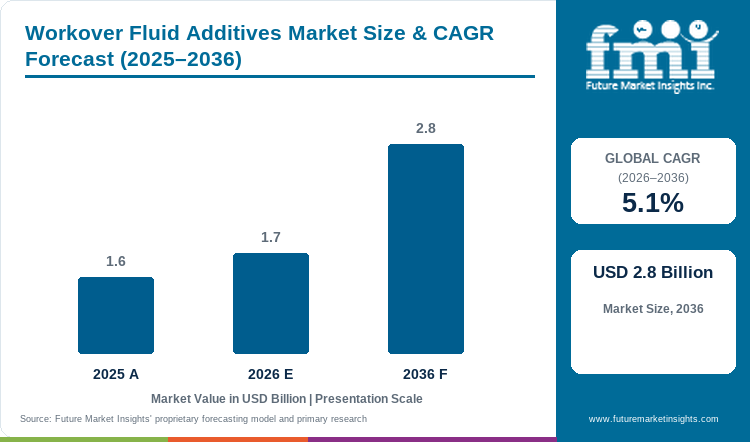
USD 1.7 Billion in 2026 and USD 2.8 Billion by 2036 at a 5.1% CAGR.
Demand for Workover Fluid Additives is estimated at USD 1.7 Billion in 2026 and is forecast to reach USD 2.8 Billion by 2036, growing at a CAGR of 5.1%. The market was valued at USD 1.6 Billion in 2025. Workover spending follows the decision to repair or restore an existing well. The USA Energy Information Administration counted 918,481 producing wells in 2024 and reported that 78% produced 15 barrels of oil equivalent per day or less. That installed base keeps repair economics central to chemical demand. Additives are selected against the chosen intervention fluid and the risks that must be controlled during the job.
Country demand depends on intervention programs and procurement structure. PEMEX's 2025-2030 work plan includes 1,300 major repairs, which gives Mexico a visible workover pipeline. Brazil's ANP extended contracts for 34 producing fields during 2025, including mature fields. In Saudi Arabia and the UAE, operator qualification and integrated service contracts shape supplier access. Japan has a smaller domestic upstream base, so demand is more project-specific. Across these markets, a chemical order follows only after the fluid package is qualified for the job and can be delivered inside the intervention window.
Key Takeaways
- The market is estimated at USD 1.7 Billion in 2026 and is forecast to reach USD 2.8 Billion by 2036 at a 5.1% CAGR.
- Corrosion inhibitors are projected to account for 22.0% of Additive Type demand in 2026.
- Brine-based fluids are estimated at 42.0% of Fluid Type demand in 2026.
- Well cleanout is forecast to hold 26.0% of Operation demand in 2026.
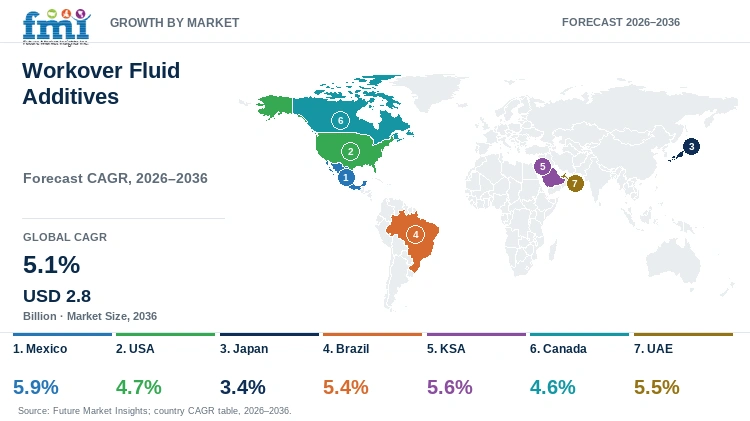
- Mexico records the highest country CAGR shown at 5.9% from 2026 to 2036, followed by KSA at 5.6% and UAE at 5.5%.
- Technical qualification is a commercial gate because additive performance changes with brine composition and downhole conditions.
- Current competition spans integrated fluid-system suppliers and specialty oilfield chemistry providers, with ChampionX now part of SLB and Newpark Fluids Systems operating separately from Newpark Resources.
Analyst Perspective
Workover additives are purchased against the risk profile of a specific job. Suppliers gain an advantage when they can qualify the chemistry quickly and support the field team if salinity, temperature or materials compatibility changes the operating window. A delayed intervention can cost more than the additive package itself.
- Nikhil Kaitwade, Principal Analyst at Future Market Insights
How is the Workover Fluid Additives Market segmented?
The Workover Fluid Additives Market is segmented by Additive Type, Fluid Type, Operation, Well Type, Sales Channel and Region.
Additive Type identifies the function performed inside the workover fluid. Fluid Type defines the carrier system and the pressure-control envelope. Operation separates cleanout and well-killing work from recompletion, plug removal and stimulation support. Well Type reflects the operating environment, while Sales Channel shows whether chemistry is purchased through a service company, a completion-fluid supplier, direct operator supply or a regional distributor.
Why do Corrosion inhibitors lead the Additive Type category?
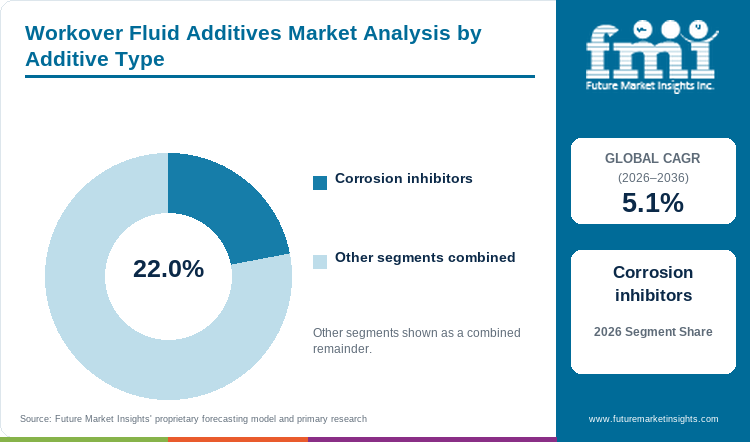
Corrosion inhibitors matter because completion and workover brines can remain in contact with tubulars and downhole tools during an intervention. Performance must hold at the target salinity and temperature while remaining compatible with other fluid components. Baker Hughes lists corrosion-inhibitor systems for completion brines, while Innospec states that its corrosion inhibitors are designed for stimulation, workover and production operations. This demand sits within the wider oilfield chemicals market, where corrosion control is a recurring operating requirement.
- Corrosion inhibitors account for 22.0% of Additive Type demand in 2026 because workover fluids must protect high-value tubulars and downhole hardware while maintaining fluid compatibility.
- Baker Hughes currently lists BRINE-PAC corrosion-inhibitor systems for completion brines, including formulations that combine corrosion control with other fluid-treatment functions.
Why do Brine-based fluids lead the Fluid Type category?
Brine-based workover fluids provide hydrostatic pressure without requiring suspended solids that can damage the formation. Their density can be adjusted, then the system can be conditioned with corrosion control and cleanup chemistry. Newpark Fluids Systems describes clear, solids-free brines as an industry standard for completion and workover applications. Similar procurement logic is visible across the broader drilling and completion fluids market.
- Brine-based fluids hold 42.0% of Fluid Type demand in 2026 because clear, solids-free systems can provide pressure control while supporting tailored corrosion and cleanup treatments.
- In July 2025, TETRA reported completion of a three-well CS Neptune project in the Gulf of America using its proprietary high-density completion-fluid platform, providing field evidence for complex deepwater fluid systems.
Why does Well cleanout lead the Operation category?
Well cleanout is required when drilling residue, debris or scale must be removed before the next operation can proceed. The fluid must transport contaminants without creating a new compatibility problem. Halliburton links completion-fluid programs with wellbore cleaning, while Newpark describes engineered displacement as a planned cleanup step before clear-brine placement. Cleanout demand therefore rises with the broader level of oil and gas field services activity around mature and producing wells.
- Well cleanout represents 26.0% of Operation demand in 2026 because debris removal and fluid displacement are common prerequisites to returning an intervened well to service.
- Halliburton completion-fluid documentation links wellbore cleaning with removal of debris and contaminants before completion or production operations.
What supports Onshore demand in the Well Type category?
Onshore workover demand is supported by a large installed base of producing and mature wells across land basins. Mobilization is generally simpler than an offshore campaign, so smaller repair scopes can remain economic. Mexico's repair program and Saskatchewan's reactivation policy both point to continued spending on existing land assets. The operating environment overlaps with the onshore drilling fluids market, although workover additives address a different stage of the well lifecycle.
- In May 2025, Saskatchewan launched the Low Productivity and Reactivation Oil Well Program to support investment in low-producing or inactive horizontal oil wells.
How do Oilfield service companies shape the Sales Channel category?
Oilfield service companies sit close to the technical decision because additive performance depends on the complete fluid program and the execution sequence. A service-led route can combine chemistry selection with testing and field troubleshooting under one work scope. Direct supply remains relevant where operators standardize formulations, while completion-fluid specialists and regional distributors support jobs that need local inventory or dedicated fluid handling.
- Newpark Fluids Systems currently markets completion brines for workover applications together with specialty completion-fluid additives, cleanout fluids and filtration services. Its current business operates separately from Newpark Resources following the 2024 sale of the Fluids Systems segment to SCF Partners.
What are the drivers, restraints and opportunities in the Workover Fluid Additives Market?
Mature-well intervention supports recurring demand, while fluid compatibility can slow approval and regional technical support can shorten the path to field use.
- Driver: Repair and reactivation programs create recurring additive demand when operators choose to restore production from existing wells.
- Restraint: High-salinity and high-temperature jobs require compatibility testing that can extend the approval cycle.
- Opportunity: Regional laboratories and nearby inventory can reduce qualification time and lower the risk of missing a scheduled workover window.
The demand trigger is the decision to spend on an existing well rather than accept production decline. PEMEX's 2025-2030 plan includes 1,300 major repairs, while Saskatchewan introduced an incentive for low-producing or inactive horizontal oil wells in May 2025. Once an intervention is approved, additive demand follows the fluid design and the well condition. The commercial opportunity is therefore tied to executable workover activity, not simply to the number of wells in a basin.
Technical qualification is the main purchasing restraint. A workover additive has to perform in the selected brine or carrier fluid and remain compatible with formation fluids, tubular metallurgy and the rest of the treatment package. Baker Hughes states that its completion fluids are engineered and tested against reservoir requirements. More demanding temperature or density conditions can lengthen the approval cycle and favor a formulation with prior field history.
The clearest opportunity is to place formulation support closer to the intervention site. Nouryon opened an oilfield Innovation Center in Houston in June 2025 for drilling, completion and production applications. Newpark Fluids Systems also operates a global laboratory network around its fluids business. Local testing can shorten reformulation cycles and reduce mobilization risk. The same need for corrosion and scale control appears across the wider oilfield production chemicals market, although the use case here is limited to workover-fluid additives.
Which country CAGRs are compared in the Workover Fluid Additives Market?
| Country | CAGR |
|---|---|
| Mexico | 5.9% |
| USA | 4.7% |
| Japan | 3.4% |
| Brazil | 5.4% |
| KSA | 5.6% |
| Canada | 4.6% |
| UAE | 5.5% |
How do country-level CAGRs compare in the Workover Fluid Additives Market?
The country growth rates shown span 2.5 percentage points from Mexico at 5.9% to Japan at 3.4% from 2026 to 2036. Mexico, KSA, UAE and Brazil form the faster-growth band between 5.4% and 5.9%. USA and Canada are close at 4.7% and 4.6%, while Japan is lower at 3.4%. These rates compare forecast pace rather than absolute market size.
- Mexico at 5.9% is 0.3 percentage points above KSA at 5.6% and 0.4 points above UAE at 5.5%. Its visible repair program supports earlier planning for local workover supply.
- KSA and UAE are separated by 0.1 percentage point, so supplier qualification and local field support matter more than the small difference in forecast pace.
- Brazil at 5.4% is 0.7 percentage points above USA at 4.7% and 0.8 points above Canada at 4.6%. Field-life extension and offshore activity support the faster rate.
- USA and Canada sit 1.3 and 1.2 percentage points above Japan. Their larger producing-well bases support broader basin-level service demand.
CAGR should be read as forecast pace rather than a ranking of current revenue. Addressable demand also depends on producing-well count, intervention economics and the route through which qualified chemistry reaches the field.
Country-wise Analysis
- Mexico: Workover purchasing is strongly influenced by PEMEX planning and the service contractors that execute major repair programs. Demand for Workover Fluid Additives in Mexico is forecast to expand at 5.9% CAGR from 2026 to 2036. PEMEX's 2025-2030 work plan includes 1,300 major repairs. Suppliers need local inventory and technical support that can move a qualified fluid package into the scheduled intervention without delay.
- USA: Demand is spread across a large operator and service-company base. Workover Fluid Additives demand in USA is forecast to expand at 4.7% CAGR from 2026 to 2036. The USA Energy Information Administration counted 918,481 producing wells in 2024, with 78% producing 15 barrels of oil equivalent per day or less. Suppliers compete on basin-level availability and evidence that the chemistry protects production without adding avoidable intervention time.
- Japan: Domestic upstream purchasing is concentrated around a smaller number of technically demanding assets. Demand for Workover Fluid Additives in Japan is forecast to expand at 3.4% CAGR from 2026 to 2036. INPEX confirmed in June 2025 that domestic gas from the Minami-Nagaoka field would supply its Kashiwazaki demonstration project. The smaller intervention base favors project-specific qualification and dependable technical support.
- Brazil: Demand combines offshore intervention with mature-field life extension. Workover Fluid Additives demand in Brazil is forecast to expand at 5.4% CAGR from 2026 to 2036. ANP reported in March 2026 that it had extended contracts for 34 producing fields during 2025, including mature fields. Local fluid handling and qualified offshore supply can reduce response time once an intervention is approved.
- KSA: Purchasing is shaped by Saudi Aramco qualification and by service companies supporting onshore and offshore work. Demand for Workover Fluid Additives in KSA is forecast to expand at 5.6% CAGR from 2026 to 2036. Aramco highlighted in February 2025 that some historic wells continue producing decades after discovery as extraction methods and operating practices improve. Suppliers need in-Kingdom technical capability and reliable chemical logistics.
- Canada: The workover channel is basin-oriented, with strong reliance on local fluid and service support. Demand for Workover Fluid Additives in Canada is forecast to expand at 4.6% CAGR from 2026 to 2036. Saskatchewan introduced a program in May 2025 for low-producing or inactive horizontal oil wells. The commercial fit depends on keeping the fluid package compatible with reactivation economics and local operating conditions.
- UAE: Purchasing is concentrated around national-operator specifications and integrated service contracts. Demand for Workover Fluid Additives in UAE is forecast to expand at 5.5% CAGR from 2026 to 2036. ADNOC and SLB announced a production-optimization platform in November 2025 for existing wells, with broader field deployment planned. Suppliers need nearby inventory and technical support so chemistry issues are resolved before the intervention reaches the critical path.
Who are the notable companies in the Workover Fluid Additives Market?
TETRA Technologies, SLB, Halliburton, Baker Hughes, Newpark Fluids Systems, Clariant, Innospec and Nouryon are the notable companies covered in this market.
Competition spans integrated completion-fluid platforms and specialist oilfield chemistry suppliers. TETRA Technologies, SLB, Halliburton and Baker Hughes combine fluid-system capability with field support. Newpark Fluids Systems provides completion brines, specialty additives and cleanout services as a fluids-focused business. Clariant and Innospec provide well-service or corrosion-control chemistry, while Nouryon supports oilfield formulation through specialty chemistry and its Houston innovation center. ChampionX is no longer treated as a separate company because it became part of SLB in July 2025. Newpark Resources is also separated from Newpark Fluids Systems following the 2024 sale of the Fluids Systems business.
- Integrated fluid-system platforms: TETRA Technologies, SLB, Halliburton, Baker Hughes and Newpark Fluids Systems combine fluid design with varying levels of testing and field support.
- Oilfield chemistry specialists: Clariant and Innospec provide corrosion-control and well-service chemistry relevant to intervention fluids.
- Formulation support: Nouryon participates through specialty chemistry and oilfield application development, supported by its Houston Innovation Center.
Competitive Benchmarking: Workover Fluid Additives Market
| Company | Completion / workover fluid evidence | Additive / chemistry evidence | Field or lab support | Current market relevance |
|---|---|---|---|---|
| TETRA Technologies | Clear-brine and high-density completion-fluid systems | Integrated fluid chemistry and brine management | Documented field deployment and technical support | Active independent completion-fluid platform |
| SLB | Completion and intervention fluids listed within current portfolio | Production chemicals and corrosion-control capability; ChampionX integrated | Global field and laboratory network | ChampionX became part of SLB in July 2025 |
| Halliburton | Completion fluids and clear-brine systems | Corrosion control and wellbore-cleaning chemistry | Laboratory and wellsite support | Active integrated oilfield service platform |
| Baker Hughes | Clear brines and completion-fluid additives | BRINE-PAC corrosion-inhibitor systems and related additives | Engineering and testing support | Active integrated oilfield service platform |
| Newpark Fluids Systems | Clear, solids-free brines for completion and workover applications | Specialty completion-fluid additives and cleanout fluids | Global laboratory network and field services | Fluids business now operates separately from Newpark Resources |
| Clariant | Well-service additives rather than a full brine platform | CORRTREAT corrosion inhibitors and other oil-service chemistries | Oil Services technical support | Active specialty oilfield chemistry supplier |
| Innospec | No base-brine platform documented | Corrosion inhibitors explicitly positioned for workover use | Oilfield application support | Active specialty oilfield chemistry supplier |
| Nouryon | Formulation support for drilling and completion applications | Specialty chemistry for oilfield formulations | Houston oilfield Innovation Center | Active chemistry-led formulation supplier |
The benchmark summarizes current public evidence of completion or workover fluid capability, additive chemistry and technical support. It does not assign company market share. Ownership changes are reflected where they alter the identity of the supplier serving the market.
Key Developments in the Workover Fluid Additives Market
- In September 2024, Newpark Resources completed the sale of substantially all of its Fluids Systems segment to SCF Partners. The fluids business continued as Newpark Fluids Systems, so current competitive analysis should treat the fluids platform separately from Newpark Resources.
- In June 2025, Nouryon opened an Innovation Center for oilfield applications in Houston, Texas. The center supports drilling and completion, production and stimulation applications, giving the company a closer technical interface with North American oilfield customers.
- In July 2025, SLB completed its acquisition of ChampionX. ChampionX production-chemistry capability now sits within SLB, so the two should not be counted as separate independent competitors.
- In July 2025, TETRA Technologies reported completion of a three-well CS Neptune project in the Gulf of America using its proprietary completion-fluid system. The project provides current field evidence for high-density fluid capability in technically demanding wells.
Key Players in the Workover Fluid Additives Market
Integrated Fluid-System Platforms
- TETRA Technologies
- SLB
- Halliburton
- Baker Hughes
- Newpark Fluids Systems
Oilfield Chemistry Specialists
- Clariant
- Innospec
Chemistry-Led Formulation Support
- Nouryon
Workover Fluid Additives Market - Report Scope
| Coverage field | Report scope |
|---|---|
| Market breakdown | Additive Type, Fluid Type, Operation, Well Type, Sales Channel and Region |
| Quantitative Units | USD Billion |
| Market Definition | Revenue from workover fluid additives used within the defined Additive Type, Fluid Type, Operation, Well Type and Sales Channel scope. Base fluids sold outside the defined additive boundary, drilling-only chemistry and downstream intervention-service revenue are excluded. |
| Regions Covered | North America; Latin America; Western Europe; Eastern Europe; East Asia; South Asia and Pacific; Middle East and Africa |
| Countries Covered | Mexico; USA; Japan; Brazil; KSA; Canada; UAE; more than twenty-five additional countries in the full report |
| Key Companies Covered | TETRA Technologies; SLB; Halliburton; Baker Hughes; Newpark Fluids Systems; Clariant; Innospec; Nouryon |
| Forecast Period | 2026 to 2036 |
| Approach | Primary and secondary research with market triangulation. |
Workover Fluid Additives Market - Research Methodology
| Method | Approach |
|---|---|
| Primary Research | FMI analysts gather input from fluid formulators, oilfield service companies, distributors and operator-side technical teams. Interviews examine additive selection, qualification criteria, route to market and the support required during workover execution. |
| Desk Research | Desk research covers official upstream activity data, regulator publications, company filings, product documentation and technical literature relevant to workover fluids and intervention chemistry. |
| Market Sizing and Forecasting | Market sizing combines supplier and channel evidence with intervention activity, fluid-system requirements and country operating conditions. Forecast assumptions consider mature-well activity, upstream spending and technical qualification requirements. |
| Data Validation | Market estimates are compared across independent public indicators and primary interviews. Products are checked against the market definition so drilling-only chemistry and downstream service revenue are not included in the additive total. |
Workover Fluid Additives Market by Segments
Workover Fluid Additives Market segmented by Additive Type:
- Corrosion inhibitors
- Biocides
- Clay stabilizers
- Surfactants
- Scale inhibitors
- Viscosifiers
Workover Fluid Additives Market segmented by Fluid Type:
- Brine-based fluids
- Foamed fluids
- Polymer fluids
- Oil-based workover fluids
- Acidic workover fluids
Workover Fluid Additives Market segmented by Operation:
- Well cleanout
- Well killing
- Recompletion
- Plug removal
- Stimulation support
Workover Fluid Additives Market segmented by Well Type:
- Onshore
- Offshore
- Mature wells
- Gas wells
- HPHT wells
Workover Fluid Additives Market segmented by Sales Channel:
- Oilfield service companies
- Completion fluid suppliers
- Direct operator supply
- Regional distributors
Workover Fluid Additives Market by Region:
- North America
- United States
- Canada
- Latin America
- Brazil
- Mexico
- Argentina
- Chile
- Western Europe
- Germany
- France
- United Kingdom
- Italy
- Spain
- Benelux
- Nordics
- Eastern Europe
- Poland
- Czech Republic
- Romania
- Hungary
- East Asia
- China
- Japan
- South Korea
- South Asia and Pacific
- India
- ASEAN
- Australia and New Zealand
- Middle East and Africa
- GCC Countries
- South Africa
- Türkiye
- Israel
Research Sources and Bibliography
- Petróleos Mexicanos (2025, February 12). Pemex presents its Work Plan for 2025-2030.
- USA Energy Information Administration (2025, December 8). USA Oil and Natural Gas Wells by Production Rate.
- INPEX Corporation (2025, June 6). Start of commissioning with domestic natural gas at the Kashiwazaki blue hydrogen and ammonia demonstration project.
- Agência Nacional do Petróleo, Gás Natural e Biocombustíveis (2026, March 10). ANP extended contracts for 34 oil and gas production fields in 2025.
- Saudi Aramco (2025, February 26). Aramco's historic No. 1 wells.
- Government of Saskatchewan (2025, May 13). Saskatchewan Launches New Program to Boost Oil Production and Generate Investment.
- ADNOC (2025, November 3). ADNOC and SLB Launch AI-Powered Solution to Boost Upstream Productivity.
- TETRA Technologies (2025, July 29). Second Quarter 2025 Results and Full Year Guidance.
- Newpark Fluids Systems. Advanced Completion Brines for Well Integrity.
- SLB (2025, July 16). SLB Completes Acquisition of ChampionX.
- Nouryon (2025, June 18). Nouryon launches Innovation Center for oilfield solutions in Texas, US.
- Halliburton. Completion Fluids.
- Baker Hughes. Clear Brines and Additives.
- Innospec. Corrosion Inhibitors.
- Clariant. Well Service Additives and Oil Services.
This bibliography is provided for reader reference and is not exhaustive. The full report contains the complete reference list and detailed citations.
This Report Answers
- What are the Workover Fluid Additives Market values in 2026 and 2036?
- Which mature-well and intervention pressures support demand for workover fluid additives?
- Why do Corrosion inhibitors hold the leading position in Additive Type?
- How do Brine-based fluids influence downstream additive selection and qualification?
- Why does Well cleanout hold the leading position in Operation?
- How do growth rates differ across Mexico, USA, Japan, Brazil, KSA, Canada, and UAE?
- Which companies provide completion-fluid systems or specialist oilfield chemistry for workover applications?
- How do compatibility and qualification requirements restrain additive adoption?
- What should operators and service companies evaluate before purchasing workover fluid additives?
Frequently Asked Questions
What is driving growth in the Workover Fluid Additives Market?
Growth is tied to repair and reactivation work on existing wells. Once a workover is approved, additives are used to manage corrosion and fluid compatibility so the intervention can restore production without creating new equipment or formation problems.
Who are the key players in the Workover Fluid Additives Market?
Key companies include TETRA Technologies, SLB, Halliburton, Baker Hughes, Newpark Fluids Systems, Clariant, Innospec and Nouryon. ChampionX is now part of SLB, while Newpark Fluids Systems operates separately from Newpark Resources after the 2024 divestiture.
What notable restraint affects the Workover Fluid Additives Market?
The main restraint is technical qualification under the selected brine and downhole conditions. Temperature, salinity and materials compatibility can change the acceptable formulation, which may extend approval if laboratory testing identifies a conflict.
Why should executives track the Workover Fluid Additives Market?
The market connects directly to the economics of maintaining production from existing oil and gas assets. Intervention activity and mature-field policy help indicate where recurring operating expenditure can support additive demand.
What business problem does the Workover Fluid Additives Market address?
Workover fluid additives help an intervention fluid protect the well while repair or restoration work is carried out. Different chemistries address corrosion, scale interaction and fluid behavior so the job can be completed without avoidable equipment or formation damage.
What should oilfield procurement teams evaluate in the Workover Fluid Additives Market?
Procurement teams should verify compatibility with the selected fluid and the required treatment concentration. Temperature limits, metallurgy and local supply support also matter because a qualified chemistry still has to reach the well within the intervention schedule.
What limits return on investment in the Workover Fluid Additives Market?
Return weakens when qualification delays the workover, treatment rates rise beyond plan or an incompatible fluid requires remediation. Total intervention time and reliable restoration of production can matter more than the lowest chemical purchase price.
What supports long-term commercial confidence in the Workover Fluid Additives Market?
Long-term demand is supported by the need to maintain large installed well populations and recover more value from mature assets. Reactivation programs and continued investment in oilfield fluid laboratories show that intervention capability remains an operating priority. Key Players
Preview the report firsthand - request a free sample
Get SampleGet the brochure for pricing and purchase details.
Get PDFTable of Content
- Key Takeaways
- Market Size and CAGR
- Top Growth Driver
- Fastest Growing Segment
- Leading Region
- Key Companies
- Emerging Opportunities
- Executive Summary
- Global Market Outlook
- Demand-side Trends
- Supply-side Trends
- Technology Roadmap Analysis
- Analysis and Recommendations
- Analyst Perspective (What is happening? Why now? What should investors know?)
- Key Questions Answered
- How large is the market?
- What is the CAGR?
- What are key trends?
- Which region dominates?
- Who are the leaders?
- Market Overview
- Market Coverage / Taxonomy
- Market Definition / Scope / Limitations
- Research Methodology
- Chapter Orientation
- Analytical Lens and Working Hypotheses
- Market Structure, Signals, and Trend Drivers
- Benchmarking and Cross-market Comparability
- Market Sizing, Forecasting, and Opportunity Mapping
- Research Design and Evidence Framework
- Desk Research Programme (Secondary Evidence)
- Expert Input and Fieldwork (Primary Evidence)
- Tooling, Models, and Reference Databases
- Data Engineering and Model Build
- Quality Assurance and Audit Trail
- Market Background
- Market Dynamics (Drivers, Restraints, Opportunity, Trends)
- Scenario Forecast (Optimistic, Likely, Conservative)
- Impact Analysis
- AI Impact
- Sustainability Impact
- Regulatory Impact
- Technology Impact
- Consumer / Buyer Analysis
- Purchase Drivers
- Adoption Barriers
- Buyer Journey
- Opportunity Map Analysis
- Product Life Cycle Analysis
- Supply Chain Analysis
- Investment Feasibility Matrix
- Value Chain Analysis
- PESTLE and Porter's Analysis
- Regulatory Landscape
- Regional Parent Market Outlook
- Production and Consumption Statistics
- Import and Export Statistics
- Global Market Analysis and Forecast, 2021 to 2036
- Historical Market Size Value (USD Billion) Analysis, 2021 to 2025
- Current and Future Market Size Value (USD Billion) Projections, 2026 to 2036
- Y-o-Y Growth Trend Analysis
- Absolute $ Opportunity Analysis
- Global Market Pricing Analysis, 2021 to 2036
- Global Market Analysis and Forecast, By Additive Type, 2021 to 2036
- Introduction / Key Findings
- Historical Market Size Value (USD Billion) Analysis By Additive Type, 2021 to 2025
- Current and Future Market Size Value (USD Billion) Analysis and Forecast By Additive Type, 2026 to 2036
- Corrosion inhibitors
- Biocides
- Clay stabilizers
- Surfactants
- Scale inhibitors
- Viscosifiers
- Y-o-Y Growth Trend Analysis By Additive Type, 2021 to 2025
- Absolute $ Opportunity Analysis By Additive Type, 2026 to 2036
- Global Market Analysis and Forecast, By Fluid Type, 2021 to 2036
- Introduction / Key Findings
- Historical Market Size Value (USD Billion) Analysis By Fluid Type, 2021 to 2025
- Current and Future Market Size Value (USD Billion) Analysis and Forecast By Fluid Type, 2026 to 2036
- Brine-based fluids
- Foamed fluids
- Polymer fluids
- Oil-based workover fluids
- Acidic workover fluids
- Y-o-Y Growth Trend Analysis By Fluid Type, 2021 to 2025
- Absolute $ Opportunity Analysis By Fluid Type, 2026 to 2036
- Global Market Analysis and Forecast, By Operation, 2021 to 2036
- Introduction / Key Findings
- Historical Market Size Value (USD Billion) Analysis By Operation, 2021 to 2025
- Current and Future Market Size Value (USD Billion) Analysis and Forecast By Operation, 2026 to 2036
- Well cleanout
- Well killing
- Recompletion
- Plug removal
- Stimulation support
- Y-o-Y Growth Trend Analysis By Operation, 2021 to 2025
- Absolute $ Opportunity Analysis By Operation, 2026 to 2036
- Global Market Analysis and Forecast, By Well Type, 2021 to 2036
- Introduction / Key Findings
- Historical Market Size Value (USD Billion) Analysis By Well Type, 2021 to 2025
- Current and Future Market Size Value (USD Billion) Analysis and Forecast By Well Type, 2026 to 2036
- Onshore
- Offshore
- Mature wells
- Gas wells
- HPHT wells
- Y-o-Y Growth Trend Analysis By Well Type, 2021 to 2025
- Absolute $ Opportunity Analysis By Well Type, 2026 to 2036
- Global Market Analysis and Forecast, By Sales Channel, 2021 to 2036
- Introduction / Key Findings
- Historical Market Size Value (USD Billion) Analysis By Sales Channel, 2021 to 2025
- Current and Future Market Size Value (USD Billion) Analysis and Forecast By Sales Channel, 2026 to 2036
- Oilfield service companies
- Completion fluid suppliers
- Direct operator supply
- Regional distributors
- Y-o-Y Growth Trend Analysis By Sales Channel, 2021 to 2025
- Absolute $ Opportunity Analysis By Sales Channel, 2026 to 2036
- Global Market Analysis and Forecast, By Region, 2021 to 2036
- Introduction
- Historical Market Size Value (USD Billion) Analysis By Region, 2021 to 2025
- Current Market Size Value (USD Billion) Analysis and Forecast By Region, 2026 to 2036
- North America
- Latin America
- Western Europe
- Eastern Europe
- East Asia
- South Asia and Pacific
- Middle East and Africa
- Market Attractiveness Analysis By Region
- North America Market Analysis and Forecast, By Country, 2021 to 2036
- Historical Market Size Value (USD Billion) Trend Analysis By Market Taxonomy, 2021 to 2025
- Market Size Value (USD Billion) Forecast By Market Taxonomy, 2026 to 2036
- By Country
- United States
- Canada
- By Additive Type
- By Fluid Type
- By Operation
- By Well Type
- By Sales Channel
- By Country
- Market Attractiveness Analysis
- By Country
- By Additive Type
- By Fluid Type
- By Operation
- By Well Type
- By Sales Channel
- Key Takeaways
- Latin America Market Analysis and Forecast, By Country
- Historical Market Size Value (USD Billion) Trend Analysis By Market Taxonomy, 2021 to 2025
- Market Size Value (USD Billion) Forecast By Market Taxonomy, 2026 to 2036
- By Country
- Brazil
- Mexico
- Argentina
- Chile
- By Additive Type
- By Fluid Type
- By Operation
- By Well Type
- By Sales Channel
- By Country
- Market Attractiveness Analysis
- By Country
- By Additive Type
- By Fluid Type
- By Operation
- By Well Type
- By Sales Channel
- Key Takeaways
- Western Europe Market Analysis and Forecast, By Country
- Historical Market Size Value (USD Billion) Trend Analysis By Market Taxonomy, 2021 to 2025
- Market Size Value (USD Billion) Forecast By Market Taxonomy, 2026 to 2036
- By Country
- Germany
- France
- United Kingdom
- Italy
- Spain
- Benelux
- Nordics
- By Additive Type
- By Fluid Type
- By Operation
- By Well Type
- By Sales Channel
- By Country
- Market Attractiveness Analysis
- By Country
- By Additive Type
- By Fluid Type
- By Operation
- By Well Type
- By Sales Channel
- Key Takeaways
- Eastern Europe Market Analysis and Forecast, By Country
- Historical Market Size Value (USD Billion) Trend Analysis By Market Taxonomy, 2021 to 2025
- Market Size Value (USD Billion) Forecast By Market Taxonomy, 2026 to 2036
- By Country
- Poland
- Czech Republic
- Romania
- Hungary
- By Additive Type
- By Fluid Type
- By Operation
- By Well Type
- By Sales Channel
- By Country
- Market Attractiveness Analysis
- By Country
- By Additive Type
- By Fluid Type
- By Operation
- By Well Type
- By Sales Channel
- Key Takeaways
- East Asia Market Analysis and Forecast, By Country
- Historical Market Size Value (USD Billion) Trend Analysis By Market Taxonomy, 2021 to 2025
- Market Size Value (USD Billion) Forecast By Market Taxonomy, 2026 to 2036
- By Country
- China
- Japan
- South Korea
- By Additive Type
- By Fluid Type
- By Operation
- By Well Type
- By Sales Channel
- By Country
- Market Attractiveness Analysis
- By Country
- By Additive Type
- By Fluid Type
- By Operation
- By Well Type
- By Sales Channel
- Key Takeaways
- South Asia and Pacific Market Analysis and Forecast, By Country
- Historical Market Size Value (USD Billion) Trend Analysis By Market Taxonomy, 2021 to 2025
- Market Size Value (USD Billion) Forecast By Market Taxonomy, 2026 to 2036
- By Country
- India
- ASEAN
- Australia and New Zealand
- By Additive Type
- By Fluid Type
- By Operation
- By Well Type
- By Sales Channel
- By Country
- Market Attractiveness Analysis
- By Country
- By Additive Type
- By Fluid Type
- By Operation
- By Well Type
- By Sales Channel
- Key Takeaways
- Middle East and Africa Market Analysis and Forecast, By Country
- Historical Market Size Value (USD Billion) Trend Analysis By Market Taxonomy, 2021 to 2025
- Market Size Value (USD Billion) Forecast By Market Taxonomy, 2026 to 2036
- By Country
- GCC Countries
- South Africa
- Türkiye
- Israel
- By Additive Type
- By Fluid Type
- By Operation
- By Well Type
- By Sales Channel
- By Country
- Market Attractiveness Analysis
- By Country
- By Additive Type
- By Fluid Type
- By Operation
- By Well Type
- By Sales Channel
- Key Takeaways
- Key Countries Market Analysis
- United States
- Pricing Analysis
- Market Share Analysis, 2025
- By Additive Type
- By Fluid Type
- By Operation
- By Well Type
- By Sales Channel
- Canada
- Pricing Analysis
- Market Share Analysis, 2025
- By Additive Type
- By Fluid Type
- By Operation
- By Well Type
- By Sales Channel
- Mexico
- Pricing Analysis
- Market Share Analysis, 2025
- By Additive Type
- By Fluid Type
- By Operation
- By Well Type
- By Sales Channel
- Brazil
- Pricing Analysis
- Market Share Analysis, 2025
- By Additive Type
- By Fluid Type
- By Operation
- By Well Type
- By Sales Channel
- Chile
- Pricing Analysis
- Market Share Analysis, 2025
- By Additive Type
- By Fluid Type
- By Operation
- By Well Type
- By Sales Channel
- Germany
- Pricing Analysis
- Market Share Analysis, 2025
- By Additive Type
- By Fluid Type
- By Operation
- By Well Type
- By Sales Channel
- United Kingdom
- Pricing Analysis
- Market Share Analysis, 2025
- By Additive Type
- By Fluid Type
- By Operation
- By Well Type
- By Sales Channel
- Italy
- Pricing Analysis
- Market Share Analysis, 2025
- By Additive Type
- By Fluid Type
- By Operation
- By Well Type
- By Sales Channel
- Spain
- Pricing Analysis
- Market Share Analysis, 2025
- By Additive Type
- By Fluid Type
- By Operation
- By Well Type
- By Sales Channel
- France
- Pricing Analysis
- Market Share Analysis, 2025
- By Additive Type
- By Fluid Type
- By Operation
- By Well Type
- By Sales Channel
- India
- Pricing Analysis
- Market Share Analysis, 2025
- By Additive Type
- By Fluid Type
- By Operation
- By Well Type
- By Sales Channel
- ASEAN
- Pricing Analysis
- Market Share Analysis, 2025
- By Additive Type
- By Fluid Type
- By Operation
- By Well Type
- By Sales Channel
- Australia and New Zealand
- Pricing Analysis
- Market Share Analysis, 2025
- By Additive Type
- By Fluid Type
- By Operation
- By Well Type
- By Sales Channel
- China
- Pricing Analysis
- Market Share Analysis, 2025
- By Additive Type
- By Fluid Type
- By Operation
- By Well Type
- By Sales Channel
- Japan
- Pricing Analysis
- Market Share Analysis, 2025
- By Additive Type
- By Fluid Type
- By Operation
- By Well Type
- By Sales Channel
- South Korea
- Pricing Analysis
- Market Share Analysis, 2025
- By Additive Type
- By Fluid Type
- By Operation
- By Well Type
- By Sales Channel
- Poland
- Pricing Analysis
- Market Share Analysis, 2025
- By Additive Type
- By Fluid Type
- By Operation
- By Well Type
- By Sales Channel
- Hungary
- Pricing Analysis
- Market Share Analysis, 2025
- By Additive Type
- By Fluid Type
- By Operation
- By Well Type
- By Sales Channel
- Türkiye
- Pricing Analysis
- Market Share Analysis, 2025
- By Additive Type
- By Fluid Type
- By Operation
- By Well Type
- By Sales Channel
- South Africa
- Pricing Analysis
- Market Share Analysis, 2025
- By Additive Type
- By Fluid Type
- By Operation
- By Well Type
- By Sales Channel
- KSA
- Pricing Analysis
- Market Share Analysis, 2025
- By Additive Type
- By Fluid Type
- By Operation
- By Well Type
- By Sales Channel
- UAE
- Pricing Analysis
- Market Share Analysis, 2025
- By Additive Type
- By Fluid Type
- By Operation
- By Well Type
- By Sales Channel
- United States
- Market Structure Analysis
- Competition Dashboard
- Competition Benchmarking
- Market Share Analysis of Top Players
- By Regional
- By Additive Type
- By Fluid Type
- By Operation
- By Well Type
- By Sales Channel
- Emerging Startups
- Innovation Benchmarking
- Competition Analysis
- Competition Deep Dive
- TETRA Technologies
- Overview
- Product Portfolio
- Profitability by Market Segments
- Sales Footprint
- Strategy Overview
- Marketing Strategy
- Product Strategy
- Channel Strategy
- SLB
- Halliburton
- Baker Hughes
- Newpark Fluids Systems
- Clariant
- Innospec
- Nouryon
- TETRA Technologies
- Case Studies
- Success Stories
- Recent Developments
- Competition Deep Dive
- Assumptions & Acronyms Used


