

- Industry Size (2026)
- USD 647.5 Mn
- Forecast (2036)
- USD 1249.6 Mn
- CAGR (2026 to 2036)
- 6.8%
Agriculture Enzyme Market Size, Market Forecast and Outlook By FMI
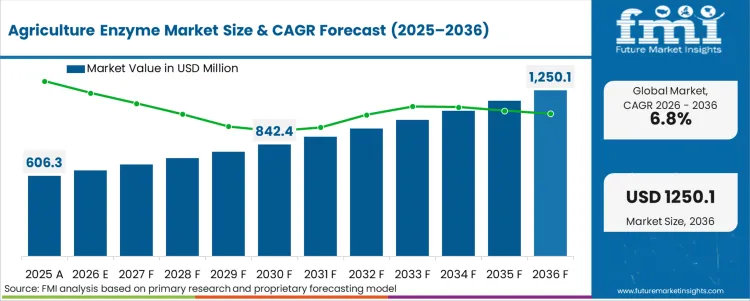
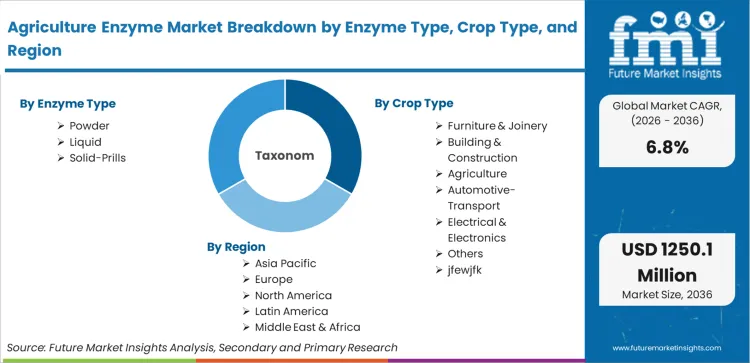
In 2025, the agriculture enzyme market was valued at USD 605.9 million. Based on Future Market Insights’ analysis, demand is estimated to grow to USD 647.5 million in 2026 and USD 1,249.6 million by 2036. FMI projects a CAGR of 6.8% during the forecast period. This projected expansion of the agriculture enzyme market mirrors a broader industry movement toward high‑performance biological inputs that improve nutrient‑use efficiency and reduce dependence on traditional synthetic fertilizers.
Leading global players are publicly echoing this shift. As Jonathan Brown, Global Head Seedcare & Biologicals at Syngenta, notes, “Syngenta is investing significantly to bring the most innovative biological solutions to farmers around the world. Biostimulants that boost the nutrient use efficiency of crops have a significant role in strengthening the sustainability of agriculture, and are integral to Syngenta’s efforts to improve both crop yields and soil health.[10]” Such industry‑wide push toward biological efficiency tools reinforces the report’s outlook that value‑based procurement, sustainability mandates, and performance‑verified enzyme solutions will increasingly shape commercial farm input strategies.
Summary of Agriculture Enzyme Market
- Agriculture Enzyme Market Definition
- The industry provides biologically active protein catalysts that improve nutrient use efficiency and soil health across commercial farming operations.
- Demand Drivers in the Market
- High fertilizer price volatility accelerates the substitution toward biological nutrient enhancers.
- Strict governmental regulations on synthetic runoff compel the adoption of precision enzymatic formulations.
- Advancements in formulation stability allow biocatalysts to be seamlessly bundled into existing fertility products.
- Key Segments Analyzed in the FMI Report
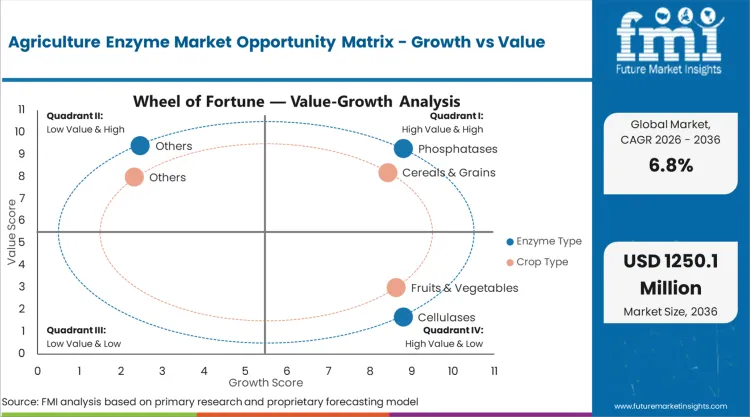
- Enzyme Type: Phosphatases dominate with a 25% share, addressing critical phosphorus availability constraints.
- Crop Type: Cereals & grains secure a 35% share due to massive global acreage and yield pressure.
- Geography: High-growth Asia Pacific outpaces mature North American and European agricultural zones.
- Analyst Opinion at FMI
- Nandini Roy Choudhury, Principal Consultant for Food and Beverage, opines, "With global inorganic fertilizer use hitting 185 million tonnes, buyers will increasingly pivot to biological stacks to decouple yield from volatile synthetic input costs."
- Strategic Implications/Executive Takeaways
- Prioritize distribution exclusivity to secure shelf space in fragmented retail channels.
- Integrate biocatalysts into established fertility packs rather than marketing standalone biological SKUs.
- Invest in clinical-grade field data to navigate tightening regulatory gateways in emerging markets.
- Methodology
- Validated through first-hand corporate production and capacity data.
- Zero reliance on speculative third-party market research reports.
- Based on verifiable industrial benchmarks and verified sources.
Country-level adoption reveals distinct policy and cost drivers across key agricultural zones. India leads the transition with a 12.6% CAGR, supported by new government mandates favoring validated bio-inputs. Japan expands at an 11.2% CAGR as high-tech greenhouse operations prioritize premium nutrient availability. The USA records a 9.8% CAGR, fueled by large-scale row crop farmers seeking financial hedges against fertilizer volatility. China (7.9%), Germany (7.3%), and the UK (7.0%) demonstrate sustained upward trajectories as strict environmental compliance frameworks penalize chemical runoff and reward biological efficiency.
Agriculture Enzyme Market Definition
The industry encompasses the commercialization of biologically active proteins designed to modify soil health and enhance crop productivity. Biocatalysts accelerate the breakdown of organic matter and alter the root microbiome, improving nutrient uptake without accumulating synthetic residues. Demand correlates directly with global pushes for regenerative agriculture and biocontrol solutions across commercial farming operations. Manufacturers calibrate these formulations to function within highly specific environmental parameters, ensuring reliable field-level efficacy.
Agriculture Enzyme Market Inclusions
Scope incorporates large-scale enzymatic formulations applied directly to soils, seeds, or foliar surfaces. Core analytical segments include phosphatases, cellulases, and proteases utilized in commercial food production. Products bundled as biostimulants or integrated within fertility packs are included where the active biological catalyst constitutes the primary functionality. The assessment also covers specialized granular and liquid delivery mechanisms tailored for modern broadcasting equipment.
Agriculture Enzyme Market Exclusions
Research excludes proteins intended strictly for post-harvest food processing or animal feed digestion. Conventional synthetic fertilizers and inorganic pesticides lacking active biological catalysts fall entirely outside the report boundaries. Experimental microbial strains lacking commercial regulatory approval or established distribution networks are omitted. Small-scale artisanal composting additives with negligible global impact and standalone industrial enzymes are not calculated within these market volumes.
Agriculture Enzyme Market Research Methodology
- Primary Research: Interviews were conducted with biological formulation developers, agricultural input distributors, and compliance consultants across major farming regions.
- Desk Research: Production statistics from the Food and Agriculture Organization (FAO) and pricing indexes from the World Bank supported baseline acreage and volume benchmarking.
- Market-Sizing and Forecasting: A hybrid top-down and bottom-up model mapped crop acreage against biological input penetration rates, validated against corporate capacity disclosures.
- Data Validation and Update Cycle: Outputs undergo cross-referencing against regional policy shifts, such as Indian biostimulant regulations, and structured peer review before final publication.
Segmental Analysis
Agriculture Enzyme Market Analysis by Enzyme Type
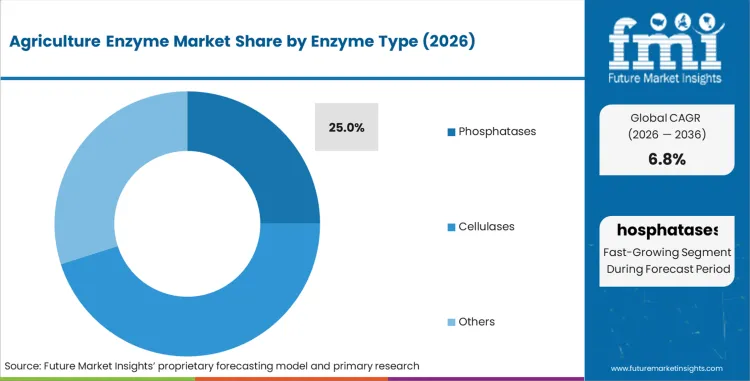
Global farm operations struggle with severe phosphorus lock-up, where expensive synthetic applications become bound in soils and unavailable to plants. Phosphatases capture a dominant 25% segment share in 2026, serving as the primary biological tool to correct these chronic nutrient inefficiencies. These targeted proteins enzymatically cleave bound organic compounds, converting legacy nutrients into bioavailable forms that root systems can easily absorb. Manufacturers are heavily promoting active formulations that explicitly document improved phosphorus use efficiency. This technical capability directly defends farmer profit margins, allowing broad-acre operators to reduce their baseline inorganic applications while maintaining consistent harvest volumes.
- Procurement trigger: Cost pressures associated with inorganic phosphate applications force operators to procure specific phosphatases to unlock legacy soil nutrients. This purchasing shift allows farm managers to maintain yield targets despite reducing their reliance on volatile commodity chemicals.
- Supply-side move: Chemical majors aggressively license biological technologies to defend their formulation advantages against pure-play biotech disruptors. In late 2024, BASF broadened its BioSolutions portfolios by integrating advanced cellulase and biostimulant technologies directly into established distribution networks [8].
- Technology shift: Next-generation stabilization techniques enable sensitive proteins to survive the harsh blending and curing processes required for commercial fertilizers. This advancement facilitates biocatalyst inclusion in dry granular formats, expanding adoption among traditional growers transitioning to biologicals during 2026 to 2036.
Agriculture Enzyme Market Analysis by Crop Type
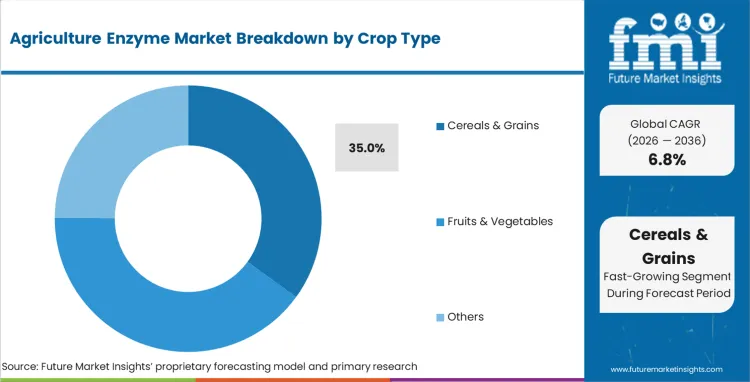
Intensive cereal rotations systematically deplete soil microbiomes, requiring external biological intervention to sustain high-output harvest cycles. Cereals and grains secure a leading 35% of the market volume, underpinned by massive global cultivation footprints and intensifying food security mandates. In these low-margin cropping systems, operators seek incremental yield advantages that integrate seamlessly into standard spraying protocols. Input suppliers are customizing biocatalysts specifically for wheat, corn, and rice to capture the largest addressable global acreage.
- Agronomic driver: Continuous broad-acre cropping degrades native soil biology, prompting farm managers to apply commercial enzymes to restore necessary catalytic activity. Growers adopt these biological solutions to maintain cereal harvest volumes without pushing synthetic chemical loads past regulatory limits.
- Buyer priority: Farm enterprises prioritize biological products that provide validated return on investment metrics over multiple challenging seasons. Solutions stacked within microbial seed treatment packages eliminate separate field passes, making adoption mathematically viable for tight-margin grain producers.
- Commercial rollout: Leading developers target massive global grain markets with highly customized biological partnerships to ensure rapid scale. A global 2025 partnership by Syngenta focused on expanding access to nitrogen-use efficiency products highlights the intense industry focus on broad-acre cereals. [7]
Agriculture Enzyme Market Analysis by Product
Rather than selling active proteins as isolated inputs, successful manufacturers integrate biocatalysts directly into established biostimulants and fertilizer blends. Fertility products represent highly viable commercial application vectors, holding a 40% segment share in 2026. This stacking strategy fundamentally de-risks the adoption curve for new biologicals, as buyers perceive the active ingredients as premium enhancements to their trusted nutrient regimes. Integrating enzymes into standard fertility protocols simplifies operational workflows by eliminating the need for dedicated tractor passes.
- Integration strategy: Formulators combine specific enzymatic strains with humic acids and micronutrients to create comprehensive, shelf-stable biostimulant packages. This approach improves overall product viability while delivering visible, measurable physiological responses in target crops.
- Regulatory signal: Governments are actively clarifying approval pathways for biological fertility enhancers to eliminate unsubstantiated product claims. In 2025, India codified biostimulant regulations under its Fertilizer Control Order, validating scientific efficacy and clearing unverified products from local supply chains [4].
- Channel expansion: Crop protection giants utilize their massive existing retail footprints to distribute sophisticated biological fertility packs to rural operators. FMC's 2024 agreement to act as the exclusive distributor for Novonesis biosolutions in Canada exemplifies exactly how corporations lock in distribution channels [6].
Agriculture Enzyme Market Drivers, Restraints, and Opportunities
Structural volatility of synthetic fertilizer costs, combined with tightening environmental mandates, serves as the primary demand accelerator for biological inputs. Global nitrogen fertilizer use hovered around 108 million tonnes in 2022, contributing heavily to agricultural emissions, watershed degradation, and operator financial risk [1]. To mitigate these impacts, policymakers and supply chain stakeholders actively incentivize precision nutrient management. Enzymatic solutions directly improve the uptake efficiency of applied nitrogen and phosphorus, allowing farmers to reduce total chemical tonnage per hectare without sacrificing harvest yields. This mechanism transforms biologicals from niche regenerative concepts into core risk-management assets, driving bulk procurement by large agricultural cooperatives utilizing advanced agriculture analytics.
Field-level performance variability and the resulting burdens of scientific proof act as significant constraints on rapid market expansion. Unlike synthetic chemicals that deliver highly predictable outcomes regardless of environment, biological catalysts remain sensitive to soil pH, moisture levels, and sudden temperature fluctuations. This inherent inconsistency creates deep adoption friction among conservative growers who demand guaranteed returns on every input investment. To overcome these hurdles, leading suppliers invest heavily in localized agronomic trials and encapsulation technologies to protect active proteins.
- Regulatory Consolidation: The implementation of strict scientific standards eliminates low-quality market participants and builds necessary buyer trust. The formal regulation of biostimulants in India during 2025 creates a high-barrier, premium environment specifically tailored for scientifically validated biological products.
- Distribution Exclusivity: Chemical majors secure exclusive biological portfolios to defend their market share against pure-play biotech firms. FMC's strategic distribution of Novonesis technology directly funnels enzymatic innovation into established, trusted retail networks across North America.
- Corporate Synergy: Mergers between specialized biological developers successfully pool intellectual property and global manufacturing scale. The 2024 combination creating Novonesis established a dominant global entity fully capable of mass-producing advanced microbial and enzymatic strains for global agriculture.
Regional Analysis
Based on the regional analysis, the agriculture enzyme market is segmented into North America, Latin America, Europe, East Asia, South Asia, Oceania and Middle East & Africa across 40+ countries. The full report also offers market attractiveness analysis based on regional trends.
.webp "Top Country Growth Comparison Agriculture Enzyme Market Cagr (2026 2036)")
| Country | CAGR (2026 to 2036) |
|---|---|
| India | 12.6% |
| Japan | 11.2% |
| USA | 9.8% |
| China | 7.9% |
| Germany | 7.3% |
| UK | 7.0% |
Source: Future Market Insights (FMI) analysis, based on proprietary forecasting model and primary research
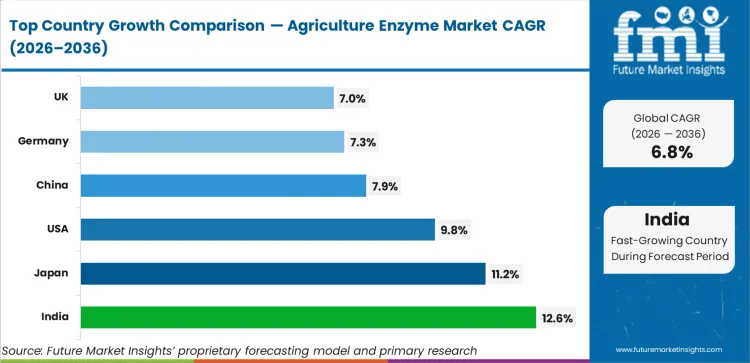
Asia Pacific Agriculture Enzyme Analysis
Intensive policy reforms and acute soil degradation establish the Asia Pacific region as the primary global growth engine for biological inputs. Governments intervene aggressively to halt the decline in arable land productivity, which directly threatens domestic food security goals. This intervention translates into subsidized support for regenerative farming practices and tighter controls over chemical fertilizer use. Companies respond by localizing formulation and distribution, tailoring biological packs to the specific agronomic needs of massive rice and wheat systems.
- India: Demand for agriculture enzymes in India is set to grow at 12.6% CAGR through 2036, supported by rapid bio-input adoption curves before procurement and budgeting cycles translate into higher deployment volumes. This trajectory is supported by strict 2025 biostimulant enforcement under the Fertilizer Control Order, which eliminates unregulated products and heavily rewards scientifically validated enzymatic formulations.
- Japan: Japan is expected to record 11.2% CAGR in agriculture enzyme demand over 2026 to 2036 as high standards for input efficiency drive premium specialty cultivation, tightening links between operational constraints and adoption-led investment. Growers deploy these precision tools to maximize nutrient availability in protected greenhouse environments, demanding extensive performance documentation from their biological suppliers.
- China: The China agriculture enzyme sector is poised to expand at 7.9% CAGR during 2026 to 2036 because severe yield pressure and efficiency mandates force operators to optimize large-scale cereal footprints, which lifts utilization rates and justifies technology refresh decisions. Domestic manufacturing capacity scales rapidly to integrate biologicals into national reduced-chemical programs, effectively substituting imported synthetic dependencies.
FMI’s report includes a detailed analysis of the growth in the Asia Pacific region, along with a country-wise assessment. South Korea and Indonesia present compelling long-term upside as their respective agricultural ministries increasingly promote humic and fulvic acid based biostimulants to combat severe soil acidification. Suppliers navigating these opportunistic markets must carefully monitor local import restrictions on microbial strains and continually adapt their registration dossiers to match evolving ASEAN regulatory expectations.
North America Agriculture Enzyme Analysis
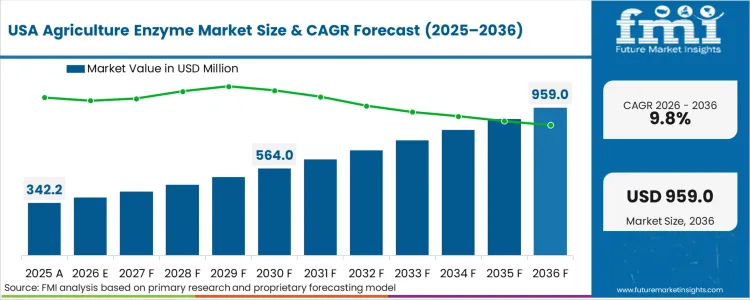
Large-scale farming operations seeking marginal gains in input efficiency drive the high penetration rates for advanced biologicals across North America. The regional landscape contends with severe fertilizer price cycles and a growing public imperative to manage nutrient runoff into critical watersheds. Operators managing thousands of acres demand integrated solutions that stack enzymes with traditional chemistry to guarantee consistent mechanical performance. Global crop protection leaders rely heavily on the US and Canadian markets to launch sophisticated biological products, leveraging established ag-retail networks for rapid distribution.
- USA: The outlook for agriculture enzymes in the USA indicates 9.8% CAGR from 2026 to 2036 as clear economics under fertilizer volatility convince large-acre crop systems to adopt enzyme and microbial stacks, strengthening demand from both public programmes and private operators. The World Bank reported significant fertilizer price index drops of over 17% in late 2024, highlighting the raw material cost fluctuations that prompt American farm managers to invest in enzymatic efficiency tools as financial hedges [2].
FMI’s report includes an extensive evaluation of the North American landscape, providing a country-wise assessment. Canada and Mexico offer substantial strategic value, particularly as cross-border agricultural trade necessitates highly uniform input quality standards. Buyers in adjacent opportunistic countries prioritize biologicals arriving pre-formulated in existing nutrient packs, shifting application burdens away from individual farm operators. Accessing feed enzymes networks provides deeper context on integrated agricultural supply chains.
Europe Agriculture Enzyme Analysis
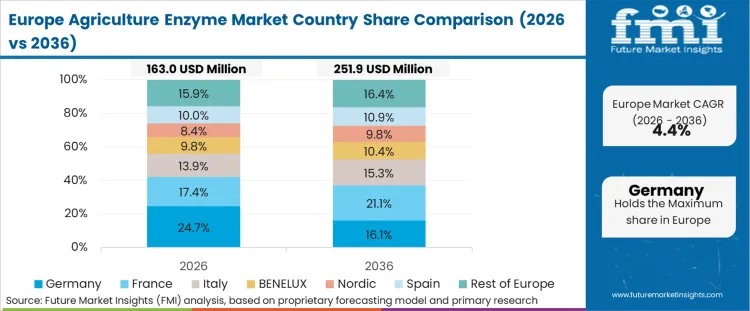
Europe enforces the strictest environmental compliance standards for crop inputs, operating as the global regulatory benchmark for sustainable agriculture. The region's strategic focus on climate resilience and soil health directly incentivizes the adoption of biological catalysts over synthetic alternatives. According to FMI's estimates, rigorous registration processes for new active ingredients create substantial market lead times, rewarding entrenched players with the capital necessary to fund extensive efficacy trials. Market growth relies less on expanding crop acreage and more on substitution effects as conventional agrochemicals face progressive phase-outs.
- Germany: Growth in agriculture enzymes across Germany is estimated at 7.3% CAGR through 2036, driven by strong demand for biological solutions supporting climate resilience and soil health focuses that increase the value of reliability and compliance in buyer criteria. Demand aligns with broader European initiatives combating severe land degradation, which currently threatens agricultural productivity across nearly 40% of the global population [3].
- UK: In the UK, agriculture enzyme growth is projected at 7.0% CAGR through 2036, with expansion tied to input optimization and sustainability reporting pull that prompts procurement teams to accelerate digital upgrades. Adoption of biocatalysts accelerates as retailer advisory groups increasingly endorse biological interventions to meet stringent supply chain sustainability and compliance targets.
FMI’s report includes a comprehensive breakdown of the European market, alongside a dedicated country-wise assessment. France and Italy remain critical agricultural hubs where specialized vineyards and horticultural operations drive premium biological demand. Success in these opportunistic markets requires suppliers to provide localized agronomic support and successfully navigate complex national-level distribution networks governing all premium agricultural inputs. Read more about European market dynamics in biostimulants research.
Competitive Aligners for Market Players
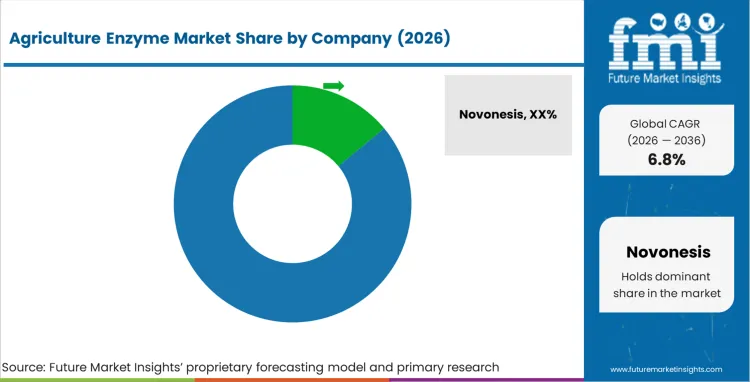
Massive corporate consolidation and strategic distribution alliances define the competitive structure of the biological input sector. Pure-play biotech innovators face immense operational challenges accessing fragmented farm retail channels independently. Companies forge exclusive commercial partnerships with legacy chemical giants to instantly bypass these retail bottlenecks. This dynamic allows specialized enzyme developers to plug their intellectual property into global supply chains, while crop protection majors rapidly refresh their portfolios with sustainable offerings.
Regulatory compliance acts as a severe competitive filter that permanently alters market participation in key regions. The formal codification of biological standards effectively sidelines unverified, low-cost manufacturers operating at the fringes of the industry. Firms capable of funding comprehensive toxicity and bio-efficacy dossiers capture the market share vacated by non-compliant competitors, transforming regulatory overhead into a distinct commercial advantage.
Vertical integration and massive manufacturing scale separate tier-one suppliers from regional formulators. Controlling the entire production sequence, from initial strain fermentation to downstream stabilization, enables integrated entities to defend margins against raw material shocks. The 2024 combination creating Novonesis consolidated vast fermentation capacity and microbial expertise under a single operational roof. Smaller competitors lacking captive manufacturing capabilities must rely on tolling agreements, exposing their supply chains to severe disruption during periods of high agricultural demand.
Recent Developments
The report includes full coverage of key trends from competitive benchmarking. Some of the recent developments covered in the reports:
- In January 2024, Novozymes and Chr. Hansen finalized their combination to launch Novonesis, creating a leading global biosolutions partner.[5]
- In May 2025, UPL partnered with Elemental Enzymes to distribute new bioprotection products starting in the Brazilian agricultural market.[9]
Key Players in Agriculture Enzyme
- Novonesis
- Syngenta
- BASF
- FMC Corporation
- UPL
- Corteva Agriscience
- Elemental Enzymes
- Acadian Plant Health
- Koppert
- Valent BioSciences
Scope of the Report
| Metric | Value |
|---|---|
| Quantitative Units | USD 647.5 million (2026) to USD 1,249.6 million (2036), at a CAGR of 6.8% |
| Market Definition | The agriculture enzyme market encompasses the commercialization of biologically active proteins used to enhance soil health and crop productivity, acting as biocatalysts to improve nutrient uptake without accumulating synthetic residues. |
| Enzyme Type Segmentation | Phosphatases, Cellulases, Others |
| Crop Type Segmentation | Cereals & Grains, Fruits & Vegetables, Others |
| Application Coverage | Fertility Products, Others |
| Regions Covered | North America, Latin America, Europe, East Asia, South Asia, Oceania, Middle East and Africa |
| Countries Covered | United States, Canada, Mexico, Brazil, Argentina, Germany, France, United Kingdom, Italy, Spain, China, India, Japan, South Korea, Indonesia, Australia and 40 plus countries |
| Key Companies Profiled | Novonesis, Syngenta, BASF, FMC Corporation, UPL, Corteva Agriscience, Elemental Enzymes, Acadian Plant Health, Koppert, Valent BioSciences |
| Forecast Period | 2026 to 2036 |
| Approach | Hybrid top-down and bottom-up market modeling validated through primary interviews with biological formulation developers, supported by FAO agricultural input statistics and corporate capacity verification |
Agriculture Enzyme Market Analysis by Segments
Enzyme Type:
- Phosphatases
- Cellulases
- Others
Crop Type:
- Cereals & Grains
- Fruits & Vegetables
- Others
Product:
- Fertility Products
- Others
Region:
- Asia Pacific
- India
- China
- Japan
- South Korea
- Indonesia
- Australia & New Zealand
- ASEAN
- Rest of Asia Pacific
- Europe
- Germany
- Italy
- France
- United Kingdom
- Spain
- Benelux
- Nordics
- Central & Eastern Europe
- Rest of Europe
- North America
- United States
- Canada
- Mexico
- Latin America
- Brazil
- Argentina
- Chile
- Rest of Latin America
- Middle East & Africa
- Kingdom of Saudi Arabia
- United Arab Emirates
- South Africa
- Turkey
- Rest of Middle East & Africa
Bibliography
- [1] Food and Agriculture Organization. (2024). Global use of inorganic fertilizers in agriculture.
- [2] World Bank. (2025). Fertilizer prices stabilize amid lower input costs and trade shifts.
- [3] UN Environment Programme. (2025). Facts about the nature crisis and land degradation.
- [4] Press Information Bureau. (2025). India biostimulants regulation timeline and registration extensions.
- [5] Nasdaq. (2024). The combination of Novozymes and Chr. Hansen is now successfully completed creating Novonesis.
- [6] FMC Corporation. (2024). FMC Corporation expands biologicals crop protection platform in Canada.
- [7] Syngenta. (2025). Syngenta and Ceres Biotics global partnership to expand access to VIXERAN.
- [8] BASF. (2024). BASF partnership broadens BioSolutions portfolio with seaweed biostimulants.
- [9] New AG International. (2025). UPL begins partnership with Elemental Enzymes in Brazil.
- [10] Syngenta AG. (2025). Sustainability in agriculture gets a boost through global biologicals partnership [Media release].
This bibliography is provided for reader reference and is not exhaustive. The full report contains the complete reference list and detailed citations.
This Report Addresses
- Market intelligence enabling structured strategic decision-making across mature and emerging biological input economies
- Market size estimation and 10-year revenue forecasts from 2026 to 2036, supported by validated corporate capacity benchmarks
- Growth opportunity mapping across phosphatases, cellulases, and diverse crop systems with emphasis on fertility integrations
- Segment and regional revenue forecasts covering cereals, fruits, vegetables, and commercial greenhouse applications
- Competition strategy assessment including vertical integration models, regulatory compliance capability, and distribution channel lock-in
- Product reformulation tracking including biological stability enhancements and granular fertilizer blending compatibility
- Regulatory impact analysis covering biostimulant mandates, chemical runoff penalties, and export-driven specification upgrades
- Market report delivery in PDF, Excel, PPT, and interactive dashboard formats for executive and operational use
Frequently Asked Questions
How large is the demand for agriculture enzymes in the global market in 2026?
Demand for agriculture enzymes in global agricultural applications is estimated to be valued at USD 647.5 million in 2026.
What will be the market size of agriculture enzymes in the global market by 2036?
The market size for agriculture enzymes is projected to reach USD 1,249.6 million by 2036.
What is the expected demand growth for agriculture enzymes in the global market between 2026 and 2036?
Demand for agriculture enzymes globally is expected to grow at a CAGR of 6.8% between 2026 and 2036.
Which Enzyme Type is poised to lead global sales by 2026?
Phosphatases are expected to be the dominant form, capturing approximately 25% of the global market share in 2026 due to their unique ability to unlock legacy soil nutrients.
How significant is the role of Cereals & Grains in driving agriculture enzyme adoption in 2026?
Cereals & grains represent a critical segment, projected to hold a substantial 35% share of total volumes in 2026 as broad-acre operators prioritize biological yield enhancements.
What is driving demand in India?
Strict government enforcement under the newly amended Fertilizer Control Order and national pushes for nitrogen efficiency drive immediate demand for validated biologicals.
What compliance standards or regulations are referenced for India?
The Fertilizer Control Order (FCO) biostimulant regulation update of 2025 is referenced as the primary regulatory benchmark.
What is the India growth outlook in this report?
India is projected to grow at a rapid CAGR of 12.6% during 2026 to 2036.
Why is North America described as a priority region in this report?
Growth is anchored by large-scale farming operations seeking effective financial hedges against severe inorganic fertilizer price cycles.
What type of demand dominates in North America?
Demand for integrated enzymatic and microbial stacks running seamlessly through existing farm broadcasting machinery dominates regional consumption.
What is the Japan growth outlook in this report?
Japan is projected to expand at a CAGR of 11.2% during 2026 to 2036.
Does the report cover the USA in its regional analysis?
Yes, the USA is included within North America under the regional scope of analysis.
What are the sources referred to for analyzing the USA?
Data from the World Bank covering fertilizer price index fluctuations are cited as primary reference sources for tracking input cost volatility.
What is the main demand theme linked to the USA in its region coverage?
North American demand is associated with large-acre crop systems adopting biological tools to aggressively manage input volatility and runoff limits.
Does the report cover China in its regional analysis?
Yes, China is included within Asia Pacific under the regional coverage frameworks.
What is the main China related demand theme in its region coverage?
Yield pressure and strict government mandates for reduced chemical dependency drive steady expansion via localized domestic biological manufacturing.
Which product formats or configurations are strategically important for Europe supply chains?
Premium biologicals equipped with extensive scientific validation are prioritized due to stringent regional environmental and registration hurdles.
What is an agriculture enzyme and what is it mainly used for?
Agriculture enzymes are biologically active proteins primarily used as catalysts to improve overall soil health, organic matter breakdown, and nutrient uptake in commercial farming.
What does agriculture enzyme mean in this report?
The agriculture enzyme market refers to the global production, formulation, and commercialization of biocatalysts applied directly to soils, seeds, or plants.
What is included in the scope of this agriculture enzyme report?
The scope covers enzymatic products classified by specific active type, targeted crop application, and integrated fertility formulations.
What is excluded from the scope of this report?
Conventional synthetic fertilizers, inorganic pesticides lacking biological catalysts, and enzymes intended exclusively for animal feed digestion are excluded.
What does market forecast mean on this page?
The market forecast represents model-based projections built on defined agricultural acreage and biological penetration assumptions for corporate strategic planning purposes.
How does FMI build and validate the agriculture enzyme forecast?
The forecast is developed using hybrid top-down and bottom-up modeling carefully validated through primary industry interviews and corporate capacity checks.
What does zero reliance on speculative third party market research mean here?
Primary interviews and verifiable public datasets are used exclusively instead of unverified syndicated market estimates.
Preview the report firsthand - request a free sample
Get SampleGet the brochure for pricing and purchase details.
Get PDFTable of Content
- Executive Summary
- Global Market Outlook
- Demand-side Trends
- Supply-side Trends
- Technology Roadmap Analysis
- Analysis and Recommendations
- Market Overview
- Market Coverage / Taxonomy
- Market Definition / Scope / Limitations
- Research Methodology
- Chapter Orientation
- Analytical Lens and Working Hypotheses
- Market Structure, Signals, and Trend Drivers
- Benchmarking and Cross-market Comparability
- Market Sizing, Forecasting, and Opportunity Mapping
- Research Design and Evidence Framework
- Desk Research Programme (Secondary Evidence)
- Company Annual and Sustainability Reports
- Peer-reviewed Journals and Academic Literature
- Corporate Websites, Product Literature, and Technical Notes
- Earnings Decks and Investor Briefings
- Statutory Filings and Regulatory Disclosures
- Technical White Papers and Standards Notes
- Trade Journals, Industry Magazines, and Analyst Briefs
- Conference Proceedings, Webinars, and Seminar Materials
- Government Statistics Portals and Public Data Releases
- Press Releases and Reputable Media Coverage
- Specialist Newsletters and Curated Briefings
- Sector Databases and Reference Repositories
- FMI Internal Proprietary Databases and Historical Market Datasets
- Subscription Datasets and Paid Sources
- Social Channels, Communities, and Digital Listening Inputs
- Additional Desk Sources
- Expert Input and Fieldwork (Primary Evidence)
- Primary Modes
- Qualitative Interviews and Expert Elicitation
- Quantitative Surveys and Structured Data Capture
- Blended Approach
- Why Primary Evidence is Used
- Field Techniques
- Interviews
- Surveys
- Focus Groups
- Observational and In-context Research
- Social and Community Interactions
- Stakeholder Universe Engaged
- C-suite Leaders
- Board Members
- Presidents and Vice Presidents
- R&D and Innovation Heads
- Technical Specialists
- Domain Subject-matter Experts
- Scientists
- Physicians and Other Healthcare Professionals
- Governance, Ethics, and Data Stewardship
- Research Ethics
- Data Integrity and Handling
- Primary Modes
- Tooling, Models, and Reference Databases
- Desk Research Programme (Secondary Evidence)
- Data Engineering and Model Build
- Data Acquisition and Ingestion
- Cleaning, Normalisation, and Verification
- Synthesis, Triangulation, and Analysis
- Quality Assurance and Audit Trail
- Market Background
- Market Dynamics
- Drivers
- Restraints
- Opportunity
- Trends
- Scenario Forecast
- Demand in Optimistic Scenario
- Demand in Likely Scenario
- Demand in Conservative Scenario
- Opportunity Map Analysis
- Product Life Cycle Analysis
- Supply Chain Analysis
- Investment Feasibility Matrix
- Value Chain Analysis
- PESTLE and Porter’s Analysis
- Regulatory Landscape
- Regional Parent Market Outlook
- Production and Consumption Statistics
- Import and Export Statistics
- Market Dynamics
- Global Market Analysis 2021 to 2025 and Forecast, 2026 to 2036
- Historical Market Size Value (USD Million) Analysis, 2021 to 2025
- Current and Future Market Size Value (USD Million) Projections, 2026 to 2036
- Y-o-Y Growth Trend Analysis
- Absolute $ Opportunity Analysis
- Global Market Pricing Analysis 2021 to 2025 and Forecast 2026 to 2036
- Global Market Analysis 2021 to 2025 and Forecast 2026 to 2036, By Enzyme Type
- Introduction / Key Findings
- Historical Market Size Value (USD Million) Analysis By Enzyme Type , 2021 to 2025
- Current and Future Market Size Value (USD Million) Analysis and Forecast By Enzyme Type , 2026 to 2036
- Phosphatases
- Cellulases
- Others
- Phosphatases
- Y-o-Y Growth Trend Analysis By Enzyme Type , 2021 to 2025
- Absolute $ Opportunity Analysis By Enzyme Type , 2026 to 2036
- Global Market Analysis 2021 to 2025 and Forecast 2026 to 2036, By Crop Type
- Introduction / Key Findings
- Historical Market Size Value (USD Million) Analysis By Crop Type, 2021 to 2025
- Current and Future Market Size Value (USD Million) Analysis and Forecast By Crop Type, 2026 to 2036
- Cereals & Grains
- Fruits & Vegetables
- Others
- Cereals & Grains
- Y-o-Y Growth Trend Analysis By Crop Type, 2021 to 2025
- Absolute $ Opportunity Analysis By Crop Type, 2026 to 2036
- Global Market Analysis 2021 to 2025 and Forecast 2026 to 2036, By Region
- Introduction
- Historical Market Size Value (USD Million) Analysis By Region, 2021 to 2025
- Current Market Size Value (USD Million) Analysis and Forecast By Region, 2026 to 2036
- North America
- Latin America
- Western Europe
- Eastern Europe
- East Asia
- South Asia and Pacific
- Middle East & Africa
- Market Attractiveness Analysis By Region
- North America Market Analysis 2021 to 2025 and Forecast 2026 to 2036, By Country
- Historical Market Size Value (USD Million) Trend Analysis By Market Taxonomy, 2021 to 2025
- Market Size Value (USD Million) Forecast By Market Taxonomy, 2026 to 2036
- By Country
- USA
- Canada
- Mexico
- By Enzyme Type
- By Crop Type
- By Country
- Market Attractiveness Analysis
- By Country
- By Enzyme Type
- By Crop Type
- Key Takeaways
- Latin America Market Analysis 2021 to 2025 and Forecast 2026 to 2036, By Country
- Historical Market Size Value (USD Million) Trend Analysis By Market Taxonomy, 2021 to 2025
- Market Size Value (USD Million) Forecast By Market Taxonomy, 2026 to 2036
- By Country
- Brazil
- Chile
- Rest of Latin America
- By Enzyme Type
- By Crop Type
- By Country
- Market Attractiveness Analysis
- By Country
- By Enzyme Type
- By Crop Type
- Key Takeaways
- Western Europe Market Analysis 2021 to 2025 and Forecast 2026 to 2036, By Country
- Historical Market Size Value (USD Million) Trend Analysis By Market Taxonomy, 2021 to 2025
- Market Size Value (USD Million) Forecast By Market Taxonomy, 2026 to 2036
- By Country
- Germany
- UK
- Italy
- Spain
- France
- Nordic
- BENELUX
- Rest of Western Europe
- By Enzyme Type
- By Crop Type
- By Country
- Market Attractiveness Analysis
- By Country
- By Enzyme Type
- By Crop Type
- Key Takeaways
- Eastern Europe Market Analysis 2021 to 2025 and Forecast 2026 to 2036, By Country
- Historical Market Size Value (USD Million) Trend Analysis By Market Taxonomy, 2021 to 2025
- Market Size Value (USD Million) Forecast By Market Taxonomy, 2026 to 2036
- By Country
- Russia
- Poland
- Hungary
- Balkan & Baltic
- Rest of Eastern Europe
- By Enzyme Type
- By Crop Type
- By Country
- Market Attractiveness Analysis
- By Country
- By Enzyme Type
- By Crop Type
- Key Takeaways
- East Asia Market Analysis 2021 to 2025 and Forecast 2026 to 2036, By Country
- Historical Market Size Value (USD Million) Trend Analysis By Market Taxonomy, 2021 to 2025
- Market Size Value (USD Million) Forecast By Market Taxonomy, 2026 to 2036
- By Country
- China
- Japan
- South Korea
- By Enzyme Type
- By Crop Type
- By Country
- Market Attractiveness Analysis
- By Country
- By Enzyme Type
- By Crop Type
- Key Takeaways
- South Asia and Pacific Market Analysis 2021 to 2025 and Forecast 2026 to 2036, By Country
- Historical Market Size Value (USD Million) Trend Analysis By Market Taxonomy, 2021 to 2025
- Market Size Value (USD Million) Forecast By Market Taxonomy, 2026 to 2036
- By Country
- India
- ASEAN
- Australia & New Zealand
- Rest of South Asia and Pacific
- By Enzyme Type
- By Crop Type
- By Country
- Market Attractiveness Analysis
- By Country
- By Enzyme Type
- By Crop Type
- Key Takeaways
- Middle East & Africa Market Analysis 2021 to 2025 and Forecast 2026 to 2036, By Country
- Historical Market Size Value (USD Million) Trend Analysis By Market Taxonomy, 2021 to 2025
- Market Size Value (USD Million) Forecast By Market Taxonomy, 2026 to 2036
- By Country
- Kingdom of Saudi Arabia
- Other GCC Countries
- Turkiye
- South Africa
- Other African Union
- Rest of Middle East & Africa
- By Enzyme Type
- By Crop Type
- By Country
- Market Attractiveness Analysis
- By Country
- By Enzyme Type
- By Crop Type
- Key Takeaways
- Key Countries Market Analysis
- USA
- Pricing Analysis
- Market Share Analysis, 2025
- By Enzyme Type
- By Crop Type
- Canada
- Pricing Analysis
- Market Share Analysis, 2025
- By Enzyme Type
- By Crop Type
- Mexico
- Pricing Analysis
- Market Share Analysis, 2025
- By Enzyme Type
- By Crop Type
- Brazil
- Pricing Analysis
- Market Share Analysis, 2025
- By Enzyme Type
- By Crop Type
- Chile
- Pricing Analysis
- Market Share Analysis, 2025
- By Enzyme Type
- By Crop Type
- Germany
- Pricing Analysis
- Market Share Analysis, 2025
- By Enzyme Type
- By Crop Type
- UK
- Pricing Analysis
- Market Share Analysis, 2025
- By Enzyme Type
- By Crop Type
- Italy
- Pricing Analysis
- Market Share Analysis, 2025
- By Enzyme Type
- By Crop Type
- Spain
- Pricing Analysis
- Market Share Analysis, 2025
- By Enzyme Type
- By Crop Type
- France
- Pricing Analysis
- Market Share Analysis, 2025
- By Enzyme Type
- By Crop Type
- India
- Pricing Analysis
- Market Share Analysis, 2025
- By Enzyme Type
- By Crop Type
- ASEAN
- Pricing Analysis
- Market Share Analysis, 2025
- By Enzyme Type
- By Crop Type
- Australia & New Zealand
- Pricing Analysis
- Market Share Analysis, 2025
- By Enzyme Type
- By Crop Type
- China
- Pricing Analysis
- Market Share Analysis, 2025
- By Enzyme Type
- By Crop Type
- Japan
- Pricing Analysis
- Market Share Analysis, 2025
- By Enzyme Type
- By Crop Type
- South Korea
- Pricing Analysis
- Market Share Analysis, 2025
- By Enzyme Type
- By Crop Type
- Russia
- Pricing Analysis
- Market Share Analysis, 2025
- By Enzyme Type
- By Crop Type
- Poland
- Pricing Analysis
- Market Share Analysis, 2025
- By Enzyme Type
- By Crop Type
- Hungary
- Pricing Analysis
- Market Share Analysis, 2025
- By Enzyme Type
- By Crop Type
- Kingdom of Saudi Arabia
- Pricing Analysis
- Market Share Analysis, 2025
- By Enzyme Type
- By Crop Type
- Turkiye
- Pricing Analysis
- Market Share Analysis, 2025
- By Enzyme Type
- By Crop Type
- South Africa
- Pricing Analysis
- Market Share Analysis, 2025
- By Enzyme Type
- By Crop Type
- USA
- Market Structure Analysis
- Competition Dashboard
- Competition Benchmarking
- Market Share Analysis of Top Players
- By Regional
- By Enzyme Type
- By Crop Type
- Competition Analysis
- Competition Deep Dive
- Novonesis
- Overview
- Product Portfolio
- Profitability by Market Segments (Product/Age /Sales Channel/Region)
- Sales Footprint
- Strategy Overview
- Marketing Strategy
- Product Strategy
- Channel Strategy
- Syngenta
- BASF
- FMC Corporation
- UPL
- Corteva Agriscience
- Elemental Enzymes
- Novonesis
- Competition Deep Dive
- Assumptions & Acronyms Used


