

- Market Size (2026)
- USD 194.3 Bn
- Forecast (2036)
- USD 351.2 Bn
- CAGR (2026 to 2036)
- 6.1%
How big is Aluminum Market in 2026?
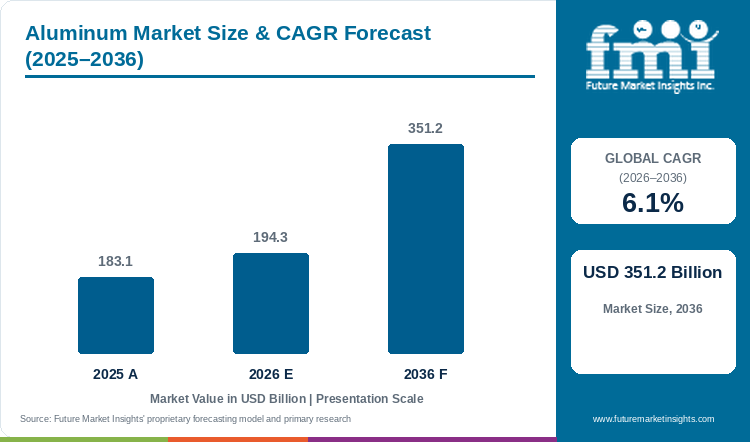
The aluminum market is estimated at USD 183.1 billion in 2025 and is projected to reach USD 194.3 billion in 2026. Sales of aluminum are expected to grow at a CAGR of 6.1% and reach USD 351.2 billion by 2036.
Aluminum market share is tilting toward remelted scrap, with the aluminum market estimated at USD 183.1 billion in 2025. USD 194.3 billion of aluminum sales is expected in 2026, and more metal in every building, car and can is forecast to carry demand for aluminum to USD 351.2 billion by 2036, a 6.1% CAGR. Through 2036, the trend expected to shape supply most is the rise of remelted scrap beside primary smelting, as smelter outages and trade barriers keep primary metal tight. Hydro raised recycling production 8% to 225 kt in the second quarter of 2026 and cited external estimates of a 0.9 million tonne global deficit of primary aluminum for 2026.[2] A remelt line uses far less energy per tonne than a smelter and starts up within months, so recyclers will fill much of the gap left by the deficit. FMI analysts recommend that extruders and can sheet rollers sign multi-year scrap contracts near the plants, since collected scrap is becoming the cheapest secure feed for new capacity.
Key Market Trends & Insights
- Series 5 is expected to lead series sales with 22.4% share in 2026, as can ends, truck bodies and ship plate use magnesium alloys, and Series 6 follows close at 21.6%.
- Profiles for windows, frames and crash boxes put extrusions narrowly in front by processing, at a projected 29.6% for 2026, with flat rolled aluminum close on 28.9%. Hydro estimated that demand for extrusions in Europe will increase 0.5% in 2026.[2]
- Window frames, facades, roofing and structural profiles give building and construction an expected 27.5% of end use sales in 2026, against 24.8% for the automotive industry. Constellium shipped 68 kt of automotive rolled products in the June 2026 quarter, up from 59 kt.[3]
- Primary production is likely to hold 64.3% of deployment sales in 2026, and secondary production an estimated 35.7%, as recyclers add remelt capacity.
Regional Highlights
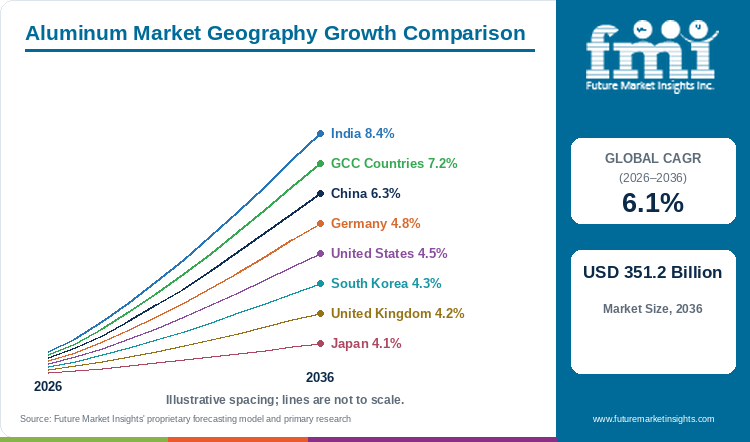
- New smelter, rolling and foil lines coming on stream in Odisha and elsewhere give India the top projected CAGR, 8.4%.
- Restored Gulf smelters return GCC Countries to 7.2%, and Chinese recycling growth holds China a little above the global rate, on 6.3%. Car body and window orders keep Germany on 4.8%, ahead of US rolling-led growth of 4.5%. Korean shipyards and British aerospace plants give 4.3% and 4.2%, and falling housing starts leave Japan on 4.1%, the slowest pace in the table.
- Hindalco commissioned an aluminum battery foil plant at Aditya in the June 2026 quarter, and Aditya Smelter Phase 2 is expected to begin metal production in FY28.[1]
Market Size & Forecast
Table 1: Market Size and Forecast for the Aluminum Market (USD billion and percentage), 2025 to 2036
| Metric | Value |
|---|---|
| 2025 Market Size | USD 183.1 billion |
| Estimated Market Size in 2026 | USD 194.3 billion |
| Projected Market Size by 2036 | USD 351.2 billion |
| CAGR, 2026 to 2036 | 6.1% |
| Added Revenue, 2026 to 2036 | USD 156.9 billion |
| Market Expansion Multiple | 1.8x |
Sales of aluminum follow both tonnage and metal prices, since producers pass the LME price and regional premiums through to buyers. Alcoa reported second-quarter 2026 revenue of USD 3,966 million, the highest quarter for the company, on 726 kt of aluminum shipments and a realized price of USD 4,752 per tonne.[4] Rio Tinto said the US Midwest duty-paid premium averaged USD 2,406 per tonne in the first half of 2026.[5] Each electric car carries an aluminum battery enclosure, and with an 8.5% CAGR in prospect for the electric vehicle battery market, sheet and extrusion mills gain a fast-growing outlet. By 2036, aluminum sales are 1.8 times the 2026 base in FMI data, a gain of USD 156.9 billion. A fall in metal prices after the Gulf supply recovery is the main risk for the aluminum market, since lower prices shrink sales value even with steady tonnage.
Smelter Supply, Recycling and Trade Barriers
Primary supply is tight after outages and restarts. EGA production fell 47% to 602,000 tonnes in the first half of 2026 after the Al Taweelah attack, and the company plans to restore prewar output by the first quarter of 2027.[6] Rio Tinto held first-half aluminum production flat at 1,676 kt and expects the AP60 smelter in Quebec to be fully ramped up by the end of 2026.[5] Alcoa completed the San Ciprián restart in Spain on 7 April 2026.[4] Buyers outside the Gulf are paying higher premiums until these tonnes return.
Rolled product makers are adding capacity close to customers. Novelis began commissioning the Bay Minette rolling plant in Alabama and shipped 916 kt of rolled products in the June 2026 quarter.[7] Constellium raised 2026 guidance and credited favorable metal costs at Muscle Shoals and Neuf-Brisach.[3] New rolling lines in the United States will cut can sheet imports and keep more scrap in domestic loops.
Table 2: Supply, Price and Rolling Indicators for the Aluminum Market (tonnes, prices and growth), 2026
| Indicator | Data Point | Relevance | Source |
|---|---|---|---|
| Alcoa realized aluminum price, Q2 2026 | USD 4,752 per tonne | Price level behind sales value | [4] |
| US Midwest duty-paid premium, H1 2026 | USD 2,406 per tonne | Tariff effect on US buyers | [5] |
| EGA aluminum production, H1 2026 | 602,000 tonnes; down 47% | Gulf supply loss | [6] |
| Hydro recycling production, Q2 2026 | 225 kt; up 8% | Growth of remelted supply | [2] |
| Novelis rolled product shipments, Q1 FY27 | 916 kt; down 5% | Rolled sheet orders and outages | [7] |
| Constellium automotive rolled shipments, Q2 2026 | 68 kt, against 59 kt | Orders for vehicle sheet | [3] |
| Japan can stock shipments, March 2026 | 33,639 tonnes; up 3.6% | Can orders in Asia | [8] |
Analyst Perspective
“The aluminum market is entering a decade in which scrap, not bauxite, sets the pace of new supply, as remelt lines start faster and cost far less than smelters. I would expect buyers that lock in recycled content and regional rolling capacity now to pay the lowest premiums once Gulf output returns.”
- Nikhil Kaitwade, Principal Consultant, Future Market Insights.
How is the aluminum market segmented?
The market is segmented into series, processing, end use, deployment, and region. Series 5 is expected to lead series with 22.4% share in 2026, and extrusions are projected to lead processing with 29.6%.
By series: Series 1, Series 2, Series 3, Series 4, Series 5, Series 6, Series 7, and Series 8.
By processing: extrusions, castings, flat rolled aluminum, rods and bars, pigments and powder, and forgings.
By end use: automotive industry, aerospace industry, building and construction industry, electrical industry, packaging industry, and industrial machinery and others.
By deployment: primary production and secondary production.
By region: smelters, remelters, rolling mills and extruders in North America, Latin America, Western Europe, Eastern Europe, East Asia, South Asia and Pacific, and Middle East and Africa.
Why does Series 5 lead aluminum sales by series?
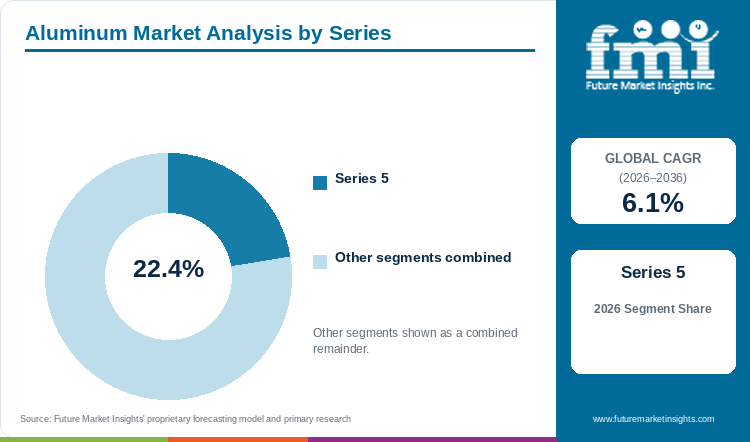
Series 5 is expected to lead series sales with 22.4% share in 2026, ahead of Series 6 at an estimated 21.6% and Series 4 at about 19.8%.
Table 3: Series Share for the Aluminum Market (percentage share), 2026
| Series | Estimated Share (2026) |
|---|---|
| Series 5 | 22.4% |
| Series 6 | 21.6% |
| Series 4 | 19.8% |
| Series 1 | 13.5% |
| Series 3 | 10.6% |
| Series 7 | 5.4% |
| Series 2 | 4.1% |
| Series 8 | 2.6% |
| Total | 100.0% |
Table 4: Series Leadership and Market Growth for the Aluminum Market (segment and CAGR percentage), 2026 to 2036
| Metric | Value |
|---|---|
| Global CAGR (2026 to 2036) | 6.1% |
| Leading Segment | Series 5 |
Can ends, tanker and truck bodies, rail cars and ship hulls all use magnesium alloys for strength and corrosion resistance without heat treatment, so Series 5 is expected to lead the alloy split, at 22.4% for 2026. Series 6, an estimated 21.6%, feeds most window, facade and vehicle extrusions, and orders there follow construction cycles. Series 4, about 19.8%, covers silicon alloys for castings and brazing sheet. Series 1 at 13.5% serves foil and power conductors, Series 3 at 10.6% goes into can bodies and cookware, Series 7 at 5.4% serves aircraft and sports goods, Series 2 at 4.1% serves aerospace and forgings, and Series 8 at 2.6% covers lithium alloys and foil. Every beverage can pairs a Series 5 end with a Series 3 body, so a 4.1% CAGR for the aluminum cans market keeps end stock orders steady. Constellium shipped 193 kt of packaging rolled products in the June 2026 quarter.[3] Rolled sheet buyers order Series 5 by the coil, which keeps the series ahead of extrusion alloys.
- Can end stock, truck and tanker body sheet and marine plate make up the Series 5 base.
- Japan shipped 33,639 tonnes of flat-rolled can stock in March 2026, up 3.6%, Japan Aluminium Association data show.[8]
Why do extrusions lead aluminum sales by processing?
Extrusions are projected to lead processing sales with 29.6% share in 2026, against an estimated 28.9% for flat rolled aluminum and 24.8% for castings.
Table 5: Processing Share for the Aluminum Market (percentage share), 2026
| Processing | Estimated Share (2026) |
|---|---|
| Extrusions | 29.6% |
| Flat Rolled Aluminum | 28.9% |
| Castings | 24.8% |
| Rods and Bars | 9.5% |
| Forgings | 4.6% |
| Pigments and Powder | 2.6% |
| Total | 100.0% |
In 2026, extrusions are expected to lead processing at 29.6%, as window frames, curtain walls, solar mounts, rail cars and vehicle crash parts all start as extruded profiles. Flat rolled aluminum, an estimated 28.9%, serves cans, foil, car panels and aircraft skin, and new capacity there means large rolling mills that require years to build. Castings, near 24.8%, go into engine blocks, wheels and housings, and the shift to electric cars removes some engine castings. Rods and bars, about 9.5%, serve wire and machining, forgings at 4.6% serve aircraft and suspension parts, and pigments and powder at 2.6% go into paint and chemicals. Coated aluminum sheet for buildings competes with coated steel, and painted aluminum panels and roofing follow the coil coatings market, forecast to rise on a 4.7% CAGR. Hydro shipped 262 kt of extrusions to external markets in the second quarter of 2026.[2] Small extrusion presses near each city keep profiles cheap to deliver, so extrusions stay just ahead of rolled sheet.
- Building systems, vehicle profiles and industrial frames make up most extrusion volume.
- About 33 kt of the June 2026 quarter shortfall in Novelis rolled shipments came from a disruption at Oswego.[7]
Why does building and construction lead aluminum sales by end use?
Building and construction is expected to lead end use sales with 27.5% share in 2026, ahead of the automotive industry at an estimated 24.8% and the packaging industry at about 16.3%.
Table 6: End Use Share for the Aluminum Market (percentage share), 2026
| End Use | Estimated Share (2026) |
|---|---|
| Building and Construction Industry | 27.5% |
| Automotive Industry | 24.8% |
| Packaging Industry | 16.3% |
| Electrical Industry | 14.1% |
| Industrial Machinery and Others | 10.2% |
| Aerospace Industry | 7.1% |
| Total | 100.0% |
Window and door frames, facades, roofing and scaffolding use aluminum in every new building and refurbishment, so building and construction will lead end use at 27.5% in 2026. The automotive industry, an estimated 24.8%, is gaining fastest as electric vehicles add battery boxes and body panels, but vehicle output limits overall tonnage. Packaging, about 16.3%, relies on beverage cans and foil, and the electrical industry, near 14.1%, uses conductor rod and busbar. Industrial machinery and other uses at 10.2% and aerospace at 7.1% complete the split, and aerospace rolled shipments at Constellium rose to 25 kt in the June 2026 quarter.[3] Battery packs need thin foil for cell current collectors, and foil rollers will move output toward battery grades as the battery pack foils market expands at an expected 10% CAGR. Buildings use the most metal per project, and that tonnage keeps construction ahead of vehicles.
- Windows, curtain walls, roofing sheet and structural profiles form the construction base.
- Japanese extruded shipments for construction fell 5.3% to 27,221 tonnes in March 2026, as housing starts declined.[8]
Why does primary production lead aluminum sales by deployment?
Primary production is likely to lead deployment sales with 64.3% share in 2026, against an estimated 35.7% for secondary production.
Table 7: Deployment Share for the Aluminum Market (percentage share), 2026
| Deployment | Estimated Share (2026) |
|---|---|
| Primary Production | 64.3% |
| Secondary Production | 35.7% |
| Total | 100.0% |
Aerospace plate, high-purity foil and many can and automotive alloys still need primary metal with tight impurity limits, so primary production is projected to lead deployment, with 64.3% of 2026 sales. Secondary production, an estimated 35.7%, remelts process and end-of-life scrap at lower energy cost, but mixed scrap carries iron and copper that limit alloy choice. Rio Tinto produced 841 kt of primary aluminum in the June 2026 quarter.[5] Steel still supplies many beams and car bodies on price, and a 4% CAGR outlook for the carbon steel market, slower than aluminum, points to further substitution by lighter metal. Primary metal keeps the lead in high-specification uses, and secondary metal gains in castings and extrusions.
- Smelter ingot, billet, slab and wire rod make up most primary sales.
- EGA plans to close the acquisition of Italian aluminum recycler Eco Green, the EGA CFO said in August 2026.[6]
What are the drivers, restraints, and opportunities in the aluminum market?
Lighter vehicles, energy-efficient buildings and recyclable cans keep aluminum use rising. Smelter outages, tariffs and power costs unsettle supply, and recycled and regional rolling capacity open new contracts.
- Driver: Carmakers, builders and can fillers choose aluminum to cut weight and raise recyclability, which raises metal use per product.
- Restraint: Smelters need cheap power and open trade routes, so outages and tariffs push premiums up and squeeze buyers.
- Opportunity: Recyclers and rolling mills that build close to scrap and to customers can sell low-carbon metal with shorter supply chains.
Lightweighting and Recyclability Raise Metal Use
Consumer preference for recyclable packaging and lighter vehicles keeps aluminum orders growing. Constellium automotive rolled shipments rose about 15% in the June 2026 quarter on North American supply shortages.[3] Japanese extrusion shipments to automotive rose 15% to 13,149 tonnes in March 2026.[8] Each new vehicle program that moves a panel or a frame from steel to aluminum adds orders for years.
Outages and Tariffs Unsettle Supply
Producers of aluminum and buyers alike face supply shocks from war and trade policy. EGA sales fell 32% to 939,000 tonnes in the first half of 2026 as the Strait of Hormuz was virtually closed.[6] Rio Tinto paid USD 773 million of US tariff costs on 585 kt of US-bound shipments in the same period.[5] In FMI's view, buyers will spread contracts across more regions and hold larger metal stocks until Gulf output returns.
Recycled Metal and Regional Rolling Open New Contracts
Remelt and rolling capacity built near scrap and customers will widen the aluminum market. Hydro earned over NOK 900 million of adjusted EBITDA from recycling in the June 2026 quarter.[2] Novelis began commissioning the Bay Minette plant in Alabama.[7] Scrap-fed rolling lines are building a closed loop from the used can to the new coil, which shortens supply routes for can makers.
Which country CAGRs are profiled in the aluminum market?
Table 8: Country CAGR Comparison for the Aluminum Market (CAGR percentage), 2026 to 2036
| Country | CAGR (2026 to 2036) |
|---|---|
| India | 8.4% |
| GCC Countries | 7.2% |
| China | 6.3% |
| Germany | 4.8% |
| United States | 4.5% |
| South Korea | 4.3% |
| United Kingdom | 4.2% |
| Japan | 4.1% |
How do country-level CAGRs compare in the aluminum market?
Hindalco is building Aditya Smelter Phase 2 in Odisha and has commissioned a battery foil plant at Aditya, with India upstream shipments up to 335 kt in the June 2026 quarter.[1] That build-out gives India 8.4%, against 6.1% globally. EGA's restoration of Al Taweelah returns the Gulf to growth of 7.2%. Building sites and car plants keep China near the global pace, on 6.3%. FMI analysis has Germany on 4.8%, as carmakers and window fabricators keep ordering. New rolling capacity behind tariffs supports 4.5% for the United States. Korean shipyards hold South Korea to 4.3%, and British aerospace buyers give 4.2%. Falling housing starts leave Japan with the smallest gain, 4.1%.
- New smelting, rolling and foil lines from Hindalco serve Indian buyers.
- Gulf smelters are rebuilding output after the 2026 attack.
- Chinese builders and carmakers keep tonnage high at a mature growth rate.
- Sheet for car bodies and profiles for windows anchor German orders.
- US rolling mills are replacing imported sheet under tariffs.
- Korean shipyards, battery and car plants use plate, foil and sheet.
- British construction and aerospace buy profiles and plate.
- In Japan, can and car orders hold steady as housing declines.
Full report country CAGRs cover: Indian, Gulf and Chinese producers outpace aluminum overall. Western buyers in Germany, the United States and the United Kingdom fall within a 0.6-point band, Korean buyers join that band, Japan ranks last, and region-level tables carry figures for the remaining standard-list countries.
Country-wise Analysis
India Aluminum Market Outlook (2026 to 2036)
Hindalco reported India aluminum upstream revenue of INR 13,403 crore in Q1 FY27, up 44%, and the Aditya FRP plant is ramping toward optimal production.[1] Power lines, buildings, vehicles and battery foil all add tonnage, so demand for aluminum in India is projected to rise at an 8.4% CAGR.
Key takeaway: New smelters drive India.
GCC Countries Aluminum Market Outlook (2026 to 2036)
EGA expects restoration of Al Taweelah to cost about USD 400 million and has set up export routes through ports outside the Strait of Hormuz.[6] Gulf smelters run on gas power and export most output. Once prewar output returns, a 7.2% CAGR is expected for GCC Countries.
Key takeaway: Restarts carry the Gulf.
China Aluminum Market Outlook (2026 to 2036)
China was a net importer of alumina in April and May 2026, at 254 kt, Hydro reported.[2] Building sites, car plants and power grids keep Chinese tonnage the largest of any country. Capped primary smelting and new recycling hold China near the global rate, and FMI data indicate 6.3%.
Key takeaway: Recycling reshapes Chinese supply.
Germany Aluminum Market Outlook (2026 to 2036)
Hydro expects demand for extrusions in Europe to rise only 0.5% in 2026 after a 0.4% rise in the second quarter.[2] German carmakers and window fabricators buy large volumes of sheet and profiles. With 4.8% likely, Germany leads the Western profiled countries.
Key takeaway: Car sheet anchors Germany.
United States Aluminum Market Outlook (2026 to 2036)
Alcoa expects Section 232 tariff costs on US imports of Canadian aluminum to fall by about USD 10 million in the third quarter of 2026.[4] Novelis is commissioning the Bay Minette rolling plant in Alabama.[7] New domestic rolling capacity replacing imported sheet supports a 4.5% CAGR for American buyers.
Key takeaway: Tariffs reshape American supply.
South Korea Aluminum Market Outlook (2026 to 2036)
South Korean shipyards, battery makers and carmakers buy plate, foil and sheet, and most primary metal is imported. FMI analysis gives South Korea 4.3%, on battery foil orders.
Key takeaway: Foil and ships carry Korea.
United Kingdom Aluminum Market Outlook (2026 to 2036)
British construction, aerospace and packaging buyers rely on imported primary metal and domestic recycling. Can recycling and aerospace plate give the United Kingdom 4.2% on FMI's numbers.
Key takeaway: Aerospace plate supports Britain.
Japan Aluminum Market Outlook (2026 to 2036)
Japan imported 89,497 tonnes of primary aluminum in March 2026, up 6.6%, as carmakers bought more, but housing starts fell 29%.[8] Weak construction offsets car and can orders, and a projected 4.1% CAGR places Japan last.
Key takeaway: Housing weakness slows Japan.
Who are the notable companies in the aluminum market?
China Hongqiao Group, Rusal, Alcoa, Rio Tinto, EGA, Hydro, Hindalco, Novelis and Constellium are the profiled companies.
FMI's profile set covers integrated smelting groups and downstream rolling and extrusion companies. Alcoa shipped 726 kt of aluminum in the June 2026 quarter and agreed on 30 June 2026 to buy South32 bauxite, alumina and aluminum interests for about USD 4.1 billion upfront.[4] Rio Tinto guided 2026 aluminum output at 3.25 to 3.45 Mt.[5] EGA reported first-half adjusted net profit up 34%.[6] Hydro, Hindalco, Novelis and Constellium reported higher earnings on higher metal prices.[2][1][7][3] China Hongqiao Group and Rusal complete the group.
- Integrated smelting groups: China Hongqiao Group, Rusal, Alcoa, Rio Tinto, EGA and Hydro.
- Rolling and extrusion specialists: Novelis and Constellium.
- Diversified metals groups: Hindalco.
Competitive Benchmarking: Aluminum Market
Table 9: Competitive Benchmarking for the Aluminum Market (qualitative documentation ratings), 2026
| Company | Primary Smelting | Rolling and Extrusion | Recycling | Recency |
|---|---|---|---|---|
| Alcoa | High | Low | Medium | High |
| Rio Tinto | High | Low | Low | High |
| Hydro | High | High | High | High |
| Novelis | Low | High | High | High |
| Constellium | Low | High | Medium | High |
Smelting, rolling and recycling scores come from 2026 production reports and results, never from tonnage rankings.
Key Developments in the Aluminum Market
- On 12 August 2026, EGA said adjusted net profit rose 34% in the first half despite the Al Taweelah attack.[6]
- On 7 August 2026, Hindalco commissioned an aluminum battery foil plant at Aditya and reported the highest quarterly results in company history.[1]
- Early August 2026: Novelis began commissioning the Bay Minette plant.[7]
- On 29 July 2026, Constellium raised 2026 adjusted EBITDA guidance to USD 980 million to USD 1.02 billion.[3]
- Hydro, 22 July 2026: recycling production rose 8% to 225 kt in the second quarter.[2]
- On 16 July 2026, Alcoa reported the highest quarterly revenue in company history, USD 3,966 million.[4]
- Rio Tinto, 15 July 2026, kept 2026 aluminum guidance at 3.25 to 3.45 Mt.[5]
- In May 2026, Japan Aluminium Association data showed March can stock shipments up 3.6%.[8]
Key Players in the Aluminum Market
Integrated Smelting Groups
- China Hongqiao Group
- Rusal
- Alcoa
- Rio Tinto
- EGA
- Hydro
Rolling and Extrusion Specialists
- Novelis
- Constellium
Diversified Metals Groups
- Hindalco
Aluminum Market - Report Scope
Table 10: Report Scope for the Aluminum Market (coverage fields and definitions), 2026 to 2036
| Coverage field | Report scope |
|---|---|
| Market breakdown | Series; processing; end use; deployment; region |
| Quantitative units | USD billion |
| Market definition | Primary and secondary aluminum sold as ingot, billet, slab, rod, extrusions, castings, flat rolled products, forgings and powder to construction, automotive, packaging, electrical, aerospace and machinery users. |
| Regions covered | North America; Latin America; Western Europe; Eastern Europe; East Asia; South Asia and Pacific; Middle East and Africa |
| Countries covered | United States; Canada; Brazil; Mexico; Argentina; Chile; Germany; France; United Kingdom; Italy; Spain; Benelux; Nordics; Poland; Czech Republic; Romania; Hungary; China; Japan; South Korea; India; ASEAN; Australia and New Zealand; GCC Countries; South Africa; Türkiye; Israel |
| Key companies profiled | China Hongqiao Group, Rusal, Alcoa, Rio Tinto, EGA, Hydro, Hindalco, Novelis, Constellium |
| Forecast period | 2026 to 2036 |
Aluminum Market - Research Methodology
Table 11: Research Methodology for the Aluminum Market (research methods and approach), 2026 edition
| Method | Approach |
|---|---|
| Data Sources | Producer results and production reports, industry association data and trade press from May 2025 onward. |
| Desk Research | Desk research covers smelter output, recycling, rolling and extrusion capacity, prices, premiums and tariffs. |
| Market Sizing and Forecasting | Sizing starts from the 2026 base of USD 194.3 billion and the 6.1% CAGR for 2026 to 2036. |
| Data Validation | Production, shipment and price figures were matched to the report or release that first carried them. |
Aluminum Market by Segments
Aluminum Market segmented by Series:
- Series 1
- Series 2
- Series 3
- Series 4
- Series 5
- Series 6
- Series 7
- Series 8
Aluminum Market segmented by Processing:
- Extrusions
- Castings
- Flat Rolled Aluminum
- Rods and Bars
- Pigments and Powder
- Forgings
Aluminum Market segmented by End Use:
- Automotive Industry
- Aerospace Industry
- Building and Construction Industry
- Electrical Industry
- Packaging Industry
- Industrial Machinery and Others
Aluminum Market segmented by Deployment:
- Primary Production
- Secondary Production
Aluminum Market by Region
- North America
- United States
- Canada
- Latin America
- Brazil
- Mexico
- Argentina
- Chile
- Western Europe
- Germany
- France
- United Kingdom
- Italy
- Spain
- Benelux
- Nordics
- Eastern Europe
- Poland
- Czech Republic
- Romania
- Hungary
- East Asia
- China
- Japan
- South Korea
- South Asia and Pacific
- India
- ASEAN
- Australia and New Zealand
- Middle East and Africa
- GCC Countries
- South Africa
- Türkiye
- Israel
Research Sources and Bibliography
- [1] Hindalco Industries Limited. (2026, August 7). Hindalco Posts Record Q1 FY27 results. https://www.hindalco.com/media/press-releases/hindalco-results-q1fy27
- [2] Norsk Hydro ASA. (2026, July 22). Second quarter report 2026. https://www.hydro.com/globalassets/06-investors/reports-and-presentations/quarterly-reports/2026/q2k9pev/second-quarter-report-2026.pdf
- [3] Constellium SE. (2026, July 29). Constellium Reports Strong Second Quarter and First Half 2026 Results (Form 8-K). https://www.sec.gov/Archives/edgar/data/0001563411/000156341126000190/a2026-q2xearningspressre.htm
- [4] Alcoa Corporation. (2026, July 16). Alcoa Corporation Reports Second Quarter 2026 Results (Form 8-K, Exhibit 99.1). https://www.sec.gov/Archives/edgar/data/0001675149/000119312526306118/aa-ex99_1.htm
- [5] Rio Tinto. (2026, July 15). Rio Tinto releases second quarter 2026 production results (Form 6-K, Exhibit 99.1). https://www.sec.gov/Archives/edgar/data/0000863064/000086306426000035/ex991results.htm
- [6] Rahman, F., The National. (2026, August 12). EGA records 34% increase in its first-half adjusted net profit after Iran war fallout. https://www.thenationalnews.com/business/markets/2026/08/12/ega-records-34-increase-in-its-first-half-adjusted-net-profit-despite-iran-war-fallout/
- [7] Novelis Inc. (2026, August 5). Novelis Reports First Quarter Fiscal Year 2027 Results (Form 8-K, Exhibit 99.1). https://investors.novelis.com/sec-filings/all-sec-filings/content/0001304280-26-000030/novelisq1fy27results.htm
- [8] AlCircle. (2026, May 19). Japan's primary aluminium imports rise 6.6% in March 2026 as auto demand recovers. https://www.alcircle.com/news/japans-primary-aluminium-imports-rise-6-6-in-march-2026-as-auto-demand-recovers-118505
This bibliography is provided for reader reference. The full report contains the complete reference list and detailed citations.
This Report Answers
- How big is the aluminum market during 2026?
- What market size is projected by 2036?
- Which series holds notable share?
- Which processing holds notable share?
- Which countries have notable growth?
- Which companies are notable in the market?
Frequently Asked Questions
How large is the aluminum market expected in 2026?
FMI projects the aluminum market at USD 194.3 billion in 2026, against USD 183.1 billion in 2025. Sales of aluminum are expected to reach USD 351.2 billion by 2036.
What CAGR is projected for the aluminum market through 2036?
The aluminum market is forecast to grow at a 6.1% CAGR from 2026 to 2036. Construction, lighter vehicles, cans and battery foil carry that growth.
Which series holds a notable market share in 2026?
Series 5 is expected to lead with 22.4% share in 2026. Series 6 follows at an estimated 21.6%.
Which processing holds a notable market share in 2026?
Extrusions are projected to lead with 29.6% share in 2026. Flat rolled aluminum holds an estimated 28.9%.
Which country has a notable expansion outlook through 2036?
India is expected to grow at an 8.4% CAGR, the highest in FMI's country table. GCC Countries follow at 7.2%.
Who are the key companies in the aluminum market?
China Hongqiao Group, Rusal, Alcoa, Rio Tinto, EGA and Hydro lead integrated smelting. Hindalco, Novelis and Constellium complete the profiled companies.
Preview the report firsthand - request a free sample
Get SampleGet the brochure for pricing and purchase details.
Get PDFTable of Content
- Key Takeaways
- Market Size and CAGR
- Top Growth Driver
- Fastest Growing Segment
- Leading Region
- Key Companies
- Emerging Opportunities
- Executive Summary
- Global Market Outlook
- Demand-side Trends
- Supply-side Trends
- Technology Roadmap Analysis
- Analysis and Recommendations
- Analyst Perspective (What is happening? Why now? What should investors know?)
- Key Questions Answered
- How large is the market?
- What is the CAGR?
- What are key trends?
- Which region dominates?
- Who are the leaders?
- Market Overview
- Market Coverage / Taxonomy
- Market Definition / Scope / Limitations
- Research Methodology
- Chapter Orientation
- Analytical Lens and Working Hypotheses
- Market Structure, Signals, and Trend Drivers
- Benchmarking and Cross-market Comparability
- Market Sizing, Forecasting, and Opportunity Mapping
- Research Design and Evidence Framework
- Desk Research Programme (Secondary Evidence)
- Expert Input and Fieldwork (Primary Evidence)
- Tooling, Models, and Reference Databases
- Data Engineering and Model Build
- Quality Assurance and Audit Trail
- Market Background
- Market Dynamics (Drivers, Restraints, Opportunity, Trends)
- Scenario Forecast (Optimistic, Likely, Conservative)
- Impact Analysis
- AI Impact
- Sustainability Impact
- Regulatory Impact
- Technology Impact
- Consumer / Buyer Analysis
- Purchase Drivers
- Adoption Barriers
- Buyer Journey
- Opportunity Map Analysis
- Product Life Cycle Analysis
- Supply Chain Analysis
- Investment Feasibility Matrix
- Value Chain Analysis
- PESTLE and Porter's Analysis
- Regulatory Landscape
- Regional Parent Market Outlook
- Production and Consumption Statistics
- Import and Export Statistics
- Global Market Analysis and Forecast, 2021 to 2036
- Historical Market Size Value (USD Billion) Analysis, 2021 to 2025
- Current and Future Market Size Value (USD Billion) Projections, 2026 to 2036
- Y-o-Y Growth Trend Analysis
- Absolute $ Opportunity Analysis
- Global Market Pricing Analysis, 2021 to 2036
- Global Market Analysis and Forecast, By Series, 2021 to 2036
- Introduction / Key Findings
- Historical Market Size Value (USD Billion) Analysis By Series, 2021 to 2025
- Current and Future Market Size Value (USD Billion) Analysis and Forecast By Series, 2026 to 2036
- Series 1
- Series 2
- Series 3
- Series 4
- Series 5
- Series 6
- Series 7
- Series 8
- Y-o-Y Growth Trend Analysis By Series, 2021 to 2025
- Absolute $ Opportunity Analysis By Series, 2026 to 2036
- Global Market Analysis and Forecast, By Processing, 2021 to 2036
- Introduction / Key Findings
- Historical Market Size Value (USD Billion) Analysis By Processing, 2021 to 2025
- Current and Future Market Size Value (USD Billion) Analysis and Forecast By Processing, 2026 to 2036
- Extrusions
- Castings
- Flat Rolled Aluminum
- Rods and Bars
- Pigments and Powder
- Forgings
- Y-o-Y Growth Trend Analysis By Processing, 2021 to 2025
- Absolute $ Opportunity Analysis By Processing, 2026 to 2036
- Global Market Analysis and Forecast, By End Use, 2021 to 2036
- Introduction / Key Findings
- Historical Market Size Value (USD Billion) Analysis By End Use, 2021 to 2025
- Current and Future Market Size Value (USD Billion) Analysis and Forecast By End Use, 2026 to 2036
- Automotive Industry
- Aerospace Industry
- Building and Construction Industry
- Electrical Industry
- Packaging Industry
- Industrial Machinery and Others
- Y-o-Y Growth Trend Analysis By End Use, 2021 to 2025
- Absolute $ Opportunity Analysis By End Use, 2026 to 2036
- Global Market Analysis and Forecast, By Deployment, 2021 to 2036
- Introduction / Key Findings
- Historical Market Size Value (USD Billion) Analysis By Deployment, 2021 to 2025
- Current and Future Market Size Value (USD Billion) Analysis and Forecast By Deployment, 2026 to 2036
- Primary Production
- Secondary Production
- Y-o-Y Growth Trend Analysis By Deployment, 2021 to 2025
- Absolute $ Opportunity Analysis By Deployment, 2026 to 2036
- Global Market Analysis and Forecast, By Region, 2021 to 2036
- Introduction
- Historical Market Size Value (USD Billion) Analysis By Region, 2021 to 2025
- Current Market Size Value (USD Billion) Analysis and Forecast By Region, 2026 to 2036
- North America
- Latin America
- Western Europe
- Eastern Europe
- East Asia
- South Asia and Pacific
- Middle East and Africa
- Market Attractiveness Analysis By Region
- North America Market Analysis and Forecast, By Country, 2021 to 2036
- Historical Market Size Value (USD Billion) Trend Analysis By Market Taxonomy, 2021 to 2025
- Market Size Value (USD Billion) Forecast By Market Taxonomy, 2026 to 2036
- By Country
- United States
- Canada
- By Series
- By Processing
- By End Use
- By Deployment
- By Country
- Market Attractiveness Analysis
- By Country
- By Series
- By Processing
- By End Use
- By Deployment
- Key Takeaways
- Latin America Market Analysis and Forecast, By Country
- Historical Market Size Value (USD Billion) Trend Analysis By Market Taxonomy, 2021 to 2025
- Market Size Value (USD Billion) Forecast By Market Taxonomy, 2026 to 2036
- By Country
- Brazil
- Mexico
- Argentina
- Chile
- By Series
- By Processing
- By End Use
- By Deployment
- By Country
- Market Attractiveness Analysis
- By Country
- By Series
- By Processing
- By End Use
- By Deployment
- Key Takeaways
- Western Europe Market Analysis and Forecast, By Country
- Historical Market Size Value (USD Billion) Trend Analysis By Market Taxonomy, 2021 to 2025
- Market Size Value (USD Billion) Forecast By Market Taxonomy, 2026 to 2036
- By Country
- Germany
- France
- United Kingdom
- Italy
- Spain
- Benelux
- Nordics
- By Series
- By Processing
- By End Use
- By Deployment
- By Country
- Market Attractiveness Analysis
- By Country
- By Series
- By Processing
- By End Use
- By Deployment
- Key Takeaways
- Eastern Europe Market Analysis and Forecast, By Country
- Historical Market Size Value (USD Billion) Trend Analysis By Market Taxonomy, 2021 to 2025
- Market Size Value (USD Billion) Forecast By Market Taxonomy, 2026 to 2036
- By Country
- Poland
- Czech Republic
- Romania
- Hungary
- By Series
- By Processing
- By End Use
- By Deployment
- By Country
- Market Attractiveness Analysis
- By Country
- By Series
- By Processing
- By End Use
- By Deployment
- Key Takeaways
- East Asia Market Analysis and Forecast, By Country
- Historical Market Size Value (USD Billion) Trend Analysis By Market Taxonomy, 2021 to 2025
- Market Size Value (USD Billion) Forecast By Market Taxonomy, 2026 to 2036
- By Country
- China
- Japan
- South Korea
- By Series
- By Processing
- By End Use
- By Deployment
- By Country
- Market Attractiveness Analysis
- By Country
- By Series
- By Processing
- By End Use
- By Deployment
- Key Takeaways
- South Asia and Pacific Market Analysis and Forecast, By Country
- Historical Market Size Value (USD Billion) Trend Analysis By Market Taxonomy, 2021 to 2025
- Market Size Value (USD Billion) Forecast By Market Taxonomy, 2026 to 2036
- By Country
- India
- ASEAN
- Australia and New Zealand
- By Series
- By Processing
- By End Use
- By Deployment
- By Country
- Market Attractiveness Analysis
- By Country
- By Series
- By Processing
- By End Use
- By Deployment
- Key Takeaways
- Middle East and Africa Market Analysis and Forecast, By Country
- Historical Market Size Value (USD Billion) Trend Analysis By Market Taxonomy, 2021 to 2025
- Market Size Value (USD Billion) Forecast By Market Taxonomy, 2026 to 2036
- By Country
- GCC Countries
- South Africa
- Türkiye
- Israel
- By Series
- By Processing
- By End Use
- By Deployment
- By Country
- Market Attractiveness Analysis
- By Country
- By Series
- By Processing
- By End Use
- By Deployment
- Key Takeaways
- Key Countries Market Analysis
- United States
- Pricing Analysis
- Market Share Analysis, 2025
- By Series
- By Processing
- By End Use
- By Deployment
- Canada
- Pricing Analysis
- Market Share Analysis, 2025
- By Series
- By Processing
- By End Use
- By Deployment
- Mexico
- Pricing Analysis
- Market Share Analysis, 2025
- By Series
- By Processing
- By End Use
- By Deployment
- Brazil
- Pricing Analysis
- Market Share Analysis, 2025
- By Series
- By Processing
- By End Use
- By Deployment
- Chile
- Pricing Analysis
- Market Share Analysis, 2025
- By Series
- By Processing
- By End Use
- By Deployment
- Germany
- Pricing Analysis
- Market Share Analysis, 2025
- By Series
- By Processing
- By End Use
- By Deployment
- United Kingdom
- Pricing Analysis
- Market Share Analysis, 2025
- By Series
- By Processing
- By End Use
- By Deployment
- Italy
- Pricing Analysis
- Market Share Analysis, 2025
- By Series
- By Processing
- By End Use
- By Deployment
- Spain
- Pricing Analysis
- Market Share Analysis, 2025
- By Series
- By Processing
- By End Use
- By Deployment
- France
- Pricing Analysis
- Market Share Analysis, 2025
- By Series
- By Processing
- By End Use
- By Deployment
- India
- Pricing Analysis
- Market Share Analysis, 2025
- By Series
- By Processing
- By End Use
- By Deployment
- ASEAN
- Pricing Analysis
- Market Share Analysis, 2025
- By Series
- By Processing
- By End Use
- By Deployment
- Australia and New Zealand
- Pricing Analysis
- Market Share Analysis, 2025
- By Series
- By Processing
- By End Use
- By Deployment
- China
- Pricing Analysis
- Market Share Analysis, 2025
- By Series
- By Processing
- By End Use
- By Deployment
- Japan
- Pricing Analysis
- Market Share Analysis, 2025
- By Series
- By Processing
- By End Use
- By Deployment
- South Korea
- Pricing Analysis
- Market Share Analysis, 2025
- By Series
- By Processing
- By End Use
- By Deployment
- Poland
- Pricing Analysis
- Market Share Analysis, 2025
- By Series
- By Processing
- By End Use
- By Deployment
- Hungary
- Pricing Analysis
- Market Share Analysis, 2025
- By Series
- By Processing
- By End Use
- By Deployment
- Türkiye
- Pricing Analysis
- Market Share Analysis, 2025
- By Series
- By Processing
- By End Use
- By Deployment
- South Africa
- Pricing Analysis
- Market Share Analysis, 2025
- By Series
- By Processing
- By End Use
- By Deployment
- GCC Countries
- Pricing Analysis
- Market Share Analysis, 2025
- By Series
- By Processing
- By End Use
- By Deployment
- United States
- Market Structure Analysis
- Competition Dashboard
- Competition Benchmarking
- Market Share Analysis of Top Players
- By Regional
- By Series
- By Processing
- By End Use
- By Deployment
- Emerging Startups
- Innovation Benchmarking
- Competition Analysis
- Competition Deep Dive
- Alcoa
- Overview
- Product Portfolio
- Profitability by Market Segments
- Sales Footprint
- Strategy Overview
- Marketing Strategy
- Product Strategy
- Channel Strategy
- Rio Tinto
- Hydro
- Novelis
- Constellium
- China Hongqiao Group
- Rusal
- EGA
- Hindalco
- Alcoa
- Case Studies
- Success Stories
- Recent Developments
- Competition Deep Dive
- Assumptions & Acronyms Used


