

- Market Size (2026)
- USD 2236.0 Mn
- Forecast (2036)
- USD 3296.8 Mn
- CAGR (2026 to 2036)
- 4.0%
How big is Antimony Market in 2026?
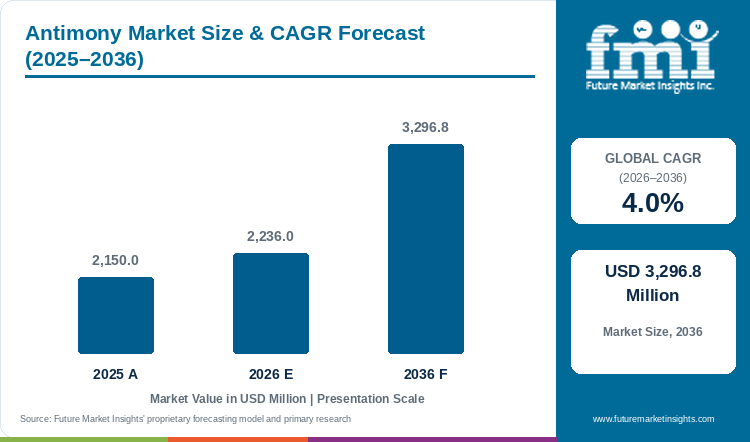
Ore, oxide and metal sales log a 4% CAGR over the decade from 2026 to 2036. Market size opens at USD 2,150 million (2025), moves to USD 2,236 million by estimate in 2026 and reaches a projected USD 3,296.8 million in 2036.
Demand for antimony is rising on fire safety and battery work, and antimony market size stood at USD 2,150 million in 2025. Sales are estimated at USD 2,236 million in 2026 and are projected to reach USD 3,296.8 million by 2036, a CAGR of 4% from 2026 to 2036, FMI's report shows. Key trends in antimony point to cable and appliance compounders buying oxide for fire-safe plastics. Flame retardants take about 42% of application demand in 2026, and halogenated retardants in cable jackets need oxide as a synergist. Lead-acid batteries add a second, steady draw, at an estimated 24.5% of applications. Demand intensity is highest in the USA, with net import reliance at an estimated 91% in 2025, the US Geological Survey reported.[1] US cable and battery plants therefore buy imported oxide or metal for almost every ton. The pursuit of growth in adjacent markets is pulling smelters toward finished oxide, since US buyers imported about 39,000 tons of oxide in 2025 and only 4,500 tons of unwrought metal.[1] The antimony trioxide market is projected to grow at a 5% CAGR from 2026 to 2036, ahead of raw antimony, owing to the value converters add at the furnace. PVC and polyolefin compounders also buy oxide for flame retarded grades. Growth of the plastic additives market at a 4.2% CAGR from 2026 to 2036 will keep those oxide orders flowing. Due to this, smelters with in-house oxide lines will capture the larger margin through 2036.
Key Market Trends & Insights
- Antimony trioxide is the largest product, at 62% of 2026 sales, and alloys follow at an estimated 13.8%.
- Demand for flame retardant grades takes about 42% of application volume in 2026. The US imported about 39,000 tons of antimony oxide in 2025, the US Geological Survey estimated.[1]
- Chemical plants buy an estimated 38.6% of end-use volume, so oxide converters set most contract prices. United States Antimony Corporation (USAC) reported 2025 antimony revenue of $35.4 million, up 219%.[2]
Regional Highlights
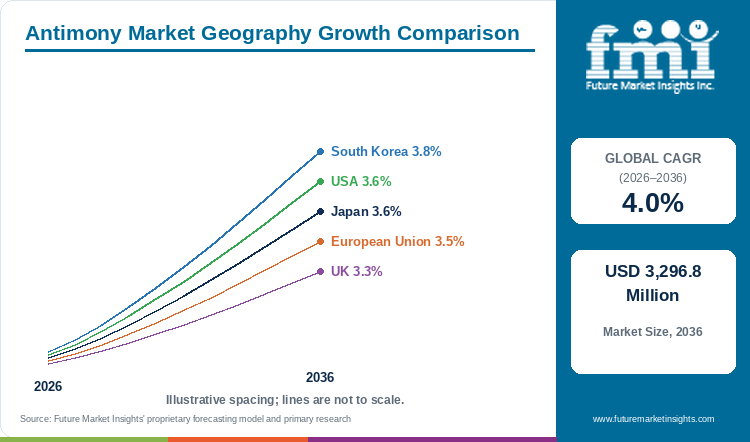
- South Korea posts the fastest profiled CAGR, at 3.8% from 2026 to 2036, on Onsan smelter output.
- Japan and the USA share 3.6%, the European Union records 3.5%, and the UK grows slowest at 3.3%.
- Korea Zinc produced about 4,500 tons of antimony in 2025 and first exported 20 tons directly from Onsan to the United States in June 2025, Herald Corp reported.[3]
Market Size & Forecast
Table 1: Market Size and Forecast for the Antimony Market (USD million and percentage), 2025 to 2036
| Metric | Value |
|---|---|
| 2025 Market Size | USD 2,150 million |
| Estimated Market Size in 2026 | USD 2,236 million |
| Projected Market Size by 2036 | USD 3,296.8 million |
| CAGR, 2026 to 2036 | 4% |
| Added Revenue, 2026 to 2036 | USD 1,060.8 million |
| Market Expansion Multiple | 1.5x |
USAC made first deliveries under a $245 million Defense Logistics Agency contract in the second quarter of 2026.[4] Recycled supply covered 12% of US apparent consumption in 2025, the US Geological Survey estimated.[1] Battery recyclers return part of that metal to grid makers, so growth of the lead acid battery recycling market will add secondary supply. FMI expects USD 1,060.8 million of added market size from 2026 to 2036, a 1.5x multiple on the 2026 base. A renewed Chinese export ban after November 2026 would raise prices and cut volumes at the same time.
Mine and Smelter Additions Outside China
Production economics are changing the competitive equation in antimony, since mines in China, Russia and Tajikistan set the cost of most of the ore sold worldwide. China mined an estimated 40,000 tons in 2025, Russia 32,000 tons and Tajikistan 22,000 tons, out of a world total near 110,000 tons, the US Geological Survey reported.[1] China suspended the US export ban from 9 November 2025 until 27 November 2026 under a Ministry of Commerce notice, The Tribune reported.[5] The ban on exports to US military end users stayed in force.[5]
Western buyers answered the 2024 ban with new plants. Perpetua Resources broke ground on early works at the Stibnite project in Idaho in October 2025 after posting $139 million in financial assurance.[6] Larvotto Resources produced first antimony concentrate at Hillgrove in New South Wales, according to a Mining Weekly article dated 21 September 2026.[7] Hillgrove targets about 4,900 tonnes of antimony for each year of an initial eight-year mine life.[7] United States Antimony Corporation commissioned expanded smelting furnaces at Thompson Falls, Montana, in the second quarter of 2026.[4] Analysts at FMI see these additions narrowing the price gap between Chinese and non-Chinese oxide by the late 2020s.
Table 2: Supply and Policy Indicators for the Antimony Market (tons, USD and dates), mixed reporting periods from 2025 to 2026
| Indicator | Data Point | Relevance | Source |
|---|---|---|---|
| World mine production, 2025 estimate | About 110,000 tons; China 40,000 tons | Mine output stays concentrated in a few countries. | [1] |
| US average metal price, 2025 | $25 per pound, over twice the 2024 level | Price shock after the December 2024 export ban. | [1] |
| US net import reliance, 2025 estimate | 91% | Domestic buyers rely on imported oxide and metal. | [1] |
| China export ban suspension, November 2025 | 9 November 2025 to 27 November 2026 | A temporary reopening of Chinese supply to US buyers. | [5] |
| Stibnite project financial assurance, October 2025 | $139 million posted | A US mine moves into construction. | [6] |
| Hillgrove planned antimony output | About 4,900 tonnes for each year of an eight-year life | New Australian concentrate for Western converters. | [7] |
| USAC DLA ingot orders, July 2026 | $57.3 million | Government stockpile demand for domestic metal. | [4] |
| Korea Zinc antimony output, 2025 | About 4,500 tons | The only Korean producer serves US buyers. | [3] |
| Costerfield antimony output, H1 2025 | 298 tonnes | By-product supply from a gold mine. | [8] |
Analyst Perspective
“The date I watch most closely in antimony is 27 November 2026, when the Chinese suspension of the US export ban runs out. China supplied 66% of US oxide imports over 2021 to 2024, so I expect careful compounders to carry extra oxide stock into early 2027.”
- Nikhil Kaitwade, Principal Consultant, Future Market Insights.
How is the antimony market segmented?
Product type, application and end-use industry form the three antimony segment axes, with region alongside. Antimony trioxide holds 62% of 2026 product sales, flame retardants about 42% of application demand, and chemical plants an estimated 38.6% of end use.
By product type: trioxide, pentoxide, alloys, metal ingots, and other product types.
By application: flame retardants, lead-acid batteries, plastic additives, stabilizers, catalysts, glass and ceramics, and others.
By end-use industry: chemical industry, automotive industry, electrical and electronics industry, and other end-use industries.
By region: two Asian blocks (East Asia, South Asia Pacific), two American blocks (North America, Latin America), two European blocks (Western Europe, Eastern Europe) and the Middle East and Africa.
Why does antimony trioxide lead product type sales?
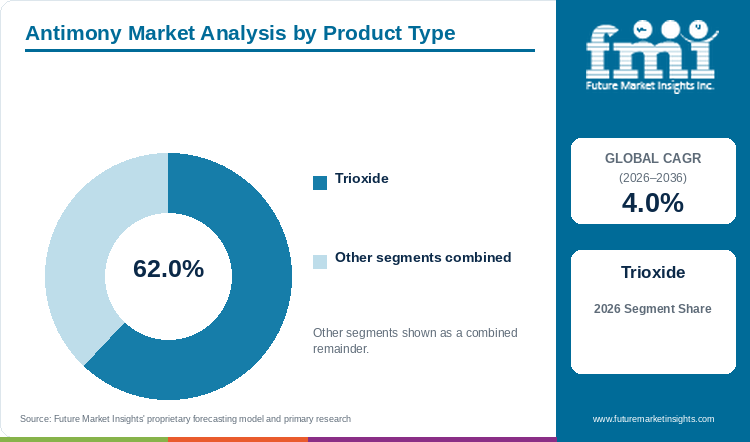
Product type sales in 2026 go 62% to antimony trioxide, with alloys next at an estimated 13.8%.
Table 3: Product Type Share for the Antimony Market (percentage share), 2026
| Product Type | Estimated Share (2026) |
|---|---|
| Trioxide | 62% |
| Alloys | 13.8% |
| Metal Ingots | 10.6% |
| Pentoxide | 9.4% |
| Other Product Types | 4.2% |
| Total | 100.0% |
Table 4: Product Type Leadership and Market Growth for the Antimony Market (segment and CAGR percentage), 2026 to 2036
| Metric | Value |
|---|---|
| Global CAGR (2026 to 2036) | 4% |
| Leading Segment | Trioxide |
Consumer preference among compounders favours oxide, and antimony trioxide holds 62% of 2026 product sales in the FMI study. Alloys, at an estimated 13.8%, sell only to battery grid and bearing makers, a narrower buyer set. Metal ingots, at about 10.6% (estimated), need a further roasting step before a compounder can use the metal. Pentoxide, at an estimated 9.4%, costs more per kilogram and suits colloidal and textile coatings. Niche glass and pigment uses make up the other product types, at about 4.2% (estimated). The US imported about 39,000 tons of antimony oxide in 2025, against 4,500 tons of unwrought metal and powder, the US Geological Survey estimated.[1]
- China supplied 66% of US oxide imports over 2021 to 2024, the US Geological Survey reported in February 2026.[1]
Why do flame retardants lead application demand?
Flame retardants take about 42% of 2026 application demand, ahead of lead-acid batteries at an estimated 24.5%.
Table 5: Application Share for the Antimony Market (percentage share), 2026
| Application | Estimated Share (2026) |
|---|---|
| Flame Retardants | 42% |
| Lead-Acid Batteries | 24.5% |
| Plastic Additives | 9.8% |
| Catalysts | 7.4% |
| Glass and Ceramics | 6.3% |
| Stabilizers | 6.2% |
| Others | 3.8% |
| Total | 100.0% |
US end use put metal products, including flame retardants, at 49% of antimony consumption, the US Geological Survey reported in February 2026.[1] Flame retardants take about 42% of 2026 application demand, FMI's report shows. Lead-acid batteries, at an estimated 24.5%, use less antimony per unit as calcium grids replace antimonial lead. Small doses per tonne of resin hold plastic additives to about 9.8% (estimated). Catalysts hold an estimated 7.4%, glass and ceramics about 6.3% (estimated) and stabilizers an estimated 6.2%. Polyester plants, glass furnaces and PVC compounders each dose antimony at one step of production, so orders from these three buyers stay small. Others hold about 3.8% (estimated). Halogen-free cable grades use phosphate blends and need no antimony oxide synergist. Due to this, part of flame retardant chemicals market growth will bypass oxide suppliers.
- Cable jackets, appliance housings, building panels and textiles carry most flame retarded resin.
- Ceramics, glass, rubber and other nonmetal products took 11% of US antimony use in 2025, the US Geological Survey estimated.[1]
Why does the chemical industry lead end-use demand?
An estimated 38.6% of 2026 end-use demand comes from chemical plants, and automotive buyers take about 27.9% (estimated).
Table 6: End-Use Industry Share for the Antimony Market (percentage share), 2026
| End-Use Industry | Estimated Share (2026) |
|---|---|
| Chemical Industry | 38.6% |
| Automotive Industry | 27.9% |
| Electrical and Electronics Industry | 24.3% |
| Other End-Use Industries | 9.2% |
| Total | 100.0% |
About 38.6% of 2026 end-use demand (estimated) comes from chemical plants, ahead of automotive buyers at about 27.9% (estimated). Chemical converters buy oxide and pentoxide by the tonne, and automotive buyers take antimony only through battery makers. Electrical and electronics makers, at an estimated 24.3%, order smaller lots of flame retarded resin. Glass, ammunition and ceramics fall under other end uses, at about 9.2% (estimated). Battery plants buy antimonial lead for starter batteries, so automotive antimony orders will move with lead acid battery market growth. Mandalay Resources produced 137 tonnes of antimony at Costerfield in the second quarter of 2025.[8] United States Antimony Corporation reported 2025 antimony revenue of $35.4 million, up 219%, in March 2026.[2]
What are the drivers, restraints, and opportunities in the antimony market?
Demand for antimony grows with fire safety codes, lead-acid battery production and defence stockpiles. Key challenges faced by manufacturers include supply concentration in China and price swings tied to export controls.
- Driver: Defence stockpiles add a buyer base, and DLA antimony ingot orders at United States Antimony Corporation reached $57.3 million by July 2026.[4]
- Restraint: Mine supply is concentrated, with China mining an estimated 40,000 tons in 2025, Russia 32,000 tons and Tajikistan 22,000 tons.[1]
- Opportunity: New Western supply is arriving, as Larvotto produced first antimony concentrate at Hillgrove in September 2026.[7]
Defence Stockpiles Add a Second Buyer Base
The US Defense Logistics Agency now orders antimony ingots alongside commercial oxide converters. USAC delivered about 82,000 pounds of antimony metal ingots in two initial shipments under a $245 million Defense Logistics Agency contract, according to a 1 July 2026 company update.[4] Total DLA ingot orders reached $57.3 million.[4] FMI predicts that DLA ingot orders will give US smelters a second buyer next to flame retardant and battery customers.
Export Licences Keep Prices Volatile
US antimony buyers paid an average of $25 per pound in 2025, over twice the 2024 level.[1] The US average antimony price reached $27.50 per pound by June 2025 and fell to $20.30 in November, the US Geological Survey reported.[1] The Chinese suspension of the US export ban ends on 27 November 2026.[5] However, monthly-contract buyers will face fresh supply risk after that date, since the ban on US military end users never lifted.[5] As a result, careful compounders will carry extra oxide stock into early 2027.
Gold Mines Yield Antimony as a By-product
New sales of antimony are expected from gold mines, as Costerfield and Hillgrove now recover concentrate as a by-product. Costerfield yielded 298 tonnes of antimony for Mandalay Resources over January to June 2025.[8] The company expects antimony grades to rise as mining advances into the higher-grade Youle zones.[8] Larvotto signed binding offtake for Hillgrove antimony with Wogen Resources.[7] At about 4,900 tonnes a year, Hillgrove alone will add supply close to the 4,500 tons Korea Zinc produced in 2025.[7][3]
Which country CAGRs are profiled in the antimony market?
Table 7: Country CAGR Comparison for the Antimony Market (CAGR percentage), 2026 to 2036
| Country | CAGR (2026 to 2036) |
|---|---|
| South Korea | 3.8% |
| USA | 3.6% |
| Japan | 3.6% |
| European Union | 3.5% |
| UK | 3.3% |
How do country-level CAGRs compare in the antimony market?
Korea Zinc runs the only Korean antimony smelter, at Onsan, and produced about 4,500 tons of antimony there in 2025.[3] South Korea grows fastest among profiled countries at a 3.8% CAGR from 2026 to 2036 on FMI's analysis. Japanese and US demand both rise at 3.6%, the European Union posts 3.5% and the UK 3.3%. Each profiled rate runs below the 4% global CAGR, so China and other unprofiled countries will add the faster tonnage.
- South Korea combines a domestic smelter with direct exports to the USA.
- The USA adds mines, smelters and DLA stockpile contracts.
- Japan relies on imported metal for ceramics, glass and flame retarded electronics.
- European Union compounders face halogen limits on flame retardants, which hold demand to a 3.5% CAGR.
- British demand grows least among the five because UK compounding capacity is small.
Full report country CAGRs cover: seven regions (Eastern Europe, Western Europe, North America, Latin America, South Asia Pacific, East Asia, Middle East and Africa) and 30 countries.
Country-wise Analysis
South Korea Antimony Market Outlook (2026 to 2036)
Korea Zinc plans to raise antimony supply to the United States above 240 tons in 2026, Herald Corp reported in September 2026.[3] Onsan is the only Korean antimony smelter.[3] South Korea leads the profiled group with a 3.8% CAGR from 2026 to 2036. Onsan shipped a first 20 tons directly to the United States in June 2025.[3]
Key takeaway: Onsan output gives Korean compounders a local feed and gives US buyers a non-Chinese option.
USA Antimony Market Outlook (2026 to 2036)
US antimony consumption grows at a 3.6% CAGR from 2026 to 2036 as domestic supply returns. Net import reliance stood at an estimated 91% in 2025, the US Geological Survey reported.[1] Mining began at the Stibnite Hill Mine in Montana in November 2025.[1] Perpetua received $80 million in Department of Defense funding for the Stibnite project in Idaho.[6] Domestic metal will go first to DLA orders and then to oxide converters.
Key takeaway: US buyers will move from import price takers to contract buyers of domestic metal once Idaho and Montana output ramps.
Japan Antimony Market Outlook (2026 to 2036)
Japanese glass, ceramics and electronics makers buy imported metal and oxide for every tonne of antimony used. Japan grows at a 3.6% CAGR through 2036, level with the USA. Wogen Resources holds binding offtake for Hillgrove antimony, so Japanese importers gain one more seller outside China.[7]
Key takeaway: Japanese buyers gain a second source in Australian by-product supply, free of Chinese licence risk.
European Union Antimony Market Outlook (2026 to 2036)
European cable and electronics compounders are replacing some halogenated flame retardants, so less oxide goes into each tonne of resin. Sales of antimony in the European Union rise at a 3.5% CAGR from 2026 to 2036. Battery recyclers will return antimonial lead to European grid makers and cut primary metal imports.
Key takeaway: European growth leans on recycled metal and on oxide grades that pass stricter chemical rules.
UK Antimony Market Outlook (2026 to 2036)
UK cable and building product makers buy imported oxide for flame retarded compounds. Growth of the UK antimony market is the slowest profiled, at a 3.3% CAGR from 2026 to 2036, owing to a small compounding base.
Key takeaway: UK demand follows building fire rules, and new industrial capacity adds little tonnage.
Who are the notable companies in the antimony market?
United States Antimony Corporation, Mandalay Resources Ltd., Korea Zinc, Chemico Synthetics Ltd., American Elements, Huachang Industry Co., Ltd., GeoProMining, Ltd., Tri-Star Resources Plc, DKL Metals Ltd and Nihon Seiko Co., Ltd. form the core antimony supplier group in 2026.
Top companies operating in the antimony market include United States Antimony Corporation, Mandalay Resources and Korea Zinc, and the FMI study also lists Hunan Gold as a major producer. The US Department of Defense gave Perpetua $80 million for the Stibnite project in Idaho, pulling new supply outside China.[6] United States Antimony Corporation reported $354 million in new antimony contracts executed in 2025.[2] Korea Zinc plans a US smelter for 11 critical minerals, antimony among them.[3]
Mandalay Resources mines antimony with gold at Costerfield.[8] Chemico Synthetics, Huachang Industry, Nihon Seiko and DKL Metals complete the key company group.
- Miners and smelters with dated supply activity: United States Antimony Corporation, Mandalay Resources Ltd., Korea Zinc, and Hunan Gold.
- Other key suppliers: Chemico Synthetics Ltd., Huachang Industry Co., Ltd., Nihon Seiko Co., Ltd., American Elements, DKL Metals Ltd., GeoProMining, Ltd., and Tri-Star Resources Plc.
- Other profiled companies: Atomized Products Group, Inc., AMG Advanced Metallurgical Group, Merck, and Belmont Metals, Inc.
Competitive Benchmarking: Antimony Market
Table 8: Competitive Benchmarking for the Antimony Market (qualitative documentation ratings), 2026
| Company | Mine Output | Smelting and Refining | Government Contracts | Disclosure |
|---|---|---|---|---|
| United States Antimony Corporation | Medium | High | High | High |
| Mandalay Resources Ltd. | High | Low | Low | High |
| Korea Zinc | Low | High | Medium | Medium |
| Perpetua Resources | Medium | Low | High | High |
| Larvotto Resources | Medium | Low | Low | Medium |
Rating levels track the number of dated antimony filings and releases on each item.
Key Developments in the Antimony Market
- In September 2026, Mining Weekly reported first antimony concentrate from the Larvotto Hillgrove mine.[7]
- In September 2026, Herald Corp reported Korea Zinc plans to supply above 240 tons of antimony to the United States in 2026.[3]
- In July 2026, United States Antimony Corporation reported first deliveries under the $245 million DLA contract.[4]
- In March 2026, United States Antimony Corporation reported 2025 antimony revenue of $35.4 million.[2]
- In February 2026, the US Geological Survey published antimony statistics for 2025.[1]
- In November 2025, China suspended the second clause of Announcement No. 46 of 2024 on exports to the United States.[5]
- In October 2025, Perpetua Resources broke ground on the Stibnite project in Idaho.[6]
- In July 2025, Mandalay Resources reported 137 tonnes of antimony from Costerfield for the second quarter.[8]
Key Players in the Antimony Market
Miners and Smelters
- United States Antimony Corporation
- Mandalay Resources Ltd.
- Korea Zinc
- Hunan Gold
Other Key Suppliers
- GeoProMining, Ltd.
- Tri-Star Resources Plc
- Chemico Synthetics Ltd.
- Huachang Industry Co., Ltd.
- Nihon Seiko Co., Ltd.
- American Elements
- DKL Metals Ltd
- Atomized Products Group, Inc.
- AMG Advanced Metallurgical Group
- Merck
- Belmont Metals, Inc.
Antimony Market - Report Scope
Table 9: Report Scope for the Antimony Market (coverage fields and definitions), 2026 to 2036
| Coverage field | Report scope |
|---|---|
| Market breakdown | Product type; application; end-use industry; region |
| Quantitative units | USD million |
| Market definition | Antimony market covering trioxide, pentoxide, alloys, metal ingots and other products used in flame retardants, lead-acid batteries, plastic additives, stabilizers, catalysts, glass and ceramics. |
| Regions covered | North America; Latin America; Western Europe; Eastern Europe; East Asia; South Asia Pacific; Middle East and Africa |
| Countries covered | South Korea; USA; Japan; European Union; UK |
| Key companies profiled | United States Antimony Corporation, Mandalay Resources Ltd., Korea Zinc, Chemico Synthetics Ltd., American Elements, Huachang Industry Co., Ltd., GeoProMining, Ltd., Tri-Star Resources Plc, DKL Metals Ltd, Nihon Seiko Co., Ltd. |
| Forecast period | 2026 to 2036 |
Antimony Market - Research Methodology
Table 10: Research Methodology for the Antimony Market (research methods and approach), 2026 edition
| Method | Approach |
|---|---|
| Data Sources | Mine, smelter and policy facts come from government statistics, company filings, ministry notices and mining trade press dated May 2025 or later. |
| Desk Research | Desk research covers mine output by country, export controls, defence stockpile orders and new smelter capacity. |
| Market Sizing and Forecasting | Sizing starts from the 2025 base of USD 2,150 million and the 4% CAGR. |
| Data Validation | Price and tonnage figures were matched across government statistics and company releases for the same period. |
Antimony Market by Segments
Antimony Market segmented by Product Type:
- Trioxide
- Pentoxide
- Alloys
- Metal Ingots
- Other Product Types
Antimony Market segmented by Application:
- Flame Retardants
- Lead-Acid Batteries
- Plastic Additives
- Stabilizers
- Catalysts
- Glass and Ceramics
- Others
Antimony Market segmented by End-Use Industry:
- Chemical Industry
- Automotive Industry
- Electrical and Electronics Industry
- Other End-Use Industries
Antimony Market by Region
- North America
- USA
- Latin America
- Western Europe
- UK
- European Union
- Eastern Europe
- East Asia
- Japan
- South Korea
- South Asia Pacific
- Middle East and Africa
Research Sources and Bibliography
- [1] U.S. Geological Survey. (2026, February). Mineral Commodity Summaries 2026: Antimony. https://pubs.usgs.gov/periodicals/mcs2026/mcs2026-antimony.pdf
- [2] United States Antimony Corporation (SEC Form 8-K, Exhibit 99.1). (2026, March 19). United States Antimony Corporation Reports Fiscal Year 2025 Financial and Operating Results. https://www.sec.gov/Archives/edgar/data/101538/000110465926032050/tm269168d1_ex99-1.htm
- [3] Herald Corp. (2026, September 11). Korea Zinc bets W11tr on US smelter to break China's grip on critical minerals. https://biz.heraldcorp.com/article/10870041
- [4] United States Antimony Corporation (ACCESS Newswire). (2026, July 1). United States Antimony Corporation Provides Update on Antimony Shipments to the DoW. https://www.accessnewswire.com/newsroom/en/metals-and-mining/united-states-antimony-corporation-provides-update-on-antimony-shipments-to-the-d-1184955
- [5] The Tribune. (2025, November 9). China suspends export restrictions on gallium, germanium, antimony, superhard materials to US. https://www.tribuneindia.com/news/world/china-suspends-export-restrictions-on-gallium-germanium-antimony-superhard-materials-to-us/amp
- [6] Mining Weekly. (2025, October 22). Perpetua breaks ground on Stibnite project. https://www.miningweekly.com/article/perpetua-breaks-ground-on-stibnite-project-2025-10-22
- [7] Mining Weekly. (2026, September 21). Larvotto reports first gold, antimony production from Hillgrove mine. https://www.miningweekly.com/article/larvotto-reports-first-gold-antimony-production-from-hillgrove-mine-2026-09-21
- [8] Mandalay Resources Corporation (GlobeNewswire). (2025, July 9). Mandalay Resources Reports Steady Q2 Production, US$101M Cash and Crucial Investment to Support Growth at Costerfield. https://www.barchart.com/story/news/33309315/mandalay-resources-reports-steady-q2-production-us101m-cash-and-crucial-investment-to-support-growth-at-costerfield
This bibliography is provided for reader reference. The full report contains the complete reference list and detailed citations.
This Report Answers
- What is the antimony market size for 2026, and what is projected for 2036?
- At what CAGR will antimony sales expand between 2026 and 2036?
- Which product type holds the largest 2026 share?
- Which application absorbs the most antimony?
- Which profiled country grows fastest?
- Which companies add supply outside China?
Frequently Asked Questions
What is the size of the antimony market in 2026?
Antimony sales are estimated at USD 2,236 million in 2026, up from USD 2,150 million in 2025. FMI expects USD 3,296.8 million by 2036. At what rate will the antimony market grow? Flame retardant compounds, at about 42% of 2026 application demand, will add the most new tonnage. Overall sales will grow at a 4% CAGR from 2026 to 2036.
Which product type will lead antimony sales?
Oxide leads, with antimony trioxide at 62% of 2026 product demand. Compounders blend the oxide straight into resin.
Which application will take the most antimony in 2026?
Flame retardants will take the most, at about 42% of application demand. Battery grids come second at an estimated 24.5%.
Which country will post the fastest antimony growth?
Onsan smelter output puts Korea first, at a 3.8% CAGR from 2026 to 2036 in FMI's country figures. Onsan supplies Korean compounders and US buyers from one smelter.
Which companies will shape antimony supply?
Stibnite in Idaho and Hillgrove in New South Wales will feed Western smelters. United States Antimony Corporation, Mandalay Resources, Korea Zinc, Chemico Synthetics, Huachang Industry and Nihon Seiko are the names to watch.
Preview the report firsthand - request a free sample
Get SampleGet the brochure for pricing and purchase details.
Get PDFTable of Content
- Key Takeaways
- Market Size and CAGR
- Top Growth Driver
- Fastest Growing Segment
- Leading Region
- Key Companies
- Emerging Opportunities
- Executive Summary
- Global Market Outlook
- Demand-side Trends
- Supply-side Trends
- Technology Roadmap Analysis
- Analysis and Recommendations
- Analyst Perspective (What is happening? Why now? What should investors know?)
- Key Questions Answered
- How large is the market?
- What is the CAGR?
- What are key trends?
- Which region dominates?
- Who are the leaders?
- Market Overview
- Market Coverage / Taxonomy
- Market Definition / Scope / Limitations
- Research Methodology
- Chapter Orientation
- Analytical Lens and Working Hypotheses
- Market Structure, Signals, and Trend Drivers
- Benchmarking and Cross-market Comparability
- Market Sizing, Forecasting, and Opportunity Mapping
- Research Design and Evidence Framework
- Desk Research Programme (Secondary Evidence)
- Expert Input and Fieldwork (Primary Evidence)
- Tooling, Models, and Reference Databases
- Data Engineering and Model Build
- Quality Assurance and Audit Trail
- Market Background
- Market Dynamics (Drivers, Restraints, Opportunity, Trends)
- Scenario Forecast (Optimistic, Likely, Conservative)
- Impact Analysis
- AI Impact
- Sustainability Impact
- Regulatory Impact
- Technology Impact
- Consumer / Buyer Analysis
- Purchase Drivers
- Adoption Barriers
- Buyer Journey
- Opportunity Map Analysis
- Product Life Cycle Analysis
- Supply Chain Analysis
- Investment Feasibility Matrix
- Value Chain Analysis
- PESTLE and Porter's Analysis
- Regulatory Landscape
- Regional Parent Market Outlook
- Production and Consumption Statistics
- Import and Export Statistics
- Global Market Analysis and Forecast, 2021 to 2036
- Historical Market Size Value (USD Million) Analysis, 2021 to 2025
- Current and Future Market Size Value (USD Million) Projections, 2026 to 2036
- Y-o-Y Growth Trend Analysis
- Absolute $ Opportunity Analysis
- Global Market Pricing Analysis, 2021 to 2036
- Global Market Analysis and Forecast, By Product Type, 2021 to 2036
- Introduction / Key Findings
- Historical Market Size Value (USD Million) Analysis By Product Type, 2021 to 2025
- Current and Future Market Size Value (USD Million) Analysis and Forecast By Product Type, 2026 to 2036
- Trioxide
- Pentoxide
- Alloys
- Metal Ingots
- Other Product Types
- Y-o-Y Growth Trend Analysis By Product Type, 2021 to 2025
- Absolute $ Opportunity Analysis By Product Type, 2026 to 2036
- Global Market Analysis and Forecast, By Application, 2021 to 2036
- Introduction / Key Findings
- Historical Market Size Value (USD Million) Analysis By Application, 2021 to 2025
- Current and Future Market Size Value (USD Million) Analysis and Forecast By Application, 2026 to 2036
- Flame Retardants
- Lead-Acid Batteries
- Plastic Additives
- Stabilizers
- Catalysts
- Glass and Ceramics
- Others
- Y-o-Y Growth Trend Analysis By Application, 2021 to 2025
- Absolute $ Opportunity Analysis By Application, 2026 to 2036
- Global Market Analysis and Forecast, By End-Use Industry, 2021 to 2036
- Introduction / Key Findings
- Historical Market Size Value (USD Million) Analysis By End-Use Industry, 2021 to 2025
- Current and Future Market Size Value (USD Million) Analysis and Forecast By End-Use Industry, 2026 to 2036
- Chemical Industry
- Automotive Industry
- Electrical and Electronics Industry
- Other End-Use Industries
- Y-o-Y Growth Trend Analysis By End-Use Industry, 2021 to 2025
- Absolute $ Opportunity Analysis By End-Use Industry, 2026 to 2036
- Global Market Analysis and Forecast, By Region, 2021 to 2036
- Introduction
- Historical Market Size Value (USD Million) Analysis By Region, 2021 to 2025
- Current Market Size Value (USD Million) Analysis and Forecast By Region, 2026 to 2036
- North America
- Latin America
- Western Europe
- Eastern Europe
- East Asia
- Middle East and Africa
- Market Attractiveness Analysis By Region
- North America Market Analysis and Forecast, By Country, 2021 to 2036
- Historical Market Size Value (USD Million) Trend Analysis By Market Taxonomy, 2021 to 2025
- Market Size Value (USD Million) Forecast By Market Taxonomy, 2026 to 2036
- By Country
- USA
- By Product Type
- By Application
- By End-Use Industry
- By Country
- Market Attractiveness Analysis
- By Country
- By Product Type
- By Application
- By End-Use Industry
- Key Takeaways
- Latin America Market Analysis and Forecast, By Country
- Historical Market Size Value (USD Million) Trend Analysis By Market Taxonomy, 2021 to 2025
- Market Size Value (USD Million) Forecast By Market Taxonomy, 2026 to 2036
- By Country
- By Product Type
- By Application
- By End-Use Industry
- Market Attractiveness Analysis
- By Country
- By Product Type
- By Application
- By End-Use Industry
- Key Takeaways
- Western Europe Market Analysis and Forecast, By Country
- Historical Market Size Value (USD Million) Trend Analysis By Market Taxonomy, 2021 to 2025
- Market Size Value (USD Million) Forecast By Market Taxonomy, 2026 to 2036
- By Country
- UK
- European Union
- By Product Type
- By Application
- By End-Use Industry
- By Country
- Market Attractiveness Analysis
- By Country
- By Product Type
- By Application
- By End-Use Industry
- Key Takeaways
- Eastern Europe Market Analysis and Forecast, By Country
- Historical Market Size Value (USD Million) Trend Analysis By Market Taxonomy, 2021 to 2025
- Market Size Value (USD Million) Forecast By Market Taxonomy, 2026 to 2036
- By Country
- By Product Type
- By Application
- By End-Use Industry
- Market Attractiveness Analysis
- By Country
- By Product Type
- By Application
- By End-Use Industry
- Key Takeaways
- East Asia Market Analysis and Forecast, By Country
- Historical Market Size Value (USD Million) Trend Analysis By Market Taxonomy, 2021 to 2025
- Market Size Value (USD Million) Forecast By Market Taxonomy, 2026 to 2036
- By Country
- Japan
- South Korea
- South Asia Pacific
- By Product Type
- By Application
- By End-Use Industry
- By Country
- Market Attractiveness Analysis
- By Country
- By Product Type
- By Application
- By End-Use Industry
- Key Takeaways
- Middle East and Africa Market Analysis and Forecast, By Country
- Historical Market Size Value (USD Million) Trend Analysis By Market Taxonomy, 2021 to 2025
- Market Size Value (USD Million) Forecast By Market Taxonomy, 2026 to 2036
- By Country
- By Product Type
- By Application
- By End-Use Industry
- Market Attractiveness Analysis
- By Country
- By Product Type
- By Application
- By End-Use Industry
- Key Takeaways
- Key Countries Market Analysis
- USA
- Pricing Analysis
- Market Share Analysis, 2025
- By Product Type
- By Application
- By End-Use Industry
- UK
- Pricing Analysis
- Market Share Analysis, 2025
- By Product Type
- By Application
- By End-Use Industry
- Japan
- Pricing Analysis
- Market Share Analysis, 2025
- By Product Type
- By Application
- By End-Use Industry
- South Korea
- Pricing Analysis
- Market Share Analysis, 2025
- By Product Type
- By Application
- By End-Use Industry
- European Union
- Pricing Analysis
- Market Share Analysis, 2025
- By Product Type
- By Application
- By End-Use Industry
- USA
- Market Structure Analysis
- Competition Dashboard
- Competition Benchmarking
- Market Share Analysis of Top Players
- By Regional
- By Product Type
- By Application
- By End-Use Industry
- Emerging Startups
- Innovation Benchmarking
- Competition Analysis
- Competition Deep Dive
- United States Antimony Corporation
- Overview
- Product Portfolio
- Profitability by Market Segments
- Sales Footprint
- Strategy Overview
- Marketing Strategy
- Product Strategy
- Channel Strategy
- Mandalay Resources Ltd.
- Korea Zinc
- Perpetua Resources
- Larvotto Resources
- Hunan Gold
- GeoProMining, Ltd.
- Tri-Star Resources Plc
- Chemico Synthetics Ltd.
- Huachang Industry Co., Ltd.
- Nihon Seiko Co., Ltd.
- American Elements
- DKL Metals Ltd
- Atomized Products Group, Inc.
- AMG Advanced Metallurgical Group
- Merck
- Belmont Metals, Inc.
- United States Antimony Corporation
- Case Studies
- Success Stories
- Recent Developments
- Competition Deep Dive
- Assumptions & Acronyms Used


