


Advanced Functional Materials Market : Global Industry Analysis and Opportunity Assessment, 2036
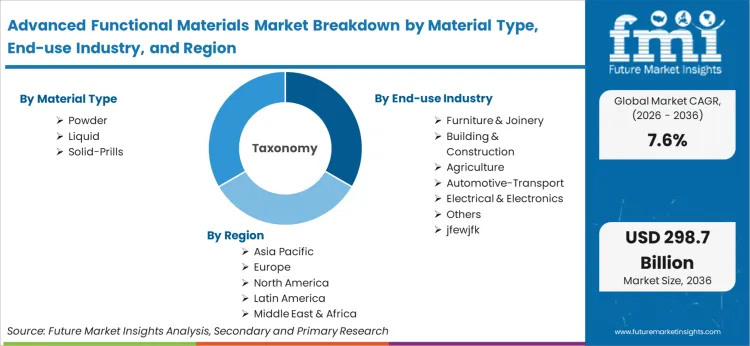
The Advanced Functional Materials Market is segmented by Material Type (Nanomaterials, Ceramics, Composites, Conductive Polymers, Energy Materials, and Other Types), End-use Industry (Electrical and Electronics, Automotive, Healthcare, Aerospace and Defence, Energy and Power, and Other Industries), and Region, with a forecast period from 2026 to 2036.
- Industry Size (2026): USD 143.6 Bn
- Forecast (2036): USD 298.8 Bn
- CAGR (2026 to 2036): 7.6%
Advanced Functional Materials Market Size, Market Forecast and Outlook By FMI
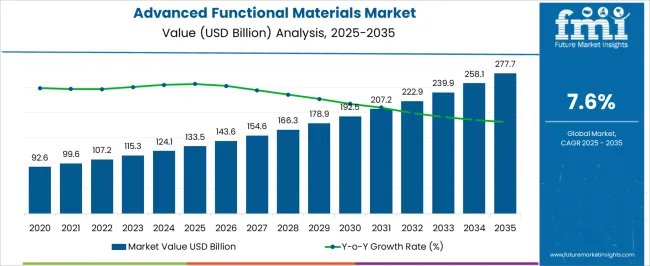
In 2025, the advanced functional materials market was valued at USD 133.5 billion. Based on Future Market Insights' analysis, demand for advanced functional materials is estimated to reach USD 143.6 billion in 2026, rising further to USD 298.8 billion by 2036. This trajectory reflects a CAGR of 7.6% during the forecast period.
Absolute dollar growth of more than USD 155 billion between 2026 and 2036 signals a market expanding at an accelerated pace, underpinned by rapid technological advancement in end-use sectors. This value uplift reflects both volume growth and a structural mix shift toward higher-value nanomaterials and advanced composites, which command significant price premiums over conventional materials due to their tailored properties at molecular and microscopic scales [1].
Summary of Advanced Functional Materials Market
- Demand Drivers in the Market
- Miniaturization and performance requirements in electronics, where conventional materials cannot meet the electrical, thermal, or mechanical demands of advanced semiconductor nodes, flexible displays, and high-frequency devices [3].
- Electrification of transportation, which requires functional materials for battery electrodes, power electronics, and lightweight structural components in electric vehicles [4].
- Medical technology advancement, including implantable devices, diagnostic sensors, and drug delivery systems that depend on biocompatible functional materials with specific biological interactions [5].
- Key Segments Analyzed in the FMI Report
- Material Type: Nanomaterials, which account for 31.2% of market value in 2026 due to their unique properties at molecular scale enabling applications from drug delivery to high-capacity battery electrodes.
- End-use Industry: Electrical and Electronics, which captures 21.8% of market value as the largest consumer, driven by semiconductor fabrication, consumer electronics, and emerging flexible device technologies.
- Analyst Opinion at FMI
- Nikhil Kaitwade, principal consultant for Chemicals & Materials at Future Market Insights states, "In the updated Advanced Functional Materials Market Report, R&D leaders and procurement specialists will observe how material selection is increasingly decoupled from traditional commodity pricing models. Performance specifications now determine value more than base composition. Suppliers that document these engineering parameters with statistical process control data gain preferred positions in technology company supply chains."
- Strategic Implications/Executive Takeaways
- Prioritize nanomaterials portfolios with documented scalability and batch-to-batch consistency, as electronics and healthcare customers require reliable supply for regulated and high-volume applications where material variation directly impacts yield.
- Align product development with electric vehicle battery roadmaps by developing advanced materials for next-generation electrodes, solid-state electrolytes, and thermal management systems where performance improvements translate directly to vehicle range and safety.
- Build application engineering capabilities that help customers integrate functional materials into manufacturing processes, addressing the gap between material properties and device-level performance through technical service and co-development partnerships.
- Methodology
- The market view is grounded in primary input from technology company materials engineers and advanced material suppliers, and in technical and policy sources focused on electronics roadmaps, vehicle electrification targets, and medical device regulations, avoiding reliance on secondary market research reports from competing providers.
North America, Europe, and Asia-Pacific account for the bulk of incremental revenues through 2036, but the underlying demand logic is distinct in each region. In North America, defense and aerospace spending drives adoption of high-performance composites and ceramics, while semiconductor manufacturing consumes advanced materials for miniaturization.
Automotive electrification and industrial automation create sustained demand for functional materials with specific electrical and thermal properties in Europe. Across Asia-Pacific, electronics manufacturing, battery production for electric vehicles, and healthcare infrastructure expansion generate the highest growth rates, with China, Japan, and South Korea as primary consumption centers [2].
Advanced Functional Materials Market Definition
Advanced functional materials are engineered substances designed to possess specific properties that enable them to perform particular functions beyond basic structural support. For this report, the market covers nanomaterials, advanced ceramics, functional composites, conductive polymers, and energy materials used in applications such as semiconductor fabrication, battery electrodes, medical implants, aircraft components, and sensor systems, where material performance directly determines device functionality and system efficiency.
Advanced Functional Materials Market Inclusions
The report provides a comprehensive analysis of the advanced functional materials market, covering global and regional market sizes in value terms and a 10-year forecast from 2026 to 2036. It includes segmental breakdowns by material type and end-use industry, across core regions including North America, Latin America, Western Europe, Eastern Europe, East Asia, South Asia & Pacific, and the Middle East & Africa.
Advanced Functional Materials Market Exclusions
The scope excludes commodity materials such as standard grades of steel, aluminum, and basic polymers that do not possess enhanced functional properties. It also omits structural composites used exclusively for load-bearing applications without integrated functionality, as well as very low-volume, research-grade materials synthesized for laboratory experimentation that do not contribute meaningfully to global revenue pools.
Advanced Functional Materials Market Research Methodology
- Primary research: Structured interviews were conducted with R&D directors and materials engineers in electronics, automotive, aerospace, and healthcare companies, alongside procurement specialists and product managers at material suppliers, on technology roadmaps, specification criteria, pricing dynamics, and adoption patterns across key regions.
- Desk research: Technical documentation and application notes from major advanced materials manufacturers, together with scientific literature on material synthesis and functionalization, were assessed to benchmark performance characteristics and to align market modeling with the latest data on end-use industry technology trends.
- Market-sizing and forecasting: A hybrid top-down and bottom-up modeling framework was applied, reconstructing advanced functional materials demand from production volumes in electronics, vehicle electrification components, medical devices, and energy storage systems, then validating outputs against publicly available commentary from leading manufacturers on sales trends and regional market dynamics.
- Data validation and update cycle: Model outputs undergo consistency checks across regions, material types, and end-use industries, with iterative calibration using new technology roadmaps, patent filings, and emerging data on research commercialization to ensure that the forecast reflects the latest structural drivers rather than short-term fluctuations.
Segmental Analysis
Advanced Functional Materials Market Analysis by Material Type
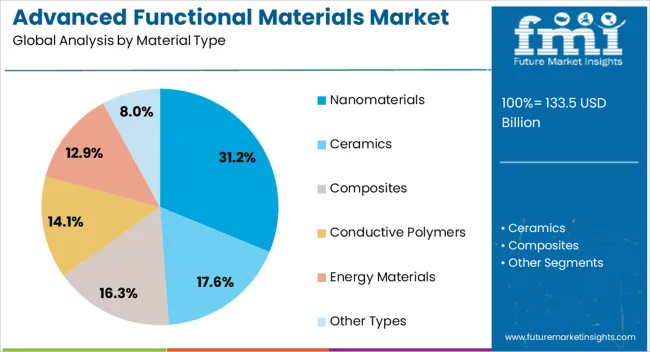
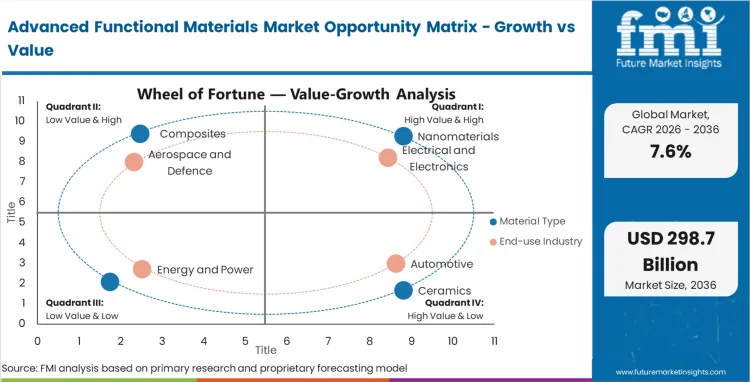
Based on FMI's advanced functional materials market assessment, Nanomaterials constitute 31.2% of global market value in 2026, underscoring their position as the highest-value material category. Their dominance reflects unique size-dependent properties-quantum effects, high surface-to-volume ratios, and tunable electrical behavior-that enable applications impossible with conventional materials [6]. Carbon nanotubes, graphene, quantum dots, and nanoscale metal oxides find use in electronics, energy storage, composites, and biomedical applications.
This leadership is expected to persist through 2036 as synthesis techniques mature, enabling larger-scale production with consistent quality. Advanced ceramics follow in value share, serving applications requiring high-temperature stability, wear resistance, and specific electrical properties in electronics and medical implants. Functional composites combine multiple material systems to achieve property combinations unavailable in monolithic materials. Conductive polymers enable flexible and printed electronics applications. Energy materials, including those for batteries, fuel cells, and solar cells, represent a rapidly growing segment aligned with clean energy transitions.
Advanced Functional Materials Market Analysis by End-use Industry
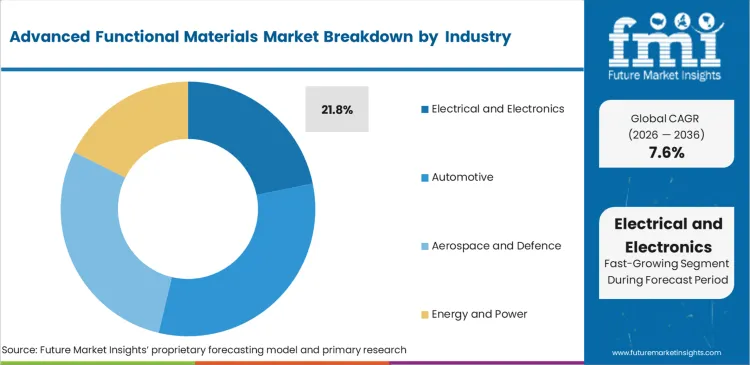
Electrical and Electronics represents the largest end-use industry segment for advanced functional materials, capturing 21.8% of market value in 2026. Semiconductor manufacturing consumes high-purity materials for wafer fabrication and packaging. Display technologies require functional materials for light emission, color filtering, and substrate engineering. Printed circuit board production depends on materials with specific dielectric and thermal properties. The segment's leadership reflects both the scale of global electronics production and the criticality of material performance in device functionality [7].
Automotive applications are growing rapidly with vehicle electrification, consuming functional materials for battery electrodes and separators, power electronics substrates, and lightweight composites for structural components. Healthcare applications include implantable devices, diagnostic sensors, and drug delivery systems requiring biocompatibility and specific biological interactions. Aerospace and Defence demand materials with high strength-to-weight ratios, thermal stability, and radar absorption characteristics. Energy and Power applications span battery storage, fuel cells, and renewable energy generation equipment.
Advanced Functional Materials Market Drivers, Restraints, Opportunities and Trends
Drivers
Semiconductor scaling and advanced packaging
Continuation of Moore's Law through advanced process nodes and new architectures requires materials with precisely controlled electrical properties at atomic scales. High-k dielectrics, low-k dielectrics, and metal gates enable continued transistor scaling. Advanced packaging technologies demand materials with specific thermal expansion coefficients and adhesion properties to manage stress in three-dimensional integrated circuits [8].
Electric vehicle battery technology advancement
Automaker commitments to electric vehicle fleets drive massive investment in battery cell manufacturing capacity, consuming functional materials for cathodes, anodes, separators, and electrolytes. Performance improvements in energy density, charging rate, and safety depend directly on material innovation, with solid-state batteries requiring entirely new classes of functional materials [9].
Medical device miniaturization and biocompatibility
Trends toward minimally invasive procedures, implantable sensors, and personalized medicine create demand for functional materials that combine small dimensions with reliable performance in biological environments. Materials must meet regulatory requirements for biocompatibility while providing electrical, mechanical, or sensing functions over device lifetimes [10].
Restraints
Manufacturing scalability and cost
Many advanced functional materials demonstrate exceptional properties at laboratory scale but face challenges in cost-effective, consistent large-scale production. Batch-to-batch variation can be unacceptable in regulated industries or high-volume manufacturing, limiting adoption. Scale-up costs require significant capital investment with uncertain returns.
Regulatory approval timelines
In healthcare and aerospace applications, materials must undergo extensive qualification and regulatory review before commercial use. Approval timelines can extend to years, slowing market entry for novel materials and creating long development cycles that favor incremental improvements over breakthrough innovations.
Opportunities
Materials for quantum technologies
Emerging quantum computing, sensing, and communication applications require materials with precisely controlled quantum properties. Defect centers in diamond, topological insulators, and two-dimensional materials with specific electronic band structures present opportunities for first-mover suppliers in what could become substantial future markets [11].
Sustainable functional materials
Development of functional materials from renewable feedstocks or with improved recyclability addresses growing customer and regulatory pressure for sustainability. Bio-based polymers with functional properties, recyclable battery materials, and materials designed for circular economy principles represent differentiation opportunities as sustainability criteria enter procurement decisions.
Regional Analysis
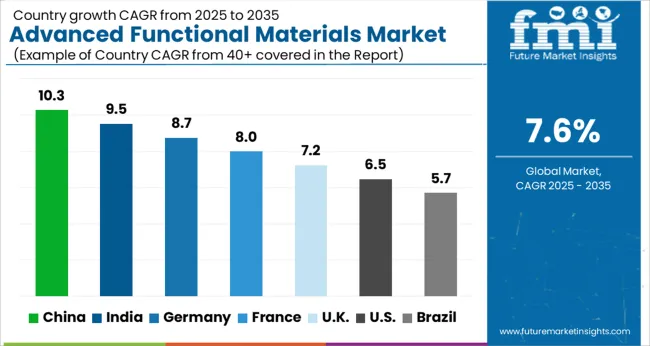
.webp "Top Country Growth Comparison Advanced Functional Materials Market Cagr (2026 2036)")
| Countries | Value CAGR (2026 to 2036) |
|---|---|
| China | 8.2% |
| South Korea | 7.9% |
| India | 7.5% |
| United States | 7.1% |
| Germany | 6.8% |
Source: Future Market Insights analysis, supported by a proprietary forecasting model and primary research
China
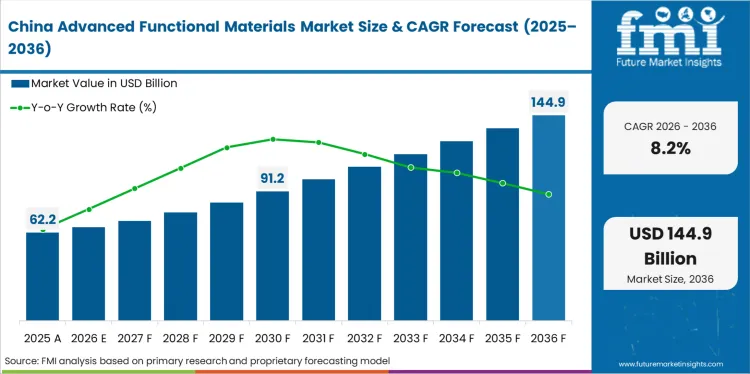
China's advanced functional materials market is projected to grow at an 8.2% CAGR from 2026 to 2036, the highest among key countries. Growth is driven by massive government investment in semiconductor self-sufficiency, electric vehicle battery production, and advanced manufacturing under initiatives like Made in China 2025.
The country's position as the world's largest electronics manufacturer and electric vehicle market generates substantial domestic demand. Research funding and technology transfer policies aim to reduce import dependence in critical material categories [12].
South Korea
South Korea's advanced functional materials market is expected to grow at a 7.9% CAGR from 2026 to 2036. The country's semiconductor and display manufacturing leadership creates concentrated demand for high-purity functional materials.
Major companies including Samsung Electronics and SK Hynix consume advanced materials for memory production and next-generation packaging. Battery material demand from LG Energy Solution and Samsung SDI adds a second high-growth vector. Government R&D funding supports domestic material development to strengthen supply chain resilience [13].
India
India's advanced functional materials market is projected to expand at a 7.5% CAGR from 2026 to 2036. Growth is underpinned by electronics manufacturing expansion under production-linked incentive schemes, which attract investment in component and device assembly requiring functional materials.
Electric vehicle adoption targets and battery manufacturing plans generate emerging demand. Healthcare infrastructure expansion and medical device manufacturing incentives create opportunities for biomaterials and diagnostic sensor materials [14].
United States
The United States advanced functional materials market is projected to grow at a 7.1% CAGR from 2026 to 2036. Growth is supported by sustained defense and aerospace R&D spending, semiconductor manufacturing investment under the CHIPS Act, and medical device innovation.
University research and national laboratory systems provide continuous material discovery and development. Startup activity in advanced materials, supported by venture capital and government SBIR programs, commercializes new technologies across multiple application sectors [15].
Germany
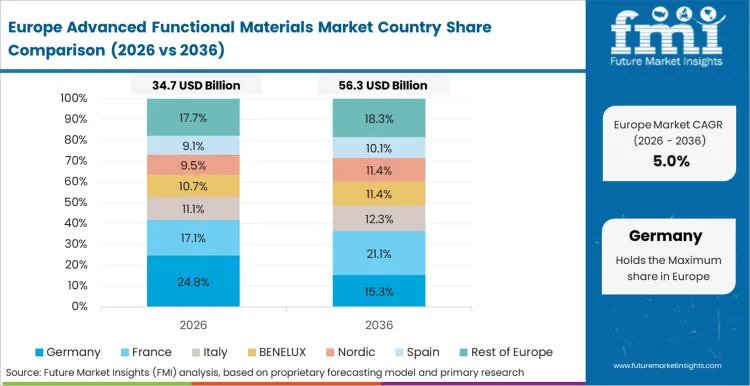
Germany's advanced functional materials market is forecast to grow at a 6.8% CAGR from 2026 to 2036. As Europe's largest industrial economy, Germany maintains strong positions in automotive engineering, industrial automation, and specialty chemicals, all intensive users of functional materials.
Automotive electrification drives demand for battery materials and power electronics substrates. The country's Fraunhofer institutes and Max Planck Society conduct leading materials research, supporting domestic innovation and technology transfer to industry [16].
Competitive Aligners for Market Players
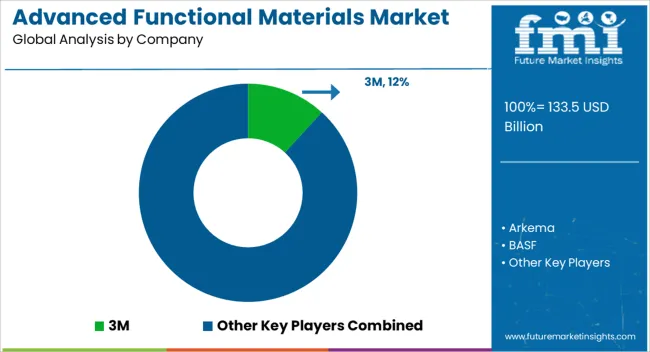
The advanced functional materials market features a diverse mix of global diversified chemical companies, specialized material suppliers, and technology companies with internal materials capabilities. Competitive positioning hinges on material performance documentation, manufacturing scalability, intellectual property portfolios, and application engineering support for customer integration.
Leading players such as BASF, Dow, 3M, and Toray Industries leverage their extensive R&D capabilities and global manufacturing footprints to serve multinational customers across electronics, automotive, and healthcare. Their portfolios span multiple material types with proprietary formulations protected by patents and trade secrets.
Specialty players including CeramTec, Kyocera, and Morgan Advanced Materials dominate specific niches such as advanced ceramics for electronics and medical applications. Asian manufacturers including LG Chem, Mitsubishi Chemical, and Sumitomo Chemical have expanded capabilities through vertical integration with electronics and automotive customers.
From a strategic perspective, differentiation is moving beyond base material properties toward demonstrable capability in three areas. These include manufacturing consistency with statistical process control for quality-sensitive applications; application engineering support that helps customers integrate materials into devices and processes; and supply chain transparency and security that addresses growing customer concern about material availability and geopolitical risk.
Key Developments
- BASF has expanded its battery materials portfolio through investment in cathode active material production capacity, positioning to serve European electric vehicle manufacturers with locally produced materials. The company's offerings include high-nickel cathodes for energy density and advanced precursors for next-generation battery chemistries.
- Toray Industries has advanced its carbon fiber composite materials for aerospace and industrial applications, with new grades offering improved strength-to-weight ratios and processing characteristics. The company's materials are specified in aircraft primary structures and hydrogen storage vessels for fuel cell vehicles.
- Kyocera Corporation has developed advanced ceramic materials for semiconductor manufacturing equipment, addressing the need for components with extreme purity, thermal stability, and plasma resistance in increasingly demanding fabrication processes.
Key Players Profiled
- 3M Company
- Arkema S.A.
- BASF SE
- CeramTec GmbH
- Covestro AG
- Dow Inc.
- Evonik Industries AG
- Hexcel Corporation
- Huntsman International LLC
- JCBL Group
- Kyocera Corporation
- LG Chem Ltd.
- Morgan Advanced Materials plc
- Resonac Holdings Corporation
- SGL Carbon SE
- Sumitomo Chemical Co., Ltd.
- Mitsubishi Chemical Group Corporation
- Toray Industries, Inc.
Scope of the Report
| Metric | Value |
|---|---|
| Quantitative Units | USD 143.6 billion (2026) to approximately USD 298.8 billion (2036), at a CAGR of 7.6%, with 2025 historic value of USD 133.5 billion |
| Market Definition | The advanced functional materials market comprises engineered substances designed to possess specific electrical, thermal, magnetic, optical, or biological properties enabling particular functions, including nanomaterials, advanced ceramics, functional composites, conductive polymers, and energy materials used in electronics, automotive, healthcare, aerospace, and energy applications. |
| Material Type Segmentation | Nanomaterials (31.2% in 2025); Ceramics; Composites; Conductive Polymers; Energy Materials; Other Types |
| End-use Industry Coverage | Electrical and Electronics (21.8% in 2025); Automotive; Healthcare; Aerospace and Defence; Energy and Power; Other Industries |
| Regions Covered | North America, Latin America, Western Europe, Eastern Europe, East Asia, South Asia & Pacific, Middle East & Africa |
| Countries Covered | China, South Korea, India, United States, Germany |
| Key Companies Profiled | 3M Company; Arkema S.A.; BASF SE; CeramTec GmbH; Covestro AG; Dow Inc.; Evonik Industries AG; Hexcel Corporation; Huntsman International LLC; JCBL Group; Kyocera Corporation; LG Chem Ltd.; Morgan Advanced Materials plc; Resonac Holdings Corporation; SGL Carbon SE; Sumitomo Chemical Co., Ltd.; Mitsubishi Chemical Group Corporation; Toray Industries, Inc. |
| Forecast Period | 2026 to 2036 |
| Approach | Hybrid top-down and bottom-up market modeling validated through primary interviews with technology company materials engineers and advanced material suppliers, supported by benchmarking against semiconductor roadmaps, electric vehicle production forecasts, and medical device regulatory filings. |
Advanced Functional Materials Market Analysis by Segments
Material Type:
- Nanomaterials
- Ceramics
- Composites
- Conductive Polymers
- Energy Materials
- Other Types
End-use Industry:
- Electrical and Electronics
- Automotive
- Healthcare
- Aerospace and Defence
- Energy and Power
- Other Industries
Region:
- North America
- Latin America
- Western Europe
- Eastern Europe
- East Asia
- South Asia & Pacific
- Middle East & Africa
Bibliography
- National Science and Technology Council. (2024). The National Nanotechnology Initiative: Supplement to the President's 2025 Budget. Subcommittee on Nanoscale Science, Engineering, and Technology.
- Asian Development Bank. (2025). Asia's industrial transformation: The role of advanced materials in manufacturing competitiveness. ADB Sustainable Development Working Paper Series.
- IEEE International Roadmap for Devices and Systems. (2024). More Moore: Semiconductor technology requirements. IEEE.
- International Energy Agency. (2025). Global EV Outlook 2025: Trends in electric vehicle adoption and battery demand. IEA Publications.
- USA Food and Drug Administration. (2024). Biocompatibility guidance for medical devices containing nanomaterials. FDA Center for Devices and Radiological Health.
- Royal Society of Chemistry. (2024). Nanomaterials synthesis, characterization, and applications. RSC Advances, 14(3), 1245-1289.
- Semiconductor Industry Association. (2025). State of the USA semiconductor industry. SIA Annual Report.
- IMEC. (2024). Advanced patterning and materials for sub-2nm technology nodes. IMEC Technology Forum Proceedings.
- USA Department of Energy, Vehicle Technologies Office. (2025). Battery500: Progress toward 500 Wh/kg cells. DOE/EE-2678.
- World Health Organization. (2024). Regulatory considerations for nanotechnology-based medical products. WHO Technical Report Series.
- National Quantum Coordination Office. (2025). Quantum materials for next-generation computing and sensing. White House Office of Science and Technology Policy.
- Ministry of Industry and Information Technology, China. (2025). Advanced materials industry development plan (2025-2030). MIIT.
- Korea Institute of Materials Science. (2024). Materials technology roadmap for semiconductor and display industries. KIMS.
- Government of India, Ministry of Electronics and Information Technology. (2025). National electronics policy: Progress and targets. MeitY.
- National Institute of Standards and Technology. (2024). CHIPS for America: Materials and manufacturing metrology. NIST Special Publication 1250.
- Federal Ministry of Education and Research, Germany. (2025). Materials research programme: From atoms to products. BMBF.
This Report Addresses
- Market intelligence to enable structured strategic decision-making across advanced materials manufacturers, technology company R&D leaders, and industry investors.
- Market size estimation and 10-year revenue forecasts from 2026 to 2036, including validated CAGR and absolute dollar opportunity sizing.
- Growth opportunity mapping across Material Type, End-use Industry, and regional demand pockets, with emphasis on nanomaterials adoption and electronics-driven consumption patterns.
- Segment and regional forecasting covering nanomaterials and advanced ceramics, alongside end-use-specific demand trajectories across electrical and electronics, automotive, and healthcare applications.
- Competition strategy assessment, including R&D investment priorities, manufacturing scalability capabilities, and buyer leverage dynamics shaping sourcing decisions.
- Product and technology tracking focused on synthesis process control, functional property documentation, and application integration support.
- Regional production analysis covering semiconductor manufacturing concentrations, electric vehicle battery capacity additions, and healthcare technology innovation trends influencing materials procurement.
- Report delivery in PDF, Excel, and presentation-ready formats to support executive planning, capacity investment decisions, and competitive benchmarking.
Frequently Asked Questions
What is the size of the global advanced functional materials market in 2025 and how fast is it expected to grow through 2036?
The global advanced functional materials market is valued at USD 133.5 billion in 2025 and is projected to grow at a 7.6% CAGR, reaching about USD 143.6 billion in 2026 and approximately USD 298.8 billion by 2036.
Why do Nanomaterials hold 31.2% of the market in 2026?
Nanomaterials account for 31.2% of market value because their unique size-dependent properties enable applications in electronics, energy storage, and healthcare that are impossible with conventional materials.
What drives Electrical and Electronics as the largest end-use industry segment?
Electrical and Electronics represents the largest segment at 21.8% due to semiconductor manufacturing requiring high-purity materials, display technologies depending on functional materials for light emission, and printed circuit board production needing specific dielectric and thermal properties.
How do semiconductor scaling trends affect advanced materials demand?
Continuation of Moore's Law requires materials with precisely controlled electrical properties at atomic scales. High-k dielectrics, low-k dielectrics, and metal gates enable continued transistor scaling, while advanced packaging demands materials with specific thermal expansion and adhesion properties.
What role does electric vehicle adoption play in market growth?
Electric vehicle battery manufacturing consumes functional materials for cathodes, anodes, separators, and electrolytes. Performance improvements in energy density, charging rate, and safety depend directly on material innovation, with solid-state batteries requiring entirely new material classes.
Why is China's advanced functional materials market projected to grow at an 8.2% CAGR?
China's 8.2% CAGR reflects massive government investment in semiconductor self-sufficiency, electric vehicle battery production, and advanced manufacturing. The country's position as the world's largest electronics manufacturer and EV market generates substantial domestic demand.
What drives South Korea's 7.9% CAGR between 2026 and 2036?
South Korea's 7.9% CAGR is driven by semiconductor and display manufacturing leadership creating concentrated demand for high-purity materials, plus battery material requirements from LG Energy Solution and Samsung SDI, supported by government R&D funding for supply chain resilience.
How does India's electronics manufacturing expansion support a 7.5% CAGR?
India's 7.5% CAGR reflects electronics manufacturing growth under production-linked incentive schemes attracting investment in component assembly, plus emerging demand from electric vehicle adoption targets and healthcare infrastructure expansion creating opportunities for biomaterials.
What factors contribute to the United States' 7.1% growth forecast?
The United States' 7.1% CAGR is supported by sustained defense and aerospace R&D, semiconductor manufacturing investment under the CHIPS Act, medical device innovation, and startup activity commercializing new materials across multiple application sectors.
Why does Germany's market grow at a 6.8% CAGR?
Germany's 6.8% CAGR reflects its position as Europe's largest industrial economy with strong automotive engineering and specialty chemicals sectors. Automotive electrification drives battery materials demand, while Fraunhofer institutes support materials research and technology transfer.
How are leading manufacturers like BASF positioning in the market?
BASF expands battery materials through cathode active material production capacity investment, serving European electric vehicle manufacturers with locally produced high-nickel cathodes and advanced precursors for next-generation battery chemistries.
What is Toray Industries' strategic focus?
Toray advances carbon fiber composites for aerospace and industrial applications with improved strength-to-weight ratios, targeting aircraft primary structures and hydrogen storage vessels for fuel cell vehicles with materials offering enhanced processing characteristics.
How does Kyocera address semiconductor equipment requirements?
Kyocera develops advanced ceramic materials for semiconductor manufacturing equipment, providing components with extreme purity, thermal stability, and plasma resistance for increasingly demanding fabrication processes.
What are the main technical barriers in advanced materials adoption?
Key barriers include manufacturing scalability from laboratory to commercial volumes with consistent quality, batch-to-batch variation unacceptable in regulated industries, and regulatory approval timelines extending years in healthcare and aerospace applications.
How do supply chain considerations affect materials sourcing?
Growing customer concern about material availability and geopolitical risk makes supply chain transparency and security competitive differentiators, with manufacturers seeking diversified sources and domestic production capabilities.
What opportunities exist in quantum technologies?
Emerging quantum computing, sensing, and communication applications require materials with precisely controlled quantum properties. Defect centers in diamond, topological insulators, and two-dimensional materials present opportunities for first-mover suppliers.
How are sustainability criteria influencing material development?
Development of functional materials from renewable feedstocks or with improved recyclability addresses customer and regulatory pressure. Bio-based functional polymers, recyclable battery materials, and circular economy designs represent differentiation opportunities.
Table of Content
- Executive Summary
- Global Market Outlook
- Demand-side Trends
- Supply-side Trends
- Technology Roadmap Analysis
- Analysis and Recommendations
- Market Overview
- Market Coverage / Taxonomy
- Market Definition / Scope / Limitations
- Research Methodology
- Chapter Orientation
- Analytical Lens and Working Hypotheses
- Market Structure, Signals, and Trend Drivers
- Benchmarking and Cross-market Comparability
- Market Sizing, Forecasting, and Opportunity Mapping
- Research Design and Evidence Framework
- Desk Research Programme (Secondary Evidence)
- Company Annual and Sustainability Reports
- Peer-reviewed Journals and Academic Literature
- Corporate Websites, Product Literature, and Technical Notes
- Earnings Decks and Investor Briefings
- Statutory Filings and Regulatory Disclosures
- Technical White Papers and Standards Notes
- Trade Journals, Industry Magazines, and Analyst Briefs
- Conference Proceedings, Webinars, and Seminar Materials
- Government Statistics Portals and Public Data Releases
- Press Releases and Reputable Media Coverage
- Specialist Newsletters and Curated Briefings
- Sector Databases and Reference Repositories
- FMI Internal Proprietary Databases and Historical Market Datasets
- Subscription Datasets and Paid Sources
- Social Channels, Communities, and Digital Listening Inputs
- Additional Desk Sources
- Expert Input and Fieldwork (Primary Evidence)
- Primary Modes
- Qualitative Interviews and Expert Elicitation
- Quantitative Surveys and Structured Data Capture
- Blended Approach
- Why Primary Evidence is Used
- Field Techniques
- Interviews
- Surveys
- Focus Groups
- Observational and In-context Research
- Social and Community Interactions
- Stakeholder Universe Engaged
- C-suite Leaders
- Board Members
- Presidents and Vice Presidents
- R&D and Innovation Heads
- Technical Specialists
- Domain Subject-matter Experts
- Scientists
- Physicians and Other Healthcare Professionals
- Governance, Ethics, and Data Stewardship
- Research Ethics
- Data Integrity and Handling
- Primary Modes
- Tooling, Models, and Reference Databases
- Desk Research Programme (Secondary Evidence)
- Data Engineering and Model Build
- Data Acquisition and Ingestion
- Cleaning, Normalisation, and Verification
- Synthesis, Triangulation, and Analysis
- Quality Assurance and Audit Trail
- Market Background
- Market Dynamics
- Drivers
- Restraints
- Opportunity
- Trends
- Scenario Forecast
- Demand in Optimistic Scenario
- Demand in Likely Scenario
- Demand in Conservative Scenario
- Opportunity Map Analysis
- Product Life Cycle Analysis
- Supply Chain Analysis
- Investment Feasibility Matrix
- Value Chain Analysis
- PESTLE and Porter’s Analysis
- Regulatory Landscape
- Regional Parent Market Outlook
- Production and Consumption Statistics
- Import and Export Statistics
- Market Dynamics
- Global Market Analysis 2021 to 2025 and Forecast, 2026 to 2036
- Historical Market Size Value (USD Million) Analysis, 2021 to 2025
- Current and Future Market Size Value (USD Million) Projections, 2026 to 2036
- Y-o-Y Growth Trend Analysis
- Absolute $ Opportunity Analysis
- Global Market Pricing Analysis 2021 to 2025 and Forecast 2026 to 2036
- Global Market Analysis 2021 to 2025 and Forecast 2026 to 2036, By Material Type
- Introduction / Key Findings
- Historical Market Size Value (USD Million) Analysis By Material Type , 2021 to 2025
- Current and Future Market Size Value (USD Million) Analysis and Forecast By Material Type , 2026 to 2036
- Nanomaterials
- Ceramics
- Composites
- Conductive Polymers
- Nanomaterials
- Y-o-Y Growth Trend Analysis By Material Type , 2021 to 2025
- Absolute $ Opportunity Analysis By Material Type , 2026 to 2036
- Global Market Analysis 2021 to 2025 and Forecast 2026 to 2036, By End-use Industry
- Introduction / Key Findings
- Historical Market Size Value (USD Million) Analysis By End-use Industry, 2021 to 2025
- Current and Future Market Size Value (USD Million) Analysis and Forecast By End-use Industry, 2026 to 2036
- Electrical and Electronics
- Automotive
- Aerospace and Defence
- Energy and Power
- Electrical and Electronics
- Y-o-Y Growth Trend Analysis By End-use Industry, 2021 to 2025
- Absolute $ Opportunity Analysis By End-use Industry, 2026 to 2036
- Global Market Analysis 2021 to 2025 and Forecast 2026 to 2036, By Region
- Introduction
- Historical Market Size Value (USD Million) Analysis By Region, 2021 to 2025
- Current Market Size Value (USD Million) Analysis and Forecast By Region, 2026 to 2036
- North America
- Latin America
- Western Europe
- Eastern Europe
- East Asia
- South Asia and Pacific
- Middle East & Africa
- Market Attractiveness Analysis By Region
- North America Market Analysis 2021 to 2025 and Forecast 2026 to 2036, By Country
- Historical Market Size Value (USD Million) Trend Analysis By Market Taxonomy, 2021 to 2025
- Market Size Value (USD Million) Forecast By Market Taxonomy, 2026 to 2036
- By Country
- USA
- Canada
- Mexico
- By Material Type
- By End-use Industry
- By Country
- Market Attractiveness Analysis
- By Country
- By Material Type
- By End-use Industry
- Key Takeaways
- Latin America Market Analysis 2021 to 2025 and Forecast 2026 to 2036, By Country
- Historical Market Size Value (USD Million) Trend Analysis By Market Taxonomy, 2021 to 2025
- Market Size Value (USD Million) Forecast By Market Taxonomy, 2026 to 2036
- By Country
- Brazil
- Chile
- Rest of Latin America
- By Material Type
- By End-use Industry
- By Country
- Market Attractiveness Analysis
- By Country
- By Material Type
- By End-use Industry
- Key Takeaways
- Western Europe Market Analysis 2021 to 2025 and Forecast 2026 to 2036, By Country
- Historical Market Size Value (USD Million) Trend Analysis By Market Taxonomy, 2021 to 2025
- Market Size Value (USD Million) Forecast By Market Taxonomy, 2026 to 2036
- By Country
- Germany
- UK
- Italy
- Spain
- France
- Nordic
- BENELUX
- Rest of Western Europe
- By Material Type
- By End-use Industry
- By Country
- Market Attractiveness Analysis
- By Country
- By Material Type
- By End-use Industry
- Key Takeaways
- Eastern Europe Market Analysis 2021 to 2025 and Forecast 2026 to 2036, By Country
- Historical Market Size Value (USD Million) Trend Analysis By Market Taxonomy, 2021 to 2025
- Market Size Value (USD Million) Forecast By Market Taxonomy, 2026 to 2036
- By Country
- Russia
- Poland
- Hungary
- Balkan & Baltic
- Rest of Eastern Europe
- By Material Type
- By End-use Industry
- By Country
- Market Attractiveness Analysis
- By Country
- By Material Type
- By End-use Industry
- Key Takeaways
- East Asia Market Analysis 2021 to 2025 and Forecast 2026 to 2036, By Country
- Historical Market Size Value (USD Million) Trend Analysis By Market Taxonomy, 2021 to 2025
- Market Size Value (USD Million) Forecast By Market Taxonomy, 2026 to 2036
- By Country
- China
- Japan
- South Korea
- By Material Type
- By End-use Industry
- By Country
- Market Attractiveness Analysis
- By Country
- By Material Type
- By End-use Industry
- Key Takeaways
- South Asia and Pacific Market Analysis 2021 to 2025 and Forecast 2026 to 2036, By Country
- Historical Market Size Value (USD Million) Trend Analysis By Market Taxonomy, 2021 to 2025
- Market Size Value (USD Million) Forecast By Market Taxonomy, 2026 to 2036
- By Country
- India
- ASEAN
- Australia & New Zealand
- Rest of South Asia and Pacific
- By Material Type
- By End-use Industry
- By Country
- Market Attractiveness Analysis
- By Country
- By Material Type
- By End-use Industry
- Key Takeaways
- Middle East & Africa Market Analysis 2021 to 2025 and Forecast 2026 to 2036, By Country
- Historical Market Size Value (USD Million) Trend Analysis By Market Taxonomy, 2021 to 2025
- Market Size Value (USD Million) Forecast By Market Taxonomy, 2026 to 2036
- By Country
- Kingdom of Saudi Arabia
- Other GCC Countries
- Turkiye
- South Africa
- Other African Union
- Rest of Middle East & Africa
- By Material Type
- By End-use Industry
- By Country
- Market Attractiveness Analysis
- By Country
- By Material Type
- By End-use Industry
- Key Takeaways
- Key Countries Market Analysis
- USA
- Pricing Analysis
- Market Share Analysis, 2025
- By Material Type
- By End-use Industry
- Canada
- Pricing Analysis
- Market Share Analysis, 2025
- By Material Type
- By End-use Industry
- Mexico
- Pricing Analysis
- Market Share Analysis, 2025
- By Material Type
- By End-use Industry
- Brazil
- Pricing Analysis
- Market Share Analysis, 2025
- By Material Type
- By End-use Industry
- Chile
- Pricing Analysis
- Market Share Analysis, 2025
- By Material Type
- By End-use Industry
- Germany
- Pricing Analysis
- Market Share Analysis, 2025
- By Material Type
- By End-use Industry
- UK
- Pricing Analysis
- Market Share Analysis, 2025
- By Material Type
- By End-use Industry
- Italy
- Pricing Analysis
- Market Share Analysis, 2025
- By Material Type
- By End-use Industry
- Spain
- Pricing Analysis
- Market Share Analysis, 2025
- By Material Type
- By End-use Industry
- France
- Pricing Analysis
- Market Share Analysis, 2025
- By Material Type
- By End-use Industry
- India
- Pricing Analysis
- Market Share Analysis, 2025
- By Material Type
- By End-use Industry
- ASEAN
- Pricing Analysis
- Market Share Analysis, 2025
- By Material Type
- By End-use Industry
- Australia & New Zealand
- Pricing Analysis
- Market Share Analysis, 2025
- By Material Type
- By End-use Industry
- China
- Pricing Analysis
- Market Share Analysis, 2025
- By Material Type
- By End-use Industry
- Japan
- Pricing Analysis
- Market Share Analysis, 2025
- By Material Type
- By End-use Industry
- South Korea
- Pricing Analysis
- Market Share Analysis, 2025
- By Material Type
- By End-use Industry
- Russia
- Pricing Analysis
- Market Share Analysis, 2025
- By Material Type
- By End-use Industry
- Poland
- Pricing Analysis
- Market Share Analysis, 2025
- By Material Type
- By End-use Industry
- Hungary
- Pricing Analysis
- Market Share Analysis, 2025
- By Material Type
- By End-use Industry
- Kingdom of Saudi Arabia
- Pricing Analysis
- Market Share Analysis, 2025
- By Material Type
- By End-use Industry
- Turkiye
- Pricing Analysis
- Market Share Analysis, 2025
- By Material Type
- By End-use Industry
- South Africa
- Pricing Analysis
- Market Share Analysis, 2025
- By Material Type
- By End-use Industry
- USA
- Market Structure Analysis
- Competition Dashboard
- Competition Benchmarking
- Market Share Analysis of Top Players
- By Regional
- By Material Type
- By End-use Industry
- Competition Analysis
- Competition Deep Dive
- 3M Company
- Overview
- Product Portfolio
- Profitability by Market Segments (Product/Age /Sales Channel/Region)
- Sales Footprint
- Strategy Overview
- Marketing Strategy
- Product Strategy
- Channel Strategy
- Arkema S.A.
- BASF SE
- CeramTec GmbH
- Covestro AG
- Dow Inc.
- 3M Company
- Competition Deep Dive
- Assumptions & Acronyms Used


