

- Industry Size (2026)
- USD 1980 Mn
- Forecast (2036)
- USD 7160 Mn
- CAGR
- 13.7 % (2026 to 2036)
Functional Nano Materials Market Forecast and Outlook By FMI
The functional nano materials market is forecasted to total USD 1,980 million in 2026, and is expected to increase further to USD 7,160 million by 2036. As per FMI’s projections, demand is slated to progress at a CAGR of 13.7 % from 2026 to 2036. Structural realignment toward application‑engineered, sustainably produced, and high‑purity nano materials is accelerating across semiconductor fabrication plants, EV battery gigafactories, advanced coating formulators, and medical device manufacturers in response to device miniaturization, electrification, renewable energy expansion, and infection control imperatives .
The semiconductor industry’s relentless scaling to 2 nm and below has fundamentally elevated functional nano materials from process aids to yield‑critical consumables. Chemical mechanical planarization slurries formulated with precisely engineered silica nanoparticles (20–100 nm) enable the defect‑free surface planarization required for extreme ultraviolet lithography. Without these tailored nano‑abrasives, sub‑3 nm gate patterning would be impossible. Major foundries now mandate nano‑silica suppliers with certified particle size distribution tolerances of ±2 nm and metallic impurity levels below 1 ppb .
Electric vehicle battery technology has entered the silicon era. Silicon’s theoretical capacity (3,579 mAh/g) is ten times that of graphite, but its 300 % volume expansion during cycling destroys conventional electrode structures. Nano‑silicon particles (50–150 nm) with engineered carbon coatings accommodate expansion without particle pulverization, extending cycle life to 1,000+ cycles. The transition from graphite anodes to silicon‑dominant architectures is projected to increase nano‑silicon demand by 40 % annually through 2036 .
A preference for integrated functional nano material systems combining conductive nanoparticles, high‑surface‑area supports, and protective coatings increasingly drives specification in this sector over single‑function additives. Corporate actions demonstrate specific adoption of these engineered formats. BASF has expanded its production capacity for cathode active materials and developed high‑purity nano‑zinc oxide for advanced electronics and personal care applications. Evonik continues advancing AEROSIL® fumed silica and ZANDURA® nanostructured metal oxides for automotive coatings, lithium‑ion battery separators, and LED encapsulation. Mitsui Chemicals has commercialized nano‑imprint lithography materials enabling sub‑10 nm patterning for next‑generation logic and memory devices .
Summary of Functional Nano Materials Market
- The functional nano materials market comprises engineered nanoparticles, nanostructured materials, and nano‑enabled formulations designed to provide specific performance enhancements—electrical conductivity, chemical reactivity, mechanical reinforcement, optical tuning, or biological activity-through controlled size, shape, composition, and surface chemistry .
- The defined scope is structured under FMI taxonomy with segmentation across application, nano function, base material, and region, focusing exclusively on materials with intentional nano‑scale functional design and excluding incidental nanoparticles, bulk materials with nano‑sized fractions, and non‑functional nano‑formulations .
- The functional nano materials market is projected to grow at a CAGR of 13.7 % from 2026 to 2036, expanding from USD 1,980 million in 2026 to USD 7,160 million by 2036, based on FMI proprietary forecasting integrating semiconductor technology roadmaps, EV battery chemistry transitions, medical device infection control mandates, and sustainable manufacturing policies across North American, European, and Asia‑Pacific supply chains .
- The sector is undergoing a structural transition from laboratory‑scale specialty chemical supply to industrial‑scale, vertically integrated material science partnerships, as major semiconductor foundries, automotive OEMs, and medical device manufacturers institutionalize nano‑material specifications within raw material approval libraries and supplier development programs.
- Competition is concentrated among global specialty chemical and material science corporations with proprietary nanoparticle synthesis technologies, stringent purity control capabilities, and multi‑regional regulatory compliance dossiers, such as BASF SE, Evonik Industries AG, 3M Company, Mitsui Chemicals Inc., and Sumitomo Chemical Co. Ltd., with competitive advantage defined by particle size distribution precision, surface functionalization versatility, scalability, and sustainability credentials .
- China is projected to be the fastest‑growing country with a CAGR of 14.8 % through 2036, propelled by government‑funded semiconductor self‑sufficiency initiatives and domestic EV battery supply chain scale‑up. The United States follows at 13.6 % CAGR driven by CHIPS Act fab construction and IRA‑stimulated battery material localization. India expands at 12.4 % CAGR supported by PLI scheme electronics manufacturing and domestic nano‑material R&D investment.
- Germany advances at 11.2 % CAGR led by automotive electrification and specialty chemical leadership. Japan grows at 9.6 % CAGR shaped by semiconductor materials dominance and Mitsui Chemicals’ advanced nano‑patterning innovations .
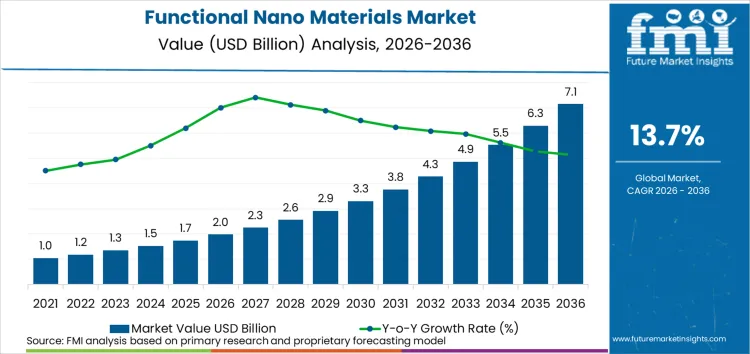
Functional Nano Materials Market Key Takeaways
| Metrics | Values |
|---|---|
| Expected Value (2026E) | USD 1,980 million |
| Projected Value (2036F) | USD 7,160 million |
| CAGR (2026-2036) | 13.7% |
Source: FMI analysis, based on proprietary forecasting model and primary research
Why is the Functional Nano Materials Market Growing?
Expansion of functional nano materials demand is propelled by semiconductor device physics scaling, electric vehicle battery chemistry transitions, medical device infection control imperatives, and optical coating performance requirements. Institutional procurement specifications from global foundries, automotive OEMs, and medical device manufacturers are forcing immediate adoption of validated, high‑purity nano materials across incoming material qualification .
Semiconductor Node Shrinkage as Primary Demand Driver
The transition to 2 nm technology nodes and below has collapsed tolerance for particulate contamination and surface defects. Chemical mechanical planarization requires nano‑silica slurries with particle size distribution CV < 5 % and large particle counts below 100 ppb. EUV photoresists incorporate organometallic nano‑clusters (e.g., tin‑based) achieving sub‑10 nm resolution. Nano‑imprint lithography, commercialized for high‑volume manufacturing by Mitsui Chemicals, uses silica nano‑stamps to pattern 6 nm features without expensive optics. Each advanced node consumes 30-50 % more nano‑materials per wafer than its predecessor .
EV Battery Silicon Anode Commercialization
The global battery industry’s shift from graphite to silicon‑dominant anodes represents a multi‑billion‑dollar opportunity for nano‑silicon suppliers. Conventional silicon micron‑particles fracture after few cycles; nano‑silicon (50-150 nm) accommodates volume expansion through particle‑level porosity and carbon coating. Market projections indicate nano‑silicon demand will exceed 100,000 metric tons annually by 2036, driven by EV adoption and grid‑scale energy storage. BASF and Evonik are scaling nano‑silicon production through joint ventures with battery manufacturers .
Medical Device Infection Prevention
Post‑pandemic healthcare design prioritizes infection prevention through antimicrobial surfaces. Silver nanoparticles (5-50 nm) incorporated into wound dressings, catheters, and implant coatings provide sustained, broad‑spectrum antimicrobial activity without systemic toxicity. Nano‑silver demand in medical applications is projected to grow at 16 % CAGR through 2036, with emerging applications in antimicrobial textiles and personal protective equipment .
Optical Coatings and Display Enhancement
Quantum dots-semiconductor nanocrystals emitting pure, size‑tunable light-have become standard in premium televisions and monitors, achieving 100 % DCI‑P3 color gamut. Cadmium‑free quantum dots (InP, ZnSe) now dominate due to RoHS compliance. Nano‑silica anti‑reflective coatings on smartphone displays achieve 0.2 % reflectance while improving scratch resistance. The proliferation of augmented reality devices will further accelerate demand for nano‑structured optical films .
How is Functional Nano Materials Market Segmented?
Why does Electronics & Automotive represent the dominant application segment?
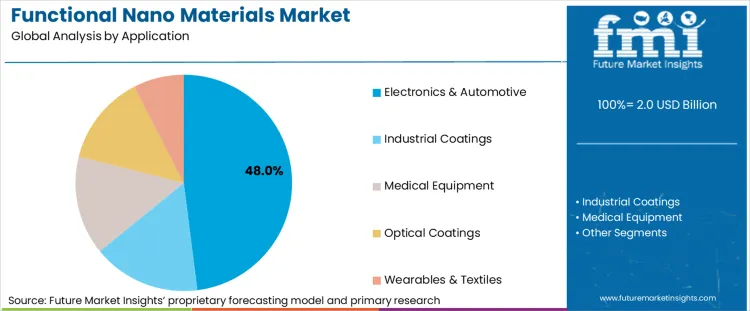
Electronics & automotive accounts for 48% of the functional nano materials market because it serves the two largest and most technologically intensive manufacturing ecosystems-semiconductor fabrication and electric vehicle production-where nano‑enabled performance directly translates to device capability and system efficiency. In semiconductors, nano‑silica CMP slurries, nano‑silver sintering pastes for die attachment, and nano‑imprint lithography resists are essential for leading‑edge node production. In EVs, nano‑silicon anodes, nano‑lithium iron phosphate cathodes, and nano‑ceramic battery separators enable the energy density, fast charging, and safety improvements driving consumer adoption. This segment’s 48 % share reflects the breadth and criticality of nano‑material applications across the electronics and automotive value chain .
Industrial coatings (28 %) represent the second‑largest segment, leveraging nano‑silica and nano‑alumina for scratch‑resistant clear coats, nano‑titanium dioxide for UV protection, and nano‑zinc oxide for anti‑corrosion primers. Medical equipment (18 %) includes antimicrobial nano‑silver coatings, nano‑hydroxyapatite for bone regeneration, and nano‑drug delivery systems. Optical coatings (6 %) rely on quantum dots and nano‑silica anti‑reflective layers. Wearables & textiles (2 %) incorporate nano‑silver for antimicrobial fabrics and conductive nanoparticles for flexible electronics.
Why does Conductive Nanoparticles maintain leadership in nano function preferences?
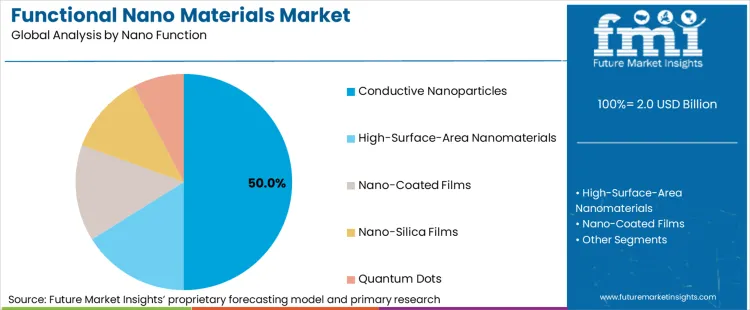
Conductive nanoparticles hold 50% of nano function demand because they enable the transition from material limitations to performance requirements across multiple high‑growth sectors. Nano‑silicon enables silicon‑dominant anodes; nano‑silver sintering pastes replace lead‑based solders in power electronics; nano‑carbon additives improve lithium‑ion battery rate capability; conductive indium tin oxide nanoparticles maintain touchscreen functionality in foldable displays. No single material class addresses such diverse conductivity challenges. The segment’s leadership reflects both the ubiquity of electrical functionality requirements and the unique ability of nano‑scale materials to solve conductivity problems without compromising mechanical or optical properties .
High‑surface‑area nanomaterials (26 % share)-fumed silica, precipitated silica, nanostructured metal oxides-provide reinforcement, rheology control, and adsorption functionality across coatings, adhesives, and catalysis. Nano‑coated films (14 %) combine substrate properties with surface functionality for barrier, anti‑fog, or anti‑microbial applications. Nano‑silica films (8 %) serve optical and protective coating roles. Quantum dots (2 %), while modest in current volume, represent the highest‑growth nano function with 25 %+ CAGR as display and lighting applications scale .
How does PET Film as the Primary Base Material drive Market Volume?
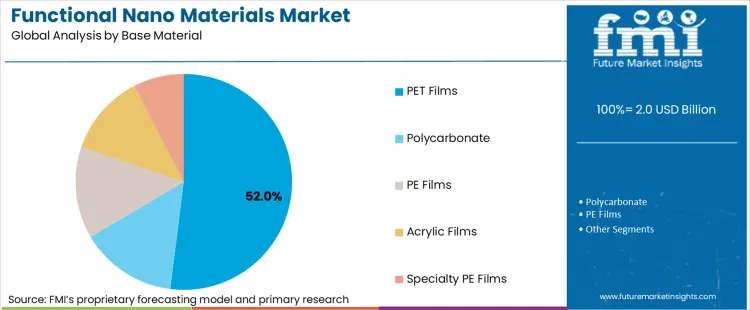
PET films constitute 52% of base material consumption in functional nano material applications. Dominance is driven by exceptional optical clarity (≥90 % transmission) for display films, dimensional stability for precision coating processes, surface chemistry enabling robust nano‑coating adhesion, and established converting infrastructure. Nano‑silica hard coatings on PET achieve 9H pencil hardness for foldable smartphone screens. Nano‑silver antimicrobial layers on PET enable self‑disinfecting touch surfaces. Conductive PET films coated with ITO or silver nanowires serve as transparent electrodes in touch panels and OLED lighting .
Polycarbonate (24 %) dominates automotive display and lighting applications requiring impact resistance and thermal stability. PE films (14 %) serve cost‑sensitive packaging and industrial applications where nano‑clay barrier coatings enhance oxygen and moisture resistance. Acrylic films (6 %) address outdoor signage and marine displays requiring exceptional UV stability. Specialty PE grades (2 %) enable wearable device encapsulants and flexible hybrid electronics.
What Drivers, Restraints, Opportunities, and Trends Prevail in the Functional Nano Materials Market?
Drivers
Semiconductor Node Shrinkage: Each new technology node increases nano‑material consumption per wafer by 30-50 %. At 2 nm, EUV‑sensitive metal‑oxide nanoparticle resists and high‑purity silica CMP slurries are indispensable. With leading‑edge capacity expanding through CHIPS Act and EU Chips Act investments, the semiconductor segment provides sustained, predictable demand growth .
EV Battery Chemistry Transition: The shift from graphite to silicon‑dominant anodes adds 5-10 wt % nano‑silicon to the negative electrode. With global lithium‑ion battery production capacity projected to exceed 5,000 GWh by 2030, nano‑silicon demand will grow at 40 %+ annually. Additional opportunities exist in nano‑lithium iron phosphate, nano‑ceramic separators, and conductive carbon additives .
Medical Device Infection Control: Healthcare‑associated infections affect 7 % of hospitalized patients in developed nations, creating sustained demand for antimicrobial surfaces. Nano‑silver coatings on catheters reduce infection rates by 30-50 %, justifying premium pricing in hospital procurement. Emerging applications in implantable devices and wound care will accelerate demand .
Display and Lighting Technology Evolution: Quantum‑dot‑enhanced LCD televisions achieve superior color gamut at lower cost than OLED. Cadmium‑free quantum dots (InP, ZnSe) have overcome regulatory barriers, enabling mass‑market adoption. Micro‑LED displays require nano‑structured phosphors for color conversion. Each display technology transition expands the addressable market for functional nano materials .
Restraints
High Production Costs and Scalability Challenges: Precision nanoparticle synthesis (controlled size, shape, surface chemistry) remains capital‑intensive. Scaling from kilogram‑scale laboratory production to hundred‑ton commercial volumes requires 5-7 years and USD 50-100 million investment. This creates supply bottlenecks and elevates prices, limiting adoption in cost‑sensitive applications .
Regulatory Uncertainty and Environmental Concerns: The environmental and health effects of manufactured nanomaterials remain incompletely characterized. REACH, TSCA, and emerging Asian chemical control frameworks impose increasing testing and documentation requirements. Regulatory delays can extend market entry by 24-36 months, particularly for novel compositions or high‑aspect‑ratio nanoparticles .
Performance‑Stability Trade‑offs: High‑surface‑area nanomaterials are thermodynamically metastable; they agglomerate, oxidize, or dissolve under processing or in‑service conditions. Maintaining nano‑specific functionality through compounding, storage, and end‑use requires sophisticated surface passivation and dispersion stabilization technologies that add cost and complexity .
Opportunity 1: Sustainable and Bio‑Based Nano Materials
Brand owner commitments to renewable feedstocks and circular economy are driving demand for nano‑cellulose, nano‑chitin, and bio‑derived silica. Cellulose nanocrystals (CNC) from wood pulp provide reinforcement and barrier properties comparable to nano‑clays with biodegradability and low carbon footprint. First‑mover suppliers with validated CNC production capacity are securing preferred supplier status in packaging and automotive applications .
Opportunity 2: Nano‑Enabled Solid‑State Batteries
Solid‑state batteries-the next frontier beyond lithium‑ion-require nano‑scale engineering of solid electrolytes (LLZO, LATP), cathode‑electrolyte interphases, and lithium‑metal anodes. Nano‑ceramic coatings on separators prevent dendrite propagation; nano‑silicon composites accommodate anode volume changes. Commercialization timelines (2028-2032) align with the forecast period, representing a USD 500 million+ opportunity by 2036 .
Opportunity 3: Nano‑Imprint Lithography Materials
Nano‑imprint lithography is emerging as a cost‑effective alternative to EUV for sub‑10 nm patterning. Mitsui Chemicals has commercialized photo‑curable nano‑imprint resists and silica stamp materials. As NIL adoption expands beyond memory to logic and advanced packaging, demand for high‑purity, defect‑free nano‑imprint materials will grow exponentially .
Trend 1: Conductive Nanoparticle Diversification
The conductive nanoparticles segment is rapidly diversifying from established materials (silver, carbon black, ITO) toward next‑generation systems: graphene, carbon nanotubes, MXenes, and conductive polymers. Each offers unique property combinations-mechanical flexibility, optical transparency, chemical stability-enabling applications previously inaccessible. Suppliers with broad conductive nano‑material portfolios capture cross‑selling opportunities and hedge against material‑specific supply risks .
Trend 2: High‑Surface‑Area Nanomaterial Functionalization
Commodity nano‑silica and nano‑alumina are being displaced by functionalized grades with tailored surface chemistry (hydrophobic, hydrophilic, epoxy‑functional, amino‑functional). Functionalized nanomaterials enable simpler formulation, stronger interface bonding, and enhanced dispersion stability. Evonik’s AEROSIL® product line exemplifies this trend, offering 20+ surface‑modified grades for specific resin systems .
Trend 3: Regional Nano‑Material Supply Chain Localization
CHIPS Act, EU Chips Act, India Semiconductor Mission, and China’s import substitution policies are accelerating domestic nano‑material production capacity. Foreign suppliers are establishing local manufacturing through joint ventures; domestic chemical companies are scaling nano‑silica, nano‑silicon, and quantum‑dot production. This localization trend reduces supply chain vulnerability and creates opportunities for regional champions .
Trend 4: Cadmium‑Free Quantum Dot Commercialization
Regulatory restrictions on cadmium have driven intensive R&D investment in indium phosphide, zinc selenide, and perovskite quantum dots. 2025-2026 marks the inflection point where cadmium‑free quantum dots achieve cost‑performance parity with legacy CdSe formulations. Major display manufacturers have committed to 100 % cadmium‑free product lines by 2028, creating sustained demand for alternative quantum‑dot materials .
Analysis of Functional Nano Materials Market by Key Countries
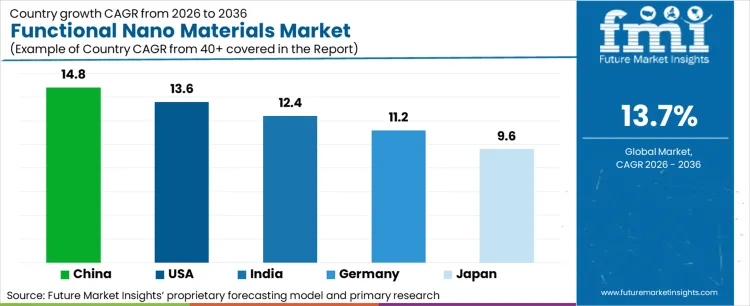
| Country | CAGR (2026-2036) |
|---|---|
| China | 14.8 % |
| United States | 13.6 % |
| India | 12.4 % |
| Germany | 11.2 % |
| Japan | 9.6 % |
Source: FMI analysis, based on proprietary forecasting model and primary research
What industrial policy and manufacturing scale drive China’s 14.8 % CAGR?
China exhibits the highest market acceleration with a CAGR of 14.8 % through 2036, propelled by the world’s largest semiconductor fabrication expansion and EV battery production ecosystem. China operates 40+ 300 mm wafer fabs with additional capacity under construction; each fab requires certified nano‑silica CMP slurries, nano‑silver sintering pastes, and nano‑imprint materials-historically imported from Japan, USA, and Germany. Government self‑sufficiency mandates now require progressive localization of these critical materials, driving domestic nano‑material producers to scale capacity and qualify at SMIC, Hua Hong, and YMTC. Concurrently, China produces approximately 70 % of global EV batteries; the transition to silicon‑dominant anodes creates demand for >50,000 metric tons of nano‑silicon annually by 2030. Domestic suppliers including Ningbo Shanshan and BTR New Material are scaling nano‑silicon production through technology partnerships and government subsidies .
How do CHIPS Act and IRA stimulate United States market growth at 13.6 % CAGR?
The United States expands at 13.6 % CAGR, supported by CHIPS Act semiconductor manufacturing incentives and IRA‑stimulated EV battery material localization. Intel’s Ohio One, TSMC’s Arizona, Samsung’s Texas, and Micron’s New York fabs represent over USD 150 billion investment; each fab requires validated nano‑materials qualified through rigorous certification processes. U.S. nano‑material suppliers with domestic manufacturing capacity and SEMI standards compliance capture import substitution opportunities. The IRA’s Advanced Manufacturing Production Credit provides USD 35-45 /kWh for domestic battery cell production, with additional credits for critical material processing; this has catalyzed nano‑silicon production capacity announcements from Group14 Technologies (USD 400 million Washington plant) and Sila Nanotechnologies (USD 600 million Moses Lake facility) .
What electronics manufacturing localization accelerates India’s 12.4 % CAGR?
India advances at 12.4 % CAGR, propelled by the Production Linked Incentive scheme targeting USD 400 billion in domestic electronics manufacturing by 2030. Apple, Samsung, and Foxconn have expanded assembly operations in India, with contract manufacturers required to achieve 50-60 % domestic value addition. Precision component manufacturing requires nano‑abrasives for polishing, conductive nano‑silver for die attachment, and nano‑silica underfills-historically imported. Domestic chemical companies are establishing nano‑material formulation capacity through technology licensing and joint ventures. India’s National Mission on Nano Science and Technology has funded 20+ academic‑industry collaborative projects targeting semiconductor and energy storage applications, building domestic R&D capability .
How does German automotive electrification leadership influence 11.2 % growth?
Germany advances at 11.2 % CAGR, shaped by the country’s position as the European center of automotive electrification R&D and premium EV production. Mercedes‑Benz, BMW, and Volkswagen have committed to 50+ % EV sales by 2030, with battery pack production localized in Germany. German material science leadership-BASF, Evonik, Merck-positions domestic suppliers as preferred partners for nano‑silicon, nano‑ceramic separators, and high‑purity nano‑zinc oxide. The German government’s “Nano‑Tech Initiative” provides €200 million in funding for industrial nano‑material scale‑up, targeting 40 % domestic sourcing of critical nano‑materials by 2030 .
How does Japan’s semiconductor materials dominance shape its 9.6 % trajectory?
Japan develops at 9.6 % CAGR, reflecting mature semiconductor materials leadership and concentration in ultra‑high‑purity, ultra‑precise nano‑material segments. Mitsui Chemicals’ nano‑imprint lithography materials are specified for leading‑edge memory production at Kioxia and Samsung; Sumitomo Chemical’s high‑purity nano‑silica CMP slurries maintain >40 % global market share. While unit volumes grow modestly, continuous specification escalation-from 50 nm to 20 nm particle size, from 10 ppb to 1 ppb metallic impurities-sustains value growth. Japan’s 9.6 % CAGR reflects this value‑over‑volume trajectory characteristic of mature, technology‑dominant markets .
What is the Competition Outlook for Functional Nano Materials Market?
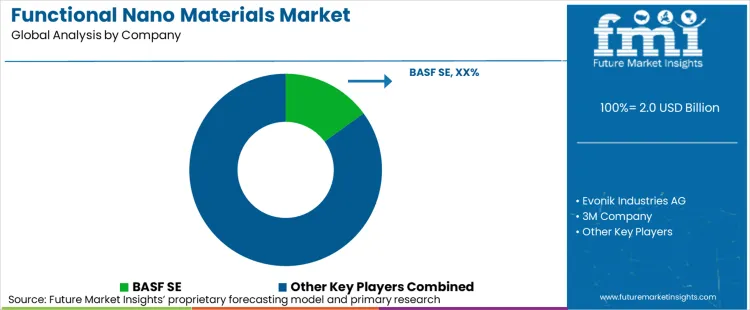
The competitive landscape for functional nano materials has undergone fundamental transformation from fragmented speciality chemical suppliers to vertically integrated material science corporations delivering application‑engineered, high‑purity nano‑material systems with documented particle size precision, surface functionality, and scalable manufacturing .
Competitive Differentiation Vectors
Particle Size Distribution Precision: Semiconductor and battery customers require nano‑materials with CV < 5 % and batch‑to‑batch consistency exceeding six‑sigma. Suppliers with proprietary reactor designs, in‑line particle size analysis, and statistical process control secure multi‑year supply agreements. Evonik’s gas‑phase AEROSIL® process achieves ±2 nm primary particle control; Mitsui Chemicals’ nano‑imprint silica stamp fabrication maintains 6 nm feature fidelity .
Surface Functionalization Versatility: Customers increasingly demand nano‑materials with tailored surface chemistry-hydrophobic, hydrophilic, epoxy‑functional, amino‑functional-to simplify formulation and enhance composite performance. Suppliers offering 20+ surface‑modified grades command premium pricing and application development partnerships. BASF’s nano‑zinc oxide product line includes 12 surface‑treated variants for specific coating systems .
Sustainability and Green Chemistry: Regulatory pressure and brand owner commitments are accelerating demand for nano‑materials manufactured via low‑energy, solvent‑free, or bio‑based routes. Suppliers with ISCC PLUS certification, life cycle assessment data, and published carbon footprint reductions capture preferred supplier status. Evonik has commercialized AEROSIL® fumed silica grades with 30 % reduced carbon footprint through renewable electricity sourcing .
Regional Manufacturing Footprint: Supply chain security concerns are driving customers to dual‑source from suppliers with multi‑regional production capacity. BASF operates nano‑silicon pilot plants in Germany and the United States; Evonik manufactures AEROSIL® in Europe, Asia, and North America. This geographic diversification provides competitive advantage in securing long‑term contracts .
Key Players Profiled
- BASF SE
- Evonik Industries AG
- 3M Company
- Mitsui Chemicals Inc.
- Sumitomo Chemical Co. Ltd.
Market Definition
The functional nano materials market comprises revenues generated from engineered nanoparticles, nanostructured materials, and nano‑enabled formulations with at least one dimension < 100 nm, designed to provide specific performance enhancements-electrical conductivity, chemical reactivity, mechanical reinforcement, optical tuning, or biological activity-through controlled size, shape, composition, and surface chemistry .
The scope includes functional nano materials categorized by application segment (electronics & automotive, industrial coatings, medical equipment, optical coatings, wearables & textiles), nano function (conductive nanoparticles, high‑surface‑area nanomaterials, nano‑coated films, nano‑silica films, quantum dots), and base material (PET films, polycarbonate, PE films, acrylic films, specialty PE films). Products within scope are engineered specifically for intentional nano‑scale functional design and are manufactured through controlled synthesis processes (gas‑phase, wet‑chemical, mechanical attrition) with validated particle size distribution and purity specifications.
The scope excludes revenues from the manufacture of substrates receiving nano‑material coatings; incidental nanoparticles generated as by‑products or impurities; bulk materials with nano‑sized fractions; non‑functional nano‑formulations; and downstream application, assembly, or installation services.
Nano‑material formulations failing to achieve minimum 90 % of particles within specified size range (by number), lacking documented batch‑to‑batch consistency, or without applicable safety data sheets and regulatory compliance documentation fall outside the defined market boundary .
Scope of Report
| Items | Values |
|---|---|
| Quantitative Units (2026) | USD 1,980 million |
| Application Segment | Electronics & Automotive, Industrial Coatings, Medical Equipment, Optical Coatings, Wearables & Textiles |
| Nano Function | Conductive Nanoparticles, High‑Surface‑Area Nanomaterials, Nano‑Coated Films, Nano‑Silica Films, Quantum Dots |
| Base Material | PET Films, Polycarbonate, PE Films, Acrylic Films, Specialty PE Films |
| Regions Covered | North America, Europe, East Asia, Japan, Rest of World |
| Countries Covered | United States, Germany, China, Japan, India, Canada, Mexico, United Kingdom, France, Italy, Spain, South Korea, Taiwan, Brazil, and additional regional markets |
| Key Companies Profiled | BASF SE, Evonik Industries AG, 3M Company, Mitsui Chemicals Inc., Sumitomo Chemical Co. Ltd. |
Source: FMI analysis, based on proprietary forecasting model and primary research
Functional Nano Materials Market Key Segments
By Application Segment
- Electronics & Automotive
- Industrial Coatings
- Medical Equipment
- Optical Coatings
- Wearables & Textiles
By Nano Function
- Conductive Nanoparticles
- High‑Surface‑Area Nanomaterials
- Nano‑Coated Films
- Nano‑Silica Films
- Quantum Dots
By Base Material
- PET Films
- Polycarbonate
- PE Films
- Acrylic Films
- Specialty PE Films
By Region
- North America
- Europe
- East Asia
- Japan
- Rest of the World
Bibliography
- BASF SE. (2026). Battery materials and functional nano‑materials portfolio update. BASF Investor Relations.
- Evonik Industries AG. (2026). AEROSIL® and ZANDURA® product line expansion for semiconductor and battery applications. Evonik Press Release.
- Mitsui Chemicals Inc. (2026). Nano‑imprint lithography materials for sub‑10 nm patterning. Mitsui Chemicals Technical Review.
- Sumitomo Chemical Co. Ltd. (2026). High‑purity nano‑silica CMP slurries for advanced logic devices. Sumitomo Chemical Integrated Report.
- 3M Company. (2026). Conductive nano‑materials for electronics and automotive applications. 3M Advanced Materials Division.
Frequently Asked Questions
What is the projected global growth rate for the functional nano materials market?
The global market is projected to expand at a 13.7 % CAGR from 2026 to 2036, from USD 1,980 million to USD 7,160 million, reflecting structural convergence of semiconductor node shrinkage (2 nm and below), EV battery chemistry transition (silicon dominant anodes), medical device infection control imperatives, and optical coating performance requirements
Which application segment and nano function dominate market demand?
Electronics & automotive accounts for 48 % of application demand, serving the semiconductor and EV sectors where nano enabled performance directly translates to device capability and energy density. Conductive nanoparticles hold 50 % of nano function demand, enabling silicon dominant anodes, lead free power electronics solders, and transparent conductive films for foldable displays .
Which base material accounts for the largest market share?
PET films account for 52 % of base material consumption. Dominance is driven by optical clarity for display films, dimensional stability for precision coating, surface chemistry facilitating robust nano coating adhesion, and established converting infrastructure enabling nano silica hard coatings (9H pencil hardness), nano silver antimicrobial layers, and ITO/silver nanowire transparent electrodes .
Which regions and countries are expected to lead market expansion over the forecast period?
China is the fastest growing country at 14.8 % CAGR, propelled by semiconductor fab expansion and EV battery supply chain localization. The United States expands at 13.6 % CAGR, supported by CHIPS Act fab construction and IRA stimulated nano silicon capacity. India advances at 12.4 % CAGR, driven by PLI scheme electronics manufacturing and domestic nano material R&D. Germany grows at 11.2 % CAGR, led by automotive electrification and specialty chemical leadership. Japan develops at 9.6 % CAGR, shaped by semiconductor materials dominance and Mitsui Chemicals’ nano imprint lithography innovations .
Preview the report firsthand - request a free sample
Get SampleGet the brochure for pricing and purchase details.
Get PDFTable of Content
- Executive Summary
- Global Market Outlook
- Demand-side Trends
- Supply-side Trends
- Technology Roadmap Analysis
- Analysis and Recommendations
- Market Overview
- Market Coverage / Taxonomy
- Market Definition / Scope / Limitations
- Research Methodology
- Chapter Orientation
- Analytical Lens and Working Hypotheses
- Market Structure, Signals, and Trend Drivers
- Benchmarking and Cross-market Comparability
- Market Sizing, Forecasting, and Opportunity Mapping
- Research Design and Evidence Framework
- Desk Research Programme (Secondary Evidence)
- Company Annual and Sustainability Reports
- Peer-reviewed Journals and Academic Literature
- Corporate Websites, Product Literature, and Technical Notes
- Earnings Decks and Investor Briefings
- Statutory Filings and Regulatory Disclosures
- Technical White Papers and Standards Notes
- Trade Journals, Industry Magazines, and Analyst Briefs
- Conference Proceedings, Webinars, and Seminar Materials
- Government Statistics Portals and Public Data Releases
- Press Releases and Reputable Media Coverage
- Specialist Newsletters and Curated Briefings
- Sector Databases and Reference Repositories
- FMI Internal Proprietary Databases and Historical Market Datasets
- Subscription Datasets and Paid Sources
- Social Channels, Communities, and Digital Listening Inputs
- Additional Desk Sources
- Expert Input and Fieldwork (Primary Evidence)
- Primary Modes
- Qualitative Interviews and Expert Elicitation
- Quantitative Surveys and Structured Data Capture
- Blended Approach
- Why Primary Evidence is Used
- Field Techniques
- Interviews
- Surveys
- Focus Groups
- Observational and In-context Research
- Social and Community Interactions
- Stakeholder Universe Engaged
- C-suite Leaders
- Board Members
- Presidents and Vice Presidents
- R&D and Innovation Heads
- Technical Specialists
- Domain Subject-matter Experts
- Scientists
- Physicians and Other Healthcare Professionals
- Governance, Ethics, and Data Stewardship
- Research Ethics
- Data Integrity and Handling
- Primary Modes
- Tooling, Models, and Reference Databases
- Desk Research Programme (Secondary Evidence)
- Data Engineering and Model Build
- Data Acquisition and Ingestion
- Cleaning, Normalisation, and Verification
- Synthesis, Triangulation, and Analysis
- Quality Assurance and Audit Trail
- Market Background
- Market Dynamics
- Drivers
- Restraints
- Opportunity
- Trends
- Scenario Forecast
- Demand in Optimistic Scenario
- Demand in Likely Scenario
- Demand in Conservative Scenario
- Opportunity Map Analysis
- Product Life Cycle Analysis
- Supply Chain Analysis
- Investment Feasibility Matrix
- Value Chain Analysis
- PESTLE and Porter’s Analysis
- Regulatory Landscape
- Regional Parent Market Outlook
- Production and Consumption Statistics
- Import and Export Statistics
- Market Dynamics
- Global Market Analysis 2021 to 2025 and Forecast, 2026 to 2036
- Historical Market Size Value (USD Million) Analysis, 2021 to 2025
- Current and Future Market Size Value (USD Million) Projections, 2026 to 2036
- Y-o-Y Growth Trend Analysis
- Absolute $ Opportunity Analysis
- Global Market Pricing Analysis 2021 to 2025 and Forecast 2026 to 2036
- Global Market Analysis 2021 to 2025 and Forecast 2026 to 2036, By Application
- Introduction / Key Findings
- Historical Market Size Value (USD Million) Analysis By Application , 2021 to 2025
- Current and Future Market Size Value (USD Million) Analysis and Forecast By Application , 2026 to 2036
- Electronics & Automotive
- Industrial Coatings
- Medical Equipment
- Optical Coatings
- Wearables & Textiles
- Electronics & Automotive
- Y-o-Y Growth Trend Analysis By Application , 2021 to 2025
- Absolute $ Opportunity Analysis By Application , 2026 to 2036
- Global Market Analysis 2021 to 2025 and Forecast 2026 to 2036, By Nano Function
- Introduction / Key Findings
- Historical Market Size Value (USD Million) Analysis By Nano Function, 2021 to 2025
- Current and Future Market Size Value (USD Million) Analysis and Forecast By Nano Function, 2026 to 2036
- Conductive Nanoparticles
- High‑Surface‑Area Nanomaterials
- Nano‑Coated Films
- Nano‑Silica Films
- Quantum Dots
- Conductive Nanoparticles
- Y-o-Y Growth Trend Analysis By Nano Function, 2021 to 2025
- Absolute $ Opportunity Analysis By Nano Function, 2026 to 2036
- Global Market Analysis 2021 to 2025 and Forecast 2026 to 2036, By Base Material
- Introduction / Key Findings
- Historical Market Size Value (USD Million) Analysis By Base Material, 2021 to 2025
- Current and Future Market Size Value (USD Million) Analysis and Forecast By Base Material, 2026 to 2036
- PET Films
- Polycarbonate
- PE Films
- Acrylic Films
- Specialty PE Films
- PET Films
- Y-o-Y Growth Trend Analysis By Base Material, 2021 to 2025
- Absolute $ Opportunity Analysis By Base Material, 2026 to 2036
- Global Market Analysis 2021 to 2025 and Forecast 2026 to 2036, By Region
- Introduction
- Historical Market Size Value (USD Million) Analysis By Region, 2021 to 2025
- Current Market Size Value (USD Million) Analysis and Forecast By Region, 2026 to 2036
- North America
- Latin America
- Western Europe
- Eastern Europe
- East Asia
- South Asia and Pacific
- Middle East & Africa
- Market Attractiveness Analysis By Region
- North America Market Analysis 2021 to 2025 and Forecast 2026 to 2036, By Country
- Historical Market Size Value (USD Million) Trend Analysis By Market Taxonomy, 2021 to 2025
- Market Size Value (USD Million) Forecast By Market Taxonomy, 2026 to 2036
- By Country
- USA
- Canada
- Mexico
- By Application
- By Nano Function
- By Base Material
- By Country
- Market Attractiveness Analysis
- By Country
- By Application
- By Nano Function
- By Base Material
- Key Takeaways
- Latin America Market Analysis 2021 to 2025 and Forecast 2026 to 2036, By Country
- Historical Market Size Value (USD Million) Trend Analysis By Market Taxonomy, 2021 to 2025
- Market Size Value (USD Million) Forecast By Market Taxonomy, 2026 to 2036
- By Country
- Brazil
- Chile
- Rest of Latin America
- By Application
- By Nano Function
- By Base Material
- By Country
- Market Attractiveness Analysis
- By Country
- By Application
- By Nano Function
- By Base Material
- Key Takeaways
- Western Europe Market Analysis 2021 to 2025 and Forecast 2026 to 2036, By Country
- Historical Market Size Value (USD Million) Trend Analysis By Market Taxonomy, 2021 to 2025
- Market Size Value (USD Million) Forecast By Market Taxonomy, 2026 to 2036
- By Country
- Germany
- UK
- Italy
- Spain
- France
- Nordic
- BENELUX
- Rest of Western Europe
- By Application
- By Nano Function
- By Base Material
- By Country
- Market Attractiveness Analysis
- By Country
- By Application
- By Nano Function
- By Base Material
- Key Takeaways
- Eastern Europe Market Analysis 2021 to 2025 and Forecast 2026 to 2036, By Country
- Historical Market Size Value (USD Million) Trend Analysis By Market Taxonomy, 2021 to 2025
- Market Size Value (USD Million) Forecast By Market Taxonomy, 2026 to 2036
- By Country
- Russia
- Poland
- Hungary
- Balkan & Baltic
- Rest of Eastern Europe
- By Application
- By Nano Function
- By Base Material
- By Country
- Market Attractiveness Analysis
- By Country
- By Application
- By Nano Function
- By Base Material
- Key Takeaways
- East Asia Market Analysis 2021 to 2025 and Forecast 2026 to 2036, By Country
- Historical Market Size Value (USD Million) Trend Analysis By Market Taxonomy, 2021 to 2025
- Market Size Value (USD Million) Forecast By Market Taxonomy, 2026 to 2036
- By Country
- China
- Japan
- South Korea
- By Application
- By Nano Function
- By Base Material
- By Country
- Market Attractiveness Analysis
- By Country
- By Application
- By Nano Function
- By Base Material
- Key Takeaways
- South Asia and Pacific Market Analysis 2021 to 2025 and Forecast 2026 to 2036, By Country
- Historical Market Size Value (USD Million) Trend Analysis By Market Taxonomy, 2021 to 2025
- Market Size Value (USD Million) Forecast By Market Taxonomy, 2026 to 2036
- By Country
- India
- ASEAN
- Australia & New Zealand
- Rest of South Asia and Pacific
- By Application
- By Nano Function
- By Base Material
- By Country
- Market Attractiveness Analysis
- By Country
- By Application
- By Nano Function
- By Base Material
- Key Takeaways
- Middle East & Africa Market Analysis 2021 to 2025 and Forecast 2026 to 2036, By Country
- Historical Market Size Value (USD Million) Trend Analysis By Market Taxonomy, 2021 to 2025
- Market Size Value (USD Million) Forecast By Market Taxonomy, 2026 to 2036
- By Country
- Kingdom of Saudi Arabia
- Other GCC Countries
- Turkiye
- South Africa
- Other African Union
- Rest of Middle East & Africa
- By Application
- By Nano Function
- By Base Material
- By Country
- Market Attractiveness Analysis
- By Country
- By Application
- By Nano Function
- By Base Material
- Key Takeaways
- Key Countries Market Analysis
- USA
- Pricing Analysis
- Market Share Analysis, 2025
- By Application
- By Nano Function
- By Base Material
- Canada
- Pricing Analysis
- Market Share Analysis, 2025
- By Application
- By Nano Function
- By Base Material
- Mexico
- Pricing Analysis
- Market Share Analysis, 2025
- By Application
- By Nano Function
- By Base Material
- Brazil
- Pricing Analysis
- Market Share Analysis, 2025
- By Application
- By Nano Function
- By Base Material
- Chile
- Pricing Analysis
- Market Share Analysis, 2025
- By Application
- By Nano Function
- By Base Material
- Germany
- Pricing Analysis
- Market Share Analysis, 2025
- By Application
- By Nano Function
- By Base Material
- UK
- Pricing Analysis
- Market Share Analysis, 2025
- By Application
- By Nano Function
- By Base Material
- Italy
- Pricing Analysis
- Market Share Analysis, 2025
- By Application
- By Nano Function
- By Base Material
- Spain
- Pricing Analysis
- Market Share Analysis, 2025
- By Application
- By Nano Function
- By Base Material
- France
- Pricing Analysis
- Market Share Analysis, 2025
- By Application
- By Nano Function
- By Base Material
- India
- Pricing Analysis
- Market Share Analysis, 2025
- By Application
- By Nano Function
- By Base Material
- ASEAN
- Pricing Analysis
- Market Share Analysis, 2025
- By Application
- By Nano Function
- By Base Material
- Australia & New Zealand
- Pricing Analysis
- Market Share Analysis, 2025
- By Application
- By Nano Function
- By Base Material
- China
- Pricing Analysis
- Market Share Analysis, 2025
- By Application
- By Nano Function
- By Base Material
- Japan
- Pricing Analysis
- Market Share Analysis, 2025
- By Application
- By Nano Function
- By Base Material
- South Korea
- Pricing Analysis
- Market Share Analysis, 2025
- By Application
- By Nano Function
- By Base Material
- Russia
- Pricing Analysis
- Market Share Analysis, 2025
- By Application
- By Nano Function
- By Base Material
- Poland
- Pricing Analysis
- Market Share Analysis, 2025
- By Application
- By Nano Function
- By Base Material
- Hungary
- Pricing Analysis
- Market Share Analysis, 2025
- By Application
- By Nano Function
- By Base Material
- Kingdom of Saudi Arabia
- Pricing Analysis
- Market Share Analysis, 2025
- By Application
- By Nano Function
- By Base Material
- Turkiye
- Pricing Analysis
- Market Share Analysis, 2025
- By Application
- By Nano Function
- By Base Material
- South Africa
- Pricing Analysis
- Market Share Analysis, 2025
- By Application
- By Nano Function
- By Base Material
- USA
- Market Structure Analysis
- Competition Dashboard
- Competition Benchmarking
- Market Share Analysis of Top Players
- By Regional
- By Application
- By Nano Function
- By Base Material
- Competition Analysis
- Competition Deep Dive
- BASF SE
- Overview
- Product Portfolio
- Profitability by Market Segments (Product/Age /Sales Channel/Region)
- Sales Footprint
- Strategy Overview
- Marketing Strategy
- Product Strategy
- Channel Strategy
- Evonik Industries AG
- 3M Company
- Mitsui Chemicals Inc.
- Sumitomo Chemical Co. Ltd.
- BASF SE
- Competition Deep Dive
- Assumptions & Acronyms Used


