

- Market Size (2026)
- USD 13.7 Bn
- Forecast (2036)
- USD 21.9 Bn
- CAGR (2026 to 2036)
- 4.8%
How big is Mining Flotation Chemicals Market in 2026?
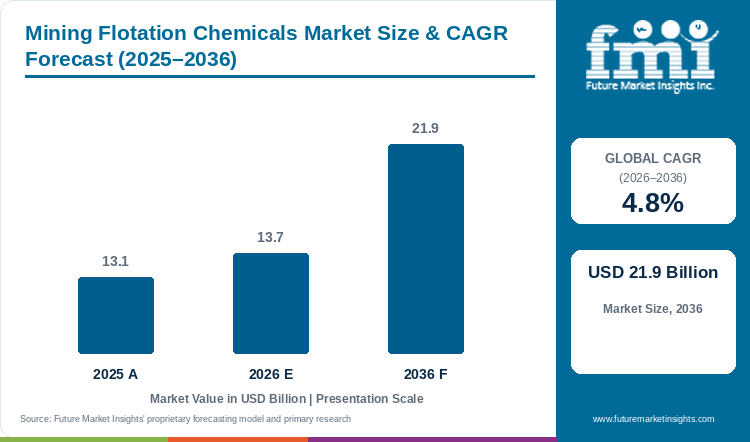
Mining flotation chemicals record a 4.8% CAGR from 2026 to 2036. The 2025 base of USD 13.1 billion moves to an estimated USD 13.73 billion in 2026 and a projected USD 21.90 billion by 2036.
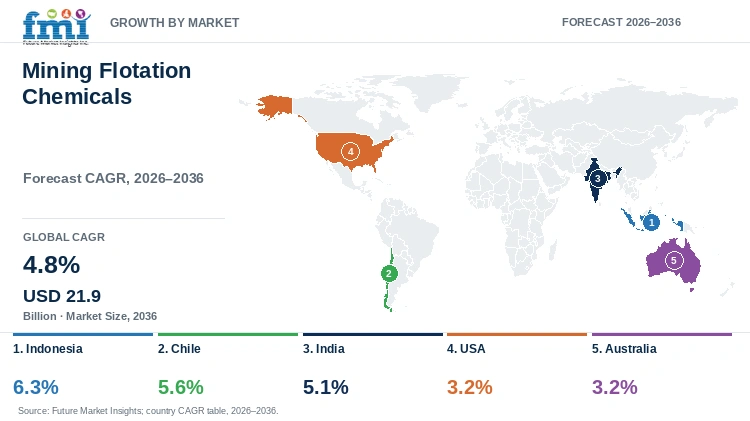
The mining flotation chemicals market share is led by collectors at 42% of 2026 chemical type sales, and the key opportunity lies in reagent programs for new copper concentrators in Indonesia and Chile. Demand for flotation reagents stood at USD 13.1 billion in 2025 and is estimated at USD 13.73 billion in 2026. Market size is projected to reach USD 21.90 billion by 2036, and analysts at FMI see a 4.8% CAGR from 2026 to 2036. Indonesia is growing at a 6.3% CAGR and Chile at 5.6%, ahead of India at 5.1% and the USA and Australia at 3.2% each.
Lower ore grades are raising reagent use per tonne of copper at older mills. USGS reported in February 2026 that U.S. copper mine output fell 5% to about 1.0 million tons in 2025, amid concentrator shutdowns and lower grades.[1] As a result, recovery guarantees on lean feed at US mills are rewriting the rules of market competition among reagent makers. Xanthates are a core collector chemistry, and the xanthate flotation collectors market is forecast at a 4.9% CAGR from 2026 to 2036. Collector pricing will follow xanthate supply. Polyglycol frothers go into the same flotation cells as xanthate collectors, and the polyglycol flotation frothers market is set for a 5% CAGR from 2026 to 2036. Western Australia's Mining Amendment Regulations of October 2025 are raising the bar for mine compliance work. Due to this, reagent makers are pairing low-toxicity blends with on-site dosing support.
Key Market Trends & Insights
- Every flotation circuit doses a collector on each tonne milled, which gives collectors 42% of 2026 chemical type sales.
- Clariant reported sales growth in Mining Solutions within Care Chemicals for the second quarter of 2026.[2] Non-sulphide circuits hold 44% of ore type demand, and sulphide circuits an estimated 56%.
Regional Highlights
- Indonesia shows the fastest profiled pace on FMI projections, a 6.3% CAGR from 2026 to 2036.
- Next come Chile (5.6%) and India (5.1%), and the USA and Australia share the lowest rate at 3.2%.
- Hindustan Copper plans capital investment of over ₹7,000 crore over five to six years to reopen closed mines in India, PTI reported in August 2026.[3]
Market Size & Forecast
Table 1: Market Size and Forecast for the Mining Flotation Chemicals Market (USD billion and percentage), 2025 to 2036
| Metric | Value |
|---|---|
| 2025 Market Size | USD 13.1 billion |
| Estimated Market Size in 2026 | USD 13.73 billion |
| Projected Market Size by 2036 | USD 21.90 billion |
| CAGR, 2026 to 2036 | 4.8% |
| Added Revenue, 2026 to 2036 | USD 8.17 billion |
| Market Expansion Multiple | 1.6x |
Reagent tonnage grows faster than copper tonnage when grades fall, because plants dose collectors and frothers by the tonne of ore milled. Sales are estimated at USD 13.73 billion in 2026 and projected at USD 21.90 billion by 2036 in the FMI study. Collectors will carry the largest part of new reagent sales on a 42% chemical type share. Growth is shifting across product categories, because polymetallic plants dose depressants, about 13% of 2026 chemical type sales (estimated), at each copper, zinc and molybdenum separation step.
Lower Ore Grades and Reagent Intensity at Copper Concentrators
World copper mine output reached about 23,000 thousand metric tons in 2025, with Chile at 5,300, Australia at 730 and Indonesia at 710, according to USGS estimates.[1] COMEX copper was projected to average a record $4.80 per pound in 2025.[1] Record prices make low-grade tonnes profitable to mill, and every extra tonne milled needs collector, frother and depressant. Codelco mines produced 1.33 million tons last year, and the Chilean miner targets 1.7 million tons by 2030, Reuters reported in October 2026.[4] Codelco and Anglo American agreed in late June to operate Andina and Los Bronces jointly, with about 120,000 additional tons of copper in each year from 2030 to 2051.[4]
Brownfield sites such as Andina and Los Bronces offer the quickest reagent volume, since a shared ore body feeds existing flotation lines. In the USA, copper was recovered or processed at 26 mines in 2025, and 17 operations accounted for more than 99% of mine production.[1] One supply award at a large US mill can therefore move a large block of US reagent volume. India adds a different pattern, with Hindustan Copper reopening closed mines on a capital plan of over ₹7,000 crore.[3] Restarted Indian mills will need full reagent programs from the first day of feed.
Table 2: Ore Grade and Concentrator Indicators for the Mining Flotation Chemicals Market (tons, counts, percentage and USD), 2025 to 2026
| Indicator | Data Point | Relevance | Source |
|---|---|---|---|
| US copper mine output, 2025 | About 1.0 million tons, down 5% | Lower grades and concentrator shutdowns cut metal per tonne milled. | [1] |
| US mines recovering or processing copper, 2025 | 26 mines, 17 with over 99% of output | Reagent buying is held by a small set of large plants. | [1] |
| World copper mine output, 2025 | About 23,000 thousand metric tons | Global flotation feed base for copper reagents. | [1] |
| Codelco own-mine output, last year | 1.33 million tons | Volume base of the largest Chilean buyer. | [4] |
| Codelco output target, 2030 | 1.7 million tons | Planned concentrator throughput growth in Chile. | [4] |
| Andina and Los Bronces joint operation | About 120,000 additional tons in each year, 2030 to 2051 | Brownfield flotation volume in central Chile. | [4] |
| Clariant input costs, Q2 2026 | Raw materials +7.4%, energy +6%, logistics +8.1% | Cost pressure on reagent makers. | [2] |
| Hindustan Copper capital plan, August 2026 | Over ₹7,000 crore over five to six years | Mine reopening adds Indian flotation demand. | [3] |
Analyst Perspective
“Reagent makers should sign recovery-linked supply agreements with the new Indonesian and Chilean concentrators before first approved lists are set. I would also build low-toxicity xanthate alternatives now, because tailings reviews in Chile and Australia will decide which collectors stay in the circuit after 2030.”
- Nikhil Kaitwade, Principal Consultant, Future Market Insights.
How is the mining flotation chemicals market segmented?
Two product axes, ore type and chemical type, stand next to region in the segmentation. Sulphide ore holds an estimated 56% of 2026 ore type demand, and collectors hold 42% of chemical type sales.
By ore type: sulphide ore and non-sulphide ore.
By chemical type: collectors, frothers, dispersants, activators, depressants, flocculants, and others (pH modifiers, defoamers, sulphidizers and grinding aids).
By region: Asia Pacific, Middle East & Africa, Latin America, Europe, and North America.
Why do collectors lead chemical type sales?
Collectors make up 42% of the 2026 chemical type split, ahead of frothers, depressants and flocculants.
Table 3: Chemical Type Share for the Mining Flotation Chemicals Market (percentage share), 2026
| Chemical Type | Estimated Share (2026) |
|---|---|
| Collectors | 42% |
| Frothers | 17.5% |
| Depressants | 13% |
| Flocculants | 11.5% |
| Activators | 6.5% |
| Dispersants | 4% |
| Others | 5.5% |
| Total | 100.0% |
Table 4: Chemical Type Leadership and Market Growth for the Mining Flotation Chemicals Market (segment and CAGR percentage), 2026 to 2036
| Metric | Value |
|---|---|
| Global CAGR (2026 to 2036) | 4.8% |
| Leading Segment | Collectors |
FMI places collectors at 42% of chemical type sales in 2026. A collector coats the target mineral on each tonne milled, and no plant can float copper without one. Frothers, an estimated 17.5%, go in at lower doses to hold the bubble, so frother cost per tonne is a fraction of collector cost. Depressants (about 13%, estimated) are needed only at plants separating two or more metals. Flocculants work after flotation in thickeners and tailings dams and take an estimated 11.5%. Pine oil is the older natural frother, and the pine oil flotation frothers market grows at a 4.4% CAGR from 2026 to 2036. Zinc and clay-rich ores alone call for activators (near 6.5% by estimate) and dispersants (about 4%, estimated).
- Care Chemicals sales at Clariant rose 4.2% in local currency in Q2 2026 on a basis that excludes portfolio pruning, and Mining Solutions was one of the growth lines.[2]
Why does sulphide ore lead ore type demand?
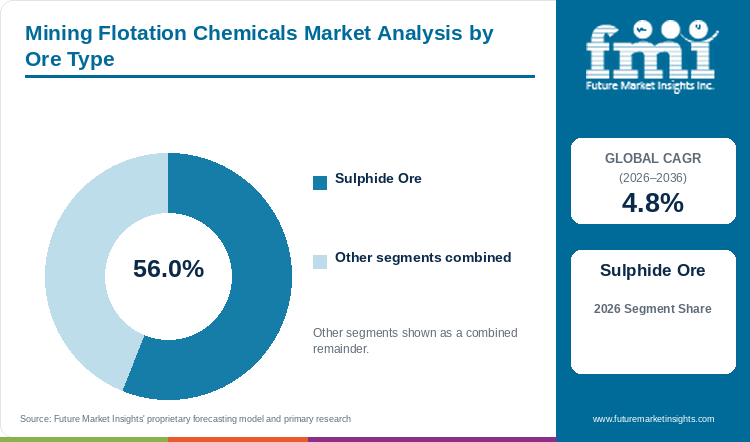
Sulphide ore circuits draw an estimated 56% of 2026 ore type demand, and non-sulphide ore draws 44%.
Table 5: Ore Type Share for the Mining Flotation Chemicals Market (percentage share), 2026
| Ore Type | Estimated Share (2026) |
|---|---|
| Sulphide Ore | 56% |
| Non-sulphide Ore | 44% |
| Total | 100.0% |
Copper, zinc, lead and nickel concentrators treat mostly sulphide feed. Due to this, sulphide circuits carry an estimated 56% of 2026 ore type demand. Non-sulphide ore, at 44% on FMI estimates, covers phosphate, potash, fluorspar, iron ore and oxide copper. Non-sulphide plants use fatty acid collectors and starch depressants at lower cost per tonne, so non-sulphide value per tonne is lower. BHP agreed in October 2026 to sell the Kambalda Nickel Concentrator in Western Australia to Gold Fields, after BHP paused Western Australia nickel assets in early 2024.[5] Idle nickel sulphide concentrators such as Kambalda will slow sulphide reagent growth in Australia.
- Gold Fields will evaluate options for the long-term use of the Kambalda concentrator, Mining Weekly reported.[5]
What are the drivers, restraints, and opportunities in the mining flotation chemicals market?
Demand drivers for mining flotation chemicals include lower copper and nickel ore grades, critical mineral projects in Indonesia and Chile, and in-country beneficiation across Asia. Growth of the mining flotation chemicals market is held back by permitting delays, water limits in Chile and rising input costs, and the main opening lies in low-toxicity reagent blends.
- Driver: Leaner ore and new concentrators raise reagent dosage per tonne of metal.
- Restraint: Raw material, energy and freight inflation squeezes reagent margins.
- Opportunity: Biodegradable collectors and low-toxicity blends for plants under tailings review.
Leaner Copper Feed Raises Dosage at US and Chilean Plants
Lower-grade copper and nickel ore raises reagent dosage, FMI's report shows. USGS linked lower 2025 US copper output to concentrator shutdowns and lower ore grades at multiple mines.[1] Codelco expects output to stay near current levels in coming years, Reuters reported.[4] Flat metal output from aging pits still needs more reagent each year as grades slide. Activators such as copper sulphate go back into the circuit at every zinc separation step, and the flotation activators market grows at a 4.8% CAGR from 2026 to 2036.
Input Inflation Narrows Reagent Margins
Rising feedstock, energy and transport costs are limiting reagent margins. Clariant put Q2 2026 increases at 7.4% for raw materials, 6% for energy and 8.1% for logistics.[2] Xanthates and polyglycols draw on petrochemical and alcohol feedstocks, so reagent makers will pass costs to miners through quarterly price resets. Mines on fixed-price contracts will meet supplier pushback at renewal, and cost increases between 6% and 8.1% will move reagent deals toward index-linked pricing.
Low-Toxicity Blends for Tailings Reviews
Plants under tailings and discharge review will trial low-toxicity collectors and depressants first. Indonesia and Chile discussed environmentally friendly management of ore processing waste, or tailings, and the further use of tailings, ANTARA reported in October 2026.[6] Codelco, PT Freeport Indonesia and INALUM were named in the proposed cooperation.[6] Tailings reuse at Codelco, Freeport Indonesia and INALUM sites will open trials for selective, low-dose reagents. Cellulose-based CMC depressants offer plants a replacement for older inorganic depressants, and the CMC flotation depressants market posts a 4.9% CAGR from 2026 to 2036.
Which country CAGRs are profiled in the mining flotation chemicals market?
Table 6: Country CAGR Comparison for the Mining Flotation Chemicals Market (CAGR percentage), 2026 to 2036
| Country | CAGR (2026 to 2036) |
|---|---|
| Indonesia | 6.3% |
| Chile | 5.6% |
| India | 5.1% |
| USA | 3.2% |
| Australia | 3.2% |
How do country-level CAGRs compare in the mining flotation chemicals market?
Indonesia is steering mining toward end-product industries and may halt new plants making partly processed nickel.[7] Indonesia ranks first among profiled countries on a 6.3% CAGR from 2026 to 2036, FMI predicts. Chile (5.6%) and India (5.1%) both run above the 4.8% global CAGR. The USA and Australia tie at 3.2%.
- A government push for end-product industries and in-country processing puts Indonesia first.
- Chile keeps the largest copper flotation base, with brownfield expansions at state and private mines.
- In India, reopened copper mines and low-grade ore use add reagent volume.
- The USA runs 26 copper mines with a concentrated buyer base.
- Idle nickel concentrators and slower reagent trials under compliance workload hold Australia back.
Full report country CAGRs cover: country tables inside MEA, APAC, NA, LATAM and Europe, covering Indonesia, Chile, India, the USA and Australia.
Country-wise Analysis
Indonesia Mining Flotation Chemicals Market Outlook (2026 to 2036)
Indonesian policy now favours finished products over semi-finished metal. Senior minister Bahlil Lahadalia said in October 2026 that the government may impose a moratorium on new plants making partly processed nickel and will promote end-product industries.[7] A royalty rise from 1.5% to 3% on copper, gold, nickel, tin and silver was postponed in May 2026 after industry feedback.[8] Indonesian mine output reached about 710 thousand metric tons of copper in 2025.[1] Indonesia's 6.3% CAGR from 2026 to 2036 will come from concentrators feeding in-country processing under that policy.
Key takeaway: Delayed royalty increases protect mine margins, so Indonesian concentrators will keep reagent budgets intact through the smelter ramp-up.
Chile Mining Flotation Chemicals Market Outlook (2026 to 2036)
Chilean reagent demand grows at a 5.6% CAGR from 2026 to 2036 on the largest copper mine base among profiled countries. USGS put Chilean output at 5,300 thousand metric tons in 2025.[1] Codelco audits of over-reported 2024 and 2025 production at Ministro Hales and Salvador put plant reporting under review, Reuters reported in October 2026.[4] Reagent vendors at Codelco sites will face tighter checks on recovery claims. The Andina and Los Bronces joint operation will add brownfield flotation volume from 2030.
Key takeaway: Chilean buyers will reward suppliers that prove recovery gains with audited plant data.
India Mining Flotation Chemicals Market Outlook (2026 to 2036)
Hindustan Copper holds about 45% of India's copper ore reserves and resources, PTI reported in August 2026.[3] The company added 135.52 million tonnes of copper ore reserves and resources in the past three years.[3] Reopened mines will feed older concentrators that need fresh collector and frother programs. India grows at a 5.1% CAGR from 2026 to 2036. Indian copper mine output stood at about 23 thousand metric tons in 2025, so each reopened mine changes national reagent demand quickly.[1]
Key takeaway: A small base and a large reserve mean Indian reagent demand will scale mine by mine.
USA Mining Flotation Chemicals Market Outlook (2026 to 2036)
Key takeaway: A small group of large copper mills will decide the pace of American reagent orders.
US reagent demand rises on a 3.2% CAGR from 2026 to 2036, level with Australia. US mine output fell about 5% to 1.0 million tons in 2025.[1] Seventeen of 26 operations produced more than 99% of US copper.[1] Permitting and compliance workloads will slow new concentrator starts. Reagent sales growth will come from recovery upgrades at existing large mills.
Australia Mining Flotation Chemicals Market Outlook (2026 to 2036)
Australian nickel concentrators stand idle at Kambalda. BHP will review the future of remaining nickel assets by February 2027, with divestment, continued suspension, restart or closure on the table, Mining Weekly reported.[5] Completion of the Kambalda sale to Gold Fields is expected during 2027.[5] Australia records a 3.2% CAGR from 2026 to 2036. Copper and gold plants will carry Australian reagent volume until nickel restarts.
Key takeaway: Nickel restarts are the swing factor for Australian flotation reagent orders.
Who are the notable companies in the mining flotation chemicals market?
BASF SE, Clariant AG, Solvay S.A., Arkema S.A., Sasol Limited, SNF Floerger, Chevron Phillips Chemical Company, Dow Chemical Company, Kemira Oyj, Nouryon, ArrMaz (Arkema), Huntsman Corporation, Cytec Industries Inc., Orica Limited and Nasaco International LLC are the profiled suppliers.
New copper concentrators in Indonesia, Chile and India are the main target for the fifteen profiled suppliers. Clariant reported growth in Mining Solutions for the second quarter of 2026.[2] Orica supplies the market through a Specialty Mining Chemicals business. Arkema holds ArrMaz within the group.
Codelco said the company was open to research and technology collaboration with Indonesia, ANTARA reported.[6] BHP is selling the Kambalda concentrator to Gold Fields.[5] Hindustan Copper announced a collaboration with CODELCO in August 2026.[3] Ownership and partnership changes at Codelco, BHP and Hindustan Copper will reset reagent qualification lists at those sites.
- Mining chemicals business lines: Clariant AG (Mining Solutions) and Orica Limited (Specialty Mining Chemicals).
- Arkema group: Arkema S.A. and ArrMaz (Arkema).
- Other profiled suppliers: BASF SE, Solvay S.A., Sasol Limited, SNF Floerger, Chevron Phillips Chemical Company, Dow Chemical Company, Kemira Oyj, Nouryon, Huntsman Corporation, Cytec Industries Inc., and Nasaco International LLC.
Competitive Benchmarking: Mining Flotation Chemicals Market
Table 7: Competitive Benchmarking for the Mining Flotation Chemicals Market (qualitative documentation ratings), 2026
| Organisation | Mining Segment Reporting | Cost Pass-Through | Plant Partnerships | Recency |
|---|---|---|---|---|
| Clariant AG | High | High | Low | High |
| Orica Limited | Medium | Low | Low | Medium |
| Arkema S.A. (ArrMaz) | Low | Low | Low | Low |
| Codelco (buyer) | High | Low | High | High |
| Hindustan Copper (buyer) | Medium | Low | High | High |
Ratings mark the depth of 2025 and 2026 filings and wire reports per item, and no rating signals market share.
Key Developments in the Mining Flotation Chemicals Market
- In October 2026, Reuters reported that Codelco is probing over-reported 2024 and 2025 copper production at Ministro Hales and Salvador.[4]
- In October 2026, BHP agreed to sell the Kambalda Nickel Concentrator and tenements in Western Australia to Gold Fields.[5]
- In October 2026, Indonesia discussed a moratorium on new plants making partly processed nickel.[7]
- In October 2026, Indonesia proposed a Green Minerals Partnership with Chile covering tailings management and green mining technology.[6]
- In August 2026, Hindustan Copper set out capital investment of over ₹7,000 crore over five to six years.[3]
- In July 2026, Clariant reported Q2 Care Chemicals sales up 4.2% in local currency, with pruning excluded, and growth in Mining Solutions.[2]
- In May 2026, Indonesia postponed a planned rise in mining royalties from 1.5% to 3%.[8]
- In February 2026, USGS estimated 2025 US copper mine output at 1.0 million tons, down 5%.[1]
Key Players in the Mining Flotation Chemicals Market
Suppliers with Mining Chemicals Business Lines
- Clariant AG
- Orica Limited
Arkema Group
- Arkema S.A.
- ArrMaz (Arkema)
Other Profiled Suppliers
- BASF SE
- Solvay S.A.
- Sasol Limited
- SNF Floerger
- Chevron Phillips Chemical Company
- Dow Chemical Company
- Kemira Oyj
- Nouryon
- Huntsman Corporation
- Cytec Industries Inc.
- Nasaco International LLC
Mining Flotation Chemicals Market - Report Scope
Table 8: Report Scope for the Mining Flotation Chemicals Market (coverage fields and definitions), 2026 to 2036
| Coverage field | Report scope |
|---|---|
| Market breakdown | Ore type; chemical type; region |
| Quantitative units | USD billion |
| Market definition | Flotation reagents used in mineral concentrators, covering collectors, frothers, dispersants, activators, depressants, flocculants and other process chemicals for sulphide and non-sulphide ores. |
| Regions covered | North America; Latin America; Europe; Asia Pacific; Middle East & Africa |
| Countries covered | Indonesia; Chile; India; USA; Australia |
| Key companies profiled | BASF SE, Clariant AG, Solvay S.A., Arkema S.A., Sasol Limited, SNF Floerger, Chevron Phillips Chemical Company, Dow Chemical Company, Kemira Oyj, Nouryon, ArrMaz (Arkema), Huntsman Corporation, Cytec Industries Inc., Orica Limited, Nasaco International LLC |
| Forecast period | 2026 to 2036 |
Mining Flotation Chemicals Market - Research Methodology
Table 9: Research Methodology for the Mining Flotation Chemicals Market (research methods and approach), 2026 edition
| Method | Approach |
|---|---|
| Data Sources | Mine output, cost and policy facts come from government mineral surveys, company results, wire reports and state news agencies dated May 2025 or later. |
| Desk Research | Desk research covers ore grades, concentrator ownership changes, reagent maker cost trends and royalty and processing policy. |
| Market Sizing and Forecasting | Sizing starts from the 2025 base of USD 13.1 billion and the 4.8% CAGR from 2026 to 2036. |
| Data Validation | Mine output figures were matched across the USGS survey and miner statements for the same year. |
Mining Flotation Chemicals Market by Segments
Mining Flotation Chemicals Market segmented by Ore Type:
- Sulphide Ore
- Non-sulphide Ore
Mining Flotation Chemicals Market segmented by Chemical Type:
- Collectors
- Frothers
- Dispersants
- Activators
- Depressants
- Flocculants
- Others (pH Modifiers, Defoamers, Sulphidizers, Grinding Aids)
Mining Flotation Chemicals Market by Region
- North America
- USA
- Latin America
- Chile
- Europe
- Asia Pacific
- Indonesia
- India
- Australia
- Middle East & Africa
Research Sources and Bibliography
- [1] United States Geological Survey. (2026, February). Mineral Commodity Summaries 2026: Copper. https://pubs.usgs.gov/periodicals/mcs2026/mcs2026-copper.pdf
- [2] Clariant. (2026, July 31). Clariant delivers continued strong results in volatile operating environment – Court dismisses Shell's damage claim related to the 2020 competition law infringement. https://www.clariant.com/Corporate/News/2026/07/Clariant-delivers-continued-strong-results-in-volatile-operating-environment--Court-dismisses-Shells
- [3] Business Standard (Press Trust of India). (2026, August 18). Hindustan Copper plans capital investment of ₹7,000 cr in next 5-6 yrs. https://www.business-standard.com/companies/news/hindustan-copper-plans-capital-investment-of-7-000-cr-in-next-5-6-yrs-126081800657_1.html
- [4] Mining Weekly (Reuters). (2026, October 7). Chile's Codelco probes over-inflated 2024, 2025 copper production figures. https://www.miningweekly.com/article/chiles-codelco-probes-over-inflated-2024-2025-copper-production-figures-2026-10-07
- [5] Mining Weekly (Reuters). (2026, October 7). BHP to sell Kambalda nickel concentrator, tenements to Gold Fields. https://www.miningweekly.com/article/bhp-to-sell-kambalda-nickel-concentrator-tenements-to-gold-fields-2026-10-07
- [6] ANTARA News. (2026, October 5). Indonesia, Chile explore green mining and critical minerals ties. https://en.antaranews.com/news/434120/indonesia-chile-explore-green-mining-and-critical-minerals-ties
- [7] Mining Weekly (Reuters). (2026, October 7). Indonesia plans to impose a moratorium on new plants making partly processed nickel. https://www.miningweekly.com/article/indonesia-plans-to-impose-a-moratorium-on-new-plants-making-partly-processed-nickel-2026-10-07
- [8] ANTARA News. (2026, May 11). Indonesia postpones increase of mining royalties. https://en.antaranews.com/news/415441/indonesia-postpones-increase-of-mining-royalties
This bibliography is provided for reader reference. The full report contains the complete reference list and detailed citations.
This Report Answers
- What will mining flotation chemicals sales total in 2026 and 2036?
- What CAGR will the market post from 2026 to 2036?
- Which chemical type will carry the largest share of sales?
- Will sulphide or non-sulphide ore circuits buy more reagent?
- Which countries will add reagent demand fastest?
- Which suppliers will compete for new concentrator contracts?
Frequently Asked Questions
What is the mining flotation chemicals market size in 2026?
USD 13.73 billion is the 2026 figure, and FMI sees market size at USD 21.90 billion by 2036. At what pace will the mining flotation chemicals market grow? Reagent sales will post a 4.8% CAGR from 2026 to 2036. Lower ore grades will add dosage at existing plants, and new concentrators will add tonnage.
Which chemical type will lead in 2026?
Collectors will lead with 42% of chemical type sales in 2026, ahead of frothers and depressants.
Which ore type will draw more reagent?
Sulphide circuits will draw an estimated 56% of 2026 ore type demand, and non-sulphide ore will draw 44%.
Which country will grow fastest through 2036?
Indonesia, per FMI, will post the quickest rise, a 6.3% CAGR from 2026 to 2036, and Chile will come next at 5.6%.
Which companies will compete for reagent contracts?
BASF, Clariant, Solvay, Arkema, Sasol, SNF Floerger, Chevron Phillips, Dow, Kemira, Nouryon, ArrMaz, Huntsman, Cytec, Orica and Nasaco International will contest plant approvals.
Preview the report firsthand - request a free sample
Get SampleGet the brochure for pricing and purchase details.
Get PDFTable of Content
- Key Takeaways
- Market Size and CAGR
- Top Growth Driver
- Fastest Growing Segment
- Leading Region
- Key Companies
- Emerging Opportunities
- Executive Summary
- Global Market Outlook
- Demand-side Trends
- Supply-side Trends
- Technology Roadmap Analysis
- Analysis and Recommendations
- Analyst Perspective (What is happening? Why now? What should investors know?)
- Key Questions Answered
- How large is the market?
- What is the CAGR?
- What are key trends?
- Which region dominates?
- Who are the leaders?
- Market Overview
- Market Coverage / Taxonomy
- Market Definition / Scope / Limitations
- Research Methodology
- Chapter Orientation
- Analytical Lens and Working Hypotheses
- Market Structure, Signals, and Trend Drivers
- Benchmarking and Cross-market Comparability
- Market Sizing, Forecasting, and Opportunity Mapping
- Research Design and Evidence Framework
- Desk Research Programme (Secondary Evidence)
- Expert Input and Fieldwork (Primary Evidence)
- Tooling, Models, and Reference Databases
- Data Engineering and Model Build
- Quality Assurance and Audit Trail
- Market Background
- Market Dynamics (Drivers, Restraints, Opportunity, Trends)
- Scenario Forecast (Optimistic, Likely, Conservative)
- Impact Analysis
- AI Impact
- Sustainability Impact
- Regulatory Impact
- Technology Impact
- Consumer / Buyer Analysis
- Purchase Drivers
- Adoption Barriers
- Buyer Journey
- Opportunity Map Analysis
- Product Life Cycle Analysis
- Supply Chain Analysis
- Investment Feasibility Matrix
- Value Chain Analysis
- PESTLE and Porter's Analysis
- Regulatory Landscape
- Regional Parent Market Outlook
- Production and Consumption Statistics
- Import and Export Statistics
- Global Market Analysis and Forecast, 2021 to 2036
- Historical Market Size Value (USD Billion) Analysis, 2021 to 2025
- Current and Future Market Size Value (USD Billion) Projections, 2026 to 2036
- Y-o-Y Growth Trend Analysis
- Absolute $ Opportunity Analysis
- Global Market Pricing Analysis, 2021 to 2036
- Global Market Analysis and Forecast, By Ore Type, 2021 to 2036
- Introduction / Key Findings
- Historical Market Size Value (USD Billion) Analysis By Ore Type, 2021 to 2025
- Current and Future Market Size Value (USD Billion) Analysis and Forecast By Ore Type, 2026 to 2036
- Sulphide Ore
- Non-sulphide Ore
- Y-o-Y Growth Trend Analysis By Ore Type, 2021 to 2025
- Absolute $ Opportunity Analysis By Ore Type, 2026 to 2036
- Global Market Analysis and Forecast, By Chemical Type, 2021 to 2036
- Introduction / Key Findings
- Historical Market Size Value (USD Billion) Analysis By Chemical Type, 2021 to 2025
- Current and Future Market Size Value (USD Billion) Analysis and Forecast By Chemical Type, 2026 to 2036
- Collectors
- Frothers
- Dispersants
- Activators
- Depressants
- Flocculants
- Others (pH Modifiers, Defoamers, Sulphidizers, Grinding Aids)
- Y-o-Y Growth Trend Analysis By Chemical Type, 2021 to 2025
- Absolute $ Opportunity Analysis By Chemical Type, 2026 to 2036
- Global Market Analysis and Forecast, By Region, 2021 to 2036
- Introduction
- Historical Market Size Value (USD Billion) Analysis By Region, 2021 to 2025
- Current Market Size Value (USD Billion) Analysis and Forecast By Region, 2026 to 2036
- North America
- Latin America
- Europe
- Middle East & Africa
- Market Attractiveness Analysis By Region
- North America Market Analysis and Forecast, By Country, 2021 to 2036
- Historical Market Size Value (USD Billion) Trend Analysis By Market Taxonomy, 2021 to 2025
- Market Size Value (USD Billion) Forecast By Market Taxonomy, 2026 to 2036
- By Country
- USA
- By Ore Type
- By Chemical Type
- By Country
- Market Attractiveness Analysis
- By Country
- By Ore Type
- By Chemical Type
- Key Takeaways
- Latin America Market Analysis and Forecast, By Country
- Historical Market Size Value (USD Billion) Trend Analysis By Market Taxonomy, 2021 to 2025
- Market Size Value (USD Billion) Forecast By Market Taxonomy, 2026 to 2036
- By Country
- Chile
- By Ore Type
- By Chemical Type
- By Country
- Market Attractiveness Analysis
- By Country
- By Ore Type
- By Chemical Type
- Key Takeaways
- Europe Market Analysis and Forecast, By Country
- Historical Market Size Value (USD Billion) Trend Analysis By Market Taxonomy, 2021 to 2025
- Market Size Value (USD Billion) Forecast By Market Taxonomy, 2026 to 2036
- By Country
- Asia Pacific
- Indonesia
- India
- Australia
- By Ore Type
- By Chemical Type
- By Country
- Market Attractiveness Analysis
- By Country
- By Ore Type
- By Chemical Type
- Key Takeaways
- Middle East & Africa Market Analysis and Forecast, By Country
- Historical Market Size Value (USD Billion) Trend Analysis By Market Taxonomy, 2021 to 2025
- Market Size Value (USD Billion) Forecast By Market Taxonomy, 2026 to 2036
- By Country
- By Ore Type
- By Chemical Type
- Market Attractiveness Analysis
- By Country
- By Ore Type
- By Chemical Type
- Key Takeaways
- Key Countries Market Analysis
- USA
- Pricing Analysis
- Market Share Analysis, 2025
- By Ore Type
- By Chemical Type
- Chile
- Pricing Analysis
- Market Share Analysis, 2025
- By Ore Type
- By Chemical Type
- India
- Pricing Analysis
- Market Share Analysis, 2025
- By Ore Type
- By Chemical Type
- Indonesia
- Pricing Analysis
- Market Share Analysis, 2025
- By Ore Type
- By Chemical Type
- Australia
- Pricing Analysis
- Market Share Analysis, 2025
- By Ore Type
- By Chemical Type
- USA
- Market Structure Analysis
- Competition Dashboard
- Competition Benchmarking
- Market Share Analysis of Top Players
- By Regional
- By Ore Type
- By Chemical Type
- Emerging Startups
- Innovation Benchmarking
- Competition Analysis
- Competition Deep Dive
- Clariant AG
- Overview
- Product Portfolio
- Profitability by Market Segments
- Sales Footprint
- Strategy Overview
- Marketing Strategy
- Product Strategy
- Channel Strategy
- Codelco
- BHP
- Hindustan Copper
- Orica Limited
- Arkema S.A.
- ArrMaz (Arkema)
- BASF SE
- Solvay S.A.
- Sasol Limited
- SNF Floerger
- Chevron Phillips Chemical Company
- Dow Chemical Company
- Kemira Oyj
- Nouryon
- Huntsman Corporation
- Cytec Industries Inc.
- Nasaco International LLC
- Clariant AG
- Case Studies
- Success Stories
- Recent Developments
- Competition Deep Dive
- Assumptions & Acronyms Used


