

- Market Size (2026)
- USD 620.6 Mn
- Forecast (2036)
- USD 954.6 Mn
- CAGR (2026 to 2036)
- 4.4%
How big is Pine Oil Flotation Frothers Market in 2026?
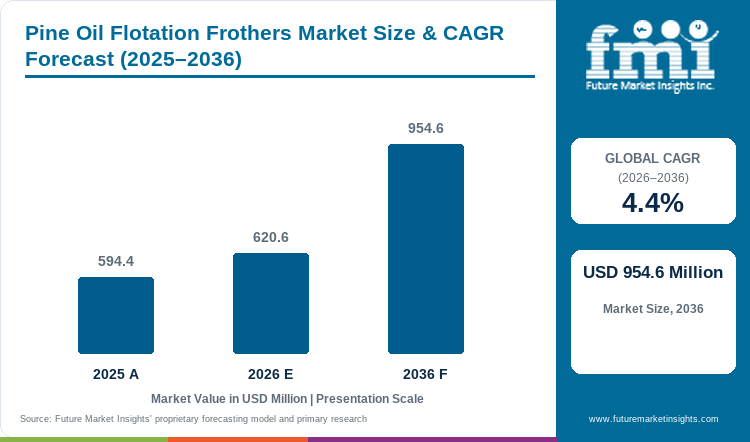
USD 620.6 million in 2026 and USD 954.6 million by 2036 at a 4.4% CAGR.
Demand for pine oil flotation frothers is projected to expand at a 4.4% CAGR between 2026 and 2036, raising valuation from USD 620.6 million to USD 954.6 million. The market was valued at USD 594.4 million in 2025. Concentrators dose frothers repeatedly because bubble control must hold recovery as feed grade and mineralogy become harder to manage. Arkema documents custom CustoFroth formulations selected against ore characteristics, flotation chemistry and operating conditions for mineral-processing circuits.
Country demand differs with the location of flotation circuits because mine-intensive economies consume reagents closer to the concentrator. METI convened representatives from 14 countries and regions in March 2026 to address copper concentrate imbalances. Japan therefore depends more on overseas mining relationships than countries with large domestic flotation bases.
Key Takeaways
- Concentrators sustain demand by dosing frothers to protect recovery and froth stability as feed mineralogy changes.
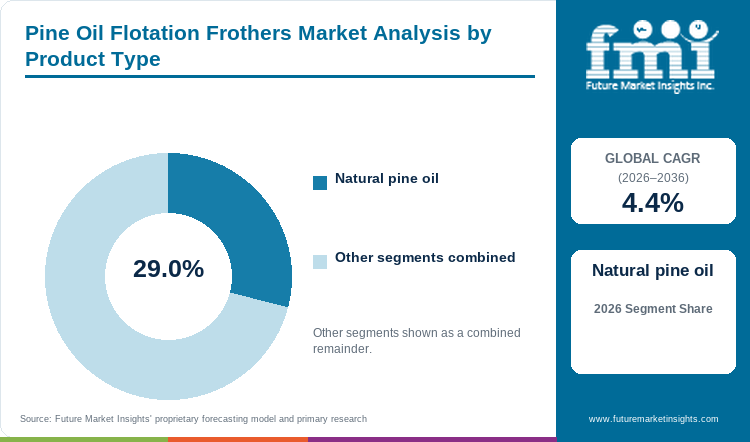
- Natural pine oil is projected to account for 29.0% of product type demand in 2026 owing to familiar frothing behavior.
- Copper ores are estimated to represent 31.0% of ore type demand in 2026 because sulfide concentrators depend on flotation.
- Standard grade is anticipated to hold 42.0% of purity demand in 2026 as plants prioritize qualified performance.
- Natural-oil variability and standardized synthetic alternatives can extend mine trials before a pine-oil formulation receives routine approval.
- Key players in the pine oil flotation frothers market include Syensqo, Clariant, BASF, Arkema, Sasol, Axis House Group, Nasaco International Ltd., AECI Mining Chemicals, SNF, and Quadra Group Ltd..
Analyst Perspective
"Mine operators should compare recovery stability and froth drainage against dosage before they compare reagent price alone. Pine-oil formulations earn repeat orders only after they hold grade through changing ore and water conditions while the chemical supplier maintains consistent batches and reliable mine-site replenishment."
- Nikhil Kaitwade, Principal Consultant, Future Market Insights
How is the pine oil flotation frothers market segmented?
The market is segmented by product type, ore type, purity, end use, sales channel and region.
Product type covers natural pine oil, synthetic terpene frothers, pine oil blends, tall-oil derived frothers and modified alcohol blends. Ore type includes copper ores, lead-zinc ores, coal flotation, phosphate ores and industrial minerals. Purity covers standard, refined, high-terpene and custom formulated grades while end use covers mining concentrators, preparation plants, industrial mineral plants and reagent distributors. Sales channels include direct mine supply, chemical distributors, regional formulators and technical service contracts.
What makes natural pine oil central to the product type category?
Natural pine oil gives metallurgists a familiar alcohol-based frothing response during routine mineral flotation. A January 2026 Journal of Hazardous Materials review identifies pine oil as a widely used natural frother and documents source-dependent composition. Plants therefore compare natural chemistry with polyglycol frothers under the same ore and water conditions before changing routine dosing.
- By product type, natural pine oil is estimated to hold 29.0% in 2026 attributable to established mineral-processing use and familiar operating response.
- Plant teams retain natural pine oil after trials confirm stable bubble control without excessive froth strength or avoidable interaction with the remaining reagent program.
Why do copper ores hold the principal position within the ore type category?
Copper concentrators evaluate frothers inside a wider reagent program because sulfide mineralogy changes recovery and froth transport. Orica acquired the Danafloat copper-flotation collector range in April 2026 together with formulation intellectual property and existing customer relationships. Copper plants therefore qualify frothers beside other beneficiation reagents before routine circuit dosing.
- Copper ores account for 31.0% of ore type demand in 2026 owing to the scale of continuous sulfide flotation and repeated reagent dosing.
- Copper operators qualify frothers beside collectors and depressants because one dosage change can alter selectivity and entrainment through the rougher-cleaner circuit.
How does standard grade hold the principal position within purity?
Standard grade competes on repeatable plant response instead of refinement for its own sake. At the Namibia Mining Expo in August 2026, AECI Mining presented mining-chemical and flotation solutions tailored to operating objectives. Routine-grade flotation reagents therefore need stable metallurgical performance before a concentrator accepts repeat supply.
- Within purity, standard grade is forecast to represent 42.0% in 2026 driven by functional consistency that meets routine concentrator specifications.
- Refined and custom grades gain preference only where selectivity or handling requirements justify tighter formulation control during the plant qualification program.
What supports mining concentrators as the principal end use?
Mining concentrators make the operating decision because frother dosage changes with feed conditions and measured metallurgical response. BASF documents laboratory, pilot and industrial test work for tailored collector and frother solutions before routine plant use. Plant-scale mining flotation chemicals gain approval only after performance holds under the site’s own circuit conditions.
- Mining concentrators account for 58.0% of end use demand in 2026 supported by direct reagent consumption and plant-level control of flotation performance.
- Concentrator engineers adjust dosage after site trials confirm that the chemistry maintains recovery under the operation’s own ore and water conditions.
Why does direct mine supply hold the principal position within sales channel?
Large concentrators use direct supply to align inventory with continuous reagent consumption and technical response. Orica reported in May 2026 that its global manufacturing and supply network maintained customer continuity during supply disruption. Direct mine accounts also need related flotation activators available without adding avoidable replenishment risk.
- Direct mine supply is expected to hold 42.0% of sales channel demand in 2026 attributable to high-throughput use and tighter control over replenishment.
- Direct contracts let mine teams review batch quality and delivery timing with one accountable counterparty during routine dosing and technical troubleshooting.
What are the drivers, restraints and opportunities in the Pine Oil Flotation Frothers Market?
Lower-grade and variable feed raises the value of disciplined froth control. Natural-oil variability slows qualification, while repeatable blends with plant support can defend pine-oil use.
- Driver: More difficult mineral feeds increase the commercial value of frother programs that protect recovery without creating unstable froth or excessive entrainment.
- Restraint: Pine oil varies with botanical source and extraction route, which can extend plant trials against standardized synthetic alternatives with tighter composition control.
- Opportunity: Formulators can retain natural chemistry in mine programs by standardizing active ranges and proving performance with laboratory screening followed by controlled plant trials.
Plant teams have less tolerance for weak froth control as variable feeds make selectivity harder to hold. At Procemin-Geomet in July 2026, AECI Mining Chemicals presented collector-blend research across different copper ore types and operating conditions. Circuits using flotation sulfidizing agents therefore require frother changes to show a measurable recovery or stability benefit.
Natural pine oil must pass a repeatability test before a plant replaces standardized incumbent chemistry. At Procemin-Geomet in July 2026, Clariant presented work evaluating frother mixtures as alternatives to MIBC for copper-molybdenum flotation. Pine-oil formulations therefore need plant evidence before displacing established frothers within circuits that also use CMC flotation depressants.
Formulators gain room to compete when mines test chemical programs against site-specific operating constraints. At the SAIMM Uranium Conference in August 2026, AECI Mining presented liquid collectors and water-recovery solutions as part of an integrated mining-chemicals offer. Pine-oil blends competing beside hydroxamate collectors therefore need comparable technical support before repeat ordering begins.
Which country CAGRs are profiled in the Pine Oil Flotation Frothers Market?
| Country | CAGR |
|---|---|
| South Africa | 5.1% |
| Chile | 4.8% |
| Brazil | 4.6% |
| Australia | 4.5% |
| Canada | 4.2% |
| USA | 4.0% |
| Japan | 3.0% |
How do country-level CAGRs compare in the Pine Oil Flotation Frothers Market?
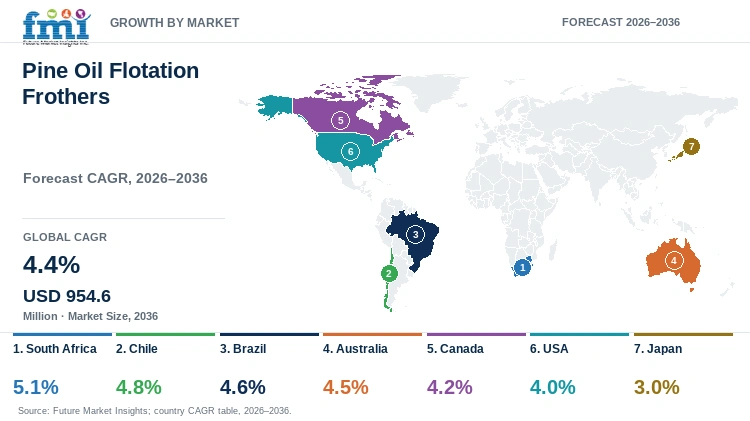
The country forecasts form three commercial groups because mine density and service routes differ materially by region. South Africa and Chile pair faster growth with dense processing activity while Brazil and Australia retain active beneficiation programs. Canada and the USA have mature concentrator bases while Japan depends more heavily on overseas mining relationships for qualified frother programs.
- South Africa pairs dense mine processing with local chemical service for varied ore and reagent requirements.
- Chile's large copper concentrators make water management and recovery economics central to plant-specific frother trials.
- Brazil's concentrated copper project map lets chemical companies target major mineral provinces with regional account coverage.
- Australia combines remote mine sites with formal test programs that make freight reliability part of replacement decisions.
- Canada needs regional inventory over long mine distances because delivery economics influence routine reagent qualification.
- USA demand comes from established copper concentrators where incumbent chemistry raises the evidence threshold for switching.
- Japan relies on technical trading relationships and overseas mine links because domestic flotation capacity is comparatively limited.
Comparable CAGRs produce different account density and service costs because mine geography changes technical coverage requirements. The full report provides country-level CAGR analysis across North America, Latin America, Western Europe, Eastern Europe, East Asia, South Asia and Pacific, and Middle East and Africa.
Country-wise Analysis
- South African concentrators span PGM, coal and base-metal operations that require different frother behavior and service routines. Pine oil flotation frother demand in South Africa is forecast to expand at 5.1% CAGR through 2036 owing to mine density and local chemical service capacity. The Minerals Council counted about 469,765 direct mining jobs during the first nine months of 2025 and cited power plus logistics constraints on competitiveness. Local formulation teams can shorten trials, but distant sites still require dependable inventory and technical coverage.
- Chilean copper concentrators judge frothers against recovery stability because lower-grade feed and water limits increase the cost of poor circuit control. Pine oil flotation frother demand in Chile is projected to record 4.8% CAGR during the assessment period supported by the country’s large concentrator base. Cochilco’s third-quarter 2025 copper report maintained national supply and demand projections for 2025-2026 under a constrained operating outlook. Hydrocarbon flotation collectors and frothers are tested as one circuit program before an incumbent formulation is replaced.
- Brazilian reagent demand is concentrated in mineral provinces where a limited number of large projects account for much of copper beneficiation activity. Pine oil flotation frother demand in Brazil is predicted to advance at 4.6% CAGR through 2036 attributable to new and modified flotation circuits. ANM recorded 384,304 metric tons of contained copper in beneficiated production during 2024 and reported the start of production at the Tucumã project. Project concentration improves account targeting, but long transport routes make regional inventory important during commissioning or chemistry changes.
- Australian mine sites pair formal metallurgical testing with long freight routes that make chemical reliability part of the operating decision. Adoption of pine oil flotation frothers in Australia is estimated to expand at 4.5% CAGR through 2036 driven by a broad operating mine base. Geoscience Australia counted 24 operating copper mines for 2024 and reported 0.75 million metric tons of copper mine production in its 2025 resource assessment. Remote sites penalize late deliveries and inconsistent batches more severely than compact mining regions.
- Canadian concentrators operate over long distances and often require regional stocking before a chemistry change receives routine plant approval. Pine oil flotation frother demand in Canada is anticipated to advance at 4.2% CAGR over the assessment period supported by an established base-metal processing sector. Natural Resources Canada recorded preliminary 2025 copper production of 499,896 metric tons. Dithiophosphate collectors and frothers are often evaluated together during sulfide test work at operating concentrators.
- USA copper concentrators favor documented plant results because a chemistry change can affect recovery immediately at high-throughput operations. Pine oil flotation frother demand in the USA is forecast to rise at 4.0% CAGR over the forecast period attributable to operating mines and incremental domestic capacity. USGS reported that 2025 copper production was affected by concentrator shutdowns and lower ore grades at several mines as new Arizona capacity entered operation. Incumbent alcohol and glycol systems therefore set a high evidence threshold for switching natural chemistry.
- Japanese demand is shaped by smelting economics and overseas copper relationships instead of a large domestic mine-flotation base. Pine oil flotation frother demand in Japan is forecast to expand at 3.0% CAGR through 2036 supported by specialty chemical channels serving international projects. METI and South Korean counterparts held a critical-minerals dialogue in December 2025 that included copper refining conditions and supply-chain cooperation. Limited domestic mine consumption keeps the addressable reagent base dependent on overseas projects.
Who are the notable companies in the Pine Oil Flotation Frothers Market?
Syensqo, Clariant, BASF, Arkema, Sasol, Axis House Group, Nasaco International Ltd., AECI Mining Chemicals, SNF, and Quadra Group Ltd. are notable companies serving this market.
Competition includes global frother producers, flotation-reagent specialists and mine-focused formulation platforms with different technical-service models. Syensqo, Clariant, BASF, Arkema and Sasol publish direct frother chemistry for mineral processing. Axis House Group, Nasaco International Ltd., AECI Mining Chemicals, SNF and Quadra Group Ltd. add custom formulation or mine-facing technical support.
- Global frother and mining-chemistry platforms include Syensqo, Clariant, BASF, Arkema and Sasol with direct mineral-processing portfolios.
- Flotation formulation specialists include Axis House Group, Nasaco International Ltd. and AECI Mining Chemicals with mine-specific reagent programs and technical work.
- Specialized formulation and distribution platforms include SNF and Quadra Group Ltd. with flotation chemistry, technical support and regional supply coverage.
Competitive Benchmarking: Pine Oil Flotation Frothers Market
| Company | Frother and Flotation-Reagent Breadth | Ore-Specific Technical Support | Mine-Site Supply Integration | Geographic Reach |
|---|---|---|---|---|
| Syensqo | High | High | Medium | Global |
| Clariant | High | High | Medium | Global |
| BASF | High | High | Medium | Global |
| Arkema | High | High | Medium | Global |
| Sasol | High | Medium | High | Global |
| Axis House Group | High | High | High | Southern Africa, Australia, Türkiye and other markets |
| Nasaco International Ltd. | High | High | Medium | Africa, Europe, Americas and Australia |
| AECI Mining Chemicals | High | High | High | South Africa and international markets |
| SNF | High | High | Medium | Global |
| Quadra Group Ltd. | High | High | High | Canada and United States |
Scoring basis: High reagent breadth requires at least three documented flotation-reagent or frother routes, Medium requires two and Low identifies one documented route. High technical support requires ore-specific testing or formulation programs while Medium reflects broader mineral-processing support. High supply integration requires manufacturing or custom blending plus mine-facing logistics while Medium reflects narrower manufacturing or distribution coverage.
Key Developments in the Pine Oil Flotation Frothers Market
- In February 2026, Syensqo brought Transfoamer frother technology and copper-molybdenum froth-management work to SME MINEXCHANGE. The program addressed overfrothing and coarse-particle recovery where cleaner-stage stability affects reagent selection and concentrate grade.
- In June 2026, AECI Mining Chemicals used DRC Mining Week to present integrated reagent strategies for flotation recovery and operational stability. The program connected mine-specific chemical selection with technical support and dependable supply for Copperbelt operations.
- In August 2026, Axis House Group published oxide-flotation guidance on targeted collectors for mineral surfaces that respond poorly to conventional chemistry. The guidance linked reagent selection with recovery losses that can persist when oxide mineralogy is treated like a sulfide circuit.
Key Players in the Pine Oil Flotation Frothers Market
Global Frother and Mining-Chemistry Platforms
- Syensqo
- Clariant
- BASF
- Arkema
- Sasol
Flotation Formulation and Mine-Site Specialists
- Axis House Group
- Nasaco International Ltd.
- AECI Mining Chemicals
Specialized Formulation and Distribution Platforms
- SNF
- Quadra Group Ltd.
Pine Oil Flotation Frothers Market - Report Scope
| Coverage field | Report scope |
|---|---|
| Market breakdown | By product type, ore type, purity, end use, sales channel and region. |
| Quantitative Units | USD million. |
| Market Definition | Revenue from flotation frother products sold within natural pine oil, synthetic terpene frothers, pine oil blends, tall-oil derived frothers and modified alcohol blends. Excludes collectors, depressants, flocculants, solvent-extraction reagents and downstream mineral or metal revenue. |
| Regions Covered | North America, Latin America, Western Europe, Eastern Europe, East Asia, South Asia and Pacific, Middle East and Africa. |
| Countries Covered | South Africa, Chile, Brazil, Australia, Canada, USA, Japan and more than twenty-five additional countries in the full report. |
| Key Companies Profiled | Syensqo, Clariant, BASF, Arkema, Sasol, Axis House Group, Nasaco International Ltd., AECI Mining Chemicals, SNF, and Quadra Group Ltd. |
| Forecast Period | 2026 to 2036. |
| Approach | Primary and secondary research with market triangulation. |
Pine Oil Flotation Frothers Market - Research Methodology
| Method | Approach |
|---|---|
| Primary Research | FMI analysts gathered input from manufacturers, service providers, technology developers, distributors, end users, procurement teams, and subject-matter experts. Interviews examined purchasing decisions, product or service evaluation, adoption barriers, approval requirements, pricing considerations, and expectations for technical or commercial support. Respondents were also asked what evidence is required before a trial, pilot, or initial order develops into regular purchasing. |
| Desk Research | Desk research covered government statistics, regulatory publications, trade data, industry associations, technical literature, standards, company filings, product information, and official corporate announcements. Sources were reviewed for relevance, publication date, geographic coverage, and consistency with the defined market scope. Claims relating to performance, applications, approvals, capacity, investment, and commercial activity were retained only when supported by credible public evidence. |
| Market Sizing and Forecasting | The market model combined the baseline value with historical performance, segment structure, pricing and volume indicators, adoption levels, company participation, and country-level demand conditions. Forecast assumptions considered economic activity, investment trends, regulatory developments, technology adoption, purchasing cycles, supply availability, and barriers to wider market use. Segment and regional estimates were reconciled before the final market total was calculated. |
| Data Validation | Estimates were checked against multiple independent indicators, including public data, company activity, trade patterns, industry developments, and findings from primary interviews. Validation also tested whether products, services, applications, and company revenues fell within the defined market boundaries. Adjacent categories, unsupported claims, overlapping revenues, and activities without direct market relevance were excluded to reduce double counting and maintain consistency across segments and countries. |
Pine Oil Flotation Frothers Market by Segments
Pine Oil Flotation Frothers Market segmented by Product Type:
- Natural pine oil
- Synthetic terpene frothers
- Pine oil blends
- Tall-oil derived frothers
- Modified alcohol blends
Pine Oil Flotation Frothers Market segmented by Ore Type:
- Copper ores
- Lead-zinc ores
- Coal flotation
- Phosphate ores
- Industrial minerals
Pine Oil Flotation Frothers Market segmented by Purity:
- Standard grade
- Refined grade
- High-terpene grade
- Custom formulated
Pine Oil Flotation Frothers Market segmented by End Use:
- Mining concentrators
- Coal preparation plants
- Industrial mineral plants
- Reagent distributors
Pine Oil Flotation Frothers Market segmented by Sales Channel:
- Direct mine supply
- Chemical distributors
- Regional formulators
- Technical service contracts
Pine Oil Flotation Frothers Market by Region:
- North America
- United States
- Canada
- Latin America
- Brazil
- Mexico
- Argentina
- Chile
- Western Europe
- Germany
- France
- United Kingdom
- Italy
- Spain
- Benelux
- Nordics
- Eastern Europe
- Poland
- Czech Republic
- Romania
- Hungary
- East Asia
- China
- Japan
- South Korea
- South Asia and Pacific
- India
- ASEAN
- Australia and New Zealand
- Middle East and Africa
- GCC Countries
- South Africa
- Türkiye
- Israel
Research Sources and Bibliography
- Arkema. (n.d.). Froth Flotation Frothers | CustoFroth®. Retrieved September 14, 2026.
- Ministry of Economy, Trade and Industry of Japan. (2026, March 4). METI Hosts Public-Private Dialogue towards Robust and Resilient Copper Supply Chains.
- Neisiani, A. A., Leal Filho, L. S., Ulsen, C., & Chehreh Chelgani, S. (2026, January 1). Eco-friendly alcohol-based frothers used in plastic and mineral flotation separation: Performance, recent advances, and future directions.
- Orica. (2026, April 17). Orica expands portfolio into copper chemistry with Danafloat acquisition.
- AECI Mining. (2026, August 4). AECI Mining at Namibia Mining Expo 2026 [LinkedIn post].
- BASF. (n.d.). Flotation Reagents. Retrieved September 14, 2026.
- Orica. (2026, May 7). Half Year Financial Results 2026.
- AECI Mining. (2026, July 7). AECI Mining Chemicals Research at Procemin-Geomet 2026 [LinkedIn post].
- Clariant. (2026, April 8). How Clariant helps mining producers deliver more copper for the energy transition.
- AECI Mining. (2026, August 14). AECI Mining at SAIMM Uranium Conference 2026 [LinkedIn post].
- Minerals Council South Africa. (2026). Facts and Figures 2025.
- Comisión Chilena del Cobre. (2025, third quarter). Informe de Tendencias del Mercado del Cobre. Proyecciones 2025-2026. Tercer Trimestre de 2025.
- Agência Nacional de Mineração. (2025). Sumário Mineral 2025 - Cobre.
- Geoscience Australia. (2026, February 26). Australia’s Identified Mineral Resources 2025: Australia’s Estimated Ore Reserves.
- Natural Resources Canada. (2026). Annual Statistics of Mineral Production - 2025 preliminary copper production.
- USA Geological Survey. (2026, February 6). Mineral Commodity Summaries 2026.
- Ministry of Economy, Trade and Industry of Japan. (2025, December 17). Second Japan-Korea High Level Dialogue in the Field of Critical Minerals Held.
- Syensqo. (2026, February 24-25). SME MINEXCHANGE 2026 Annual Conference & Expo.
- AECI Mining. (2026, June 15). AECI Mining Chemicals at DRC Mining Week 2026 [LinkedIn post].
- Axis House Group (Pty) Ltd. (2026, August 13). Boost Oxide Mineral Recovery with Targeted Collectors [LinkedIn post].
- Clariant. (2026, July 7-9). Procemin 2026.
- Axis House Group (Pty) Ltd. (2026, April 16). How much copper is being left behind in oxide circuits? [LinkedIn post].
- Sasol Chemicals. (2026, June 2). Mining & Mining Chemicals.
- Arkema. (n.d.). Mining and mineral processing. Retrieved September 14, 2026.
- SNF. (n.d.). Mining Chemicals & Process Solutions. Retrieved September 14, 2026.
- Quadra Group Ltd. (n.d.). Flotation. Retrieved September 14, 2026.
- Nasaco International Ltd. (n.d.). Nasfroth. Retrieved September 14, 2026.
This bibliography is provided for reader reference and is not exhaustive. The full report contains the complete reference list and detailed citations.
This Report Answers
- What is the pine oil flotation frothers market value in 2026 and 2036?
- Which operating conditions support repeat pine oil flotation frother demand?
- Why does natural pine oil hold 29.0% of product type demand in 2026?
- Why do copper ores hold 31.0% of ore type demand in 2026?
- Why does standard grade hold 42.0% of purity demand in 2026?
- How do growth rates differ among the seven country forecasts?
- Which companies provide frother chemistry or mine-site reagent support?
- What qualification frictions delay replacement of synthetic frothers with pine-oil formulations?
Frequently Asked Questions
How big is the Pine Oil Flotation Frothers Market in 2026?
The pine oil flotation frothers market is valued at USD 620.6 million in 2026 and is projected to reach USD 954.6 million by 2036. Repeat dosing continues because concentrators must control froth behavior and recovery as feed conditions change.
What is the CAGR of the Pine Oil Flotation Frothers Market from 2026 to 2036?
The pine oil flotation frothers market is projected to grow at a CAGR of 4.4% between 2026 and 2036. Concentrators use frothers to protect recovery as ore grade and mineralogy become harder to manage.
Which product type leads the Pine Oil Flotation Frothers Market?
The natural pine oil segment is expected to hold 29.0% of the pine oil flotation frothers market in 2026, attributable to familiar frothing behavior in mineral circuits. Standardized alternatives gain preference where plants require tighter batch composition control.
Which ore type leads the Pine Oil Flotation Frothers Market?
The copper ores segment is expected to hold 31.0% of the pine oil flotation frothers market in 2026, driven by continuous sulfide flotation and repeated reagent dosing. Copper plants retune frother chemistry as mineralogy changes during operating campaigns.
Which companies are active in the Pine Oil Flotation Frothers Market?
Key companies operating in the market include Syensqo, Clariant, BASF, Arkema, Sasol, Axis House Group, Nasaco International Ltd., AECI Mining Chemicals, SNF, and Quadra Group Ltd.. Their positions differ by frother breadth, ore-specific technical support and mine-site supply coverage.
Preview the report firsthand - request a free sample
Get SampleGet the brochure for pricing and purchase details.
Get PDFTable of Content
- Key Takeaways
- Market Size and CAGR
- Top Growth Driver
- Fastest Growing Segment
- Leading Region
- Key Companies
- Emerging Opportunities
- Executive Summary
- Global Market Outlook
- Demand-side Trends
- Supply-side Trends
- Technology Roadmap Analysis
- Analysis and Recommendations
- Analyst Perspective (What is happening? Why now? What should investors know?)
- Key Questions Answered
- How large is the market?
- What is the CAGR?
- What are key trends?
- Which region dominates?
- Who are the leaders?
- Market Overview
- Market Coverage / Taxonomy
- Market Definition / Scope / Limitations
- Research Methodology
- Chapter Orientation
- Analytical Lens and Working Hypotheses
- Market Structure, Signals, and Trend Drivers
- Benchmarking and Cross-market Comparability
- Market Sizing, Forecasting, and Opportunity Mapping
- Research Design and Evidence Framework
- Desk Research Programme (Secondary Evidence)
- Expert Input and Fieldwork (Primary Evidence)
- Tooling, Models, and Reference Databases
- Data Engineering and Model Build
- Quality Assurance and Audit Trail
- Market Background
- Market Dynamics (Drivers, Restraints, Opportunity, Trends)
- Scenario Forecast (Optimistic, Likely, Conservative)
- Impact Analysis
- AI Impact
- Sustainability Impact
- Regulatory Impact
- Technology Impact
- Consumer / Buyer Analysis
- Purchase Drivers
- Adoption Barriers
- Buyer Journey
- Opportunity Map Analysis
- Product Life Cycle Analysis
- Supply Chain Analysis
- Investment Feasibility Matrix
- Value Chain Analysis
- PESTLE and Porter's Analysis
- Regulatory Landscape
- Regional Parent Market Outlook
- Production and Consumption Statistics
- Import and Export Statistics
- Global Market Analysis and Forecast, 2021 to 2036
- Historical Market Size Value (USD Million) Analysis, 2021 to 2025
- Current and Future Market Size Value (USD Million) Projections, 2026 to 2036
- Y-o-Y Growth Trend Analysis
- Absolute $ Opportunity Analysis
- Global Market Pricing Analysis, 2021 to 2036
- Global Market Analysis and Forecast, By Product Type, 2021 to 2036
- Introduction / Key Findings
- Historical Market Size Value (USD Million) Analysis By Product Type, 2021 to 2025
- Current and Future Market Size Value (USD Million) Analysis and Forecast By Product Type, 2026 to 2036
- Natural pine oil
- Synthetic terpene frothers
- Pine oil blends
- Tall-oil derived frothers
- Modified alcohol blends
- Y-o-Y Growth Trend Analysis By Product Type, 2021 to 2025
- Absolute $ Opportunity Analysis By Product Type, 2026 to 2036
- Global Market Analysis and Forecast, By Ore Type, 2021 to 2036
- Introduction / Key Findings
- Historical Market Size Value (USD Million) Analysis By Ore Type, 2021 to 2025
- Current and Future Market Size Value (USD Million) Analysis and Forecast By Ore Type, 2026 to 2036
- Copper ores
- Lead-zinc ores
- Coal flotation
- Phosphate ores
- Industrial minerals
- Y-o-Y Growth Trend Analysis By Ore Type, 2021 to 2025
- Absolute $ Opportunity Analysis By Ore Type, 2026 to 2036
- Global Market Analysis and Forecast, By Purity, 2021 to 2036
- Introduction / Key Findings
- Historical Market Size Value (USD Million) Analysis By Purity, 2021 to 2025
- Current and Future Market Size Value (USD Million) Analysis and Forecast By Purity, 2026 to 2036
- Standard grade
- Refined grade
- High-terpene grade
- Custom formulated
- Y-o-Y Growth Trend Analysis By Purity, 2021 to 2025
- Absolute $ Opportunity Analysis By Purity, 2026 to 2036
- Global Market Analysis and Forecast, By End Use, 2021 to 2036
- Introduction / Key Findings
- Historical Market Size Value (USD Million) Analysis By End Use, 2021 to 2025
- Current and Future Market Size Value (USD Million) Analysis and Forecast By End Use, 2026 to 2036
- Mining concentrators
- Coal preparation plants
- Industrial mineral plants
- Reagent distributors
- Y-o-Y Growth Trend Analysis By End Use, 2021 to 2025
- Absolute $ Opportunity Analysis By End Use, 2026 to 2036
- Global Market Analysis and Forecast, By Sales Channel, 2021 to 2036
- Introduction / Key Findings
- Historical Market Size Value (USD Million) Analysis By Sales Channel, 2021 to 2025
- Current and Future Market Size Value (USD Million) Analysis and Forecast By Sales Channel, 2026 to 2036
- Direct mine supply
- Chemical distributors
- Regional formulators
- Technical service contracts
- Y-o-Y Growth Trend Analysis By Sales Channel, 2021 to 2025
- Absolute $ Opportunity Analysis By Sales Channel, 2026 to 2036
- Global Market Analysis and Forecast, By Region, 2021 to 2036
- Introduction
- Historical Market Size Value (USD Million) Analysis By Region, 2021 to 2025
- Current Market Size Value (USD Million) Analysis and Forecast By Region, 2026 to 2036
- North America
- Latin America
- Western Europe
- Eastern Europe
- East Asia
- South Asia and Pacific
- Middle East and Africa
- Market Attractiveness Analysis By Region
- North America Market Analysis and Forecast, By Country, 2021 to 2036
- Historical Market Size Value (USD Million) Trend Analysis By Market Taxonomy, 2021 to 2025
- Market Size Value (USD Million) Forecast By Market Taxonomy, 2026 to 2036
- By Country
- United States
- Canada
- By Product Type
- By Ore Type
- By Purity
- By End Use
- By Sales Channel
- By Country
- Market Attractiveness Analysis
- By Country
- By Product Type
- By Ore Type
- By Purity
- By End Use
- By Sales Channel
- Key Takeaways
- Latin America Market Analysis and Forecast, By Country
- Historical Market Size Value (USD Million) Trend Analysis By Market Taxonomy, 2021 to 2025
- Market Size Value (USD Million) Forecast By Market Taxonomy, 2026 to 2036
- By Country
- Brazil
- Mexico
- Argentina
- Chile
- By Product Type
- By Ore Type
- By Purity
- By End Use
- By Sales Channel
- By Country
- Market Attractiveness Analysis
- By Country
- By Product Type
- By Ore Type
- By Purity
- By End Use
- By Sales Channel
- Key Takeaways
- Western Europe Market Analysis and Forecast, By Country
- Historical Market Size Value (USD Million) Trend Analysis By Market Taxonomy, 2021 to 2025
- Market Size Value (USD Million) Forecast By Market Taxonomy, 2026 to 2036
- By Country
- Germany
- France
- United Kingdom
- Italy
- Spain
- Benelux
- Nordics
- By Product Type
- By Ore Type
- By Purity
- By End Use
- By Sales Channel
- By Country
- Market Attractiveness Analysis
- By Country
- By Product Type
- By Ore Type
- By Purity
- By End Use
- By Sales Channel
- Key Takeaways
- Eastern Europe Market Analysis and Forecast, By Country
- Historical Market Size Value (USD Million) Trend Analysis By Market Taxonomy, 2021 to 2025
- Market Size Value (USD Million) Forecast By Market Taxonomy, 2026 to 2036
- By Country
- Poland
- Czech Republic
- Romania
- Hungary
- By Product Type
- By Ore Type
- By Purity
- By End Use
- By Sales Channel
- By Country
- Market Attractiveness Analysis
- By Country
- By Product Type
- By Ore Type
- By Purity
- By End Use
- By Sales Channel
- Key Takeaways
- East Asia Market Analysis and Forecast, By Country
- Historical Market Size Value (USD Million) Trend Analysis By Market Taxonomy, 2021 to 2025
- Market Size Value (USD Million) Forecast By Market Taxonomy, 2026 to 2036
- By Country
- China
- Japan
- South Korea
- By Product Type
- By Ore Type
- By Purity
- By End Use
- By Sales Channel
- By Country
- Market Attractiveness Analysis
- By Country
- By Product Type
- By Ore Type
- By Purity
- By End Use
- By Sales Channel
- Key Takeaways
- South Asia and Pacific Market Analysis and Forecast, By Country
- Historical Market Size Value (USD Million) Trend Analysis By Market Taxonomy, 2021 to 2025
- Market Size Value (USD Million) Forecast By Market Taxonomy, 2026 to 2036
- By Country
- India
- ASEAN
- Australia and New Zealand
- By Product Type
- By Ore Type
- By Purity
- By End Use
- By Sales Channel
- By Country
- Market Attractiveness Analysis
- By Country
- By Product Type
- By Ore Type
- By Purity
- By End Use
- By Sales Channel
- Key Takeaways
- Middle East and Africa Market Analysis and Forecast, By Country
- Historical Market Size Value (USD Million) Trend Analysis By Market Taxonomy, 2021 to 2025
- Market Size Value (USD Million) Forecast By Market Taxonomy, 2026 to 2036
- By Country
- GCC Countries
- South Africa
- Türkiye
- Israel
- By Product Type
- By Ore Type
- By Purity
- By End Use
- By Sales Channel
- By Country
- Market Attractiveness Analysis
- By Country
- By Product Type
- By Ore Type
- By Purity
- By End Use
- By Sales Channel
- Key Takeaways
- Key Countries Market Analysis
- United States
- Pricing Analysis
- Market Share Analysis, 2025
- By Product Type
- By Ore Type
- By Purity
- By End Use
- By Sales Channel
- Canada
- Pricing Analysis
- Market Share Analysis, 2025
- By Product Type
- By Ore Type
- By Purity
- By End Use
- By Sales Channel
- Mexico
- Pricing Analysis
- Market Share Analysis, 2025
- By Product Type
- By Ore Type
- By Purity
- By End Use
- By Sales Channel
- Brazil
- Pricing Analysis
- Market Share Analysis, 2025
- By Product Type
- By Ore Type
- By Purity
- By End Use
- By Sales Channel
- Chile
- Pricing Analysis
- Market Share Analysis, 2025
- By Product Type
- By Ore Type
- By Purity
- By End Use
- By Sales Channel
- Germany
- Pricing Analysis
- Market Share Analysis, 2025
- By Product Type
- By Ore Type
- By Purity
- By End Use
- By Sales Channel
- United Kingdom
- Pricing Analysis
- Market Share Analysis, 2025
- By Product Type
- By Ore Type
- By Purity
- By End Use
- By Sales Channel
- Italy
- Pricing Analysis
- Market Share Analysis, 2025
- By Product Type
- By Ore Type
- By Purity
- By End Use
- By Sales Channel
- Spain
- Pricing Analysis
- Market Share Analysis, 2025
- By Product Type
- By Ore Type
- By Purity
- By End Use
- By Sales Channel
- France
- Pricing Analysis
- Market Share Analysis, 2025
- By Product Type
- By Ore Type
- By Purity
- By End Use
- By Sales Channel
- India
- Pricing Analysis
- Market Share Analysis, 2025
- By Product Type
- By Ore Type
- By Purity
- By End Use
- By Sales Channel
- ASEAN
- Pricing Analysis
- Market Share Analysis, 2025
- By Product Type
- By Ore Type
- By Purity
- By End Use
- By Sales Channel
- Australia and New Zealand
- Pricing Analysis
- Market Share Analysis, 2025
- By Product Type
- By Ore Type
- By Purity
- By End Use
- By Sales Channel
- China
- Pricing Analysis
- Market Share Analysis, 2025
- By Product Type
- By Ore Type
- By Purity
- By End Use
- By Sales Channel
- Japan
- Pricing Analysis
- Market Share Analysis, 2025
- By Product Type
- By Ore Type
- By Purity
- By End Use
- By Sales Channel
- South Korea
- Pricing Analysis
- Market Share Analysis, 2025
- By Product Type
- By Ore Type
- By Purity
- By End Use
- By Sales Channel
- Poland
- Pricing Analysis
- Market Share Analysis, 2025
- By Product Type
- By Ore Type
- By Purity
- By End Use
- By Sales Channel
- Hungary
- Pricing Analysis
- Market Share Analysis, 2025
- By Product Type
- By Ore Type
- By Purity
- By End Use
- By Sales Channel
- Türkiye
- Pricing Analysis
- Market Share Analysis, 2025
- By Product Type
- By Ore Type
- By Purity
- By End Use
- By Sales Channel
- South Africa
- Pricing Analysis
- Market Share Analysis, 2025
- By Product Type
- By Ore Type
- By Purity
- By End Use
- By Sales Channel
- Australia
- Pricing Analysis
- Market Share Analysis, 2025
- By Product Type
- By Ore Type
- By Purity
- By End Use
- By Sales Channel
- United States
- Market Structure Analysis
- Competition Dashboard
- Competition Benchmarking
- Market Share Analysis of Top Players
- By Regional
- By Product Type
- By Ore Type
- By Purity
- By End Use
- By Sales Channel
- Emerging Startups
- Innovation Benchmarking
- Competition Analysis
- Competition Deep Dive
- Syensqo
- Overview
- Product Portfolio
- Profitability by Market Segments
- Sales Footprint
- Strategy Overview
- Marketing Strategy
- Product Strategy
- Channel Strategy
- Clariant
- BASF
- Arkema
- Sasol
- Axis House Group
- Nasaco International Ltd.
- AECI Mining Chemicals
- SNF
- Quadra Group Ltd.
- Syensqo
- Case Studies
- Success Stories
- Recent Developments
- Competition Deep Dive
- Assumptions & Acronyms Used


