

- Market Size (2026)
- USD 8.3 Bn
- Forecast (2036)
- USD 39.2 Bn
- CAGR (2026 to 2036)
- 16.8%
How big is Industrial Robotics Market in 2026?
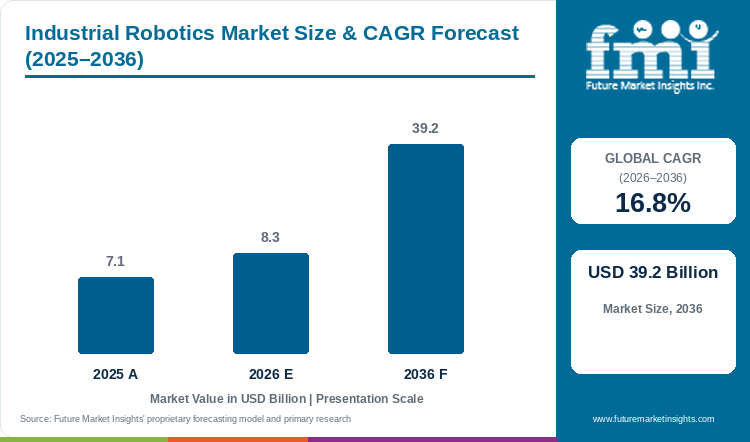
Demand is projected to expand at 16.8% CAGR from 2026 to 2036. Market value rises from USD 7.1 billion in 2025 to USD 8.29 billion in 2026 and USD 39.19 billion by 2036.
The global industrial robotics market covers programmable, multifunction manipulators used in manufacturing, from material handling and assembly to welding, painting and inspection. Valued at USD 7.1 billion in 2025, it is estimated to reach USD 8.29 billion in 2026 and USD 39.19 billion by 2036, expanding at a CAGR of 16.8% from 2026 to 2036. Articulated robots hold an estimated 49.0% of product-type demand in 2026, reflecting their versatility across production tasks, while automotive represents 34.0% of end-use demand.
Factory investment creates demand for new cells and for changes to established lines, with integration determining how effectively an arm performs its assigned operation. ISO's 2025 safety standard distinguishes requirements for the robot from those for the complete application. [2] Validation is also receiving closer attention: NIST's 2025 study found that plausible object-shape variations could disrupt learned manipulation policies, highlighting a specific testing challenge. [3] In Great Britain, HSE's machinery review connects equipment supply with the continuing responsibilities of workplace use, bringing training and maintenance into implementation planning. [4]
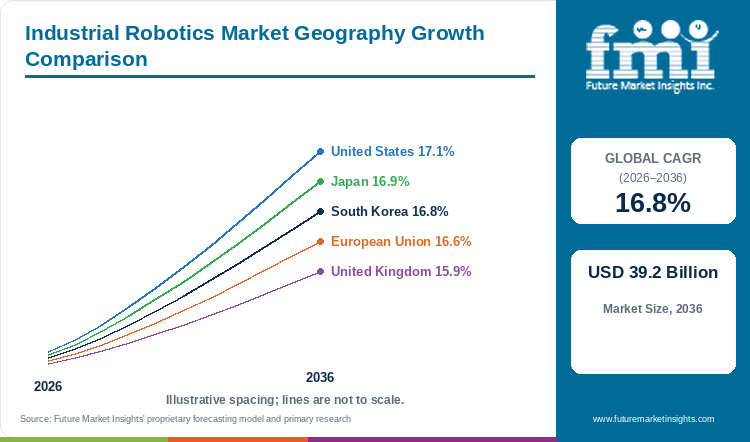
The United States leads the profiled 2026 to 2036 outlook at 17.1% CAGR, followed by Japan at 16.9% and South Korea at 16.8%. The European Union, assessed as a combined geography, is projected at 16.6%, and the United Kingdom at 15.9%.
FANUC Corporation, ABB Ltd., Yaskawa Electric Corporation, KUKA AG and Mitsubishi Electric Corporation form the representative competitive roster. Differentiation depends on the arm, tooling and controls working together under production conditions. Suppliers and integrators can strengthen their position through representative trials, clear acceptance criteria and support for fault recovery and later process changes. Compatibility with retained fixtures and controls also gives continuing application support a role in repeat orders.
Key Market Trends & Insights
- Factory buyers increasingly need evidence that a proposed manipulation system can handle plausible variation in parts; NIST research published in 2025 exposed failures missed by standard benchmark tests. [3]
- ISO published the third edition of its industrial-robot safety standard in 2025, distinguishing requirements for the robot from the integration of a complete application. [2]
Regional Highlights
- The United States has the highest profiled forecast CAGR at 17.1%.
- Japan and South Korea have projected CAGRs of 16.9% and 16.8%, respectively, with substantial existing factory robot populations informing replacement and integration needs.
- The European Union is profiled as a combined geography at 16.6%, alongside a separate United Kingdom forecast of 15.9%; the EU figure is not an individual member-state rate.
Market Size & Forecast
Table 1: Market Size and Forecast for Industrial Robotics Market (USD Billion and Percentage), 2025 to 2036
| Metric | Value |
|---|---|
| 2025 market value | USD 7.1 billion |
| 2026 market value | USD 8.29 billion |
| 2036 market value | USD 39.19 billion |
| CAGR 2026 to 2036 | 16.8% |
| Revenue increase 2026 to 2036 | USD 30.9 billion |
| Market expansion 2026 to 2036 | 4.73 times |
Projected annual market value rises by USD 30.90 billion between 2026 and 2036. A robot order can involve a new production line, an additional operation or the replacement of equipment already working inside a cell. Those buying situations create different engineering commitments. New installations allow more freedom in layout, whereas a replacement must work with existing fixtures and controls. The forecast consequently describes revenue growth across varied configurations and applications; it does not imply that unit installations or every country's orders increase at the same rate each year.
The arm must work with the controls that coordinate motion and the surrounding process. The Industrial Robot Controller Market provides related coverage of that equipment layer.
Production Validation and Safety Integration Shape Robot Purchasing
A robot demonstration becomes commercially useful when its conditions resemble the factory task. Buyers need to know what happens when a component changes slightly, an operator intervenes or the equipment restarts after a fault. NIST's 2025 manipulation study examined geometric variations that disrupted trained policies. [3] ISO's public scope distinguishes the industrial robot itself from a complete integrated system. [2] Together, these sources direct attention to the work needed around the arm before a manufacturer can accept a production cell.
Table 2: Industry Evidence Relevant to the Industrial Robotics Market
| Indicator | Data point or observation | Market relevance | Source |
|---|---|---|---|
| Robot and cell safety | ISO 10218-1:2025 addresses the robot; the companion part addresses integration. | Procurement responsibilities should distinguish the equipment from the complete application. | [2] |
| Manipulation robustness | A 2025 NIST study generated plausible object variations that caused manipulation failures. | Acceptance testing should address relevant workpiece variation as well as nominal demonstrations. | [3] |
Analyst Perspective
“Labour scarcity, reshoring and new manufacturing applications link robot purchases to factory investment. Implementation still depends on the production task, the operating environment and the capacity to integrate and test the equipment safely within the line.”
- Nikhil Kaitwade, Future Market Insights
How is the Industrial Robotics Market segmented?
The market is segmented by Product Type, End Use, Technology, Application, and Region.
Product type describes the manipulator configuration, end use identifies the purchasing industry, technology describes the operating approach and application identifies the task. An articulated arm used for automotive welding contributes to several categories without creating several independent sales. Collaborative operation also depends on the complete application, so its presence in a product taxonomy should not be read as a guarantee that safeguarding is unnecessary. Buyers can use the segmentation to narrow their technical requirements before comparing a complete installed solution.
Why Do Articulated Robots Lead the Product-Type Breakdown?
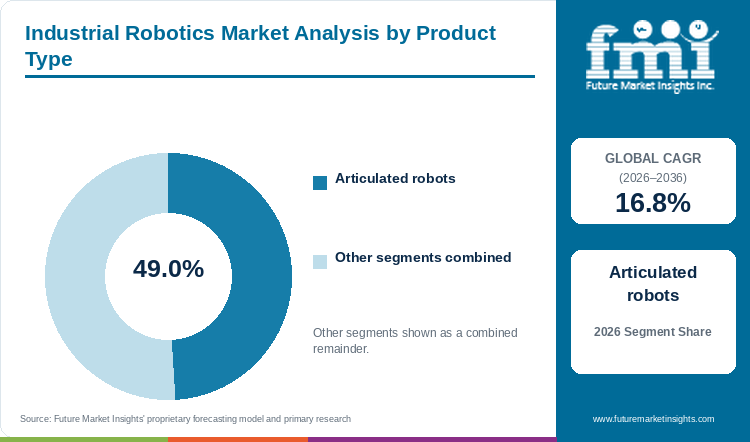
Table 3: Product Type Share for Industrial Robotics Market (Percentage Share), 2026
| Product Type | Estimated share (2026) |
|---|---|
| Articulated robots | 49.0% |
| Other product types | 51.0% |
| Total | 100.0% |
Table 4: Segment Position and Market Growth for Industrial Robotics Market, 2026 to 2036
| Metric | Value |
|---|---|
| Global CAGR (2026 to 2036) | 16.8% |
| Profiled product type segment | Articulated robots |
An articulated arm can approach a workpiece from several directions, which makes it useful when welding, painting or handling a part involves more than a straight transfer. The segment is estimated to represent 49.0% of the product-type breakdown in 2026. A buyer still needs to match the arm's reach and movement to the tool, fixture and available workspace. A wide motion range brings little value if the proposed cell cannot access the required surfaces or maintain the intended process. Integration therefore remains central to the purchase. ISO's distinction between the robot and a complete application is relevant here: equipment selection does not by itself establish that an installed welding or handling cell is suitable for operation. [2]
The Articulated robots segment is projected to account for 49.0% of product type demand in 2026.
- Articulated robots are estimated to hold 49.0% of product-type demand in 2026; other product types together account for 51.0%.
- Buyers should assess the arm, tool and fixture together against the movement and access required for the production task.
What Sustains Automotive Demand for Industrial Robots?
Table 5: End Use Share for Industrial Robotics Market (Percentage Share), 2026
| End Use | Estimated share (2026) |
|---|---|
| Automotive | 34.0% |
| Other end uses | 66.0% |
| Total | 100.0% |
Automotive purchasing combines high-volume repeated operations with changes to vehicle designs and production arrangements. A body-welding cell, paint operation and assembly station place different demands on a robot even when they belong to the same plant. Automotive is estimated to account for 34.0% of the end-use breakdown in 2026. The buyer must consider how the proposed equipment fits the surrounding line, how changeovers will be managed and which responsibilities belong to the integrator. The segment's importance therefore reflects a large application base, while individual orders remain tied to production programmes and the practical work of installing or renewing a cell.
The Automotive segment is projected to account for 34.0% of end use demand in 2026.
- Automotive is estimated to represent 34.0% of end-use demand in 2026; all other end uses together account for 66.0%.
- An automotive offer should identify the production operation, interfaces with the line and the acceptance conditions for commissioning.
- The tool at the end of the arm determines how a part is held and released. The Robotic Grippers Market examines this related component of handling and assembly applications.
What are the drivers, restraints, and opportunities in the Industrial Robotics Market?
Repeated manufacturing tasks support robot demand; integration and validation constrain adoption; suppliers can create value through clearer commissioning and continuing application support.
Driver
Manufacturers buy robots when a defined operation can benefit from more consistent execution, additional capacity or a different allocation of production work. Repeated handling, assembly, welding and inspection create distinct requirements for equipment and integration. Further orders depend on factories identifying tasks for which an installed solution can meet operating and financial requirements over the intended production programme.
Restraint
The arm is only part of the investment. Tooling, fixtures, controls, safety assessment, programming and training all affect whether a proposed cell can work in production. A successful nominal demonstration can also conceal sensitivity to changes in the workpiece. NIST's research illustrates this problem for learned manipulation policies rather than establishing a failure rate for industrial robots generally. [3] Buyers need acceptance tests that represent their own process and a clear allocation of responsibility for resolving faults before committing to wider deployment.
Opportunity
A supplier can improve its offer by making the route from trial to production easier to assess. Demonstrating representative parts, documenting operating limits and agreeing a practical handover reduce uncertainty for the manufacturer. In Great Britain, HSE's 2025 review distinguishes machinery supply from safe workplace use, making the purchaser's continuing responsibilities relevant to implementation. [4] Support for later part changes and fault recovery can also help an installation remain useful as the production programme evolves.
Manufacturers considering human-adjacent applications can consult the Collaborative Robots Market alongside their task-specific integration assessment. The complete application determines the required safeguards.
Which country CAGRs are profiled in the Industrial Robotics Market?
Table 6: Country CAGR Comparison for Industrial Robotics Market (CAGR Percentage), 2026 to 2036
| Country | CAGR |
|---|---|
| United States | 17.1% |
| Japan | 16.9% |
| South Korea | 16.8% |
| European Union | 16.6% |
| United Kingdom | 15.9% |
Country-wise Analysis
United States Industrial Robotics Market Outlook (2026 to 2036)
The United States illustrates the difference between a long-term growth outlook and the timing of equipment orders. Manufacturers assessing a new cell must relate that investment to a specific production programme, with clear requirements for tooling, operation and acceptance. An installation cannot be justified by the size of the national market alone. For suppliers, a useful proposal makes the cost and responsibility of integration visible and provides a route for testing the actual workpiece. This approach is relevant both to a new line and to the renewal of an established operation, where compatibility with retained equipment can determine the practical scope of the order.
Japan Industrial Robotics Market Outlook (2026 to 2036)
A substantial installed robot population creates purchasing needs beyond the first automation project. Japan's factory owners must consider how replacement arms, revised tooling and changes to production will fit equipment already in operation. A buyer renewing an established cell needs to compare disruption, control compatibility and access for maintenance alongside the arm specification. Suppliers able to explain those implementation requirements can compete for repeat work, although the country's role in manufacturing robots should not be confused with domestic demand for installing them.
South Korea Industrial Robotics Market Outlook (2026 to 2036)
South Korea's robotics outlook is shaped by the needs of factories that already use automation extensively. The market is projected to grow at 16.8% from 2026 to 2036. For an electronics or vehicle-production buyer, another robot must improve a particular operation and work with the handling, inspection or assembly stages around it. Repeatability under the intended conditions matters more than a demonstration on a single ideal part. NIST's manipulation research provides a useful reason to test plausible variation before scaling a learned process. [3] This creates room for suppliers that can support application testing and later changes without assuming that a mature automation base removes the need for careful integration.
European Union Industrial Robotics Market Outlook (2026 to 2036)
The European Union is a combined market in this comparison, with a projected 16.6% CAGR from 2026 to 2036. It should not be interpreted as a national rate for Germany or another member state. An equipment buyer expanding an existing facility must reconcile the new cell with its operating procedures and the rest of the line. Clear responsibility for robot selection, integration and testing is therefore commercially useful. The public scope of ISO 10218-1:2025 separates requirements for the robot from those of the complete application, helping frame that discussion without implying that publication of a standard compels wholesale replacement of existing assets. [2]
United Kingdom Industrial Robotics Market Outlook (2026 to 2036)
Installation timing has been uneven in the United Kingdom. The longer-term market outlook remains a projected 15.9% CAGR from 2026 to 2036. For a manufacturer considering automation, the purchase decision must still address the process, the people using the equipment and the responsibilities that remain after delivery. HSE's 2025 machinery review distinguishes supply requirements from employers' duties concerning safe, suitable and maintained work equipment. [4] A supplier's commissioning and training arrangements consequently belong in the commercial discussion. Clear acceptance conditions and support for subsequent changes can make a proposal more useful to a factory evaluating its first cell or expanding an existing installation.
Who are the notable companies in the Industrial Robotics Market?
FANUC Corporation; ABB Ltd.; Yaskawa Electric Corporation; KUKA AG; Mitsubishi Electric Corporation
FANUC, ABB, Yaskawa, KUKA and Mitsubishi Electric are representative participants identified in the market coverage. A buyer's comparison starts with the operation rather than a supplier ranking: the arm, tooling and controls must form a workable cell. Quotes should make integration responsibilities and acceptance conditions comparable. The company table identifies questions to assess in a proposal, with attention to the operating requirements and integration work involved.
Competitive Benchmarking
Table 7: Competitive Positioning for the Industrial Robotics Market
| Company | Positioning | Buyer comparison focus |
|---|---|---|
| FANUC Corporation | Industrial robot participant | Compare the arm configuration, reach and interfaces against the proposed handling or production task. |
| ABB Ltd. | Industrial robot participant | Assess the proposed tooling, control interfaces and responsibilities for integrating the cell. |
| Yaskawa Electric Corporation | Industrial robot participant | Examine programming, maintenance access and recovery procedures for the intended operation. |
| KUKA AG | Industrial robot participant | Compare the cell layout and acceptance conditions against the production programme. |
| Mitsubishi Electric Corporation | Industrial robot participant | Assess compatibility with the retained equipment and the proposed handover arrangements. |
Key Developments in the Industrial Robotics Market
- ISO published the third edition of ISO 10218-1 in February 2025, updating the industrial-robot safety reference while keeping integration within the companion part. [2]
- NIST published research in October 2025 showing how plausible object-shape changes can expose weaknesses in trained manipulation policies. [3]
- HSE updated its machinery-safety review page in April 2025, summarising the different responsibilities associated with supplying and using equipment. [4]
Key Players in the Industrial Robotics Market
- FANUC Corporation
- ABB Ltd.
- Yaskawa Electric Corporation
- KUKA AG
- Mitsubishi Electric Corporation
Industrial Robotics Market Report Scope
Table 8: Report Scope for Industrial Robotics Market, 2026 to 2036
| Coverage field | Report scope |
|---|---|
| Market definition | Programmable, multifunction manipulators used for manufacturing automation. |
| Quantitative units | USD billion and percentage |
| Historical reference year | 2025 |
| Forecast period | 2026 to 2036 |
| Market breakdown | Product Type; End Use; Technology; Application |
| Profiled countries and geography | United States; Japan; South Korea; European Union; United Kingdom |
| Regions covered | North America; Latin America; Western Europe; Eastern Europe; East Asia; South Asia and Pacific; Middle East and Africa |
| Representative companies | FANUC Corporation; ABB Ltd.; Yaskawa Electric Corporation; KUKA AG; Mitsubishi Electric Corporation |
| Exclusions | Non-manufacturing service robots, mobile robots without manipulation capability and CNC machine tools. |
Industrial Robotics Market Research Methodology
Table 9: Research Methodology for Industrial Robotics Market, 2026 Edition
| Method | Approach |
|---|---|
| Market definition | The scope separates manufacturing manipulators from non-manufacturing service robots and machine tools. |
| Market sizing | Market values refer to the stated 2026 to 2036 outlook, with 2025 as the historical reference. |
| Secondary evidence | Public robotics-federation, standards-body and government material published or updated from 2025 onward informs the application analysis. |
| Segment assessment | Product-type and end-use shares are assessed separately, using 2026 as their reference year. |
| Geographic assessment | Five published forecast rates are compared, with the European Union treated as a combined geography. |
| Company assessment | Representative participants are assessed through application fit, integration responsibilities and support for the proposed cell. |
Industrial Robotics Market by Segments
Industrial Robotics Market segmented by Product Type:
- Articulated robots
- Six-axis robots
- Dual-arm robots
- SCARA robots
- Assembly robots
- Pick-and-place robots
- Cartesian robots
- Linear robots
- Gantry robots
- Collaborative robots
- Light-payload cobots
- Heavy-payload cobots
- Delta robots
- High-speed pick-and-place robots
- Packaging robots
- Parallel robots
- Cylindrical robots
- Others
Industrial Robotics Market segmented by End Use:
- Automotive
- Electrical and electronics
- Metals and machinery
- Chemicals, plastic and rubber
- Food manufacturing
- Healthcare manufacturing
- Construction
- Others
Industrial Robotics Market segmented by Technology:
- Automatic
- Semi-automatic
- Manual
Industrial Robotics Market segmented by Application:
- Material handling
- Pick and place
- Palletizing
- Assembly
- Electronics assembly
- Automotive assembly
- Welding
- Arc welding
- Spot welding
- Painting
- Coating and finishing
- Inspection
- Quality inspection
- Testing
Industrial Robotics Market by Region
- North America
- United States
- Canada
- Mexico
- Latin America
- Brazil
- Chile
- Rest of Latin America
- Western Europe
- Germany
- United Kingdom
- Italy
- Spain
- France
- Nordic countries
- BENELUX
- Rest of Western Europe
- Eastern Europe
- Russia
- Poland
- Hungary
- Balkan and Baltic countries
- Rest of Eastern Europe
- East Asia
- China
- Japan
- South Korea
- South Asia and Pacific
- India
- ASEAN
- Australia
- New Zealand
- Rest of South Asia and Pacific
- Middle East and Africa
- Saudi Arabia
- Other GCC countries
- Turkiye
- South Africa
- Other African Union countries
- Rest of Middle East and Africa
Research Sources and Bibliography
- [2] International Organization for Standardization. February 2025. ISO 10218-1:2025 — Robotics — Safety requirements — Part 1: Industrial robots
- [3] National Institute of Standards and Technology. 14 October 2025. Geometric Red-Teaming for Robotic Manipulation
- [4] Health and Safety Executive. Updated 3 April 2025. RR1214: Review of key machinery safety standards and guidance, and how they reflect on emerging technologies
This Report Answers
- How big is the Industrial Robotics Market in 2026?
- What is the projected value in 2036?
- Which product type has the largest profiled share?
- What share does automotive represent?
- Which profiled market has the highest forecast CAGR?
- Does a collaborative robot remove the need for application safety assessment?
Frequently Asked Questions
What is the estimated market size in 2026?
The market is estimated at USD 8.29 billion in 2026, compared with USD 7.1 billion in 2025.
What is the projected value in 2036?
The market is projected to reach USD 39.19 billion by 2036, with a CAGR of 16.8% from 2026 to 2036.
Which product type has the largest profiled share?
Articulated robots are estimated to hold 49.0% of the product-type breakdown in 2026.
What share does automotive represent?
Automotive accounts for an estimated 34.0% of the end-use breakdown in 2026.
Which profiled market has the highest forecast CAGR?
The United States has the highest profiled CAGR at 17.1% for 2026 to 2036.
Does a collaborative robot remove the need for application safety assessment?
No. Buyers must assess the complete task, tooling, workspace and interaction with people rather than assume that a product label establishes the safety of an installation. [2]
Preview the report firsthand - request a free sample
Get SampleGet the brochure for pricing and purchase details.
Get PDFTable of Content
- Key Takeaways
- Market Size and CAGR
- Top Growth Driver
- Fastest Growing Segment
- Leading Region
- Key Companies
- Emerging Opportunities
- Executive Summary
- Global Market Outlook
- Demand-side Trends
- Supply-side Trends
- Technology Roadmap Analysis
- Analysis and Recommendations
- Analyst Perspective (What is happening? Why now? What should investors know?)
- Key Questions Answered
- How large is the market?
- What is the CAGR?
- What are key trends?
- Which region dominates?
- Who are the leaders?
- Market Overview
- Market Coverage / Taxonomy
- Market Definition / Scope / Limitations
- Research Methodology
- Chapter Orientation
- Analytical Lens and Working Hypotheses
- Market Structure, Signals, and Trend Drivers
- Benchmarking and Cross-market Comparability
- Market Sizing, Forecasting, and Opportunity Mapping
- Research Design and Evidence Framework
- Desk Research Programme (Secondary Evidence)
- Expert Input and Fieldwork (Primary Evidence)
- Tooling, Models, and Reference Databases
- Data Engineering and Model Build
- Quality Assurance and Audit Trail
- Market Background
- Market Dynamics (Drivers, Restraints, Opportunity, Trends)
- Scenario Forecast (Optimistic, Likely, Conservative)
- Impact Analysis
- AI Impact
- Sustainability Impact
- Regulatory Impact
- Technology Impact
- Consumer / Buyer Analysis
- Purchase Drivers
- Adoption Barriers
- Buyer Journey
- Opportunity Map Analysis
- Product Life Cycle Analysis
- Supply Chain Analysis
- Investment Feasibility Matrix
- Value Chain Analysis
- PESTLE and Porter's Analysis
- Regulatory Landscape
- Regional Parent Market Outlook
- Production and Consumption Statistics
- Import and Export Statistics
- Global Market Analysis and Forecast, 2021 to 2036
- Historical Market Size Value (USD Billion) Analysis, 2021 to 2025
- Current and Future Market Size Value (USD Billion) Projections, 2026 to 2036
- Y-o-Y Growth Trend Analysis
- Absolute $ Opportunity Analysis
- Global Market Pricing Analysis, 2021 to 2036
- Global Market Analysis and Forecast, By Product Type, 2021 to 2036
- Introduction / Key Findings
- Historical Market Size Value (USD Billion) Analysis By Product Type, 2021 to 2025
- Current and Future Market Size Value (USD Billion) Analysis and Forecast By Product Type, 2026 to 2036
- Articulated robots
- Six-axis robots
- Dual-arm robots
- SCARA robots
- Assembly robots
- Pick-and-place robots
- Cartesian robots
- Linear robots
- Gantry robots
- Collaborative robots
- Light-payload cobots
- Heavy-payload cobots
- Delta robots
- High-speed pick-and-place robots
- Packaging robots
- Parallel robots
- Cylindrical robots
- Others
- Y-o-Y Growth Trend Analysis By Product Type, 2021 to 2025
- Absolute $ Opportunity Analysis By Product Type, 2026 to 2036
- Global Market Analysis and Forecast, By End Use, 2021 to 2036
- Introduction / Key Findings
- Historical Market Size Value (USD Billion) Analysis By End Use, 2021 to 2025
- Current and Future Market Size Value (USD Billion) Analysis and Forecast By End Use, 2026 to 2036
- Automotive
- Electrical and electronics
- Metals and machinery
- Chemicals, plastic and rubber
- Food manufacturing
- Healthcare manufacturing
- Construction
- Others
- Y-o-Y Growth Trend Analysis By End Use, 2021 to 2025
- Absolute $ Opportunity Analysis By End Use, 2026 to 2036
- Global Market Analysis and Forecast, By Technology, 2021 to 2036
- Introduction / Key Findings
- Historical Market Size Value (USD Billion) Analysis By Technology, 2021 to 2025
- Current and Future Market Size Value (USD Billion) Analysis and Forecast By Technology, 2026 to 2036
- Automatic
- Semi-automatic
- Manual
- Y-o-Y Growth Trend Analysis By Technology, 2021 to 2025
- Absolute $ Opportunity Analysis By Technology, 2026 to 2036
- Global Market Analysis and Forecast, By Application, 2021 to 2036
- Introduction / Key Findings
- Historical Market Size Value (USD Billion) Analysis By Application, 2021 to 2025
- Current and Future Market Size Value (USD Billion) Analysis and Forecast By Application, 2026 to 2036
- Material handling
- Pick and place
- Palletizing
- Assembly
- Electronics assembly
- Automotive assembly
- Welding
- Arc welding
- Spot welding
- Painting
- Coating and finishing
- Inspection
- Quality inspection
- Testing
- Y-o-Y Growth Trend Analysis By Application, 2021 to 2025
- Absolute $ Opportunity Analysis By Application, 2026 to 2036
- Global Market Analysis and Forecast, By Region, 2021 to 2036
- Introduction
- Historical Market Size Value (USD Billion) Analysis By Region, 2021 to 2025
- Current Market Size Value (USD Billion) Analysis and Forecast By Region, 2026 to 2036
- North America
- Latin America
- Western Europe
- Eastern Europe
- East Asia
- South Asia and Pacific
- Middle East and Africa
- Market Attractiveness Analysis By Region
- North America Market Analysis and Forecast, By Country, 2021 to 2036
- Historical Market Size Value (USD Billion) Trend Analysis By Market Taxonomy, 2021 to 2025
- Market Size Value (USD Billion) Forecast By Market Taxonomy, 2026 to 2036
- By Country
- United States
- Canada
- Mexico
- By Product Type
- By End Use
- By Technology
- By Application
- By Country
- Market Attractiveness Analysis
- By Country
- By Product Type
- By End Use
- By Technology
- By Application
- Key Takeaways
- Latin America Market Analysis and Forecast, By Country
- Historical Market Size Value (USD Billion) Trend Analysis By Market Taxonomy, 2021 to 2025
- Market Size Value (USD Billion) Forecast By Market Taxonomy, 2026 to 2036
- By Country
- Brazil
- Chile
- Rest of Latin America
- By Product Type
- By End Use
- By Technology
- By Application
- By Country
- Market Attractiveness Analysis
- By Country
- By Product Type
- By End Use
- By Technology
- By Application
- Key Takeaways
- Western Europe Market Analysis and Forecast, By Country
- Historical Market Size Value (USD Billion) Trend Analysis By Market Taxonomy, 2021 to 2025
- Market Size Value (USD Billion) Forecast By Market Taxonomy, 2026 to 2036
- By Country
- Germany
- United Kingdom
- Italy
- Spain
- France
- Nordic countries
- BENELUX
- Rest of Western Europe
- By Product Type
- By End Use
- By Technology
- By Application
- By Country
- Market Attractiveness Analysis
- By Country
- By Product Type
- By End Use
- By Technology
- By Application
- Key Takeaways
- Eastern Europe Market Analysis and Forecast, By Country
- Historical Market Size Value (USD Billion) Trend Analysis By Market Taxonomy, 2021 to 2025
- Market Size Value (USD Billion) Forecast By Market Taxonomy, 2026 to 2036
- By Country
- Russia
- Poland
- Hungary
- Balkan and Baltic countries
- Rest of Eastern Europe
- By Product Type
- By End Use
- By Technology
- By Application
- By Country
- Market Attractiveness Analysis
- By Country
- By Product Type
- By End Use
- By Technology
- By Application
- Key Takeaways
- East Asia Market Analysis and Forecast, By Country
- Historical Market Size Value (USD Billion) Trend Analysis By Market Taxonomy, 2021 to 2025
- Market Size Value (USD Billion) Forecast By Market Taxonomy, 2026 to 2036
- By Country
- China
- Japan
- South Korea
- By Product Type
- By End Use
- By Technology
- By Application
- By Country
- Market Attractiveness Analysis
- By Country
- By Product Type
- By End Use
- By Technology
- By Application
- Key Takeaways
- South Asia and Pacific Market Analysis and Forecast, By Country
- Historical Market Size Value (USD Billion) Trend Analysis By Market Taxonomy, 2021 to 2025
- Market Size Value (USD Billion) Forecast By Market Taxonomy, 2026 to 2036
- By Country
- India
- ASEAN
- Australia
- New Zealand
- Rest of South Asia and Pacific
- By Product Type
- By End Use
- By Technology
- By Application
- By Country
- Market Attractiveness Analysis
- By Country
- By Product Type
- By End Use
- By Technology
- By Application
- Key Takeaways
- Middle East and Africa Market Analysis and Forecast, By Country
- Historical Market Size Value (USD Billion) Trend Analysis By Market Taxonomy, 2021 to 2025
- Market Size Value (USD Billion) Forecast By Market Taxonomy, 2026 to 2036
- By Country
- Saudi Arabia
- Other GCC countries
- Turkiye
- South Africa
- Other African Union countries
- Rest of Middle East and Africa
- By Product Type
- By End Use
- By Technology
- By Application
- By Country
- Market Attractiveness Analysis
- By Country
- By Product Type
- By End Use
- By Technology
- By Application
- Key Takeaways
- Key Countries Market Analysis
- United States
- Pricing Analysis
- Market Share Analysis, 2025
- By Product Type
- By End Use
- By Technology
- By Application
- Canada
- Pricing Analysis
- Market Share Analysis, 2025
- By Product Type
- By End Use
- By Technology
- By Application
- Mexico
- Pricing Analysis
- Market Share Analysis, 2025
- By Product Type
- By End Use
- By Technology
- By Application
- Brazil
- Pricing Analysis
- Market Share Analysis, 2025
- By Product Type
- By End Use
- By Technology
- By Application
- Chile
- Pricing Analysis
- Market Share Analysis, 2025
- By Product Type
- By End Use
- By Technology
- By Application
- Germany
- Pricing Analysis
- Market Share Analysis, 2025
- By Product Type
- By End Use
- By Technology
- By Application
- United Kingdom
- Pricing Analysis
- Market Share Analysis, 2025
- By Product Type
- By End Use
- By Technology
- By Application
- Italy
- Pricing Analysis
- Market Share Analysis, 2025
- By Product Type
- By End Use
- By Technology
- By Application
- Spain
- Pricing Analysis
- Market Share Analysis, 2025
- By Product Type
- By End Use
- By Technology
- By Application
- France
- Pricing Analysis
- Market Share Analysis, 2025
- By Product Type
- By End Use
- By Technology
- By Application
- India
- Pricing Analysis
- Market Share Analysis, 2025
- By Product Type
- By End Use
- By Technology
- By Application
- ASEAN
- Pricing Analysis
- Market Share Analysis, 2025
- By Product Type
- By End Use
- By Technology
- By Application
- China
- Pricing Analysis
- Market Share Analysis, 2025
- By Product Type
- By End Use
- By Technology
- By Application
- Japan
- Pricing Analysis
- Market Share Analysis, 2025
- By Product Type
- By End Use
- By Technology
- By Application
- South Korea
- Pricing Analysis
- Market Share Analysis, 2025
- By Product Type
- By End Use
- By Technology
- By Application
- Russia
- Pricing Analysis
- Market Share Analysis, 2025
- By Product Type
- By End Use
- By Technology
- By Application
- Poland
- Pricing Analysis
- Market Share Analysis, 2025
- By Product Type
- By End Use
- By Technology
- By Application
- Hungary
- Pricing Analysis
- Market Share Analysis, 2025
- By Product Type
- By End Use
- By Technology
- By Application
- South Africa
- Pricing Analysis
- Market Share Analysis, 2025
- By Product Type
- By End Use
- By Technology
- By Application
- European Union
- Pricing Analysis
- Market Share Analysis, 2025
- By Product Type
- By End Use
- By Technology
- By Application
- United States
- Market Structure Analysis
- Competition Dashboard
- Competition Benchmarking
- Market Share Analysis of Top Players
- By Regional
- By Product Type
- By End Use
- By Technology
- By Application
- Emerging Startups
- Innovation Benchmarking
- Competition Analysis
- Competition Deep Dive
- FANUC Corporation
- Overview
- Product Portfolio
- Profitability by Market Segments
- Sales Footprint
- Strategy Overview
- Marketing Strategy
- Product Strategy
- Channel Strategy
- ABB Ltd.
- Yaskawa Electric Corporation
- KUKA AG
- Mitsubishi Electric Corporation
- FANUC Corporation
- Case Studies
- Success Stories
- Recent Developments
- Competition Deep Dive
- Assumptions & Acronyms Used


