

- Market Size (2026)
- USD 31556.4 Mn
- Forecast (2036)
- USD 43239.8 Mn
- CAGR (2026 to 2036)
- 3.2%
How big is Polyethylene Terephthalate Market in 2026?
Sales of polyethylene terephthalate will grow at a CAGR of 3.2% from 2026 to 2036. Market size was USD 30,577.9 million in 2025 and is projected to reach USD 31,556.4 million in 2026 and USD 43,239.8 million by 2036.
Polyethylene terephthalate market size is estimated at USD 31,556.4 million in 2026, up from USD 30,577.9 million in 2025, and is projected to reach USD 43,239.8 million by 2036.
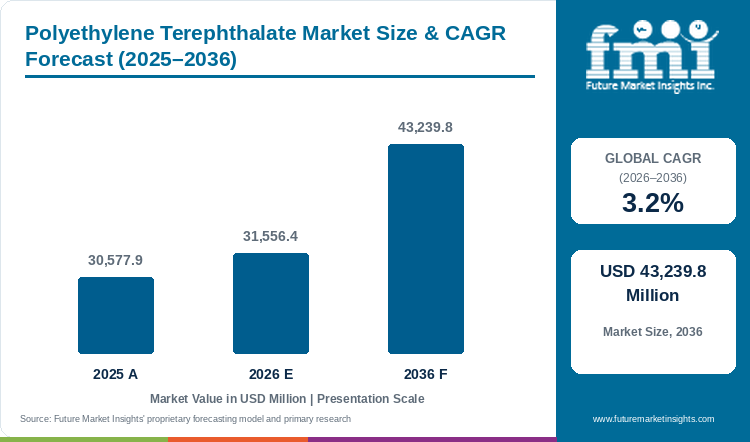
Sales of polyethylene terephthalate will grow at a CAGR of 3.2% from 2026 to 2036. The pace is modest because packaging already holds 64% of application sales and food and beverages hold 57% of end user sales in 2026, FMI finds. Bottle and food buyers are established, and new volume is limited.
Recycled content is changing fastest. The UK charges GBP 228.82 per tonne from 1 April 2026 on plastic packaging components with less than 30% recycled plastic.[1] Alpek was set to close the Reading, Pennsylvania recycling plant on 15 March 2026, with 100 employees affected.[2] A tax that rewards recycled content alongside a plant closure shows that recycling capacity needs to be close to bottlers. Demand for recycled PET will rise faster than demand for virgin PET, and producers with that capacity will earn most of the added sales.
Key Market Trends & Insights
- By application, packaging led the market with 64% of sales in 2026, ahead of sheets and films at 17% and consumer goods at 12%. Indorama Ventures has recycled more than 150 billion post-consumer PET bottles since 2011.[3]
- By end user, food and beverages accounted for 57% of sales in 2026, ahead of automotive at 17% and electronics at 15%. Otsuka Pharmaceutical began rolling out 100% recycled PET bottles in Japan in late January 2026.[4]
Regional Highlights
- Fastest-growing profiled country: South Korea (3.5% CAGR, 2026 to 2036).
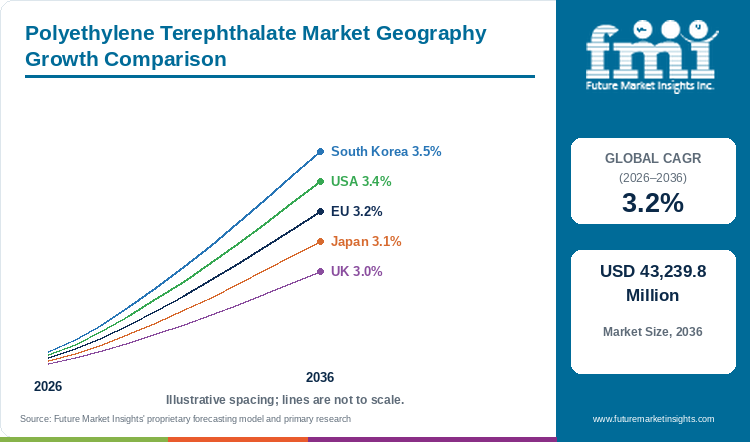
- By country, FMI profiles the USA (3.4%) and the EU (3.2%) after South Korea, with Japan at 3.1% and the UK recording the lowest profiled CAGR at 3%.
- South Korea required at least 10% recycled PET in bottles from 1 January 2026 for bottled water and nonalcoholic beverage producers using more than 5,000 metric tons of PET bottles a year.[5]
Market Size & Forecast
Table 1: Market Size and Forecast for the Polyethylene Terephthalate Market (USD million and percentage), 2025 to 2036
| Metric | Value |
|---|---|
| 2025 Market Size | USD 30,577.9 million |
| Estimated Market Size in 2026 | USD 31,556.4 million |
| Projected Market Size by 2036 | USD 43,239.8 million |
| CAGR, 2026 to 2036 | 3.2% |
| Added Revenue, 2026 to 2036 | USD 11,683.4 million |
| Market Expansion Multiple | 1.4x |
Market size for polyethylene terephthalate is projected to add USD 11,683.4 million between 2026 and 2036. Beverage makers that buy PET for bottles also set volumes in the bottled water market, so recycled content decisions at brands flow straight into resin purchasing. Otsuka Pharmaceutical began a nationwide rollout of 100% recycled PET beverage bottles in late January 2026.[4] FMI puts food and beverages at 57% of end user sales, which gives brand packaging choices real weight.
Rules add a cost layer to packs with little recycled content. The UK charges GBP 228.82 per tonne from 1 April 2026 on plastic packaging components with less than 30% recycled plastic.[1] Alpek assumes a PET reference margin of USD 145 a ton in the 2026 base case.[6] Margins that thin leave resin producers little room to absorb extra recycling cost.
Recycled PET Supply and Recycling Capacity
Recycled content rules are arriving faster than recycling plants. South Korea set a floor of 10% recycled PET from 1 January 2026 for large beverage bottlers and aims for 30% by 2030.[5] The UK tax applies below 30% recycled plastic.[1] On the supply side, Alpla reports 300,000 tonnes of installed and projected rPET capacity and a 2030 target of 700,000 tonnes of recycled capacity.[7] Indorama Ventures runs more than 20 recycling facilities across 11 countries.[3] The recycled PET packaging market follows the same supply chain. Loop Industries expects the India facility to be operational in calendar 2028, after the first compliance dates have passed.[8]
Table 2: Recycled PET Supply and Rule Indicators for the Polyethylene Terephthalate Market (tonnes, percentage and GBP values), mixed reporting years from 2025 to 2026
| Indicator | Data Point | Why This Matters | Source |
|---|---|---|---|
| UK plastic packaging tax, April 2026 | GBP 228.82 per tonne; applies below 30% recycled plastic | The rate rose from GBP 223.69 per tonne in April 2025. | [1] |
| South Korea recycled PET requirement | At least 10% from 1 January 2026; 30% targeted by 2030 | Producers using more than 5,000 metric tons of PET bottles a year are covered. | [5] |
| Alpek polyester sales volume, 2025 | 3,609 kt, down 8% from 3,911 kt | The segment spans PTA, PET resin and sheet, and rPET. | [6] |
| Alpek Reading recycling plant, 2026 | Closure set for 15 March 2026; 100 employees affected | Reading is the former CarbonLite site. | [2] |
| Alpek Richmond, Indiana site | Part of the Reading capacity is set to move to the integrated site | Alpek still produces rPET at an Indiana plant. | [6][2] |
| Alpla recycling capacity, March 2026 | 300,000 tonnes rPET within 400,000 tonnes of recycled material | The 2030 target is 700,000 tonnes of recycled capacity. | [7] |
| Indorama Ventures bottles recycled, August 2025 | More than 150 billion since 2011; more than 20 facilities in 11 countries | The company recycles 789 bottles every second. | [3] |
| Indorama Ventures PET EBITDA, 1Q26 | THB 5.5 billion, up 134% on the previous quarter | Shale-to-PET integration in the Americas widened the cost advantage. | [9] |
| Loop Industries Europe and India projects, May 2026 | Schwarzheide, Germany site selected; India facility due in calendar 2028 | New plants arrive after the first compliance dates. | [8] |
| Otsuka Pharmaceutical rollout, January 2026 | 100% recycled PET resin containers; more than 90% of PET bottle beverage products | The company claims a reduction of about 5,300 t in greenhouse gas emissions. | [4] |
Analyst Perspective
“Recycled content rules are arriving faster than recycled flake capacity, and the Reading closure shows the gap in the United States. Resin groups with integrated feedstock and owned recycling will hold the steadiest bottle-grade supply through 2036.”
- Nikhil Kaitwade, Principal Consultant, Future Market Insights.
How is the polyethylene terephthalate market segmented?
The polyethylene terephthalate market is segmented into application and end user, and region. In 2026, packaging holds 64% of application sales and food and beverages hold 57% of end user sales.
By application: sheets and films, packaging, consumer goods, and other applications.
By end user: automotive industry, electronics, food and beverages, and other end users.
By region: North America, Latin America, Western Europe, Eastern Europe, Asia Pacific excluding Japan, Japan, and Middle East and Africa.
Why does packaging lead application sales?
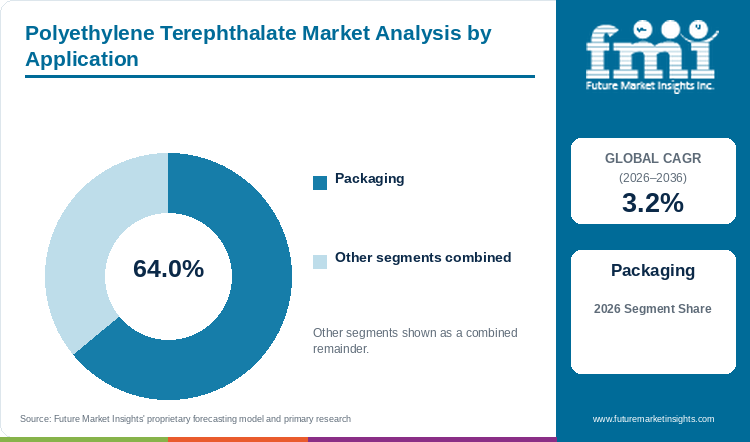
Packaging accounts for 64% of application sales in 2026, ahead of sheets and films at 17% and consumer goods at 12%.
Table 3: Application Share for the Polyethylene Terephthalate Market (percentage share), 2026
| Application | Estimated Share (2026) |
|---|---|
| Sheets and Films | 17% |
| Packaging | 64% |
| Consumer Goods | 12% |
| Other Applications | 7% |
| Total | 100.0% |
Table 4: Application Leadership and Market Growth for the Polyethylene Terephthalate Market (segment and CAGR percentage), 2026 to 2036
| Metric | Value |
|---|---|
| Global CAGR (2026 to 2036) | 3.2% |
| Leading Segment | Packaging |
In the FMI split for 2026, packaging carries 64% of application sales. Rules now attach to the pack itself. The UK taxes plastic packaging components with less than 30% recycled plastic at GBP 228.82 per tonne from 1 April 2026.[1] South Korea set a 10% recycled PET floor for large beverage bottlers from 1 January 2026.[5] The plastic packaging market gives the wider pack context for these rules. Neither rule can be met without a steady flow of recycled flake, and that flow is the part of the chain under strain.
- Bottlers are the first buyers to feel any shortage of recycled flake.
- Alpla reports 300,000 tonnes of installed and projected rPET capacity across the recycling plants of the group.[7]
Why do food and beverages lead end use?
Food and beverages account for 57% of end user sales in 2026, ahead of automotive at 17% and electronics at 15%.
Table 5: End User Share for the Polyethylene Terephthalate Market (percentage share), 2026
| End User | Estimated Share (2026) |
|---|---|
| Automotive Industry | 17% |
| Electronics | 15% |
| Food and Beverages | 57% |
| Other End Users | 11% |
| Total | 100.0% |
Food and beverage makers account for 57% of end user sales in 2026 as per FMI estimates. Brand pledges turn that share into orders for recycled flake. Otsuka Pharmaceutical began a nationwide rollout of 100% recycled PET beverage bottles in late January 2026.[4] Indorama Ventures has recycled more than 150 billion post-consumer PET bottles since 2011, which shows the scale of bottle collection already in place.[3] Flake that misses food contact grade has another outlet in the polyester fiber market. Beverage brands therefore choose between food-grade flake and lower grades that suit other products.
- Food-grade flake is the grade that beverage brands compete for.
- Otsuka holds resource-circulation agreements with 30 Japanese local governments for bottle collection.[4]
What are the drivers, restraints, and opportunities in the polyethylene terephthalate market?
In the polyethylene terephthalate market, recycled content rules and beverage demand support sales, plant closures constrain recycled flake supply, and integrated recycling capacity opens the principal commercial opportunity.
- Driver: Recycled content rules in the UK and South Korea pull recycled PET into bottle supply chains.
- Restraint: Recycling plant closures in the United States cut the supply of recycled flake.
- Opportunity: Integrated resin and recycling groups and new recycling plants widen secure bottle-grade supply.
Recycled Content Rules Pull Demand for Recycled Flake
South Korea began a 10% recycled PET requirement for covered beverage makers on 1 January 2026, and the Ministry of Environment aims to raise the figure to 30% by 2030.[5] The UK rate rose from GBP 223.69 per tonne in April 2025 to GBP 228.82 per tonne on 1 April 2026.[1] Otsuka Pharmaceutical planned to cover more than 90% of the PET bottle beverage products of the company by bottle count with recycled PET containers in 2026.[4] Each rule or pledge adds a buyer for recycled flake. Supply has to follow.
Plant Closures Limit Recycled Flake Supply
Alpek still produces recycled PET at the Indiana plant after the Reading closure.[2] Polyester sales volume at the company was 3,609 kt in 2025, down from 3,911 kt in 2024.[6] The 2026 base case assumes minimal benefits from U.S. PET reciprocal tariffs.[6] Buyers near the Reading plant lose a local source of flake.
Integrated Producers and New Plants Widen Supply
Indorama Ventures reported on 18 May 2026 that PET EBITDA rose 134% on the previous quarter to THB 5.5 billion.[9] Loop Industries said on 27 May 2026 that Infinite Loop Europe selected BASF Industriepark Lausitz in Schwarzheide, Germany, as the site for the first facility.[8] The PET preform market links resin makers to bottle makers, and preform buyers gain from any group that secures both virgin and recycled resin. The India plant due in 2028 serves the second half of the forecast period.
Which country CAGRs are profiled in the polyethylene terephthalate market?
Table 6: Country CAGR Comparison for the Polyethylene Terephthalate Market (CAGR percentage), 2026 to 2036
| Country | CAGR |
|---|---|
| South Korea | 3.5% |
| USA | 3.4% |
| EU | 3.2% |
| Japan | 3.1% |
| UK | 3% |
How do country-level CAGRs compare in the polyethylene terephthalate market?
Growth across the five profiled countries differs owing to recycled content rules, plant closures and beverage buyer commitments. As per the analysis from FMI, South Korea is projected at a 3.5% CAGR from 2026 to 2036, followed by the USA at 3.4% and the EU at 3.2%. Japan is projected at 3.1%, and the UK at 3%. The spread between the top and the bottom of the range is 0.5 points.
- South Korea pairs a 10% recycled PET floor from 1 January 2026 with a 30% target for 2030.
- The USA combines the Reading closure with continued recycled PET output at the Indiana plant of Alpek.
- The EU draws on Alpla recycling plants in six member states and a planned chemical recycling site in Germany.
- Japan links recycled PET sales to brand commitments such as the 100% recycled bottles of Otsuka.
- The UK tax of GBP 228.82 per tonne applies to plastic packaging with less than 30% recycled plastic.
Full report country CAGRs cover: North America; Latin America; Western Europe; Eastern Europe; Asia Pacific excluding Japan; Japan; Middle East and Africa.
Country-wise Analysis
South Korea Polyethylene Terephthalate Market Outlook (2026 to 2036)
A Cabinet decision set a requirement from 1 January 2026 for bottled water and nonalcoholic beverage producers using more than 5,000 metric tons of PET bottles a year, with at least 10% of the PET used in bottles coming from recycled sources.[5] About 10 major firms are covered, including Coca-Cola Korea, Lotte Chilsung Beverage and Jeju Development Corp., and the Ministry of Environment plans to widen coverage to producers above 1,000 tons and to reach 30% by 2030.[5] South Korea is projected to grow at a CAGR of 3.5% from 2026 to 2036, the fastest of the five profiled countries.
Key takeaway: South Korea has a legal floor under the 3.5% pace, and a covered group of about 10 bottlers carries the first compliance load.
USA Polyethylene Terephthalate Market Outlook (2026 to 2036)
The USA is projected to grow at a CAGR of 3.4% from 2026 to 2036, and supply is the open question. The Reading, Pennsylvania plant of Alpek, the former CarbonLite site, was set to close on 15 March 2026 with 100 employees affected.[2] Alpek still produces recycled PET at the Indiana plant, and the 4Q25 report moves part of the Reading capacity to the Richmond, Indiana integrated site.[2][6] The 2026 base case of the company assumes minimal benefits from U.S. PET reciprocal tariffs.[6] Bottlers that buy recycled flake deal with fewer plants and a tariff outlook that offers little relief.
Key takeaway: The 3.4% pace in the USA is carried by fewer recycling sites, and the Alpek base case excludes tariff relief for PET.
EU Polyethylene Terephthalate Market Outlook (2026 to 2036)
Alpla runs recycling plants in Germany, Italy, Austria, Poland, Romania and Spain among 14 sites worldwide, with 300,000 tonnes of rPET capacity installed and projected across the group.[7] Infinite Loop Europe selected BASF Industriepark Lausitz in Schwarzheide, Germany, for the first facility, and the project is in engineering and permitting.[8] The EU is projected to grow at a CAGR of 3.2% from 2026 to 2036. Bottle makers that buy from groups with plants in several member states spread supply risk better than buyers tied to one national site.
Key takeaway: The 3.2% pace of the EU leans on mechanical plants already running and on a German chemical recycling project still in engineering and permitting.
Japan Polyethylene Terephthalate Market Outlook (2026 to 2036)
Otsuka Pharmaceutical began a nationwide rollout of PET bottle beverage products in 100% recycled PET resin in late January 2026, covering more than 90% of the PET bottle beverage products of the company by bottle count in the 2026 production plan.[4] The company claims a reduction of about 5,300 t in greenhouse gas emissions and holds resource-circulation agreements with 30 local governments.[4] Japan is projected to grow at a CAGR of 3.1% from 2026 to 2036. Brand-led switching to recycled resin is the visible change in Japanese beverage packaging.
Key takeaway: Japan at 3.1% shows brand-led switching, with Otsuka backing 100% recycled PET through agreements with 30 local governments.
UK Polyethylene Terephthalate Market Outlook (2026 to 2036)
The UK is projected to grow at a CAGR of 3% from 2026 to 2036, the lowest of the five profiled countries. The plastic packaging tax rose from GBP 223.69 per tonne in April 2025 to GBP 228.82 per tonne on 1 April 2026 and applies to plastic packaging components with less than 30% recycled plastic.[1] A rising rate rewards packs above 30% recycled content. UK packaging buyers therefore compare the tax saving against the cost of recycled flake.
Key takeaway: UK growth of 3% is the lowest profiled, and the tax at GBP 228.82 per tonne makes recycled content a cost question for every pack under 30%.
Who are the notable companies in the polyethylene terephthalate market?
SABIC, Indorama Ventures, Sinopec Group, Alpek, Teijin, M&G Chemicals, SRF Limited, Far Eastern Group, Toray Industries, SCG Chemicals, and Yucheng Jinhe Industrial are notable companies profiled in this market.
FMI names SABIC, Indorama Ventures, Sinopec Group, Alpek and Teijin as the top players in polyethylene terephthalate. M&G Chemicals, SRF Limited, Far Eastern Group, Toray Industries, SCG Chemicals and Yucheng Jinhe Industrial also compete in PET resin.
Documented positions differ by recycling exposure. Alpek reported polyester sales volume of 3,609 kt in 2025, and the Reading recycling plant closed in March 2026.[6][2] Indorama Ventures runs more than 20 recycling facilities in 11 countries.[3] Alpla, a packaging maker, holds 300,000 tonnes of rPET capacity.[7] Loop Industries licenses technology to Reed Societe Generale Group for a European site.[8]
- Producers named by FMI: SABIC, Indorama Ventures, Sinopec Group, Alpek, Teijin, M&G Chemicals, SRF Limited, Far Eastern Group, Toray Industries, SCG Chemicals, and Yucheng Jinhe Industrial.
- Companies with documented recycling activity in 2025 and 2026: Indorama Ventures, Alpek, Alpla, and Loop Industries.
Competitive Benchmarking: Polyethylene Terephthalate Market
Table 7: Competitive Benchmarking for the Polyethylene Terephthalate Market (qualitative documentation ratings), 2026
| Company | Recycling | PET Resin | Activity | Disclosure |
|---|---|---|---|---|
| Indorama Ventures | High | High | High | High |
| Alpek | Medium | High | High | High |
| Alpla | High | Low | Medium | Medium |
| Loop Industries | Medium | Low | Medium | High |
High indicates wider documentation in company filings and releases, Medium indicates limited documentation, and Low indicates less direct documentation. Ratings do not indicate product quality, market share or company rank.
Key Developments in the Polyethylene Terephthalate Market
- In May 2026, Loop Industries reported that Infinite Loop Europe selected Schwarzheide, Germany, and that the India facility is expected to be operational in calendar 2028.[8]
- In May 2026, Indorama Ventures reported PET EBITDA of THB 5.5 billion for 1Q26, up 134% on the previous quarter.[9]
- In March 2026, Alpla reported 300,000 tonnes of installed and projected rPET capacity across 14 recycling plants in 10 countries.[7]
- In January 2026, Otsuka Pharmaceutical began a nationwide rollout of 100% recycled PET beverage bottles in Japan.[4]
- In January 2026, Resource Recycling reported that the Alpek Reading plant would close on 15 March 2026 with 100 employees affected.[2]
Key Players in the Polyethylene Terephthalate Market
Top Producers Named
- SABIC
- Indorama Ventures Public Company Limited
- Sinopec Group
- Alpek S.A.B. de C.V.
- Teijin Limited
Other Key Producers
- M&G Chemicals
- SRF Limited
- Far Eastern Group
- Toray Industries
- SCG Chemicals
- Yucheng Jinhe Industrial
Companies with Documented Recycling Activity
- ALPLA Group
- Loop Industries
Polyethylene Terephthalate Market - Report Scope
Table 8: Report Scope for the Polyethylene Terephthalate Market (coverage fields and definitions), 2026 to 2036
| Coverage field | Report scope |
|---|---|
| Market breakdown | Application; end user; region |
| Quantitative units | USD million |
| Market definition | Polyethylene terephthalate (PET) market covering sheets and films, packaging, consumer goods and other applications, tracked by end user in automotive, electronics, food and beverages and other uses. |
| Regions covered | North America; Latin America; Western Europe; Eastern Europe; Asia Pacific excluding Japan; Japan; Middle East and Africa |
| Countries covered | South Korea; USA; EU; Japan; UK |
| Key companies profiled | SABIC, Indorama Ventures, Sinopec Group, Alpek, Teijin, M&G Chemicals, SRF Limited, Far Eastern Group, Toray Industries, SCG Chemicals, Yucheng Jinhe Industrial |
| Forecast period | 2026 to 2036 |
Polyethylene Terephthalate Market - Research Methodology
Table 9: Research Methodology for the Polyethylene Terephthalate Market (research methods and approach), 2026 edition
| Method | Approach |
|---|---|
| Data Sources | Recycling and supply facts come from company filings, press releases, a tax authority page and trade press dated May 2025 or later. |
| Desk Research | Desk research covers company filings, official press releases, tax and mandate rules and trade press on PET resin and recycled PET. |
| Market Sizing and Forecasting | Sizing starts from the 2025 base of USD 30,577.9 million and the 3.2% CAGR. |
| Data Validation | Resin, recycling and tax facts are drawn from company filings, a tax authority notice and dated trade press. |
Polyethylene Terephthalate Market by Segments
Polyethylene Terephthalate Market segmented by Application:
- Sheets and Films
- Packaging
- Consumer Goods
- Other Applications
Polyethylene Terephthalate Market segmented by End User:
- Automotive Industry
- Electronics
- Food and Beverages
- Other End Users
Polyethylene Terephthalate Market by Region
- North America
- United States
- Latin America
- Western Europe
- European Union
- United Kingdom
- Eastern Europe
- Asia Pacific excluding Japan
- South Korea
- Japan
- Middle East and Africa
Research Sources and Bibliography
- [1] GOV.UK. (2026). Plastic Packaging Tax. https://www.gov.uk/government/publications/introduction-of-plastic-packaging-tax/plastic-packaging-tax
- [2] Antoinette Smith, Resource Recycling. (2026, January 22). Alpek closing Pennsylvania rPET plant. https://resource-recycling.com/plastics/2026/01/22/alpek-closing-pennsylvania-rpet-plant/
- [3] Hydrocarbon Processing. (2025, August 5). Indorama Ventures reaches 150 billion PET recycling milestone, reaffirming its commitment to a circular economy. https://hydrocarbonprocessing.com/news/2025/08/indorama-ventures-reaches-150-billion-pet-recycling-milestone-reaffirming-its-commitment-to-a-circular-economy/
- [4] petpla.net. (2026, January 27). Otsuka Pharmaceutical begins rollout of 100% rPET bottles. https://petpla.net/2026/01/27/otsuka-pharmaceutical-begins-rollout-of-100-rpet-bottles/
- [5] Lee Jung-joo, The Korea Herald (Asia News Network). (2025, September 17). Korea is requiring drinks companies use recycled plastic in their bottles, but is it safe? https://asianews.network/korea-is-requiring-drinks-companies-use-recycled-plastic-in-their-bottles-but-is-it-safe
- [6] Alpek, S.A.B. de C.V. (2026). Alpek 4Q25 Report. https://www.alpek.com/wp-content/uploads/2026/02/Alpek-4Q25-Report-ENG.pdf
- [7] ALPLA. (2026, March 18). Global Recycling Day 2026: ALPLA milestones. https://blog.alpla.com/en/blog/recycling/global-recycling-day-2026-alpla-milestones
- [8] Loop Industries (ACCESS Newswire). (2026, May 27). Loop Industries Reports Fourth Quarter and Full Year Fiscal 2026 Results and Provides Update on Business Developments. https://www.accessnewswire.com/newsroom/en/clean-technology/loop-industries-reports-fourth-quarter-and-full-year-fiscal-2026-results-and-provi-1171151
- [9] Indorama Ventures. (2026, May 18). Indorama Ventures marks decisive inflection point with 89% QoQ EBITDA growth in 1Q26 driven by IVL 2.0 strategy and industry upturn. https://beta.indoramaventures.com/news/earnings-releases/indorama-ventures-marks-decisive-inflection-point-with-89-qoq-ebitda-growth-in-1q26-driven-by-ivl-20-strategy-and-industry-upturn
This bibliography is provided for reader reference. The full report contains the complete reference list and detailed citations.
This Report Answers
- How big is the polyethylene terephthalate market during 2026?
- What market size is projected by 2036?
- Which application holds notable share?
- Which end user holds notable share?
- Which countries have notable growth?
- Which companies are notable in the market?
Frequently Asked Questions
How large is the polyethylene terephthalate market expected in 2026?
Future Market Insights sizes the polyethylene terephthalate market at USD 31,556.4 million in 2026. Market size is projected to reach USD 43,239.8 million by 2036.
What CAGR is projected for the polyethylene terephthalate market through 2036?
As per FMI analysis, sales of polyethylene terephthalate will grow at a CAGR of 3.2% from 2026 to 2036. Recycled content rules in the UK and South Korea support the outlook.
Which application holds a notable market share in 2026?
Packaging carries 64% of application sales in 2026. Sheets and films, consumer goods and other applications make up the balance.
Which end user holds a notable market share in 2026?
Food and beverages account for 57% of end user sales in 2026. Automotive, electronics and other end users make up the balance.
Which country has a notable expansion outlook through 2036?
South Korea is projected to record the fastest growth at a 3.5% CAGR from 2026 to 2036, according to FMI. The 10% recycled PET requirement in force from 1 January 2026 supports that outlook.
Who are the key companies in the polyethylene terephthalate market?
Notable companies include SABIC, Indorama Ventures, Sinopec Group, Alpek, Teijin, M&G Chemicals, SRF Limited, Far Eastern Group, Toray Industries, SCG Chemicals, and Yucheng Jinhe Industrial.
Preview the report firsthand - request a free sample
Get SampleGet the brochure for pricing and purchase details.
Get PDFTable of Content
- Key Takeaways
- Market Size and CAGR
- Top Growth Driver
- Fastest Growing Segment
- Leading Region
- Key Companies
- Emerging Opportunities
- Executive Summary
- Global Market Outlook
- Demand-side Trends
- Supply-side Trends
- Technology Roadmap Analysis
- Analysis and Recommendations
- Analyst Perspective (What is happening? Why now? What should investors know?)
- Key Questions Answered
- How large is the market?
- What is the CAGR?
- What are key trends?
- Which region dominates?
- Who are the leaders?
- Market Overview
- Market Coverage / Taxonomy
- Market Definition / Scope / Limitations
- Research Methodology
- Chapter Orientation
- Analytical Lens and Working Hypotheses
- Market Structure, Signals, and Trend Drivers
- Benchmarking and Cross-market Comparability
- Market Sizing, Forecasting, and Opportunity Mapping
- Research Design and Evidence Framework
- Desk Research Programme (Secondary Evidence)
- Expert Input and Fieldwork (Primary Evidence)
- Tooling, Models, and Reference Databases
- Data Engineering and Model Build
- Quality Assurance and Audit Trail
- Market Background
- Market Dynamics (Drivers, Restraints, Opportunity, Trends)
- Scenario Forecast (Optimistic, Likely, Conservative)
- Impact Analysis
- AI Impact
- Sustainability Impact
- Regulatory Impact
- Technology Impact
- Consumer / Buyer Analysis
- Purchase Drivers
- Adoption Barriers
- Buyer Journey
- Opportunity Map Analysis
- Product Life Cycle Analysis
- Supply Chain Analysis
- Investment Feasibility Matrix
- Value Chain Analysis
- PESTLE and Porter's Analysis
- Regulatory Landscape
- Regional Parent Market Outlook
- Production and Consumption Statistics
- Import and Export Statistics
- Global Market Analysis and Forecast, 2021 to 2036
- Historical Market Size Value (USD Million) Analysis, 2021 to 2025
- Current and Future Market Size Value (USD Million) Projections, 2026 to 2036
- Y-o-Y Growth Trend Analysis
- Absolute $ Opportunity Analysis
- Global Market Pricing Analysis, 2021 to 2036
- Global Market Analysis and Forecast, By Application, 2021 to 2036
- Introduction / Key Findings
- Historical Market Size Value (USD Million) Analysis By Application, 2021 to 2025
- Current and Future Market Size Value (USD Million) Analysis and Forecast By Application, 2026 to 2036
- Sheets and Films
- Packaging
- Consumer Goods
- Other Applications
- Y-o-Y Growth Trend Analysis By Application, 2021 to 2025
- Absolute $ Opportunity Analysis By Application, 2026 to 2036
- Global Market Analysis and Forecast, By End User, 2021 to 2036
- Introduction / Key Findings
- Historical Market Size Value (USD Million) Analysis By End User, 2021 to 2025
- Current and Future Market Size Value (USD Million) Analysis and Forecast By End User, 2026 to 2036
- Automotive Industry
- Electronics
- Food and Beverages
- Other End Users
- Y-o-Y Growth Trend Analysis By End User, 2021 to 2025
- Absolute $ Opportunity Analysis By End User, 2026 to 2036
- Global Market Analysis and Forecast, By Region, 2021 to 2036
- Introduction
- Historical Market Size Value (USD Million) Analysis By Region, 2021 to 2025
- Current Market Size Value (USD Million) Analysis and Forecast By Region, 2026 to 2036
- North America
- Latin America
- Western Europe
- Eastern Europe
- Middle East and Africa
- Market Attractiveness Analysis By Region
- North America Market Analysis and Forecast, By Country, 2021 to 2036
- Historical Market Size Value (USD Million) Trend Analysis By Market Taxonomy, 2021 to 2025
- Market Size Value (USD Million) Forecast By Market Taxonomy, 2026 to 2036
- By Country
- United States
- By Application
- By End User
- By Country
- Market Attractiveness Analysis
- By Country
- By Application
- By End User
- Key Takeaways
- Latin America Market Analysis and Forecast, By Country
- Historical Market Size Value (USD Million) Trend Analysis By Market Taxonomy, 2021 to 2025
- Market Size Value (USD Million) Forecast By Market Taxonomy, 2026 to 2036
- By Country
- By Application
- By End User
- Market Attractiveness Analysis
- By Country
- By Application
- By End User
- Key Takeaways
- Western Europe Market Analysis and Forecast, By Country
- Historical Market Size Value (USD Million) Trend Analysis By Market Taxonomy, 2021 to 2025
- Market Size Value (USD Million) Forecast By Market Taxonomy, 2026 to 2036
- By Country
- European Union
- United Kingdom
- By Application
- By End User
- By Country
- Market Attractiveness Analysis
- By Country
- By Application
- By End User
- Key Takeaways
- Eastern Europe Market Analysis and Forecast, By Country
- Historical Market Size Value (USD Million) Trend Analysis By Market Taxonomy, 2021 to 2025
- Market Size Value (USD Million) Forecast By Market Taxonomy, 2026 to 2036
- By Country
- Asia Pacific excluding Japan
- South Korea
- Japan
- By Application
- By End User
- By Country
- Market Attractiveness Analysis
- By Country
- By Application
- By End User
- Key Takeaways
- Middle East and Africa Market Analysis and Forecast, By Country
- Historical Market Size Value (USD Million) Trend Analysis By Market Taxonomy, 2021 to 2025
- Market Size Value (USD Million) Forecast By Market Taxonomy, 2026 to 2036
- By Country
- By Application
- By End User
- Market Attractiveness Analysis
- By Country
- By Application
- By End User
- Key Takeaways
- Key Countries Market Analysis
- United States
- Pricing Analysis
- Market Share Analysis, 2025
- By Application
- By End User
- United Kingdom
- Pricing Analysis
- Market Share Analysis, 2025
- By Application
- By End User
- Japan
- Pricing Analysis
- Market Share Analysis, 2025
- By Application
- By End User
- South Korea
- Pricing Analysis
- Market Share Analysis, 2025
- By Application
- By End User
- EU
- Pricing Analysis
- Market Share Analysis, 2025
- By Application
- By End User
- United States
- Market Structure Analysis
- Competition Dashboard
- Competition Benchmarking
- Market Share Analysis of Top Players
- By Regional
- By Application
- By End User
- Emerging Startups
- Innovation Benchmarking
- Competition Analysis
- Competition Deep Dive
- Indorama Ventures
- Overview
- Product Portfolio
- Profitability by Market Segments
- Sales Footprint
- Strategy Overview
- Marketing Strategy
- Product Strategy
- Channel Strategy
- Alpek
- Alpla
- Loop Industries
- SABIC
- Indorama Ventures Public Company Limited
- Sinopec Group
- Alpek S.A.B. de C.V.
- Teijin Limited
- M&G Chemicals
- SRF Limited
- Far Eastern Group
- Toray Industries
- SCG Chemicals
- Yucheng Jinhe Industrial
- ALPLA Group
- Indorama Ventures
- Case Studies
- Success Stories
- Recent Developments
- Competition Deep Dive
- Assumptions & Acronyms Used


