

- Market Size (2026)
- USD 3.3 Bn
- Forecast (2036)
- USD 5.8 Bn
- CAGR (2026 to 2036)
- 5.7%
How big is Orthopedic Prosthetics Market in 2026?
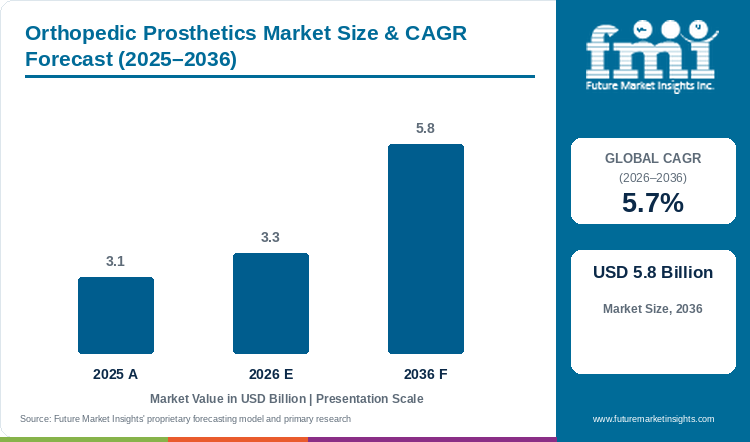
Demand is projected to expand at 5.7% CAGR from 2026 to 2036. Market value rises from USD 3.14 billion in 2025 to USD 3.32 billion in 2026 and USD 5.78 billion by 2036.
The orthopedic prosthetics market is estimated at USD 3.32 billion in 2026 and projected to reach USD 5.78 billion by 2036, at a CAGR of 5.7% from 2026 to 2036. Revenue covers external prosthetic limbs and their components, including sockets, liners and modular parts, while orthoses, implanted joint replacements and separately billed clinical services are excluded. Demand follows the devices needed by people with limb loss or limb difference, with clinical assessment and fitting shaping which components can be used effectively. WHO’s standards place appropriate products within organized provision by trained personnel, explaining why access to care remains commercially important to device purchasing. [1] Lower-extremity systems address walking and balance, while electric powered technology provides another dimension of choice for assessed movement or grasping requirements. Buyers need to consider fit, training and maintenance alongside the user’s intended activities, because component performance reaches the person through the complete prosthesis. Medicare’s functional requirements and England’s updated service specification illustrate how those clinical considerations influence access to products. [2][3] Replacement and changing support needs sustain demand over time, giving suppliers opportunities to maintain suitable component availability throughout continuing prosthetic care.
Key Market Trends & Insights
- Microprocessor and powered technologies broaden the available component choices, while fitting, rehabilitation and maintenance continue to determine how effectively an individual can use the selected device. [1][4]
- Lower-limb demand keeps mobility assessment central to purchasing, because the most appropriate knee, foot or other component depends on the user’s functional requirements. [2]
- Service organization is receiving closer attention as prosthetic provision extends from the initial assessment and fitting to training, follow-up and continued access to support. [1][3]
Regional Highlights
- United States Medicare coverage criteria connect lower-limb component selection with functional needs and documented eligibility, giving clinical assessment a direct purchasing role. [2]
- England’s May 2025 prosthetic-service specification addresses people of all ages with limb loss or limb difference, placing product provision within continuing rehabilitation services. [3]
- Japan’s aging-related mobility requirements and South Korea’s interest in advanced devices create different component-selection needs, with trained fitting and continuing support determining practical access. [1][4]
Market Size & Forecast
Table 1: Market Size and Forecast for Orthopedic Prosthetics Market (USD billion and percentage), 2025 to 2036
| Metric | Value |
|---|---|
| 2025 market value | USD 3.14 billion |
| 2026 market value | USD 3.32 billion |
| 2036 market value | USD 5.78 billion |
| CAGR 2026 to 2036 | 5.7% |
| Revenue increase 2026 to 2036 | USD 2.46 billion |
| Market expansion 2026 to 2036 | 1.74 times |
Expansion through 2036 is expected to combine replacement of existing prostheses, additional access to care and adoption of technologies suited to individual users. Across prosthetics and orthotics services, assessment and follow-up connect product selection with sustained practical use. Suppliers can improve their position by aligning components with the training, fitting and maintenance support available in the intended care setting, giving the purchaser a clearer view of the resources needed to support function after the initial device is supplied. [1]
Why does prosthetic service capacity influence product demand?
A prosthesis needs to be selected and fitted for an individual, with rehabilitation and follow-up supporting its continued use. WHO’s standards organize these requirements around policy, products, personnel and provision, while national purchasing systems define their own eligibility and service arrangements. These conditions connect the commercial outlook for components with the availability of qualified clinical and technical support. [1][2][3]
Table 2: Industry evidence relevant to the orthopedic prosthetics market
| Indicator | Data point or observation | Market relevance | Source |
|---|---|---|---|
| Service standards | WHO addresses products, personnel and organized provision. | Component availability needs a functioning care pathway. | [1] |
| Functional assessment | Medicare criteria consider the beneficiary’s functional needs. | Purchasing depends on documented individual requirements. | [2] |
| Continuing rehabilitation | England’s 2025 service specification covers all ages with limb loss or difference. | Support extends beyond the initial prosthetic fitting. | [3] |
Analyst Perspective
"Manufacturers that combine advanced materials with reliable fitting support are likely to gain stronger acceptance across hospitals and rehabilitation networks."
- Anurag Sharma, Principal Consultant for Healthcare, FMI
How is the Orthopedic Prosthetics Market segmented?
The market is segmented by Product, Technology, and Region.
Product coverage follows the functions and interfaces needed to assemble a usable prosthesis: upper- and lower-extremity systems address different activities, while liners, sockets and modular components support fit and connection. Technology coverage then distinguishes conventional, electric powered and hybrid approaches, which need to be matched with the person’s functional goals and capacity to use the system. A component can therefore belong to a broad product category while creating particular training or maintenance requirements. Examining the two axes together helps clinical teams and purchasers connect the physical device with fitting, rehabilitation and continuing care, preserving the role of individual assessment in the choice of technology. [1][2][3]
Why does the lower extremity prosthetics segment lead demand by product?
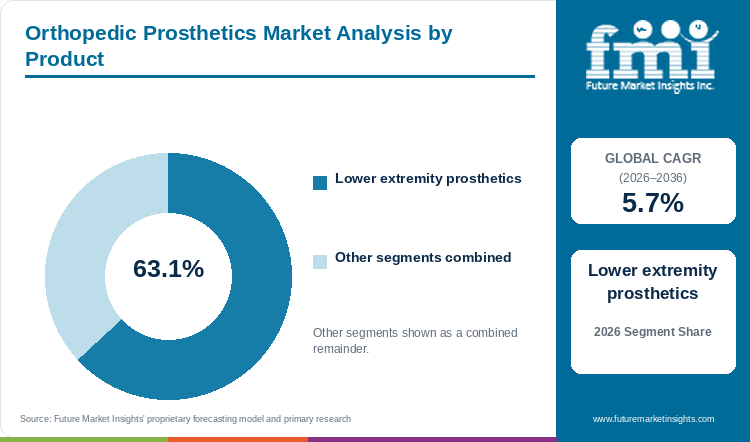
The Lower extremity prosthetics segment is projected to account for 63.1% of product demand in 2026.
Table 3: Product Share for Orthopedic Prosthetics Market (percentage share), 2026
| Product | Estimated share (2026) |
|---|---|
| Lower extremity prosthetics | 63.1% |
| Other products | 36.9% |
| Total | 100.0% |
Table 4: Segment Position and Market Growth for Orthopedic Prosthetics Market, 2026 to 2036
| Metric | Value |
|---|---|
| Global CAGR (2026 to 2036) | 5.7% |
| Profiled product segment | Lower extremity prosthetics |
Lower extremity prosthetics lead the product mix because walking, balance and everyday mobility create continuing requirements for lower-limb components and the services supporting their use. The suitable system varies with the level of limb loss, the condition of the residual limb and the user’s functional goals, making assessment and fitting central to the purchasing process. Medicare’s lower-limb coverage criteria illustrate the importance of documented functional needs when selecting components. [2] Demand therefore includes more than a complete new prosthesis, because sockets, liners and modular parts may need attention as a person’s circumstances change. A reliable service route supports this recurring requirement and helps connect technical component performance with practical use in daily life. [1]
- Lower extremity prosthetics are projected to hold 63.1% of product demand in 2026, supported by continuing walking, balance and daily mobility requirements. [1]
- Lower-limb component selection depends on individual functional requirements and the support needed to achieve safe, sustained use within the person’s everyday environment. [1][2]
Why does the electric powered segment lead demand by technology?
The Electric powered segment is projected to account for 47.5% of technology demand in 2026.
Table 5: Technology Share for Orthopedic Prosthetics Market (percentage share), 2026
| Technology | Estimated share (2026) |
|---|---|
| Electric powered | 47.5% |
| Other technologies | 52.5% |
| Total | 100.0% |
Electric powered technology holds a substantial position because powered control can address particular movement and grasping requirements within suitable prosthetic systems. Its usefulness depends on the intended function and the person’s ability to operate the device, so a more advanced specification is not automatically the most appropriate choice for every user. Assessment needs to account for training, charging and maintenance alongside the physical fit and the activities the person wants to undertake. WHO’s service standards place these requirements within continuing provision rather than a single product transaction. [1] The segment’s commercial role therefore rests on matching technology with the user and the support available, while maintaining a clear distinction between powered movement and other forms of electronic control.
- Electric powered systems are projected to account for 47.5% of technology demand in 2026, serving movement and grasping requirements where powered function suits the assessed user. [1]
- Powered and electronically controlled prosthetic systems require appropriate training and support, with the device chosen according to the user’s needs and abilities. [1]
What are the drivers, restraints, and opportunities in the Orthopedic Prosthetics Market?
The value of a component depends on whether the person can use it comfortably and continue receiving the adjustments, training and maintenance it requires. Suppliers and clinical organizations can make the investment more effective by connecting the selected technology with a sustainable care route, allowing assessment of the device and the service needed to support its everyday function. [1][2][3]
Driver
Everyday mobility and activity needs sustain demand for suitable prostheses and the care supporting their use, with fitting and follow-up connecting a component purchase to practical function. [1] Orthopedic prosthetic accessories include the liners, sockets and modular parts that may need adjustment or replacement as a person’s circumstances change. Access to qualified services helps turn these requirements into usable provision, particularly where rehabilitation and maintenance remain available after the initial fitting. [1][3]
Restraint
Advanced components can require specialist assessment, fitting and training, while the availability of maintenance and follow-up may constrain their practical use. WHO’s standards show why access depends on organized services as well as products. [1] Coverage and eligibility requirements also affect purchasing, as illustrated by United States Medicare’s functional criteria. [2] These conditions can limit adoption where budgets or qualified personnel are scarce, even when a suitable device exists within the supplier’s portfolio and has relevant technical capabilities.
Opportunity
Motorized prosthetic systems create opportunities when powered movement matches the user’s intended function and the clinical service can support training and maintenance. [1] Suppliers can work with care organizations to connect that technology with assessment, fitting and follow-up, making the requirements for charging, adjustment and continued operation clear at the outset. A dependable service route then helps the device remain useful as daily activities or physical needs change, supporting access to an appropriate option within the available care resources. [1][3]
Which country CAGRs are profiled in the Orthopedic Prosthetics Market?
Table 6: Country CAGR Comparison for Orthopedic Prosthetics Market (CAGR percentage), 2026 to 2036
| Country | CAGR | Forecast period |
|---|---|---|
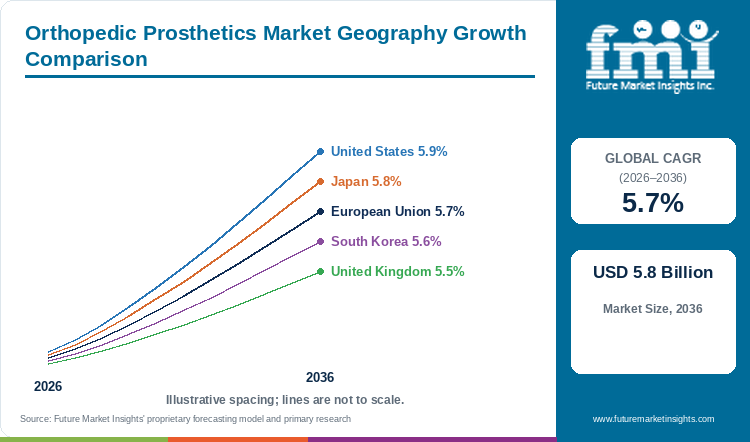
| United States | 5.9% | 2026 to 2036 |
| United Kingdom | 5.5% | 2026 to 2036 |
| European Union | 5.7% | 2026 to 2036 |
| Japan | 5.8% | 2026 to 2036 |
| South Korea | 5.6% | 2026 to 2036 |
Country-wise Analysis
United States Orthopedic Prosthetics Market Outlook (2026 to 2036)
Medicare’s lower-limb prosthesis policy connects US component purchasing with documented clinical and functional requirements, including eligibility for particular knee technologies. [2] The prosthetic service therefore has a role in identifying the activities a person needs to perform and the components appropriate to those goals. US device demand is projected to grow at 5.9% CAGR from 2026 to 2036. A suitable prescription still needs to become a fitted prosthesis with appropriate socket alignment, training and access to later adjustment. Those care activities influence product selection and continued use, while the market value covers devices and components. Suppliers can support the purchasing relationship through dependable component availability and information that helps clinical teams maintain an appropriate system as the user’s requirements change. [1]
United Kingdom Orthopedic Prosthetics Market Outlook (2026 to 2036)
NHS England’s May 2025 service specification places people of all ages with limb loss or limb difference within an organized rehabilitation and prosthetics pathway, giving UK suppliers a clear example of the clinical setting surrounding device provision. [3] Children and adults may need different components and review arrangements, while changing activity or fit can create another product requirement over time. The UK device market is projected at 5.5% CAGR from 2026 to 2036. Purchasers therefore consider whether a component can be fitted, taught and maintained through the service available to the individual. Product revenue remains separate from clinical fees, with assessment and continuing rehabilitation explaining the demand for suitable devices rather than forming an additional sales category. [1]
European Union Orthopedic Prosthetics Market Outlook (2026 to 2036)
The European Union includes established prosthetic manufacturing and rehabilitation services, with component selection taking place through local care arrangements that can differ between member markets. A lower-limb system for walking and an upper-limb system for grasping present different functional requirements, making the clinical assessment central to the device order. The combined EU device outlook projects 5.7% CAGR from 2026 to 2036. Ottobock’s C-Leg provides a documented example of microprocessor-controlled knee technology, whose role needs to be assessed alongside fit, training and the user’s activities. [4] Manufacturers can support local clinical teams through suitable component information and dependable availability, while WHO’s service standards explain why qualified personnel and continuing access remain important around the product. [1]
Japan Orthopedic Prosthetics Market Outlook (2026 to 2036)
Japan’s aging population makes manageable device weight, reliable everyday mobility and access to follow-up practical considerations for prosthetic users and their clinical teams. A person returning to an established home or community routine may need a component combination that can be used comfortably and maintained through the assistance available locally. Japanese device demand is projected to expand at 5.8% CAGR from 2026 to 2036. Training and review become particularly relevant when a new system changes the way the user walks, balances or performs an upper-limb task. WHO’s standards place these requirements within qualified provision. [1] Suppliers therefore need to relate technical options to the user’s functional goals and the fitting service that will support adjustment or replacement as needs change.
South Korea Orthopedic Prosthetics Market Outlook (2026 to 2036)
South Korean interest in advanced mobility devices creates a purchasing context in which electronic control and powered function need to be explained in relation to the individual’s activities. A microprocessor-controlled knee and a powered upper-limb component address different tasks, so the most useful option follows clinical assessment and the person’s ability to use the selected system. [1][4] South Korean device demand is projected at 5.6% CAGR from 2026 to 2036. Suppliers can support that choice through clear component information and a workable training and maintenance route, with local fitting teams translating the specification into a complete prosthesis. Continued review also sustains replacement and adjustment requirements when physical condition, fit or the activities the user wishes to perform change over time.
Who are the notable companies in the Orthopedic Prosthetics Market?
Ottobock; Össur; Blatchford; Steeper Group; Hanger Clinic
Component manufacturers and clinical-service organizations contribute different capabilities to prosthetic care, with the relevant comparison depending on the activities the user needs to perform. Upper limb prosthetics place grasping and movement requirements alongside the fitting and training needed for daily use, while lower-limb portfolios address mobility. [1] Buyers can examine the appropriate component range, clinical access and continuing support, clarifying whether the organization supplies devices, provides care or combines both functions in the proposed arrangement. [1][3]
Competitive Benchmarking: Orthopedic Prosthetics Market
Table 7: Competitive positioning for the orthopedic prosthetics market
| Company | Positioning | Commercial distinction |
|---|---|---|
| Ottobock | Prosthetic components and systems | Offers C-Leg microprocessor-controlled knee technology. [4] |
| Össur | Upper- and lower-limb prosthetic components | Supplies prosthetic feet, knees, hands and liners. |
| Blatchford | Prosthetic components and clinical services | Provides lower-limb prosthetic products and associated care services. |
| Steeper Group | Upper-limb prosthetics and assistive technology | Offers upper-limb prosthetic components including myoelectric products. |
| Hanger Clinic | Prosthetic clinical care | Delivers assessment, fitting and support for upper- and lower-limb prosthetic users. |
Key Developments in the Orthopedic Prosthetics Market
- NHS England published its revised all-age amputee rehabilitation and prosthetics service specification in May 2025, updating the organized-care reference for people with limb loss or limb difference. [3]
- The Medicare lower-limb prosthesis policy includes defined circumstances for covering certain knee technologies at functional level 2, making eligibility and documentation relevant to component selection. [2]
- Ottobock’s C-Leg portfolio continues to illustrate microprocessor-controlled knee technology, with the product’s operating requirements reinforcing the importance of appropriate selection and user support. [4]
Key Players in the Orthopedic Prosthetics Market
Prosthetic components and systems
- Ottobock
Upper- and lower-limb prosthetic components
- Össur
Prosthetic components and clinical services
- Blatchford
Upper-limb prosthetics and assistive technology
- Steeper Group
Prosthetic clinical care
- Hanger Clinic
Orthopedic Prosthetics Market - Report Scope
Table 8: Report Scope for Orthopedic Prosthetics Market, 2026 to 2036
| Coverage field | Report scope |
|---|---|
| Market | Orthopedic Prosthetics Market |
| Revenue coverage | External prosthetic limbs and components; orthoses, implanted joint replacements and separately billed clinical services excluded. |
| Historical reference year | 2025 |
| Base year | 2026 |
| Forecast period | 2026 to 2036 |
| Quantitative units | USD billion and percentage shares/CAGRs |
| 2026 market value | USD 3.32 billion |
| 2036 market value | USD 5.78 billion |
| Forecast CAGR | 5.7% from 2026 to 2036 |
| Segmentation | Product, Technology |
| Country and market profiles | United States, United Kingdom, European Union, Japan, South Korea |
Orthopedic Prosthetics Market - Research Methodology
Table 9: Research Methodology for Orthopedic Prosthetics Market, 2026 edition
| Method | Approach |
|---|---|
| Market definition | Revenue covers external prosthetic limbs and components, including replacement parts; orthoses, implanted joint replacements and separately billed clinical services are excluded. |
| Secondary research | FMI market coverage is assessed alongside official technical guidance, regulatory material and relevant first-party disclosures. |
| Segmentation | Demand is organized by the stated category axes, retaining the distinction between segment shares and growth rates. |
| Country assessment | Local care pathways, purchasing conditions and service availability inform the interpretation of each geographic outlook. |
| Competitive assessment | Participants are compared by relevant offering, customer setting and delivery capability rather than unsupported company rankings. |
| Consistency review | Market values, forecast periods, units, segment labels and country growth rates are checked for agreement throughout the analysis. |
Orthopedic Prosthetics Market by Segments
Orthopedic Prosthetics Market segmented by Product:
- Upper extremity prosthetics
- Hand prosthetics
- Elbow prosthetics
- Shoulder prosthetics
- Lower extremity prosthetics
- Foot & ankle prosthetics
- Knee prosthetics
- Hip prosthetics
- Liners
- Sockets
- Modular components
- Hand prosthetics
Orthopedic Prosthetics Market segmented by Technology:
- Conventional
- Electric powered
- Hybrid orthopedic prosthetics
Orthopedic Prosthetics Market by Region
- North America
- United States
- Canada
- Latin America
- Brazil
- Mexico
- Argentina
- Chile
- Western Europe
- Germany
- France
- United Kingdom
- Italy
- Spain
- Benelux
- Nordics
- Eastern Europe
- Poland
- Czech Republic
- Romania
- Hungary
- East Asia
- China
- Japan
- South Korea
- South Asia and Pacific
- India
- ASEAN
- Australia and New Zealand
- Middle East and Africa
- GCC Countries
- South Africa
- Türkiye
- Israel
Research Sources and Bibliography
- [1] World Health Organization. Accessed 15 October 2026. WHO standards for prosthetics and orthotics
- [2] Centers for Medicare & Medicaid Services. Accessed 15 October 2026. Lower Limb Prostheses: L33787
- [3] NHS England. Accessed 15 October 2026. Amputee rehabilitation and prosthetics services for people of all ages with limb loss and limb difference
- [4] Ottobock. Accessed 15 October 2026. C-Leg
This Report Answers
- How big is the orthopedic prosthetics market in 2026?
- What is the market outlook through 2036?
- Which segments lead demand in 2026?
- Which countries and markets are examined in the forecast?
- Which companies participate in the market?
Frequently Asked Questions
How big is the orthopedic prosthetics market in 2026?
The market is estimated at USD 3.32 billion in 2026, compared with USD 3.14 billion in 2025.
What is the market outlook through 2036?
Market value is projected to reach USD 5.78 billion by 2036, with a CAGR of 5.7% from 2026 to 2036.
Which segments lead demand in 2026?
The Lower extremity prosthetics segment is projected to hold 63.1% of product demand in 2026. Electric powered is projected to hold 47.5% of technology demand in 2026.
Which countries and markets are examined in the forecast?
The analysis covers United States, United Kingdom, European Union, Japan and South Korea, with projected device-market growth from 2026 to 2036.
Which companies participate in the market?
Relevant participants include Ottobock, Össur, Blatchford, Steeper Group, Hanger Clinic, whose portfolios serve different requirements within the market.
Preview the report firsthand - request a free sample
Get SampleGet the brochure for pricing and purchase details.
Get PDFTable of Content
- Key Takeaways
- Market Size and CAGR
- Top Growth Driver
- Fastest Growing Segment
- Leading Region
- Key Companies
- Emerging Opportunities
- Executive Summary
- Global Market Outlook
- Demand-side Trends
- Supply-side Trends
- Technology Roadmap Analysis
- Analysis and Recommendations
- Analyst Perspective (What is happening? Why now? What should investors know?)
- Key Questions Answered
- How large is the market?
- What is the CAGR?
- What are key trends?
- Which region dominates?
- Who are the leaders?
- Market Overview
- Market Coverage / Taxonomy
- Market Definition / Scope / Limitations
- Research Methodology
- Chapter Orientation
- Analytical Lens and Working Hypotheses
- Market Structure, Signals, and Trend Drivers
- Benchmarking and Cross-market Comparability
- Market Sizing, Forecasting, and Opportunity Mapping
- Research Design and Evidence Framework
- Desk Research Programme (Secondary Evidence)
- Expert Input and Fieldwork (Primary Evidence)
- Tooling, Models, and Reference Databases
- Data Engineering and Model Build
- Quality Assurance and Audit Trail
- Market Background
- Market Dynamics (Drivers, Restraints, Opportunity, Trends)
- Scenario Forecast (Optimistic, Likely, Conservative)
- Impact Analysis
- AI Impact
- Sustainability Impact
- Regulatory Impact
- Technology Impact
- Consumer / Buyer Analysis
- Purchase Drivers
- Adoption Barriers
- Buyer Journey
- Opportunity Map Analysis
- Product Life Cycle Analysis
- Supply Chain Analysis
- Investment Feasibility Matrix
- Value Chain Analysis
- PESTLE and Porter's Analysis
- Regulatory Landscape
- Regional Parent Market Outlook
- Production and Consumption Statistics
- Import and Export Statistics
- Global Market Analysis and Forecast, 2021 to 2036
- Historical Market Size Value (USD Billion) Analysis, 2021 to 2025
- Current and Future Market Size Value (USD Billion) Projections, 2026 to 2036
- Y-o-Y Growth Trend Analysis
- Absolute $ Opportunity Analysis
- Global Market Pricing Analysis, 2021 to 2036
- Global Market Analysis and Forecast, By Product, 2021 to 2036
- Introduction / Key Findings
- Historical Market Size Value (USD Billion) Analysis By Product, 2021 to 2025
- Current and Future Market Size Value (USD Billion) Analysis and Forecast By Product, 2026 to 2036
- Upper extremity prosthetics
- Hand prosthetics
- Elbow prosthetics
- Shoulder prosthetics
- Lower extremity prosthetics
- Foot & ankle prosthetics
- Knee prosthetics
- Hip prosthetics
- Liners
- Sockets
- Modular components
- Y-o-Y Growth Trend Analysis By Product, 2021 to 2025
- Absolute $ Opportunity Analysis By Product, 2026 to 2036
- Global Market Analysis and Forecast, By Technology, 2021 to 2036
- Introduction / Key Findings
- Historical Market Size Value (USD Billion) Analysis By Technology, 2021 to 2025
- Current and Future Market Size Value (USD Billion) Analysis and Forecast By Technology, 2026 to 2036
- Conventional
- Electric powered
- Hybrid orthopedic prosthetics
- Y-o-Y Growth Trend Analysis By Technology, 2021 to 2025
- Absolute $ Opportunity Analysis By Technology, 2026 to 2036
- Global Market Analysis and Forecast, By Region, 2021 to 2036
- Introduction
- Historical Market Size Value (USD Billion) Analysis By Region, 2021 to 2025
- Current Market Size Value (USD Billion) Analysis and Forecast By Region, 2026 to 2036
- North America
- Latin America
- Western Europe
- Eastern Europe
- East Asia
- South Asia and Pacific
- Middle East & Africa
- Market Attractiveness Analysis By Region
- North America Market Analysis and Forecast, By Country, 2021 to 2036
- Historical Market Size Value (USD Billion) Trend Analysis By Market Taxonomy, 2021 to 2025
- Market Size Value (USD Billion) Forecast By Market Taxonomy, 2026 to 2036
- By Country
- USA
- Canada
- Mexico
- By Product
- By Technology
- By Country
- Market Attractiveness Analysis
- By Country
- By Product
- By Technology
- Key Takeaways
- Latin America Market Analysis and Forecast, By Country
- Historical Market Size Value (USD Billion) Trend Analysis By Market Taxonomy, 2021 to 2025
- Market Size Value (USD Billion) Forecast By Market Taxonomy, 2026 to 2036
- By Country
- Brazil
- Chile
- Rest of Latin America
- By Product
- By Technology
- By Country
- Market Attractiveness Analysis
- By Country
- By Product
- By Technology
- Key Takeaways
- Western Europe Market Analysis and Forecast, By Country
- Historical Market Size Value (USD Billion) Trend Analysis By Market Taxonomy, 2021 to 2025
- Market Size Value (USD Billion) Forecast By Market Taxonomy, 2026 to 2036
- By Country
- Germany
- UK
- Italy
- Spain
- France
- Nordic
- BENELUX
- Rest of Western Europe
- By Product
- By Technology
- By Country
- Market Attractiveness Analysis
- By Country
- By Product
- By Technology
- Key Takeaways
- Eastern Europe Market Analysis and Forecast, By Country
- Historical Market Size Value (USD Billion) Trend Analysis By Market Taxonomy, 2021 to 2025
- Market Size Value (USD Billion) Forecast By Market Taxonomy, 2026 to 2036
- By Country
- Russia
- Poland
- Hungary
- Balkan & Baltic
- Rest of Eastern Europe
- By Product
- By Technology
- By Country
- Market Attractiveness Analysis
- By Country
- By Product
- By Technology
- Key Takeaways
- East Asia Market Analysis and Forecast, By Country
- Historical Market Size Value (USD Billion) Trend Analysis By Market Taxonomy, 2021 to 2025
- Market Size Value (USD Billion) Forecast By Market Taxonomy, 2026 to 2036
- By Country
- China
- Japan
- South Korea
- By Product
- By Technology
- By Country
- Market Attractiveness Analysis
- By Country
- By Product
- By Technology
- Key Takeaways
- South Asia and Pacific Market Analysis and Forecast, By Country
- Historical Market Size Value (USD Billion) Trend Analysis By Market Taxonomy, 2021 to 2025
- Market Size Value (USD Billion) Forecast By Market Taxonomy, 2026 to 2036
- By Country
- India
- ASEAN
- Australia & New Zealand
- Rest of South Asia and Pacific
- By Product
- By Technology
- By Country
- Market Attractiveness Analysis
- By Country
- By Product
- By Technology
- Key Takeaways
- Middle East & Africa Market Analysis and Forecast, By Country
- Historical Market Size Value (USD Billion) Trend Analysis By Market Taxonomy, 2021 to 2025
- Market Size Value (USD Billion) Forecast By Market Taxonomy, 2026 to 2036
- By Country
- Kingdom of Saudi Arabia
- Other GCC Countries
- Turkiye
- South Africa
- Other African Union
- Rest of Middle East & Africa
- By Product
- By Technology
- By Country
- Market Attractiveness Analysis
- By Country
- By Product
- By Technology
- Key Takeaways
- Key Countries Market Analysis
- USA
- Pricing Analysis
- Market Share Analysis, 2025
- By Product
- By Technology
- Canada
- Pricing Analysis
- Market Share Analysis, 2025
- By Product
- By Technology
- Mexico
- Pricing Analysis
- Market Share Analysis, 2025
- By Product
- By Technology
- Brazil
- Pricing Analysis
- Market Share Analysis, 2025
- By Product
- By Technology
- Chile
- Pricing Analysis
- Market Share Analysis, 2025
- By Product
- By Technology
- Germany
- Pricing Analysis
- Market Share Analysis, 2025
- By Product
- By Technology
- UK
- Pricing Analysis
- Market Share Analysis, 2025
- By Product
- By Technology
- Italy
- Pricing Analysis
- Market Share Analysis, 2025
- By Product
- By Technology
- Spain
- Pricing Analysis
- Market Share Analysis, 2025
- By Product
- By Technology
- France
- Pricing Analysis
- Market Share Analysis, 2025
- By Product
- By Technology
- India
- Pricing Analysis
- Market Share Analysis, 2025
- By Product
- By Technology
- ASEAN
- Pricing Analysis
- Market Share Analysis, 2025
- By Product
- By Technology
- Australia & New Zealand
- Pricing Analysis
- Market Share Analysis, 2025
- By Product
- By Technology
- China
- Pricing Analysis
- Market Share Analysis, 2025
- By Product
- By Technology
- Japan
- Pricing Analysis
- Market Share Analysis, 2025
- By Product
- By Technology
- South Korea
- Pricing Analysis
- Market Share Analysis, 2025
- By Product
- By Technology
- Russia
- Pricing Analysis
- Market Share Analysis, 2025
- By Product
- By Technology
- Poland
- Pricing Analysis
- Market Share Analysis, 2025
- By Product
- By Technology
- Hungary
- Pricing Analysis
- Market Share Analysis, 2025
- By Product
- By Technology
- Kingdom of Saudi Arabia
- Pricing Analysis
- Market Share Analysis, 2025
- By Product
- By Technology
- South Africa
- Pricing Analysis
- Market Share Analysis, 2025
- By Product
- By Technology
- European Union
- Pricing Analysis
- Market Share Analysis, 2025
- By Product
- By Technology
- USA
- Market Structure Analysis
- Competition Dashboard
- Competition Benchmarking
- Market Share Analysis of Top Players
- By Regional
- By Product
- By Technology
- Emerging Startups
- Innovation Benchmarking
- Competition Analysis
- Competition Deep Dive
- Ottobock
- Overview
- Product Portfolio
- Profitability by Market Segments
- Sales Footprint
- Strategy Overview
- Marketing Strategy
- Product Strategy
- Channel Strategy
- Össur
- Blatchford
- Steeper Group
- Hanger Clinic
- Ottobock
- Case Studies
- Success Stories
- Recent Developments
- Competition Deep Dive
- Assumptions & Acronyms Used


