

- Market Size (2026)
- USD 149.0 Bn
- Forecast (2036)
- USD 1124.5 Bn
- CAGR (2026 to 2036)
- 22.4%
How big is Smart Railways Market in 2026?
The global smart railways market is estimated at USD 121.7 billion in 2025 and is expected to reach USD 149.0 billion in 2026. Sales of smart railway systems are projected to reach USD 1,124.5 billion by 2036, growing at a CAGR of 22.4% between 2026 and 2036. According to FMI analysis, rail sensors are expected to hold the largest share, at 55% of 2026 device and component sales.
Demand for smart railway systems is rising with fixed legal deadlines for digital train control in Europe. For instance, under the TEN-T Regulation, ERTMS is due on the core network by 2030, with the wider network following by 2040 and 2050 [1]. As a result, signalling renewal has turned into scheduled programmes with a visible order pipeline. Sales of onboard train control units are also gaining from a large retrofit backlog, as about 19% of the EU railway fleet, or 8,730 vehicles, carried ETCS equipment at the end of 2024 [1]. Adoption of digital interlocking is moving to long framework deals between operators and suppliers. Evidence of this comes from Hitachi Rail, which secured a 30-year, EUR 1.3 billion framework contract from ÖBB in September 2026, covering roughly 300 digital interlocking units [2]. FMI analysis shows that contracts of this length tie software, upgrades and lifecycle support to one supplier for decades.
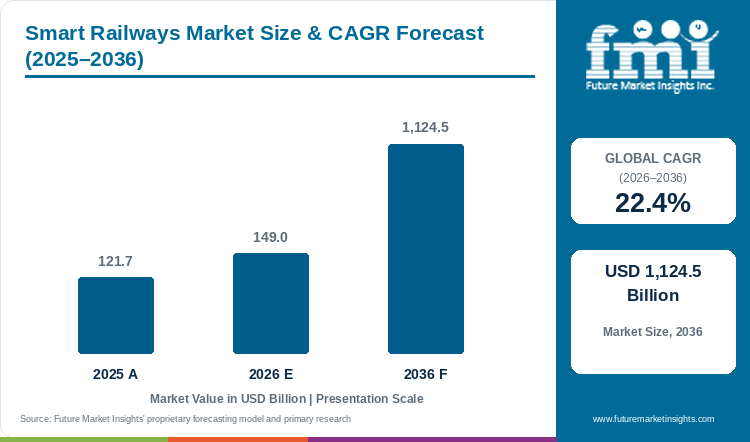
Table 1: Smart Railways Market Size and Forecast (USD billion), 2025 to 2036
| Market size and forecast | Value |
|---|---|
| 2025 market size | USD 121.7 billion |
| Estimated market size in 2026 | USD 149.0 billion |
| Projected market size by 2036 | USD 1,124.5 billion |
| CAGR (2026 to 2036) | 22.4% |
| Added sales, 2026 to 2036 | USD 975.5 billion |
Key Market Trends & Insights
- By device and component: Rail sensors are expected to hold 55% of device and component sales in 2026, as axle counters, track circuits and condition monitors feed every digital signalling and maintenance system.
- By system: At an estimated 28% of 2026 system sales, rail communication and networking systems will lead, since signalling, ticketing and passenger information all run over one trackside data network.
- By service: Hosted platforms for asset data and timetabling give cloud services the top position in services, with about 41% of 2026 sales.
Regional Highlights
- Fastest-growing country: China is projected to grow at a CAGR of 26.8% between 2026 and 2036, the fastest pace among profiled countries, as operating mileage is planned to reach 180,000 km by 2030 [3].
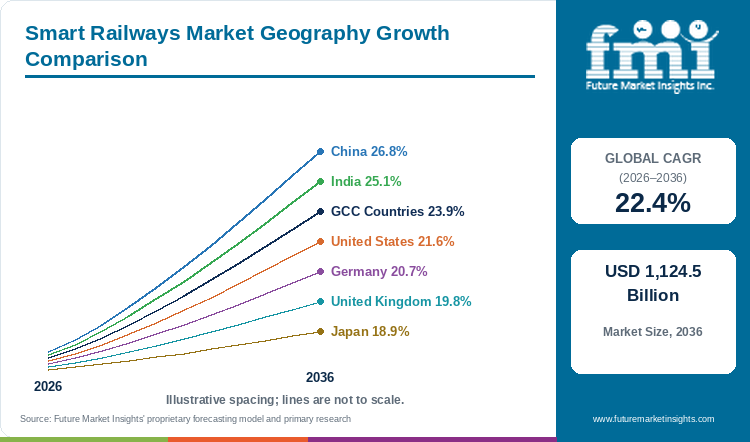
- Growth across other countries: India comes next at 25.1% and GCC Countries at 23.9%, both ahead of the 22.4% global pace. The United States is projected at 21.6% as freight lines add analytics, and Germany at 20.7% as ETCS retrofits continue. The United Kingdom is projected at 19.8%, held back by an older network, and Japan grows slowest at 18.9%.
On existing European lines, signalling capacity remains the tightest constraint on digital rail growth. ETCS covered around 10% of the TEN-T network, or 12,400 km, at the end of 2024 [1]. Low coverage leaves a long retrofit backlog, and clearing that backlog will be costly. Completing ERTMS deployment will need investments of EUR 75 billion to EUR 85 billion, according to a European Commission study [4]. Consequently, European orders depend on how fast governments release funds for trackside work. Asian networks, by contrast, are adding train protection at a quicker pace. Indian Railways had implemented Kavach on more than 2,200 route km by February 2026, with works on another 2,667 route km sanctioned [5]. As these sanctioned sections reach commissioning, orders for radio units, sensors and onboard kits in India will grow.
Rail operators keep orders flowing to large suppliers, although order flow is uneven from quarter to quarter. Alstom reported signalling orders of EUR 551 million and signalling sales of EUR 625 million in the first quarter of 2026/27, with sales up 4% [6]. Sales held steady even as orders fell, which shows a large backlog still being delivered and keeps factories busy. Similarly, Siemens reported third-quarter Mobility revenue of EUR 3.2 billion, up 6% and driven mainly by rail infrastructure [7]. Growth led by infrastructure shows that signalling and electrification programmes, more than new trains, now set the pace for digital rail suppliers. Moreover, long service contracts are adding visibility, since operators prefer one partner across the full life of a signalling asset.
Driverless metros and data platforms are moving digital rail from pilots into full lines. Hitachi Rail signed a contract of about EUR 481.6 million in March 2026 for trains and CBTC signalling at GoA4 on a section of Turin Metro Line 2, with HMAX asset management onboard [8]. Driverless metro lines bundle signalling, data platforms and rolling stock, which raises the digital content of each urban project. Supplier results from the large rail groups confirm the shift toward data products and services. Wabtec's Digital Intelligence line grew 24.2% to USD 369 million in the third quarter of 2026 [9]. Growth at that pace shows operators paying for analytics, train control and connectivity on top of hardware. Regulation adds a further push, as the European ERTMS Coordinator now calls for industrial-scale ERTMS deployment [1]. Standard designs and larger batches are likely to lower unit costs and widen the pool of lines ready for upgrade.
Table 2: Supporting Industry Indicators for the Smart Railways Market, 2024 to 2026
| Indicator | Data point | Why it matters | Source |
|---|---|---|---|
| ETCS coverage of the TEN-T network | Around 10%, or 12,400 km, at the end of 2024 | A large share of European lines still needs digital train control | [1] |
| EU fleet fitted with ETCS | About 19%, or 8,730 vehicles, at the end of 2024 | Onboard retrofits remain a large open task | [1] |
| ERTMS completion investment | EUR 75 billion to EUR 85 billion, October 2026 study | Sets the scale of remaining European signalling work | [4] |
| China railway fixed-asset investment | 901.5 billion yuan in 2025, up 6% | New lines need sensors, signalling and communication systems | [10] |
| China railway investment, January to July 2026 | 440.6 billion yuan, up 1.8% | Construction growth is slowing, so digital content per project matters more | [3] |
| China railway passenger trips | 4.255 billion in 2025, up 4.2% | Rising traffic needs denser train control and passenger information | [10] |
| Kavach coverage in India | More than 2,200 route km, with 2,667 route km sanctioned, February 2026 | Train protection rollout creates orders for radios, sensors and onboard units | [5] |
| Electronic interlocking in India | 6,660 stations as of December 2025 | Interlocking upgrades prepare stations for centralised traffic control | [5] |
| Siemens Mobility third-quarter revenue | EUR 3.2 billion in fiscal 2026, up 6% | Rail infrastructure leads supplier growth | [7] |
| Alstom signalling, first quarter 2026/27 | Orders EUR 551 million; sales EUR 625 million, up 4% | Signalling deliveries hold steady through uneven order intake | [6] |
| Wabtec Digital Intelligence sales | USD 369 million in the third quarter of 2026, up 24.2% | Data and control products grow faster than hardware | [9] |
Demand Intensity Analysis
National construction budgets offer the clearest outside yardstick for a market of this size. China invested 901.5 billion yuan, about USD 128.9 billion, in railway fixed assets during 2025 [10]. At USD 121.7 billion in 2025, the smart railways market estimate comes to roughly 0.94 times that single national budget. Scope differs sharply, since the Chinese figure covers track, bridges and stations in one country. By contrast, the market estimate covers digital devices, systems and services across mainline, metro and freight networks globally. A ratio close to one therefore implies that the estimate counts operator ICT, connectivity and recurring service contracts alongside signalling hardware.
The leading device segment gives a second check, this time against the size of a large supplier. Applying the 55% rail sensors share to 2026 sales yields roughly USD 82.0 billion for that device group. Wabtec expects full-year 2026 revenue of USD 12.30 billion to USD 12.60 billion [9]. On these figures, the sensor segment alone equals 6.5 to 6.7 times the annual sales of one of the largest rail equipment groups. Wabtec sales include locomotives and freight components, whereas the sensor segment spans track, rolling stock and station devices from many component makers. The gap shows that sensor value is spread across a wide supplier field, so no single rail group controls a large share of this segment.
Comparing growth rates tells a similar story about digital content per project. Chinese railway investment rose 6% in 2025 and 1.8% in January to July 2026 [10] [3]. Against a 22.4% market CAGR, the 2025 investment growth implies that digital value per unit of rail investment needs to rise by about 15.5% each year. Supplier data makes that pace plausible, as Wabtec Digital Intelligence sales grew 24.2% in the third quarter of 2026 [9]. The forecast therefore rests on retrofits, software and services gaining weight inside each rail budget, more than on new track alone.
Looking at value per km shows how the type of project shapes the market mix. ETCS covered 12,400 km, around 10% of the TEN-T network, at the end of 2024, which implies about 111,600 km still unequipped [1]. Spreading the EUR 75 billion to EUR 85 billion completion bill over that length gives roughly EUR 0.67 million to EUR 0.76 million per km [4]. Hitachi Rail's Turin Metro Line 2 contract, by comparison, comes to about EUR 481.6 million for trains and signalling on one section of a line planned at about 28 km [8]. Even spread over the full 28 km, that equals about EUR 17.2 million per km, and the figure per contracted km is higher. Metro automation projects thus deliver far more digital value per km than mainline retrofits, so urban lines weigh heavily on market growth.
Table 3: Demand Intensity Metrics for the Smart Railways Market, 2024 to 2026 Data Against 2025 and 2026 Market Values
| Demand intensity metric | Value | Basis |
|---|---|---|
| China railway fixed-asset investment, 2025 | 901.5 billion yuan (about USD 128.9 billion) | China Daily, national railway investment for 2025 |
| 2025 market value as a multiple of China railway investment | 0.94 times | Calculated from China Daily figures and the 2025 market value |
| Wabtec revenue guidance, 2026 | USD 12.30 billion to USD 12.60 billion | Wabtec, third-quarter 2026 results |
| Rail sensors value as a multiple of Wabtec 2026 revenue | 6.5 to 6.7 times | Calculated from Wabtec guidance and the 55% rail sensors share of the 2026 market value |
| China railway investment growth, 2025 | 6% | China Daily, 2025 national railway investment |
| Implied annual rise in digital value per unit of rail investment | About 15.5% | Calculated from China Daily investment growth and the 2026 to 2036 market CAGR |
| Wabtec Digital Intelligence sales growth, third quarter 2026 | 24.2% | Wabtec, third-quarter 2026 results |
| ERTMS completion investment, European Union | EUR 75 billion to EUR 85 billion | European Commission, Directorate-General for Mobility and Transport, October 2026 |
| ERTMS cost per unequipped TEN-T km | EUR 0.67 million to EUR 0.76 million | Calculated from European Union Agency for Railways coverage data and the European Commission investment range |
| Turin Metro Line 2 contract value per km of the planned line (lower bound) | About EUR 17.2 million | Calculated from the Hitachi Rail contract of about EUR 481.6 million and the 28 km planned line length |
Analyst Perspective
“Digital rail is moving from single upgrades to integrated operating platforms, and the suppliers that own the signalling and data layer will hold customers for thirty years. Europe sets the pace on standards, and Asia sets the pace on volume. Operators now judge bids on lifecycle cost and software support more than on equipment price.”
- Sudip saha, Principal Consultant, Future Market Insights.
How is the smart railways market segmented?
The market is segmented into device and component, system, service, and region. Rail sensors are expected to lead device and component with 55% share in 2026, and rail communication and networking systems lead system with an estimated 28%.
By device and component: rail sensors, video surveillance cameras, smart cards, networking and connectivity devices, and others including multimedia displays.
By system: passenger information systems, railway traffic management systems, advanced security management systems, smart ticketing systems, rail operations management systems, rail communication and networking systems, and others including rail analytics and freight information systems.
By service: professional services, cloud services, and integration services.
By region: mainline, metro and freight networks across North America, Latin America, Western Europe, Eastern Europe, East Asia, South Asia and Pacific, and Middle East and Africa.
Why do rail sensors lead smart railways sales by device and component?
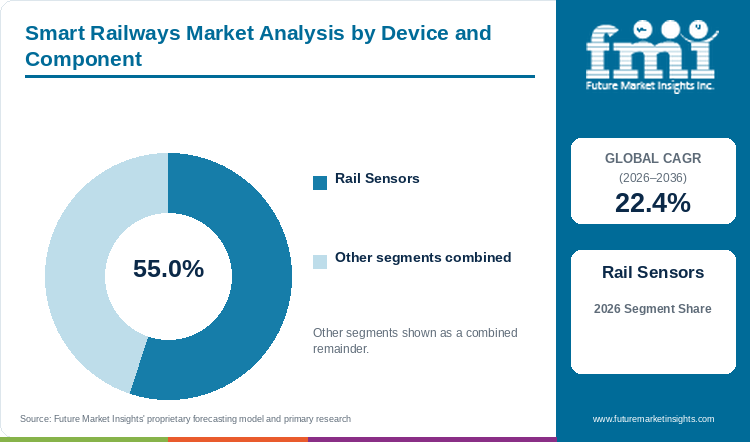
Rail sensors are expected to lead device and component sales with 55% share in 2026, ahead of networking and connectivity devices at an estimated 17.5%.
Table 4: Device and Component Share for the Smart Railways Market (percentage share), 2026
| Device and Component | Estimated Share (2026) |
|---|---|
| Rail Sensors | 55% |
| Networking and Connectivity Devices | 17.5% |
| Video Surveillance Cameras | 13% |
| Smart Cards | 9.5% |
| Others (Multimedia Displays) | 5% |
| Total | 100.0% |
Table 5: Device and Component Leadership and Market Growth for the Smart Railways Market (segment and CAGR percentage), 2026 to 2036
| Metric | Value |
|---|---|
| Global CAGR (2026 to 2036) | 22.4% |
| Leading Segment | Rail Sensors |
Every digital rail function starts with a measurement, so rail sensors account for the largest device share. FMI estimates rail sensors at 55% of 2026 device and component sales, more than three times networking and connectivity devices at 17.5%. Video surveillance cameras follow at 13%, as station security budgets grow, and the video surveillance market is projected to expand at a 10.7% CAGR through 2035. Smart cards hold 9.5% and multimedia displays 5%, since ticketing and display hardware is a smaller, mature purchase. Train protection programmes keep adding sensors on busy mainlines, especially in India. Kavach Version 4.0 now covers 1,306.3 route km across five Indian Railways zones [5]. Each protected section needs track-side tags and onboard readers, so sensor counts rise faster than track length through 2036.
- Axle counters, track circuits, balises, wheel and bearing monitors, and weather and structural sensors make up the rail sensors group.
- In India, station security now relies more and more on cameras and sensors. Video surveillance systems were commissioned at 1,731 railway stations, according to the Government of India [5]. Wider camera coverage creates a base for analytics sold on top of the hardware.
Why do rail communication and networking systems lead smart railways sales by system?
Rail communication and networking systems are expected to lead system sales with 28% share in 2026, ahead of railway traffic management systems at an estimated 22%.
Table 6: System Share for the Smart Railways Market (percentage share), 2026
| System | Estimated Share (2026) |
|---|---|
| Rail Communication and Networking Systems | 28% |
| Railway Traffic Management Systems | 22% |
| Passenger Information Systems | 15.5% |
| Rail Operations Management Systems | 12% |
| Advanced Security Management Systems | 9.5% |
| Smart Ticketing Systems | 8% |
| Others (Rail Analytics and Freight Information Systems) | 5% |
| Total | 100.0% |
Signalling, ticketing and passenger information all ride on one trackside data network, so communication systems lead the system mix. FMI places rail communication and networking systems at 28% of 2026 system sales, six points ahead of railway traffic management systems at 22%. Passenger information systems hold 15.5% and operations management 12%, as operators link timetables with live train positions. Security management at 9.5% and smart ticketing at 8% serve narrower budgets, and the smart card in government market is expected to reach USD 9.5 billion by 2036. Fibre backbones give the communication layer a wide reach across national rail networks. Cumulative optical fibre on Indian Railways reached about 67,233 route km as of October 2025 [5]. Long fibre routes of this kind let operators add radio, video and control traffic on one network, which keeps communication systems in the lead.
- Fibre backbones, trackside radio, train-to-ground links and station networks make up the communication and networking group.
- Digital train control in Europe runs over these networks, and ETCS covered around 10% of the TEN-T network at the end of 2024 [1]. Each new ETCS section needs secure radio and fibre links, so communication orders rise with every km upgraded.
Why do cloud services lead smart railways sales by service?
Cloud services are expected to lead service sales with 41% share in 2026, ahead of integration services at an estimated 33%.
Table 7: Service Share for the Smart Railways Market (percentage share), 2026
| Service | Estimated Share (2026) |
|---|---|
| Cloud Services | 41% |
| Integration Services | 33% |
| Professional Services | 26% |
| Total | 100.0% |
Operators want asset data, timetables and passenger feeds on shared platforms, so cloud services hold the largest service share. In FMI estimates, cloud services account for 41% of 2026 service sales, against 33% for integration services and 26% for professional services. Integration keeps a large share, since every signalling or ticketing upgrade has to connect with legacy systems. Professional services cover design, testing and safety approval, and this work grows with the number of projects. Hosted asset management is now a standard part of large rolling stock and signalling contracts. Hitachi Rail will fit HMAX asset management on the driverless trains for Turin Metro Line 2, under a contract signed in March 2026 [8]. Bundled data platforms of this kind create recurring fees after handover, which supports cloud services through the forecast period.
- Hosted asset management, timetable planning, passenger data platforms and remote diagnostics make up cloud services.
- Data products are now the fastest-growing business line inside large rail equipment groups. Wabtec Digital Intelligence sales rose 24.2% in the third quarter of 2026 [9]. Faster growth in software shows that operators are shifting budgets toward recurring service contracts.
What are the drivers, restraints, and opportunities in the smart railways market?
Legal deadlines and safety programmes push operators toward digital train control. High retrofit costs and fragmented specifications slow projects, and long lifecycle contracts open steady service sales.
- Driver: Regulators and rail ministries set firm dates for digital train control and protection, which turns upgrades into funded programmes with clear milestones.
- Restraint: Retrofit costs are high, and national variations in specifications raise engineering effort for each line, which delays awards on budget-limited networks.
- Opportunity: Long framework and maintenance contracts let suppliers sell software updates, data platforms and support across the full life of a signalling asset.
Legal Deadlines and Safety Programmes Drive Digital Train Control
Law and safety policy, more than traffic growth alone, drive digital rail orders. Under the TEN-T Regulation, ERTMS is due on the core network by 2030 and on the wider network by 2040 and 2050 [1]. Deadlines of this kind give European suppliers a fixed timetable of trackside and onboard work. India is moving on a similar path for safety reasons. Electrical and electronic interlocking had been provided at 6,660 stations as of December 2025 [5]. Interlocking upgrades prepare stations for centralised control, so further orders for traffic management systems are expected to follow.
Retrofit Costs and Fragmented Specifications Restrain Awards
On older European lines, the cost of retrofits is the main brake on digital rail adoption. A European Commission study found that fragmentation raises the cost of ERTMS trackside deployment and recommended alignment to reduce expense [4]. National variations force suppliers to redesign products for each network, which lengthens approval and raises bid prices. Order intake also swings from quarter to quarter, since a few large awards dominate each period. Alstom group orders fell 37% to EUR 2,560 million in the first quarter of 2026/27, against a strong prior-year quarter [6]. Even so, a backlog of EUR 102.8 billion cushions suppliers against such swings, and common specifications would speed awards.
Lifecycle Contracts Open Recurring Service Sales
Long framework contracts are changing how suppliers earn from digital rail. Siemens Mobility secured an extended maintenance contract of EUR 2.0 billion in the United Kingdom, reported with third-quarter results in August 2026 [7]. Maintenance awards of this size give suppliers steady sales across decades, beyond the original installation. Connected fleets also produce data that operators want analysed, and the railway telematics market is projected to grow at a 7.3% CAGR between 2026 and 2036. Suppliers that pair telematics with signalling support will gain share in renewals through 2036.
Which country CAGRs are profiled in the smart railways market?
Table 8: Country CAGR Comparison for the Smart Railways Market (CAGR percentage), 2026 to 2036
| Country | CAGR |
|---|---|
| China | 26.8% |
| India | 25.1% |
| GCC Countries | 23.9% |
| United States | 21.6% |
| Germany | 20.7% |
| United Kingdom | 19.8% |
| Japan | 18.9% |
How do country-level CAGRs compare in the smart railways market?
FMI projects China at 26.8%, 4.4 points above the 22.4% global CAGR, as new lines arrive with digital systems built in. India, at 25.1%, and GCC Countries, at 23.9%, gain from national safety and transit programmes. The United States at 21.6% and Germany at 20.7% sit close to the global pace, since much of the activity there involves upgrading existing networks. The United Kingdom at 19.8% and Japan at 18.9% close the table, as both already operate dense digital systems.
- Demand for communication and control systems in China stays high, as new high-speed lines arrive with integrated signalling.
- Sales of trackside and onboard units in India grow with each Kavach section, which opens repeat orders for local and global suppliers.
- Buyers of metro and mainline projects across GCC Countries plan digital lines from day one, so integrators can bid for complete systems.
- Use of analytics on existing train control is spreading among US freight railroads, which shifts sales toward software and data services.
- Key drivers of the smart railways market in Germany include ETCS deadlines, which give signalling suppliers multi-year workloads.
- Buyer preference for suppliers with large service teams shapes maintenance and resignalling contracts in the United Kingdom.
- Adoption of new control systems in Japan comes mainly from replacing older ones on a mature, highly automated network.
Full report country CAGRs cover: Japan at 18.9% and China at 26.8% mark the ends of a seven-country range, and regional tables add the other standard countries.
Country-wise Analysis
China Smart Railways Market Outlook (2026 to 2036)
China keeps adding high-speed lines at scale, and each new line arrives with digital signalling and communication systems. More than 3,100 km of new railway opened in 2025, including 2,862 km of high-speed rail [10]. New capacity of this size creates large first-fit orders for control and passenger systems. No profiled country outpaces China, which FMI projects at a 26.8% CAGR to 2036.
Key takeaway: Chinese rail operators will place the largest first-fit orders for signalling and communication systems, since every new high-speed line is built with them.
India Smart Railways Market Outlook (2026 to 2036)
India is pairing train protection with station upgrades, which widens the range of digital products bought by Indian Railways. Additional sanctioned Kavach works cover 2,667 route km, with execution underway, as of February 2026 [5]. Sanctioned work at this scale sustains orders for radios, tags and onboard units over several years. Demand for smart railway systems in India is projected to grow at a 25.1% CAGR as these works proceed.
Key takeaway: Indian Railways will keep buying Kavach radios, tags and onboard units through funded safety programmes, and suppliers that manufacture locally stand to win most of these orders.
GCC Countries Smart Railways Market Outlook (2026 to 2036)
Gulf states are building metro and mainline networks as part of wider transport plans, and new lines start with automated train control and digital passenger systems. Greenfield projects allow integrators to supply complete packages from signalling to ticketing. On this basis, GCC Countries are projected to grow at a 23.9% CAGR, ahead of the global rate.
Key takeaway: Transit authorities in GCC Countries are building new metro and mainline networks, so these authorities tend to buy complete digital packages from a single integrator.
United States Smart Railways Market Outlook (2026 to 2036)
Freight railroads in the United States already run train control, so new sales focus on analytics, fleet monitoring and data services. Transit agencies add communication-based control on urban lines, which adds more digital equipment to each project. Growth of the smart railways market in the United States is projected at a 21.6% CAGR.
Key takeaway: In the United States, freight railroads and transit agencies will spend most new money on software and analytics as basic train control is already installed.
Germany Smart Railways Market Outlook (2026 to 2036)
Germany combines a long ETCS retrofit with growing service contracts for new fleets. Siemens Mobility secured a long-term service contract of EUR 0.6 billion for battery-powered trains in Germany, reported in August 2026 [7]. Service awards of this kind tie digital monitoring to fleet maintenance for many years. With steady retrofit and service work, Germany is projected to grow at a 20.7% CAGR through 2036.
Key takeaway: German operators will keep ordering ETCS retrofits and long service contracts for new fleets, which gives signalling suppliers a steady flow of work.
United Kingdom Smart Railways Market Outlook (2026 to 2036)
The United Kingdom relies on resignalling and maintenance contracts to extend the life of a busy network. Siemens Mobility secured an extended maintenance contract of EUR 2.0 billion in the United Kingdom during the third quarter of fiscal 2026 [7]. Contracts of this scale favour suppliers with large service teams and remote diagnostics. With most work tied to renewals, the United Kingdom is projected to grow at a 19.8% CAGR, below the global rate.
Key takeaway: British rail owners mostly buy resignalling and maintenance services, so suppliers with large service teams will win more work there than those focused on new builds.
Japan Smart Railways Market Outlook (2026 to 2036)
Renewal of older control systems dominates upgrade work in Japan, which operates one of the most automated rail networks. Operators focus on predictive maintenance and passenger information to manage ageing assets with fewer staff. FMI projects Japan at an 18.9% CAGR, last in the country table, as most demand comes from renewals.
Key takeaway: Japanese operators will mainly buy replacements for older control systems and maintenance tools that save labour, as most of the network is already automated.
Who are the notable companies in the smart railways market?
Rail system integrators, signalling and control specialists, and network suppliers make up the profiled field, led by Siemens Mobility, Alstom and Hitachi Rail. Bombardier Transportation, Thales Group, General Electric (GE), Cisco Systems, Huawei Technologies, ABB Group and Indra Sistemas complete the list.
Top companies operating in the smart railways market combine signalling, rolling stock and lifecycle service, so competition centres on a few rail system groups. The profiled companies fall into three groups by role, with system integrators holding the widest reach in large tenders. Consolidation has reshaped the field, as Bombardier Transportation now operates within Alstom and the Thales ground transportation business moved to Hitachi Rail. Order backlogs at the largest rail groups remain deep, which supports steady deliveries. Alstom reported a backlog of EUR 102.8 billion at the end of June 2026 [6]. A backlog of this depth gives integrators pricing power, so network and ICT suppliers compete mainly on connectivity and security layers.
- Rail system integrators: Siemens Mobility, Alstom, Hitachi Rail and Bombardier Transportation.
- Signalling, electrification and control specialists: Thales Group, ABB Group, Indra Sistemas and General Electric (GE), which supply interlocking, power and control subsystems.
- Network and ICT suppliers: Cisco Systems and Huawei Technologies.
Competitive Benchmarking: Smart Railways Market
Table 9: Competitive Benchmarking for the Smart Railways Market (qualitative ratings), 2026
| Company | Signalling and Train Control | Rail Communication Networks | Lifecycle Services | Recent Activity |
|---|---|---|---|---|
| Siemens Mobility | High | High | High | High |
| Alstom | High | Medium | High | High |
| Hitachi Rail | High | Medium | High | High |
| Thales Group | Medium | High | Medium | Low |
| Indra Sistemas | Medium | Medium | Medium | Low |
| Cisco Systems | Low | High | Medium | Low |
| Huawei Technologies | Low | High | Medium | Low |
Ratings compare the companies on signalling and train control, rail communication networks, lifecycle services and recent activity.
Key Developments in the Smart Railways Market
- Wabtec reported Digital Intelligence sales of USD 369 million for the third quarter of 2026 on October 21, 2026, up 24.2%, a sign that data products now outgrow hardware lines [9].
- A European Commission study released on October 1, 2026 found that fragmentation raises ERTMS trackside costs, and recommended aligning engineering rules to reduce deployment costs [4].
- At InnoTrans 2026, Hitachi Rail secured a 30-year, EUR 1.3 billion framework contract from ÖBB for digital interlocking, alongside Siemens Mobility, securing decades of Austrian signalling work [2].
- On August 6, 2026, Siemens reported third-quarter Mobility revenue of EUR 3.2 billion, up 6% and driven mainly by rail infrastructure, which supports steady signalling deliveries [7].
- Signalling sales at Alstom reached EUR 625 million in the first quarter of 2026/27, reported in July 2026, so deliveries continue despite softer orders [6].
- In March 2026, Hitachi Rail signed a contract with the City of Turin for driverless trains and GoA4 CBTC signalling on Turin Metro Line 2, raising digital content in Italian urban rail [8].
- The European ERTMS Coordinator published the Third ERTMS Work Plan in February 2026 and called for industrial-scale deployment, which favours suppliers able to deliver standard designs in volume [1].
- On February 6, 2026, the Government of India reported Kavach on more than 2,200 route km, with 2,667 route km more sanctioned, extending train protection orders for several years [5].
Key Players in the Smart Railways Market
Rail System Integrators
- Siemens Mobility
- Alstom
- Hitachi Rail
- Bombardier Transportation
Signalling, Electrification and Control Specialists
- Thales Group
- ABB Group
- Indra Sistemas
- General Electric (GE)
Network and ICT Suppliers
- Cisco Systems
- Huawei Technologies
Smart Railways Market - Report Scope
Table 10: Report Scope for the Smart Railways Market (coverage fields and definitions), 2026 to 2036
| Coverage field | Report scope |
|---|---|
| Market breakdown | Device and component; system; service; region |
| Quantitative units | USD billion |
| Market definition | Digital devices, systems and services that monitor, control and connect railway networks, including rail sensors, communication networks, traffic management, passenger information, security, ticketing and related cloud, integration and professional services. |
| Regions covered | North America; Latin America; Western Europe; Eastern Europe; East Asia; South Asia and Pacific; Middle East and Africa |
| Countries covered | China; India; GCC Countries; United States; Germany; United Kingdom; Japan |
| Key companies profiled | Siemens Mobility, Alstom, Hitachi Rail, Bombardier Transportation, Thales Group, General Electric (GE), Cisco Systems, Huawei Technologies, ABB Group, Indra Sistemas |
| Forecast period | 2026 to 2036 |
Smart Railways Market - Research Methodology
Table 11: Research Methodology for the Smart Railways Market (research methods and approach), 2026 edition
| Method | Approach |
|---|---|
| Data Sources | Company results, industry associations, government statistics and trade publications. |
| Desk Research | Desk research covers digital signalling, train protection, rail communication networks, passenger systems and lifecycle services. |
| Market Sizing | Market size is built from device, system and service sales across regions and countries. |
| Data Validation | Figures are cross-checked across company, industry and government sources. |
Smart Railways Market by Segments
Smart Railways Market segmented by Device and Component:
- Rail Sensors
- Video Surveillance Cameras
- Smart Cards
- Networking and Connectivity Devices
- Others (Multimedia Displays)
Smart Railways Market segmented by System:
- Passenger Information Systems
- Railway Traffic Management Systems
- Advanced Security Management Systems
- Smart Ticketing Systems
- Rail Operations Management Systems
- Rail Communication and Networking Systems
- Others (Rail Analytics and Freight Information Systems)
Smart Railways Market segmented by Service:
- Professional Services
- Cloud Services
- Integration Services
Smart Railways Market by Region
- North America
- United States
- Canada
- Latin America
- Brazil
- Mexico
- Argentina
- Chile
- Western Europe
- Germany
- France
- United Kingdom
- Italy
- Spain
- Benelux
- Nordics
- Eastern Europe
- Poland
- Czech Republic
- Romania
- Hungary
- East Asia
- China
- Japan
- South Korea
- South Asia and Pacific
- India
- ASEAN
- Australia and New Zealand
- Middle East and Africa
- GCC Countries
- South Africa
- Türkiye
- Israel
Research Sources and Bibliography
- [1] European Union Agency for Railways. (2026, February 24). Third ERTMS Work Plan: deployment progressing, but further acceleration required. https://www.era.europa.eu/content/third-ertms-work-plan-deployment-progressing-further-acceleration-required
- [2] Railway-News. (2026, September 28). Hitachi Rail Partners with ÖBB for Digitalisation of Austrian Signalling Infrastructure. https://railway-news.com/hitachi-rail-partners-with-obb-for-digitalisation-of-austrian-signalling-infrastructure/
- [3] People's Daily. (2026, August 17). China's railway investment in Jan-July rises 1.8 pct as key projects progress. https://english.henan.gov.cn/2026/08-17/3399994.html
- [4] European Commission, Directorate-General for Mobility and Transport. (2026, October 1). New study finds fragmentation raises costs of ERTMS trackside deployment, recommends alignment to reduce expense. https://transport.ec.europa.eu/news-events/news/new-study-finds-fragmentation-raises-costs-ertms-trackside-deployment-recommends-alignment-reduce-2026-10-01_en
- [5] Press Information Bureau, Government of India. (2026, February 6). On Safer Tracks: How Kavach and AI Are Strengthening Railway Safety in India. https://static.pib.gov.in/WriteReadData/specificdocs/documents/2026/feb/doc202626781101.pdf
- [6] Alstom. (2026, July 22). Alstom's first quarter 2026/27. https://www.alstom.com/press-releases-news/2026/7/alstoms-first-quarter-202627
- [7] Siemens AG. (2026, August 6). Record third quarter - Outlook raised. https://press.siemens.com/global/en/pressrelease/record-third-quarter-outlook-raised
- [8] Hitachi, Ltd. (2026, March 4). Hitachi Rail and the City of Turin sign contract for Metro Line 2. https://www.hitachi.com/New/cnews/month/2026/03/260305.html
- [9] Wabtec Corporation. (2026, October 21). Wabtec Reports Strong Third Quarter 2026 Results. https://www.sec.gov/Archives/edgar/data/0000943452/000094345226000017/a3q26pressreleaseword.htm
- [10] China Daily. (2026, January 5). High-speed rail's rapid rise rolls on. https://english.henan.gov.cn/2026/01-05/3282536.html
This bibliography is provided for reader reference. The full report contains the complete reference list and detailed citations.
This Report Answers
- How big is the smart railways market during 2026?
- What market size is projected by 2036?
- Which device and component holds notable share?
- Which system holds notable share?
- Which countries have notable growth?
- Which companies are notable in the market?
Frequently Asked Questions
How large is the smart railways market expected in 2026?
Operators are funding signalling and train protection programmes, and FMI estimates the smart railways market at USD 149.0 billion in 2026, up from USD 121.7 billion in 2025.
What CAGR is projected for the smart railways market through 2036?
Legal deadlines and safety programmes keep digital upgrades funded, so a 22.4% CAGR is projected from 2026 to 2036, reaching USD 1,124.5 billion.
Which device and component holds a notable market share in 2026?
Rail sensors are expected to hold 55% of device and component sales in 2026, as every signalling and monitoring function depends on trackside and onboard measurement.
Which system holds a notable market share in 2026?
Rail communication and networking systems are likely to account for 28% of system sales in 2026, as signalling, ticketing and passenger data share one network.
Which country has a notable expansion outlook through 2036?
China leads the FMI country outlook at a 26.8% CAGR, as new high-speed lines arrive with integrated digital systems.
Who are the key companies in the smart railways market?
Siemens Mobility, Alstom and Hitachi Rail lead as rail system integrators, supported by Thales Group, ABB Group, Indra Sistemas, Cisco Systems and Huawei Technologies, since lifecycle contracts favour suppliers with signalling and service depth.
Preview the report firsthand - request a free sample
Get SampleGet the brochure for pricing and purchase details.
Get PDFTable of Content
- Key Takeaways
- Market Size and CAGR
- Top Growth Driver
- Fastest Growing Segment
- Leading Region
- Key Companies
- Emerging Opportunities
- Executive Summary
- Global Market Outlook
- Demand-side Trends
- Supply-side Trends
- Technology Roadmap Analysis
- Analysis and Recommendations
- Analyst Perspective (What is happening? Why now? What should investors know?)
- Key Questions Answered
- How large is the market?
- What is the CAGR?
- What are key trends?
- Which region dominates?
- Who are the leaders?
- Market Overview
- Market Coverage / Taxonomy
- Market Definition / Scope / Limitations
- Research Methodology
- Chapter Orientation
- Analytical Lens and Working Hypotheses
- Market Structure, Signals, and Trend Drivers
- Benchmarking and Cross-market Comparability
- Market Sizing, Forecasting, and Opportunity Mapping
- Research Design and Evidence Framework
- Desk Research Programme (Secondary Evidence)
- Expert Input and Fieldwork (Primary Evidence)
- Tooling, Models, and Reference Databases
- Data Engineering and Model Build
- Quality Assurance and Audit Trail
- Market Background
- Market Dynamics (Drivers, Restraints, Opportunity, Trends)
- Scenario Forecast (Optimistic, Likely, Conservative)
- Impact Analysis
- AI Impact
- Sustainability Impact
- Regulatory Impact
- Technology Impact
- Consumer / Buyer Analysis
- Purchase Drivers
- Adoption Barriers
- Buyer Journey
- Opportunity Map Analysis
- Product Life Cycle Analysis
- Supply Chain Analysis
- Investment Feasibility Matrix
- Value Chain Analysis
- PESTLE and Porter's Analysis
- Regulatory Landscape
- Regional Parent Market Outlook
- Production and Consumption Statistics
- Import and Export Statistics
- Global Market Analysis and Forecast, 2021 to 2036
- Historical Market Size Value (USD Billion) Analysis, 2021 to 2025
- Current and Future Market Size Value (USD Billion) Projections, 2026 to 2036
- Y-o-Y Growth Trend Analysis
- Absolute $ Opportunity Analysis
- Global Market Pricing Analysis, 2021 to 2036
- Global Market Analysis and Forecast, By Device and Component, 2021 to 2036
- Introduction / Key Findings
- Historical Market Size Value (USD Billion) Analysis By Device and Component, 2021 to 2025
- Current and Future Market Size Value (USD Billion) Analysis and Forecast By Device and Component, 2026 to 2036
- Rail Sensors
- Video Surveillance Cameras
- Smart Cards
- Networking and Connectivity Devices
- Others (Multimedia Displays)
- Y-o-Y Growth Trend Analysis By Device and Component, 2021 to 2025
- Absolute $ Opportunity Analysis By Device and Component, 2026 to 2036
- Global Market Analysis and Forecast, By System, 2021 to 2036
- Introduction / Key Findings
- Historical Market Size Value (USD Billion) Analysis By System, 2021 to 2025
- Current and Future Market Size Value (USD Billion) Analysis and Forecast By System, 2026 to 2036
- Passenger Information Systems
- Railway Traffic Management Systems
- Advanced Security Management Systems
- Smart Ticketing Systems
- Rail Operations Management Systems
- Rail Communication and Networking Systems
- Others (Rail Analytics and Freight Information Systems)
- Y-o-Y Growth Trend Analysis By System, 2021 to 2025
- Absolute $ Opportunity Analysis By System, 2026 to 2036
- Global Market Analysis and Forecast, By Service, 2021 to 2036
- Introduction / Key Findings
- Historical Market Size Value (USD Billion) Analysis By Service, 2021 to 2025
- Current and Future Market Size Value (USD Billion) Analysis and Forecast By Service, 2026 to 2036
- Professional Services
- Cloud Services
- Integration Services
- Y-o-Y Growth Trend Analysis By Service, 2021 to 2025
- Absolute $ Opportunity Analysis By Service, 2026 to 2036
- Global Market Analysis and Forecast, By Region, 2021 to 2036
- Introduction
- Historical Market Size Value (USD Billion) Analysis By Region, 2021 to 2025
- Current Market Size Value (USD Billion) Analysis and Forecast By Region, 2026 to 2036
- North America
- Latin America
- Western Europe
- Eastern Europe
- East Asia
- South Asia and Pacific
- Middle East and Africa
- Market Attractiveness Analysis By Region
- North America Market Analysis and Forecast, By Country, 2021 to 2036
- Historical Market Size Value (USD Billion) Trend Analysis By Market Taxonomy, 2021 to 2025
- Market Size Value (USD Billion) Forecast By Market Taxonomy, 2026 to 2036
- By Country
- United States
- Canada
- By Device and Component
- By System
- By Service
- By Country
- Market Attractiveness Analysis
- By Country
- By Device and Component
- By System
- By Service
- Key Takeaways
- Latin America Market Analysis and Forecast, By Country
- Historical Market Size Value (USD Billion) Trend Analysis By Market Taxonomy, 2021 to 2025
- Market Size Value (USD Billion) Forecast By Market Taxonomy, 2026 to 2036
- By Country
- Brazil
- Mexico
- Argentina
- Chile
- By Device and Component
- By System
- By Service
- By Country
- Market Attractiveness Analysis
- By Country
- By Device and Component
- By System
- By Service
- Key Takeaways
- Western Europe Market Analysis and Forecast, By Country
- Historical Market Size Value (USD Billion) Trend Analysis By Market Taxonomy, 2021 to 2025
- Market Size Value (USD Billion) Forecast By Market Taxonomy, 2026 to 2036
- By Country
- Germany
- France
- United Kingdom
- Italy
- Spain
- Benelux
- Nordics
- By Device and Component
- By System
- By Service
- By Country
- Market Attractiveness Analysis
- By Country
- By Device and Component
- By System
- By Service
- Key Takeaways
- Eastern Europe Market Analysis and Forecast, By Country
- Historical Market Size Value (USD Billion) Trend Analysis By Market Taxonomy, 2021 to 2025
- Market Size Value (USD Billion) Forecast By Market Taxonomy, 2026 to 2036
- By Country
- Poland
- Czech Republic
- Romania
- Hungary
- By Device and Component
- By System
- By Service
- By Country
- Market Attractiveness Analysis
- By Country
- By Device and Component
- By System
- By Service
- Key Takeaways
- East Asia Market Analysis and Forecast, By Country
- Historical Market Size Value (USD Billion) Trend Analysis By Market Taxonomy, 2021 to 2025
- Market Size Value (USD Billion) Forecast By Market Taxonomy, 2026 to 2036
- By Country
- China
- Japan
- South Korea
- By Device and Component
- By System
- By Service
- By Country
- Market Attractiveness Analysis
- By Country
- By Device and Component
- By System
- By Service
- Key Takeaways
- South Asia and Pacific Market Analysis and Forecast, By Country
- Historical Market Size Value (USD Billion) Trend Analysis By Market Taxonomy, 2021 to 2025
- Market Size Value (USD Billion) Forecast By Market Taxonomy, 2026 to 2036
- By Country
- India
- ASEAN
- Australia and New Zealand
- By Device and Component
- By System
- By Service
- By Country
- Market Attractiveness Analysis
- By Country
- By Device and Component
- By System
- By Service
- Key Takeaways
- Middle East and Africa Market Analysis and Forecast, By Country
- Historical Market Size Value (USD Billion) Trend Analysis By Market Taxonomy, 2021 to 2025
- Market Size Value (USD Billion) Forecast By Market Taxonomy, 2026 to 2036
- By Country
- GCC Countries
- South Africa
- Türkiye
- Israel
- By Device and Component
- By System
- By Service
- By Country
- Market Attractiveness Analysis
- By Country
- By Device and Component
- By System
- By Service
- Key Takeaways
- Key Countries Market Analysis
- United States
- Pricing Analysis
- Market Share Analysis, 2025
- By Device and Component
- By System
- By Service
- Canada
- Pricing Analysis
- Market Share Analysis, 2025
- By Device and Component
- By System
- By Service
- Mexico
- Pricing Analysis
- Market Share Analysis, 2025
- By Device and Component
- By System
- By Service
- Brazil
- Pricing Analysis
- Market Share Analysis, 2025
- By Device and Component
- By System
- By Service
- Chile
- Pricing Analysis
- Market Share Analysis, 2025
- By Device and Component
- By System
- By Service
- Germany
- Pricing Analysis
- Market Share Analysis, 2025
- By Device and Component
- By System
- By Service
- United Kingdom
- Pricing Analysis
- Market Share Analysis, 2025
- By Device and Component
- By System
- By Service
- Italy
- Pricing Analysis
- Market Share Analysis, 2025
- By Device and Component
- By System
- By Service
- Spain
- Pricing Analysis
- Market Share Analysis, 2025
- By Device and Component
- By System
- By Service
- France
- Pricing Analysis
- Market Share Analysis, 2025
- By Device and Component
- By System
- By Service
- India
- Pricing Analysis
- Market Share Analysis, 2025
- By Device and Component
- By System
- By Service
- ASEAN
- Pricing Analysis
- Market Share Analysis, 2025
- By Device and Component
- By System
- By Service
- Australia and New Zealand
- Pricing Analysis
- Market Share Analysis, 2025
- By Device and Component
- By System
- By Service
- China
- Pricing Analysis
- Market Share Analysis, 2025
- By Device and Component
- By System
- By Service
- Japan
- Pricing Analysis
- Market Share Analysis, 2025
- By Device and Component
- By System
- By Service
- South Korea
- Pricing Analysis
- Market Share Analysis, 2025
- By Device and Component
- By System
- By Service
- Poland
- Pricing Analysis
- Market Share Analysis, 2025
- By Device and Component
- By System
- By Service
- Hungary
- Pricing Analysis
- Market Share Analysis, 2025
- By Device and Component
- By System
- By Service
- Türkiye
- Pricing Analysis
- Market Share Analysis, 2025
- By Device and Component
- By System
- By Service
- South Africa
- Pricing Analysis
- Market Share Analysis, 2025
- By Device and Component
- By System
- By Service
- GCC Countries
- Pricing Analysis
- Market Share Analysis, 2025
- By Device and Component
- By System
- By Service
- United States
- Market Structure Analysis
- Competition Dashboard
- Competition Benchmarking
- Market Share Analysis of Top Players
- By Regional
- By Device and Component
- By System
- By Service
- Emerging Startups
- Innovation Benchmarking
- Competition Analysis
- Competition Deep Dive
- Siemens Mobility
- Overview
- Product Portfolio
- Profitability by Market Segments
- Sales Footprint
- Strategy Overview
- Marketing Strategy
- Product Strategy
- Channel Strategy
- Alstom
- Hitachi Rail
- Thales Group
- Indra Sistemas
- Cisco Systems
- Huawei Technologies
- Bombardier Transportation
- ABB Group
- General Electric (GE)
- Siemens Mobility
- Case Studies
- Success Stories
- Recent Developments
- Competition Deep Dive
- Assumptions & Acronyms Used


