


By Nikhil Kaitwade
Aerographite is back in focus as aerospace primes and satellite builders hunt grams. Launch pricing remains tied to kilograms, so ultralight conductive materials draw budget attention. The market now sits at the junction of weight, shielding, and manufacturability.
What is shaping the Aerographite Market right now
- Every kilogram matters in orbit.
- Aerographite's origin story still anchors its value case.
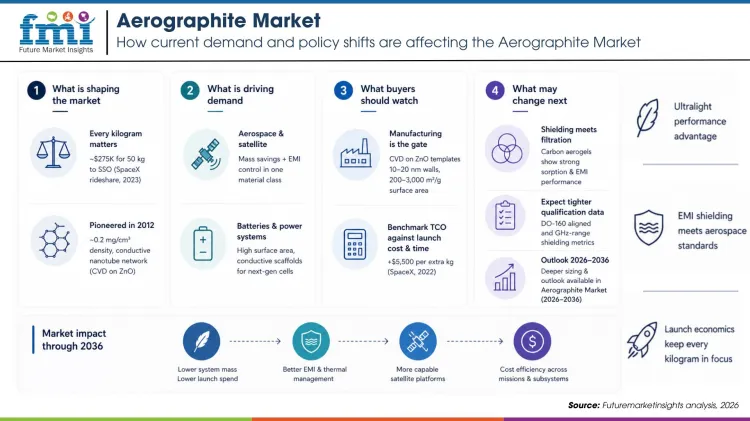
Every kilogram matters in orbit. The International Telecommunication Union's 2023 Small Satellites Handbook cites SpaceX rideshare list pricing of about $275,000 for 50 kilograms to sun-synchronous. Lighter structures and components cut recurring launch costs today, not in a distant horizon.
Aerographite's origin story still anchors its value case. Kiel University and Hamburg University of Technology reported the material in July 2012 with a density near 0.2 mg/cm3 and a conductive, resilient nanotube network produced by chemical vapor deposition on ZnO templates. Physics Today and the Kiel release set the benchmark for lightness and structural elasticity that current buyers reference in R&D screens.
What is driving demand in the Aerographite Market
- Aerospace and satellite programs seek mass savings and electromagnetic control in one material class.
- Battery and power subsystems push parallel demand.
Aerospace and satellite programs seek mass savings and electromagnetic control in one material class. RTCA DO-160 environmental and EMI test regimes keep pressure on avionics suppliers to manage emissions and shielding without heavy metal enclosures. Lightweight carbon architectures and aerogels show strong shielding efficacy across GHz bands, with recent studies reporting 60 dB class EMI performance from thin carbon.
Battery and power subsystems push parallel demand. Research on carbon aerogels and graphene-based aerogels in lithium-sulfur systems highlights high surface area, conductive scaffolds that stabilize high energy cathodes. The technical pathway is transferable to aerographite because of similar pore networks and conductivity targets, keeping the material on shortlists for advanced cell packaging where structural and electrical roles converge.
What should buyers watch in the Aerographite Market
- Manufacturing remains the gating factor.
- Benchmark total cost of ownership against launch pricing and qualification time.
Manufacturing remains the gating factor. TUHH documents nanoporous materials with internal surface area in the 200 to 3,000 m2/g range, and outlines pilot-scale capability that informs cost curves for carbon. Buyers should verify supplier control over ZnO template CVD routes and reproducible wall thickness in the 10-20 nm range.
Benchmark total cost of ownership against launch pricing and qualification time. Even modest mass cuts can be material. CNBC's pricing update in March 2022 logged a rideshare base increase and a move to $5,500 per extra kilogram, while later ITU guidance captured common plate pricing. Programs that lock lighter bills of material before critical design reviews reduce both launch line items and vibration qualification risk tied to heavier assemblies.
What may change next in the Aerographite Market
- Shielding and filtration use cases are converging as civil operators test carbon aerogels for environmental services.
- Expect tighter qualification data.
- For deeper segment sizing and the 2026 to 2036 outlook, see Aerographite Market at Aerographite Market (2026 - 2036).
Shielding and filtration use cases are converging as civil operators test carbon aerogels for environmental services. Peer-reviewed work continues to show strong sorption and shielding performance from carbon aerogel classes, strengthening the case for aerographite variants in municipal. Cross-sector volume would support steadier CVD utilization and lower per-unit costs for aerospace buyers.
Expect tighter qualification data. As more satellite buses stack EMI, thermal, and structural duties into single ultralight parts, program managers will ask for DO-160 aligned evidence and GHz-range shielding metrics from carbon networks, metal meshes. When that data arrives from flight heritage and extended ground tests, purchasing rules will shift toward multi-function nanocarbon parts.
For deeper segment sizing and the 2026 to 2036 outlook, see Aerographite Market at Aerographite Market (2026 - 2036).
Bibliography
- https://www.uni-kiel.de/aktuell/pm/2012/2012-212-aerographit-e.shtml
- https://physicstoday.aip.org/news/new-material-is-one-sixth-as-heavy-as-air
- https://www.itu.int/dms_pub/itu-r/opb/hdb/R-HDB-65-2023-PDF-E.pdf
- https://en.wikipedia.org/wiki/DO-160
- https://arxiv.org/abs/2108.10016
- https://www.tuhh.de/v8/research/nanoporous-materials
- https://en.wikipedia.org/wiki/Aerographite
- https://www.cnbc.com/2022/03/23/spacex-raises-prices-for-launches-and-starlink-due-to-inflation.html
- https://www.sciencedirect.com/science/article/pii/S0008622322008016
- https://pubs.acs.org/doi/10.1021/acsaem.3c00177

