

- Market Size (2026)
- USD 0.8 Bn
- Forecast (2036)
- USD 1.9 Bn
- CAGR (2026 to 2036)
- 9.3%
Anti-Microbial and Anti-Allergen Floor Coating Systems Market Size, Market Forecast and Outlook By FMI
The anti-microbial and anti-allergen floor coating systems market was valued at USD 0.7 billion in 2025 and is estimated at USD 0.8 billion in 2026. The industry is forecast to reach USD 1.9 billion by 2036 at 9.3% CAGR. Jointless poured floors are projected to lead installation format demand with 48.0% share in 2026.
Summary of the Anti-Microbial and Anti-Allergen Floor Coating Systems Market
- Demand and Growth Drivers
- Demand is being supported by hospital and school flooring replacement where cleaning access and odor control shape project specifications.
- Healthcare use is attributable to infection prevention programs because floor joints and damaged surfaces complicate routine cleaning.
- Demand in schools or education facilities is driven by indoor air quality plans as asthma remains a named concern for facility managers.
- Coating suppliers are gaining specification access when they provide low volatile organic compound data and cleaning chemical resistance.
- Product and Segment View
- Epoxy systems are projected to account for 37.0% share in 2026 because installers know the chemistry well.
- Antimicrobial films are expected to hold 42.0% share of functional claims as suppliers focus on coating preservation.
- Hospitals and clinics are forecast to account for 31.0% share in 2026 due to cleaning and repair cycles.
- Geography and Competitive Outlook
- India is expected to record 10.4% CAGR during the forecast period as hospital empanelment and health infrastructure widen floor renewal needs.
- The United Kingdom is projected at 9.7% CAGR through 2036 as school and hospital repair programs remain active.
- Companies such as Sherwin-Williams and Sika shape specification depth through resin flooring systems and published product data for institutional projects.
- MAPEI and RPM International compete through polyurethane cement and resin floor systems for food and healthcare spaces.
- Analyst Opinion
- Nikhil Kaitwade of FMI says, “The growth opportunity in floor coatings is driven by specification-based demand. I expect the market to shift toward solutions that enable faster cleaning cycles and improved indoor air quality, while remaining compliant with regulatory limits on health-related claims. Institutional tenders are likely to favor suppliers who communicate product capabilities with clarity and avoid overstating antimicrobial performance.”
- Anti-Microbial and Anti-Allergen Floor Coating Systems Market Value Analysis
- The market is moving from general resin flooring into claim-led systems used in hospitals and schools.
- Demand for antimicrobial coatings is expanding as buyers prioritize compliant solutions, with adoption increasing where claims are legally validated and clearly tied to surface performance. Protective antimicrobial coatings for high-touch surfaces face similar proof needs around treated surfaces.
- Anti-allergen floor coatings are gaining traction driven by low-VOC formulations that align with indoor air quality programs in schools and healthcare facilities Low-odor specifications also use low-VOC industrial coatings logic when indoor work needs emission control.
- Demand for advanced resin flooring formats is increasing with the shift toward jointless and smooth-surface systems.
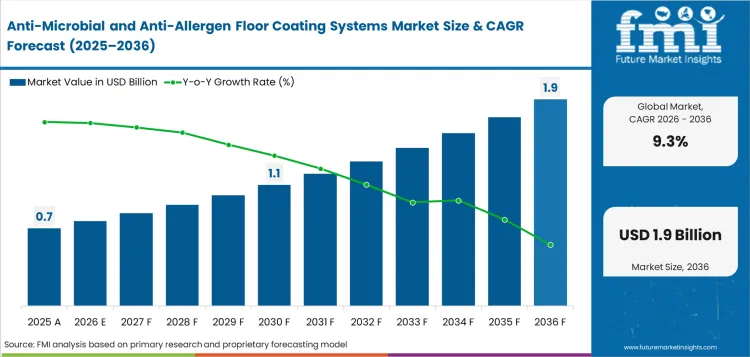
Key Takeaways, Market Size, and Forecast
- The anti-microbial and anti-allergen floor coating systems market was valued at USD 0.7 billion in 2025.
- By 2036, the market is expected to be worth USD 1.9 billion as hygiene floor renewal widens.
- From 2026 to 2036, the market is projected to expand at 9.3% CAGR under FMI analysis.
- The market is projected to create an incremental opportunity of USD 1.1 billion between 2026 and 2036.
- Jointless poured floors are projected to account for 48.0% share in 2026.
- Specification-led contractors are expected to account for 45.0% share by sales model in 2026.
- India at 10.4% CAGR and the United Kingdom at 9.7% CAGR is expected to show notable demand outlook through 2036.
Antimicrobial claims need careful handling because treated articles cannot imply public health protection unless the product is registered for that claim. The United States Environmental Protection Agency states antimicrobial treated paints may claim protection of the dried paint film when the claim stays within treated article limits. Anti-allergen value depends on low odor installation and smooth surfaces that hold less dust than cracked tile joints. The United States Environmental Protection Agency states that people spend about 90% of their time indoors.
Anti-Microbial and Anti-Allergen Floor Coating Systems Market Definition
The Anti-Microbial and Anti-Allergen Floor Coating Systems Market covers liquid-applied and trowel-applied resin systems used on floors where hygiene claims or allergen control shape the specification. Scope includes epoxy systems and polyurethane cement used on floors in institutional buildings. It also includes methyl methacrylate acrylic and polyaspartic systems used in commercial or institutional settings. The market includes systems that help protect the coating film from microbial staining or odor. It also includes low odor and smooth cleanable surfaces that reduce dust catch points for allergy-sensitive spaces. Epoxy paint chemistry is important when chemical resistance and surface protection shape floor specifications.
Anti-Microbial and Anti-Allergen Floor Coating Systems Market Inclusions
Market scope covers coating systems sold with antimicrobial film protection, mold resistance or low volatile organic compound documentation. Included uses cover hospitals and clinics where cleaning and repair timing influence product choice. They also cover schools and childcare centers. They further cover food plants, labs and aged care buildings. Revenue includes primers and broadcast layers used in complete resin floor systems. It also includes body coats, antimicrobial topcoats and coving materials sold as part of a floor system. Contractor-applied systems are included when material value can be separated from labor. Coating additives support formulation changes as suppliers need stain control or application performance.
Anti-Microbial and Anti-Allergen Floor Coating Systems Market Exclusions
Scope does not include loose flooring or ceramic tile. It also excludes vinyl sheet goods and standard decorative paint used without hygiene floor claims. Claims tied only to cleaning chemicals are excluded because the coating system itself is not the active product. Public health disinfection claims are excluded unless the coating carries the proper pesticide registration for that use. General concrete repair and waterproofing work is excluded unless hygiene or allergen control is part of the specification.
Anti-Microbial and Anti-Allergen Floor Coating Systems Market Research Methodology
- Primary Research: FMI analysts reviewed floor coating specifications, supplier portfolios and installer feedback across institutional repair projects.
- Desk Research: The study used public data from health agencies and national statistics offices. The study also used regulator pages and official supplier technical pages published after January 2024.
- Market sizing and forecasting: Market size was estimated through bottom-up installation value and top-down checks against related coatings.
- Data validation: Forecast checks compared hospital spending and public construction activity. They also reviewed resin flooring signals and antimicrobial claim rules for public tenders.
Why is the Anti-Microbial and Anti-Allergen Floor Coating Systems Market Growing?
- Hospitals are replacing damaged floors where cracks and joints make cleaning harder for environmental services staff.
- Schools are using low odor coatings where indoor air programs connect flooring work with asthma risk control.
- Food and pharmaceutical facilities are specifying polyurethane cement floors where washdown and cleaning chemicals are routine.
Floor renewal is moving closer to infection prevention and indoor air planning in hospitals and schools. In March 2024, the Centers for Disease Control and Prevention stated that healthcare environmental cleaning programs require cleaning supplies and management oversight. That guidance makes the floor surface part of a wider cleaning system that depends on smooth seams and documented maintenance steps. Chemical resistant coating requirements are close to food and pharmaceutical floor use since cleaning fluids affect wear.
Demand in schools or institutions is also rising because indoor air concerns now influence renovation material choices. In September 2025, the United States Environmental Protection Agency stated that nearly 1 in 13 school-age children has asthma and that allergens such as dust mites, pests and mold are common in schools. Low odor floor coatings and smooth surface finishes support these projects when renewal work must fit short closure windows. Fast return systems gain preference when contractors can document VOC emissions and cleaning compatibility before work begins.
Market Segmentation Analysis
- Epoxy systems are projected to reach 37.0% share in 2026 as contractors rely on proven resin flooring workflows.
- Antimicrobial films are expected to represent 42.0% share in 2026 because surface preservation claims remain the safest route.
- Hospitals and clinics are forecast to account for 31.0% share in 2026 due to frequent cleaning and repair cycles.
- Jointless poured floors are projected to capture 48.0% share in 2026 as facility managers seek fewer dirt catch points.
- Specification-led contractors are estimated to hold 45.0% share in 2026 because product selection often happens before bidding.
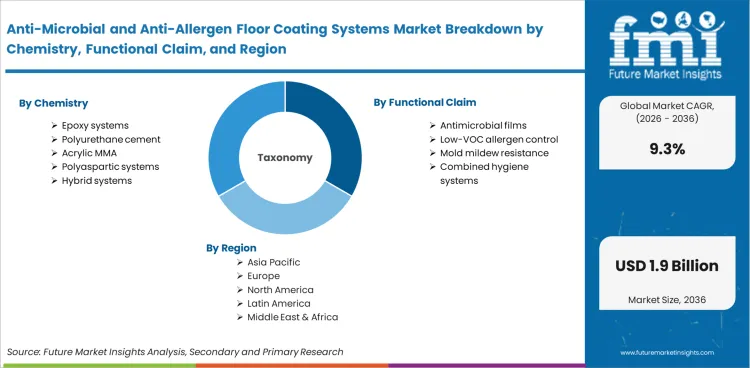
The market is divided into five primary segment groups based on chemistry and functional claim. It also covers end use, installation format and sales model for project planning. Chemistry shows how the system performs under wear and cleaning exposure after installation. Functional claim explains how the system is positioned to the facility owner during specification. End use and installation format show where the system is placed and why the project carries a hygiene premium.
Insights into the Epoxy Systems Chemistry Segment
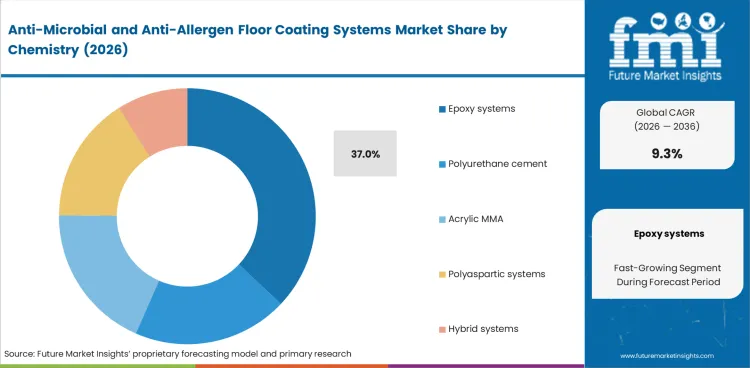
- Epoxy systems are projected to account for 37.0% share of chemistry demand in 2026. Contractors use them in hospitals and labs because surface preparation and cure behavior are familiar.
- Polyurethane cement follows closely where hot water washdown and thermal shock are expected in food plants. Acrylic methyl methacrylate systems win smaller jobs where rapid return matters more than odor sensitivity. Epoxy curing agent selection affects cure speed and resistance in resin flooring systems.
Insights into the Antimicrobial Films Functional Claim Segment
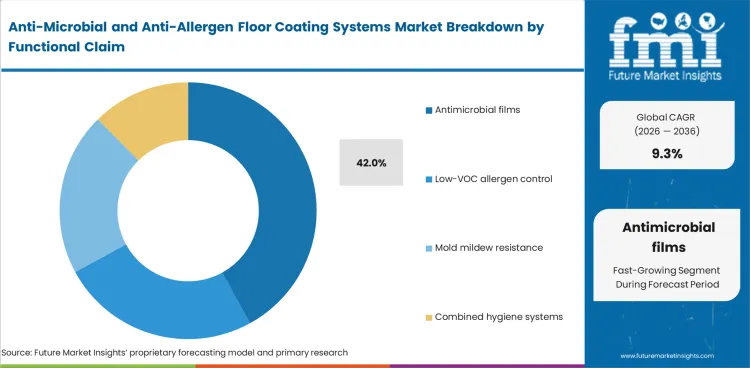
- Antimicrobial films are expected to account for 42.0% share of functional claim demand in 2026. These claims usually focus on the coated surface and its resistance to staining or odor organisms.
- Low volatile organic compound allergen control claims remain important in schools and health buildings during repair work.
Insights into the Hospitals and Clinics End Use Segment
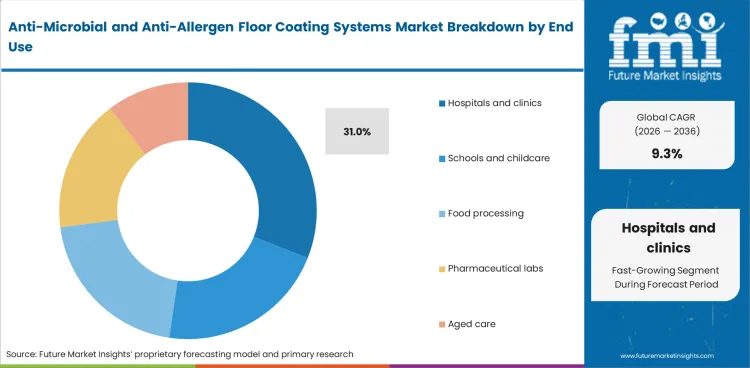
- Hospitals and clinics are forecast to account for 31.0% share in 2026. Cleaning intensity and repair downtime make flooring choices more visible in healthcare budgets during planned maintenance.
- Schools and childcare centers form the next major use group because indoor air planning affects product choice. Their projects often value low odor installation and a smooth finish that is easier to clean after daily use.
Insights into the Jointless Poured Floors Installation Format Segment
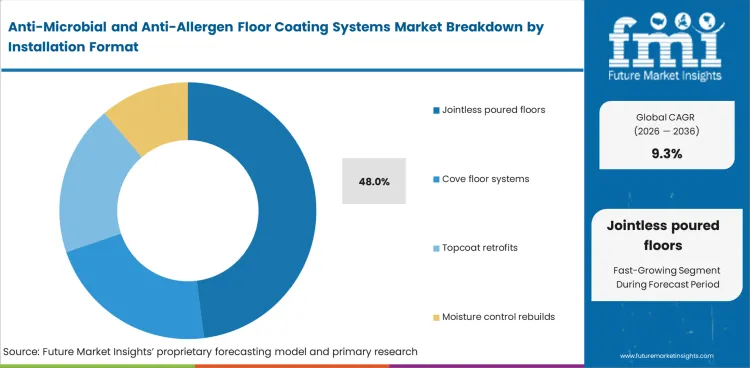
- Jointless poured floors are projected to account for 48.0% share in 2026. Smooth poured systems reduce grout lines and damaged seams that collect soil after daily building use.
- Cove floor systems serve areas where wall and floor joints need easier cleaning after spills. Topcoat retrofits remain useful when the existing base is sound and project time is short.
Insights into the Specification-Led Contractors Sales Model Segment
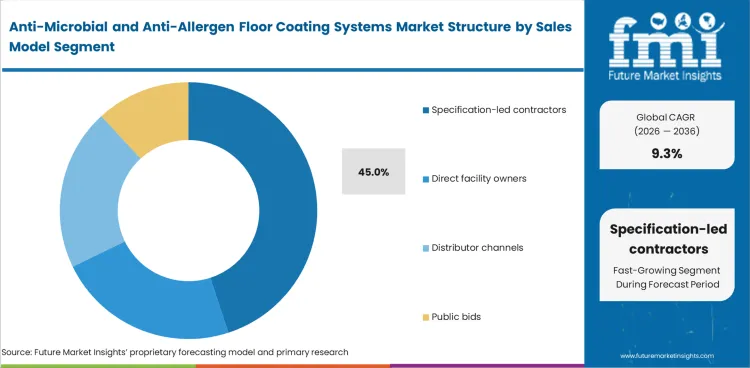
- Specification-led contractors are estimated to account for 45.0% share of sales model demand in 2026. Facility owners often rely on installers to match resin systems with cleaning needs and closure windows.
- Direct facility owner buying is more common in repeat hospital and school programs with known specifications.
Anti-Microbial and Anti-Allergen Floor Coating Systems Market Drivers, Restraints, and Opportunities
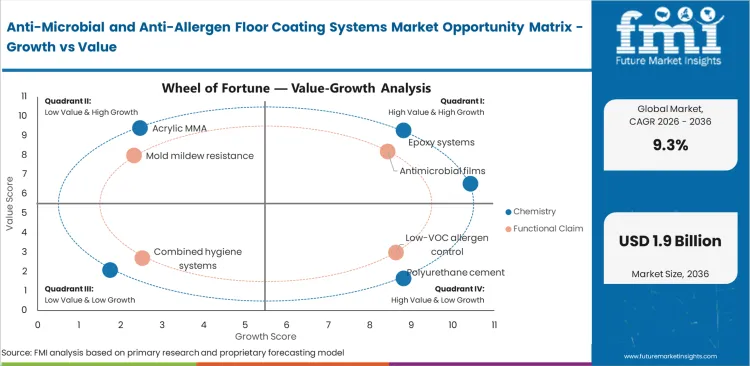
- Hygiene-led repair work is lifting resin floor specifications in hospitals and food plants.
- Claim limits restrain wider use because antimicrobial wording must remain within registered product rules for coating claims.
- Low odor and fast cure systems create opportunity in schools where closure windows are short.
Hospital capital and repair budgets is projected to drive demand for resin floors in high cleaning areas. The Centers for Medicare and Medicaid Services reported that United States hospital expenditures reached USD 1,634.7 billion in 2024. That spending does not flow directly into coatings because only part of it reaches facility repair. It show the scale of healthcare facilities that need cleanable floors and safer work sequencing.
Claim Limits Restrain Overstatement
The market growth is impacted due to legal boundary around antimicrobial claims. The United States Environmental Protection Agency explains that treated paints may claim dry film protection only when the claim protects the coating itself. This rule forces suppliers to sell cleaning support and coating preservation rather than disease prevention
Low Odor Projects Create Repair Demand
A lucrative opportunity is present in low odor systems that can be installed without long building closures. Schools and clinics prefer floors that return to use quickly after repair during short closure periods. For instance, Sherwin-Williams states that its Resuflor WB water-based epoxy floor and wall coating meets LEED v4 and BREEAM emission criteria. That type of documentation helps specifiers compare coatings by emissions data and durability claims.
Analysis of Anti-Microbial and Anti-Allergen Floor Coating Systems Market by Key Countries
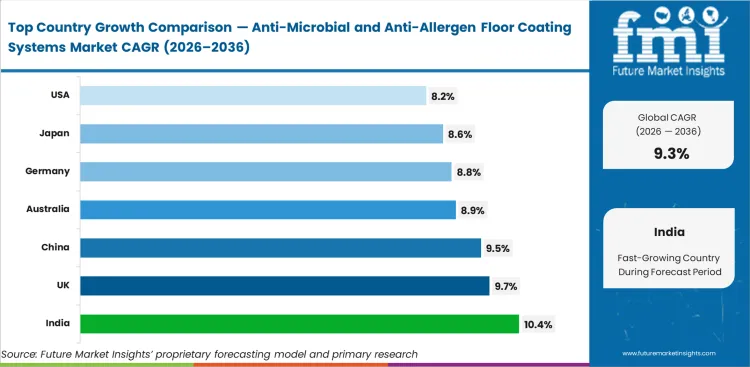
.webp "Top Country Growth Comparison Anti Microbial And Anti Allergen Floor Coating Systems Market Cagr (2026 2036)")
| Country | CAGR |
|---|---|
| United States | 8.2% |
| China | 9.5% |
| India | 10.4% |
| Germany | 8.8% |
| Japan | 8.6% |
| United Kingdom | 9.7% |
| Australia | 8.9% |
Source: Future Market Insights, 2026.
Anti-Microbial and Anti-Allergen Floor Coating Systems Market CAGR Analysis by Country
- India is expected to post 10.4% CAGR by 2036 as hospital empanelment and district health projects widen flooring needs.
- The United Kingdom is projected to record 9.7% CAGR by 2036 as school rebuilding and hospital repair keep demand active.
- China is forecast at 9.5% CAGR by 2036 because its hospital base is large despite weaker building starts.
- Australia is expected to advance at 8.9% CAGR by 2036 as hospital spending supports planned maintenance.
- Germany and Japan remain below the global rate because facility bases are mature and replacement projects move more slowly.
Demand for anti-microbial and anti-allergen floor coating systems is forecast to rise at 9.3% CAGR from 2026 to 2036. Country-level analysis covers markets where healthcare assets and resin flooring supply support specification-led demand.
Demand Outlook for Anti-Microbial and Anti-Allergen Floor Coating Systems in the United States
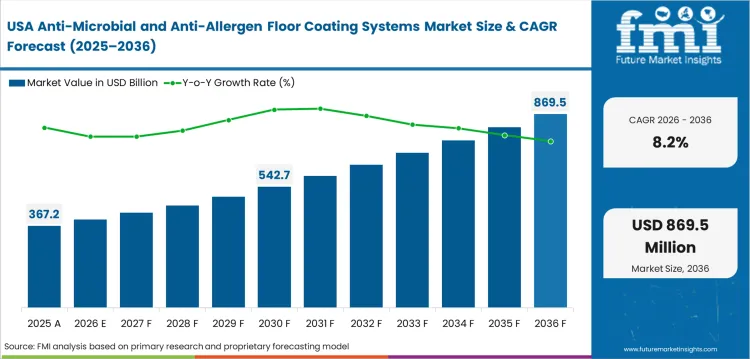
Healthcare and education buildings make the United States a large and mature market for hygiene floor systems. The United States is projected to record 8.2% CAGR through 2036 because resin flooring is already common in many institutional buildings. The United States Census Bureau reported public construction spending at USD 526.4 billion in March 2026. Facility owners are likely to favor systems with clear claim language and low odor data during renewal projects.
- Hospital repair teams can use jointless coatings in corridors and procedure support areas with frequent cleaning.
- School districts can specify low odor topcoats where summer work windows remain short and classrooms reopen quickly.
- Food plants use polyurethane cement floors in areas where cleaning chemicals and washdown affect durability.
Sales Analysis of Anti-Microbial and Anti-Allergen Floor Coating Systems in China
China has a large hospital and institutional building base that needs durable repair systems. The National Bureau of Statistics of China reported 39,000 hospitals at the end of 2024. The country is expected to expand at 9.5% CAGR through 2036 as healthcare assets and domestic resin supply move together.
- Large public hospitals can use coating systems in service corridors and cleaning rooms with heavy movement.
- Private hospital chains may choose faster cure coatings to reduce disruption during renovation in active buildings.
- Domestic coating suppliers can win when they document chemical resistance and treated surface limits for tenders.
Demand Outlook for Anti-Microbial and Anti-Allergen Floor Coating Systems in India
India is adding health facility access through public insurance and district infrastructure programs. India is forecast to grow at 10.4% CAGR through 2036 as empanelled hospitals and new care blocks create specification openings. The Press Information Bureau of India reported 32,574 hospitals empanelled under Ayushman Bharat Pradhan Mantri Jan Arogya Yojana as of December 2025. Suppliers that train installers near tier-two cities can convert policy expansion into material demand over time.
- Government hospitals need repair systems that balance cost with cleanable surface performance in high-use areas.
- Private hospitals can specify low odor coatings when renovation occurs near active patient areas and clinics.
- Food processing units create a second demand route for polyurethane cement and cove flooring systems.
Opportunity Analysis of Anti-Microbial and Anti-Allergen Floor Coating Systems in Germany
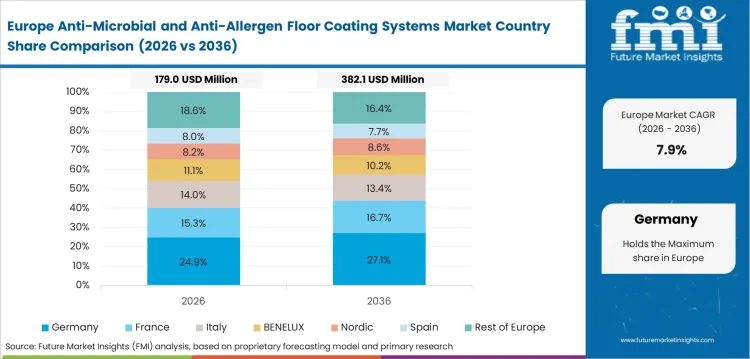
German buyers usually compare chemical resistance and emission documentation before approving resin floors. Health expenditure reached EUR 538.2 billion in 2024 according to the Federal Statistical Office of Germany. Germany is expected to advance at 8.8% CAGR through 2036 because hospital and food plant projects remain specification led.
- Hospital operators can use water-based epoxy systems where odor limits affect repair planning during active operations.
- Food plants are expected to prefer polyurethane cement floors for thermal shock and washdown areas with frequent cleaning.
- Specialist installers can win by proving substrate preparation quality before coating work starts on active sites.
Future Outlook for Anti-Microbial and Anti-Allergen Floor Coating Systems in Japan
Japan has a compact institutional building base where repair quality matters more than rapid area expansion. The Statistics Bureau of Japan reported 102.74 million square meters of building construction starts in 2024. Japan is projected to rise at 8.6% CAGR through 2036 because healthcare and food facilities still need high reliability repair systems. Faster expansion is limited by cautious specification cycles and strict installer qualification in public projects.
- Urban hospitals can use low odor coatings where floor renewal must avoid patient disruption during active care.
- Food plants require systems that resist hot water cleaning and frequent washdown after daily production.
- Local distributors need clear product data in Japanese to support contractor training and correct installation.
Sales Analysis of Anti-Microbial and Anti-Allergen Floor Coating Systems in the United Kingdom
School and hospital repair programs create a clear route for floor coating demand in the United Kingdom. The United Kingdom is forecast at 9.7% CAGR through 2036 because public repair work keeps hygiene flooring on tender lists. The Office for National Statistics reported that construction repair and maintenance grew 3.4% in the first quarter of 2026. Suppliers with low odor systems can target projects that run during school and ward closures.
- School rebuilding creates chances for low emission epoxy and polyurethane systems during planned refurbishment.
- Hospitals affected by aging estate issues can use jointless floors in support spaces with frequent cleaning.
- Contractors need clear guidance on antimicrobial claim limits during public bids and tenders.
Future Outlook for Anti-Microbial and Anti-Allergen Floor Coating Systems in Australia
Australia has a high spend healthcare base and a concentrated hospital network. The Australian Institute of Health and Welfare reported hospital care spending of AUD 113.8 billion in 2023 to 2024. Australia is expected to post 8.9% CAGR through 2036 because public hospitals and food facilities need durable repair systems.
- Public hospitals can use specification-led resin floors during planned maintenance programs with cleaning needs.
- Aged care buildings create demand for low odor systems with shorter return windows during floor renewal.
- Food processing sites support polyurethane cement use where floor cleaning is frequent and washdown is routine.
Competitive Landscape and Strategic Positioning
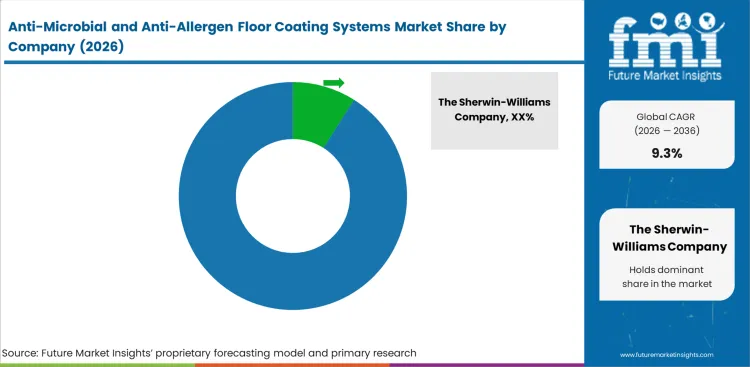
- Competition is shaped by specification trust rather than coating volume alone.
- Large suppliers win when they combine resin chemistry with installer networks and claim control in tenders.
- Specialist firms compete through antimicrobial additives or systems for hospitals and food plants with hygiene needs.
- Entry barriers include emissions data, cleaning chemical resistance and legal wording for antimicrobial claims.
Competition in this market is driven by specification credibility and the ability to meet strict regulatory claim limits. Leading players differentiate through system performance and alignment with institutional procurement requirements. For instance, key players such as Sherwin-Williams have an advantage in specification channels because its high performance flooring portfolio covers education and pharmaceutical facilities. Its Accelera One system targets commercial and institutional environments that need rapid curing and sterilant resistance.
Sika and MAPEI compete through resin flooring systems that address food plants and laboratory areas. Sika’s Sikafloor-41 PurCem product data sheet identifies a polyurethane hybrid screed used at 3 to 6 mm thickness. MAPEI’s Mapefloor CPU+/RT literature describes a polyurethane-cement mortar used at 6 to 9 mm thickness. The same source states that the system is easy to sanitize and suitable for non-slip surfaces.
Key Companies in the Anti-Microbial and Anti-Allergen Floor Coating Systems Market
Competition is best read by role because resin suppliers, additive firms and specialist installers influence different parts of the specification.
- System Suppliers: The Sherwin-Williams Company, Sika AG, RPM International Inc., and MAPEI S.p.A. hold stronger positions through resin flooring portfolios and contractor access.
- Coating and Additive Specialists: PPG Industries Inc., Protective Industrial Polymers Inc. and Microban International Ltd. support claims through coatings, systems or antimicrobial technologies.
- Contractor Influence: Installation firms decide much of the practical system choice because substrate condition and closure time shape final selection.
Competitive Benchmarking: Anti-Microbial and Anti-Allergen Floor Coating Systems Market
| Company | Hygienic System Depth | Claim Control | Installer Support | Geographic Footprint |
|---|---|---|---|---|
| The Sherwin-Williams Company | High | High | Strong | Global with strong education and healthcare specification access |
| Sika AG | High | Medium | Strong | Global with construction chemicals and resin flooring depth |
| RPM International Inc. | High | Medium | Strong | Global with Stonhard and construction product businesses |
| MAPEI S.p.A. | Medium | Medium | Strong | Global with polyurethane cement and flooring systems |
| PPG Industries Inc. | Medium | High | Medium | Global coatings supplier with healthcare surface coating options |
| Protective Industrial Polymers Inc. | Medium | Medium | Medium | North America centered with specialist resin floor systems |
| Microban International Ltd. | Low | High | Medium | Global antimicrobial technology provider with partner-led flooring reach |
Source: Future Market Insights competitive analysis, 2026. Ratings reflect relative positioning based on system depth, claim control and installer support.
Key Developments in the Anti-Microbial and Anti-Allergen Floor Coating Systems Market
- In March 2025, Microban International launched AkoTech, a multifunctional coating technology platform for flooring and other surfaces.
- In March 2025, BASF and Sika launched Baxxodur EC 151 for epoxy resin flooring systems. The companies said the hardener enables ultra low VOC epoxy floor formulations and can cut VOC release by up to 90% versus conventional hardeners.
- In January 2026, MAPEI launched Mapefloor Finish 56, a clear high gloss polyaspartic resin for industrial flooring systems. The company positioned it for institutional buildings, laboratories, clean rooms, pharmaceutical facilities and processing environments.
Key Players in the Anti-Microbial and Anti-Allergen Floor Coating Systems Market
- The Sherwin-Williams Company
- Sika AG
- RPM International Inc.
- MAPEI S.p.A.
- PPG Industries Inc.
- Protective Industrial Polymers Inc.
- Microban International Ltd.
Report Scope and Coverage
| Item | Value |
|---|---|
| Quantitative Units | USD billion for value and CAGR% for demand expansion |
| Market Definition | Floor coating systems with antimicrobial surface protection or anti-allergen positioning |
| Chemistry | Epoxy systems, polyurethane cement, acrylic MMA, polyaspartic systems and hybrid systems |
| Functional Claim | Antimicrobial films, low-VOC allergen control, mold mildew resistance and combined hygiene systems |
| End Use | Hospitals and clinics, schools and childcare, food processing, pharmaceutical labs and aged care |
| Installation Format | Jointless poured floors, cove floor systems, topcoat retrofits and moisture control rebuilds |
| Sales Model | Specification-led contractors, direct facility owners, distributor channels and public bids |
| Regions Covered | North America, Latin America, Europe, East Asia, South Asia Pacific and Middle East and Africa |
| Countries Covered | United States, China, India, Germany, Japan, United Kingdom and Australia |
| Key Companies Profiled | Sherwin-Williams, Sika, RPM International, MAPEI, PPG Industries, Protective Industrial Polymers and Microban |
| Forecast Period | 2026 to 2036 |
| Approach | Bottom-up project value model with top-down checks against related coatings and public facility data |
Anti-Microbial and Anti-Allergen Floor Coating Systems Market Breakdown by Chemistry, Functional Claim, End Use, Installation Format, Sales Model, and Region
Anti-Microbial and Anti-Allergen Floor Coating Systems Market Segmented by Chemistry:
- Epoxy systems
- Polyurethane cement
- Acrylic MMA
- Polyaspartic systems
- Hybrid systems
Anti-Microbial and Anti-Allergen Floor Coating Systems Market Segmented by Functional Claim:
- Antimicrobial films
- Low-VOC allergen control
- Mold mildew resistance
- Combined hygiene systems
Anti-Microbial and Anti-Allergen Floor Coating Systems Market Segmented by End Use:
- Hospitals and clinics
- Schools and childcare
- Food processing
- Pharmaceutical labs
- Aged care
Anti-Microbial and Anti-Allergen Floor Coating Systems Market Segmented by Installation Format:
- Jointless poured floors
- Cove floor systems
- Topcoat retrofits
- Moisture control rebuilds
Anti-Microbial and Anti-Allergen Floor Coating Systems Market Segmented by Sales Model:
- Specification-led contractors
- Direct facility owners
- Distributor channels
- Public bids
Anti-Microbial and Anti-Allergen Floor Coating Systems Market by Region:
- North America
- Latin America
- Europe
- East Asia
- South Asia Pacific
- Middle East and Africa
Research Sources and Bibliography
- United States Environmental Protection Agency. (2024, December 12). Label review manual: Chapter 12, Antimicrobial claims.
- United States Environmental Protection Agency. (2025, September 24). Creating healthy indoor air quality in schools.
- Centers for Disease Control and Prevention. (2024, March 19). Environmental cleaning procedures in healthcare facilities.
- Centers for Disease Control and Prevention. (2026, January 29). 2024 National and State Healthcare-Associated Infections Progress Report.
- United States Census Bureau. (2026, May 7). Monthly construction spending, March 2026.
- Centers for Medicare and Medicaid Services. (2026, January 14). National health expenditure fact sheet.
- National Bureau of Statistics of China. (2025, February 28). Statistical communiqué of the People's Republic of China on the 2024 national economic and social development.
- Press Information Bureau, Government of India. (2026, January 1). Initiatives & Achievements-2025.
- Federal Statistical Office of Germany. (2026, April). Health expenditure in 2024.
- Statistics Bureau of Japan. (2025, September). Statistical handbook of Japan 2025.
- Office for National Statistics. (2026, May 15). Construction output in Great Britain, March 2026.
- Australian Institute of Health and Welfare. (2026, March 23). Hospitals at a glance.
- The Sherwin-Williams Company. (2024, March). Sherwin-Williams takes Resuflor WB’s environmental credentials to the next level.
- Microban International. (2025, March 18). Microban introduces AkoTech: Advanced multifunctional coating platform.
- BASF SE. (2025, March 17). BASF and Sika launch epoxy hardener for sustainable solutions in the construction industry.
- MAPEI Corporation. (2026, January 30). MAPEI introduces Mapefloor Finish 56 high-gloss UV-resistant polyaspartic resin for industrial-flooring systems.
- The Sherwin-Williams Company. (2024, August). High Performance Flooring Accelera One product update.
- Sika AG. (2024, February). Sikafloor-41 PurCem product data sheet.
- MAPEI S.p.A. (2024). Mapefloor CPU+/RT technical data sheet.
The bibliography is provided for reader reference and uses government, public health, company and official technical sources relevant to hygiene floor coatings and institutional demand signals.
This Report Answers
- What is the current and future size of the anti-microbial and anti-allergen floor coating systems market?
- How fast is the anti-microbial and anti-allergen floor coating systems market expected to expand between 2026 and 2036?
- Which chemistry is expected to lead anti-microbial and anti-allergen floor coating systems demand by 2026?
- Which installation format is projected to account for the largest share in 2026?
- Why are hospitals and schools important end users for this market?
- How do antimicrobial claim rules affect supplier positioning and product language?
- Which countries are projected to record faster expansion during the forecast period?
- Who are the main companies active in anti-microbial and anti-allergen floor coating systems?
- How does FMI define the market scope and its exclusions?
- How does FMI estimate and validate the 2026 to 2036 forecast?
Frequently Asked Questions
What is the global market demand for Anti-Microbial and Anti-Allergen Floor Coating Systems in 2026?
In 2026, the global market is expected to be worth USD 0.8 billion as institutional floor renewal moves toward hygiene-led specifications.
How big will the Anti-Microbial and Anti-Allergen Floor Coating Systems Market be in 2036?
By 2036, the market is expected to be worth USD 1.9 billion as hospitals, schools and food plants widen resin floor use.
How much will Anti-Microbial and Anti-Allergen Floor Coating Systems demand expand between 2026 and 2036?
Demand is projected to expand at 9.3% CAGR from 2026 to 2036 under FMI’s specification-led facility renewal model.
Which chemistry leads the Anti-Microbial and Anti-Allergen Floor Coating Systems Market?
Epoxy systems lead with 37.0% share in 2026 because contractors know the workflow and facility owners understand performance limits.
Which installation format leads Anti-Microbial and Anti-Allergen Floor Coating Systems demand?
Jointless poured floors lead with 48.0% share in 2026 because smooth surfaces reduce joints that can collect soil.
Which country grows fastest for Anti-Microbial and Anti-Allergen Floor Coating Systems?
India is forecast at 10.4% CAGR through 2036 as hospital access and health infrastructure programs expand flooring needs.
What does the Anti-Microbial and Anti-Allergen Floor Coating Systems Market include?
The market includes resin floors with antimicrobial film protection, low odor positioning and smooth cleanable surfaces for institutional buildings.
How did FMI estimate the Anti-Microbial and Anti-Allergen Floor Coating Systems forecast?
FMI used a bottom-up project value model and checked results against public health, construction and related coatings data.
Which floor coating is best for hospitals?
Hospitals usually need jointless epoxy or polyurethane cement systems because cleaning chemicals, carts and short repair windows affect floor performance.
What is the difference between antimicrobial and anti-allergen floor coatings?
Antimicrobial coatings usually protect the film from odor and staining organisms. Anti-allergen positioning relies on low odor and cleanable surfaces.
How long do anti-microbial floor coating systems last?
Service life depends on substrate preparation, traffic load and cleaning chemicals. Many institutional systems are specified for planned multi-year maintenance cycles.
What are the main disadvantages of anti-microbial floor coating systems?
The main limits are higher installation cost, careful substrate preparation and strict claim rules around antimicrobial public health language.
Preview the report firsthand - request a free sample
Get SampleGet the brochure for pricing and purchase details.
Get PDFTable of Content
- Key Takeaways
- Market Size and CAGR
- Top Growth Driver
- Fastest Growing Segment
- Leading Region
- Key Companies
- Emerging Opportunities
- Executive Summary
- Global Market Outlook
- Demand-side Trends
- Supply-side Trends
- Technology Roadmap Analysis
- Analysis and Recommendations
- Analyst Perspective (What is happening? Why now? What should investors know?)
- Key Questions Answered
- How large is the market?
- What is the CAGR?
- What are key trends?
- Which region dominates?
- Who are the leaders?
- Market Overview
- Market Coverage / Taxonomy
- Market Definition / Scope / Limitations
- Research Methodology
- Chapter Orientation
- Analytical Lens and Working Hypotheses
- Market Structure, Signals, and Trend Drivers
- Benchmarking and Cross-market Comparability
- Market Sizing, Forecasting, and Opportunity Mapping
- Research Design and Evidence Framework
- Desk Research Programme (Secondary Evidence)
- Expert Input and Fieldwork (Primary Evidence)
- Tooling, Models, and Reference Databases
- Data Engineering and Model Build
- Quality Assurance and Audit Trail
- Market Background
- Market Dynamics (Drivers, Restraints, Opportunity, Trends)
- Scenario Forecast (Optimistic, Likely, Conservative)
- Impact Analysis
- AI Impact
- Sustainability Impact
- Regulatory Impact
- Technology Impact
- Consumer / Buyer Analysis
- Purchase Drivers
- Adoption Barriers
- Buyer Journey
- Opportunity Map Analysis
- Product Life Cycle Analysis
- Supply Chain Analysis
- Investment Feasibility Matrix
- Value Chain Analysis
- PESTLE and Porter's Analysis
- Regulatory Landscape
- Regional Parent Market Outlook
- Production and Consumption Statistics
- Import and Export Statistics
- Global Market Analysis and Forecast, 2021 to 2036
- Historical Market Size Value (USD Billion) Analysis, 2021 to 2025
- Current and Future Market Size Value (USD Billion) Projections, 2026 to 2036
- Y-o-Y Growth Trend Analysis
- Absolute $ Opportunity Analysis
- Global Market Pricing Analysis, 2021 to 2036
- Global Market Analysis and Forecast, By Chemistry, 2021 to 2036
- Introduction / Key Findings
- Historical Market Size Value (USD Billion) Analysis By Chemistry, 2021 to 2025
- Current and Future Market Size Value (USD Billion) Analysis and Forecast By Chemistry, 2026 to 2036
- Epoxy systems
- Polyurethane cement
- Acrylic MMA
- Polyaspartic systems
- Hybrid systems
- Epoxy systems
- Y-o-Y Growth Trend Analysis By Chemistry, 2021 to 2025
- Absolute $ Opportunity Analysis By Chemistry, 2026 to 2036
- Global Market Analysis and Forecast, By Functional Claim, 2021 to 2036
- Introduction / Key Findings
- Historical Market Size Value (USD Billion) Analysis By Functional Claim, 2021 to 2025
- Current and Future Market Size Value (USD Billion) Analysis and Forecast By Functional Claim, 2026 to 2036
- Antimicrobial films
- Low-VOC allergen control
- Mold mildew resistance
- Combined hygiene systems
- Antimicrobial films
- Y-o-Y Growth Trend Analysis By Functional Claim, 2021 to 2025
- Absolute $ Opportunity Analysis By Functional Claim, 2026 to 2036
- Global Market Analysis and Forecast, By End Use, 2021 to 2036
- Introduction / Key Findings
- Historical Market Size Value (USD Billion) Analysis By End Use, 2021 to 2025
- Current and Future Market Size Value (USD Billion) Analysis and Forecast By End Use, 2026 to 2036
- Hospitals and clinics
- Schools and childcare
- Food processing
- Pharmaceutical labs
- Aged care
- Hospitals and clinics
- Y-o-Y Growth Trend Analysis By End Use, 2021 to 2025
- Absolute $ Opportunity Analysis By End Use, 2026 to 2036
- Global Market Analysis and Forecast, By Installation Format, 2021 to 2036
- Introduction / Key Findings
- Historical Market Size Value (USD Billion) Analysis By Installation Format, 2021 to 2025
- Current and Future Market Size Value (USD Billion) Analysis and Forecast By Installation Format, 2026 to 2036
- Jointless poured floors
- Cove floor systems
- Topcoat retrofits
- Moisture control rebuilds
- Jointless poured floors
- Y-o-Y Growth Trend Analysis By Installation Format, 2021 to 2025
- Absolute $ Opportunity Analysis By Installation Format, 2026 to 2036
- Global Market Analysis and Forecast, By Sales Model, 2021 to 2036
- Introduction / Key Findings
- Historical Market Size Value (USD Billion) Analysis By Sales Model, 2021 to 2025
- Current and Future Market Size Value (USD Billion) Analysis and Forecast By Sales Model, 2026 to 2036
- Specification-led contractors
- Direct facility owners
- Distributor channels
- Public bids
- Specification-led contractors
- Y-o-Y Growth Trend Analysis By Sales Model, 2021 to 2025
- Absolute $ Opportunity Analysis By Sales Model, 2026 to 2036
- Global Market Analysis and Forecast, By Region, 2021 to 2036
- Introduction
- Historical Market Size Value (USD Billion) Analysis By Region, 2021 to 2025
- Current Market Size Value (USD Billion) Analysis and Forecast By Region, 2026 to 2036
- North America
- Latin America
- Western Europe
- Eastern Europe
- East Asia
- South Asia and Pacific
- Middle East & Africa
- Market Attractiveness Analysis By Region
- North America Market Analysis and Forecast, By Country, 2021 to 2036
- Historical Market Size Value (USD Billion) Trend Analysis By Market Taxonomy, 2021 to 2025
- Market Size Value (USD Billion) Forecast By Market Taxonomy, 2026 to 2036
- By Country
- USA
- Canada
- By Chemistry
- By Functional Claim
- By End Use
- By Installation Format
- By Sales Model
- By Country
- Market Attractiveness Analysis
- By Country
- By Chemistry
- By Functional Claim
- By End Use
- By Installation Format
- By Sales Model
- Key Takeaways
- Latin America Market Analysis and Forecast, By Country
- Historical Market Size Value (USD Billion) Trend Analysis By Market Taxonomy, 2021 to 2025
- Market Size Value (USD Billion) Forecast By Market Taxonomy, 2026 to 2036
- By Country
- Brazil
- Mexico
- Chile
- Rest of Latin America
- By Chemistry
- By Functional Claim
- By End Use
- By Installation Format
- By Sales Model
- By Country
- Market Attractiveness Analysis
- By Country
- By Chemistry
- By Functional Claim
- By End Use
- By Installation Format
- By Sales Model
- Key Takeaways
- Western Europe Market Analysis and Forecast, By Country
- Historical Market Size Value (USD Billion) Trend Analysis By Market Taxonomy, 2021 to 2025
- Market Size Value (USD Billion) Forecast By Market Taxonomy, 2026 to 2036
- By Country
- Germany
- UK
- Italy
- Spain
- France
- Nordic
- BENELUX
- Rest of Western Europe
- By Chemistry
- By Functional Claim
- By End Use
- By Installation Format
- By Sales Model
- By Country
- Market Attractiveness Analysis
- By Country
- By Chemistry
- By Functional Claim
- By End Use
- By Installation Format
- By Sales Model
- Key Takeaways
- Eastern Europe Market Analysis and Forecast, By Country
- Historical Market Size Value (USD Billion) Trend Analysis By Market Taxonomy, 2021 to 2025
- Market Size Value (USD Billion) Forecast By Market Taxonomy, 2026 to 2036
- By Country
- Russia
- Poland
- Hungary
- Balkan & Baltic
- Rest of Eastern Europe
- By Chemistry
- By Functional Claim
- By End Use
- By Installation Format
- By Sales Model
- By Country
- Market Attractiveness Analysis
- By Country
- By Chemistry
- By Functional Claim
- By End Use
- By Installation Format
- By Sales Model
- Key Takeaways
- East Asia Market Analysis and Forecast, By Country
- Historical Market Size Value (USD Billion) Trend Analysis By Market Taxonomy, 2021 to 2025
- Market Size Value (USD Billion) Forecast By Market Taxonomy, 2026 to 2036
- By Country
- China
- Japan
- South Korea
- By Chemistry
- By Functional Claim
- By End Use
- By Installation Format
- By Sales Model
- By Country
- Market Attractiveness Analysis
- By Country
- By Chemistry
- By Functional Claim
- By End Use
- By Installation Format
- By Sales Model
- Key Takeaways
- South Asia and Pacific Market Analysis and Forecast, By Country
- Historical Market Size Value (USD Billion) Trend Analysis By Market Taxonomy, 2021 to 2025
- Market Size Value (USD Billion) Forecast By Market Taxonomy, 2026 to 2036
- By Country
- India
- ASEAN
- Australia & New Zealand
- Rest of South Asia and Pacific
- By Chemistry
- By Functional Claim
- By End Use
- By Installation Format
- By Sales Model
- By Country
- Market Attractiveness Analysis
- By Country
- By Chemistry
- By Functional Claim
- By End Use
- By Installation Format
- By Sales Model
- Key Takeaways
- Middle East & Africa Market Analysis and Forecast, By Country
- Historical Market Size Value (USD Billion) Trend Analysis By Market Taxonomy, 2021 to 2025
- Market Size Value (USD Billion) Forecast By Market Taxonomy, 2026 to 2036
- By Country
- Kingdom of Saudi Arabia
- Other GCC Countries
- Türkiye
- South Africa
- Other African Union
- Rest of Middle East & Africa
- By Chemistry
- By Functional Claim
- By End Use
- By Installation Format
- By Sales Model
- By Country
- Market Attractiveness Analysis
- By Country
- By Chemistry
- By Functional Claim
- By End Use
- By Installation Format
- By Sales Model
- Key Takeaways
- Key Countries Market Analysis
- USA
- Pricing Analysis
- Market Share Analysis, 2025
- By Chemistry
- By Functional Claim
- By End Use
- By Installation Format
- By Sales Model
- Canada
- Pricing Analysis
- Market Share Analysis, 2025
- By Chemistry
- By Functional Claim
- By End Use
- By Installation Format
- By Sales Model
- Mexico
- Pricing Analysis
- Market Share Analysis, 2025
- By Chemistry
- By Functional Claim
- By End Use
- By Installation Format
- By Sales Model
- Brazil
- Pricing Analysis
- Market Share Analysis, 2025
- By Chemistry
- By Functional Claim
- By End Use
- By Installation Format
- By Sales Model
- Chile
- Pricing Analysis
- Market Share Analysis, 2025
- By Chemistry
- By Functional Claim
- By End Use
- By Installation Format
- By Sales Model
- Germany
- Pricing Analysis
- Market Share Analysis, 2025
- By Chemistry
- By Functional Claim
- By End Use
- By Installation Format
- By Sales Model
- UK
- Pricing Analysis
- Market Share Analysis, 2025
- By Chemistry
- By Functional Claim
- By End Use
- By Installation Format
- By Sales Model
- Italy
- Pricing Analysis
- Market Share Analysis, 2025
- By Chemistry
- By Functional Claim
- By End Use
- By Installation Format
- By Sales Model
- Spain
- Pricing Analysis
- Market Share Analysis, 2025
- By Chemistry
- By Functional Claim
- By End Use
- By Installation Format
- By Sales Model
- France
- Pricing Analysis
- Market Share Analysis, 2025
- By Chemistry
- By Functional Claim
- By End Use
- By Installation Format
- By Sales Model
- India
- Pricing Analysis
- Market Share Analysis, 2025
- By Chemistry
- By Functional Claim
- By End Use
- By Installation Format
- By Sales Model
- ASEAN
- Pricing Analysis
- Market Share Analysis, 2025
- By Chemistry
- By Functional Claim
- By End Use
- By Installation Format
- By Sales Model
- Australia & New Zealand
- Pricing Analysis
- Market Share Analysis, 2025
- By Chemistry
- By Functional Claim
- By End Use
- By Installation Format
- By Sales Model
- China
- Pricing Analysis
- Market Share Analysis, 2025
- By Chemistry
- By Functional Claim
- By End Use
- By Installation Format
- By Sales Model
- Japan
- Pricing Analysis
- Market Share Analysis, 2025
- By Chemistry
- By Functional Claim
- By End Use
- By Installation Format
- By Sales Model
- South Korea
- Pricing Analysis
- Market Share Analysis, 2025
- By Chemistry
- By Functional Claim
- By End Use
- By Installation Format
- By Sales Model
- Russia
- Pricing Analysis
- Market Share Analysis, 2025
- By Chemistry
- By Functional Claim
- By End Use
- By Installation Format
- By Sales Model
- Poland
- Pricing Analysis
- Market Share Analysis, 2025
- By Chemistry
- By Functional Claim
- By End Use
- By Installation Format
- By Sales Model
- Hungary
- Pricing Analysis
- Market Share Analysis, 2025
- By Chemistry
- By Functional Claim
- By End Use
- By Installation Format
- By Sales Model
- Kingdom of Saudi Arabia
- Pricing Analysis
- Market Share Analysis, 2025
- By Chemistry
- By Functional Claim
- By End Use
- By Installation Format
- By Sales Model
- Türkiye
- Pricing Analysis
- Market Share Analysis, 2025
- By Chemistry
- By Functional Claim
- By End Use
- By Installation Format
- By Sales Model
- South Africa
- Pricing Analysis
- Market Share Analysis, 2025
- By Chemistry
- By Functional Claim
- By End Use
- By Installation Format
- By Sales Model
- USA
- Market Structure Analysis
- Competition Dashboard
- Competition Benchmarking
- Market Share Analysis of Top Players
- By Regional
- By Chemistry
- By Functional Claim
- By End Use
- By Installation Format
- By Sales Model
- Emerging Startups
- Innovation Benchmarking
- Competition Analysis
- Competition Deep Dive
- The Sherwin-Williams Company
- Overview
- Product Portfolio
- Profitability by Market Segments
- Sales Footprint
- Strategy Overview
- Marketing Strategy
- Product Strategy
- Channel Strategy
- Sika AG
- RPM International Inc.
- MAPEI S.p.A.
- PPG Industries Inc.
- Protective Industrial Polymers Inc.
- Microban International Ltd.
- The Sherwin-Williams Company
- Case Studies
- Success Stories
- Recent Developments
- Competition Deep Dive
- Assumptions & Acronyms Used


