


By Nikhil Kaitwade
Aerospace demand is rising while production and compliance pressures tighten. Adhesives and sealants sit inside this squeeze. The category tracks aircraft build rates, MRO cycles, and evolving chemical rules.
What is shaping the Aerospace Adhesives and Sealants Market
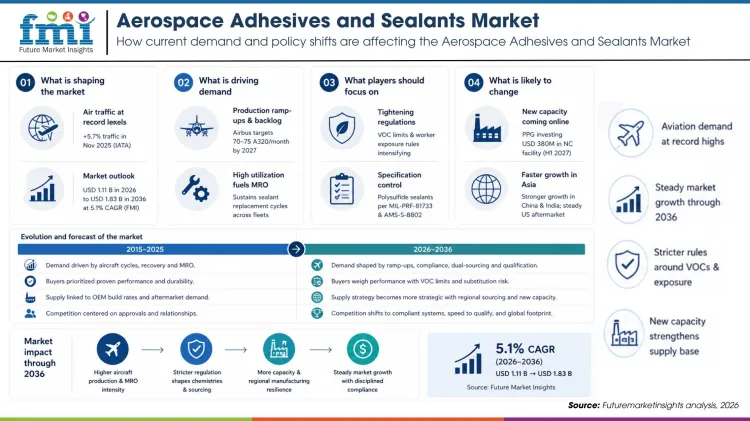
- Air traffic set fresh records in 2024 and continued to grow through 2025, sustaining MRO workloads and line-fit consumption for bonding and sealing materials.
- FMI tracks this market at about USD 1.11 billion in 2026 and USD 1.83 billion by 2036 at a 5.1% CAGR, with epoxy leading resin usage and adhesives holding most spend.
Air traffic set fresh records in 2024 and continued to grow through 2025, sustaining MRO workloads and line-fit consumption for bonding and sealing materials. IATA reported record-high 2024 demand and a further 5.7% traffic increase in November 2025, with Asia Pacific leading 2025 international growth at 10.9%. Airbus still targets historically high A320 family output, adding new final assembly lines in Mobile and Toulouse and guiding to record 2026 deliveries.
FMI tracks this market at about USD 1.11 billion in 2026 and USD 1.83 billion by 2036 at a 5.1% CAGR, with epoxy leading resin usage and adhesives holding most spend. Those levels align with OEM and MRO expansion but assume steady qualification pipelines and compliant chemistries.
Evolution and Forecast of the Aerospace Adhesives and Sealants Market
| 2015-2025 | 2026-2036 |
|---|---|
| Demand was shaped mainly by commercial aircraft production cycles, airline recovery phases, and MRO replacement demand. | Demand is likely to be shaped by production ramp-ups plus stricter regulatory compliance, dual-sourcing needs, and chemistry qualification cycles. |
| Buyers focused more on proven performance in bonding, sealing, and durability across OEM and aftermarket use cases. | Buyers are likely to weigh performance alongside VOC limits, worker-exposure rules, and substitution risk for regulated chemistries. |
| Supply planning was influenced largely by OEM build rates and routine aftermarket demand, with less visible urgency around reshoring or new capacity. | Supply strategy is likely to become more strategic as new capacity comes online, regional sourcing matters more, and approval delays can affect program continuity. |
| Competition centered on specification compliance, incumbent approvals, and long-standing relationships in defense and commercial aerospace. | Competition is likely to shift toward compliant low-solvent systems, qualification speed, regional manufacturing footprint, and the ability to support fast-growing markets such as China and India. |
What is driving demand in the Aerospace Adhesives and Sealants Market
- Production recovery and backlog protection drive volume.
- Passenger yields softened into 2025.
Production recovery and backlog protection drive volume. Airbus targets 70-75 A320 family aircraft a month by 2027 and added a second A320 line in Alabama in October 2025. The narrowbody surge multiplies adhesive bonding points across wings, nacelles, cabins, and fuselage joints.
Passenger yields softened into 2025. Traffic stayed firm and airline profitability guidance improved. High utilization sustains sealant replacement cycles, especially in tanks and wet wings during heavy checks.
What are the key factors that market players should focus on
- Regulation is tightening around emissions and worker exposure.
- Specification control remains tight in defense and commercial programs.
Regulation is tightening around emissions and worker exposure. In the United States, EPA's Aerospace Manufacturing and Rework NESHAP at 40 CFR 63 Subpart GG sets hazardous air pollutant controls and monitoring. South Coast AQMD is updating Rule 1124 governing aerospace VOC limits on coatings, adhesives, and sealants, with proposals that influence allowable solvents and exempt.
Specification control remains tight in defense and commercial programs. Fuel and faying surface work relies on polysulfide sealants qualified to MIL-PRF-81733 and AMS-S-8802. Buyers should validate type and class fit by location and media exposure before substituting chromate-free options.
What is likely to change in the Aerospace Adhesives and Sealants Market
- Capacity is coming online.
- FMI's outlook cites faster growth in China and India and steady US aftermarket pull.
Capacity is coming online. PPG committed USD 380 million to a new aerospace sealants and coatings complex in North Carolina, with completion expected in the first half of 2027. Added output near US
FMI's outlook cites faster growth in China and India and steady US aftermarket pull. Buyers should plan dual-sourcing where possible, align chemistries to emerging VOC and training rules, and budget for recurring approvals as low-solvent and water-borne systems win specifications.
Bibliography
- https://www.iata.org/en/pressroom/2025-releases/2025-01-30-01/
- https://www.iata.org/en/pressroom/2026-releases/2026-01-08-02/
- https://www.iata.org/en/pressroom/2026-releases/2026-01-29-02/
- https://www.airbus.com/en/newsroom/stories/2025-10-ramping-up-a320-family-production
- https://www.airbus.com/en/annual-press-conference-2026
- https://www.law.cornell.edu/cfr/text/40/part-63/subpart-GG
- https://www.aqmd.gov/home/rules-compliance/rules/scaqmd-rule-book/proposed-rules/rule-1124
- https://www.aqmd.gov/docs/default-source/rule-book/proposed-rules/par-1124/par-1124-draft-staff-report.pdf
- https://eur-lex.europa.eu/legal-content/EN/ALL/?uri=CELEX%3A32020R1149
- https://safeusediisocyanates.eu/reach-legislation/
- https://www.southcoastaqmd.gov/docs/default-source/clean-air-plans/air-quality-management-plans/2022-air-quality-management-plan/final-2022-aqmp/07-ch4.pdf
- https://www.ascouncil.org/news/ppg-building-380-million-aerospace-and-sealants-manufacturing-facility
- https://aviationweek.com/air-transport/aircraft-propulsion/chinas-airlines-expect-33-comac-c919-deliveries-2026
- https://www.aqmd.gov/home/research/pubs-docs-reports/newsletters/oct-nov-dec-2025/2026-rule-compliance-deadlines
- https://www.southcoastaqmd.gov/home/rules-compliance/compliance/vocs/adhesive-and-sealants
- https://www.southcoastaqmd.gov/docs/default-source/rule-book/proposed-rules/par-1107_1124_1136-wgm1-july-2024.pdf?sfvrsn=10
- https://www.silmid.com/knowledge-centre/aerospace-specifications/sae-ams-s-8802/
- https://nslaerospace.com/sealant-spec-mil-prf-81733/

