


By Nikhil Kaitwade
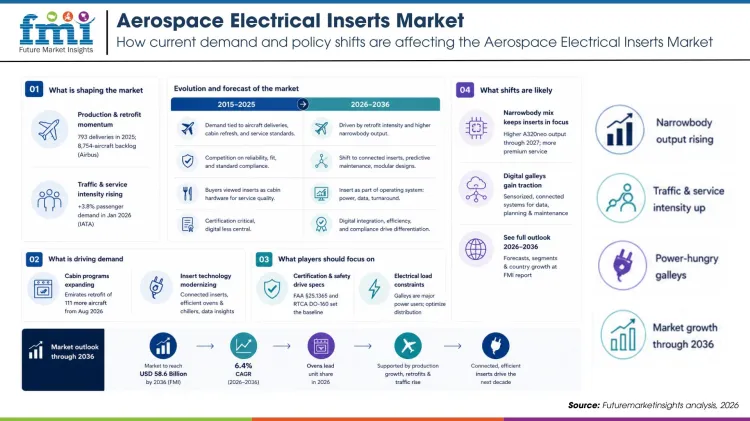
Aircraft galleys are turning into connected, power-hungry workstations. Airlines are refreshing cabins while airframers chase record narrowbody output, putting ovens, brewers, chillers, and trash compactors on the critical path of service delivery. Future Market Insights projects a USD 58.6 billion market by 2036 on a 6.4% CAGR, with ovens leading 2026 unit share.
What is shaping the Aerospace Electrical Inserts Market right now
- Production and retrofit momentum are real and dated.
- Traffic and service intensity are also rising.
Airbus delivered 793 jets in 2025 and entered 2026 with a record 8,754-aircraft backlog, most of it single-aisle A320neo family that requires full galley fit-outs. That sets a multi-year floor for inserts demand.
Traffic and service intensity are also rising. IATA reported January 2026 passenger demand up 3.8% year on year, with capacity growth tracking ahead into March. Operators need reliable galley power and appliances to monetize higher load factors and premium cabins.
| 2015-2025 | 2026-2036 |
|---|---|
| Demand was tied mainly to aircraft delivery cycles, cabin refresh programs, and airline service standards across widebody and premium fleets. | Demand is likely to be driven by both retrofit intensity and higher narrowbody output, with single-aisle aircraft taking on more premium food-service roles. |
| Product competition focused more on functional reliability, installed fit, and compliance with galley equipment standards. | Competition is likely to shift toward connected inserts, predictive maintenance, modular layouts, and data-enabled galley management. |
| Buyers evaluated inserts largely as cabin hardware tied to catering quality and replacement cycles. | Buyers are likely to view inserts more as part of a broader operating system involving power load management, usage analytics, and quicker turnaround planning. |
| Certification and qualification were important, but digital capability was less central to the buying decision. | Certification will remain critical, but digital integration, electrical efficiency, and compliance-ready designs are likely to become stronger differentiators in both line-fit and retrofit programs. |
What is driving demand in the Aerospace Electrical Inserts Market
- Cabin programs are expanding in scope and duration.
- Insert technology is modernizing, creating significant opportunities.
Emirates moved the next phase of its US$5 billion retrofit to 111 additional aircraft beginning August 2026, scaling its refurbishment plan to 219 A380s and 777s. Each widebody cycle refresh triggers galley insert replacement or upgrade.
Collins Aerospace has introduced connected inserts that capture usage data and support predictive maintenance. Safran Cabin promotes steam and combi-convection ovens plus espresso and coffee systems across standardized ATLAS formats. These product moves align with airlines pushing crew efficiency and consistent service.
What key factors should market players focus on
- Certification and safety rules shape specs and lead times.
- These factors add time and cost to line-fit and retrofit projects.
FAA guidance for §25.1365 places detailed design expectations on galley heating equipment, including overheat protection and installation practices. Environmental testing to RTCA DO-160 remains the base path to qualify electronic inserts for vibration, temperature, and electromagnetic conditions.
These factors add time and cost to line-fit and retrofit projects. Electrical load is a constraint. Research programs with Diehl partners highlight galleys as major onboard power consumers and explore smarter distribution to stabilize service. Buyers should pressure-test power provisioning against denser premium cabins and longer catering cycles.
What key shifts is the market likely to witness?
Narrowbody mix shifts keep inserts in focus. Airbus plans higher A320neo output through 2027, while 2025 bottlenecks on engines and structures underscored interiors as a pacing item. As A321-range missions lengthen, carriers will standardize ovens and chillers to support hot meals and premium beverage service on single-aisles.
Digital galleys gain traction. Diehl's eSmart concepts point to sensorized, networked galley management, while Collins' connected inserts create a data layer for catering planning and maintenance. Expect RFPs to require connectivity, usage analytics, and lighter modularity that supports quick-swap layouts.
For forecast ranges, segment splits, and country growth rates, see Aerospace Electrical Inserts Market: Aerospace Electrical Inserts Market (2026 - 2036)
Bibliography
- Airbus reports 793 commercial aircraft deliveries in 2025; backlog 8,754: https://www.airbus.com/en/newsroom/press-releases/2026-01-airbus-reports-793-commercial-aircraft-deliveries-in-2025
- Airbus A320 Family production and backlog context: https://www.airbus.com/en/newsroom/stories/2025-10-ramping-up-a320-family-production
- IATA, 2026 begins with 3.8% air passenger demand growth: https://www.iata.org/en/pressroom/2026-releases/2026-03-02-02/
- Collins Aerospace, connected galley inserts: https://www.militaryaerospace.com/commercial-aerospace/article/14294903/collins-aerospace-introduces-new-connected-galley-inserts-for-commercial-aircraft
- Collins Aerospace, galley inserts product range: https://www.collinsaerospace.com/what-we-do/commercial-aviation/cabin/galley-inserts
- Safran Cabin, executive electrical inserts portfolio: https://www.safran-group.com/products-services/elevate-gourmet-new-heights-safran-cabin-executive-inserts
- FAA Advisory Circular AC 25.1365-1, galley heating equipment considerations: https://www.faa.gov/documentLibrary/media/Advisory_Circular/AC_25.1365-1.pdf
- RTCA DO-160 overview: https://www.rtca.org/do-160/
- Diehl Aviation, galleys and eSmart concepts: https://new.diehl.com/aviation/en/portfolio/cabin-interiors/galleys-1/
- Fraunhofer IMM, galley power research: https://www.imm.fraunhofer.de/en/projects/energy-supply-for-aircraft.html

