

- Market Size (2026)
- USD 1.4 Bn
- Forecast (2036)
- USD 2.4 Bn
- CAGR (2026 to 2036)
- 5.3%
Off-Road Vehicle Park Brake Mechanism Components Market Size, Market Forecast and Outlook By FMI
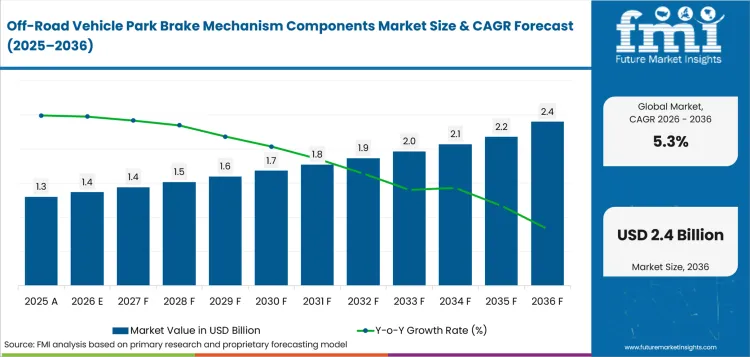
The off-road vehicle park brake mechanism components market is forecast to rise from USD 1.3 billion in 2025 to USD 2.4 billion by 2036 at 5.3% CAGR. OEM supply is projected to account for 63.0% share in 2026, while steel brackets are anticipated to represent 46.2% share as manufacturers prioritize safer vehicle hold and easier service.
Key Takeaways, Market Size, and Forecast
- 2026 Market Size: USD 1.4 billion
- 2036 Market Size: USD 2.4 billion
- Forecast CAGR: 5.3% from 2026 to 2036
- Leading Component Type: Cable assemblies
- Cable Assemblies Share in 2026: 36.4%
- Leading Sales Channel: OEM supply
- OEM Supply Share in 2026: 63.0%
- Fastest-growing Country: India
- India CAGR: 6.8% through 2036
Summary of the Off-Road Vehicle Park Brake Mechanism Components Market
- Demand and Growth Drivers
- Off-road vehicles need park brake parts that can hold machines safely during field stops. This is important because many vehicles work on slopes and loose ground.
- Service demand stays active as cables stretch and springs weaken after repeated use. Dealers need parts that are easy to fit and quick to adjust.
- Electric utility vehicles are creating demand for compact hold systems. These systems need to fit near drive units without making service work harder.
- Product and Segment View
- Cable assemblies are important because many compact vehicles still use simple manual release systems. Repair shops prefer these parts because they can be replaced without special tools.
- SAHR units are used in heavier machines because braking force stays applied after hydraulic pressure drops. This makes them useful for equipment working with heavier loads.
- Steel brackets support the brake layout by keeping the cable path and caliper position stable. Good bracket design helps reduce uneven wear and poor release movement.
- Geography and Competitive Outlook
- The United States and India have strong service demand because farm fleets need regular park brake repair. Dealer networks in both countries help replacement parts reach users faster.
- China and Germany are important because local equipment production creates steady OEM demand. Suppliers in these countries need to match cost targets and technical approval needs.
- Competition is based on hold force, fitment support and service life. OEMs prefer suppliers that provide clear drawings and tested parts before vehicle launch.
- Analyst Opinion
- Nikhil Kaitwade, principal consultant of FMI says, “Park brake components are becoming safety-critical parts for off-road OEMs. Buyers compare hold torque and sealed release quality before approving suppliers. Companies able to offer durable mechanical parts with electric hold options will be preferred across utility and farm equipment programs.”
- Off-Road Vehicle Park Brake Mechanism Components Market Value Analysis
- The off-road vehicle park brake mechanism components market is shifting from basic service parts toward safety-focused component demand.
- Demand is driven by park brake parts that hold tractors and utility vehicles safely on uneven ground.
- Market value is supported by wider use of sealed calipers and stronger brackets in off-road vehicle designs.
- Replacement value rises as cables stretch and springs weaken during daily field use.
Preventing unintended movement remains a core safety need as off-road equipment works on steep grades and rough job sites. Supplier selection is becoming more evidence based as OEMs qualify park brake layouts at vehicle level. Carlisle Brake & Friction continues to promote spring-applied hydraulic-release park brake systems that engage automatically when release pressure is absent.
The design reduces dependence on operator action and supports integrated driveline layouts. A brake lever patent published in June 2024 introduced a stopper arrangement that limits excess lever travel at the cancel position. Such design refinements help reduce misuse-related wear and lower service concerns in demanding off-road use.
Off-Road Vehicle Park Brake Mechanism Components Market Definition
Off-road vehicle park brake mechanism components cover cable assemblies and lever modules used to hold a vehicle at rest. Scope includes calipers and actuator units fitted to all-terrain vehicles and compact work machines. Farm tractors and construction machines are included when park brake parts are sold as validated hold mechanisms. Electric parking brake actuator components are included only for off-road duty cycles.
Off-Road Vehicle Park Brake Mechanism Components Market Inclusions
Market scope covers off-road vehicle park brake mechanism components categorized by component type, including cable assemblies, lever modules, brake calipers, actuator units, and spring kits; vehicle type, including utility terrain vehicles, all-terrain vehicles, farm tractors, construction machines, and turf vehicles; actuation type, including SAHR units, mechanical cable systems, electric hold systems, and electrohydraulic units; and material type, including steel brackets, aluminum housings, cast iron parts, and polymer seals.
The scope also includes park brake parts used within axle, wheel-end, and driveline brake layouts where hold force, release movement, and mounting fit need to work as one vehicle safety function. Revenue scope covers 2026 to 2036. The key stakeholders include off-road vehicle OEMs, brake component suppliers, axle system manufacturers, hydraulic system suppliers, electric actuator providers, agricultural equipment makers, construction equipment producers, utility vehicle manufacturers, dealer service networks, independent repair workshops, parts distributors, rental fleet operators, and vehicle safety approval authorities.
Off-Road Vehicle Park Brake Mechanism Components Market Exclusions
Scope excludes service brake pads and full brake systems sold as complete assemblies. Electronic stability control modules are outside scope. Passenger car park brake parts are excluded unless supplied for off-road utility vehicles. Heavy truck parking brake systems are excluded because spring chamber architecture uses a different parts structure.
Off-Road Vehicle Park Brake Mechanism Components Market Research Methodology
- Primary Research: FMI analysts reviewed off-road brake suppliers and OEM fitment needs across farm and utility vehicles. Dealer feedback was checked to understand cable and lever replacement patterns.
- Desk Research: Research used equipment registration data and trade association updates. Public regulation texts and company product releases were used for market checks.
- Market Sizing and Forecasting: Market size was estimated by checking vehicle build volume and part value per unit. Service replacement rates were applied across component type and sales channel.
- Data Validation: Forecast checks compared tractor sales and supplier part coverage across major regions. Electric utility vehicle launches were reviewed to test demand for actuator units.
Why is the Off-Road Vehicle Park Brake Mechanism Components Market Growing?
- OEMs need park brake parts that can hold loaded machines on slopes after engine shutdown.
- Dealer service demand is supported by cable stretch and spring wear in farm vehicles.
- Electric off-road machines need compact hold brakes that fit near drive modules.
- Public road access rules are raising the need for documented hold and release checks.
Off-road vehicle makers are giving more attention to park brake parts because parked machines often stop on rough ground. A weak hold system can create rollaway risk after the operator leaves the vehicle. EU Regulation 2025/14 applies to self-propelled non-road mobile machinery circulating on public roads from January 29, 2028. Public road access increases the need for repeatable brake hold checks. Related heavy-duty truck parking brake systems use different hardware. The buyer focus on safe hold and clear release data is similar.
Service replacement supports demand as park brake parts work in mud and vibration. Ausco Products’ 2024 30 Series SAHR manual says hydraulic pressure must fall to zero psi for correct brake operation. It also limits the brake to vehicles with maximum speed not above 25.0 mph. The same manual states that the brake should be used only on 4WD vehicles. These limits show why machine fitment and release pressure data are important. The forestry vehicle brake and retarder systems segment faces similar field exposure in wet terrain.
Electric off-road machines create demand for hold systems near compact drive units. Carlisle Brake & Friction lists an Electric Park Brake for off-highway park and emergency disc brake use. The company describes the unit as electrically actuated and lightweight. That type of brake gives OEMs a cleaner route when cable space is tight. Demand for electric parking brake actuator components gives off-road suppliers a close reference for actuator packaging and release control.
Market Segmentation Analysis
- Cable assemblies are expected to account for 36.4% share in 2026.
- Utility terrain vehicles are forecast at 29.7% share of vehicle type demand in 2026.
- SAHR units are anticipated to represent 41.8% share in 2026.
- Steel brackets are projected to reach 46.2% share of material type demand in 2026.
- OEM supply is expected to hold 63.0% share in 2026.
The market is divided into five primary segment groups based on component type and vehicle type. Actuation type, material type, and sales channel complete the structure. Component type covers cable assemblies and lever modules. Brake calipers and actuator units complete the group. Vehicle type covers utility terrain vehicles and all-terrain vehicles. Farm tractors and construction machines complete the vehicle scope. Actuation type covers SAHR units and mechanical cable systems. Electric hold systems and electrohydraulic units complete the actuation scope. Material type covers steel brackets and aluminum housings. Cast iron parts and polymer seals complete the material scope. Sales channel covers OEM supply and dealer parts. Independent service and direct retrofit complete the channel scope.
Insights into Off-Road Vehicle Park Brake Mechanism Components Market by Component Type
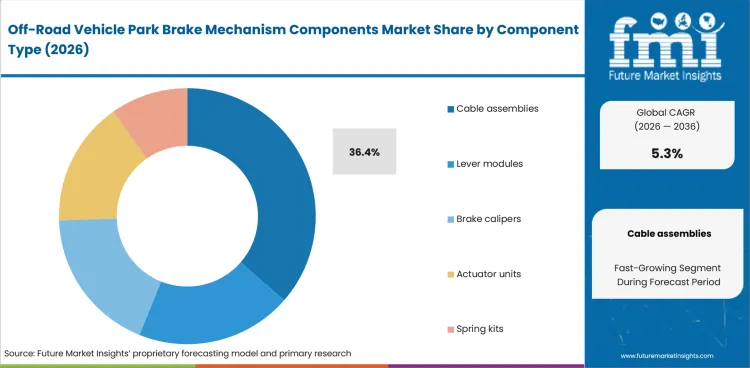
- Cable assemblies are expected to hold 36.4% share in 2026 because compact off-road vehicles need simple manual release parts. Dealers prefer cable kits that can be replaced without special tools.
- Lever modules will support steady demand in 2026 since operators need smooth engagement after repeated use. The all-terrain vehicle performance brake kits space gives nearby insight into compact vehicle brake upgrades.
Insights into Off-Road Vehicle Park Brake Mechanism Components Market by Vehicle Type
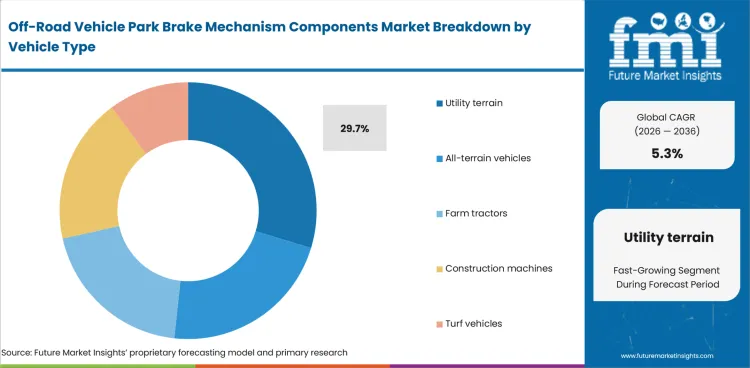
- Utility terrain vehicles are forecast to account for 29.7% share in 2026. These vehicles stop often during farm work and property maintenance, so park brake parts must engage quickly.
- Farm tractors will keep demand active in 2026 because loaded implements add pressure on hold systems. Construction machines need stronger calipers since dust can affect release movement.
Insights into Off-Road Vehicle Park Brake Mechanism Components Market by Actuation Type
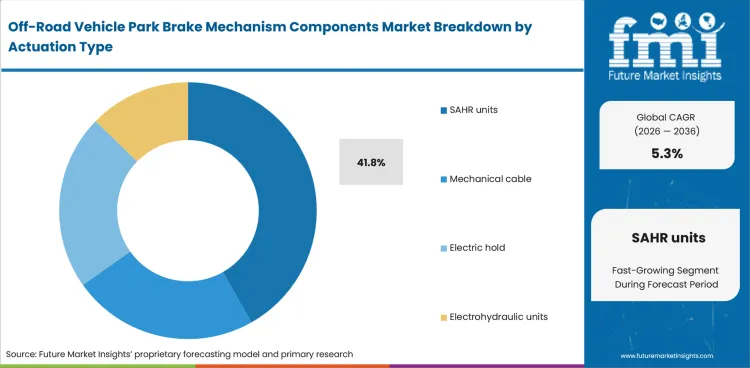
- SAHR units are anticipated to represent 41.8% share in 2026. Spring-applied hydraulic release designs keep braking force applied after hydraulic pressure drops.
- Mechanical cable systems will continue in smaller machines in 2026 since rural workshops can repair them quickly. Demand for off-highway hydraulic valve actuator systems supports nearby hydraulic control know-how used in release systems.
Insights into Off-Road Vehicle Park Brake Mechanism Components Market by Material Type
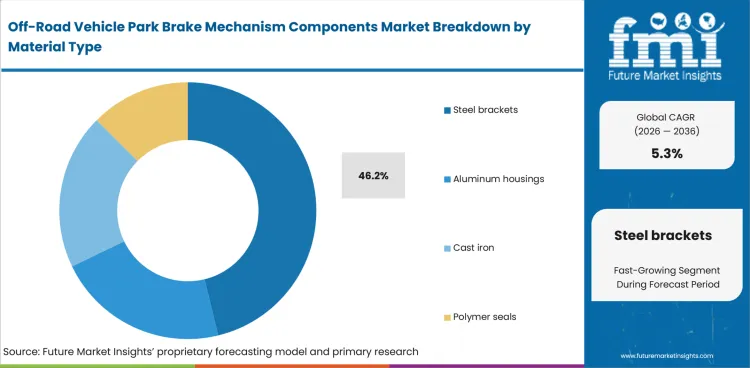
- Steel brackets are projected to account for 46.2% share in 2026. Mounting parts must resist vibration because poor alignment can change cable travel over time.
- Aluminum housings will find use in lighter utility vehicles in 2026. Polymer seals will protect actuator parts from dust and water during outdoor operation.
Insights into Off-Road Vehicle Park Brake Mechanism Components Market by Sales Channel
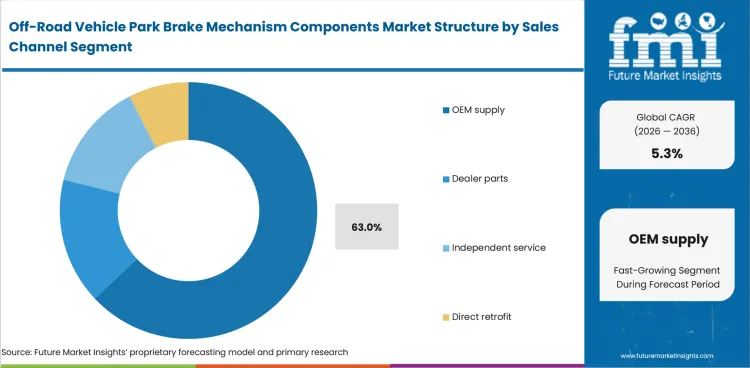
- OEM supply is expected to account for 63.0% share in 2026. Park brake mechanisms need axle layout checks before a vehicle enters production.
- Dealer parts will support repeat demand in 2026 when cables stretch and return springs weaken. The brake system powerpack and boosterless units area gives a wider view of factory-level brake integration.
Off-Road Vehicle Park Brake Mechanism Components Market Drivers, Restraints, and Opportunities
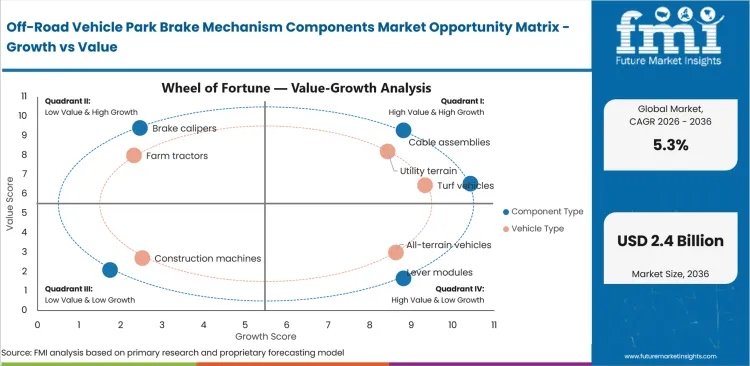
- Slope hold safety increases OEM demand because tractors and utility vehicles often stop on uneven ground.
- Dust and corrosion can slow replacement acceptance when cable ends and lever pivots wear early.
- Electric hold units create new fitment space as compact electric vehicles need integrated brake packages.
Slope Hold Safety Raises OEM Fitment
OEMs need park brake hardware that holds the machine after hydraulic pressure drops. Carlisle Brake & Friction describes its SAHR RT Series Park Brake as a failsafe spring-applied hydraulic release sliding caliper. The brake is designed for static and secondary applications. Multiple calipers may be used on one disc to raise torque output. This gives heavy equipment builders a practical way to match hold force with machine weight. Demand for off-road hub bearing units follows a similar path because wheel-end loads affect brake package design.
Dust and Corrosion Raise Service Cost
Field exposure can make park brake parts harder to service. Mud raises pull effort after machines sit outside for long periods. Moisture can corrode lever pivots during storage. Buyers compare coated brackets before approving replacement kits. Shielded cable ends improve service life in wet and dusty use. Weak service access increases workshop time and reduces dealer trust in low-cost parts.
Electric Park Brake Creates OEM Upgrade Route
Electric hold systems create new fitment space inside compact off-road vehicles. Cable routing becomes harder when drive modules take more room near the axle. Electric park brake units reduce the need for long manual release paths. OEMs still need safe release behavior and simple service access. The agricultural and construction vehicle chassis bearings segment faces similar durability needs near mud-exposed chassis points.
Analysis of Off-Road Vehicle Park Brake Mechanism Components Market by Key Countries
.webp "Top Country Growth Comparison Off Road Vehicle Park Brake Mechanism Components Market Cagr (2026 2036)")
| Country | Forecast CAGR |
|---|---|
| United States | 5.2% |
| China | 6.5% |
| India | 6.8% |
| Germany | 5.1% |
| France | 4.9% |
| Japan | 4.8% |
| United Kingdom | 4.6% |
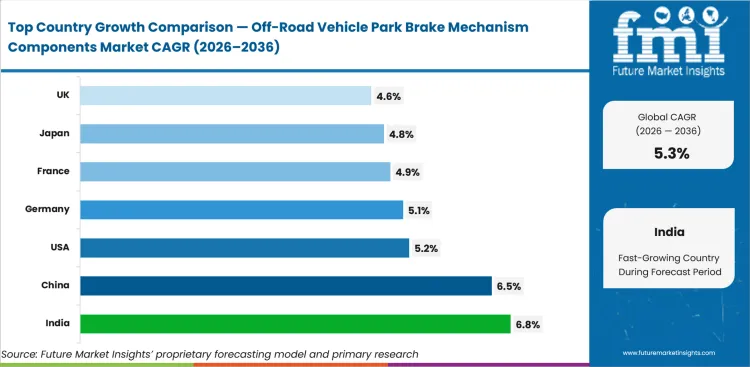
Source: Future Market Insights, 2026.
Off-Road Vehicle Park Brake Mechanism Components Market CAGR Analysis by Country
- India is forecast to record 6.8% CAGR by 2036 as tractor repair demand and rural service depth support replacement kits.
- China’s anticipated CAGR of 6.5% through 2036 reflects equipment production depth and export-oriented component sourcing across local machinery clusters.
- The United States is expected to expand at 5.2% CAGR through 2036 as dealer networks support park brake repair demand.
- Germany’s 5.1% CAGR during the forecast period is supported by premium machinery programs and stronger supplier validation needs.
- France is projected to advance at 4.9% CAGR as farm service cycles support compact brake hardware demand.
- Japan’s 4.8% CAGR reflects compact machinery design and precision part requirements in small equipment layouts.
- The United Kingdom is forecast to grow at 4.6% CAGR as wet-field use keeps repair demand active.
Demand Outlook for Off-Road Vehicle Park Brake Mechanism Components Market in the United States
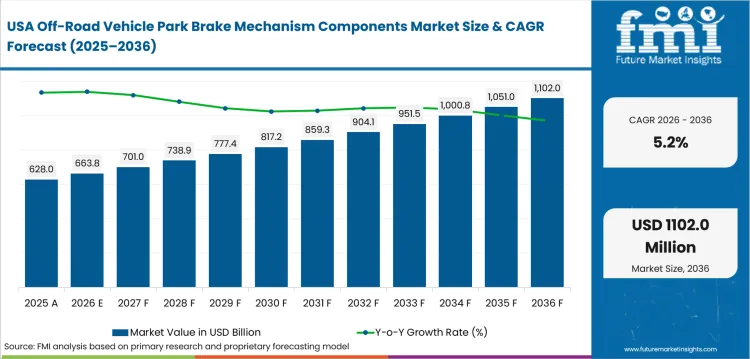
Large off-road service base · 2026 to 2036
Country Market Snapshot Table
| Parameter | Value |
|---|---|
| Market Size in 2025 | USD 286 million |
| Market Forecast in 2036 | USD 504 million |
| CAGR 2026 to 2036 | 5.2% |
| Years Considered | 2021 to 2036 |
| Base Year | 2025 |
| Forecast Period | 2026 to 2036 |
| Units Considered | Value USD million |
| Leading Sub-Region | Midwest farm equipment corridor |
United States Off-Road Vehicle Park Brake Mechanism Components Market Outlook
USA demand comes from farm tractors and utility vehicles that work across large outdoor sites. Park brake parts must hold machines safely after repeated stops on slopes and loose ground.
Dealer service channels are important because cables and return springs wear during daily use. OEMs also need park brake parts with clear drawings and release pressure data before vehicle approval.
Key Growth Drivers
- Farm fleets need reliable park brake kits for field stops, as AEM reported 18,587 USA farm tractor sales in the first two months of 2026. This keeps replacement demand active across dealer networks.
- Heavy-duty machines need stronger hold parts, as AEM reported 148 four-wheel drive tractors sold in February 2026. These units place higher loads on calipers and mounting brackets.
- Utility vehicle makers need compact park brake assemblies for turf work and property service vehicles. Short travel routes make frequent stop-and-park cycles more common.
- OEM engineers prefer suppliers with torque data and fitment drawings. Better documentation reduces redesign work before vehicle launch.
Key Restraints
- Smaller repair shops can delay replacement when low-cost parts lack clear fitment notes.
- Warranty risk rises when cable ends and return springs wear early in dusty use.
- OEM part orders can soften when new tractor buying slows, as AEM reported USA farm tractor sales fell 9.1% in March 2026. This can shift more demand toward service replacement.
What makes United States unique
The United States is unique because dealer service networks can move replacement park brake kits quickly across large farm and utility vehicle fleets.
Demand Outlook for Off-Road Vehicle Park Brake Mechanism Components Market in China
Large equipment production base · 2026 to 2036
Country Market Snapshot Table
| Parameter | Value |
|---|---|
| Market Size in 2025 | USD 216 million |
| Market Forecast in 2036 | USD 431 million |
| CAGR 2026 to 2036 | 6.5% |
| Years Considered | 2021 to 2036 |
| Base Year | 2025 |
| Forecast Period | 2026 to 2036 |
| Units Considered | Value USD million |
| Leading Sub-Region | Yangtze River Delta manufacturing belt |
China Off-Road Vehicle Park Brake Mechanism Components Market Outlook
China has broad manufacturing depth across farm machinery and construction equipment. Park brake component demand comes from OEM fitment and replacement parts for machines used in rough outdoor conditions.
Local suppliers focus on cost control and high-volume metal parts. Electric utility vehicles create another route for actuator units and compact hold systems.
Key Growth Drivers
- Equipment makers need brake parts for a broader machinery production base, as China’s equipment manufacturing value added increased 9.2% in 2025 and accounted for 36.8% of industrial enterprises above designated size. This supports OEM demand for brackets and compact park brake assemblies.
- Local machinery output supports bracket and caliper sourcing, as China’s special purpose machinery value added increased 2.1% year on year in May 2024. This gives component suppliers a wider OEM base.
- Construction machines need park brake parts that can handle dust and washing cycles. Sealed caliper slides improve service life in rough site work.
- Export programs need brake parts that match cost targets and buyer specifications. Suppliers with stable metal forming quality can serve wider machine programs.
Key Restraints
- Price pressure can reduce supplier room for better coatings and stronger seals.
- Smaller suppliers may struggle when OEMs ask for repeatable torque test records.
- Construction equipment demand can weaken when building activity slows, as China’s cement output fell 8.2% year on year in May 2024. Softer construction output can delay some off-road vehicle orders.
What Makes China Unique
China is unique because off-road brake part demand is closely connected with local machine production and export-oriented component sourcing.
Demand Outlook for Off-Road Vehicle Park Brake Mechanism Components Market in India
Tractor-heavy service market · 2026 to 2036
Country Market Snapshot Table
| Parameter | Value |
|---|---|
| Market Size in 2025 | USD 118 million |
| Market Forecast in 2036 | USD 244 million |
| CAGR 2026 to 2036 | 6.8% |
| Years Considered | 2021 to 2036 |
| Base Year | 2025 |
| Forecast Period | 2026 to 2036 |
| Units Considered | Value USD million |
| Leading Sub-Region | North and West tractor belt |
India Off-Road Vehicle Park Brake Mechanism Components Market Outlook
India’s market is driven by farm tractor use and a wide rural service network. Park brake parts need to be simple to fit because many repairs happen in small workshops.
OEM demand is moving toward better brackets and release parts for tractors used on road and field surfaces. Replacement demand stays active as cable stretch and spring wear affect older machines.
Key Growth Drivers
- Tractor service networks need fast-moving brake kits, as FADA reported 1,050,077 tractor retail units in FY 2026. That scale gives cable assemblies and return springs a broad service route.
- Domestic tractor makers are adding more service points, as TAFE reported about 214,951 tractor sales in FY 2026. Higher tractor use supports park brake inspection and replacement needs.
- Rural workshops need low-cost cable kits that can be repaired near end users. Simple mechanical parts keep service practical outside large cities.
- Compact construction machines create demand for calipers and actuator parts. These machines need park brake parts that tolerate dust and daily stop cycles.
Key Restraints
- Low-cost imports can pressure local part makers on price and margin.
- Workshop skill gaps can increase adjustment errors after cable replacement.
- Construction equipment softness can reduce brake part orders in one end use, as FADA reported 71,227 construction equipment retail units in FY 2026 with an 11.7% decline. This can slow demand from smaller equipment dealers.
What Makes India Unique
India is unique because rural workshops and tractor dealers shape replacement demand as much as OEM sourcing teams do.
Demand Outlook for Off-Road Vehicle Park Brake Mechanism Components Market in Germany
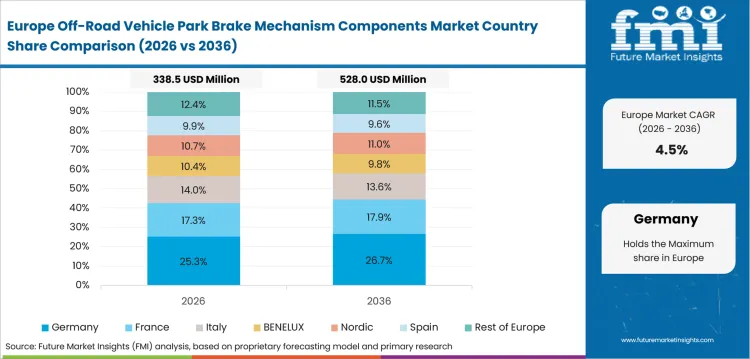
Precision machinery supplier base · 2026 to 2036
Country Market Snapshot Table
| Parameter | Value |
|---|---|
| Market Size in 2025 | USD 92 million |
| Market Forecast in 2036 | USD 159 million |
| CAGR 2026 to 2036 | 5.1% |
| Years Considered | 2021 to 2036 |
| Base Year | 2025 |
| Forecast Period | 2026 to 2036 |
| Units Considered | Value USD million |
| Leading Sub-Region | Bavaria and Baden-Württemberg machinery belt |
Germany Off-Road Vehicle Park Brake Mechanism Components Market Outlook
Germany’s market is built around high-spec machinery and export-oriented suppliers. Park brake components need strong documentation because OEMs check torque data and fitment drawings before approval.
Demand is steady in premium farm machines and compact construction equipment. Suppliers with sealed actuation and high-quality steel parts can fit programs that need long service life.
Key Growth Drivers
- Premium tractor programs need reliable brake parts, as Fendt reported 6,326 new tractor registrations in Germany in 2025. Higher-spec machines need better hold control and fitment support.
- Machinery suppliers need parts for a large national tractor pool, as KBA data cited by Fendt showed 24,440 new tractor registrations in Germany in 2025. This keeps OEM and dealer channels relevant.
- Export-focused OEMs use parts that can pass buyer checks across several regions. Clear test records improve supplier acceptance in international programs.
- Compact construction machines need sealed brake parts for rental fleets. Rental use raises brake wear because machines change operators often.
Key Restraints
- High validation cost can slow new supplier approval for smaller brake part makers.
- Premium part pricing can limit replacement demand in cost-sensitive repair channels.
- New tractor demand can soften in weak buying cycles, as VDMA recorded 16,516 German tractor registrations from January to July 2025 with a 15.3% decline. Lower OEM demand can push suppliers toward service orders.
What Makes Germany Unique
Germany is unique because technical validation and export machine standards have a strong effect on supplier selection.
Demand Outlook for Off-Road Vehicle Park Brake Mechanism Components Market in France
Farm equipment service corridor · 2026 to 2036
Country Market Snapshot Table
| Parameter | Value |
|---|---|
| Market Size in 2025 | USD 62 million |
| Market Forecast in 2036 | USD 105 million |
| CAGR 2026 to 2036 | 4.9% |
| Years Considered | 2021 to 2036 |
| Base Year | 2025 |
| Forecast Period | 2026 to 2036 |
| Units Considered | Value USD million |
| Leading Sub-Region | Northern and western farm equipment belt |
France Off-Road Vehicle Park Brake Mechanism Components Market Outlook
France has steady demand from tractors and specialist agricultural machines. Park brake parts need to work across wet farms and mixed rural road use.
Replacement demand is important because farm machines stay in use for long periods. OEMs and service shops prefer parts with simple cable adjustment and corrosion resistance.
Key Growth Drivers
- Higher-powered tractors need stronger hold parts, as CEMA reported average standard tractor power reached 169 hp in France in 2024. Stronger machines need better caliper and bracket fitment.
- Landscaping equipment creates demand for compact brake parts, as CEMA reported 6,718 landscaping and gardening tractor registrations in 2024. This raises need for small park brake kits.
- Farm service centers need cable kits for tractors used across wet rural areas. Corrosion-resistant parts reduce repeat service work.
- Vineyard and orchard machines need compact brake hardware in tight axle layouts. Smaller machines create demand for precise lever travel and clean release.
Key Restraints
- Farm income pressure can delay replacement work on older tractors.
- Small specialist machines need compact parts that may raise unit cost.
- Equipment demand can weaken during soft buying years, as AXEMA reported 39,198 agricultural tractor first registrations in France in 2024 with a 5.8% decline. This can slow OEM-side brake part orders.
What Makes France Unique
France is unique because farm service demand covers standard tractors and smaller specialist machines used in vineyards and orchards.
Demand Outlook for Off-Road Vehicle Park Brake Mechanism Components Market in Japan
Compact machinery and precision parts base · 2026 to 2036
Country Market Snapshot Table
| Parameter | Value |
|---|---|
| Market Size in 2025 | USD 74 million |
| Market Forecast in 2036 | USD 124 million |
| CAGR 2026 to 2036 | 4.8% |
| Years Considered | 2021 to 2036 |
| Base Year | 2025 |
| Forecast Period | 2026 to 2036 |
| Units Considered | Value USD million |
| Leading Sub-Region | Chubu and Kanto machinery belt |
Japan Off-Road Vehicle Park Brake Mechanism Components Market Outlook
Japan’s demand comes from compact construction equipment and small agricultural machines. Park brake components need precise movement because axle layouts are often crowded.
Suppliers focus on reliable release behavior and low-noise operation. Electric compact machines create demand for actuator parts that fit small drive packages.
Key Growth Drivers
- Construction equipment programs need reliable brake parts, as Japan CEMA expected FY 2025 shipment value to reach JPY 3,203.3 billion. This supports demand for machinery components.
- Domestic equipment service needs stay active, as Japan CEMA expected FY 2025 domestic construction equipment demand at JPY 971.4 billion. Local repair channels need compact brake parts.
- Compact construction machines need small calipers and controlled release movement. Tight axle layouts raise the value of precise component design.
- Electric machines need hold systems that fit close to motor and gearbox units. This creates demand for compact actuator parts.
Key Restraints
- Compact designs can raise validation effort because small parts must still meet hold force needs.
- Smaller farm fleets can limit replacement volume in some rural areas.
- Monthly construction equipment demand can shift, as Japan CEMA reported September 2025 domestic shipment value of JPY 101.8 billion with a 4.9% decline. This can make short-term component orders uneven.
What Makes Japan Unique
Japan is unique because compact machine design creates demand for small and precise park brake parts.
Demand Outlook for Off-Road Vehicle Park Brake Mechanism Components Market in the United Kingdom
Repair-focused farm equipment market · 2026 to 2036
Country Market Snapshot Table
| Parameter | Value |
|---|---|
| Market Size in 2025 | USD 47 million |
| Market Forecast in 2036 | USD 76 million |
| CAGR 2026 to 2036 | 4.6% |
| Years Considered | 2021 to 2036 |
| Base Year | 2025 |
| Forecast Period | 2026 to 2036 |
| Units Considered | Value USD million |
| Leading Sub-Region | Midlands and eastern farm machinery corridor |
United Kingdom Off-Road Vehicle Park Brake Mechanism Components Market Outlook
UK demand comes from farm machinery repair and specialist off-road vehicles. Park brake parts need to handle wet ground and long outdoor storage.
Service channels are important because many farms extend machine life during softer buying periods. Compact brake kits and clear fitment notes help dealers reduce workshop time.
Key Growth Drivers
- Higher-powered tractors need dependable hold parts, as AEA reported average UK tractor power at 172.9 hp in 2025. Stronger tractors place more load on brake hardware.
- Repair channels need parts for a meaningful tractor fleet, as AEA recorded 1,520 thousand total horsepower across UK tractor registrations in 2025. This keeps demand active for brackets and cable kits.
- Specialist vehicle builders use compact brake systems for utility and defense platforms. These buyers need reliable release control in low-volume builds.
- Wet field use raises demand for sealed actuation and corrosion protection. Better sealing helps reduce repeat workshop visits.
Key Restraints
- Lower new tractor sales can reduce OEM fitment demand in the short term.
- Import reliance can raise lead time for specialist brake parts.
- Repair demand rises when machines age, as AEA reported 8,791 UK agricultural tractor registrations in 2025 with a 14.2% decline. Lower replacement buying can keep older machines in service for longer.
What Makes the United Kingdom Unique
The United Kingdom is unique because farm repair demand and specialist vehicle projects both influence park brake component sourcing.
Competitive Landscape and Strategic Positioning
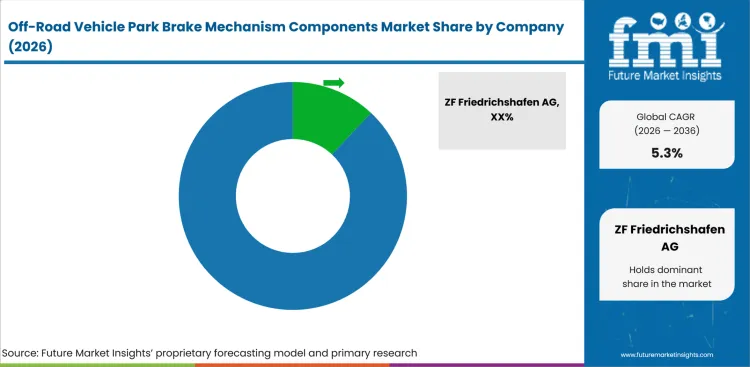
- Competition is centered on hold force proof and sealed actuation quality.
- Suppliers win when brackets and calipers arrive with fitment drawings.
- OEMs prefer partners that support prototype testing before vehicle launch.
- Dealer channels favor parts that reduce adjustment time after installation.
Competition in this market is practical and test based. OEMs compare hold force and release pressure before approving a park brake supplier. Hayes Performance Systems and Ausco Products support specialist programs with mechanical and SAHR brake depth. Carlisle Brake & Friction gives wider product coverage in off-highway park brake assemblies. Suppliers with clear mounting guidance can reduce design changes during vehicle testing. This improves the approval path for farm and utility vehicle programs.
Carlisle Brake & Friction lists Electric Park Brake and FCP Series Park Brake in its off-highway park and emergency disc brake range. The same range includes G1 Series Park Brake and G2 Series Park Brake. Product depth matters because one brake layout does not fit every off-road machine. Heavy equipment needs higher torque output. Compact utility vehicles need smaller packaging and easier service access. ZF Friedrichshafen AG and Brakes India support wider brake system needs across OEM and regional service channels.
Supplier choice will depend on fitment data and service access through 2036. OEM engineers need drawings before they approve a bracket or caliper. Service teams need parts that reduce repair time in farm and utility fleets. Buyers will favor sealed actuation and clear mounting instructions. Parts that hold safely after vibration and washing will protect repeat orders.
Key Companies in the Off-Road Vehicle Park Brake Mechanism Components Market
Brake Component Specialists
- Hayes Performance Systems
- Ausco Products
- Carlisle Brake & Friction
Hydraulic and Electric Hold Suppliers
- ZF Friedrichshafen AG
- Danfoss Power Solutions
Regional and Specialty Vehicle Suppliers
- AL-KO Vehicle Technology
- Brakes India
Competitive Benchmarking: Off-Road Vehicle Park Brake Mechanism Components Market
| Company | Hold Force Depth | Sealed Actuation Support | OEM Validation Support | Geographic Reach |
|---|---|---|---|---|
| ZF Friedrichshafen AG | High | High | High | Global with European strength |
| Hayes Performance Systems | High | Medium | High | North America centered |
| Carlisle Brake & Friction | High | High | Medium | Global industrial reach |
| Danfoss Power Solutions | Medium | High | High | Global off-highway reach |
| AL-KO Vehicle Technology | Medium | High | Medium | Europe centered |
| Ausco Products | High | Medium | Medium | North America centered |
| Brakes India | Medium | Medium | Medium | India centered |
Source: Future Market Insights competitive analysis, 2026.
Key Developments in Off-Road Vehicle Park Brake Mechanism Components Market
- In 2025, Club Car introduced its next-generation Tempo golf car with Automatic Park Brake and StopSmart Technology. The company says the system gives smoother gradual deceleration and supports safer parking control.
- In November 2025, Danfoss Power Solutions announced the Editron EM-PMI180 motor and said its ED-DT180 eDrive integrates an electric motor, reduction gearbox and electromagnetic brake in one compact package for MEWPs and similar off-highway vehicles.
Key Players in the Off-Road Vehicle Park Brake Mechanism Components Market
Major Global Players
- ZF Friedrichshafen AG
- Hayes Performance Systems
- Carlisle Brake & Friction
- Danfoss Power Solutions
- AL-KO Vehicle Technology
Specialist and Regional Players
- Ausco Products
- Brakes India
Off-Road Vehicle Park Brake Mechanism Components Market - Report Scope
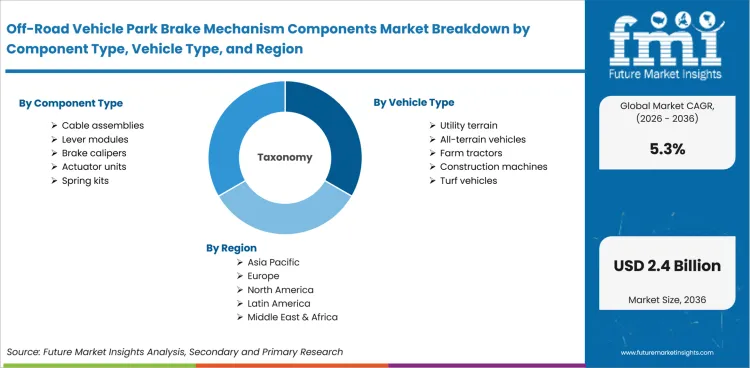
| Parameter | Details |
|---|---|
| Market size by 2036 | USD 2.4 billion |
| Growth rate | 5.3% CAGR from 2026 to 2036 |
| Forecast period | 2026 to 2036 |
| Base year value 2026 | USD 1.4 billion |
| By component type | Cable assemblies, lever modules, brake calipers, actuator units, spring kits |
| By vehicle type | Utility terrain vehicles, all-terrain vehicles, farm tractors, construction machines, turf vehicles |
| By actuation type | SAHR units, mechanical cable systems, electric hold systems, electrohydraulic units |
| By material type | Steel brackets, aluminum housings, cast iron parts, polymer seals |
| By sales channel | OEM supply, dealer parts, independent service, direct retrofit |
| Regions covered | North America, Latin America, Western Europe, Eastern Europe, East Asia, South Asia and Pacific, Middle East and Africa |
| Countries covered | United States, China, India, Germany, France, Japan, United Kingdom, and 30 plus countries |
| Key companies profiled | ZF Friedrichshafen AG, Hayes Performance Systems, Carlisle Brake & Friction, Danfoss Power Solutions, AL-KO Vehicle Technology, Ausco Products, Brakes India Private Limited |
| Approach | Hybrid bottom-up and top-down methodology using off-road vehicle output, component fitment rates, service replacement demand, OEM sourcing patterns, and regional equipment use. |
Source: Future Market Insights, 2026.
Key Segments
Off-Road Vehicle Park Brake Mechanism Components Market Segmented by Component Type
- Cable assemblies
- Lever modules
- Brake calipers
- Actuator units
- Spring kits
Off-Road Vehicle Park Brake Mechanism Components Market Segmented by Vehicle Type
- Utility terrain
- All-terrain vehicles
- Farm tractors
- Construction machines
- Turf vehicles
Off-Road Vehicle Park Brake Mechanism Components Market Segmented by Actuation Type
- SAHR units
- Mechanical cable
- Electric hold
- Electrohydraulic units
Off-Road Vehicle Park Brake Mechanism Components Market Segmented by Material Type
- Steel brackets
- Aluminum housings
- Cast iron
- Polymer seals
Off-Road Vehicle Park Brake Mechanism Components Market Segmented by Sales Channel
- OEM supply
- Dealer parts
- Independent service
- Direct retrofit
Off-Road Vehicle Park Brake Mechanism Components Market by Region
- North America
- Latin America
- Western Europe
- Eastern Europe
- East Asia
- South Asia Pacific
- Middle East and Africa
Research Sources and Bibliography
- Agricultural Engineers Association. (2026). Tractor statistics. AEA.
- Association of Equipment Manufacturers. (2026, March 17). USA and Canadian agricultural tractor and combine sales show mixed results in February. AEM.
- Association of Equipment Manufacturers. (2026, April 10). USA and Canadian agricultural tractor and combine sales decline in March 2026. AEM.
- Ausco Products, Inc. (2024, March 12). 30 Series SAHR calipers manual 107304. Ausco Products.
- AXEMA. (2025, January 10). Marché des agroéquipements: Immatriculations de tracteurs agricoles en 2024. AXEMA.
- Carlisle Brake & Friction. (2026). Electric Park Brake. Carlisle Brake & Friction.
- Carlisle Brake & Friction. (2026). Park & emergency disc brakes. Carlisle Brake & Friction.
- Carlisle Brake & Friction. (2026). SAHR RT Series Park Brake. Carlisle Brake & Friction.
- CEMA. (2025, April 8). European tractor registrations at 10-year low in 2024. CEMA.
- Club Car. (2025, March 20). Club Car raises the bar again with next-gen Tempo golf car. Club Car.
- Danfoss Power Solutions. (2025, November 10). New Danfoss Editron EM-PMI180 low-voltage electric motor efficiently powers hydraulic functions on compact electric machinery. Danfoss.
- European Parliament & Council of the European Union. (2025, January 8). Regulation (EU) 2025/14 of 19 December 2024 on the approval and market surveillance of non-road mobile machinery circulating on public roads and amending Regulation (EU) 2019/1020. Official Journal of the European Union.
- Federation of Automobile Dealers Associations. (2026, April 6). FADA releases FY 2026 and March 2026 vehicle retail data. FADA.
- Fendt. (2026, January 16). One in four German farmers bought a Fendt tractor in 2025. Fendt.
- National Bureau of Statistics of China. (2026, February 28). Statistical communiqué of the People’s Republic of China on the 2025 national economic and social development.National Bureau of Statistics of China.
- Japan Construction Equipment Manufacturers Association. (2024, August 9). Forecast of demand for construction equipment: August 2024. CEMA Japan.
- Japan Construction Equipment Manufacturers Association. (2025, October 30). Shipment value statistics of construction equipment for September 2025. CEMA Japan.
- John Deere. (2024, June 11). XUV 875M Diesel: Crossover Gator utility vehicles UTV. John Deere.
- National Bureau of Statistics of China. (2024, June 18). Industrial production operation in May 2024. National Bureau of Statistics of China.
- VDMA Agricultural Machinery Association. (2025, August 13). Tractor registrations Germany by kW: July 2025. VDMA.
This bibliography is provided for reader reference and is not exhaustive. The full report contains the complete reference list and detailed citations
Frequently Asked Questions
What is the current and future value of the off-road vehicle park brake mechanism components market?
The market is expected to rise from USD 1.4 billion in 2026 to USD 2.4 billion by 2036.
What CAGR is expected for the off-road vehicle park brake mechanism components market?
Demand is forecast to expand at 5.3% CAGR from 2026 to 2036.
Which component type is expected to lead demand in 2026?
Cable assemblies are expected to hold 36.4% share in 2026 due to serviceable mechanical release use in compact machines.
Which sales channel is expected to hold a strong share in 2026?
OEM supply is expected to account for 63.0% share in 2026 as park brake geometry needs vehicle-level validation.
What factors are driving park brake component use in off-road vehicles?
Slope parking safety and longer service cycles are the main demand drivers. Electric utility vehicle fitment creates another route for higher-value actuator units.
How do regulations affect off-road park brake component sourcing?
Machinery safety and public-road use rules increase demand for tested hold force and traceable parts.
Which countries are expected to move faster in the market?
India at 6.8% CAGR and China at 6.5% CAGR are expected to move above the global pace by 2036.
Preview the report firsthand - request a free sample
Get SampleGet the brochure for pricing and purchase details.
Get PDFTable of Content
- Key Takeaways
- Market Size and CAGR
- Top Growth Driver
- Fastest Growing Segment
- Leading Region
- Key Companies
- Emerging Opportunities
- Executive Summary
- Global Market Outlook
- Demand-side Trends
- Supply-side Trends
- Technology Roadmap Analysis
- Analysis and Recommendations
- Analyst Perspective (What is happening? Why now? What should investors know?)
- Key Questions Answered
- How large is the market?
- What is the CAGR?
- What are key trends?
- Which region dominates?
- Who are the leaders?
- Market Overview
- Market Coverage / Taxonomy
- Market Definition / Scope / Limitations
- Research Methodology
- Chapter Orientation
- Analytical Lens and Working Hypotheses
- Market Structure, Signals, and Trend Drivers
- Benchmarking and Cross-market Comparability
- Market Sizing, Forecasting, and Opportunity Mapping
- Research Design and Evidence Framework
- Desk Research Programme (Secondary Evidence)
- Expert Input and Fieldwork (Primary Evidence)
- Tooling, Models, and Reference Databases
- Data Engineering and Model Build
- Quality Assurance and Audit Trail
- Market Background
- Market Dynamics (Drivers, Restraints, Opportunity, Trends)
- Scenario Forecast (Optimistic, Likely, Conservative)
- Impact Analysis
- AI Impact
- Sustainability Impact
- Regulatory Impact
- Technology Impact
- Consumer / Buyer Analysis
- Purchase Drivers
- Adoption Barriers
- Buyer Journey
- Opportunity Map Analysis
- Product Life Cycle Analysis
- Supply Chain Analysis
- Investment Feasibility Matrix
- Value Chain Analysis
- PESTLE and Porter's Analysis
- Regulatory Landscape
- Regional Parent Market Outlook
- Production and Consumption Statistics
- Import and Export Statistics
- Global Market Analysis and Forecast, 2021 to 2036
- Historical Market Size Value (USD Billion) & Volume (Unit) Analysis, 2021 to 2025
- Current and Future Market Size Value (USD Billion) & Volume (Unit) Projections, 2026 to 2036
- Y-o-Y Growth Trend Analysis
- Absolute $ Opportunity Analysis
- Global Market Pricing Analysis, 2021 to 2036
- Global Market Analysis and Forecast, By Component Type, 2021 to 2036
- Introduction / Key Findings
- Historical Market Size Value (USD Billion) & Volume (Unit) Analysis By Component Type, 2021 to 2025
- Current and Future Market Size Value (USD Billion) & Volume (Unit) Analysis and Forecast By Component Type, 2026 to 2036
- Y-o-Y Growth Trend Analysis By Component Type, 2021 to 2025
- Absolute $ Opportunity Analysis By Component Type, 2026 to 2036
- Global Market Analysis and Forecast, By Vehicle Type, 2021 to 2036
- Introduction / Key Findings
- Historical Market Size Value (USD Billion) & Volume (Unit) Analysis By Vehicle Type, 2021 to 2025
- Current and Future Market Size Value (USD Billion) & Volume (Unit) Analysis and Forecast By Vehicle Type, 2026 to 2036
- Y-o-Y Growth Trend Analysis By Vehicle Type, 2021 to 2025
- Absolute $ Opportunity Analysis By Vehicle Type, 2026 to 2036
- Global Market Analysis and Forecast, By Actuation Type, 2021 to 2036
- Introduction / Key Findings
- Historical Market Size Value (USD Billion) & Volume (Unit) Analysis By Actuation Type, 2021 to 2025
- Current and Future Market Size Value (USD Billion) & Volume (Unit) Analysis and Forecast By Actuation Type, 2026 to 2036
- Y-o-Y Growth Trend Analysis By Actuation Type, 2021 to 2025
- Absolute $ Opportunity Analysis By Actuation Type, 2026 to 2036
- Global Market Analysis and Forecast, By Material Type, 2021 to 2036
- Introduction / Key Findings
- Historical Market Size Value (USD Billion) & Volume (Unit) Analysis By Material Type, 2021 to 2025
- Current and Future Market Size Value (USD Billion) & Volume (Unit) Analysis and Forecast By Material Type, 2026 to 2036
- Y-o-Y Growth Trend Analysis By Material Type, 2021 to 2025
- Absolute $ Opportunity Analysis By Material Type, 2026 to 2036
- Global Market Analysis and Forecast, By Sales Channel, 2021 to 2036
- Introduction / Key Findings
- Historical Market Size Value (USD Billion) & Volume (Unit) Analysis By Sales Channel, 2021 to 2025
- Current and Future Market Size Value (USD Billion) & Volume (Unit) Analysis and Forecast By Sales Channel, 2026 to 2036
- Y-o-Y Growth Trend Analysis By Sales Channel, 2021 to 2025
- Absolute $ Opportunity Analysis By Sales Channel, 2026 to 2036
- Global Market Analysis and Forecast, By Region, 2021 to 2036
- Introduction
- Historical Market Size Value (USD Billion) & Volume (Unit) Analysis By Region, 2021 to 2025
- Current Market Size Value (USD Billion) & Volume (Unit) Analysis and Forecast By Region, 2026 to 2036
- North America
- Latin America
- Western Europe
- Eastern Europe
- East Asia
- South Asia and Pacific
- Middle East & Africa
- Market Attractiveness Analysis By Region
- North America Market Analysis and Forecast, By Country, 2021 to 2036
- Historical Market Size Value (USD Billion) & Volume (Unit) Trend Analysis By Market Taxonomy, 2021 to 2025
- Market Size Value (USD Billion) & Volume (Unit) Forecast By Market Taxonomy, 2026 to 2036
- By Country
- USA
- Canada
- Mexico
- By Component Type
- By Vehicle Type
- By Actuation Type
- By Material Type
- By Sales Channel
- By Country
- Market Attractiveness Analysis
- By Country
- By Component Type
- By Vehicle Type
- By Actuation Type
- By Material Type
- By Sales Channel
- Key Takeaways
- Latin America Market Analysis and Forecast, By Country
- Historical Market Size Value (USD Billion) & Volume (Unit) Trend Analysis By Market Taxonomy, 2021 to 2025
- Market Size Value (USD Billion) & Volume (Unit) Forecast By Market Taxonomy, 2026 to 2036
- By Country
- Brazil
- Chile
- Rest of Latin America
- By Component Type
- By Vehicle Type
- By Actuation Type
- By Material Type
- By Sales Channel
- By Country
- Market Attractiveness Analysis
- By Country
- By Component Type
- By Vehicle Type
- By Actuation Type
- By Material Type
- By Sales Channel
- Key Takeaways
- Western Europe Market Analysis and Forecast, By Country
- Historical Market Size Value (USD Billion) & Volume (Unit) Trend Analysis By Market Taxonomy, 2021 to 2025
- Market Size Value (USD Billion) & Volume (Unit) Forecast By Market Taxonomy, 2026 to 2036
- By Country
- Germany
- UK
- Italy
- Spain
- France
- Nordic
- BENELUX
- Rest of Western Europe
- By Component Type
- By Vehicle Type
- By Actuation Type
- By Material Type
- By Sales Channel
- By Country
- Market Attractiveness Analysis
- By Country
- By Component Type
- By Vehicle Type
- By Actuation Type
- By Material Type
- By Sales Channel
- Key Takeaways
- Eastern Europe Market Analysis and Forecast, By Country
- Historical Market Size Value (USD Billion) & Volume (Unit) Trend Analysis By Market Taxonomy, 2021 to 2025
- Market Size Value (USD Billion) & Volume (Unit) Forecast By Market Taxonomy, 2026 to 2036
- By Country
- Russia
- Poland
- Hungary
- Balkan & Baltic
- Rest of Eastern Europe
- By Component Type
- By Vehicle Type
- By Actuation Type
- By Material Type
- By Sales Channel
- By Country
- Market Attractiveness Analysis
- By Country
- By Component Type
- By Vehicle Type
- By Actuation Type
- By Material Type
- By Sales Channel
- Key Takeaways
- East Asia Market Analysis and Forecast, By Country
- Historical Market Size Value (USD Billion) & Volume (Unit) Trend Analysis By Market Taxonomy, 2021 to 2025
- Market Size Value (USD Billion) & Volume (Unit) Forecast By Market Taxonomy, 2026 to 2036
- By Country
- China
- Japan
- South Korea
- By Component Type
- By Vehicle Type
- By Actuation Type
- By Material Type
- By Sales Channel
- By Country
- Market Attractiveness Analysis
- By Country
- By Component Type
- By Vehicle Type
- By Actuation Type
- By Material Type
- By Sales Channel
- Key Takeaways
- South Asia and Pacific Market Analysis and Forecast, By Country
- Historical Market Size Value (USD Billion) & Volume (Unit) Trend Analysis By Market Taxonomy, 2021 to 2025
- Market Size Value (USD Billion) & Volume (Unit) Forecast By Market Taxonomy, 2026 to 2036
- By Country
- India
- ASEAN
- Australia & New Zealand
- Rest of South Asia and Pacific
- By Component Type
- By Vehicle Type
- By Actuation Type
- By Material Type
- By Sales Channel
- By Country
- Market Attractiveness Analysis
- By Country
- By Component Type
- By Vehicle Type
- By Actuation Type
- By Material Type
- By Sales Channel
- Key Takeaways
- Middle East & Africa Market Analysis and Forecast, By Country
- Historical Market Size Value (USD Billion) & Volume (Unit) Trend Analysis By Market Taxonomy, 2021 to 2025
- Market Size Value (USD Billion) & Volume (Unit) Forecast By Market Taxonomy, 2026 to 2036
- By Country
- Kingdom of Saudi Arabia
- Other GCC Countries
- Türkiye
- South Africa
- Other African Union
- Rest of Middle East & Africa
- By Component Type
- By Vehicle Type
- By Actuation Type
- By Material Type
- By Sales Channel
- By Country
- Market Attractiveness Analysis
- By Country
- By Component Type
- By Vehicle Type
- By Actuation Type
- By Material Type
- By Sales Channel
- Key Takeaways
- Key Countries Market Analysis
- USA
- Pricing Analysis
- Market Share Analysis, 2025
- By Component Type
- By Vehicle Type
- By Actuation Type
- By Material Type
- By Sales Channel
- Canada
- Pricing Analysis
- Market Share Analysis, 2025
- By Component Type
- By Vehicle Type
- By Actuation Type
- By Material Type
- By Sales Channel
- Mexico
- Pricing Analysis
- Market Share Analysis, 2025
- By Component Type
- By Vehicle Type
- By Actuation Type
- By Material Type
- By Sales Channel
- Brazil
- Pricing Analysis
- Market Share Analysis, 2025
- By Component Type
- By Vehicle Type
- By Actuation Type
- By Material Type
- By Sales Channel
- Chile
- Pricing Analysis
- Market Share Analysis, 2025
- By Component Type
- By Vehicle Type
- By Actuation Type
- By Material Type
- By Sales Channel
- Germany
- Pricing Analysis
- Market Share Analysis, 2025
- By Component Type
- By Vehicle Type
- By Actuation Type
- By Material Type
- By Sales Channel
- UK
- Pricing Analysis
- Market Share Analysis, 2025
- By Component Type
- By Vehicle Type
- By Actuation Type
- By Material Type
- By Sales Channel
- Italy
- Pricing Analysis
- Market Share Analysis, 2025
- By Component Type
- By Vehicle Type
- By Actuation Type
- By Material Type
- By Sales Channel
- Spain
- Pricing Analysis
- Market Share Analysis, 2025
- By Component Type
- By Vehicle Type
- By Actuation Type
- By Material Type
- By Sales Channel
- France
- Pricing Analysis
- Market Share Analysis, 2025
- By Component Type
- By Vehicle Type
- By Actuation Type
- By Material Type
- By Sales Channel
- India
- Pricing Analysis
- Market Share Analysis, 2025
- By Component Type
- By Vehicle Type
- By Actuation Type
- By Material Type
- By Sales Channel
- ASEAN
- Pricing Analysis
- Market Share Analysis, 2025
- By Component Type
- By Vehicle Type
- By Actuation Type
- By Material Type
- By Sales Channel
- Australia & New Zealand
- Pricing Analysis
- Market Share Analysis, 2025
- By Component Type
- By Vehicle Type
- By Actuation Type
- By Material Type
- By Sales Channel
- China
- Pricing Analysis
- Market Share Analysis, 2025
- By Component Type
- By Vehicle Type
- By Actuation Type
- By Material Type
- By Sales Channel
- Japan
- Pricing Analysis
- Market Share Analysis, 2025
- By Component Type
- By Vehicle Type
- By Actuation Type
- By Material Type
- By Sales Channel
- South Korea
- Pricing Analysis
- Market Share Analysis, 2025
- By Component Type
- By Vehicle Type
- By Actuation Type
- By Material Type
- By Sales Channel
- Russia
- Pricing Analysis
- Market Share Analysis, 2025
- By Component Type
- By Vehicle Type
- By Actuation Type
- By Material Type
- By Sales Channel
- Poland
- Pricing Analysis
- Market Share Analysis, 2025
- By Component Type
- By Vehicle Type
- By Actuation Type
- By Material Type
- By Sales Channel
- Hungary
- Pricing Analysis
- Market Share Analysis, 2025
- By Component Type
- By Vehicle Type
- By Actuation Type
- By Material Type
- By Sales Channel
- Kingdom of Saudi Arabia
- Pricing Analysis
- Market Share Analysis, 2025
- By Component Type
- By Vehicle Type
- By Actuation Type
- By Material Type
- By Sales Channel
- Türkiye
- Pricing Analysis
- Market Share Analysis, 2025
- By Component Type
- By Vehicle Type
- By Actuation Type
- By Material Type
- By Sales Channel
- South Africa
- Pricing Analysis
- Market Share Analysis, 2025
- By Component Type
- By Vehicle Type
- By Actuation Type
- By Material Type
- By Sales Channel
- USA
- Market Structure Analysis
- Competition Dashboard
- Competition Benchmarking
- Market Share Analysis of Top Players
- By Regional
- By Component Type
- By Vehicle Type
- By Actuation Type
- By Material Type
- By Sales Channel
- Emerging Startups
- Innovation Benchmarking
- Competition Analysis
- Competition Deep Dive
- Competition Deep Dive
- Case Studies
- Success Stories
- Recent Developments
- Assumptions & Acronyms Used


