

- Market Size (2026)
- USD 1.3 Bn
- Forecast (2036)
- USD 2.5 Bn
- CAGR (2026 to 2036)
- 6.8%
Off-Road Vehicle Hill-Descent Brake Systems Market Size, Market Forecast and Outlook By FMI
The off-road vehicle hill-descent brake systems market is expected to rise from USD 1.2 billion in 2025 to USD 2.5 billion by 2036, at a 6.8% CAGR, supported by safer downhill control in off-road SUVs and wider use of terrain-mode braking software. The OEM fitment is expected to account for 67.5% share in 2026 and ICE platforms hold 56.4% share as automakers prioritize stable braking on steep and loose surfaces.
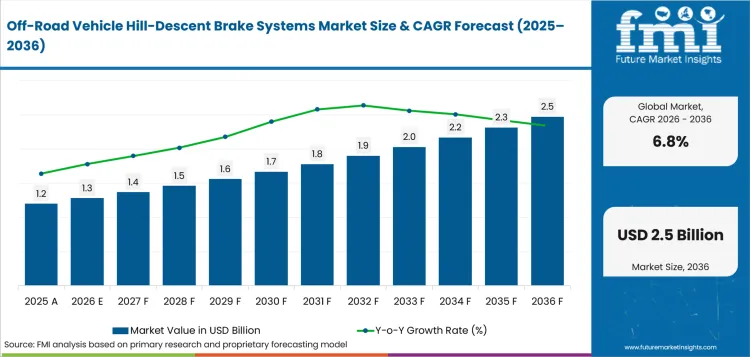
Key Takeaways, Market Size, and Forecast
- 2026 Market Size: USD 1.3 billion
- 2036 Market Size: USD 2.5 billion
- Forecast CAGR: 6.8% from 2026 to 2036
- Leading System Type: ESC-integrated hill descent
- ESC-integrated Hill Descent Share in 2026: 46.7%
- Leading Vehicle Type: Passenger SUVs
- Passenger SUVs Share in 2026: 54.8%
- Leading Sales Channel: OEM fitment
- OEM Fitment Share in 2026: 67.5%
- Fastest-growing Country: India
- India CAGR: 8.3% through 2036
Summary of the Off-Road Vehicle Hill-Descent Brake Systems Market
- Demand and Growth Drivers
- Off-road vehicles need better downhill control because drivers use them on steep tracks and rough roads. Hill-descent brake systems help the vehicle hold a slow speed without heavy pedal use.
- Automakers are adding terrain modes to SUVs and pickup trucks. Hill-descent control fits well into these packages because it improves driver confidence during low-speed off-road use.
- Electric and hybrid off-road vehicles need smoother brake control. These vehicles must balance motor recovery with wheel braking during downhill movement.
- Product and Segment View
- ESC-integrated hill descent has wider use because it can work through existing brake-control hardware. This makes it easier for OEMs to add the feature during vehicle development.
- Passenger SUVs create steady demand as buyers add off-road features to family utility vehicles. Hill-descent control gives these vehicles a clear safety and comfort benefit.
- OEM fitment is the preferred route because brake response must be tested with the full vehicle. Tire size and vehicle weight affect how the system works on slopes.
- Geography and Competitive Outlook
- China and India offer faster adoption because SUV demand is expanding across more price levels. Local OEMs can use hill-descent control as a visible feature upgrade.
- The United States draws demand from pickup trucks and off-road SUVs. These vehicles often need downhill control during towing and trail driving.
- Suppliers with brake software and vehicle testing depth will have better program access. OEMs need partners that can tune the system for real slope conditions.
- Analyst Opinion
- Nikhil Kaitwade, Principal Consultant at FMI says, “Hill-descent brake control is becoming a practical safety feature for off-road SUVs and pickup trucks. It gives drivers better speed control on slopes and reduces brake panic on loose ground. Suppliers with proven ESC software and terrain-mode calibration will be preferred in new vehicle programs.”
- Off-Road Vehicle Hill-Descent Brake Systems Market Value Analysis
- The off-road vehicle hill-descent brake systems market is moving from a premium SUV feature into a practical vehicle-control function.
- Safety needs are driving adoption as off-road vehicles move downhill on steep and loose surfaces.
- Wider use of terrain modes in SUVs and pickup trucks supports market value.
- Demand is also supported by brake software that helps vehicles hold a steady speed without repeated driver braking.
- Value is strongest in OEM fitment because hill-descent control works best when it is tested with the full vehicle.
Drivers on steep off-road terrain now expect brake systems that hold a controlled descent without repeated pedal input. Manufacturers are placing hill-descent functions inside terrain-management packages instead of treating them as standalone features. Ford’s 2026 Bronco materials list up to seven G.O.A.T. Modes and Trail Control for low-speed trail use. This gives suppliers more room to compete through software calibration and vehicle integration. Bosch’s 2025 brake-by-wire validation also shows why documentation is becoming more important. Its engineers completed a public-road test of more than 2,050 miles across multiple climate zones. OEMs and brake suppliers that combine terrain-specific control with verified brake software are better placed for future off-road programs.
Off-Road Vehicle Hill-Descent Brake Systems Market Definition
Off-road vehicle hill-descent brake systems are electronic braking systems that help a vehicle move downhill at a slow and steady speed on steep or loose ground. The system reads wheel movement and slope behavior, then controls brake pressure so the driver does not need to press the brake repeatedly. It improves vehicle control during low-speed downhill driving and reduces the chance of wheel lock on gravel, mud or uneven tracks.
Off-Road Vehicle Hill-Descent Brake Systems Market Inclusions
Market scope covers off-road vehicle hill-descent brake systems categorized by system type, including ESC-integrated hill descent and brake-by-wire hill descent; vehicle type, including passenger SUVs and pickup trucks; propulsion type, including ICE platforms, hybrid platforms, and electric platforms; and terrain use, including recreational off-road, worksite mobility, agriculture routes, and defense mobility. The scope also includes brake-control functions integrated within electronic stability control and ABS systems where wheel-speed sensing, brake-pressure control, and downhill speed management operate as a single vehicle control process. Revenue scope covers 2026 to 2036. The key stakeholders include brake system suppliers, automotive OEMs, chassis control software providers, electronic stability control module makers, off-road vehicle manufacturers, sensor suppliers, system integrators, vehicle testing providers, dealer service networks, regulatory authorities, and MRO service providers.
Off-Road Vehicle Hill-Descent Brake Systems Market Exclusions
Market scope excludes basic mechanical brakes sold without a hill-descent function. Motorcycle-only braking systems and aircraft braking electronics are not covered. General ABS modules are excluded unless they include hill-descent software. Brake pads, rotors and fluids are also outside the scope unless they are bundled within a certified hill-descent control package.
Off-Road Vehicle Hill-Descent Brake Systems Market Research Methodology
- Primary Research: FMI analysts reviewed brake-control suppliers and off-road vehicle feature maps. OEM fitment and terrain-mode usage were checked across key SUV and pickup platforms.
- Desk Research: The study used public data from vehicle regulators, trade bodies, and company technical releases. Brake-by-wire and ESC documents were reviewed for adoption signals.
- Market Sizing and Forecasting: Market size was estimated using off-road vehicle volumes and system value per fitted vehicle. OEM fitment share and retrofit service demand were used for channel checks.
- Data Validation: Forecast checks compared global vehicle production, SUV demand, and braking software rollout. Supplier activity was reviewed across brake-by-wire and stability-control portfolios.
Why is the Off-Road Vehicle Hill-Descent Brake Systems Market Growing?
- Off-road SUVs need safer downhill control when drivers use them on steep tracks and loose access roads.
- Hill-descent systems help vehicles hold low speed without harsh pedal use during controlled downhill movement.
- Brake-by-wire and ESC software help OEMs tune downhill braking for each vehicle platform and tire setup.
- Hybrid and electric off-road vehicles need smoother brake blending when motor recovery and wheel braking work together.
Hill-descent brake demand is rising as off-road vehicles become heavier and more software controlled. Drivers want the vehicle to control speed on slopes without sudden wheel lock. Bosch expects more than 5.5 million vehicles worldwide to be equipped with brake-by-wire by 2030, supporting wider use of electronically controlled braking architectures. Wheel-level control can support hill-descent braking on loose surfaces. Suppliers that support automotive brake system upgrades can serve OEMs adding terrain-specific control.
Off-road driving creates a brake need that normal road use does not cover. A vehicle moving downhill on gravel needs slow wheel movement and steady brake force. Electronic brake control can apply pressure with less driver effort. Software tuning then adjusts the brake response to slope angle and wheel slip. OEMs can place hill descent inside a larger terrain-mode package. Safer low-speed control becomes the clear value for SUVs and pickup trucks used beyond paved roads.
Market Segmentation Analysis
- ESC-integrated hill descent is expected to hold 46.7% share in 2026 because OEMs can use existing brake-control hardware.
- Passenger SUVs are forecast to account for 54.8% share in 2026 as off-road modes move into family utility vehicles with higher ride height.
- ICE platforms are likely to represent 56.4% share in 2026 as gasoline and diesel off-road models still pair hill descent with engine braking.
- OEM fitment is projected at 67.5% share in 2026 since brake response must be validated with the full vehicle.
- Recreational off-road use is expected to hold 42.6% share by 2026 as trail users need slow downhill control on loose terrain.
The market is divided into five primary segment groups based on system type and vehicle type. Propulsion type, sales channel and terrain use complete the structure. System type covers ESC-integrated hill descent and brake-by-wire hill descent. ABS-linked hill descent and standalone terrain control complete the group. Vehicle type covers passenger SUVs and pickup trucks. UTVs and light commercial off-road vehicles complete the vehicle scope. Propulsion type covers ICE platforms and hybrid platforms. Electric platforms complete the propulsion scope. Sales channel covers OEM fitment and retrofit modernization. MRO replacement completes the channel scope. Terrain use covers recreational off-road and worksite mobility. Agriculture routes and defense mobility complete the terrain-use scope.
Insights into Off-Road Vehicle Hill-Descent Brake Systems Market by System Type
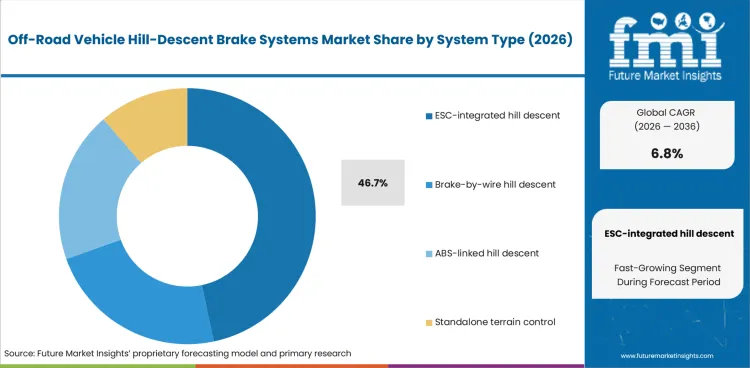
- ESC-integrated hill descent is expected to account for 46.7% share in 2026. OEMs prefer this format since it uses existing wheel-speed sensors and brake-pressure controls without adding a separate controller.
- Brake-by-wire hill descent is expected to see wider use in premium SUVs. The system gives quicker brake response and fits future automotive brake-by-wire pedal simulator designs.
Insights into Off-Road Vehicle Hill-Descent Brake Systems Market by Vehicle Type
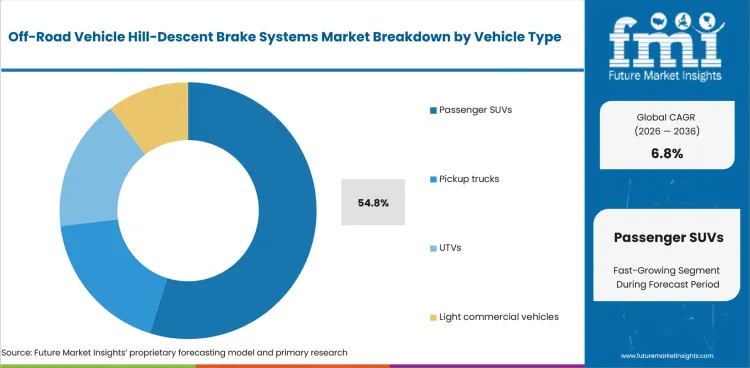
- Passenger SUVs are projected to hold 54.8% share in 2026. Automakers add hill descent in these vehicles to improve low-speed control on slopes and rough access roads.
- Pickup trucks create steady demand through towing and trail use. UTVs need compact control units that can handle mud and uneven ground without making driving harder.
Insights into Off-Road Vehicle Hill-Descent Brake Systems Market by Propulsion Type
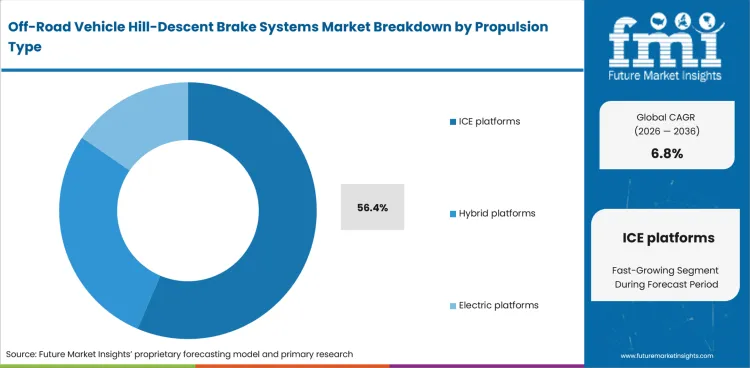
- ICE platforms are forecast to reach 56.4% share in 2026. Many off-road models still use gasoline or diesel engines and can pair hill descent with engine braking.
- Hybrid platforms need cleaner brake blending between motor recovery and wheel braking. Electric platforms need software coordination as brake system control becomes part of energy recovery.
Insights into Off-Road Vehicle Hill-Descent Brake Systems Market by Sales Channel
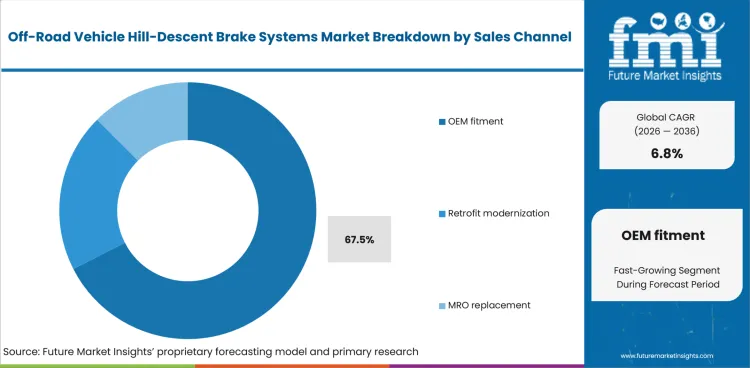
- OEM fitment is expected to represent 67.5% share in 2026. Factory installation works better since hill-descent response must be tested with vehicle weight and tire size.
- Retrofit modernization serves older off-road vehicles with basic ABS hardware. Demand stays narrower here since most hill-descent functions need access to the vehicle’s brake software.
Insights into Off-Road Vehicle Hill-Descent Brake Systems Market by Terrain Use
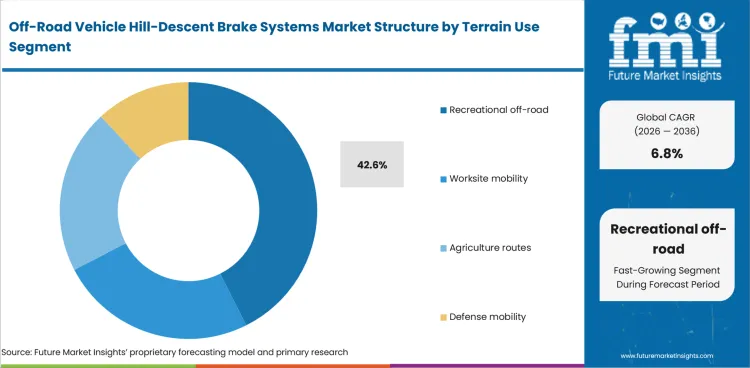
- Recreational off-road use is projected to take 42.6% share in 2026. Trail driving and overlanding need slow downhill control on rocks and loose soil.
- Worksite mobility uses hill-descent control for construction and mining support vehicles. Agriculture routes need dependable braking on wet tracks and sloped field roads.
Off-Road Vehicle Hill-Descent Brake Systems Market Drivers, Restraints, and Opportunities
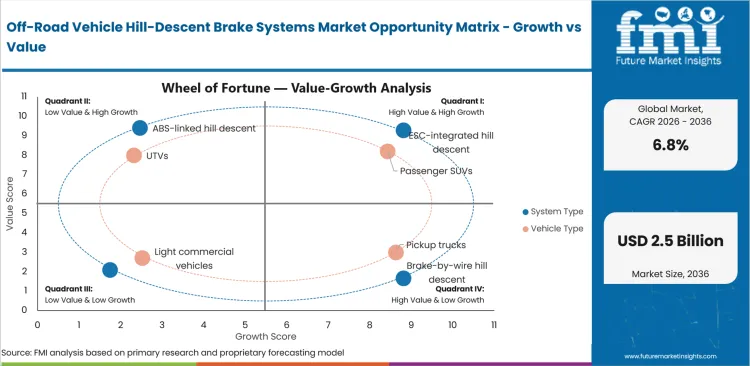
- Terrain-mode software raises OEM demand as off-road vehicles need steady low-speed braking on slopes.
- Calibration cost can slow entry-level fitment as each vehicle needs testing across tires and vehicle loads.
- Wheel-level brake control creates a premium upgrade route as OEMs move toward sensor-enabled chassis systems.
Terrain-Mode Software Is Raising OEM Fitment
Modern off-road vehicles sell on driver confidence during difficult terrain use. Hill-descent control gives the driver a set downhill pace and reduces sudden braking on loose ground. Bosch said its Vehicle Motion Management combines braking and suspension control across six degrees of freedom. The same control logic is useful for downhill braking on mixed terrain. Demand for off-highway vehicle brake systems is tied to safer control in rugged vehicle use.
Calibration Cost Limits Entry-Level Fitment
Hill-descent control must work safely across many surfaces. A system tuned for dry rock may feel too sharp on wet soil. Automakers need test time for tire grip and brake heating. Vehicle weight changes the brake map as the slope gets steeper. Smaller off-road models may delay fitment if added cost raises trim pricing. Brake suppliers must provide software maps and test support with the module. Low-cost hardware is not enough if the system cannot hold speed safely on a real slope.
Wheel-Level Control Opens a Premium Upgrade Route
By-wire braking gives automakers a cleaner way to manage each wheel. ZF said in January 2025 that a global OEM contract will equip nearly 5 million vehicles with electro-mechanical braking over the contract period. The same control idea fits hill descent because each wheel may need a different brake response on loose ground. Premium off-road SUVs can use wheel-level control to improve downhill comfort and stability. Demand for automotive brake booster and master cylinder components will shift as electronic actuation spreads across more platforms.
Analysis of Off-Road Vehicle Hill-Descent Brake Systems Market by Key Countries
.webp "Top Country Growth Comparison Off Road Vehicle Hill Descent Brake Systems Market Cagr (2026 2036)")
| Country | CAGR |
|---|---|
| China | 7.9% |
| India | 8.3% |
| United States | 6.5% |
| Germany | 6.2% |
| Japan | 5.8% |
| United Kingdom | 5.6% |
| France | 5.4% |
| Global | 6.8% |
Source: Future Market Insights, 2026.
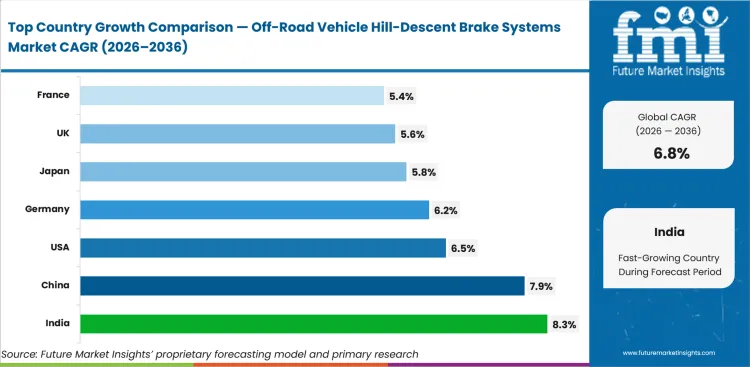
Off-Road Vehicle Hill-Descent Brake Systems Market CAGR Analysis by Country
- India is forecast to lead country-level growth at 8.3% CAGR by 2036 as compact SUVs add terrain-control features across mid and premium trims.
- China is projected to expand at 7.9% CAGR by 2036 as domestic SUV models add richer brake-control software.
- The United States is expected to rise at 6.5% CAGR over the forecast period due to pickup and off-road SUV fitment.
- Germany is anticipated to record 6.2% CAGR by 2036 as premium SUV engineering keeps brake software work active.
- Japan is forecast to reach 5.8% CAGR through 2036 due to hybrid SUV control needs and export platform demand.
- The United Kingdom is projected to post 5.6% CAGR by 2036 as premium off-road vehicle programs need refined downhill control.
- France is expected to advance at 5.4% CAGR by 2036 as chassis electronics suppliers support European SUV platforms.
Demand Outlook for Off-Road Vehicle Hill-Descent Brake Systems Market in the United States
Large pickup and SUV base · 2026 to 2036
Country Market Snapshot Table
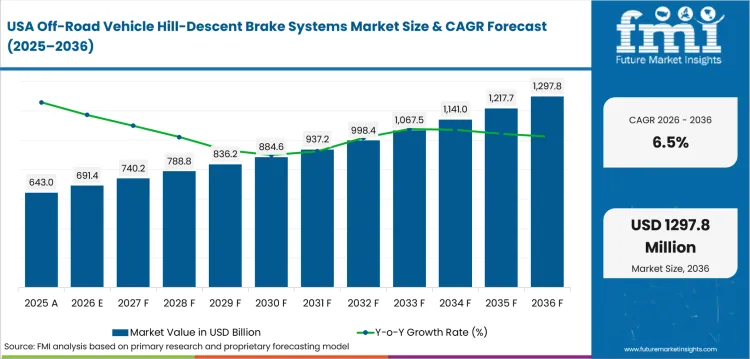
| Parameter | Value |
|---|---|
| Market Size in 2025 | USD 0.31 billion |
| Market Forecast in 2036 | USD 0.62 billion |
| CAGR 2026 to 2036 | 6.5% |
| Years Considered | 2021 to 2036 |
| Base Year | 2025 |
| Forecast Period | 2026 to 2036 |
| Units Considered | Value USD Billion |
| Leading Sub-Region | Midwest and Southern off-road vehicle corridor |
United States Off-Road Vehicle Hill-Descent Brake Systems Market Outlook
U.S. demand comes from pickup trucks and off-road SUVs used for towing and trail driving. Hill-descent control gives drivers better low-speed control on slopes without heavy pedal use.
OEMs prefer factory-fitted systems because brake tuning must match vehicle weight and tire size. Retrofit use is narrower because hill-descent control needs access to the brake controller and ESC software.
Key Growth Drivers
- Ford’s 2026 Bronco page lists Trail Control as off-road cruise control for low-speed driving, supporting the fitment case for controlled downhill and trail use in U.S. off-road SUVs.
- Ford’s 2026 Bronco off-roading package lists up to seven G.O.A.T. Modes, HOSS suspension systems, Trail Turn Assist and Trail Control as trail technologies.
- Off-road trim buyers expect low-speed control during gravel and trail driving. OEMs can use hill descent as a clear feature upgrade in premium trims.
- Demand for automotive active safety systems creates a wider base for brake sensors and electronic control units.
Key Restraints
- Validation cost can slow fitment in lower-priced trims because each slope condition needs a safe brake map.
- Retrofit scope is limited because brake software access stays controlled by the OEM.
- Bosch’s public-road brake-by-wire test shows suppliers are using real-world validation to prove electronic brake response across climate and road conditions.
What makes United States unique
The United States is unique because pickup trucks and off-road SUVs are used for daily driving and recreation. This makes hill-descent control useful beyond premium adventure models.
Key Companies
- Robert Bosch LLC
- ZF Active Safety US Inc.
- Brembo North America Inc.
- BWI Group
- Performance Friction Corporation
Sales & Marketing Channels
- OEM chassis engineering teams
- Pickup and SUV platform sourcing teams
- Authorized brake system integrators
- Dealer diagnostic service networks
Frequently Asked Questions
How fast is the United States off-road vehicle hill-descent brake systems market growing?
The United States market is forecast to expand at 6.5% CAGR from 2026 to 2036. Demand comes from pickup trucks and off-road SUV trims.
Who leads the United States off-road vehicle hill-descent brake systems market?
Robert Bosch LLC and ZF Active Safety US Inc. lead through brake electronics and control-system supply.
What is driving adoption of hill-descent brake systems in the United States?
Off-road trims need steady downhill speed control. Pickup users also need safer braking during towing on slopes.
Country Segment Breakdown Table
| Segment | Sub-Segments |
|---|---|
| By System Type | ESC-integrated hill descent · Brake-by-wire hill descent · ABS-linked hill descent · Standalone terrain control |
| By Vehicle Type | Passenger SUVs · Pickup trucks · UTVs · Light commercial vehicles |
| By Propulsion Type | ICE platforms · Hybrid platforms · Electric platforms |
| By Sales Channel | OEM fitment · Retrofit modernization · MRO replacement |
| By Terrain Use | Recreational off-road · Worksite mobility · Agriculture routes · Defense mobility |
| Key Sub-Regions Covered | Michigan · Ohio · Indiana · Kentucky · Tennessee · Alabama · Texas · California |
Sales Analysis of Off-Road Vehicle Hill-Descent Brake Systems Market in China
Large SUV production base · 2026 to 2036
Country Market Snapshot Table
| Parameter | Value |
|---|---|
| Market Size in 2025 | USD 0.22 billion |
| Market Forecast in 2036 | USD 0.50 billion |
| CAGR 2026 to 2036 | 7.9% |
| Years Considered | 2021 to 2036 |
| Base Year | 2025 |
| Forecast Period | 2026 to 2036 |
| Units Considered | Value USD Billion |
| Leading Sub-Region | Yangtze River Delta vehicle cluster |
China Off-Road Vehicle Hill-Descent Brake Systems Market Outlook
China has a large SUV production base and a fast vehicle software cycle. Hill-descent control is useful in domestic SUV models that carry terrain modes for light off-road use.
Local suppliers are improving brake actuation and control software. OEMs in China need systems that can be tuned quickly for many vehicle platforms.
Key Growth Drivers
- GWM sold 44,801 boxy-style vehicles in July 2025, up 17.01% year over year, supporting demand for rugged SUV features in China.
- GWM sold 34,593 NEVs in July 2025, up 43.27% year over year, supporting stronger need for software-managed braking in electrified SUV platforms.
- Local brake suppliers shorten development time for Chinese OEMs. Nearby testing teams can tune hill-descent response faster.
- Demand for automotive brake system upgrades grows as vehicle software content expands.
Key Restraints
- Price pressure can limit fitment in lower-trim SUVs because feature cost matters in high-volume domestic models.
- Frequent model refreshes can shorten validation windows when suppliers must tune software for several platforms.
- GWM sold 1,199,652 vehicles from January to November 2025, up 9.26% year over year, increasing the need for fast supplier calibration across many platforms.
What makes China unique
China is unique because OEMs launch models quickly and expect supplier support at the same speed. Local brake-control suppliers get value when they can tune systems near vehicle plants.
Key Companies
- Bethel Automotive Safety Systems Co. Ltd.
- Zhejiang Asia-Pacific Mechanical and Electronic Co. Ltd.
- Tongyu Automotive Technology Co. Ltd.
- Wanxiang Qianchao Co. Ltd.
- Zhejiang Vie Science and Technology Co. Ltd.
Sales & Marketing Channels
- Direct OEM supply agreements
- Local chassis software teams
- Vehicle platform engineering centers
- Brake module distribution partners
Frequently Asked Questions (Country-Specific)
How fast is China’s off-road vehicle hill-descent brake systems market growing?
China is projected to expand at 7.9% CAGR from 2026 to 2036. SUV output and fast vehicle software cycles support demand.
Who leads China’s off-road vehicle hill-descent brake systems market?
Bethel Automotive Safety Systems Co. Ltd. and Zhejiang Asia-Pacific Mechanical and Electronic Co. Ltd. are active in braking and chassis control supply.
What is driving adoption in China?
Chinese OEMs use terrain-control features to improve SUV appeal. Local brake suppliers help reduce development time.
Country Segment Breakdown Table
| Segment | Sub-Segments |
|---|---|
| By System Type | ESC-integrated hill descent · Brake-by-wire hill descent · ABS-linked hill descent · Standalone terrain control |
| By Vehicle Type | Passenger SUVs · Pickup trucks · UTVs · Light commercial vehicles |
| By Propulsion Type | ICE platforms · Hybrid platforms · Electric platforms |
| By Sales Channel | OEM fitment · Retrofit modernization · MRO replacement |
| By Terrain Use | Recreational off-road · Worksite mobility · Agriculture routes · Defense mobility |
| Key Sub-Regions Covered | Shanghai · Zhejiang · Jiangsu · Guangdong · Chongqing · Hubei · Shandong · Anhui |
Demand Outlook for Off-Road Vehicle Hill-Descent Brake Systems Market in India
Compact SUV expansion · 2026 to 2036
Country Market Snapshot Table
| Parameter | Value |
|---|---|
| Market Size in 2025 | USD 0.12 billion |
| Market Forecast in 2036 | USD 0.29 billion |
| CAGR 2026 to 2036 | 8.3% |
| Years Considered | 2021 to 2036 |
| Base Year | 2025 |
| Forecast Period | 2026 to 2036 |
| Units Considered | Value USD Billion |
| Leading Sub-Region | Western and Southern vehicle corridor |
India Off-Road Vehicle Hill-Descent Brake Systems Market Outlook
India’s compact SUV market is moving toward richer safety and comfort features. Hill-descent control is useful for hilly roads and rough access routes.
Local OEMs can use hill-descent control as a clear feature upgrade in mid and premium trims. Suppliers that balance cost and calibration support will have better access to high-volume programs.
Key Growth Drivers
- Mahindra’s XUV 7XO includes over 120 safety features and 75 standard safety features, including ESP with EBD and Hill Descent Control.
- Mahindra sold 58,021 utility vehicles in the domestic market in May 2026, up 11% year over year, supporting a wider base for hill-descent control fitment.
- Local vehicle makers can add hill descent as a visible safety upgrade. The feature fits hilly road use and rural travel needs.
- Demand for regenerative braking systems increases the need for coordinated brake control in hybrid and electric SUVs.
Key Restraints
- Cost sensitivity can slow wider fitment in entry trims because hill descent adds calibration and testing cost.
- Local validation needs more time across hill roads and hot conditions before OEMs can approve brake maps.
- Early-year demand swings can delay feature planning, as SIAM reported passenger vehicle sales fell 1.4% in Q1 FY 2025 to 2026.
What makes India unique
India is unique because hill-descent control has practical value on steep roads and broken surfaces. The feature can move from premium SUVs into compact utility vehicles over time.
Key Companies
- Brakes India Private Limited
- Endurance Technologies Limited
- ASK Automotive Limited
- Rane Brake Lining Limited
- Uno Minda Limited
Sales & Marketing Channels
- OEM purchasing teams
- Local component supplier networks
- Authorized service centers
- Vehicle platform engineering teams
Country Segment Breakdown Table
| Segment | Sub-Segments |
|---|---|
| By System Type | ESC-integrated hill descent · Brake-by-wire hill descent · ABS-linked hill descent · Standalone terrain control |
| By Vehicle Type | Passenger SUVs · Pickup trucks · UTVs · Light commercial vehicles |
| By Propulsion Type | ICE platforms · Hybrid platforms · Electric platforms |
| By Sales Channel | OEM fitment · Retrofit modernization · MRO replacement |
| By Terrain Use | Recreational off-road · Worksite mobility · Agriculture routes · Defense mobility |
| Key Sub-Regions Covered | Maharashtra · Tamil Nadu · Karnataka · Gujarat · Haryana · Rajasthan · Uttar Pradesh · Himachal Pradesh |
Frequently Asked Questions
How fast is India’s off-road vehicle hill-descent brake systems market growing?
India is forecast to record 8.3% CAGR from 2026 to 2036. Compact SUV demand gives the country a faster pace than the global average.
Who leads India’s off-road brake component supply base?
Brakes India Private Limited and Endurance Technologies Limited are active local suppliers in braking and vehicle component supply.
What is driving adoption in India?
Hilly road use and compact SUV upgrades are driving fitment. OEMs can use hill descent as a practical safety feature.
Opportunity Analysis of Off-Road Vehicle Hill-Descent Brake Systems Market in Germany
Brake software engineering depth · 2026 to 2036
Country Market Snapshot Table
| Parameter | Value |
|---|---|
| Market Size in 2025 | USD 0.10 billion |
| Market Forecast in 2036 | USD 0.19 billion |
| CAGR 2026 to 2036 | 6.2% |
| Years Considered | 2021 to 2036 |
| Base Year | 2025 |
| Forecast Period | 2026 to 2036 |
| Units Considered | Value USD Bn |
| Leading Sub-Region | Bavaria and Lower Saxony vehicle corridor |
Germany Off-Road Vehicle Hill-Descent Brake Systems Market Outlook
Germany has a strong base in brake software and chassis control. Hill-descent systems in the country are mainly linked with premium SUVs and export platforms.
German suppliers can serve global OEM programs from local engineering centers. Their advantage comes from testing depth and vehicle-level validation.
Key Growth Drivers
- Premium SUV programs need smooth downhill control, as VDA expects domestic passenger car production of 4.11 million units in 2026. This keeps brake-control work active in German vehicle programs.
- Global programs widen supplier opportunity, as VDA expects foreign production by German brands to reach 9.2 million vehicles in 2026. This gives German brake-software teams reach beyond domestic production.
- Brake software teams can tune hill-descent response for global off-road SUV platforms. This makes Germany important for system validation.
- Demand for automotive brake-by-wire pedal simulator rises as electronic braking moves into premium vehicle platforms.
Key Restraints
- European cost pressure can delay new braking features in mid-price trims when buyers compare safety content with vehicle price.
- Strict validation raises development time for chassis control systems because each brake response must be tested at vehicle level.
- Export pressure can affect program timing, as VDA reported passenger car exports of 2.41 million units from January to September 2025.
What makes Germany unique
Germany is unique because brake-control design often starts inside premium vehicle programs. The country can influence hill-descent system standards for export SUVs.
Key Companies
- AUMOVIO SE
- Knorr-Bremse AG
- HELLA GmbH and Co. KGaA
- Schaeffler AG
- iwis SE and Co. KG
Sales & Marketing Channels
- Premium OEM engineering offices
- Tier one brake system programs
- Chassis validation centers
- Software-defined vehicle development teams
Country Segment Breakdown Table
| Segment | Sub-Segments |
|---|---|
| By System Type | ESC-integrated hill descent · Brake-by-wire hill descent · ABS-linked hill descent · Standalone terrain control |
| By Vehicle Type | Passenger SUVs · Pickup trucks · UTVs · Light commercial vehicles |
| By Propulsion Type | ICE platforms · Hybrid platforms · Electric platforms |
| By Sales Channel | OEM fitment · Retrofit modernization · MRO replacement |
| By Terrain Use | Recreational off-road · Worksite mobility · Agriculture routes · Defense mobility |
| Key Sub-Regions Covered | Bavaria · Baden-Württemberg · Lower Saxony · North Rhine-Westphalia · Hesse · Saxony · Bremen · Hamburg |
Frequently Asked Questions
How fast is Germany’s off-road vehicle hill-descent brake systems market growing?
Germany is anticipated to advance at 6.2% CAGR from 2026 to 2036. Demand comes from premium SUVs and global brake software programs.
Who leads Germany’s brake-control supplier base?
AUMOVIO SE and Knorr-Bremse AG are active in braking and vehicle-control technologies.
What is driving German demand?
Premium SUV engineering and brake-by-wire work are driving demand. Export platforms give suppliers a wider route than domestic sales alone.
Sales Analysis of Off-Road Vehicle Hill-Descent Brake Systems Market in Japan
Hybrid SUV control focus · 2026 to 2036
Country Market Snapshot Table
| Parameter | Value |
|---|---|
| Market Size in 2025 | USD 0.08 billion |
| Market Forecast in 2036 | USD 0.15 billion |
| CAGR 2026 to 2036 | 5.8% |
| Years Considered | 2021 to 2036 |
| Base Year | 2025 |
| Forecast Period | 2026 to 2036 |
| Units Considered | Value USD Billion |
| Leading Sub-Region | Chubu automotive cluster |
Japan Off-Road Vehicle Hill-Descent Brake Systems Market Outlook
Japan’s demand is centered on safe control and smooth driver feel. Hill-descent braking fits SUVs and hybrid vehicles that need stable brake blending.
Japanese suppliers focus on reliable electronic control and compact packaging. This makes the country important for control modules used across export platforms.
Key Growth Drivers
- Hybrid SUVs need smooth brake blending, as OICA listed Japan’s 2025 passenger car production at 7,207,025 units. This production base supports brake-control module demand.
- Export and domestic programs need stable brake response, as OICA listed Japan’s motor vehicle sales at 4,565,777 units in 2025. Hill-descent control can support SUV and crossover models.
- Compact modules help OEMs fit more brake-control content into smaller vehicle layouts. This suits Japanese platform design habits.
- Demand for brake system upgrades grows as vehicle control shifts toward software-managed braking.
Key Restraints
- Local demand can be slower than export-driven demand when domestic SUV programs hold feature rollouts for later trims.
- Compact packaging raises design difficulty for brake-control modules because smaller platforms leave less room for added electronics.
- Passenger-car concentration raises qualification pressure, as JAMA listed passenger cars at 86.7% of Japan’s motor vehicle production in its 2025 report.
What makes Japan unique
Japan is unique because hill-descent systems must work smoothly with hybrid braking. Supplier value comes from quiet control and dependable low-speed response.
Key Companies
- Hitachi Astemo Ltd.
- ADVICS Co. Ltd.
- Akebono Brake Industry Co. Ltd.
- Nisshinbo Brake Inc.
- DENSO Corporation
Sales & Marketing Channels
- OEM chassis control teams
- Hybrid vehicle engineering groups
- Export platform sourcing teams
- Authorized brake component distributors
Country Segment Breakdown Table
| Segment | Sub-Segments |
|---|---|
| By System Type | ESC-integrated hill descent · Brake-by-wire hill descent · ABS-linked hill descent · Standalone terrain control |
| By Vehicle Type | Passenger SUVs · Pickup trucks · UTVs · Light commercial vehicles |
| By Propulsion Type | ICE platforms · Hybrid platforms · Electric platforms |
| By Sales Channel | OEM fitment · Retrofit modernization · MRO replacement |
| By Terrain Use | Recreational off-road · Worksite mobility · Agriculture routes · Defense mobility |
| Key Sub-Regions Covered | Aichi · Shizuoka · Kanagawa · Saitama · Tochigi · Fukuoka · Hiroshima · Gunma |
Frequently Asked Questions
How fast is Japan’s off-road vehicle hill-descent brake systems market growing?
Japan is projected to rise at 5.8% CAGR from 2026 to 2036. Hybrid SUVs and export programs support steady demand.
Who leads Japan’s brake-control supplier base?
Hitachi Astemo Ltd. and ADVICS Co. Ltd. are active in brake-control and chassis-related systems.
What is driving adoption in Japan?
Hybrid vehicle control and export SUV requirements are driving adoption. Compact brake modules help fit more control content into vehicle platforms.
Future Outlook for Off-Road Vehicle Hill-Descent Brake Systems Market in the United Kingdom
Premium off-road vehicle base · 2026 to 2036
Country Market Snapshot Table
| Parameter | Value |
|---|---|
| Market Size in 2025 | USD 0.07 billion |
| Market Forecast in 2036 | USD 0.13 billion |
| CAGR 2026 to 2036 | 5.6% |
| Years Considered | 2021 to 2036 |
| Base Year | 2025 |
| Forecast Period | 2026 to 2036 |
| Units Considered | Value USD Bn |
| Leading Sub-Region | West Midlands vehicle engineering cluster |
United Kingdom Off-Road Vehicle Hill-Descent Brake Systems Market Outlook
The United Kingdom has a strong identity in premium off-road vehicles. Hill-descent control fits brand needs around comfort and low-speed confidence.
The local market also has specialty brake engineering and motorsport skills. These skills can support calibration work for premium SUVs and rugged vehicles.
Key Growth Drivers
- Premium SUV programs need refined downhill control, as SMMT reported over 717,000 cars were built in the UK in 2025. This keeps brake suppliers close to vehicle engineering teams.
- Electrified models need smoother brake blending, as SMMT expects BEV car market volume to rise 18.7% in 2026. This supports electronic brake-control demand.
- Specialty brake firms can support low-volume performance and off-road vehicle programs. Their engineering depth suits premium hill-descent calibration work.
- Demand for automotive carbon ceramic brake components supports premium brake hardware in high-end off-road trims.
Key Restraints
- Vehicle production swings can delay sourcing plans when OEMs defer added brake features to later model updates.
- Specialty brake programs face high engineering cost per unit because low-volume vehicles spread testing expense across fewer units.
- Local output pressure can limit near-term scale, as SMMT reported total UK vehicle production fell 15.5% in 2025.
What makes United Kingdom unique
The United Kingdom is unique because premium off-road identity and engineering services sit close together. This creates a route for hill-descent calibration and specialty brake upgrades.
Key Companies
- AP Racing Ltd.
- Surface Transforms plc
- Alcon Components Ltd.
- EBC Brakes
- TMD Friction UK Ltd.
Sales & Marketing Channels
- Premium OEM project teams
- Specialty brake distributors
- Motorsport engineering partners
- Off-road vehicle conversion firms
Country Segment Breakdown Table
| Segment | Sub-Segments |
|---|---|
| By System Type | ESC-integrated hill descent · Brake-by-wire hill descent · ABS-linked hill descent · Standalone terrain control |
| By Vehicle Type | Passenger SUVs · Pickup trucks · UTVs · Light commercial vehicles |
| By Propulsion Type | ICE platforms · Hybrid platforms · Electric platforms |
| By Sales Channel | OEM fitment · Retrofit modernization · MRO replacement |
| By Terrain Use | Recreational off-road · Worksite mobility · Agriculture routes · Defense mobility |
| Key Sub-Regions Covered | West Midlands · East Midlands · North West England · South West England · Wales · Scotland · Yorkshire · Oxfordshire |
Frequently Asked Questions
How fast is the United Kingdom off-road vehicle hill-descent brake systems market growing?
The United Kingdom is forecast to register 5.6% CAGR from 2026 to 2036. Premium SUVs and specialty brake work keep demand active.
Who leads the United Kingdom’s specialty brake supply base?
AP Racing Ltd. and Alcon Components Ltd. are active in performance braking. Surface Transforms plc adds high-end brake material capability.
What is driving UK adoption?
Premium off-road vehicle demand and local engineering services are driving adoption. Buyers expect smoother downhill control in high-end SUVs.
European SUV and chassis supply base · 2026 to 2036
Country Market Snapshot Table
| Parameter | Value |
|---|---|
| Market Size in 2025 | USD 0.06 billion |
| Market Forecast in 2036 | USD 0.11 billion |
| CAGR 2026 to 2036 | 5.4% |
| Years Considered | 2021 to 2036 |
| Base Year | 2025 |
| Forecast Period | 2026 to 2036 |
| Units Considered | Value USD Billion |
| Leading Sub-Region | Northern France and Île-de-France vehicle corridor |
France Off-Road Vehicle Hill-Descent Brake Systems Market Outlook
France has a measured but useful role in hill-descent brake systems. Demand comes from European SUV platforms and chassis control work.
French suppliers add value through sensors and control electronics around braking. OEMs need these parts to make downhill control smoother and safer.
Key Growth Drivers
- European SUV platforms need stable braking on steep and low-grip roads, as PFA data carried by OICA showed France produced 1.464 million vehicles in 2025. This keeps local chassis suppliers active.
- French production recovery supports supplier planning, as PFA data showed vehicle output rose 8% in 2025. This improves local sourcing interest for braking and control parts.
- Sensor suppliers support brake-control systems that read wheel and vehicle behavior. This improves how hill descent responds to loose road surfaces.
- Demand for automotive brake shims stays relevant as braking comfort matters in low-speed downhill use.
Key Restraints
- Retrofit demand is limited because hill descent needs access to OEM brake software and vehicle-level calibration data.
- Mid-priced vehicle programs may delay premium control features when added testing cost raises trim pricing.
- Wider European output is only moving slowly, as ACEA reported EU car production increased 0.3% in 2025.
What makes France unique
France is unique because sensor and chassis electronics suppliers can support brake-control development. The country adds value through system parts that improve how hill descent reads vehicle movement.
Key Companies
- Valeo SE
- FORVIA SE
- Tallano Technologies
- NTN Europe
- Actia Group
Sales & Marketing Channels
- European OEM sourcing teams
- Chassis electronics suppliers
- Brake sensor distribution partners
- Vehicle testing and validation service firms
Country Segment Breakdown Table
| Segment | Sub-Segments |
|---|---|
| By System Type | ESC-integrated hill descent · Brake-by-wire hill descent · ABS-linked hill descent · Standalone terrain control |
| By Vehicle Type | Passenger SUVs · Pickup trucks · UTVs · Light commercial vehicles |
| By Propulsion Type | ICE platforms · Hybrid platforms · Electric platforms |
| By Sales Channel | OEM fitment · Retrofit modernization · MRO replacement |
| By Terrain Use | Recreational off-road · Worksite mobility · Agriculture routes · Defense mobility |
| Key Sub-Regions Covered | Île-de-France · Hauts-de-France · Grand Est · Auvergne-Rhône-Alpes · Normandy · Pays de la Loire · Bourgogne-Franche-Comté · Nouvelle-Aquitaine |
Frequently Asked Questions (Country-Specific)
How fast is France’s off-road vehicle hill-descent brake systems market growing?
France is forecast to post 5.4% CAGR from 2026 to 2036. European SUV platforms and chassis electronics support demand.
Who leads France’s related chassis and vehicle-control supply base?
Valeo SE and FORVIA SE are active in vehicle electronics and system supply. Tallano Technologies adds brake-related technology depth.
What is driving French demand?
SUV platform needs and braking comfort requirements drive demand. Sensor and electronics suppliers support the control layer behind hill descent.
Competitive Landscape and Strategic Positioning
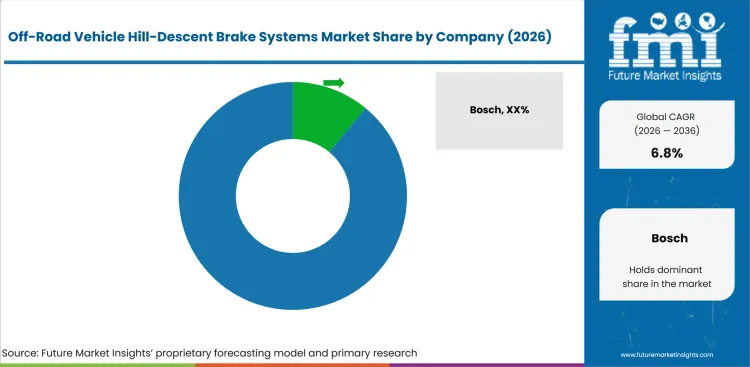
- Competition is based on how well a supplier can control braking through software. OEMs need systems that respond smoothly on steep slopes and loose surfaces.
- Suppliers stand out when their systems read wheel speed quickly and adjust brake pressure without delay. This helps the vehicle hold a steady downhill pace.
- Terrain-mode calibration improves access to premium off-road programs. Automakers need brake control that works with different tires and vehicle weights.
- Safety testing creates a clear barrier for new suppliers. Each system must prove that it can work safely before it is used in a vehicle program.
- OEM integration work makes the market harder for smaller suppliers. Hill-descent control must connect with ESC software and the main brake controller.
Competitive position in this market depends on the connection between brake hardware and software control. AUMOVIO highlighted next-generation brake systems and motion-control software in its 2026 winter customer presentations. The focus fits hill-descent control since downhill braking needs hardware and software to work together. Suppliers with automotive carbon ceramic brake depth can target premium off-road trims that need stronger stopping hardware. OEMs will prefer suppliers that can prove stable brake response under low-grip conditions.
Brake software does not sell alone in off-road programs. OEMs need tested modules and pressure-control parts. Calibration support must come with those parts. Astemo said in April 2025 its Auto Shanghai exhibit would include chassis systems for the software-defined vehicle era. The exhibit points to stronger interest in braking and vehicle-control integration. Demand for automotive brake shims stays connected to noise control as brake hardware works harder in downhill and low-speed use. Suppliers with clear testing support will be better placed in OEM sourcing talks.
Key Companies in the Off-Road Vehicle Hill-Descent Brake Systems Market
- Brake Control Leaders: Bosch, ZF, and AUMOVIO hold strong positions through ESC control and OEM platform reach. Bosch has public brake-by-wire road testing. ZF has a major electro-mechanical braking contract. AUMOVIO offers integrated brake systems and a staged roadmap from wet to dry braking.
- Integrated Brake Specialists: Brembo, Astemo, and ADVICS support the market through brake hardware and control-system depth. Brembo’s SENSIFY platform shows a move into intelligent braking. Astemo supplies electro-hydraulic braking and Smart Brake concepts. ADVICS brings brake hardware and ESC-related capability under the Aisin group.
- Commercial and Specialty Participants: Knorr-Bremse and off-road vehicle electronics specialists support heavy-duty and specialty vehicle needs. Their role is strongest in worksite mobility and rugged platforms, in which each-wheel control and diagnostic support affect uptime.
Competitive Benchmarking: Off-Road Vehicle Hill-Descent Brake Systems Market
| Company | ESC Software Depth | Brake-by-Wire Readiness | Terrain Calibration Support | Geographic Footprint |
|---|---|---|---|---|
| Bosch | High | High | Strong | Global |
| ZF | High | High | Strong | Global |
| AUMOVIO | High | High | Strong | Global |
| Brembo | Medium | High | Medium | Global |
| Astemo | High | Medium | Medium | Japan, Europe, North America |
| ADVICS | High | Medium | Medium | Japan, North America, Asia Pacific |
| Knorr-Bremse | Medium | Medium | Strong | Europe and commercial vehicle regions |
| HL Mando | Medium | Medium | Medium | South Korea, China, North America |
Source: Future Market Insights competitive analysis, 2026.
Key Developments in Off-Road Vehicle Hill-Descent Brake Systems Market
- In July 2025, ZF brought a full brake-by-wire portfolio to market. The company stated that its hybrid brake-by-wire system is suited for heavy-duty light vehicles and pickup trucks, with the electromechanical brake used as both a service brake and parking brake.
- In May 2026, Brembo started production of SENSIFY™, its intelligent braking platform, for a leading global vehicle manufacturer. Brembo stated that the system is fitted as standard on 100% of vehicles in the program and uses wheel-level intelligence to modulate braking forces.
Key Players in the Off-Road Vehicle Hill-Descent Brake Systems Market
Major Global Players
- Bosch
- ZF
- AUMOVIO
- Brembo
- Astemo
Specialist and Regional Players
- ADVICS
- Knorr-Bremse
- HL Mando
Report Scope and Coverage
| Parameter | Details |
|---|---|
| Market size by 2036 | USD 2.5 billion |
| Growth rate | 6.8% CAGR from 2026 to 2036 |
| Forecast period | 2026 to 2036 |
| Base year value 2026 | USD 1.3 billion |
| By system type | ESC-integrated hill descent, brake-by-wire hill descent, ABS-linked hill descent, standalone terrain control |
| By vehicle type | Passenger SUVs, pickup trucks, UTVs, light commercial vehicles |
| By propulsion type | ICE platforms, hybrid platforms, electric platforms |
| By sales channel | OEM fitment, retrofit modernization, MRO replacement |
| By terrain use | Recreational off-road, worksite mobility, agriculture routes, defense mobility |
| Regions covered | North America, Latin America, Western Europe, Eastern Europe, East Asia, South Asia and Pacific, Middle East and Africa |
| Countries covered | United States, China, India, Germany, France, Japan, United Kingdom, 30 plus countries |
| Key companies profiled | Bosch, ZF, AUMOVIO, Brembo, Astemo, ADVICS, Knorr-Bremse, HL Mando |
| Approach | Hybrid bottom-up and top-down methodology using off-road vehicle volumes, OEM fitment rates, brake-control system value, terrain-mode adoption, and supplier activity across key regions. |
Source: Future Market Insights, 2026.
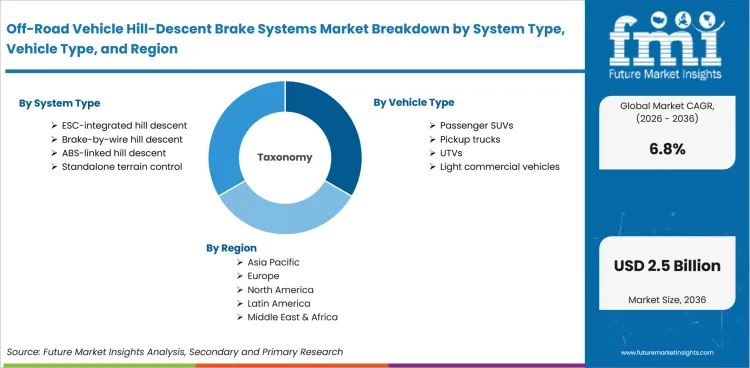
Off-Road Vehicle Hill-Descent Brake Systems Market Breakdown by System Type, Vehicle Type, Propulsion Type, Sales Channel, Terrain Use, and Region
Off-Road Vehicle Hill-Descent Brake Systems Market Segmented by System Type:
- ESC-integrated hill descent
- Brake-by-wire hill descent
- ABS-linked hill descent
- Standalone terrain control
Off-Road Vehicle Hill-Descent Brake Systems Market Segmented by Vehicle Type:
- Passenger SUVs
- Pickup trucks
- UTVs
- Light commercial vehicles
Off-Road Vehicle Hill-Descent Brake Systems Market Segmented by Propulsion Type:
- ICE platforms
- Hybrid platforms
- Electric platforms
Off-Road Vehicle Hill-Descent Brake Systems Market Segmented by Sales Channel:
- OEM fitment
- Retrofit modernization
- MRO replacement
Off-Road Vehicle Hill-Descent Brake Systems Market Segmented by Terrain Use:
- Recreational off-road
- Worksite mobility
- Agriculture routes
- Defense mobility
Off-Road Vehicle Hill-Descent Brake Systems Market by Region:
- North America
- Latin America
- Western Europe
- Eastern Europe
- East Asia
- South Asia and Pacific
- Middle East and Africa
Research Sources and Bibliography
- Bosch Mobility. (2025). Bosch at IAA Mobility 2025. Bosch Mobility.
- FORVIA. (2024, July 24). Half-year results 2024. FORVIA.
- FORVIA. (2026, February 23). Annual results 2025. FORVIA.
- Great Wall Motor Company Limited. (2025, August 8). GWM achieves dual growth in NEV & global markets, Brazil plant ready for launch. GWM.
- Great Wall Motor Company Limited. (2025, December 6). GWM surpasses 16 million global sales driving strong growth with breakthrough technologies. GWM.
- Jaguar Land Rover Automotive plc. (2025, May 13). JLR delivers strong full year performance. JLR Media Newsroom.
- Jaguar Land Rover Automotive plc. (2026, April 2). JLR Q4 sales bounce back after cyber incident. JLR Media Newsroom.
- Mahindra & Mahindra Ltd. (2026). Mahindra premieres XUV 7XO with 5 pioneering tech disruptions. Mahindra Auto.
- Mahindra & Mahindra Ltd. (2026, June 1). Mahindra Auto clocks 58,021 SUVs and 99,636 total vehicle sales, a robust 20% YoY growth in May 2026. Mahindra.
- Robert Bosch LLC. (2025, January 30). With brake-by-wire from Bosch to the Arctic Circle. Bosch Media Service.
- Toyota Motor Corporation. (2026, May 14). Toyota launches all-new Land Cruiser “FJ” series in Japan. Toyota Global Newsroom.
- Valeo. (2025, September 8). Valeo at the heart of tomorrow’s mobility: IAA Mobility 2025. Valeo.
- ZF Friedrichshafen AG. (2025, January 6). ZF secures substantial brake-by-wire technology business for light vehicles. ZF.
- ACEA. (2026, April 1). Economic and market report: Global and EU auto industry full year 2025. European Automobile Manufacturers’ Association.
- International Organization of Motor Vehicle Manufacturers. (2026). Production statistics. OICA.
- International Organization of Motor Vehicle Manufacturers. (2026). Sales statistics. OICA.
- Japan Automobile Manufacturers Association. (2025, September). The motor industry of Japan 2025. JAMA.
- Society of Indian Automobile Manufacturers. (2025, July 15). Performance of auto industry during Q1 of 2025-26. SIAM.
- Society of Motor Manufacturers and Traders. (2026, January 29). Tough year for auto but new models and Industrial Strategy can deliver growth. SMMT.
- Society of Motor Manufacturers and Traders. (2026). UK new car and van outlook. SMMT.
- Verband der Automobilindustrie. (2025, December 7). Forecasts for 2026: New car registrations in Germany rise slightly. VDA.
This Report Answers
- What is the current and future value of the off-road vehicle hill-descent brake systems market?
- What CAGR is expected for hill-descent brake systems between 2026 and 2036?
- Which system type is forecast to lead hill-descent brake system demand in 2026?
- Which vehicle type is expected to create the strongest hill-descent brake system demand?
- How do terrain modes and ESC software affect hill-descent brake system fitment?
- Which countries are expected to record faster adoption of hill-descent brake control?
- Which companies are active across brake-by-wire and ESC-integrated hill-descent control?
- How does FMI define the off-road vehicle hill-descent brake systems market scope?
- What forecasting method was used to estimate hill-descent brake system demand?
Frequently Asked Questions
What is the global market demand for off-road vehicle hill-descent brake systems in 2026?
In 2026, the global off-road vehicle hill-descent brake systems market is expected to be worth USD 1.3 billion as OEM fitment widens.
How big will the off-road vehicle hill-descent brake systems market be in 2036?
By 2036, the off-road vehicle hill-descent brake systems market is forecast to reach USD 2.5 billion as terrain-mode software spreads.
What CAGR is expected for off-road vehicle hill-descent brake systems from 2026 to 2036?
Demand is expected to expand at 6.8% CAGR from 2026 to 2036, supported by SUV fitment and brake-control software.
Which system type is expected to lead the market in 2026?
ESC-integrated hill descent is expected to lead system type demand with 46.7% share in 2026 due to lower extra hardware cost.
Which sales channel is expected to hold a strong share in 2026?
OEM fitment is projected to represent 67.5% share in 2026 since brake calibration must match vehicle weight and tire layout.
Which country is expected to expand fastest in the market?
India is forecast to lead country-level expansion at 8.3% CAGR as compact SUVs and rugged utility vehicles add terrain-control features.
What does the off-road vehicle hill-descent brake systems market include?
The market includes brake-control modules and software that hold low vehicle speed during downhill off-road driving on loose or steep surfaces.
How does FMI forecast hill-descent brake system demand?
FMI estimates demand using off-road vehicle volumes, system value per fitted vehicle, OEM fitment share, and supplier brake-control activity.
How does hill-descent control work in an off-road vehicle?
Hill-descent control reads wheel speed and slope behavior, then applies brake pressure automatically so the driver can keep a slow downhill pace.
Why do SUVs need hill-descent brake systems?
SUVs need hill-descent systems because higher weight and loose terrain can make manual downhill braking harder for many drivers.
Can hill-descent control work with electric off-road vehicles?
Yes. Electric off-road vehicles can use hill-descent control with regenerative braking and friction braking to keep speed stable on slopes.
Preview the report firsthand - request a free sample
Get SampleGet the brochure for pricing and purchase details.
Get PDFTable of Content
- Key Takeaways
- Market Size and CAGR
- Top Growth Driver
- Fastest Growing Segment
- Leading Region
- Key Companies
- Emerging Opportunities
- Executive Summary
- Global Market Outlook
- Demand-side Trends
- Supply-side Trends
- Technology Roadmap Analysis
- Analysis and Recommendations
- Analyst Perspective (What is happening? Why now? What should investors know?)
- Key Questions Answered
- How large is the market?
- What is the CAGR?
- What are key trends?
- Which region dominates?
- Who are the leaders?
- Market Overview
- Market Coverage / Taxonomy
- Market Definition / Scope / Limitations
- Research Methodology
- Chapter Orientation
- Analytical Lens and Working Hypotheses
- Market Structure, Signals, and Trend Drivers
- Benchmarking and Cross-market Comparability
- Market Sizing, Forecasting, and Opportunity Mapping
- Research Design and Evidence Framework
- Desk Research Programme (Secondary Evidence)
- Expert Input and Fieldwork (Primary Evidence)
- Tooling, Models, and Reference Databases
- Data Engineering and Model Build
- Quality Assurance and Audit Trail
- Market Background
- Market Dynamics (Drivers, Restraints, Opportunity, Trends)
- Scenario Forecast (Optimistic, Likely, Conservative)
- Impact Analysis
- AI Impact
- Sustainability Impact
- Regulatory Impact
- Technology Impact
- Consumer / Buyer Analysis
- Purchase Drivers
- Adoption Barriers
- Buyer Journey
- Opportunity Map Analysis
- Product Life Cycle Analysis
- Supply Chain Analysis
- Investment Feasibility Matrix
- Value Chain Analysis
- PESTLE and Porter's Analysis
- Regulatory Landscape
- Regional Parent Market Outlook
- Production and Consumption Statistics
- Import and Export Statistics
- Global Market Analysis and Forecast, 2021 to 2036
- Historical Market Size Value (USD Billion) & Volume (Unit) Analysis, 2021 to 2025
- Current and Future Market Size Value (USD Billion) & Volume (Unit) Projections, 2026 to 2036
- Y-o-Y Growth Trend Analysis
- Absolute $ Opportunity Analysis
- Global Market Pricing Analysis, 2021 to 2036
- Global Market Analysis and Forecast, By System Type, 2021 to 2036
- Introduction / Key Findings
- Historical Market Size Value (USD Billion) & Volume (Unit) Analysis By System Type, 2021 to 2025
- Current and Future Market Size Value (USD Billion) & Volume (Unit) Analysis and Forecast By System Type, 2026 to 2036
- ESC-integrated hill descent
- ABS-linked hill descent
- Brake-by-wire hill descent
- Standalone terrain control
- ESC-integrated hill descent
- Y-o-Y Growth Trend Analysis By System Type, 2021 to 2025
- Absolute $ Opportunity Analysis By System Type, 2026 to 2036
- Global Market Analysis and Forecast, By Vehicle Type, 2021 to 2036
- Introduction / Key Findings
- Historical Market Size Value (USD Billion) & Volume (Unit) Analysis By Vehicle Type, 2021 to 2025
- Current and Future Market Size Value (USD Billion) & Volume (Unit) Analysis and Forecast By Vehicle Type, 2026 to 2036
- Passenger SUVs
- Pickup trucks
- UTVs
- Light commercial vehicles
- Passenger SUVs
- Y-o-Y Growth Trend Analysis By Vehicle Type, 2021 to 2025
- Absolute $ Opportunity Analysis By Vehicle Type, 2026 to 2036
- Global Market Analysis and Forecast, By Propulsion Type, 2021 to 2036
- Introduction / Key Findings
- Historical Market Size Value (USD Billion) & Volume (Unit) Analysis By Propulsion Type, 2021 to 2025
- Current and Future Market Size Value (USD Billion) & Volume (Unit) Analysis and Forecast By Propulsion Type, 2026 to 2036
- ICE platforms
- Hybrid platforms
- Electric platforms
- ICE platforms
- Y-o-Y Growth Trend Analysis By Propulsion Type, 2021 to 2025
- Absolute $ Opportunity Analysis By Propulsion Type, 2026 to 2036
- Global Market Analysis and Forecast, By Sales Channel, 2021 to 2036
- Introduction / Key Findings
- Historical Market Size Value (USD Billion) & Volume (Unit) Analysis By Sales Channel, 2021 to 2025
- Current and Future Market Size Value (USD Billion) & Volume (Unit) Analysis and Forecast By Sales Channel, 2026 to 2036
- OEM fitment
- Retrofit modernization
- MRO replacement
- OEM fitment
- Y-o-Y Growth Trend Analysis By Sales Channel, 2021 to 2025
- Absolute $ Opportunity Analysis By Sales Channel, 2026 to 2036
- Global Market Analysis and Forecast, By Terrain Use, 2021 to 2036
- Introduction / Key Findings
- Historical Market Size Value (USD Billion) & Volume (Unit) Analysis By Terrain Use, 2021 to 2025
- Current and Future Market Size Value (USD Billion) & Volume (Unit) Analysis and Forecast By Terrain Use, 2026 to 2036
- Recreational off-road
- Worksite mobility
- Agriculture routes
- Defense mobility
- Recreational off-road
- Y-o-Y Growth Trend Analysis By Terrain Use, 2021 to 2025
- Absolute $ Opportunity Analysis By Terrain Use, 2026 to 2036
- Global Market Analysis and Forecast, By Region, 2021 to 2036
- Introduction
- Historical Market Size Value (USD Billion) & Volume (Unit) Analysis By Region, 2021 to 2025
- Current Market Size Value (USD Billion) & Volume (Unit) Analysis and Forecast By Region, 2026 to 2036
- North America
- Latin America
- Western Europe
- Eastern Europe
- East Asia
- South Asia and Pacific
- Middle East & Africa
- Market Attractiveness Analysis By Region
- North America Market Analysis and Forecast, By Country, 2021 to 2036
- Historical Market Size Value (USD Billion) & Volume (Unit) Trend Analysis By Market Taxonomy, 2021 to 2025
- Market Size Value (USD Billion) & Volume (Unit) Forecast By Market Taxonomy, 2026 to 2036
- By Country
- USA
- Canada
- Mexico
- By System Type
- By Vehicle Type
- By Propulsion Type
- By Sales Channel
- By Terrain Use
- By Country
- Market Attractiveness Analysis
- By Country
- By System Type
- By Vehicle Type
- By Propulsion Type
- By Sales Channel
- By Terrain Use
- Key Takeaways
- Latin America Market Analysis and Forecast, By Country
- Historical Market Size Value (USD Billion) & Volume (Unit) Trend Analysis By Market Taxonomy, 2021 to 2025
- Market Size Value (USD Billion) & Volume (Unit) Forecast By Market Taxonomy, 2026 to 2036
- By Country
- Brazil
- Chile
- Rest of Latin America
- By System Type
- By Vehicle Type
- By Propulsion Type
- By Sales Channel
- By Terrain Use
- By Country
- Market Attractiveness Analysis
- By Country
- By System Type
- By Vehicle Type
- By Propulsion Type
- By Sales Channel
- By Terrain Use
- Key Takeaways
- Western Europe Market Analysis and Forecast, By Country
- Historical Market Size Value (USD Billion) & Volume (Unit) Trend Analysis By Market Taxonomy, 2021 to 2025
- Market Size Value (USD Billion) & Volume (Unit) Forecast By Market Taxonomy, 2026 to 2036
- By Country
- Germany
- UK
- Italy
- Spain
- France
- Nordic
- BENELUX
- Rest of Western Europe
- By System Type
- By Vehicle Type
- By Propulsion Type
- By Sales Channel
- By Terrain Use
- By Country
- Market Attractiveness Analysis
- By Country
- By System Type
- By Vehicle Type
- By Propulsion Type
- By Sales Channel
- By Terrain Use
- Key Takeaways
- Eastern Europe Market Analysis and Forecast, By Country
- Historical Market Size Value (USD Billion) & Volume (Unit) Trend Analysis By Market Taxonomy, 2021 to 2025
- Market Size Value (USD Billion) & Volume (Unit) Forecast By Market Taxonomy, 2026 to 2036
- By Country
- Russia
- Poland
- Hungary
- Balkan & Baltic
- Rest of Eastern Europe
- By System Type
- By Vehicle Type
- By Propulsion Type
- By Sales Channel
- By Terrain Use
- By Country
- Market Attractiveness Analysis
- By Country
- By System Type
- By Vehicle Type
- By Propulsion Type
- By Sales Channel
- By Terrain Use
- Key Takeaways
- East Asia Market Analysis and Forecast, By Country
- Historical Market Size Value (USD Billion) & Volume (Unit) Trend Analysis By Market Taxonomy, 2021 to 2025
- Market Size Value (USD Billion) & Volume (Unit) Forecast By Market Taxonomy, 2026 to 2036
- By Country
- China
- Japan
- South Korea
- By System Type
- By Vehicle Type
- By Propulsion Type
- By Sales Channel
- By Terrain Use
- By Country
- Market Attractiveness Analysis
- By Country
- By System Type
- By Vehicle Type
- By Propulsion Type
- By Sales Channel
- By Terrain Use
- Key Takeaways
- South Asia and Pacific Market Analysis and Forecast, By Country
- Historical Market Size Value (USD Billion) & Volume (Unit) Trend Analysis By Market Taxonomy, 2021 to 2025
- Market Size Value (USD Billion) & Volume (Unit) Forecast By Market Taxonomy, 2026 to 2036
- By Country
- India
- ASEAN
- Australia & New Zealand
- Rest of South Asia and Pacific
- By System Type
- By Vehicle Type
- By Propulsion Type
- By Sales Channel
- By Terrain Use
- By Country
- Market Attractiveness Analysis
- By Country
- By System Type
- By Vehicle Type
- By Propulsion Type
- By Sales Channel
- By Terrain Use
- Key Takeaways
- Middle East & Africa Market Analysis and Forecast, By Country
- Historical Market Size Value (USD Billion) & Volume (Unit) Trend Analysis By Market Taxonomy, 2021 to 2025
- Market Size Value (USD Billion) & Volume (Unit) Forecast By Market Taxonomy, 2026 to 2036
- By Country
- Kingdom of Saudi Arabia
- Other GCC Countries
- Türkiye
- South Africa
- Other African Union
- Rest of Middle East & Africa
- By System Type
- By Vehicle Type
- By Propulsion Type
- By Sales Channel
- By Terrain Use
- By Country
- Market Attractiveness Analysis
- By Country
- By System Type
- By Vehicle Type
- By Propulsion Type
- By Sales Channel
- By Terrain Use
- Key Takeaways
- Key Countries Market Analysis
- USA
- Pricing Analysis
- Market Share Analysis, 2025
- By System Type
- By Vehicle Type
- By Propulsion Type
- By Sales Channel
- By Terrain Use
- Canada
- Pricing Analysis
- Market Share Analysis, 2025
- By System Type
- By Vehicle Type
- By Propulsion Type
- By Sales Channel
- By Terrain Use
- Mexico
- Pricing Analysis
- Market Share Analysis, 2025
- By System Type
- By Vehicle Type
- By Propulsion Type
- By Sales Channel
- By Terrain Use
- Brazil
- Pricing Analysis
- Market Share Analysis, 2025
- By System Type
- By Vehicle Type
- By Propulsion Type
- By Sales Channel
- By Terrain Use
- Chile
- Pricing Analysis
- Market Share Analysis, 2025
- By System Type
- By Vehicle Type
- By Propulsion Type
- By Sales Channel
- By Terrain Use
- Germany
- Pricing Analysis
- Market Share Analysis, 2025
- By System Type
- By Vehicle Type
- By Propulsion Type
- By Sales Channel
- By Terrain Use
- UK
- Pricing Analysis
- Market Share Analysis, 2025
- By System Type
- By Vehicle Type
- By Propulsion Type
- By Sales Channel
- By Terrain Use
- Italy
- Pricing Analysis
- Market Share Analysis, 2025
- By System Type
- By Vehicle Type
- By Propulsion Type
- By Sales Channel
- By Terrain Use
- Spain
- Pricing Analysis
- Market Share Analysis, 2025
- By System Type
- By Vehicle Type
- By Propulsion Type
- By Sales Channel
- By Terrain Use
- France
- Pricing Analysis
- Market Share Analysis, 2025
- By System Type
- By Vehicle Type
- By Propulsion Type
- By Sales Channel
- By Terrain Use
- India
- Pricing Analysis
- Market Share Analysis, 2025
- By System Type
- By Vehicle Type
- By Propulsion Type
- By Sales Channel
- By Terrain Use
- ASEAN
- Pricing Analysis
- Market Share Analysis, 2025
- By System Type
- By Vehicle Type
- By Propulsion Type
- By Sales Channel
- By Terrain Use
- Australia & New Zealand
- Pricing Analysis
- Market Share Analysis, 2025
- By System Type
- By Vehicle Type
- By Propulsion Type
- By Sales Channel
- By Terrain Use
- China
- Pricing Analysis
- Market Share Analysis, 2025
- By System Type
- By Vehicle Type
- By Propulsion Type
- By Sales Channel
- By Terrain Use
- Japan
- Pricing Analysis
- Market Share Analysis, 2025
- By System Type
- By Vehicle Type
- By Propulsion Type
- By Sales Channel
- By Terrain Use
- South Korea
- Pricing Analysis
- Market Share Analysis, 2025
- By System Type
- By Vehicle Type
- By Propulsion Type
- By Sales Channel
- By Terrain Use
- Russia
- Pricing Analysis
- Market Share Analysis, 2025
- By System Type
- By Vehicle Type
- By Propulsion Type
- By Sales Channel
- By Terrain Use
- Poland
- Pricing Analysis
- Market Share Analysis, 2025
- By System Type
- By Vehicle Type
- By Propulsion Type
- By Sales Channel
- By Terrain Use
- Hungary
- Pricing Analysis
- Market Share Analysis, 2025
- By System Type
- By Vehicle Type
- By Propulsion Type
- By Sales Channel
- By Terrain Use
- Kingdom of Saudi Arabia
- Pricing Analysis
- Market Share Analysis, 2025
- By System Type
- By Vehicle Type
- By Propulsion Type
- By Sales Channel
- By Terrain Use
- Türkiye
- Pricing Analysis
- Market Share Analysis, 2025
- By System Type
- By Vehicle Type
- By Propulsion Type
- By Sales Channel
- By Terrain Use
- South Africa
- Pricing Analysis
- Market Share Analysis, 2025
- By System Type
- By Vehicle Type
- By Propulsion Type
- By Sales Channel
- By Terrain Use
- USA
- Market Structure Analysis
- Competition Dashboard
- Competition Benchmarking
- Market Share Analysis of Top Players
- By Regional
- By System Type
- By Vehicle Type
- By Propulsion Type
- By Sales Channel
- By Terrain Use
- Emerging Startups
- Innovation Benchmarking
- Competition Analysis
- Competition Deep Dive
- Robert Bosch LLC
- Overview
- Product Portfolio
- Profitability by Market Segments (Product/Region/Sales Channel)
- Sales Footprint
- Strategy Overview
- Marketing Strategy
- Product Strategy
- Channel Strategy
- ZF Active Safety US Inc.
- Brembo North America Inc.
- AUMOVIO SE
- Hitachi Astemo Ltd.
- ADVICS Co. Ltd.
- Knorr-Bremse AG
- Robert Bosch LLC
- Case Studies
- Success Stories
- Recent Developments
- Competition Deep Dive
- Assumptions & Acronyms Used


