


- Probiotic supplements should be designed around the benefit state and user group, not only around a broad gut-health promise.
- Digestive health leads functionality demand in FMI’s Probiotic Supplements Market, while Baby leads customer orientation, reinforcing the importance of targeted use cases.
- Adult digestive comfort, immune support, baby care, women’s health, men’s health, metabolic wellness, and daily maintenance each require different strain, CFU, format, and communication logic.
- The most successful products connect strain evidence, delivery format, dosage guidance, and consumer education into a clear use architecture.
- Multistrain products can add value, but only when the strain combination supports a clear use case rather than a longer ingredient list.
- The misconception to avoid is that all probiotics compete in one gut-health category. In reality, use-case fit decides conversion and repeat purchase.
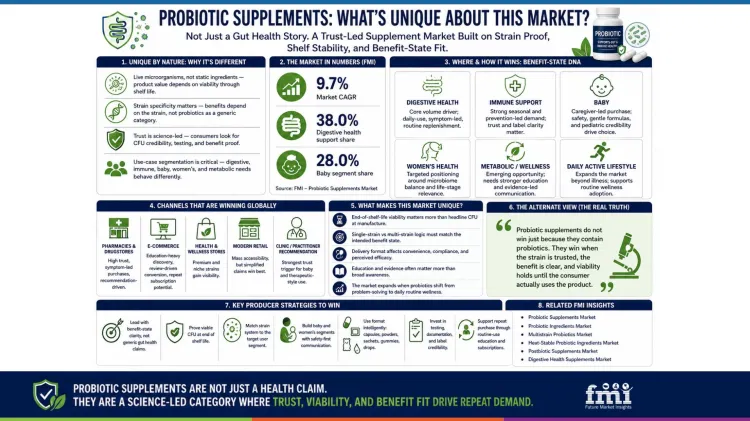
Probiotic supplements are commonly grouped under one broad promise: gut health. That umbrella is useful for market education, but it is too broad for product strategy. In the Probiotic Supplements Market, the more practical question is which benefit state the product is designed to support and which user group is expected to trust it. A product for daily digestive comfort should not be built the same way as a product for infants, women’s wellness, immune support, post-antibiotic use, or metabolic health.
This is why a practical product-architecture angle fits probiotic supplements better than a generic growth article. Probiotics are not only ingredients; they are condition-linked routines. Consumers may start with a general interest in microbiome balance, but they usually buy for a more specific reason: bloating, irregularity, antibiotic recovery, seasonal immunity, vaginal health, baby digestion, travel, daily maintenance, or overall wellness. Each use case requires different messaging and often different formulation logic.
FMI’s Probiotic Supplements Market identifies digestive health support as the leading functionality segment and Baby as the leading customer-orientation segment. These two benchmarks show the tension in the market. Digestive health remains the broadest consumer entry point, but specific user groups are shaping product design. A baby probiotic drop, a women’s probiotic capsule, a men’s daily probiotic, and a family digestive product are not interchangeable from a formulation or trust perspective.
Digestive health products remain the category foundation. They generally focus on regularity, bloating relief, digestive comfort, microbiome balance, or post-disruption recovery. These products need clear dosage guidance, consumer-friendly explanations, and an evidence story that feels practical rather than overly clinical. The strongest digestive products usually avoid vague “wellness” language and explain the daily routine clearly: when to take it, what benefit to expect, and why the selected strain or combination is appropriate.
The Digestive Health Supplements Market is a useful adjacent reference because FMI notes probiotics as a foundational category for gut-health consumers. However, that does not mean probiotic products can remain generic. As gut health becomes more familiar, consumers begin to compare products by strain, format, use case, and proof. Generic gut-balance positioning becomes less powerful when shoppers see multiple products making similar claims.
Baby and pediatric probiotics require a different architecture. Parents and caregivers are more cautious. They look for dosage safety, age relevance, pediatric suitability, drop or powder format convenience, gentle positioning, and often practitioner reassurance. A baby probiotic does not need aggressive performance language. It needs trust, clarity, and simple administration. Claims and communication must avoid overstating outcomes and should focus on appropriate support, tolerance, and routine use where permitted.
Women’s health products represent another specialized pathway. These products may connect gut microbiome, vaginal microbiome, urinary tract support, bloating, immunity, or beauty-from-within positioning. The challenge is that women’s probiotics can easily become overextended. A product that tries to cover every possible women’s wellness claim may lose credibility. Stronger products define the primary use case and align the strain selection, dosage, and supporting ingredients with that use case.
The Probiotic for Men Market also shows how gender-specific probiotic positioning is expanding. Men’s probiotics may connect digestive support with active lifestyles, metabolism, immunity, or daily performance routines. But, as with women’s products, the risk is superficial segmentation. A male-targeted pack design does not create product architecture. The formula and evidence story must explain why the product is meaningfully different.
Immune-support probiotics require careful communication because regulatory and consumer expectations vary by market. A product positioned for immune support must be especially precise about claims and supportive evidence. The strongest products connect immune positioning with strain-specific data, seasonal use routines, and clear consumer education. Weak products rely on vague immunity language without explaining why the formula is appropriate.
Metabolic health is a more emerging benefit state. It may include weight management, glucose metabolism, satiety-adjacent positioning, gut-brain axis concepts, or broader wellness support. These products need the strongest evidence discipline because consumer expectations can be high and regulatory scrutiny can be sensitive. Brands should avoid turning early microbiome science into broad performance claims. Product architecture should make clear what is established, what is supportive, and what the product is not designed to do.
The Multistrain Probiotics Market is relevant because many brands use multi-strain positioning to signal broader coverage. Multistrain products can be valuable, especially when strains are chosen for complementary roles. However, “more strains” is not automatically better. A longer ingredient list can create stability, interaction, and communication challenges. The right question is not how many strains are included; it is whether the combination fits the target benefit state.
Format must also match the use case. Capsules may suit adults seeking a daily routine. Sachets may fit travel or family use. Drops may work better for babies. Gummies may improve adherence among children or lifestyle users, but they create stability challenges. Powders may support flexible dosing, while delayed-release capsules may support delivery positioning. The format decision should follow the consumer problem, not the other way around.
Retail channel also influences product architecture. Pharmacy-led products may need more clinical language, practitioner credibility, and dosage clarity. E-commerce products need stronger comparison content, reviews, subscription logic, and education. Mass retail products need simple claims, familiar formats, and affordable entry points. Specialty health stores can support premium strain stories and multistrain positioning. One product architecture rarely works equally well across every channel.
For manufacturers, the practical framework is to start with five questions. Who is the user? What benefit state is being addressed? Which strain or strain combination supports that benefit? Which format protects viability and improves adherence? Which channel will explain the product properly? These questions are more useful than starting with a generic CFU count or a broad gut-health claim.
The misconception to avoid is that all probiotic supplements compete in a single category. They do not. They compete in use cases. A baby drop does not compete the same way as a women’s probiotic, an immune-support capsule, a digestive comfort gummy, or a multistrain premium powder.
Bottom line: probiotic supplement winners will be those that build around benefit-state architecture. The product must connect user need, strain logic, format, dosage, evidence, and channel education into one clear reason to repeat.
Related FMI Reports
- Probiotic Supplements Market: Primary interlink in introduction and conclusion
- Digestive Health Supplements Market: Use when discussing gut-health category context
- Multistrain Probiotics Market: Use when discussing strain combinations and multi-strain product design
- Probiotic for Men Market: Use when discussing gender-specific probiotic positioning
- Probiotic Ingredients Market: Use when discussing strain supply, Lactobacillus, and ingredient documentation
- Dietary Supplements Market: Use when connecting probiotics to broader supplement routines

