


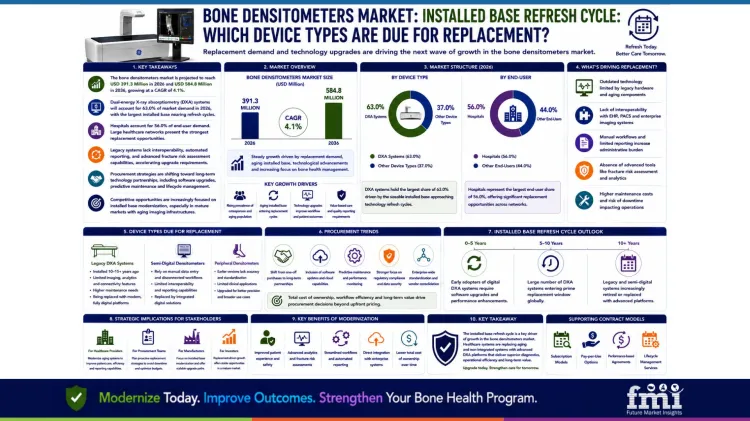
- The bone densitometers market is predicted to hit USD 391.3 million by 2026 and USD 584.8 million by 2036, with a CAGR of 4.1%. Replacement demand is expected to be a major growth driver.
- The demand for dual-energy X-ray absorptiometry (DXA) systems will account for 63.0% of market demand in 2026 and these systems have the largest installed equipment base approaching technology refresh cycles.
- Hospitals account for 56.0% of end-user demand. Large healthcare networks provide the most replacement opportunities of aging densitometry systems.
- Legacy DXA platforms and semi-digital densitometers are increasingly non-interoperable, lack automated reporting, and lack advanced fracture risk assessment capabilities, accelerating upgrade requirements.
- Procurement strategies are moving away from one-off equipment purchases to long-term technology relationships, including software upgrades, predictive maintenance and lifecycle management services.
- Competitive opportunities are increasingly focused on installed base modernization, rather than greenfield deployments, especially in mature healthcare markets with aging imaging infrastructures.
Introduction
Bone densitometers markets are poised for a replacement-led growth cycle as health systems continue to upgrade aging diagnostic infrastructure. The increasing prevalence of osteoporosis and aging population still remain to be the key drivers for the bone health assessment technology, but the replacement of the equipment rather than the first-time installation will probably contribute to a substantial part of future market growth.
The market is expected to reach USD 391.3 million in 2026 and USD 584.8 million in 2036 growing at a CAGR of 4.1% during the forecast period. This relatively modest growth trajectory reflects the maturity of the market, in which replacement investments are becoming more important than greenfield expansion opportunities.
Bone densitometers are typically long-lived capital assets that may be in service for a decade or more. Many systems currently deployed in hospitals and imaging facilities were installed before major advances in digital imaging, interoperability and workflow automation technologies. Healthcare systems are focusing more on efficiency, connectivity and patient-centered care, and replacement cycles are accelerating.
Consequently, the installed base refresh cycle is evolving as one of the most prominent strategic factors shaping future demand trends across the bone densitometers market.
Market Context
The global burden of osteoporosis and age-related bone disorders continues to increase. The aging population is creating an increasing demand for services to manage bone health and healthcare systems are focusing more on early diagnosis and prevention of fractures.
But bone densitometers remain the clinical standard for measuring bone mineral density and evaluating fracture risk. But the expectations for technology have changed a lot in the past decade.
Healthcare providers are demanding more and more imaging modalities that can support integrated diagnostic pathways, digital reporting and integrated sharing of information. Many current systems were designed before these requirements became key procurement priorities.
The market structure points to the importance of replacement opportunities. Dual-energy X-ray absorptiometry (DXA) systems have the largest installed equipment base, accounting for 63.0% of market demand in 2026. End-user demand for hospitals is 56.0%, presenting significant opportunities for enterprise-scale replacement efforts.
As healthcare organizations embrace digital transformation strategies, aging densitometry systems are being scrutinized not just on operational status but on how well they can accommodate changing clinical and information management needs.
Which Device Types Are Due for Replacement?
Legacy DXA Systems
The DXA technology is still the most dominant modality in the bone densitometers market and accounted for 63.0% of the market demand in 2026. This dominance also means that DXA systems form the largest installed base approaching replacement cycles.
Most of these early generation DXA platforms are still working well from a hardware perspective. These systems often lack capabilities that are increasingly expected by healthcare providers such as advanced visualization tools, integrated fracture risk analysis, automated reporting and cloud enabled data management.
Older systems often require a great deal of maintenance and may not work with current electronic health record systems.
Healthcare providers are increasingly aware that maintaining aging DXA equipment can create workflow inefficiencies and limited diagnostic capabilities. Replacement investments are therefore increasingly justified on operational and technological grounds rather than solely on the basis of equipment failure.
Semi-Digital Bone Densitometers
Many older densitometry systems still operate on semi-digital platforms and disconnected reporting workflows.
They also often rely on manual data entry, limited interoperability and isolated workflow management processes that increase administrative burden and decrease operational efficiency.
With healthcare systems moving to integrated care delivery and centralized information management, the economic justification for semi-digital systems is becoming increasingly difficult.
The failure to participate effectively in enterprise imaging ecosystems is driving retirement decisions and sparking demand for modern, digitally integrated replacements.
Peripheral Bone Densitometers
These systems were popular because lower costs for acquisition and ease of operation. The capabilities of many installed units remain limited relative to modern DXA platforms and often lack advanced analytics and connectivity.
Healthcare providers are increasingly looking for technologies that can support comprehensive osteoporosis management programs rather than isolated screening activities.
As clinical expectations evolve, older peripheral systems will come under increasing pressure to be replaced.
Technology Obsolescence Is Driving Refresh Demand
The installed base refresh cycle is increasingly being driven by technological obsolescence rather than equipment failure.
Healthcare providers increasingly seek systems capable of supporting:
- Automated fracture risk assessment
- Artificial intelligence-assisted image analysis
- Electronic health record integration
- Cloud-based reporting platforms
- Enterprise imaging interoperability
- Workflow automation
- Advanced visualization capabilities
- Predictive maintenance services
Many legacy systems cannot support these functionalities without extensive upgrades.
Digital transformation initiatives are also reshaping expectations regarding patient experiences and clinician productivity. Modern systems reduce administrative workloads, accelerate reporting processes, and facilitate multidisciplinary care coordination.
As a result, replacement investments increasingly reflect strategic modernization priorities rather than routine equipment renewal.
End-User Insights
Hospitals will hold the largest share in replacement opportunities, holding 56.0% of market demand in 2026.
Large healthcare systems are increasingly exploring enterprise imaging modernization strategies that include replacement of aging densitometry equipment. Standardized technology platforms enhance interoperability, allow for centralized management and reduce operational complexity.
Hospitals are also under growing pressure to increase patient throughput and optimize diagnostic workflows. Next generation densitometry systems help support these objectives through enhanced automation and integrated reporting capabilities.
The diagnostic imaging centers are another important substitution market. They compete on efficiency and quality of service and are increasingly looking for technologies that will improve productivity and patient experience.
Many academic medical centers are also upgrading existing systems to support research applications and advanced osteoporosis management programs.
Replacement demand is increasingly driven by modernization initiatives across all end-user categories.
Procurement and Buyer Behavior
Replacement procurement strategies differ fundamentally from first-time acquisitions.
Healthcare organizations replacing aging densitometers generally possess extensive operational experience and therefore establish more demanding evaluation criteria.
Procurement decisions increasingly prioritize:
- Total cost of ownership
- Interoperability capabilities
- Software upgrade pathways
- Long-term service agreements
- Predictive maintenance programs
- Training and implementation support
- Technology scalability
- Vendor innovation roadmaps
Long-term supplier relationships are becoming increasingly important because healthcare organizations seek technology partners capable of supporting ongoing digital transformation initiatives.
Enterprise contracts that include lifecycle management services and continuous software enhancements are becoming increasingly common.
Competitive Implications
The installed base refresh cycle is reshaping competition across the bone densitometers market.
Manufacturers with significant installed customer bases have great opportunities to gain replacement demand through trade-in programs, upgrade pathways, and long-term service relationships.
Replacement cycles also provide opportunities for competitors that are able to offer superior digital functionality and workflow integration capabilities.
Competition is increasingly moving from hardware performance to ecosystem development, software services and lifecycle management offerings.
While greenfield installation opportunities remain relatively sparse in mature healthcare markets, replacement demand is poised to be the key source of competitive differentiation over the next decade.
Winning manufacturers that position themselves as long-term modernization partners are likely to improve market share positions.
Strategic Implications
The bone densitometers market is moving towards a replacement based investment cycle with technology modernization and digital transformation.
Healthcare providers are more and more often replacing aging systems not because the devices have reached the end of their useful life, but because they do not meet today’s expectations on connectivity, workflow, integrated patient management.
With 63.0% demand in the market, DXA systems have the largest installed base close to refresh cycles and thus the most significant opportunity for replacement. Hospitals (56.0% of market demand) will remain the primary drivers of enterprise-scale modernization initiatives.
Looking ahead, manufacturers that can align their product development strategies with the digital transformation priorities and lifecycle management requirements of healthcare providers will be best placed to capitalize on replacement demand.
Bottom Line
The refresh cycle of the installed base is turning out to be one of the most significant growth drivers for the bone densitometers market. With healthcare providers emphasizing interoperability, workflow automation and enhanced diagnostic capabilities, legacy DXA systems, semi-digital platforms and aging peripheral densitometers are increasingly in need of replacement. The market's future growth trajectory will be less reliant on new installations and more on the manufacturers' ability to capitalize on modernization opportunities across a large and aging installed equipment base.

