

- Industry Size (2026)
- USD 38.9 Mn
- Forecast (2036)
- USD 59.3 Mn
- CAGR (2026 to 2036)
- 4.3%
Bone Densitometers Outlook in the UK 2026 to 2036
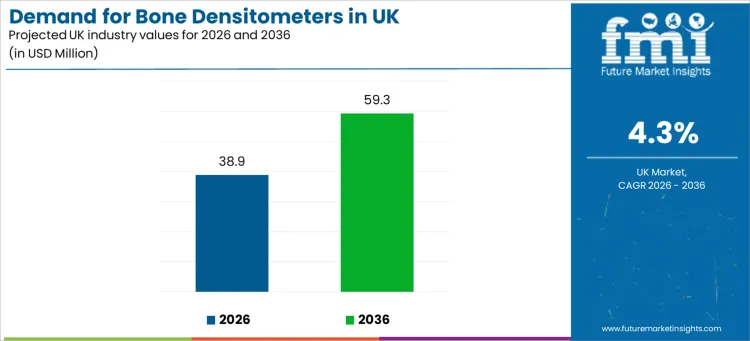
Demand for bone densitometers in the UK is projected at USD 38.9 million in 2026 and is expected to reach USD 59.3 million by 2036, expanding at a 4.3% CAGR. This demand is shaped by how hospitals, diagnostic imaging centers, and specialty clinics expand screening capacity for osteoporosis risk, fragility fracture prevention programs, and monitoring requirements tied to long-term bone health management.
Bone densitometry is treated as a decision-support tool that helps clinicians translate fracture risk assessment into actionable care pathways. Providers evaluate these systems through scan reliability, reproducibility across operators, workflow throughput, image quality, and reporting consistency.
For hospital leaders, the core business question is capacity and access: how quickly patients can be assessed, how reliably scans can be delivered, and how well results can be integrated into clinical decision making. For imaging center operators, uptime and predictable service support matter because scanning slots need to remain stable to protect revenue and patient satisfaction.
Technology service providers and equipment partners also influence purchasing outcomes. System selection is tied to maintenance contracts, calibration discipline, training readiness, and data integration into clinical workflows. Buyers value equipment that supports repeatable outcomes across multiple sites, especially in networks that standardise protocols to reduce variability in results.
Quick Stats for Bone Densitometers Demand in the UK
- Bone Densitometers Valuation in the UK (2026): USD 38.9 million
- Bone Densitometers Forecast Valuation in the UK (2036): USD 59.3 million
- Bone Densitometers Forecast CAGR 2026 to 2036: 4.3%
- Leading Regional Growth: England (4.7%)
- Leading Product: Axial Bone Densitometers (61.4% share)
- Leading Technology: DXA (52.0% share)
- Leading End User: Hospitals (43.5% share)
- Key Companies Profiled: GE Healthcare; Hologic, Inc.; Swissray International, Inc.; DMS Imaging; BeamMed Ltd.
Bone Densitometers Industry in the UK Key Takeaways
| Metric | Value |
|---|---|
| Industry Value (2026) | USD 38.9 million |
| Industry Forecast Value (2036) | USD 59.3 million |
| Forecast CAGR (2026 to 2036) | 4.3% |
Why is the UK Building Steady Demand for Bone Densitometers?
Demand in the UK grows as healthcare systems place stronger emphasis on fracture prevention, earlier diagnosis of low bone density, and more structured osteoporosis care pathways. Clinical teams increasingly use fracture risk assessment tools to determine who benefits from measurement, then use bone density results to support treatment decisions and monitoring cadence. NOGG guidance outlines assessment and management approaches for osteoporosis, including the role of fracture risk assessment and BMD measurement.
Patient awareness is also improving, which increases referrals and testing expectations. The Royal Osteoporosis Society explains how DXA scans are used for bone density measurement and how results are considered alongside fracture risk assessment methods such as FRAX. This drives a practical requirement for more scanning capacity, especially where primary and secondary care referral pathways are trying to reduce gaps between risk identification and formal diagnosis.
Hospital procurement teams often map densitometry capacity planning alongside device strategy anchored in bone densitometers, while imaging leaders standardise performance requirements against DXA scanners when throughput and reproducibility targets are being formalised. Service networks that compare multi-site rollout options also evaluate product positioning through bone densitometer devices where system configuration and technology segmentation influence adoption routes.
How is Bone Densitometers Demand Segmented by Product, Technology, and End User?
The segmentation reflects clinical workflow needs, scanning site requirements, and purchasing priorities tied to throughput, patient access, and repeatability.
Why are axial bone densitometers the preferred choice for high-confidence osteoporosis assessment programs?
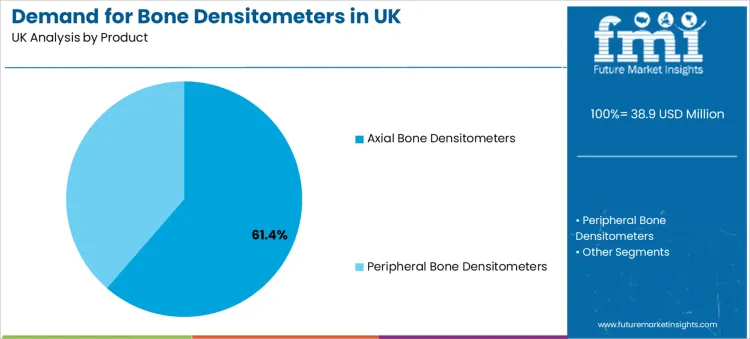
Axial bone densitometers hold a 61.4% share, making them the leading product category. Their dominance reflects the clinical requirement to measure key skeletal sites commonly used for osteoporosis assessment, including hip and spine. Providers prioritise systems that deliver repeatable results at these sites because the outcomes influence treatment decisions, monitoring strategies, and long-term patient management.
Axial systems also align well with hospital and imaging center workflows where structured reporting is expected. Standardised protocols are easier to implement when scanning sites and outputs remain consistent across operators. In multi-site networks, axial deployment also supports comparative monitoring where consistency over time is essential for clinical confidence.
What is supporting DXA as the leading technology choice for densitometry delivery?
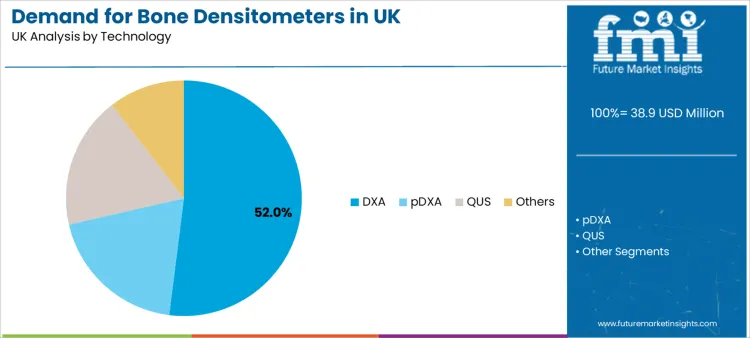
DXA accounts for a 52.0% share, positioning it as the leading technology. DXA is used widely because it provides quantitative bone density measurement and supports clinical decision making when combined with fracture risk assessment tools. The Royal Osteoporosis Society describes DXA scanning as the standard test for measuring bone density, and highlights how results are used within broader fracture risk assessment pathways
Technology leaders and imaging managers also value DXA for workflow predictability. DXA protocols are well established, operator training routes are mature, and reporting frameworks are familiar across clinical teams. These factors support procurement decisions where the goal is consistent performance rather than experimentation with unfamiliar modalities.
DXA system requirements are frequently aligned with performance expectations tracked across DXA scanners adoption, especially where service operators balance throughput capacity with scan quality and maintenance discipline.
Why do hospitals remain the largest end-user setting for bone densitometry services?
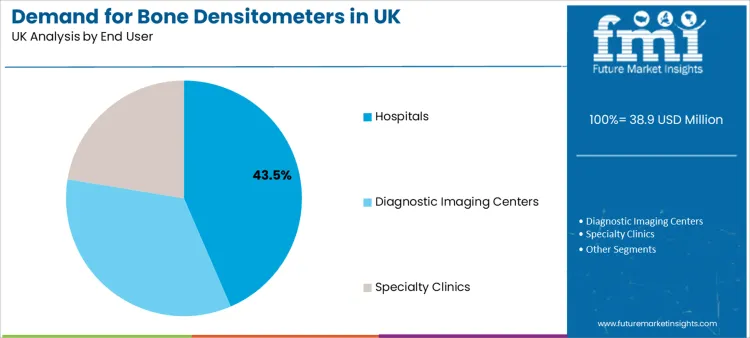
Hospitals represent a 43.5% share, making them the leading end user segment. Hospitals hold this position because they manage larger patient volumes, run structured osteoporosis and fracture liaison pathways, and integrate densitometry into multidisciplinary care. They also handle complex cases where broader clinical assessment is required alongside scanning.
Hospitals are more likely to invest in systems that support service-line scale and long-term utilisation. They prioritise reliability, service responsiveness, and training resources that support stable scanning capacity through staffing changes and demand spikes.
Diagnostic imaging centers also play a strong role, especially where they reduce referral bottlenecks and offer dedicated scanning capacity. Specialty clinics support demand through targeted patient groups and monitoring programs, often focusing on clinical convenience and rapid access.
What are the Dynamics, Restraints, Opportunities, and Threats Shaping this Space?
What dynamics are strengthening demand across UK healthcare delivery?
Fracture prevention programs and osteoporosis care pathway development support consistent growth. NOGG guidance highlights the importance of structured assessment for osteoporosis management, supporting continued densitometry demand. Clinical teams also use fracture risk tools such as FRAX to guide referral and measurement decisions, reinforcing repeatable demand cycles.
Another driver is the operational push to reduce avoidable fractures and improve patient outcomes. Densitometry capacity expands when healthcare systems prioritise earlier identification of risk, monitoring of therapy response, and consistent patient follow-up.
What restraints can limit adoption or delay equipment refresh cycles?
Capital budget competition is a key restraint. Hospitals and imaging centers must prioritise across multiple diagnostic systems, which can slow densitometry expansion when budgets are constrained. Workforce capacity can also limit utilisation. Even when systems are available, scanning throughput depends on trained staff and scheduling discipline.
Maintenance and calibration requirements influence decisions as well. Buyers avoid platforms that increase downtime risk or require complex servicing that disrupts scanning schedules.
Where do practical opportunities exist for suppliers and clinical stakeholders?
- Service-line throughput optimisation: Providers that reduce scan time and simplify reporting can improve utilisation and reduce referral backlogs.
- Network standardisation: Health systems benefit when multi-site scanning protocols and training pathways are unified, enabling consistent results across sites.
- Workflow and data integration support: Equipment partners that improve connectivity, reporting templates, and quality control routines strengthen adoption. These priorities often align with system comparison activity in bone densitometer devices.
What threats can disrupt demand expectations?
Delays in referral pathways can reduce short-term scanning volumes, particularly if access is constrained by workforce or scheduling limitations. Substitution risk exists if some providers shift monitoring focus toward alternative clinical measures in specific patient groups, though DXA remains central for many care pathways. Procurement risk also increases if service support is inconsistent, since downtime can create patient dissatisfaction and missed clinical windows.
How is Bone Densitometers Demand Evolving across Key Regions in the UK?
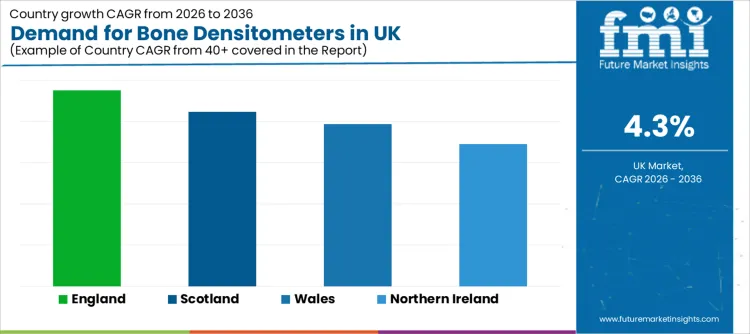
| Region | CAGR 2026 to 2036 |
|---|---|
| England | 4.7% |
| Scotland | 4.2% |
| Wales | 3.9% |
| Northern Ireland | 3.5% |
Why is England leading growth through higher scanning volume requirements and wider provider networks?
England grows at 4.7%, supported by larger healthcare delivery networks and higher scanning volume requirements. Demand rises where providers expand fracture risk assessment pathways and need accessible densitometry capacity to reduce delays between referral and diagnosis.
How is Scotland expanding through steady adoption tied to structured osteoporosis care pathways?
Scotland increases at 4.2%, shaped by stable demand for consistent diagnosis and monitoring. Providers prioritise reliable results and controlled scanning workflows, with purchasing decisions influenced by service support quality and staff training readiness.
What is shaping Wales as densitometry uptake grows through practical capacity building?
Wales grows at 3.9%, driven by capacity-building priorities where providers want predictable scanning access and consistent reporting. Adoption strengthens when systems improve scheduling reliability and reduce bottlenecks for high-risk patient assessment.
Why is Northern Ireland progressing through measured rollout and selective investment cycles?
Northern Ireland rises at 3.5%, reflecting measured expansion tied to investment discipline and staged procurement. Providers scale utilisation when system uptime remains stable and when trained operator availability supports throughput goals.
What Defines the Competitive Landscape for Bone Densitometers in the UK?
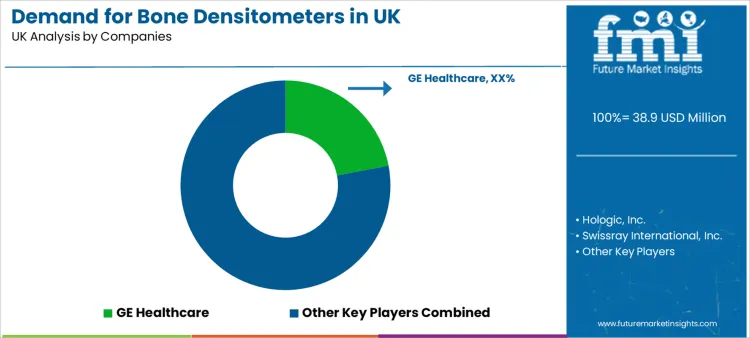
Competition is shaped by scan accuracy, reproducibility, uptime performance, service coverage, and the strength of training support. Providers evaluate vendors on how reliably they can deliver consistent results, how quickly systems can be serviced, and how effectively software supports clinical reporting.
GE Healthcare competes through broad diagnostic infrastructure experience and established service models. Hologic, Inc. holds strong positioning in densitometry with platforms associated with high clinical familiarity and standardised workflows. Swissray International, Inc. and DMS Imaging contribute through differentiated system offerings and configuration options for imaging operators. BeamMed Ltd. adds competitive pressure through portable and alternative modality approaches that can support access and workflow needs in selected care settings.
Procurement decisions also favour suppliers that can deliver stable lifecycle support, including calibration guidance, software updates, and training resources that help maintain scanning consistency across staffing changes.
Key Industry Participants
- GE Healthcare
- Hologic, Inc.
- Swissray International, Inc.
- DMS Imaging
- BeamMed Ltd.
Scope of Report
| Items | Values |
|---|---|
| Quantitative Units | USD Million |
| Product | Axial Bone Densitometers; Peripheral Bone Densitometers |
| Technology | DXA; pDXA; QUS; Others |
| End User | Hospitals; Diagnostic Imaging Centers; Specialty Clinics |
| Regions Covered | England; Scotland; Wales; Northern Ireland |
| Key Companies Profiled | GE Healthcare; Hologic, Inc.; Swissray International, Inc.; DMS Imaging; BeamMed Ltd. |
Bone Densitometers Demand in the UK by Segments
By Product:
- Axial Bone Densitometers
- Peripheral Bone Densitometers
By Technology:
- DXA
- pDXA
- QUS
- Others
By End User:
- Hospitals
- Diagnostic Imaging Centers
- Specialty Clinics
By Region:
- England
- Scotland
- Wales
- Northern Ireland
Bibliography
- National Osteoporosis Guideline Group. (2024). Clinical guideline for the prevention and treatment of osteoporosis.
- Royal Osteoporosis Society. (n.d.). Bone density scan (DXA/DEXA).
- Compston, J., Cooper, A., Cooper, C., et al. (2022). UK clinical guideline for the prevention and treatment of osteoporosis. Archives of Osteoporosis.
Frequently Asked Questions
How big is the demand for bone densitometers in uk in 2026?
The demand for bone densitometers in uk is estimated to be valued at USD 38.9 million in 2026.
What will be the size of bone densitometers in uk in 2036?
The market size for the bone densitometers in uk is projected to reach USD 59.3 million by 2036.
How much will be the demand for bone densitometers in uk growth between 2026 and 2036?
The demand for bone densitometers in uk is expected to grow at a 4.3% CAGR between 2026 and 2036.
What are the key product types in the bone densitometers in uk?
The key product types in bone densitometers in uk are axial bone densitometers and peripheral bone densitometers.
Which technology segment is expected to contribute significant share in the bone densitometers in uk in 2026?
In terms of technology, dxa segment is expected to command 52.0% share in the bone densitometers in uk in 2026.
Preview the report firsthand - request a free sample
Get SampleGet the brochure for pricing and purchase details.
Get PDFTable of Content
- Executive Summary
- UK Market Outlook
- Demand-side Trends
- Supply-side Trends
- Technology Roadmap Analysis
- Analysis and Recommendations
- Market Overview
- Market Coverage / Taxonomy
- Market Definition / Scope / Limitations
- Market Background
- Market Dynamics
- Drivers
- Restraints
- Opportunity
- Trends
- Scenario Forecast
- Demand in Optimistic Scenario
- Demand in Likely Scenario
- Demand in Conservative Scenario
- Opportunity Map Analysis
- Product Life Cycle Analysis
- Supply Chain Analysis
- Investment Feasibility Matrix
- Value Chain Analysis
- PESTLE and Porter’s Analysis
- Regulatory Landscape
- Regional Parent Market Outlook
- Production and Consumption Statistics
- Import and Export Statistics
- Market Dynamics
- UK Market Analysis 2021 to 2025 and Forecast, 2026 to 2036
- Historical Market Size Value (USD Million) Analysis, 2021 to 2025
- Current and Future Market Size Value (USD Million) Projections, 2026 to 2036
- Y-o-Y Growth Trend Analysis
- Absolute $ Opportunity Analysis
- UK Market Pricing Analysis 2021 to 2025 and Forecast 2026 to 2036
- UK Market Analysis 2021 to 2025 and Forecast 2026 to 2036, By Product
- Introduction / Key Findings
- Historical Market Size Value (USD Million) Analysis By Product , 2021 to 2025
- Current and Future Market Size Value (USD Million) Analysis and Forecast By Product , 2026 to 2036
- Axial Bone Densitometers
- Peripheral Bone Densitometers
- Axial Bone Densitometers
- Y-o-Y Growth Trend Analysis By Product , 2021 to 2025
- Absolute $ Opportunity Analysis By Product , 2026 to 2036
- UK Market Analysis 2021 to 2025 and Forecast 2026 to 2036, By Technology
- Introduction / Key Findings
- Historical Market Size Value (USD Million) Analysis By Technology, 2021 to 2025
- Current and Future Market Size Value (USD Million) Analysis and Forecast By Technology, 2026 to 2036
- DXA
- pDXA
- QUS
- Others
- DXA
- Y-o-Y Growth Trend Analysis By Technology, 2021 to 2025
- Absolute $ Opportunity Analysis By Technology, 2026 to 2036
- UK Market Analysis 2021 to 2025 and Forecast 2026 to 2036, By End User
- Introduction / Key Findings
- Historical Market Size Value (USD Million) Analysis By End User, 2021 to 2025
- Current and Future Market Size Value (USD Million) Analysis and Forecast By End User, 2026 to 2036
- Hospitals
- Diagnostic Imaging Centers
- Specialty Clinics
- Hospitals
- Y-o-Y Growth Trend Analysis By End User, 2021 to 2025
- Absolute $ Opportunity Analysis By End User, 2026 to 2036
- Market Structure Analysis
- Competition Dashboard
- Competition Benchmarking
- Market Share Analysis of Top Players
- By Regional
- By Product
- By Technology
- By End User
- Competition Analysis
- Competition Deep Dive
- GE Healthcare
- Overview
- Product Portfolio
- Profitability by Market Segments (Product/Age /Sales Channel/Region)
- Sales Footprint
- Strategy Overview
- Marketing Strategy
- Product Strategy
- Channel Strategy
- Hologic, Inc.
- Swissray International, Inc.
- DMS Imaging
- BeamMed Ltd.
- GE Healthcare
- Competition Deep Dive
- Assumptions & Acronyms Used
- Research Methodology


