

- Industry Size (2026)
- USD 11.8 Mn
- Forecast (2036)
- USD 17.3 Mn
- CAGR (2026 to 2036)
- 3.9%
Demand for Bone Densitometers in South Korea Forecast and Outlook 2026 to 2036
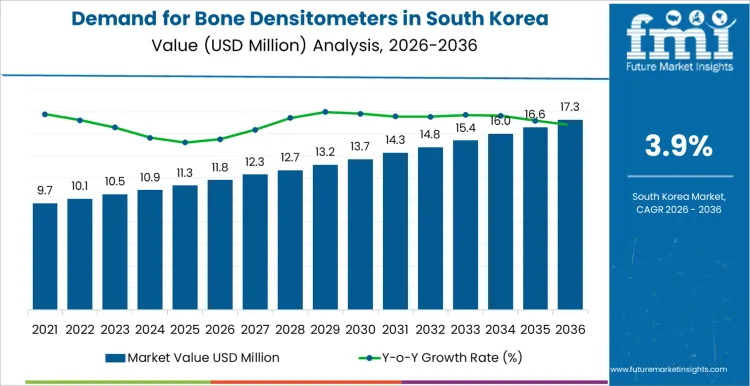
Demand for bone densitometers in South Korea is poised to be valued at USD 11.8 million in 2026. Expenditure on the sector is likely to ascend to USD 17.3 million by 2036, progressing at a compound annual growth rate of 3.9%. South Korea faces a rapidly aging demographic, which significantly amplifies the prevalence of osteoporosis and osteopenia among the elderly population. This demographic shift necessitates robust diagnostic infrastructure capable of early detection and fracture risk assessment. Medical institutions are increasingly prioritizing preventive care, driven by national health insurance coverage that supports regular screening for post-menopausal women and older adults. Consequently, hospitals and clinics are investing in advanced imaging modalities to manage the rising patient volume effectively.
Prior to diving into the statistical specifics, it is essential to recognize the role of lifestyle changes in driving equipment adoption. rapid urbanization and changing dietary habits have led to concerns regarding bone health across younger demographics as well, not just the elderly. Corporate wellness programs are beginning to include comprehensive health check-ups that encompass bone density scans, broadening the potential user base. Awareness campaigns by medical associations regarding the silent nature of osteoporosis are prompting individuals to seek proactive diagnostics. This cultural shift towards preventive medicine ensures a steady stream of demand for reliable and accessible bone densitometry services across the nation.
Quick Stats for Demand for Bone Densitometers in South Korea
- Demand for Bone Densitometers in South Korea Value (2026): USD 11.8 million
- Demand for Bone Densitometers in South Korea Forecast Value (2036): USD 17.3 million
- Demand for Bone Densitometers in South Korea Forecast CAGR: 3.9%
- Leading Product Segment for Bone Densitometers Industry in South Korea: Axial Bone Densitometers (65.0%)
- Leading Technology Segment for Bone Densitometers Industry in South Korea: DXA (54.7%)
- Leading End User Segment for Bone Densitometers Industry in South Korea: Hospitals (45.8%)
- Key Growth Regions for Bone Densitometers Industry in South Korea: Jeju, South Gyeongsang, South Jeolla, North Jeolla
- Bone Densitometers Industry in South Korea Key Players: GE Healthcare, Hologic, Inc., Swissray International, Inc., DMS Imaging, BeamMed Ltd.
Technological advancements are reshaping the diagnostic landscape, with a strong emphasis on integrating artificial intelligence into imaging protocols. Clinicians are adopting dxa scanner systems enhanced with AI to improve measurement accuracy and workflow efficiency. These intelligent systems assist radiologists in identifying vertebral fractures that might otherwise go unnoticed during routine scans. There is also a growing synergy between bone health diagnostics and ai osteoporosis screening tools, which leverage machine learning algorithms to predict fracture risk based on density data. Such innovations are critical for enhancing the diagnostic value of standard procedures and ensuring that patients receive timely interventions.
Demand for Bone Densitometers in South Korea Key Takeaways
| Metric | Value |
|---|---|
| Industry Size (2026) | USD 11.8 million |
| Industry Value (2036) | USD 17.3 million |
| CAGR (2026 to 2036) | 3.9% |
What Factors Are Fueling Bone Densitometers Adoption?
Rising incidence rates of lifestyle-related skeletal conditions are a primary driver for equipment procurement. As the population engages in less physical activity, the need for anti osteoporosis therapy and fracture healing monitoring increases, necessitating frequent scans. Orthopedic departments are expanding their capabilities to include comprehensive orthopaedic imaging suites that combine densitometry with other modalities. This holistic approach allows for better management of patients undergoing treatment for fractures or chronic bone diseases. High healthcare expenditure per capita in South Korea enables facilities to afford premium diagnostic systems, ensuring that financial barriers do not hinder the adoption of top-tier technology.
How is the Sector Structured Across Key Segments?
The sector is segmented by product type, technology, and end-user facility, reflecting the diverse needs of the healthcare ecosystem. Product categorization distinguishes between central scanning systems and peripheral units used for screening. Technology segmentation highlights the dominance of X-ray-based methods over ultrasound alternatives. End-user classification reveals where the majority of diagnostic procedures occur, ranging from large tertiary hospitals to specialized private clinics. Understanding this structure is vital for manufacturers aiming to target specific niches, such as high-volume screening centers or specialized orthopedic research institutes.
Why Do Axial Bone Densitometers Dominate?
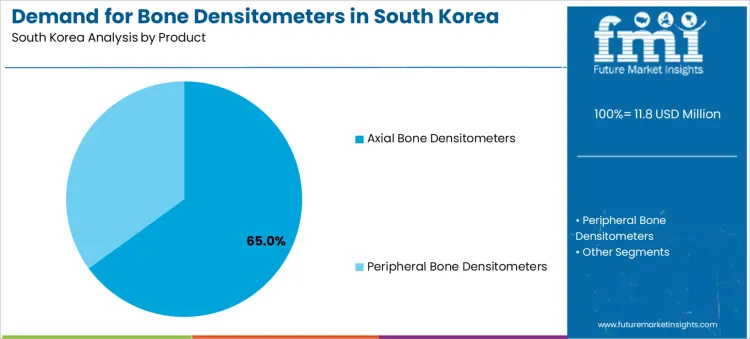
Axial Bone Densitometers command a 65.0% share of the industry. This dominance stems from their clinical superiority in measuring bone density at critical fracture sites like the hip and lumbar spine. Korean medical guidelines strongly recommend central DXA scans for the definitive diagnosis of osteoporosis, making these machines indispensable for hospitals. Physicians rely on the precision of axial systems to monitor treatment efficacy over time, a capability that peripheral devices often lack. Reimbursement policies in South Korea also favor comprehensive central scans, incentivizing healthcare providers to invest in these larger, more capable units despite their higher initial cost and space requirements.
Is DXA Technology the Standard of Care?
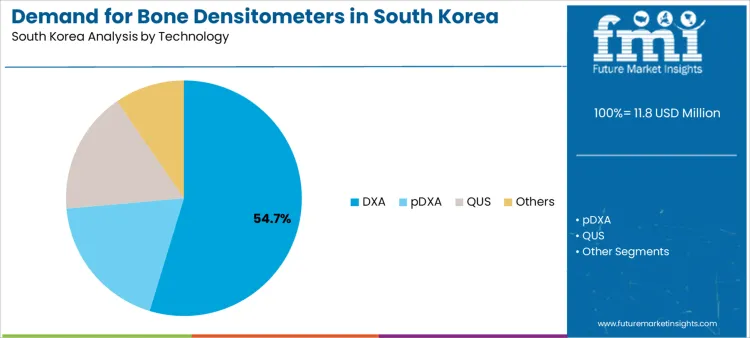
DXA technology leads the sector with a 54.7% share. Dual-Energy X-ray Absorptiometry provides the most reliable data for assessing bone mineral density with minimal radiation exposure. Its widespread acceptance is reinforced by its role as the reference standard in World Health Organization guidelines. Comparative effectiveness against other modalities like quantitative ultrasound ensures that DXA remains the preferred choice for confirmatory diagnosis. Continued innovation in this field, such as the development of fan-beam technology, allows for faster scan times and higher image resolution, further solidifying its position in busy Korean radiology departments.
Why Do Hospitals Lead Consumption?
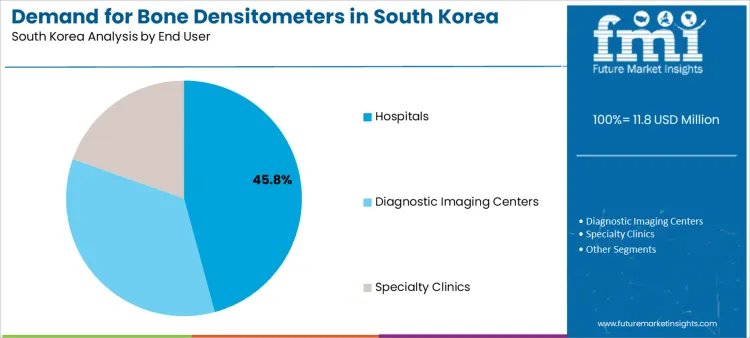
Hospitals account for 45.8% of the usage share. Large general hospitals and university medical centers in South Korea serve as the primary hubs for managing complex geriatric cases. These institutions possess the capital and infrastructure to house sophisticated diagnostic suites. Patients often prefer visiting hospitals for comprehensive check-ups where densitometry is part of a broader battery of tests. The concentration of specialized medical staff, including endocrinologists and orthopedic surgeons, within hospital settings ensures that bone density data is immediately actionable. This integration of diagnosis and treatment planning drives the continuous procurement of high-end densitometers by the hospital segment.
Will Software Integration Change Diagnostics?
Software advancements are increasingly becoming a differentiator for hardware manufacturers. New platforms offer automated analysis of bone structure, reducing the time radiologists spend on interpretation. The integration of osteoporosis screening software allows for longitudinal tracking of patient data, alerting clinicians to significant changes in bone density. This trend is particularly relevant in South Korea, where digital health records are highly advanced. Compatibility with hospital information systems is now a key purchasing criterion. Manufacturers that offer seamless connectivity and AI-driven analytical tools are likely to gain a competitive edge as facilities seek to optimize workflow and improve patient outcomes.
Does Radiation Concern Limit X-ray Adoption?
Radiation safety remains a pertinent topic among Korean patients and regulators. While DXA involves very low doses, consumer wariness can sometimes hinder participation in voluntary screening programs. This concern opens a niche opportunity for radiation-free alternatives, though their clinical utility remains limited compared to X-ray systems. Manufacturers are responding by developing diagnostic x ray system technologies with even lower dose protocols. Educational campaigns explaining the minimal risk relative to the diagnostic benefit are essential. Overcoming this psychological barrier is crucial for sustaining participation rates in national screening initiatives, especially among younger, health-conscious demographics.
How Can Dental Imaging Cross-Pollinate?
There is emerging interest in the correlation between oral bone health and systemic osteoporosis. Research suggests that panoramic radiographs taken by dental imaging equipment can serve as an opportunistic screening tool for low bone mass. Dentists are increasingly collaborating with general practitioners to refer patients with suspicious jawbone patterns for full densitometry scans. This cross-disciplinary approach expands the funnel for patient identification. Manufacturers who can bridge the gap between dental and medical imaging data, perhaps through unified software platforms, may uncover new avenues for growth by leveraging the high frequency of dental visits in the Korean population.
How is the Landscape Evolving Across South Korea's Regions?
Regional development in the diagnostic sector mirrors the broader distribution of healthcare resources and demographic aging patterns. While Seoul and the surrounding metropolitan areas hold the largest concentration of advanced equipment, provincial regions are witnessing faster growth rates due to government-led healthcare decentralization. Specific provinces with higher median ages are prioritizing geriatric care infrastructure. Local governments are subsidizing the upgrade of public health centers, bringing modern diagnostic tools to underserved communities.
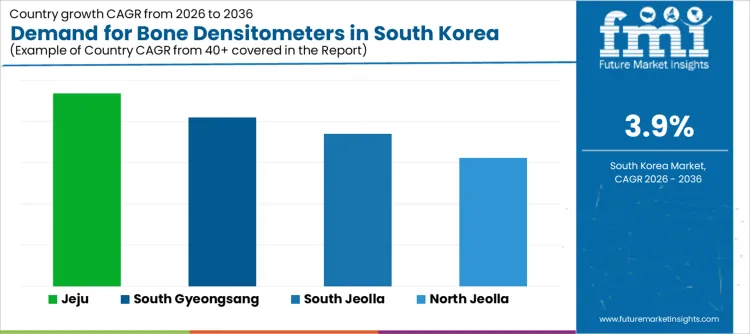
| Region | CAGR (2026 to 2036) |
|---|---|
| Jeju | 4.7% |
| South Gyeongsang | 4.1% |
| South Jeolla | 3.7% |
| North Jeolla | 3.1% |
Why is Jeju Experiencing Rapid Growth?
Adoption of diagnostic equipment in Jeju is projected to expand at a CAGR of 4.7%. Jeju Island acts as a unique hub for medical tourism and wellness retreats, attracting both domestic and international visitors seeking health check-ups. The local government is actively promoting the island as a center for longevity and preventive medicine. This branding drives demand for premium diagnostic services, including bone health assessments. Clinics on the island are investing in high-end equipment to cater to this affluent clientele. The aging local population also necessitates improved local healthcare access, reducing the need for residents to travel to the mainland for routine screenings.
How is Industrial Health Shaping South Gyeongsang?
Sales of densitometers in South Gyeongsang are likely to reach a CAGR of 4.1%. This region is the industrial heartland of Korea, hosting major shipyards and manufacturing plants. Occupational health standards are stringent, and large corporations often contract local hospitals to provide comprehensive health screenings for their aging workforce. The prevalence of physical labor in these industries makes musculoskeletal health a priority. Consequently, regional hospitals are well-equipped with bone metabolism test capabilities and imaging hardware. Investments here are driven by the need to maintain a healthy, productive workforce amidst a shrinking labor pool.
What Drives Demand in South Jeolla?
The sector in South Jeolla is anticipated to rise at a CAGR of 3.7%. South Jeolla has one of the highest proportions of elderly residents in the country. This demographic reality places immense pressure on the regional healthcare system to manage age-related conditions like osteoporosis effectively. Public health centers play a critical role here, often serving as the primary point of care for rural communities. Funding is increasingly directed towards equipping these centers with portable and peripheral bone densitometers that are easier to deploy in smaller facilities. The focus is on accessibility and early intervention to prevent debilitating fractures in the senior population.
How is North Jeolla Modernizing?
Deployment of imaging systems in North Jeolla is expected to increase at a CAGR of 3.1%. While growth is more moderate compared to other regions, there is a steady trend of replacing obsolete analog equipment with digital solutions. University hospitals in cities like Jeonju are serving as regional anchors, adopting state-of-the-art technology to provide tertiary care. The drive here is to reduce the disparity in healthcare quality between the province and the capital region. Efforts to attract medical professionals to the area are complemented by investments in modern diagnostic tools, ensuring that residents have access to standard-of-care bone health evaluations locally.
What Strategies Define Leadership?
GE Healthcare commands a dominant position with a 22.0% share, leveraging its extensive portfolio of imaging solutions and deep relationships with major Korean hospitals. Their strategy focuses on offering comprehensive women's health packages, bundling mammography and bone densitometry systems. Competitors are responding by introducing compact, cost-effective devices targeted at the growing clinic segment. Companies like Hologic are emphasizing superior image quality and precision analytics to capture the high-end academic research segment. Local presence and rapid technical support are critical differentiators, as Korean facilities demand high uptime and quick service response.
How Are Niche Players Competing?
Smaller players like BeamMed and DMS Imaging are carving out niches by focusing on specialized technologies such as ultrasound-based assessment. These companies target pediatric clinics and smaller orthopedic practices where full-body DXA systems may be impractical due to space or cost. By offering portable and radiation-free options, they address specific gaps in the current infrastructure. Marketing strategies for these firms often highlight patient safety and ease of use. Collaborations with local distributors help these international brands navigate the complex regulatory and procurement landscape of the Korean medical device sector.
Key Companies
- GE Healthcare
- Hologic, Inc.
- Swissray International, Inc.
- DMS Imaging
- BeamMed Ltd.
Scope of Report
| Items | Values |
|---|---|
| Quantitative Units | USD Million |
| Product | Axial Bone Densitometers, Peripheral Bone Densitometers |
| Technology | DXA, pDXA, QUS, Others |
| End User | Hospitals, Diagnostic Imaging Centers, Specialty Clinics |
| Regions Covered | Jeju, South Gyeongsang, South Jeolla, North Jeolla |
| Key Companies Profiled | GE Healthcare, Hologic, Swissray International, DMS Imaging, BeamMed |
Demand for Bone Densitometers in South Korea by Segments
By Product
- Axial Bone Densitometers
- Peripheral Bone Densitometers
By Technology
- DXA (Dual Energy X-ray Absorptiometry)
- pDXA (Peripheral Dual Energy X-ray Absorptiometry)
- QUS (Quantitative Ultrasound)
- Others
By End User
- Hospitals
- Diagnostic Imaging Centers
- Specialty Clinics
Bibliography
- Ministry of Health and Welfare. (2024, December 26). 2024 Health and Welfare Statistical Yearbook. Ministry of Health and Welfare, Republic of Korea.
- Statistics Korea. (2024, December). Population projections for Korea (2023-2073). Statistics Korea, Republic of Korea.
- Korean Society of Bone and Mineral Research. (2024). The 2024 guidelines for osteoporosis. Journal of Bone Metabolism.
- Health Insurance Review and Assessment Service. (2025). Statistics Data Repository (health insurance statistics yearbook access point). Health Insurance Review and Assessment Service, Republic of Korea.
Frequently Asked Questions
How big is the demand for Bone Densitometers in South Korea in 2026?
The demand for Bone Densitometers in South Korea is estimated to be valued at USD 11.8 million in 2026.
What will be the size of Bone Densitometers in South Korea in 2036?
The industry size for the Bone Densitometers in South Korea is projected to reach USD 17.3 million by 2036.
How much will be the demand for Bone Densitometers in South Korea growth between 2026 and 2036?
The demand for Bone Densitometers in South Korea is expected to grow at a 3.9% CAGR between 2026 and 2036.
What are the key product types in the Bone Densitometers in South Korea?
The key product types in Bone Densitometers in South Korea are Axial Bone Densitometers and Peripheral Bone Densitometers.
Which end user segment is expected to contribute significant share in the Bone Densitometers in South Korea in 2026?
By end user, Hospitals segment is expected to command 45.8% share in the Bone Densitometers in South Korea in 2026.
Preview the report firsthand - request a free sample
Get SampleGet the brochure for pricing and purchase details.
Get PDFTable of Content
- Executive Summary
- South Korea Market Outlook
- Demand-side Trends
- Supply-side Trends
- Technology Roadmap Analysis
- Analysis and Recommendations
- Market Overview
- Market Coverage / Taxonomy
- Market Definition / Scope / Limitations
- Market Background
- Market Dynamics
- Drivers
- Restraints
- Opportunity
- Trends
- Scenario Forecast
- Demand in Optimistic Scenario
- Demand in Likely Scenario
- Demand in Conservative Scenario
- Opportunity Map Analysis
- Product Life Cycle Analysis
- Supply Chain Analysis
- Investment Feasibility Matrix
- Value Chain Analysis
- PESTLE and Porter’s Analysis
- Regulatory Landscape
- Regional Parent Market Outlook
- Production and Consumption Statistics
- Import and Export Statistics
- Market Dynamics
- South Korea Market Analysis 2021 to 2025 and Forecast, 2026 to 2036
- Historical Market Size Value (USD Million) Analysis, 2021 to 2025
- Current and Future Market Size Value (USD Million) Projections, 2026 to 2036
- Y-o-Y Growth Trend Analysis
- Absolute $ Opportunity Analysis
- South Korea Market Pricing Analysis 2021 to 2025 and Forecast 2026 to 2036
- South Korea Market Analysis 2021 to 2025 and Forecast 2026 to 2036, By Product
- Introduction / Key Findings
- Historical Market Size Value (USD Million) Analysis By Product , 2021 to 2025
- Current and Future Market Size Value (USD Million) Analysis and Forecast By Product , 2026 to 2036
- Axial Bone Densitometers
- Peripheral Bone Densitometers
- Axial Bone Densitometers
- Y-o-Y Growth Trend Analysis By Product , 2021 to 2025
- Absolute $ Opportunity Analysis By Product , 2026 to 2036
- South Korea Market Analysis 2021 to 2025 and Forecast 2026 to 2036, By Technology
- Introduction / Key Findings
- Historical Market Size Value (USD Million) Analysis By Technology, 2021 to 2025
- Current and Future Market Size Value (USD Million) Analysis and Forecast By Technology, 2026 to 2036
- DXA
- pDXA
- QUS
- Others
- DXA
- Y-o-Y Growth Trend Analysis By Technology, 2021 to 2025
- Absolute $ Opportunity Analysis By Technology, 2026 to 2036
- South Korea Market Analysis 2021 to 2025 and Forecast 2026 to 2036, By End User
- Introduction / Key Findings
- Historical Market Size Value (USD Million) Analysis By End User, 2021 to 2025
- Current and Future Market Size Value (USD Million) Analysis and Forecast By End User, 2026 to 2036
- Hospitals
- Diagnostic Imaging Centers
- Specialty Clinics
- Hospitals
- Y-o-Y Growth Trend Analysis By End User, 2021 to 2025
- Absolute $ Opportunity Analysis By End User, 2026 to 2036
- Market Structure Analysis
- Competition Dashboard
- Competition Benchmarking
- Market Share Analysis of Top Players
- By Regional
- By Product
- By Technology
- By End User
- Competition Analysis
- Competition Deep Dive
- GE Healthcare
- Overview
- Product Portfolio
- Profitability by Market Segments (Product/Age /Sales Channel/Region)
- Sales Footprint
- Strategy Overview
- Marketing Strategy
- Product Strategy
- Channel Strategy
- Hologic, Inc.
- Swissray International, Inc.
- DMS Imaging
- BeamMed Ltd.
- GE Healthcare
- Competition Deep Dive
- Assumptions & Acronyms Used
- Research Methodology


