


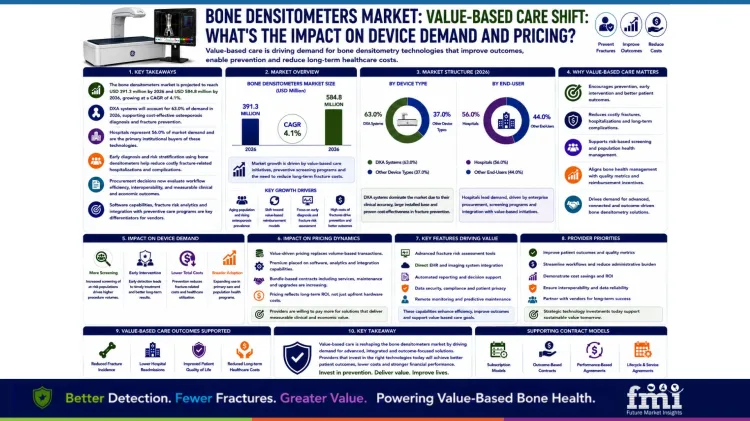
- The bone densitometers market is projected to reach USD 391.3 million by 2026 and USD 584.8 million by 2036, growing at a CAGR of 4.1%, driven by value-based healthcare initiatives and preventive care strategies.
- In 2026, dual-energy X-ray absorptiometry (DXA) systems are expected to account for 63.0% of market demand and are key technologies for cost-effective osteoporosis diagnosis and fracture prevention programs.
- Hospitals account for 56.0% of demand in the market, making institutional purchase decisions a key parameter driving the adoption of value-based bone health management technologies.
- Healthcare providers are investing in bone densitometry systems that assist in early diagnosis, risk stratification, and long-term disease management to reduce costly fracture-related interventions.
- Procurement decisions are moving from hardware examinations to analysing workflow efficiency, interoperability and demonstrable clinical and economic outcomes.
- Competitive differentiation is increasingly being associated with software capability, fracture risk analytics and integration with wider preventive health care and population management efforts.
Introduction
The healthcare system worldwide is gradually transitioning from fee-for-service reimbursement models to value-based care models that reward quality, efficiency, and measurable patient outcomes. This shift is transforming the demand landscape across diagnostic technologies and opening new opportunities for medical devices that enable preventive intervention and long-term disease management.
Bone densitometers are becoming more important in this environment to identify patients at risk for osteoporosis and fractures before expensive complications arise. Bone mineral density measurement has been considered in the past as a specialised diagnostic service, mainly used in endocrinology and osteoporosis clinics. Today, bone health is increasingly becoming part of a broader healthcare strategy. for preventive care and population health.
The bone densitometers market is expected to grow to USD 391.3 million by 2026 and USD 584.8 million by 2036 at a CAGR of 4.1%. The rising adoption of technologies that can improve clinical outcomes and reduce the long-term economic burden associated with osteoporotic fractures and age-related bone disorders is propelling the growth of the market.
As value-based care initiatives continue to proliferate worldwide, bone densitometry technologies are transitioning from diagnostic tools to strategic assets that facilitate the delivery of preventive healthcare and cost-effective patient management.
Market Context
Osteoporosis is among the leading causes of morbidity and health care costs in the aging population. Fragility fractures are linked to significant clinical outcomes, including hospitalization, disability, loss of independence, and increased risk of mortality.
Increasingly, more and more healthcare providers are coming to realize that preventing fractures is a lot cheaper than dealing with the complications of advanced disease. Therefore, early detection and timely intervention are emerging as key goals of value-based healthcare systems.
Bone densitometers support these goals by providing the ability to diagnose decreases in bone mineral density in a timely manner and to make risk-based treatment decisions. They can also be important for preventive health care strategies that align closely with value-based reimbursement principles that focus on improving outcomes and controlling health care costs.
The market structure further enhances this strategic importance. DXA systems are still considered the gold standard for osteoporosis diagnosis and fracture risk assessment and will make up 63.0% of the market demand in 2026. The hospitals segment accounts for 56.0% of the market demand, with large healthcare systems being the primary adopter of the value-based bone health management technologies.
As health care systems look to reduce the costs associated with fractures and improve patient outcomes, the demand for advanced densitometry technologies is increasingly driven by preventive care goals.
Value-Based Care Is Expanding Device Demand
Bone densitometry technologies are seeing a new demand, spurred by value-based care.
Healthcare providers are increasingly looking for tools to allow for earlier intervention and better long-term outcomes for patients. Bone densitometers help achieve these goals by finding people at risk before they have fractures and by allowing treatment plans to be based on research findings.
Given the high costs associated with hospitalization and long-term care needs that often accompany osteoporotic fractures, the importance of fracture prevention programs is increasing in aging populations. Bone densitometry technologies allow for earlier diagnosis, which helps healthcare organizations reduce downstream treatment costs and improve quality outcomes.
And population health initiatives are broadening the role of bone densitometry. Healthcare systems are increasingly adopting risk-based screening approaches to identify groups of vulnerable patients and to initiate preventive interventions.
This evolution is expanding the use of densitometry technologies beyond specialized osteoporosis clinics and is increasing in primary care networks, integrated delivery systems and preventive health programs.
The growing momentum of value based care initiatives is leading to higher demand for bone densitometers that can help drive healthcare efficiency in the long term rather than just provide diagnostic measurements.
Impact on Pricing Dynamics
Value-based care is impacting pricing expectations in the bone densitometers market significantly.
Previously, purchases were frequently made based on price and technical requirements. Today, healthcare providers are increasingly evaluating technologies based on their ability to deliver long-term value.
Hospitals and healthcare networks are looking for systems that can improve diagnostic accuracy, speed up workflows and implement preventive care strategies that reduce expensive fracture-related interventions.
‘Technologies with proven measurable impact on better patient outcomes and healthcare efficiency can increasingly command premium pricing’.
At the same time, value-based healthcare models are putting pricing pressure on products that do not have interoperability, workflow automation and advanced analytics capabilities.
The increasing budgetary constraints and increased accountability of investments in technology pose challenges to health care providers. Procurement decisions are accordingly more focused on total cost of ownership and long-term return on investment.
Manufacturers are reacting by putting advanced software features, automated reporting systems and tools to assess fracture risk into their product lines. These improvements strengthen value propositions and support pricing strategies based on outcome improvement rather than just hardware functionality.
Segment Insights
DXA systems are the dominant technology segment in the market, accounting for 63.0% of market demand in 2026.
Their leadership reflects their clinical reliability, their widespread acceptance in osteoporosis management guidelines and their ability to support objectives for preventive health care.
Value-based care initiatives further bolster demand for DXA technologies as early identification of fracture risk aids interventions that reduce long-term treatment costs and improve patient outcomes.
DXA systems’ continued dominance also shows increasing provider demand for technology that can produce standardized, reproducible measurements for longitudinal patient management.
With the expansion of preventive care programs worldwide, DXA systems are expected to be the key technologies to support value-based bone health strategies.
End-User Insights
The largest beneficiaries of value-based investments in bone densitometry technologies are hospitals, which account for 56.0% of market demand.
Large healthcare systems are starting to appreciate the economic impact of osteoporotic fractures and are beginning to implement screening programs to identify high risk populations.
Bone densitometers aid in these efforts by allowing for earlier diagnosis and better treatment decision-making.
Academic medical centers and integrated delivery networks also are increasingly adopting advanced densitometry technologies as part of the broader population health management initiatives.
As the need for preventive bone health assessments increases and diagnostic imaging centers continue to add services, the demand for these services is growing.
Value-based care initiatives are making technologies that can improve outcomes while reducing long-term healthcare expenditures more strategically important for all end-user categories.
Procurement decisions increasingly prioritize:
- Total cost of ownership
- Workflow efficiency
- Electronic health record integration
- Automated reporting capabilities
- Fracture risk analytics
- Software upgrade pathways
- Long-term service support
- Population health management capabilities
Clinical leaders, information technology teams, and financial stakeholders are all playing more active roles in purchasing decisions.
Healthcare providers increasingly seek technology partners capable of supporting preventive care initiatives and long-term digital transformation objectives.
These changing procurement priorities are reshaping competitive dynamics throughout the market.
Competitive Implications
The shift to value-based care is radically changing the competitive environment of the bone densitometers market.
Manufacturers are increasingly competing on their ability to support preventive healthcare strategies and deliver measurable clinical and economic value.
Advanced analytics, automated fracture risk assessment tools and interoperability capabilities are becoming key sources of competitive differentiation.
Companies able to integrate densitometry technologies into larger population health and preventative care ecosystems are positioning for growth.
Manufacturers are strategically partnering with healthcare information technology providers and digital health companies, which are gaining importance, to expand their solution capabilities.
Success in the competitive arena increasingly requires demonstrating the contribution of technologies to improving outcomes and the efficiency of health care as opposed to just providing diagnostic performance.
Strategic Implications
As the shift to value-based care continues, bone densitometers are transitioning from diagnostic tools for specialists to strategic tools in the larger preventive healthcare infrastructure.
Healthcare systems are becoming more aware of the fact that early diagnosis and treatment of osteoporosis can help save a substantial amount of fracture-related costs and provide better long-term patient outcomes.
As a result, the need for bone densitometry technologies is increasingly tied to the healthcare provider’s ability to meet preventive care goals and optimize resource use.
Manufacturers that align product development strategies with value-based care priorities, including interoperability, analytics, workflow automation and population health integration will be in the best position to capture future growth opportunities.
“With the continued emphasis on prevention and improved outcomes from healthcare systems, we can expect bone densitometers to be increasingly important components of long-term care management strategies.”
Bottom Line
Technology adoption is linked to preventive care, fracture reduction, and healthcare efficiency in the long-term, which is revolutionizing the bone densitometers market through value-based care. DXA systems will continue to be at the core of this transformation with 63.0% of market demand while hospitals will represent 56.0% of end-user demand. Manufacturers who can show measurable clinical and economic value with digitally integrated, outcome-oriented densitometry solutions will be best positioned to take advantage of the changing market toward preventive and value-based healthcare delivery.

