


- The bovine pericardial valve market is projected to increase from USD 2.2 billion in 2026 to USD 3.6 billion by 2036, at a 5.1% CAGR during the forecast period.
- Hospitals are increasingly balancing single-supplier relationships with multi-vendor procurement strategies to improve supply continuity and strengthen negotiating leverage in cardiovascular device purchasing.
- Long term agreements with established valve manufacturers are still favored by large tertiary cardiac centers due to strong clinical familiarity, physician preference and consistency of performance.
- Health systems are increasingly adopting multi-supplier procurement models to mitigate supply chain risks and pricing pressures in structural heart programs.
- Unit pricing is evolving into contract structures that provide physician training support, inventory management services and procedural education commitments.
- Procurement decisions are increasingly based on total value, which includes product reliability, long-term clinical outcomes, service responsiveness and availability of transcatheter-compatible technologies.
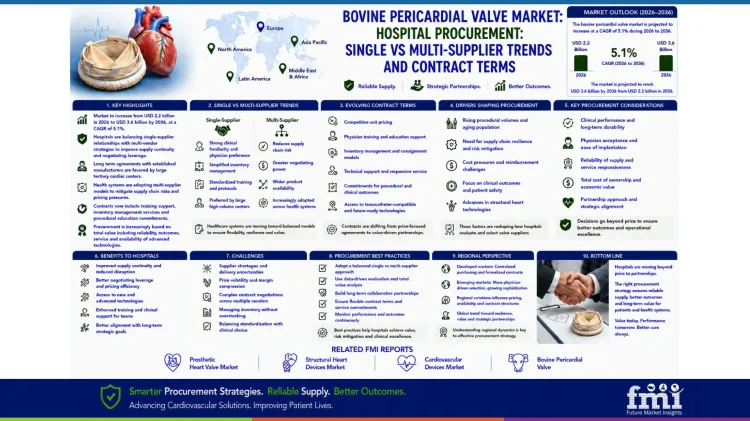
The bovine pericardial valve market continues to evolve amid rising procedural volumes, increasing cost pressures, and an increased focus on supply chain resilience for healthcare providers. The market size is expected to reach USD 3.6 billion by 2036 from USD 2.2 billion in 2026. Hospitals and cardiac centers are becoming increasingly sophisticated in their buying decisions. The market is expected to be driven by the increasing demand for bioprosthetic solutions with aging populations and higher access to valve replacement procedures, which is expected to increase at a 5.1% CAGR.
Traditionally, hospitals had single supplier agreements for bovine pericardial valves. The links provided benefits such as faster training of physicians, easier inventory management and standardization of clinical protocols. Cardiothoracic surgeons tended to develop familiarity with certain valve platforms and hence loyalty to established suppliers.
Purchasing from a single supplier is still common, especially in large-volume academic and specialized cardiovascular centers. For these organizations, procedural consistency is often more important than short-term pricing benefits. Standardization may reduce variation in operating room processes and support the joint training of surgical teams.
But procurement priorities are shifting.
The latest supply chain disruptions have underlined the risks of leaning too heavily on a limited number of suppliers. Healthcare systems are increasingly aware that relying on a single manufacturer can make institutions vulnerable to shortages, delivery delays and limited negotiating flexibility.
The consequence has been an increasing use of multi-supplier procurement strategies.
In these models, hospitals work with a number of approved vendors but leave it to physicians to choose, depending on the clinical situation. This method increases the continuity of supply and the negotiating power of the hospital for good commercial terms.
This trend is especially visible among integrated delivery networks and large purchasing organizations managing multiple facilities. Through aggregation of purchasing volumes across institutions, these organizations can achieve pricing efficiencies without sacrificing supply security.
And contract structures are evolving simultaneously.
Price is still a consideration, but procurement teams are increasingly looking at wider aspects of value. The selection of the prosthetic valves is increasingly based on clinical evidence of durability, ease of implantation, postoperative results and compatibility with future interventions.
Training support has also become an important differentiator.
Manufacturers can develop long-term relationships with healthcare providers through surgeon education programs, technical support for initial cases, and continuing professional development initiatives. These value added services are often built into the procurement conversations.
Inventory management capabilities also affect contract negotiations.
Hospitals need to have procurement agreements that reduce excess inventory but also ensure that there is immediate product availability for both scheduled and emergency procedures. Competitive advantages may be enjoyed by vendors that are flexible with stocking arrangements and have responsive replenishment models.
The complexity is compounded by the evolution of technology.
As structural heart interventions continue to advance, providers are increasingly looking at future treatment pathways when evaluating valve technologies. Products designed to allow for potential valve-in-valve procedures may be better aligned with long-term goals of patient management.
So the line between acquisition and partnership is getting blurry.
Manufacturers are increasingly asked to be strategic partners in support of clinical excellence, operational efficiency and supply continuity. Procurement decision making is not just about the transaction. It is about the whole fit of the organization.
There is still a clear regional variation.
In well-developed health systems, the procurement systems tend to be more formalized within centralized purchasing structures. Meanwhile, emerging markets may continue to rely more heavily on physician-driven selection processes, although institutional procurement sophistication is steadily rising.
The trap to avoid is the one that says procurement decisions are made on the basis of price alone.
In practice, hospitals consider many dimensions simultaneously: clinical outcomes, physician acceptance, quality of service, reliability of logistics and compatibility with future technologies. The best procurement model is often a function of institutional priorities, procedural nuances and resources available.
Bottom Line
The bovine pericardial valve market is gradually moving towards stronger and value-based procurement models. While single-supplier relationships continue to provide operational benefits, multi-supplier strategies are emerging as a way to improve flexibility, increase supply security, and maximize long-term value across cardiovascular care programs.

