


- The brain fitness market is projected to reach USD 3.40 billion in 2026 and witness a CAGR of 9.8% during 2026-2036 to reach USD 12.58 billion by 2036 backed by growing demand for cognitive health solutions in clinical and wellness settings.
- The growing importance of formal procurement structures for brain fitness solutions in hospital settings, weighing the advantages of a diversified supplier base versus the efficiencies of working with a limited number of providers.
- Big healthcare organizations still prefer to use multiple suppliers when they buy things, so they can stay flexible about the software platforms, biofeedback technologies and cognitive training applications they use.
- Integrated healthcare systems are increasingly adopting single-supplier agreements where interoperability, centralized support and simple contract management have become strategic priorities.
- Contract negotiations are expanding beyond simply acquisition costs to include implementation support, staff training, software upgrades, cybersecurity standards, and long-term maintenance provisions.
- As brain fitness programs continue to be integrated into preventive health strategies, procurement decisions will likely be driven by scalability, clinical validation and total cost of ownership.
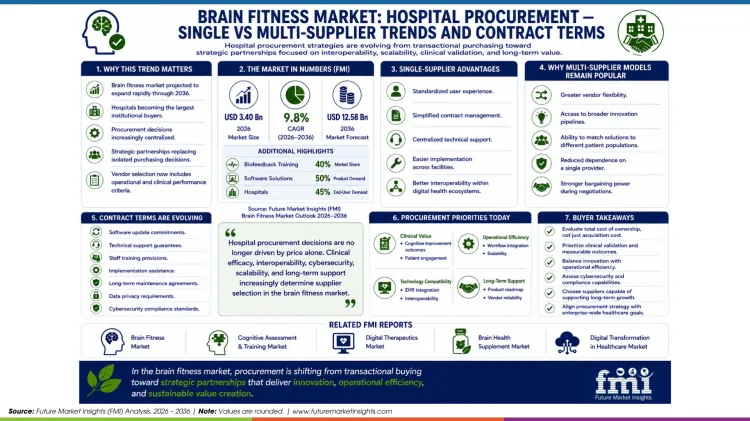
The brain fitness market has been experiencing consistent growth with healthcare providers, wellness companies and hospitals increasingly focusing on the management of cognitive health. The market size is estimated to grow from USD 3.40 billion in 2026 to USD 12.58 billion by 2036, at a CAGR of 9.8% between 2026 and 2036. The growth path is propelled by a rising awareness on the prevention of cognitive decline, increasing acceptance of non-pharmacological interventions and increasing investments on digital health technologies.
With adoption increasing, hospital purchasing behavior is becoming a key determinant in who wins and loses with suppliers.
Procurement decisions in this segment used to be decentralized, with individual departments choosing their own cognitive assessment tools or training platforms in isolation. However, as brain fitness programs transition from niche offerings to structured components of patient engagement and preventive care initiatives, purchasing decisions are becoming more formalized.
One of the big issues is should organizations be looking for partnerships with one supplier or should they be dealing with multiple suppliers?
There are a number of operational advantages of single supplier procurement models. Healthcare systems that partner with a single provider often benefit from more streamlined implementations, standardized user experiences and simplified contract administration. Centralized vendor management can also provide more standardized technical support and training of personnel across multiple facilities.
These advantages are especially relevant in the context of growing adoption of brain fitness solutions by hospitals as part of a wider digital health ecosystem.
Dependence on one supplier can also restrict flexibility in product availability and bargaining power. As technology rapidly progresses and disrupts the landscape of cognitive health, healthcare organizations are incentivized to preserve access to a broad portfolio of innovation pipelines.
That is why many large institutions continue to pursue multi-supplier procurement strategies.
Multi-supplier arrangements Hospitals may opt to deploy different brain fitness solutions for different patient populations or therapeutic goals. Software-based cognitive training platforms are useful in preventive wellness applications and biofeedback systems in neurorehabilitation efforts.
This allows vendors to optimize the clinical fit and move away from single vendor reliance.
Contract structures are evolving, too.
Increasingly, procurement departments are evaluating agreements on long-term value creation rather than just on upfront acquisition cost. Contract negotiations increasingly include software update schedules, availability of technical support, implementation assistance and data privacy provisions.
Since many brain fitness offerings are digital, the importance of cybersecurity is becoming more and more important.
Healthcare organizations want to be confident that their patient data will be secure, their systems will be compliant with regulations, and their systems will be resilient. Good information governance practices can help suppliers improve their procurement evaluation standing.
The growing importance of tangible results also affects the buying behavior.
Hospitals want suppliers to prove their clinical efficacy as well as engagement with users. Improved adherence, patient satisfaction or measures of cognitive performance may enhance value propositions and support procurement approvals.
Segmentation trends provide more insight into the changing priorities of buyers.
The biofeedback brain fitness training is projected to account for 40% of the market share in 2026 which indicates the ongoing interest in interactive cognitive interventions. Software solutions are projected to comprise 50% of the product demand indicating increasing digitization of brain fitness programs.
From the end-user view, hospitals are projected to contribute 45% of the market demand by 2026, highlighting their central role in shaping procurement standards and vendor expectations.
As you go geographically, procurement becomes more complicated. Multi-site healthcare providers are increasingly looking for scalable procurement arrangements that can support standardized deployment, but also local regulatory requirements.
Suppliers with flexible contracting models may therefore be better suited to meet the variety of institutional needs.
The misconception to avoid is that procurement decisions are made on price alone.
Hospitals actually consider brain fitness solutions from multiple perspectives - clinical value, operational efficiency, technology compatibility and long-term support.
With the maturing of the market, procurement sophistication is expected to increase accordingly.
Bottom line: Shifts in hospital procurement practices are changing the competitive landscape of the brain fitness market. Organizations are moving from transactional buying to strategic partnerships that bring innovation, operational efficiency and sustainable value creation.

