

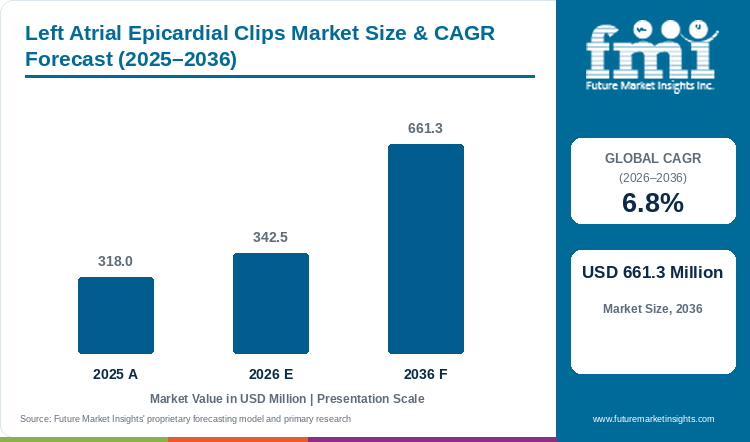
- Market Size (2026)
- USD 342.5 Mn
- Forecast (2036)
- USD 661.3 Mn
- CAGR (2026 to 2036)
- 6.8%
How big is Left Atrial Epicardial Clips Market in 2026?
Assessed at USD 318.0 million in 2025 and progressing to USD 342.5 million in 2026, the left atrial epicardial clips market valuation is on course to reach USD 661.3 million by 2036, supported by a forecast-period CAGR of 6.8%.
Routine closure of the heart's left atrial pouch during scheduled open-heart operations is driving steady device adoption across hospital cardiac surgery departments. Updated heart surgery guidelines now recommend external clip placement whenever patients with irregular heart rhythms undergo bypass or valve repair, supported by an August 2025 multicenter United States V-CLIP study of 155 patients in the Journal of Clinical Medicine that verified 97.0% complete pouch closure at 12 months with 100.0% 30-day safety [1]. Surgeons choose nitinol braided-polyester clips for 72.4% of 2026 clip construction demand because the soft fabric sleeve seals fragile heart muscle without causing surface bleeding. Starting from USD 318.0 million in 2025, the global left atrial epicardial clips market is forecast to reach USD 342.5 million in 2026 and climb to USD 661.3 million by 2036, progressing at a 6.8% CAGR to generate USD 318.8 million in net market expansion. Demand for external heart clips is growing more than twice as fast as coronary artery bypass grafts at a 2.9% CAGR as surgeons also place clips during keyhole rhythm operations and AtriCure completes enrollment of 6,500 preventive patients in its LeAAPS stroke trial. Even so, fixed hospital procedure payments for open-heart surgery force administrators to absorb clip costs out of existing operating room budgets, which slows uptake in cost-sensitive community hospitals.
Key Market Trends & Insights
- By clip construction: Nitinol braided-polyester clips secure 72.4% of 2026 demand because fabric-covered spring beams cushion the heart wall and prevent blood vessel rubbing.
- By surgical access: Concomitant open sternotomy makes up 56.8% in 2026 as heart surgeons attach the clip during scheduled bypass and valve operations.
- By applier shaft: Articulating malleable appliers claim 64.2% in 2026 since bendable shafts fit cleanly through narrow rib-space and keyhole ports.
- By clinical benefit: Dual mechanical-electrical isolation accounts for 68.5% in 2026 by blocking blood clots while shutting down stray electrical signals from the pouch.
- By verification modality: Transesophageal echocardiography guidance holds 61.4% in 2026 through immediate operating-table ultrasound checks confirming residual pouches stay under 10 millimeters.
Regional Highlights
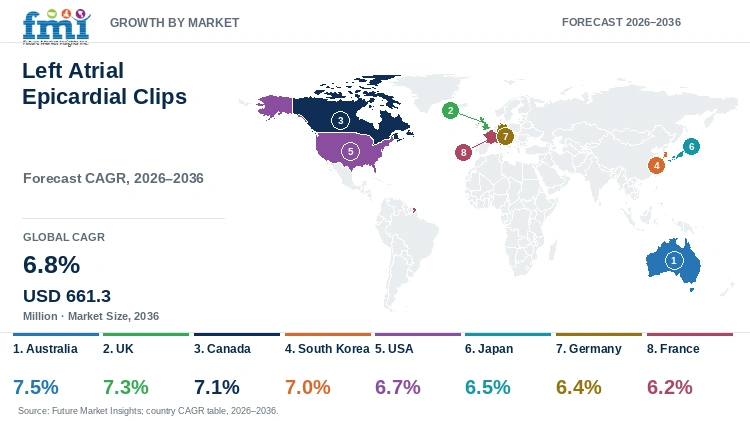
- Top national expansion: Australia paces major heart-surgery markets at a 7.5% CAGR through 2036 under high-volume combined mitral valve repair and clip placement programs.
- Broader country progression: The UK grows at a 7.3% CAGR ahead of Canada at 7.1% and South Korea at 7.0%, whereas France records a 6.2% CAGR.
Market Size & Forecast
Table 1: Market Size and Forecast for the Left Atrial Epicardial Clips Market (USD million and CAGR percentage), 2025 to 2036
| Metric | Value |
|---|---|
| 2025 Market Size | USD 318.0 million |
| Estimated Market Size in 2026 | USD 342.5 million |
| Projected Market Size by 2036 | USD 661.3 million |
| CAGR, 2026 to 2036 | 6.8% |
| Added Market Value, 2026 to 2036 | USD 318.8 million |
Hospital heart surgery teams and blood-thinner clinics deal with high post-operative bleeding rates when older atrial fibrillation patients stay on lifelong blood thinners after open-heart surgery. Hand-sewn stitches and surgical staples often pull apart over time and leave small gaps or leftover pouches wider than 10 millimeters where blood clots can form. In May 2026, heart outcomes researchers at the University of Pennsylvania published a matched Medicare study of 10,407 surgical pouch-closure patients in The Annals of Thoracic Surgery confirming that stopping blood thinners early cut five-year major bleeding from 17.8% to 13.4% without raising stroke or death rates [2]. Heart surgery directors across the atrial appendage occluder sector are therefore specifying external mechanical clips that keep the pouch sealed from the outside.
Patient-Pool and Procedure-Requirement Sizing
Table 2: Patient-Pool and Procedure-Requirement Sizing for the Left Atrial Epicardial Clips Market (USD million and operational ranges), 2025 to 2036
| Metric | 2025 | 2026 | 2036 |
|---|---|---|---|
| Market size (USD million) | 318.0 | 342.5 | 661.3 |
| Cardiac surgery AFib & high-risk pool (thousand) | 460.0 to 510.0 | 485.0 to 535.0 | 780.0 to 860.0 |
| Epicardial clip procedures per year (thousand) | 215.0 to 235.0 | 230.0 to 252.0 | 415.0 to 455.0 |
| Average clip & applier price per procedure (USD) | 1,350.0 to 1,480.0 | 1,360.0 to 1,490.0 | 1,450.0 to 1,590.0 |
Operational note: Surgical volume benchmarks cross-reference global open and keyhole heart operations against documented atrial fibrillation rates and clip attachment percentages.
Complete external closure of the left atrial pouch without leaving bare metal inside the bloodstream remains a top buying requirement for hospital heart committees. Hospital purchasing boards coordinate clip contracts with appendage management device agreements so patients can avoid post-surgery blood-thinner drug regimens.
Per Capita & Healthcare Facility Sizing
Table 3: Per Capita and Facility Spending Indicators for the Left Atrial Epicardial Clips Market (USD), 2025 to 2036
| Metric | 2025 | 2026 | 2036 |
|---|---|---|---|
| Global population (million) | 8,200.0 | 8,300.0 | 9,000.0 |
| Spend per 1,000 people (USD) | 38.8 | 41.3 | 73.5 |
| Annual spend per cardiac surgery center (USD) | 72,000.0 to 82,000.0 | 76,500.0 to 87,500.0 | 138,000.0 to 156,000.0 |
| Concomitant sternotomy contract share (%) | 55.0% to 58.0% | 56.0% to 58.0% | 50.0% to 54.0% |
Table 4: Facility & Institutional Cardiac Surgery Spending Indicators for the Left Atrial Epicardial Clips Market (USD and percentages), 2026
| Metric | Value | Institutional Reference Basis |
|---|---|---|
| Market size, 2026 | USD 342.5 million | 2026 global market valuation baseline |
| Cardiac surgery centers globally | 4,200 | Global open-heart and thoracoscopic surgical registry |
| Market spend per facility | USD 81,547.6 | Annualized epicardial clip applier expenditure |
| Concomitant open sternotomy allocation, 2026 | USD 194.5 million | 56.8% surgical-access segment allocation |
Reliable stroke prevention during valve and bypass operations depends on fast 60-second clip placement before taking the patient off the heart-lung machine. Surgical teams pack preloaded clip appliers with surgical heart valves and bypass instrument trays to meet Class I stroke-prevention guidelines.
Analyst Perspective
"Heart surgeons have moved away from hand-sewing the left atrial pouch because reopened stitch gaps undo the stroke-protection goal of the operation. Clip makers that pair slim bendable shafts with fabric-cushioned or curved beams will win both open-chest bypass rooms and keyhole rhythm suites."
- Anurag Sharma, Principal Consultant, Future Market Insights.
How is the left atrial epicardial clips market segmented?
The left atrial epicardial clips market is segmented by clip construction, surgical access, applier shaft, clinical benefit, and verification modality. In 2026, nitinol braided-polyester clips are projected at 72.4%, concomitant open sternotomy at 56.8%, articulating malleable appliers at 64.2%, dual mechanical-electrical isolation at 68.5%, and transesophageal echocardiography guidance at 61.4%.
By clip construction: Nitinol braided-polyester clips, hinged titanium-PEEK clips, articulated polymer-beam clips, and elastomeric compression clips.
By surgical access: Concomitant open sternotomy, thoracoscopic standalone access, and robotic minithoracotomy access.
By applier shaft: Articulating malleable appliers, standard rigid-shaft appliers, and steerable endoscopic appliers.
By clinical benefit: Dual mechanical-electrical isolation, anticoagulation-intolerant prophylaxis, prophylactic sinus-rhythm closure, and hybrid convergent rhythm control.
By verification modality: Transesophageal echocardiography guidance, epicardial conduction mapping, computed tomography angiography, intracardiac echocardiography confirmation, and direct thoracoscopic inspection.
Why do Nitinol Braided-Polyester Clips lead the clip construction category?
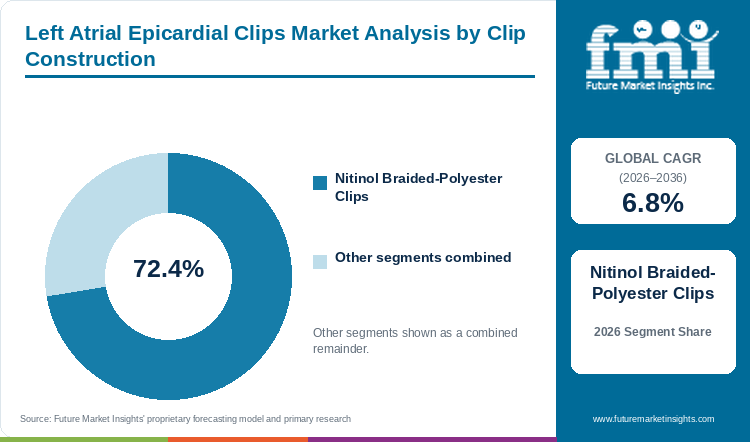
Nitinol braided-polyester clips are projected to capture 72.4% of clip construction demand in 2026, supported by gentle tissue cushioning and natural tissue healing.
Table 5: Clip Construction Share for the Left Atrial Epicardial Clips Market (percentage share), 2026
| Clip Construction | Share (2026) |
|---|---|
| Nitinol Braided-Polyester Clips | 72.4% |
| Other Segments Combined | 27.6%* |
| Total | 100.0% |
*Note: Remaining clip construction categories sum to 100.0% of 2026 epicardial clip volume.
Table 6: Clip Construction Leadership and Market Growth for the Left Atrial Epicardial Clips Market (segment and CAGR percentage), 2026 to 2036
| Metric | Value |
|---|---|
| Global CAGR (2026 to 2036) | 6.8% |
| Leading Segment | Nitinol Braided-Polyester Clips |
Parallel dual-tube nitinol springs wrapped in a braided polyester sleeve lead hospital purchasing because the soft fabric cover cushions the fragile neck of the left atrial pouch and encourages natural tissue healing over the clip. Uncovered rigid metal clips can press against nearby heart arteries, whereas polyester-wrapped nitinol beams adjust evenly across thick or thin pouch walls within the surgical clips category.
- Nitinol braided-polyester clips capture an estimated 72.4% of clip construction market value in 2026 by combining steady spring pressure with gentle outer-heart tissue healing.
- A March 2025 surgical report from Houston Methodist DeBakey Heart & Vascular Center published in the Methodist DeBakey Cardiovascular Journal documented heart-wall bleeding after an uncovered rigid clip rubbed against the heart groove during coronary bypass surgery, reinforcing surgeon preference for fabric-sleeved nitinol clips [3].
Why does Concomitant Open Sternotomy define the largest surgical access segment?
Concomitant open sternotomy is estimated to secure 56.8% of the surgical access category in 2026, driven by Class I guidelines during CABG and valve surgery.
Scheduled open-chest heart surgery for coronary artery bypass and heart valve replacement gives the surgeon direct visual and hand access to the left atrial pouch. Because the chest is already open and the heart is supported on a heart-lung machine, sliding an external clip onto the pouch adds less than two minutes to surgery time while complementing cardiopulmonary bypass systems in hospital heart centers.
- Concomitant open sternotomy secures 56.8% of the surgical access segment in 2026 as AHA/ACC and ESC cardiology societies assign Class I priority to closing the pouch during open-heart operations.
- A January 2026 multicenter registry study (TT-LAAOS) of 567 atrial fibrillation patients across six hospitals in Japan published in Circulation Reports showed a 99.8% clip placement success rate and 99.5% freedom from stroke across 875.8 patient-years as surgical programs standardized external closure [4].
What keeps Articulating Malleable Appliers ahead by applier shaft?
Articulating malleable appliers are expected to command 64.2% of applier shaft volume in 2026, driven by multi-angle placement through open-chest and keyhole incisions.
Single-use appliers with bendable shafts and pivoting tips let the surgeon shape the metal shaft by hand and angle the clip jaws through 12-millimeter keyhole ports or small side-chest openings. Open-ended V-shaped jaws slide smoothly around the base of the pouch without pulling on fragile heart tissue during atrial fibrillation device procedures.
- Articulating malleable appliers generate 64.2% of applier shaft market value in 2026 because multi-angle tip movement works in both open-chest operations and small keyhole incisions.
- A July 2026 clinical study in Medicina evaluated 40 atrial fibrillation patients undergoing minimally invasive mitral valve repair through a small right-chest incision using an articulating clip applier (90% 35 mm clips) and reported 100% placement success with zero hospital deaths [5].
Why does Dual Mechanical-Electrical Isolation lead the clinical benefit category?
Dual mechanical-electrical isolation is forecast to generate 68.5% of clinical benefit market value in 2026, owing to combined stroke prevention and rhythm trigger silencing.
Internal catheter plugs block blood clots from leaving the pouch while leaving live heart muscle firing stray electrical signals, whereas external clips squeeze the base shut and permanently silence the pouch tissue. Complete silencing of these unwanted electrical signals from the left atrial pouch directly improves normal heart rhythm recovery during combined rhythm procedures within the electrophysiology sector.
- Dual mechanical-electrical isolation accounts for 68.5% of clinical benefit demand in 2026 as heart-rhythm surgical teams target both stroke prevention and rhythm control in one step.
- The multicenter DEEP clinical trial of 90 patients with persistent atrial fibrillation published in Circulation: Arrhythmia and Electrophysiology in September 2025 confirmed that combining outer-heart ablation with external left atrial clip closure safely restored lasting normal rhythm [6].
What gives Transesophageal Echocardiography Guidance the leading position in verification modality?
Transesophageal echocardiography guidance is anticipated to account for 61.4% of verification modality demand in 2026, reinforced by operating-table confirmation of zero residual leak.
Operating-room ultrasound probes placed in the esophagus (TEE) govern immediate surgical sign-off because live ultrasound images confirm that zero blood is leaking into the pouch and verify that any remaining stump is under 10 millimeters before the surgeon releases the clip or closes the chest.
- Transesophageal echocardiography guidance commands 61.4% of verification modality demand in 2026 because immediate on-table ultrasound lets the surgeon adjust clip position before finishing surgery.
- An October 2025 clinical review in Future Cardiology confirmed that standardized external clipping reaches over 93% complete closure rates when paired with operating-room ultrasound checks and follow-up CT scans [7].
What are the drivers, restraints, and opportunities in the left atrial epicardial clips market?
In the left atrial epicardial clips market, Class I surgical guidelines and preventive non-AFib trials are projected to expand clip attachment whereas bundled hospital procedure payments limit standalone margin growth and hybrid keyhole ablation creates slim applier opportunities.
- Driver: Class I heart-surgery guidelines and clinical trials testing preventive clipping in patients without prior arrhythmia speed up hospital applier orders.
- Restraint: Bundled hospital surgery payments and delicate arteries sitting right next to the pouch limit standalone clip price increases.
- Opportunity: Keyhole hybrid rhythm procedures and small-incision valve repairs create fast-growing demand for slim articulating clip appliers.
Growth Analysis and Future Potential: Qualitative Demand Catalysts
Hospital cardiac surgery departments are expanding external clip use beyond diagnosed atrial fibrillation into older high-risk patients in normal heart rhythm who are scheduled for routine bypass or valve surgery. New irregular heart rhythms appear in up to one-third of patients right after open-heart surgery, creating a dangerous window for post-surgical strokes. Preventive pouch closure is therefore becoming a standard part of ablation devices and surgical stroke-prevention protocols across heart hospitals. Clinical investigators published the design of the international randomized LeAAPS trial in the American Heart Journal in June 2025, enrolling 6,500 heart-surgery patients without prior atrial fibrillation across 250 hospitals to measure stroke reduction from preventive AtriClip placement [8]. Positive trial readouts and broader guideline coverage will expand the eligible open-heart patient pool through 2036.
Risk Assessment of the Left Atrial Epicardial Clips Market: Operational and Formulation Friction
Incomplete clip seating that leaves a gap or a pouch stump deeper than 10 millimeters and accidental pinching of the nearby circumflex heart artery remain the main clinical risks in external clipping. When a stiff or multi-lobed pouch base keeps the clip jaws from closing flat, blood continues flowing into the pocket and forces doctors to place a second catheter plug from inside the heart. In June 2026, cardiologists reported in JACC: Case Reports on an 81-year-old atrial fibrillation patient with repeated falls and a central leak after prior surgical AtriClip placement who needed a catheter septal plug to stop blood-thinner medication [9]. Hospital purchasing committees also compare single-use clip applier prices against powered surgical staplers when fixed inpatient bypass payments do not include a separate device reimbursement add-on.
Commercial Opportunity Analysis: Formulation Differentiation and Value-Add Formats
Heart surgery device makers win higher-margin procedure volume by building slim, repositionable V-clip appliers designed for keyhole hybrid ablation and robotic chest surgery. Thousands of patients with long-standing atrial fibrillation or stomach-bleeding risks fail standard catheter ablation or cannot safely take blood thinners after an internal plug implant. Joint deployment of outer-heart wall ablation and keyhole clip closure in the rhythm-surgery suite removes the need for both internal metal plugs and post-procedure blood thinners. In April 2026, heart surgeons at University of Copenhagen Rigshospitalet reported in the Journal of Clinical Medicine that external pouch clipping during hybrid rhythm ablation achieved 96.4% closure success and 0.0% 12-month stroke rates with 75.0% freedom from atrial fibrillation [10]. Suppliers that deliver 12-millimeter port-ready articulating appliers win multi-year hospital heart-team contracts.
Left Atrial Epicardial Clips Market by Country (2026 to 2036)
Future Market Insights projects that Australia will pace left atrial epicardial clip growth across major healthcare systems at a 7.5% CAGR through 2036, while France advances at a 6.2% CAGR. Hospital purchasing across Asia-Pacific and European heart centers as well as North American surgical networks tracks Class I guideline compliance and keyhole valve and hybrid rhythm surgery volumes.
Table 7: Country CAGR and Primary Growth Levers for the Left Atrial Epicardial Clips Market (CAGR percentage and operational drivers), 2026 to 2036
| Country | CAGR (2026 to 2036) | Primary Growth Lever |
|---|---|---|
| Australia | 7.5% | High-volume combined mitral valve repair and private Prostheses List clip reimbursement |
| UK | 7.3% | NHS regional heart-center hybrid ablation expansion and normal-rhythm survival proof |
| Canada | 7.1% | LAAOS III and LAAOS IV university clinical trial leadership standardizing surgical pouch closure |
| South Korea | 7.0% | High combined mitral-valve and surgical Maze procedure share across university hospitals |
| USA | 6.7% | Class I AHA/ACC surgical guidelines, LeAAPS non-AFib trial rollout, and keyhole hybrid ablation |
| Japan | 6.5% | Dedicated Chuikyo functional reimbursement and multicenter TT-LAAOS keyhole closure registry |
| Germany | 6.4% | Specialized heart-center volume in right-chest valve repair and keyhole rhythm clamping |
| France | 6.2% | Zero bloodstream metal contact avoiding surface blood clots seen on 3-month internal plug CT scans |
Source: Future Market Insights analysis
Australia Left Atrial Epicardial Clips Market Outlook (2026 to 2036)
Public and private heart surgery hospitals in Australia focus on combining valve repair and external pouch clipping in a single operation to shorten hospital stays and avoid repeat admissions. A July 2026 multi-year cohort study of 247 appendage closure patients over 1,155 patient-years published in the Journal of Cardiovascular Electrophysiology confirmed a 99.2% closure success rate and a 67% drop in strokes compared with baseline risk scores [11]. Market value in Australia is projected to expand at a leading 7.5% CAGR through 2036 across Sydney and Melbourne heart centers. Although national Prostheses List fee reviews check single-use applier prices, strong private health insurance reimbursement for combined mitral and aortic valve clipping supports rapid adoption.
Key takeaway: Australia combines high-volume mitral valve repair with private Prostheses List reimbursement to generate the fastest national clip expansion.
UK Left Atrial Epicardial Clips Market Outlook (2026 to 2036)
Regional National Health Service heart hospitals across the UK are expanding combined surgical-and-catheter rhythm programs and adopting preventive clipping in normal-rhythm surgery patients, driving a projected 7.3% CAGR from 2026 to 2036. In March 2025, heart surgeons at Imperial College London and Liverpool Heart and Chest Hospital published a meta-analysis of six studies covering 2,742 normal-rhythm heart surgery patients in Heart Rhythm confirming that surgical pouch closure improved stroke-free survival without raising post-operative arrhythmia rates [12]. Tight NHS hospital budgets still limit standalone keyhole clipping to patients who cannot take blood thinners, keeping most volume in scheduled open-heart surgery.
Key takeaway: Verified stroke-free survival gains across regional NHS heart centers speed up open-heart clip attachment in the UK.
Canada Left Atrial Epicardial Clips Market Outlook (2026 to 2036)
University heart surgery networks in Canada lead global clinical trials for surgical pouch closure through the McMaster University and Population Health Research Institute LAAOS III and LAAOS IV trial programs. In January 2026, LAAOS III researchers published a follow-up study in JAMA Neurology showing that surgical pouch closure during heart surgery cut total stroke and clot events by 33% and reduced disabling cortical strokes without adding surgical risk [13]. In response, the Canada left atrial epicardial clips market is estimated to grow at a 7.1% CAGR through 2036. Provincial hospital budgets cap disposable device spend per operation, prompting suppliers to bundle external clips into multi-year provincial heart-surgery supply contracts.
Key takeaway: Domestic LAAOS III clinical leadership across provincial heart institutes makes routine pouch closure standard practice in Canada.
South Korea Left Atrial Epicardial Clips Market Outlook (2026 to 2036)
High volumes of combined mitral valve and surgical Maze rhythm operations in patients with chronic atrial fibrillation set heart surgery departments in South Korea apart. In August 2026, heart surgeons at Seoul National University Hospital reported in Interdisciplinary CardioVascular and Thoracic Surgery on their surgical left atrial Maze and pouch management workflow, showing how organized team steps keep heart-lung machine time short during complex rhythm surgery [14]. Commercial demand in South Korea is forecast to rise at a 7.0% CAGR through 2036 across major university hospitals in Seoul and Busan. Because national health insurance rules review imported single-use appliers closely, surgeons favor articulating clips that save operating time during combined valve and Maze procedures.
Key takeaway: High combined mitral-valve and Maze surgery volumes at university hospitals sustain articulating clip demand across South Korea.
USA Left Atrial Epicardial Clips Market Outlook (2026 to 2036)
Broad Class I AHA/ACC guideline compliance across more than 1,100 heart surgery programs and fast growth in keyhole hybrid rhythm procedures make the USA the largest national market for left atrial epicardial clips. In August 2026, investigators from the multicenter randomized LAA-CLOSURE trial of 904 tissue aortic valve replacement patients without prior atrial fibrillation published in the Journal of the American Heart Association confirmed that preventive surgical pouch closure was safe and did not increase surgical bleeding [15]. Although bundled Medicare hospital payments for bypass and valve surgery require hospitals to cover applier costs out of the procedure fee, 30-day stroke readmission penalties and well-reimbursed hybrid rhythm procedures keep clip use rising. The USA market is slated to register a 6.7% CAGR from 2026 to 2036.
Key takeaway: Class I AHA/ACC surgical guidelines and growing hybrid rhythm programs support the largest global clip installation base in the USA.
Japan Left Atrial Epicardial Clips Market Outlook (2026 to 2036)
Wide use of standalone and combined keyhole thoracoscopic pouch closure in older patients who face high brain-bleed risks from blood thinners drives the Japan market at a projected 6.5% CAGR between 2026 and 2036. A June 2026 matched study of 25,059 adults undergoing valve or bypass surgery from the national hospital database in Japan published in Circulation Journal tracked real-world safety outcomes of concomitant surgical pouch closure across domestic heart centers [16]. National Chuikyo device reimbursement provides dedicated functional pricing for external heart clips, though strict surgeon training rules keep rural hospital rollout gradual.
Key takeaway: Dedicated Chuikyo device reimbursement and multicenter keyhole surgery registries support steady clip adoption in Japan.
Germany Left Atrial Epicardial Clips Market Outlook (2026 to 2036)
High-volume minimally invasive right-chest valve repair and keyhole rhythm clamping define surgical practice across specialized heart centers in Germany. In June 2025, heart surgeons at Charite - Universitatsmedizin Berlin and domestic CASE-AF registry centers reported in The Thoracic and Cardiovascular Surgeon on 42 patients undergoing keyhole radiofrequency clamping paired with external clip pouch closure, achieving zero major complications and 92.9% normal heart rhythm at discharge [17]. Market value in Germany is anticipated to expand at a 6.4% CAGR through 2036. Because hospital DRG payment rules in Germany cap supply budgets for routine open-chest operations, purchasing managers favor versatile articulating clips that fit both open valve replacements and keyhole rhythm procedures.
Key takeaway: Specialized heart-center volume in keyhole rhythm ablation and small-incision valve repair supports clip purchasing in Germany.
France Left Atrial Epicardial Clips Market Outlook (2026 to 2036)
University hospital cardiology and heart surgery teams in France weigh catheter-placed internal plugs against external surgical clipping. In December 2025, heart rhythm and imaging specialists at Dijon University Hospital reported in Catheterization and Cardiovascular Interventions on 102 internal plug patients checked by 3-month CT scans, finding surface thickening in 24% and device blood clots in 2.9% [18]. Demand for external clips in France is projected to grow at a 6.2% CAGR through 2036 as heart surgeons point out that outside clipping leaves zero metal in the bloodstream to trigger surface clots. Strict national health authority reimbursement rules still keep public hospital funding focused on scheduled open-heart operations.
Key takeaway: Zero bloodstream metal contact compared with internal plugs supports surgical clip adoption across public university hospitals in France.
Full report country CAGRs cover: North America; Latin America; Western Europe; Eastern Europe; East Asia; South Asia and Pacific; Middle East and Africa.
Who are the notable companies in the left atrial epicardial clips market?
AtriCure, Inc., Medtronic plc, Peters Surgical (Advanced Medical Solutions Group), Fehling Instruments GmbH & Co. KG, Genesee BioMedical, Inc., Teleflex Incorporated, B. Braun SE, and Edwards Lifesciences Corporation are the notable companies in the left atrial epicardial clips market.
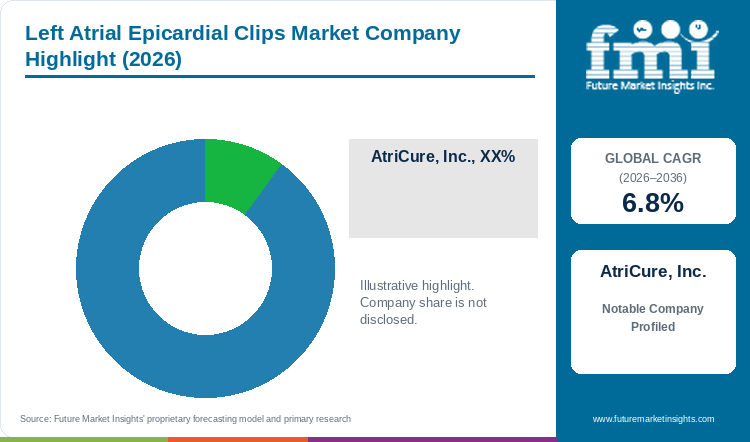
Focused surgical atrial fibrillation and appendage closure specialists compete with large cardiovascular medtech corporations across hospital operating rooms. Market leaders build preloaded single-use open and keyhole clip appliers supported by multi-thousand-patient randomized stroke trials. Rival suppliers differentiate through repositionable curved clip frames and titanium surgical closure systems.
- Dedicated Epicardial Appendage Exclusion Specialists: AtriCure, Inc. and Genesee BioMedical, Inc. supply purpose-built nitinol braided-polyester AtriClip systems and FDA-cleared ATLAAS external closure clips.
- Global Cardiovascular Medtech Platforms: Medtronic plc and Edwards Lifesciences Corporation pair the fabric-free curved Penditure LAA Exclusion System with structural heart valve portfolios across hospital cardiac operating rooms.
- European Cardiothoracic Clip and Instrument Specialists: Peters Surgical (Advanced Medical Solutions Group) and Fehling Instruments GmbH & Co. KG as well as Teleflex Incorporated and B. Braun SE supply titanium clips and surgical closure instruments.
Competitive Benchmarking: Left Atrial Epicardial Clips Market
Table 8: Competitive Benchmarking for the Left Atrial Epicardial Clips Market (qualitative capability ratings), 2026
| Company | Epicardial Clip & Applier Breadth | Clinical Trial & Registry Depth | Cardiothoracic OR / Hybrid Access | Geographic Reach |
|---|---|---|---|---|
| AtriCure, Inc. | High | High | High | High |
| Medtronic plc | High | High | High | High |
| Peters Surgical (AMS Group) | Medium | Medium | High | Medium |
| Fehling Instruments GmbH & Co. KG | Medium | Medium | Medium | Medium |
| Genesee BioMedical, Inc. | High | Medium | Medium | Medium |
| Teleflex Incorporated | Medium | Medium | High | High |
| B. Braun SE | Medium | Medium | High | High |
| Edwards Lifesciences Corporation | Medium | High | High | High |
Scoring basis: Benchmark ratings weight documented external clip and applier shaft variety as well as randomized stroke-trial and registry proof across heart surgery operating rooms.
Key Developments in the Left Atrial Epicardial Clips Market
- AtriCure, Inc. reported full-year 2025 global revenue of USD 534.5 million (up 14.9% year over year) in February 2026, driven by strong hospital orders for its AtriClip FLEX-V and AtriClip PRO-Mini appendage closure systems [19].
- Medtronic plc received European CE Mark approval for its Penditure Left Atrial Appendage Exclusion System in October 2025 while passing 10,000 Penditure clips sold across heart surgery centers [20].
- Genesee BioMedical, Inc. received U.S. FDA 510(k) clearance in May 2026 for its ATLAAS epicardial left atrial appendage occlusion device built for open and minimally invasive heart surgery [21].
Key Players in the Left Atrial Epicardial Clips Market
Dedicated Epicardial Appendage Exclusion Specialists
- AtriCure, Inc.
- Genesee BioMedical, Inc.
- Teleflex Incorporated
Global Cardiovascular Medtech Platforms
- Medtronic plc
- Edwards Lifesciences Corporation
- B. Braun SE
European Cardiothoracic Clip and Instrument Specialists
- Peters Surgical (Advanced Medical Solutions Group)
- Fehling Instruments GmbH & Co. KG
Left Atrial Epicardial Clips Market - Report Scope
Table 9: Report Scope for the Left Atrial Epicardial Clips Market (coverage fields and definitions), 2026 to 2036
| Coverage field | Report scope |
|---|---|
| Market breakdown | Clip Construction; Surgical Access; Applier Shaft; Clinical Benefit; Verification Modality |
| Quantitative Units | USD Million |
| Market Definition | Includes commercial supplier market value from preloaded left atrial epicardial exclusion clips and single-use open, articulating malleable, and thoracoscopic deployment appliers. Category Scope Note: Excludes catheter-placed internal plug occluders, non-clip surgical staplers, and general blood-vessel clips. |
| Regions Covered | North America; Latin America; Western Europe; Eastern Europe; East Asia; South Asia and Pacific; Middle East and Africa |
| Countries Covered | Australia, UK, Canada, South Korea, USA, Japan, Germany, France, and additional countries in the full report |
| Key Companies Covered | AtriCure, Inc., Medtronic plc, Peters Surgical (Advanced Medical Solutions Group), Fehling Instruments GmbH & Co. KG, Genesee BioMedical, Inc., Teleflex Incorporated, B. Braun SE, Edwards Lifesciences Corporation |
| Forecast Period | 2026 to 2036 |
| Approach | Primary and secondary research with top-down and bottom-up market triangulation. |
Left Atrial Epicardial Clips Market - Research Methodology
Table 10: Research Methodology for the Left Atrial Epicardial Clips Market (research methods and approach), 2026 edition
| Method | Approach |
|---|---|
| Primary Research | Structured interviews with heart surgeons, hybrid rhythm electrophysiologists, cardiac operating-room nursing directors, and hospital purchasing committees to verify clip attachment rates and applier pricing. |
| Secondary Research | Analysis of SEC Form 10-K and 10-Q filings, FDA 510(k) and CE Mark records, PubMed and PMC heart surgery registries (V-CLIP, LAAOS III, LeAAPS, TT-LAAOS), and AHA/ACC/ESC guidelines. |
| Market Sizing and Forecasting | Top-down hospital cardiac surgery supply budgets cross-checked against bottom-up bypass, valve replacement, and standalone keyhole AFib procedure counts from 2026 to 2036. |
| Country Forecasting Model | Econometric national projections weight open-heart and small-incision surgical volumes, AFib prevalence in valve patients, hospital DRG and Chuikyo device reimbursement rules, and hybrid rhythm lab adoption across eight healthcare systems. |
| Operational Benchmark Traceability | Patient-pool and facility spending indicators in Tables 2, 3, and 4 trace to V-CLIP post-market imaging cohorts, Medicare surgical closure studies, and TT-LAAOS multicenter registries. |
| Data Triangulation and Validation | Demand estimates are cross-checked against manufacturer appendage-management revenue disclosures and heart-surgery registry procedure counts without double counting internal catheter plugs. |
Left Atrial Epicardial Clips Market by Segments
Left Atrial Epicardial Clips Market segmented by Clip Construction:
- Nitinol Braided-Polyester Clips
- Hinged Titanium-PEEK Clips
- Articulated Polymer-Beam Clips
- Elastomeric Compression Clips
Left Atrial Epicardial Clips Market segmented by Surgical Access:
- Concomitant Open Sternotomy
- Thoracoscopic Standalone Access
- Robotic Minithoracotomy Access
Left Atrial Epicardial Clips Market segmented by Applier Shaft:
- Articulating Malleable Appliers
- Standard Rigid-Shaft Appliers
- Steerable Endoscopic Appliers
Left Atrial Epicardial Clips Market segmented by Clinical Benefit:
- Dual Mechanical-Electrical Isolation
- Anticoagulation-Intolerant Prophylaxis
- Prophylactic Sinus-Rhythm Closure
- Hybrid Convergent Rhythm Control
Left Atrial Epicardial Clips Market segmented by Verification Modality:
- Transesophageal Echocardiography Guidance
- Epicardial Conduction Mapping
- Computed Tomography Angiography
- Intracardiac Echocardiography Confirmation
- Direct Thoracoscopic Inspection
Left Atrial Epicardial Clips Market by Region
- North America
- United States
- Canada
- Latin America
- Brazil
- Mexico
- Argentina
- Chile
- Western Europe
- Germany
- France
- United Kingdom
- Italy
- Spain
- Benelux
- Nordics
- Eastern Europe
- Poland
- Czech Republic
- Romania
- Hungary
- East Asia
- China
- Japan
- South Korea
- South Asia and Pacific
- India
- ASEAN
- Australia and New Zealand
- Middle East and Africa
- GCC Countries
- South Africa
- Türkiye
- Israel
Research Sources and Bibliography
- [1] Zias, E., Phillips, K. G., Gerdisch, M. W., & Ramlawi, B. (2025, August 4). Long-Term Follow-Up of Left Atrial Appendage Exclusion: Results of the V-CLIP Multi-Center Post-Market Study. Journal of Clinical Medicine, 14(15), 5473 (PubMed PMID 40807093).
- [2] Brown, C. R., Han, J. J., & Acker, M. A. (2026, May 11). Early discontinuation of long-term anticoagulation after surgical left atrial appendage occlusion. The Annals of Thoracic Surgery, 121(6), 1412-1420 (PubMed PMID 42119753).
- [3] Ramchandani, M., Al-Jughaiman, M., & Reardon, M. J. (2025, March 7). Left Atrium Compression by Iatrogenic Hematoma Due to Left Atrial Appendage Clipping in Open Coronary Artery Bypass Grafting Surgery. Methodist DeBakey Cardiovascular Journal, 21(1), 16-19 (PubMed PMID 40060970).
- [4] Ohtsuka, T., Ninomiya, M., & Nonaka, T. (2026, January 9). Outcomes of Thoracoscopic Left Atrial Appendage Occlusion With or Without Concomitant Thoracoscopic Ablation - Multicenter Retrospective Registry of 567 Patients in Japan. Circulation Reports, 8(3), 391-399 (PubMed PMID 41808952).
- [5] Miceli, A., Glauber, M., & Solinas, M. (2026, July 22). Left Atrial Appendage Exclusion via Right Minithoracotomy Using an Epicardial Clip Device During Minimally Invasive Mitral Valve Surgery. Medicina, 62(7), 1417 (PubMed PMID 42512960).
- [6] DeLurgio, D. B., Ellenbogen, K. A., & Gillinov, A. M. (2025, September 30). Dual Epicardial and Endocardial Procedure (DEEP) for Persistent or Longstanding Persistent Atrial Fibrillation. Circulation: Arrhythmia and Electrophysiology, 18(10), e013692 (PubMed PMID 41025224).
- [7] Chen, Y., Wang, Z., & Liu, J. (2025, October 17). Challenges and solutions for optimizing outcomes in patients undergoing surgical left atrial appendage closure. Future Cardiology, 21(12), 881-891 (PubMed PMID 41105724).
- [8] Whitlock, R. P., Healey, J. S., & Connolly, S. J. (2025, June 15). The left atrial appendage exclusion for prophylactic stroke reduction (LEAAPS) trial: Rationale and design. American Heart Journal, 284, 94-102 (PubMed PMID 39395566).
- [9] Patel, A. R., Smith, T. W., & Kavinsky, C. J. (2026, June 13). Significant Left Atrial Appendage Leak After LAA Exclusion System Deployment Closed With an Amplatzer Septal Occluder. JACC: Case Reports, 31(11), 103412 (PubMed PMID 42283686).
- [10] Jespersen, C. H., Carranza, C. L., & Petersen, J. K. (2026, April 30). Convergent Hybrid Ablation and Concomitant Left Atrial Appendage Exclusion for Stroke Prevention and Rhythm Control in Persistent Atrial Fibrillation. Journal of Clinical Medicine, 15(9), 3440 (PubMed PMID 42123172).
- [11] Hildick-Smith, D., Saha, M., & Unya, R. (2026, July 8). Long-Term Outcomes of Minimalist Left Atrial Appendage Occlusion Guided by Periprocedural Imaging. Journal of Cardiovascular Electrophysiology, 37(8), 1845-1853 (PubMed PMID 42418822).
- [12] Athanasiou, T., Harky, A., & Casula, R. (2025, March 23). Clinical impact of surgical left atrial appendage occlusion during cardiac surgery in patients in sinus rhythm: A meta-analysis. Heart Rhythm, 22(10), 2595-2602 (PubMed PMID 40132739).
- [13] Srivastava, A., Whitlock, R. P., & Healey, J. S. (2026, January 1). Stroke Mechanism and Severity After Left Atrial Appendage Occlusion: Insights From the LAAOS III Randomized Clinical Trial. JAMA Neurology, 83(1), 76-82 (PubMed PMID 41247709).
- [14] Kim, K. H., Choi, J. W., & Hwang, H. Y. (2026, August 8). Initial experiences of surgical left atrial maze through resected left atrial appendage. Interdisciplinary CardioVascular and Thoracic Surgery, 43(2), ivac210 (PubMed PMID 42570204).
- [15] Kiviniemi, T., Halfwerk, F., & Grau, J. (2026, August 20). Prophylactic Surgical Left Atrial Appendage Closure in Bioprosthetic Aortic Valve Replacement: Short-Term Outcomes of Randomized Controlled LAA-CLOSURE Trial. Journal of the American Heart Association, 15(17), e046654 (PubMed PMID 42622223).
- [16] Yamaguchi, A., Saito, A., & Motomura, N. (2026, June 23). Perioperative Outcomes of Surgical Left Atrial Appendage Occlusion in Patients Undergoing Cardiac Surgery. Circulation Journal, 90(8), 1120-1128 (PubMed PMID 42334945).
- [17] Grubitzsch, H., Treskatsch, S., & Falk, V. (2025, June 27). Totally Thoracoscopic Ablation for Atrial Fibrillation: All-Box Clamping. The Thoracic and Cardiovascular Surgeon, 73(6), 445-452 (PubMed PMID 40461046).
- [18] Guilleminot, P., Richard, C., Roger, A., Daller, M., Laurent, G., Vergely, C., Guenancia, C., & Pommier, T. (2025, December 9). Incidence and Predictors of Hypoattenuated Thickening and Device-Related Thrombus at Three Months Postprocedural CT Assessment Following Left Atrial Appendage Occlusion. Catheterization and Cardiovascular Interventions, 107(2), 312-321 (PubMed PMID 41363692).
- [19] AtriCure, Inc. (2026, February 17). AtriCure Reports Fourth Quarter 2025 and Full Year 2025 Financial Results. AtriCure Investor Relations Official Release.
- [20] Medtronic plc. (2025, October 1). Medtronic receives CE Mark for Penditure Left Atrial Appendage Exclusion System, ushering in a new era of left atrial appendage management in Europe as it surpasses 10,000 Penditure Devices Sold Globally. Medtronic Official Newsroom Release.
- [21] Genesee BioMedical, Inc. (2026, May 27). Genesee BioMedical Receives FDA 510(k) Clearance for ATLAAS Epicardial Left Atrial Appendage Occlusion Device. Genesee BioMedical Official Corporate Release.
- [22] AtriCure, Inc. (2026, July 23). AtriCure Reports Second Quarter 2026 Financial Results. AtriCure Investor Relations Official Release.
- [23] Bailey, M., & Borger, M. A. (2026, April 7). Hybrid mitral repair and coronary artery bypass with Penditure left atrial appendage closure. Multimedia Manual of Cardiothoracic Surgery, 2026, mmcts.2026.007 (PubMed PMID 41944548).
This bibliography is provided for reader reference and is not exhaustive. The full report contains the complete reference list and detailed citations.
This Report Answers
- How large is the left atrial epicardial clips market in 2026 and what is forecast for 2036?
- Which clinical guidelines and surgical workflows support demand for left atrial epicardial clips?
- Why do nitinol braided-polyester clips lead the clip construction category?
- Why does concomitant open sternotomy lead the surgical access category globally?
- How do growth rates differ across Australia, the UK, Canada, and the USA?
- Which leading companies supply epicardial appendage exclusion clips and appliers today?
- What limits adoption or supplier switching in the left atrial epicardial clips market?
- What should buyers evaluate before purchasing a left atrial epicardial clip?
Frequently Asked Questions
How big is the left atrial epicardial clips market in 2026, and what is forecast for 2036?
Global left atrial epicardial clips demand rises from USD 318.0 million in 2025 to an estimated USD 342.5 million in 2026. FMI projects the market will reach USD 661.3 million by 2036 as heart surgeons standardize external pouch closure during open and keyhole heart surgery.
What is the CAGR for the left atrial epicardial clips market from 2026 to 2036?
The market advances at a 6.8% CAGR between 2026 and 2036, adding USD 318.8 million in cumulative opportunity across hospital cardiac operating rooms and hybrid rhythm suites.
Which clip construction segment leads the left atrial epicardial clips market?
Within clip construction, nitinol braided-polyester clips hold a leading 72.4% share in 2026 because parallel nitinol springs wrapped in polyester knit provide even, gentle tissue compression and natural tissue healing.
Which surgical access segment leads the left atrial epicardial clips market?
By surgical access, concomitant open sternotomy accounts for 56.8% of 2026 demand as surgeons place external clips during scheduled coronary artery bypass and valve replacement procedures.
Which country has a notable growth outlook during the assessment period?
Among major surgical markets, Australia paces national expansion at a 7.5% CAGR through 2036 on the strength of high combined mitral valve repair volumes and private Prostheses List reimbursement.
Who are the key players in the market?
AtriCure, Inc., Medtronic plc, Peters Surgical (Advanced Medical Solutions Group), Fehling Instruments GmbH & Co. KG, Genesee BioMedical, Inc., Teleflex Incorporated, B. Braun SE, and Edwards Lifesciences Corporation lead commercial supply.
Preview the report firsthand - request a free sample
Get SampleGet the brochure for pricing and purchase details.
Get PDFTable of Content
- Key Takeaways
- Market Size and CAGR
- Top Growth Driver
- Fastest Growing Segment
- Leading Region
- Key Companies
- Emerging Opportunities
- Executive Summary
- Global Market Outlook
- Demand-side Trends
- Supply-side Trends
- Technology Roadmap Analysis
- Analysis and Recommendations
- Analyst Perspective (What is happening? Why now? What should investors know?)
- Key Questions Answered
- How large is the market?
- What is the CAGR?
- What are key trends?
- Which region dominates?
- Who are the leaders?
- Market Overview
- Market Coverage / Taxonomy
- Market Definition / Scope / Limitations
- Research Methodology
- Chapter Orientation
- Analytical Lens and Working Hypotheses
- Market Structure, Signals, and Trend Drivers
- Benchmarking and Cross-market Comparability
- Market Sizing, Forecasting, and Opportunity Mapping
- Research Design and Evidence Framework
- Desk Research Programme (Secondary Evidence)
- Expert Input and Fieldwork (Primary Evidence)
- Tooling, Models, and Reference Databases
- Data Engineering and Model Build
- Quality Assurance and Audit Trail
- Market Background
- Market Dynamics (Drivers, Restraints, Opportunity, Trends)
- Scenario Forecast (Optimistic, Likely, Conservative)
- Impact Analysis
- AI Impact
- Sustainability Impact
- Regulatory Impact
- Technology Impact
- Consumer / Buyer Analysis
- Purchase Drivers
- Adoption Barriers
- Buyer Journey
- Opportunity Map Analysis
- Product Life Cycle Analysis
- Supply Chain Analysis
- Investment Feasibility Matrix
- Value Chain Analysis
- PESTLE and Porter's Analysis
- Regulatory Landscape
- Regional Parent Market Outlook
- Production and Consumption Statistics
- Import and Export Statistics
- Global Market Analysis and Forecast, 2021 to 2036
- Historical Market Size Value (USD Million) Analysis, 2021 to 2025
- Current and Future Market Size Value (USD Million) Projections, 2026 to 2036
- Y-o-Y Growth Trend Analysis
- Absolute $ Opportunity Analysis
- Global Market Pricing Analysis, 2021 to 2036
- Global Market Analysis and Forecast, By Clip Construction, 2021 to 2036
- Introduction / Key Findings
- Historical Market Size Value (USD Million) Analysis By Clip Construction, 2021 to 2025
- Current and Future Market Size Value (USD Million) Analysis and Forecast By Clip Construction, 2026 to 2036
- Nitinol Braided-Polyester Clips
- Hinged Titanium-PEEK Clips
- Articulated Polymer-Beam Clips
- Elastomeric Compression Clips
- Y-o-Y Growth Trend Analysis By Clip Construction, 2021 to 2025
- Absolute $ Opportunity Analysis By Clip Construction, 2026 to 2036
- Global Market Analysis and Forecast, By Surgical Access, 2021 to 2036
- Introduction / Key Findings
- Historical Market Size Value (USD Million) Analysis By Surgical Access, 2021 to 2025
- Current and Future Market Size Value (USD Million) Analysis and Forecast By Surgical Access, 2026 to 2036
- Concomitant Open Sternotomy
- Thoracoscopic Standalone Access
- Robotic Minithoracotomy Access
- Y-o-Y Growth Trend Analysis By Surgical Access, 2021 to 2025
- Absolute $ Opportunity Analysis By Surgical Access, 2026 to 2036
- Global Market Analysis and Forecast, By Applier Shaft, 2021 to 2036
- Introduction / Key Findings
- Historical Market Size Value (USD Million) Analysis By Applier Shaft, 2021 to 2025
- Current and Future Market Size Value (USD Million) Analysis and Forecast By Applier Shaft, 2026 to 2036
- Articulating Malleable Appliers
- Standard Rigid-Shaft Appliers
- Steerable Endoscopic Appliers
- Y-o-Y Growth Trend Analysis By Applier Shaft, 2021 to 2025
- Absolute $ Opportunity Analysis By Applier Shaft, 2026 to 2036
- Global Market Analysis and Forecast, By Clinical Benefit, 2021 to 2036
- Introduction / Key Findings
- Historical Market Size Value (USD Million) Analysis By Clinical Benefit, 2021 to 2025
- Current and Future Market Size Value (USD Million) Analysis and Forecast By Clinical Benefit, 2026 to 2036
- Dual Mechanical-Electrical Isolation
- Anticoagulation-Intolerant Prophylaxis
- Prophylactic Sinus-Rhythm Closure
- Hybrid Convergent Rhythm Control
- Y-o-Y Growth Trend Analysis By Clinical Benefit, 2021 to 2025
- Absolute $ Opportunity Analysis By Clinical Benefit, 2026 to 2036
- Global Market Analysis and Forecast, By Verification Modality, 2021 to 2036
- Introduction / Key Findings
- Historical Market Size Value (USD Million) Analysis By Verification Modality, 2021 to 2025
- Current and Future Market Size Value (USD Million) Analysis and Forecast By Verification Modality, 2026 to 2036
- Transesophageal Echocardiography Guidance
- Epicardial Conduction Mapping
- Computed Tomography Angiography
- Intracardiac Echocardiography Confirmation
- Direct Thoracoscopic Inspection
- Y-o-Y Growth Trend Analysis By Verification Modality, 2021 to 2025
- Absolute $ Opportunity Analysis By Verification Modality, 2026 to 2036
- Global Market Analysis and Forecast, By Region, 2021 to 2036
- Introduction
- Historical Market Size Value (USD Million) Analysis By Region, 2021 to 2025
- Current Market Size Value (USD Million) Analysis and Forecast By Region, 2026 to 2036
- North America
- Latin America
- Western Europe
- Eastern Europe
- East Asia
- South Asia and Pacific
- Middle East and Africa
- Market Attractiveness Analysis By Region
- North America Market Analysis and Forecast, By Country, 2021 to 2036
- Historical Market Size Value (USD Million) Trend Analysis By Market Taxonomy, 2021 to 2025
- Market Size Value (USD Million) Forecast By Market Taxonomy, 2026 to 2036
- By Country
- United States
- Canada
- By Clip Construction
- By Surgical Access
- By Applier Shaft
- By Clinical Benefit
- By Verification Modality
- By Country
- Market Attractiveness Analysis
- By Country
- By Clip Construction
- By Surgical Access
- By Applier Shaft
- By Clinical Benefit
- By Verification Modality
- Key Takeaways
- Latin America Market Analysis and Forecast, By Country
- Historical Market Size Value (USD Million) Trend Analysis By Market Taxonomy, 2021 to 2025
- Market Size Value (USD Million) Forecast By Market Taxonomy, 2026 to 2036
- By Country
- Brazil
- Mexico
- Argentina
- Chile
- By Clip Construction
- By Surgical Access
- By Applier Shaft
- By Clinical Benefit
- By Verification Modality
- By Country
- Market Attractiveness Analysis
- By Country
- By Clip Construction
- By Surgical Access
- By Applier Shaft
- By Clinical Benefit
- By Verification Modality
- Key Takeaways
- Western Europe Market Analysis and Forecast, By Country
- Historical Market Size Value (USD Million) Trend Analysis By Market Taxonomy, 2021 to 2025
- Market Size Value (USD Million) Forecast By Market Taxonomy, 2026 to 2036
- By Country
- Germany
- France
- United Kingdom
- Italy
- Spain
- Benelux
- Nordics
- By Clip Construction
- By Surgical Access
- By Applier Shaft
- By Clinical Benefit
- By Verification Modality
- By Country
- Market Attractiveness Analysis
- By Country
- By Clip Construction
- By Surgical Access
- By Applier Shaft
- By Clinical Benefit
- By Verification Modality
- Key Takeaways
- Eastern Europe Market Analysis and Forecast, By Country
- Historical Market Size Value (USD Million) Trend Analysis By Market Taxonomy, 2021 to 2025
- Market Size Value (USD Million) Forecast By Market Taxonomy, 2026 to 2036
- By Country
- Poland
- Czech Republic
- Romania
- Hungary
- By Clip Construction
- By Surgical Access
- By Applier Shaft
- By Clinical Benefit
- By Verification Modality
- By Country
- Market Attractiveness Analysis
- By Country
- By Clip Construction
- By Surgical Access
- By Applier Shaft
- By Clinical Benefit
- By Verification Modality
- Key Takeaways
- East Asia Market Analysis and Forecast, By Country
- Historical Market Size Value (USD Million) Trend Analysis By Market Taxonomy, 2021 to 2025
- Market Size Value (USD Million) Forecast By Market Taxonomy, 2026 to 2036
- By Country
- China
- Japan
- South Korea
- By Clip Construction
- By Surgical Access
- By Applier Shaft
- By Clinical Benefit
- By Verification Modality
- By Country
- Market Attractiveness Analysis
- By Country
- By Clip Construction
- By Surgical Access
- By Applier Shaft
- By Clinical Benefit
- By Verification Modality
- Key Takeaways
- South Asia and Pacific Market Analysis and Forecast, By Country
- Historical Market Size Value (USD Million) Trend Analysis By Market Taxonomy, 2021 to 2025
- Market Size Value (USD Million) Forecast By Market Taxonomy, 2026 to 2036
- By Country
- India
- ASEAN
- Australia and New Zealand
- By Clip Construction
- By Surgical Access
- By Applier Shaft
- By Clinical Benefit
- By Verification Modality
- By Country
- Market Attractiveness Analysis
- By Country
- By Clip Construction
- By Surgical Access
- By Applier Shaft
- By Clinical Benefit
- By Verification Modality
- Key Takeaways
- Middle East and Africa Market Analysis and Forecast, By Country
- Historical Market Size Value (USD Million) Trend Analysis By Market Taxonomy, 2021 to 2025
- Market Size Value (USD Million) Forecast By Market Taxonomy, 2026 to 2036
- By Country
- GCC Countries
- South Africa
- Türkiye
- Israel
- By Clip Construction
- By Surgical Access
- By Applier Shaft
- By Clinical Benefit
- By Verification Modality
- By Country
- Market Attractiveness Analysis
- By Country
- By Clip Construction
- By Surgical Access
- By Applier Shaft
- By Clinical Benefit
- By Verification Modality
- Key Takeaways
- Key Countries Market Analysis
- United States
- Pricing Analysis
- Market Share Analysis, 2025
- By Clip Construction
- By Surgical Access
- By Applier Shaft
- By Clinical Benefit
- By Verification Modality
- Canada
- Pricing Analysis
- Market Share Analysis, 2025
- By Clip Construction
- By Surgical Access
- By Applier Shaft
- By Clinical Benefit
- By Verification Modality
- Mexico
- Pricing Analysis
- Market Share Analysis, 2025
- By Clip Construction
- By Surgical Access
- By Applier Shaft
- By Clinical Benefit
- By Verification Modality
- Brazil
- Pricing Analysis
- Market Share Analysis, 2025
- By Clip Construction
- By Surgical Access
- By Applier Shaft
- By Clinical Benefit
- By Verification Modality
- Chile
- Pricing Analysis
- Market Share Analysis, 2025
- By Clip Construction
- By Surgical Access
- By Applier Shaft
- By Clinical Benefit
- By Verification Modality
- Germany
- Pricing Analysis
- Market Share Analysis, 2025
- By Clip Construction
- By Surgical Access
- By Applier Shaft
- By Clinical Benefit
- By Verification Modality
- United Kingdom
- Pricing Analysis
- Market Share Analysis, 2025
- By Clip Construction
- By Surgical Access
- By Applier Shaft
- By Clinical Benefit
- By Verification Modality
- Italy
- Pricing Analysis
- Market Share Analysis, 2025
- By Clip Construction
- By Surgical Access
- By Applier Shaft
- By Clinical Benefit
- By Verification Modality
- Spain
- Pricing Analysis
- Market Share Analysis, 2025
- By Clip Construction
- By Surgical Access
- By Applier Shaft
- By Clinical Benefit
- By Verification Modality
- France
- Pricing Analysis
- Market Share Analysis, 2025
- By Clip Construction
- By Surgical Access
- By Applier Shaft
- By Clinical Benefit
- By Verification Modality
- India
- Pricing Analysis
- Market Share Analysis, 2025
- By Clip Construction
- By Surgical Access
- By Applier Shaft
- By Clinical Benefit
- By Verification Modality
- ASEAN
- Pricing Analysis
- Market Share Analysis, 2025
- By Clip Construction
- By Surgical Access
- By Applier Shaft
- By Clinical Benefit
- By Verification Modality
- Australia and New Zealand
- Pricing Analysis
- Market Share Analysis, 2025
- By Clip Construction
- By Surgical Access
- By Applier Shaft
- By Clinical Benefit
- By Verification Modality
- China
- Pricing Analysis
- Market Share Analysis, 2025
- By Clip Construction
- By Surgical Access
- By Applier Shaft
- By Clinical Benefit
- By Verification Modality
- Japan
- Pricing Analysis
- Market Share Analysis, 2025
- By Clip Construction
- By Surgical Access
- By Applier Shaft
- By Clinical Benefit
- By Verification Modality
- South Korea
- Pricing Analysis
- Market Share Analysis, 2025
- By Clip Construction
- By Surgical Access
- By Applier Shaft
- By Clinical Benefit
- By Verification Modality
- Poland
- Pricing Analysis
- Market Share Analysis, 2025
- By Clip Construction
- By Surgical Access
- By Applier Shaft
- By Clinical Benefit
- By Verification Modality
- Hungary
- Pricing Analysis
- Market Share Analysis, 2025
- By Clip Construction
- By Surgical Access
- By Applier Shaft
- By Clinical Benefit
- By Verification Modality
- Türkiye
- Pricing Analysis
- Market Share Analysis, 2025
- By Clip Construction
- By Surgical Access
- By Applier Shaft
- By Clinical Benefit
- By Verification Modality
- South Africa
- Pricing Analysis
- Market Share Analysis, 2025
- By Clip Construction
- By Surgical Access
- By Applier Shaft
- By Clinical Benefit
- By Verification Modality
- Australia
- Pricing Analysis
- Market Share Analysis, 2025
- By Clip Construction
- By Surgical Access
- By Applier Shaft
- By Clinical Benefit
- By Verification Modality
- United States
- Market Structure Analysis
- Competition Dashboard
- Competition Benchmarking
- Market Share Analysis of Top Players
- By Regional
- By Clip Construction
- By Surgical Access
- By Applier Shaft
- By Clinical Benefit
- By Verification Modality
- Emerging Startups
- Innovation Benchmarking
- Competition Analysis
- Competition Deep Dive
- AtriCure, Inc.
- Overview
- Product Portfolio
- Profitability by Market Segments
- Sales Footprint
- Strategy Overview
- Marketing Strategy
- Product Strategy
- Channel Strategy
- Medtronic plc
- Peters Surgical (AMS Group)
- Fehling Instruments GmbH & Co. KG
- Genesee BioMedical, Inc.
- Teleflex Incorporated
- B. Braun SE
- Edwards Lifesciences Corporation
- Peters Surgical (Advanced Medical Solutions Group)
- AtriCure, Inc.
- Case Studies
- Success Stories
- Recent Developments
- Competition Deep Dive
- Assumptions & Acronyms Used


