

- Market Size (2026)
- USD 55.6 Mn
- Forecast (2036)
- USD 247.4 Mn
- CAGR (2026 to 2036)
- 16.1%
How big is Wearable Seismocardiography Monitors Market in 2026?
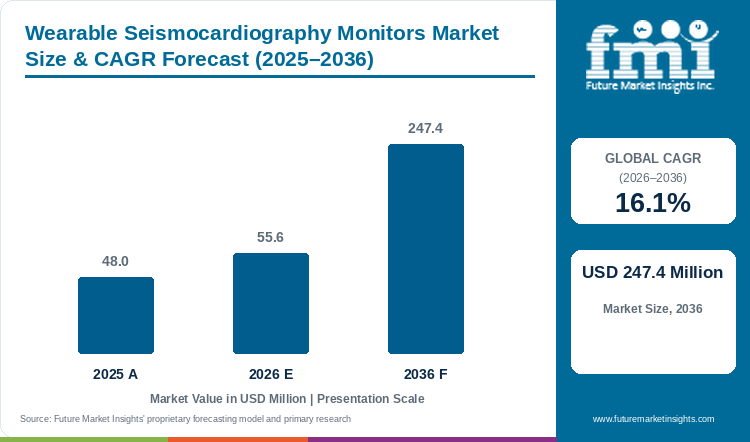
Accounting for USD 48.0 million in 2025 and rising to USD 55.6 million in 2026, the wearable seismocardiography monitors market is projected to expand to USD 247.4 million by 2036, advancing at a CAGR of 16.1%.
Early detection of fluid buildup in discharged heart failure patients before they require an expensive emergency hospital return has become a primary growth driver for remote cardiology care. Direct measurement of internal heart filling pressure previously required a USD 15,000 surgical implant or a hospital catheter test, yet a June 2025 multicenter SEISMIC-HF I study of 310 heart failure patients in JACC Heart Failure proved that Cardiosense's stick-on CardioTag chest patch tracks internal heart pressure across an 18.1 mm Hg baseline cohort as accurately as an invasive catheter [1]. Cardiology clinics are adopting these non-invasive chest patches to adjust water-pill doses while patients recover at home, giving MEMS accelerometer-gyroscope patches a 66.8% share of 2026 sensor fusion architecture demand. Global wearable seismocardiography monitors market value is projected to expand from USD 48.0 million in 2025 to USD 55.6 million in 2026 and climb to USD 247.4 million by 2036 at a 16.1% CAGR, adding USD 191.8 million in new industry value. Because stick-on vibration patches measure mechanical heart pumping instead of electrical rhythm alone, buyer adoption is growing at nearly double the 8.1% CAGR of continuous cardiac monitoring devices. Even with strong clinical validation, body motion during walking blurs tiny chest vibration signals and strict insurance billing rules still limit patch use to five-minute resting checks.
Key Market Trends & Insights
- By sensor fusion architecture: MEMS accelerometer-gyroscope patches lead at 66.8% in 2026 because combined straight-line and rotational chest-wall motion sensing pinpoints heart valve opening and closing times.
- By derived hemodynamic metric: VO2max and timing intervals make up 54.2% of 2026 volume as doctors measure resting oxygen fitness and heart pumping intervals without treadmill tests.
- By clinical pathway: Heart failure readmission triage generates 58.6% in 2026 since early water-pill adjustments prevent costly 30-day emergency hospital readmissions.
- By deployment setting: Post-discharge home telemetry supplies 56.4% in 2026 through daily five-minute resting recordings sent from patient homes.
- By signal processing: Cloud machine-learning inference captures 61.2% in 2026 via neural network software trained against hospital heart catheter pressure readings.
Regional Highlights
- Top national expansion: Japan tops major cardiology markets at a 17.1% CAGR through 2036 under older-adult home heart-failure monitoring and domestic low-noise MEMS sensor manufacturing.
- Broader country progression: Denmark expands at a 16.8% CAGR ahead of South Korea at 16.5% and Australia at 16.2%, while Canada registers a 15.2% CAGR.
Market Size & Forecast
Table 1: Market Size and Forecast for the Wearable Seismocardiography Monitors Market (USD million and CAGR percentage), 2025 to 2036
| Metric | Value |
|---|---|
| 2025 Market Size | USD 48.0 million |
| Estimated Market Size in 2026 | USD 55.6 million |
| Projected Market Size by 2036 | USD 247.4 million |
| CAGR, 2026 to 2036 | 16.1% |
| Added Market Value, 2026 to 2036 | USD 191.8 million |
Hospital networks and outpatient heart-failure clinics face heavy financial penalties when discharged heart-failure patients build up fluid and return to the emergency room within 30 days. While surgically implanted artery sensors cut readmissions, device and surgery costs above USD 15,000 per patient keep implants limited to a small fraction of heart-failure patients. In April 2025, cardiology researchers published a clinical review of the SEISMIC-HF I trial in Heart Failure Reviews confirming that non-invasive chest vibration sensing paired with machine learning fills the home monitoring gap for outpatient heart failure [2]. Heart care teams across the hospital-at-home wearable biosensor sector are therefore handing out stick-on chest vibration patches to guide home diuretic dosing at a fraction of implant cost.
Patient-Pool and Patch-Deployment Sizing
Table 2: Patient-Pool and Patch-Deployment Sizing for the Wearable Seismocardiography Monitors Market (USD million and operational ranges), 2025 to 2036
| Metric | 2025 | 2026 | 2036 |
|---|---|---|---|
| Market size (USD million) | 48.0 | 55.6 | 247.4 |
| Monitored CHF & fitness triage pool (thousand) | 185.0 to 215.0 | 215.0 to 250.0 | 980.0 to 1,120.0 |
| Active sternal patches & pods deployed (thousand) | 95.0 to 112.0 | 110.0 to 130.0 | 510.0 to 580.0 |
| Annual hardware & AI spend per patient (USD) | 220.0 to 260.0 | 222.0 to 258.0 | 220.0 to 252.0 |
Operational note: Cohort projections combine discharged heart-failure patient counts and outpatient fitness screening volumes with documented chest patch and cloud software adoption rates.
Tracking heart muscle squeeze and internal filling pressure weeks before weight gain or shortness of breath appears lets heart-failure nurses step in early at home. Remote cardiology teams connect chest vibration patches with remote patient monitoring devices to trigger nurse review alerts whenever internal heart pressure starts rising.
Per Capita & Healthcare Facility Sizing
Table 3: Per Capita and Facility Spending Indicators for the Wearable Seismocardiography Monitors Market (USD), 2025 to 2036
| Metric | 2025 | 2026 | 2036 |
|---|---|---|---|
| Global population (million) | 8,200.0 | 8,300.0 | 9,000.0 |
| Spend per 1,000 people (USD) | 5.9 | 6.7 | 27.5 |
| Annual spend per cardiology clinic (USD) | 2,650.0 to 3,100.0 | 3,050.0 to 3,550.0 | 12,800.0 to 14,900.0 |
| Heart-failure telemetry contract share (%) | 57.0% to 59.0% | 58.0% to 60.0% | 61.0% to 64.0% |
Table 4: Facility & Institutional Cardiology Spending Indicators for the Wearable Seismocardiography Monitors Market (USD and percentages), 2026
| Metric | Value | Institutional Reference Basis |
|---|---|---|
| Market size, 2026 | USD 55.6 million | 2026 global market valuation baseline |
| Cardiology & rehab clinics globally | 17,200 | Global heart-failure clinic and cardiopulmonary rehab registry |
| Market spend per facility | USD 3,232.6 | Annualized wearable seismocardiography expenditure |
| Heart failure readmission triage allocation, 2026 | USD 32.6 million | 58.6% clinical-pathway segment allocation |
Elimination of tiring treadmill stress tests in frail older adults depends on resting chest sensors that measure peak oxygen fitness in under three minutes. Outpatient clinics pair vibration patches with wearable blood pressure monitors to build complete non-invasive heart pumping profiles during routine office visits.
Analyst Perspective
"An ECG strip tells a cardiologist when the heart's electrical signal fires, but it cannot show whether a weakened heart chamber is actually pumping blood against rising fluid pressure. Stick-on chest vibration patches that turn tiny breastbone movements into FDA-cleared filling pressures and resting VO2max scores are turning hospital catheter measurements into routine home checkups."
- Anurag Sharma, Principal Consultant, Future Market Insights.
How is the wearable seismocardiography monitors market segmented?
The wearable seismocardiography monitors market is segmented by sensor fusion architecture, derived hemodynamic metric, clinical pathway, deployment setting, and signal processing. In 2026, MEMS accelerometer-gyroscope patches are projected at 66.8%, VO2max and timing intervals at 54.2%, heart failure readmission triage at 58.6%, post-discharge home telemetry at 56.4%, and cloud machine-learning inference at 61.2%.
By sensor fusion architecture: MEMS accelerometer-gyroscope patches, piezoelectric PVDF film patches, mechano-acoustic optical patches, and triboelectric sternal patches.
By derived hemodynamic metric: VO2max and timing intervals, wedge pressure decompensation index, and valvular acoustic-seismic signatures.
By clinical pathway: Heart failure readmission triage, non-exercise VO2max triage, and apnea and valvular screening.
By deployment setting: Post-discharge home telemetry, outpatient cardiology clinics, cardiac rehabilitation centers, and occupational health clinics.
By signal processing: Cloud machine-learning inference, edge microcontroller filtering, hybrid clinical portal analytics, adaptive Kalman denoising, and generative diffusion denoising.
Why do MEMS Accelerometer-Gyroscope Patches lead the sensor fusion architecture category?
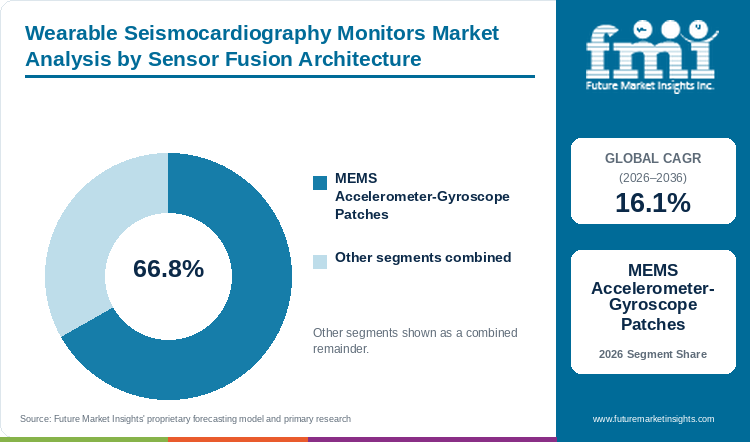
MEMS accelerometer-gyroscope patches are projected to capture 66.8% of sensor fusion architecture demand in 2026, supported by 6-axis linear and rotational chest motion sensing paired with ECG.
Table 5: Sensor Fusion Architecture Share for the Wearable Seismocardiography Monitors Market (percentage share), 2026
| Sensor Fusion Architecture | Share (2026) |
|---|---|
| MEMS Accelerometer-Gyroscope Patches | 66.8% |
| Other Segments Combined | 33.2%* |
| Total | 100.0% |
*Note: Remaining sensor fusion architecture categories sum to 100.0% of 2026 wearable seismocardiography volume.
Table 6: Sensor Fusion Architecture Leadership and Market Growth for the Wearable Seismocardiography Monitors Market (segment and CAGR percentage), 2026 to 2036
| Metric | Value |
|---|---|
| Global CAGR (2026 to 2036) | 16.1% |
| Leading Segment | MEMS Accelerometer-Gyroscope Patches |
Three-axis low-noise MEMS accelerometer and gyroscope chest patches paired with single-lead ECG lead hardware demand because combining straight-line chest vibration with rotational motion captures over 60% more mechanical heart energy than single-axis sensors. Multi-axis motion sensing locks onto exact valve opening and closing peaks across the sensor patches category even when heavier body weight softens surface vibrations.
- MEMS accelerometer-gyroscope patches account for 66.8% of sensor fusion architecture market value in 2026 by delivering synchronized electrical and mechanical heart waveforms.
- A March 2025 validation study across 256 chest-vibration recordings from 150 healthy and heart-disease subjects published in Scientific Reports showed 97.8% sensitivity and 98.6% positive predictive value for automated heartbeat detection in healthy adults as well as 85.0% sensitivity and 95.0% positive predictive value in heart patients [3].
Why do VO2max and Timing Intervals define the largest derived hemodynamic metric segment?
VO2max and timing intervals are estimated to secure 54.2% of the derived hemodynamic metric category in 2026, driven by resting non-exercise fitness checks and PEP/LVET heart timing.
Non-invasive capture of peak oxygen fitness (VO2max) and heart-pumping time intervals (PEP and LVET) from aortic and mitral valve vibration peaks gives doctors immediate heart-strength staging without catheters or exhausting treadmill tests. Because pumping time ratios show how strongly the left ventricle contracts, doctors use these readings across cardiac ambulatory monitoring and sports medicine clinics.
- VO2max and timing intervals make up 54.2% of the derived hemodynamic metric segment in 2026 as European and North American clinics adopt 40-second resting fitness and heart-timing checks.
- A February 2025 clinical study published in Computers in Biology and Medicine measured chest-vibration waveform shifts before and after exercise and confirmed that pre-ejection period, left ventricular ejection time, and filling intervals track heart-lung workload changes [4].
What keeps Heart Failure Readmission Triage ahead by clinical pathway?
Heart failure readmission triage is expected to command 58.6% of clinical pathway volume in 2026, driven by hospital demand for non-invasive fluid-pressure checks to prevent 30-day readmissions.
Avoidance of 30-day hospital readmissions after a heart-failure stay is the largest revenue pathway because hospitals face Medicare payment penalties and high inpatient costs whenever fluid-overloaded patients return for IV diuretics. Stick-on chest patches that estimate blood output and internal filling pressure let clinic nurses adjust oral water pills in coordination with wearable healthcare devices before lung fluid builds up.
- Heart failure readmission triage claims 58.6% of clinical pathway market value in 2026 because preventing one USD 18,000 hospital readmission pays for dozens of home patch kits.
- A September 2025 study in The American Journal of Cardiology trained a deep neural network on 73 heart-failure patients undergoing simultaneous right-heart catheterization and chest-patch recording, proving accurate non-invasive cardiac output estimation across validation cohorts [5].
Why does Post-Discharge Home Telemetry lead the deployment setting category?
Post-discharge home telemetry is forecast to generate 56.4% of deployment setting market value in 2026, owing to daily lying-down home recordings sent to remote cardiology portals.
Tracking daily heart-pressure trends during the high-risk 30-to-90-day recovery window after a heart-failure hospitalization requires simple stick-on chest patches worn at home. Unlike one-time clinic checks, daily home recordings taken while lying flat remove clinic anxiety spikes and give doctors a steady baseline.
- Post-discharge home telemetry generates 56.4% of deployment setting demand in 2026 as hospital-at-home and remote cardiac monitoring programs expand.
- In June 2026, biomedical engineers published the modular SArES mobile seismocardiography software framework in Sensors to verify immediate signal quality checks and automated valve-peak detection on portable tablets for home heart monitoring [6].
What gives Cloud Machine-Learning Inference the leading position in signal processing?
Cloud machine-learning inference is anticipated to account for 61.2% of signal processing demand in 2026, reinforced by deep neural networks trained against hospital catheter pressure readings.
Accurate conversion of subtle chest-vibration waveforms that shift with patient body weight and valve stiffness into calibrated millimeter-of-mercury heart pressures or VO2max scores requires deep neural networks hosted on secure cloud servers. Cloud software engines refine individual patient baselines and send clear summary reports directly into hospital electronic health records.
- Cloud machine-learning inference secures 61.2% of signal processing market value in 2026 because multi-layer pressure prediction models require central training against thousands of hospital catheter records.
- A July 2025 IEEE Engineering in Medicine and Biology Society study testing seven noise-removal algorithms across 20 wearable-patch users confirmed that Variational Mode Decomposition and Savitzky-Golay filtering cut heart-rate error by up to 38% during stepping exercise [7].
What are the drivers, restraints, and opportunities in the wearable seismocardiography monitors market?
In the wearable seismocardiography monitors market, FDA-cleared non-invasive heart pressure and resting VO2max software are projected to speed up outpatient patch adoption whereas walking motion noise limits continuous walking readings and automated valve narrowing checks create primary-care screening opportunities.
- Driver: FDA 510(k) and De Novo clearances for AI-based non-invasive heart pressure and resting VO2max scoring open insurance-reimbursed cardiology clinic orders.
- Restraint: High sensitivity of tiny chest vibrations to walking motion and posture changes limits continuous walking pressure accuracy.
- Opportunity: Expanding chest vibration sensing into automated aortic valve narrowing checks and home sleep apnea screening opens primary-care clinic volume.
Growth Analysis and Future Potential: Qualitative Demand Catalysts
Hospital cardiology departments and outpatient heart-failure clinics are moving away from basic bathroom weight scales toward direct internal filling-pressure checks. Daily weight scales miss early internal fluid shifts, whereas chest seismocardiography spots heart-filling vibration changes as soon as internal fluid pressure rises. Clinical validation against hospital ultrasound and catheter tests is placing chest vibration patches into patient monitoring devices contracts across hospital networks. In April 2025, clinical researchers at Aalborg University Hospital published a comparative study in the European Heart Journal - Digital Health evaluating 26 subjects before and after a 2-liter saline fluid infusion. Their results proved that chest-vibration amplitudes Ls (+19%), Dd (+23%), and Ed (+48%) reliably detected fluid overload and separated heart-disease patients from healthy controls [8]. Health systems therefore buy wearable SCG patches to catch fluid buildup days before an emergency room visit.
Risk Assessment of the Wearable Seismocardiography Monitors Market: Operational and Formulation Friction
Heavy signal noise from chest muscle movement, deep breathing, and footsteps during walking remains the main technical hurdle limiting 24-hour walking pressure tracking. Because breastbone heart vibrations measure only a few thousandths of a g-force, walking or pedaling creates motion noise ten times larger than heart valve opening peaks. In September 2025, biomedical engineers at Georgia Institute of Technology reported in Physiological Measurement that while wearable seismocardiography models kept error rates below 8% and median R2 at 0.75 for heart rate and blood output during post-exercise rest, accuracy dropped sharply during active bike pedaling [9]. Device suppliers within the piezoelectric sensors and MEMS supply chain therefore instruct patients to take 1-to-5-minute lying-down or seated resting readings instead of promising continuous walking pressure numbers.
Commercial Opportunity Analysis: Formulation Differentiation and Value-Add Formats
New chest-patch software trained to spot undiagnosed heart valve narrowing and nighttime breathing pauses from a single breastbone patch opens large primary-care and senior screening markets. Thousands of older adults with severe aortic valve narrowing go undiagnosed until fainting or heart failure occurs because busy primary-care doctors lack routine ultrasound and stethoscopes miss quiet murmurs. Automated valve-vibration screening paired with chest-wall breathing tilt tracking connects sternal SCG patches directly into the home sleep apnea diagnostic wearables and heart-valve referral pipeline. In January 2026, clinical researchers in Finland and the USA published a two-phase study of 214 subjects in Open Heart showing that a 3D MEMS accelerometer and single-lead ECG patch algorithm spotted severe aortic stenosis in a blinded 99-patient group with 92.0% sensitivity and a 96.0% area under the curve [10]. Primary-care clinic adoption of three-minute chest screening patches creates a profitable diagnostic referral channel.
Wearable Seismocardiography Monitors Market by Country (2026 to 2036)
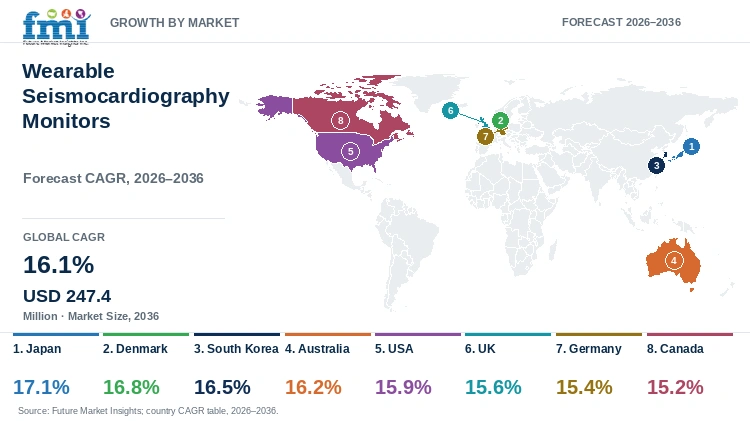
National growth projections show Japan leading wearable seismocardiography monitor adoption across major healthcare systems at a 17.1% CAGR through 2036, while Canada advances at a 15.2% CAGR. Deployment momentum across East Asian and European healthcare networks as well as North American hospital systems tracks remote heart-failure billing codes and non-exercise senior fitness checks.
Table 7: Country CAGR and Primary Growth Levers for the Wearable Seismocardiography Monitors Market (CAGR percentage and operational drivers), 2026 to 2036
| Country | CAGR (2026 to 2036) | Primary Growth Lever |
|---|---|---|
| Japan | 17.1% | Older-adult heart-failure home monitoring demand and domestic Murata/TDK low-noise MEMS manufacturing |
| Denmark | 16.8% | VentriJect Seismofit clinical adoption across municipal rehab and university hospital senior cohorts |
| South Korea | 16.5% | Multimodal wireless mechano-acoustic skin patches and university smart-ward cardiology monitoring |
| Australia | 16.2% | State-funded Hospital in the Home remote heart-failure care and flexible PVDF patch research |
| USA | 15.9% | FDA 510(k) and De Novo clearances (CardioTag, Sensinel) paired with Medicare RPM CPT billing |
| UK | 15.6% | NHS virtual heart-failure ward rollout and workplace clinic three-minute VO2max screening |
| Germany | 15.4% | Statutory G-BA heart-failure telemonitoring coverage and domestic Bosch Sensortec MEMS supply |
| Canada | 15.2% | Provincial heart-function clinic demand for U-Net automated valve timing and home cardiac rehab |
Source: Future Market Insights analysis
Japan Wearable Seismocardiography Monitors Market Outlook (2026 to 2036)
Large older-adult heart-failure and valve-disease patient populations paired with domestic manufacturing of ultra-quiet MEMS accelerometers by Murata Manufacturing and TDK place Japan in the lead for global demand. In August 2025, cardiovascular researchers published the SensSmartTech synchronized ECG and heart-sound seismocardiogram dataset across heart rates from 52 to 182 beats per minute in Scientific Data to standardize sensor calibration across wide heart-rate changes [11]. Market value in Japan is projected to expand at a leading 17.1% CAGR through 2036 across university hospitals and senior home-care networks. Although national medical device software reviews require local clinical data, strong Ministry of Health tele-cardiology incentives speed up home patch rollout.
Key takeaway: Older-adult heart-failure care needs and domestic low-noise MEMS sensor manufacturing drive the fastest national market growth in Japan.
Denmark Wearable Seismocardiography Monitors Market Outlook (2026 to 2036)
Early clinical rollout of resting non-exercise seismocardiography VO2max patches by VentriJect ApS and Aalborg University's heart-mechanics research group drives Denmark at a 16.8% CAGR from 2026 to 2036. In June 2026, geriatric exercise researchers at Copenhagen University Hospital Bispebjerg published a validation study of 36 older adults aged 65 to 75 years in BMC Geriatrics comparing a 40-second lying-down Seismofit chest test against stationary bike exercise testing. Their results confirmed a clear positive correlation (r = 0.57, p < 0.001) while defining calibration adjustments for older adults [12]. Municipal health clinics and cardiac rehab centers across Denmark are buying wireless chest pods to replace tiring stationary bike tests.
Key takeaway: Domestic clinical adoption of 40-second resting VO2max patches at university hospitals and municipal rehab clinics sustains fast European growth in Denmark.
South Korea Wearable Seismocardiography Monitors Market Outlook (2026 to 2036)
Ultra-thin, flexible wireless skin patches built for multi-day hospital ward and home heart monitoring drive demand across South Korea. In August 2025, biomedical engineers published a clinical validation in Biosensors and Bioelectronics showing an electrode-free wireless mechano-acoustic skin patch that combines chest vibration and heart-sound sensing for continuous heart monitoring without sticky gel irritation [13]. In response, the South Korea wearable seismocardiography monitors market is estimated to grow at a 16.5% CAGR through 2036. Widespread smartphone health app use and digital hospital wards in Seoul support adoption, though national health insurance AI-software billing reviews still govern primary-care reimbursement.
Key takeaway: Flexible skin-patch electronics and university hospital smart-ward rollouts speed up multimodal chest monitor demand in South Korea.
Australia Wearable Seismocardiography Monitors Market Outlook (2026 to 2036)
Long travel distances between country patients and city heart specialists in Sydney and Melbourne make low-cost wearable chest patches highly practical for state-funded Hospital in the Home programs across Australia. In March 2025, sensor researchers from Western Sydney University and the University of Naples Federico II published a 35-subject clinical evaluation in Sensors confirming that a flexible lead-free PVDF piezoelectric chest patch captured heart vibration and breathing signals with R2 above 0.99 for heartbeat intervals and R2 above 0.96 for breathing intervals [14]. Commercial demand in Australia is forecast to rise at a 16.2% CAGR through 2036 across state health networks and outpatient heart-failure clinics. Because rural internet dropouts can interrupt live streaming, health districts in Australia favor patches with built-in memory chips and automatic cloud upload.
Key takeaway: State-funded Hospital in the Home growth and flexible piezoelectric patch research drive remote heart-and-lung monitoring in Australia.
USA Wearable Seismocardiography Monitors Market Outlook (2026 to 2036)
FDA 510(k) and De Novo clearances for Cardiosense's CardioTag and Analog Devices' Sensinel Cardiopulmonary Management System as well as Medicare hospital readmission penalties make the USA the largest global revenue pool. In December 2025, biomedical engineers at the Florida Institute of Technology published a digital-twin study in the Journal of Biomechanical Engineering showing how heart muscle squeeze and chest-wall tissue stiffness shape breastbone vibration waveforms [15]. Because Medicare remote monitoring codes CPT 99454 and 99457 pay monthly fees for device supply and nurse review, United States cardiology groups earn recurring clinic income while preventing expensive hospital readmissions. The USA market is slated to register a 15.9% CAGR from 2026 to 2036.
Key takeaway: FDA 510(k) and De Novo clearances paired with Medicare remote monitoring billing codes support the largest global revenue pool in the USA.
UK Wearable Seismocardiography Monitors Market Outlook (2026 to 2036)
Fast adoption of three-minute resting VO2max fitness checks in workplace health clinics and National Health Service virtual heart-failure wards drives a projected 15.6% CAGR across the UK between 2026 and 2036. In January 2025, preventive cardiology researchers at Liverpool John Moores University published a workplace clinic study in BMC Public Health showing strong employee acceptance and fast clinic throughput for resting seismocardiography fitness screening during routine work checkups [16]. While NHS regional budget rules require clear proof of avoided emergency admissions, corporate health providers and private cardiology clinics are rolling out wireless chest VO2max pods.
Key takeaway: NHS virtual heart-failure ward expansion and workplace clinic use of three-minute resting VO2max checks drive strong national uptake in the UK.
Germany Wearable Seismocardiography Monitors Market Outlook (2026 to 2036)
National statutory telemonitoring coverage for heart failure (TM-HI) under the Federal Joint Committee (G-BA) and domestic MEMS sensor production led by Bosch Sensortec shape wearable seismocardiography adoption across Germany. In October 2025, heart-lung signal researchers at Silesian University of Technology and partner institutes in Germany published a study in Scientific Reports showing continuous tracking of breathing waves and heart-lung timing from chest-wall accelerometer tilt and amplitude changes [17]. Market value in Germany is anticipated to expand at a 15.4% CAGR through 2036 across telemedical centers and outpatient cardiology offices. Strict national patient-privacy rules in Germany require cloud software vendors to host chest-patch data on domestic European servers.
Key takeaway: Statutory G-BA heart-failure telemonitoring coverage and domestic Bosch MEMS production support steady clinical rollout across Germany.
Canada Wearable Seismocardiography Monitors Market Outlook (2026 to 2036)
Provincial cardiac rehab waiting lists and winter travel distances across Canada create strong hospital demand for home and clinic chest patches that check heart pumping timing without full treadmill stress tests. In December 2025, deep-learning researchers published a U-Net neural network study across 42,452 heartbeats from 198 subjects in Frontiers in Digital Health. Their software achieved 0.843 to 0.918 median sensitivity and 0.809 to 1.000 positive predictive value across 11 automated chest-vibration timing points [18]. Demand in Canada is projected to grow at a 15.2% CAGR through 2036 across Ontario, British Columbia, and Alberta heart-function clinics. Provincial hospital buying rules still require multi-month clinic pilot trials before signing multi-hospital patch contracts.
Key takeaway: Provincial heart-function clinic demand for automated beat-to-beat valve timing and home rehab monitoring sustains market expansion in Canada.
Full report country CAGRs cover: North America; Latin America; Western Europe; Eastern Europe; East Asia; South Asia and Pacific; Middle East and Africa.
Who are the notable companies in the wearable seismocardiography monitors market?
VentriJect ApS, Cardiosense, Inc., Analog Devices, Inc., TDK Corporation, Murata Manufacturing Co., Ltd., Bosch Sensortec GmbH, STMicroelectronics N.V., and Eko Health, Inc. are the notable companies in the wearable seismocardiography monitors market.
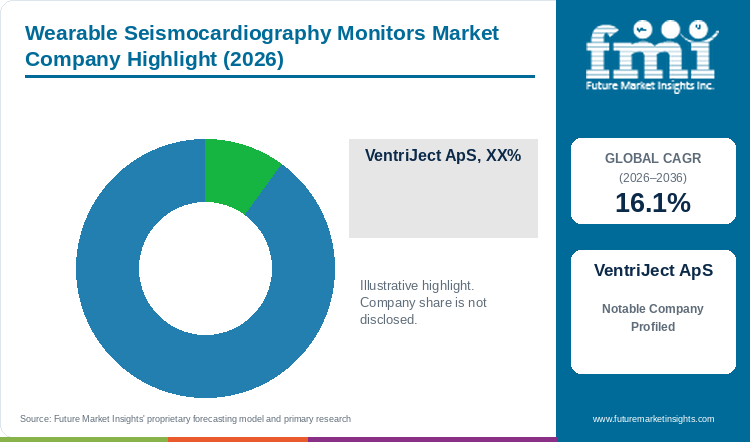
Clinical wearable chest-patch developers partner with multinational semiconductor and low-noise MEMS sensor manufacturers to supply cardiology and rehab clinics. Medical device companies combine 3-axis accelerometers and optical blood-flow sensors with single-lead ECG inside stick-on chest patches paired with FDA-cleared machine-learning software for internal heart pressure and resting VO2max scoring. Upstream MEMS chip makers build the ultra-quiet sensing dies that pick up tiny mitral and aortic valve vibrations on the skin.
- Clinical Wearable Seismocardiography System Specialists: VentriJect ApS and Cardiosense, Inc. commercialize the CE-marked Seismofit resting VO2max sensor and the FDA 510(k)-cleared CardioTag SCG+PPG+ECG heart-pressure patch.
- Integrated Cardiopulmonary Patch & Acoustic Platforms: Analog Devices, Inc. (Sensinel Cardiopulmonary Management System) and Eko Health, Inc. supply FDA-cleared chest-worn heart failure and heart-sound valve monitoring systems.
- Ultra-Low-Noise Medical MEMS Inertial Sensor Leaders: TDK Corporation (InvenSense) and Murata Manufacturing Co., Ltd. as well as Bosch Sensortec GmbH and STMicroelectronics N.V. manufacture high-sensitivity 3-axis and 6-axis MEMS accelerometers and gyroscopes built for chest vibration capture.
Competitive Benchmarking: Wearable Seismocardiography Monitors Market
Table 8: Competitive Benchmarking for the Wearable Seismocardiography Monitors Market (qualitative capability ratings), 2026
| Company | Sternal SCG/MEMS Fidelity | Clinical AI Hemodynamic Depth | Cardiology / Homecare Access | Geographic Reach |
|---|---|---|---|---|
| VentriJect ApS | High | High | High | Medium |
| Cardiosense, Inc. | High | High | High | Medium |
| Analog Devices, Inc. | High | High | High | High |
| TDK Corporation (InvenSense) | High | Medium | Medium | High |
| Murata Manufacturing Co., Ltd. | High | Medium | Medium | High |
| Bosch Sensortec GmbH | High | Medium | Medium | High |
| STMicroelectronics N.V. | High | Medium | Medium | High |
| Eko Health, Inc. | Medium | High | High | High |
Scoring basis: Vendor capability tiers compare chest SCG and GCG sensor noise-floor performance against clinical AI pressure validation depth and multi-country regulatory clearances.
Key Developments in the Wearable Seismocardiography Monitors Market
- Cardiosense, Inc. received U.S. FDA 510(k) clearance (K243566) in July 2025 for its CardioTag wearable sensor patch capturing synchronized seismocardiography and ECG signals paired with optical blood-flow sensing. This clearance was followed by FDA De Novo authorization for its non-invasive pulmonary capillary wedge pressure AI software in May 2026 [19].
- University of Copenhagen and University of Southern Denmark researchers published a multi-month validation study in the European Journal of Sport Science in September 2025 confirming that VentriJect's resting seismocardiography equation estimated VO2peak with a 7.4% mean absolute percentage error and tracked 1-year fitness changes (R2 = 0.62) against stationary bike testing [20].
- Biomedical engineering researchers at the University of Maryland and Georgia Institute of Technology published a 3-axis seismocardiography fluid-status study in Frontiers in Physiology in May 2026 using CardioTag recordings to prove that side-to-side chest vibration consistency separates stable heart-failure patients from fluid-overloaded patients (p = 0.042) and dehydrated patients (p = 0.012) [21].
Key Players in the Wearable Seismocardiography Monitors Market
Clinical Wearable Seismocardiography System Specialists
- VentriJect ApS
- Cardiosense, Inc.
- Eko Health, Inc.
Integrated Cardiopulmonary Patch Platforms
- Analog Devices, Inc.
- STMicroelectronics N.V.
- TDK Corporation (InvenSense)
Ultra-Low-Noise Medical MEMS Sensor Leaders
- Murata Manufacturing Co., Ltd.
- Bosch Sensortec GmbH
Wearable Seismocardiography Monitors Market - Report Scope
Table 9: Report Scope for the Wearable Seismocardiography Monitors Market (coverage fields and definitions), 2026 to 2036
| Coverage field | Report scope |
|---|---|
| Market breakdown | Sensor Fusion Architecture; Derived Hemodynamic Metric; Clinical Pathway; Deployment Setting; Signal Processing |
| Quantitative Units | USD Million |
| Market Definition | Includes commercial supplier market value from wearable chest seismocardiography and gyrocardiography patches, resting VO2max SCG sensor pods, cloud heart-pressure machine-learning software subscriptions, and medical-grade SCG MEMS sensor modules. Category Scope Note: Excludes electrical-only Holter ECG patches, wrist-worn optical fitness bands, and surgically implanted artery pressure sensors. |
| Regions Covered | North America; Latin America; Western Europe; Eastern Europe; East Asia; South Asia and Pacific; Middle East and Africa |
| Countries Covered | Japan, Denmark, South Korea, Australia, USA, UK, Germany, Canada, and additional countries in the full report |
| Key Companies Covered | VentriJect ApS, Cardiosense, Inc., Analog Devices, Inc., TDK Corporation, Murata Manufacturing Co., Ltd., Bosch Sensortec GmbH, STMicroelectronics N.V., Eko Health, Inc. |
| Forecast Period | 2026 to 2036 |
| Approach | Primary and secondary research with top-down and bottom-up market triangulation. |
Wearable Seismocardiography Monitors Market - Research Methodology
Table 10: Research Methodology for the Wearable Seismocardiography Monitors Market (research methods and approach), 2026 edition
| Method | Approach |
|---|---|
| Primary Research | Structured interviews with heart-failure cardiologists, exercise physiologists, hospital-at-home nursing directors, and medical MEMS sensor engineers to verify patch wear protocols and software pricing. |
| Secondary Research | Analysis of FDA 510(k) (K243566) and De Novo records, PubMed and PMC clinical validation studies (SEISMIC-HF I, Seismofit CPET trials), IEEE EMBC signal-processing papers, and Medicare RPM fee schedules. |
| Market Sizing and Forecasting | Top-down health-system remote patient monitoring budgets cross-checked against bottom-up discharged heart-failure patient enrollments and outpatient VO2max screening counts from 2026 to 2036. |
| Country Forecasting Model | Econometric national projections weight heart-failure hospitalization rates, 65+ valve-disease demographics, statutory telemonitoring tariffs (Medicare RPM, G-BA TM-HI), and clinical patch clearances across eight countries. |
| Operational Benchmark Traceability | Patient-pool and clinic spending indicators in Tables 2, 3, and 4 trace to JACC Heart Failure SEISMIC-HF I cohorts, BMC Geriatrics Seismofit evaluations, and Open Heart aortic stenosis trials. |
| Data Triangulation and Validation | Demand estimates are cross-checked against medical MEMS accelerometer shipment allocations and clinical telemetry subscription counts without double counting standard Holter ECG patches. |
Wearable Seismocardiography Monitors Market by Segments
Wearable Seismocardiography Monitors Market segmented by Sensor Fusion Architecture:
- MEMS Accelerometer-Gyroscope Patches
- Piezoelectric PVDF Film Patches
- Mechano-Acoustic Optical Patches
- Triboelectric Sternal Patches
Wearable Seismocardiography Monitors Market segmented by Derived Hemodynamic Metric:
- VO2max and Timing Intervals
- Wedge Pressure Decompensation Index
- Valvular Acoustic-Seismic Signatures
Wearable Seismocardiography Monitors Market segmented by Clinical Pathway:
- Heart Failure Readmission Triage
- Non-Exercise VO2max Triage
- Apnea and Valvular Screening
Wearable Seismocardiography Monitors Market segmented by Deployment Setting:
- Post-Discharge Home Telemetry
- Outpatient Cardiology Clinics
- Cardiac Rehabilitation Centers
- Occupational Health Clinics
Wearable Seismocardiography Monitors Market segmented by Signal Processing:
- Cloud Machine-Learning Inference
- Edge Microcontroller Filtering
- Hybrid Clinical Portal Analytics
- Adaptive Kalman Denoising
- Generative Diffusion Denoising
Wearable Seismocardiography Monitors Market by Region
- North America
- United States
- Canada
- Latin America
- Brazil
- Mexico
- Argentina
- Chile
- Western Europe
- Germany
- France
- United Kingdom
- Italy
- Spain
- Benelux
- Nordics
- Eastern Europe
- Poland
- Czech Republic
- Romania
- Hungary
- East Asia
- China
- Japan
- South Korea
- South Asia and Pacific
- India
- ASEAN
- Australia and New Zealand
- Middle East and Africa
- GCC Countries
- South Africa
- Türkiye
- Israel
Research Sources and Bibliography
- [1] Klein, L., Fudim, M., Etemadi, M., & Inan, O. T. (2025, June 20). Noninvasive Pulmonary Capillary Wedge Pressure Estimation in Heart Failure Patients With the Use of Wearable Sensing and AI. JACC: Heart Failure, 13(8), 102513 (PubMed PMID 40542792).
- [2] Fudim, M., Ponikowski, P., & Abraham, W. T. (2025, April 23). SEISMIC-HF 1: key findings from AHA24 and implications for remote cardiac monitoring. Heart Failure Reviews, 30(5), 1099-1101 (PubMed PMID 40268799).
- [3] Parlato, S., Centracchio, J., Esposito, D., Bifulco, P., & Andreozzi, E. (2025, March 13). Fully automated template matching method for ECG-free heartbeat detection in cardiomechanical signals of healthy and pathological subjects. Scientific Reports, 15(1), 8642 (PubMed PMID 40080259).
- [4] Taebi, A., Solar, B. E., & Mansy, H. A. (2025, February 15). Effect of respiration and exercise on seismocardiographic signals. Computers in Biology and Medicine, 186, 109612 (PubMed PMID 39709866).
- [5] Al-Zaiti, S. S., Sejdic, E., & Shusterman, V. (2025, September 30). Deep learning predicts cardiac output from seismocardiographic signals in heart failure. The American Journal of Cardiology, 256, 114-122 (PubMed PMID 41038524).
- [6] SArES Consortium Investigators. (2026, June 29). A Modular Edge-Based SCG Processing Framework for Space-Oriented and Clinical Wearable Health Monitoring. Sensors, 26(13), 4218 (PubMed PMID 42393991).
- [7] Kizir, B., & Semiz, B. (2025, July 15). Comparative Evaluation of Denoising Algorithms for Enhanced SCG-Based Heart Rate Estimation in Dynamic Conditions. Annual International Conference of the IEEE Engineering in Medicine and Biology Society, 2025, 1-4 (PubMed PMID 41335805).
- [8] Agam, A., Søgaard, P., & Schmidt, S. E. (2025, April 16). Evaluation of seismocardiography in detecting pre-load changes and cardiovascular disease: a comparative study with transthoracic echocardiography. European Heart Journal - Digital Health, 6(4), 811-821 (PubMed PMID 40703121).
- [9] Zia, J., Kimball, J., & Inan, O. T. (2025, September 29). Seismocardiography-based estimation of hemodynamic parameters during submaximal ergometer test. Physiological Measurement, 46(9), 095008 (PubMed PMID 40967253).
- [10] Järvelä, J., Tadi, M. J., & Koivisto, T. (2026, January 16). Severe aortic stenosis detection using seismocardiography. Open Heart, 13(1), e003563 (PubMed PMID 41545297).
- [11] Petrovic, J., Omal, M., & Bajic, D. (2025, August 20). Synchronous post-exercise electrocardiogram, phonocardiogram, photoplethysmograms and seismocardiogram. Scientific Data, 12(1), 1452 (PubMed PMID 40835611).
- [12] Sundberg, M., Gates, A. T., & Boraxbekk, C. J. (2026, June 20). Seismocardiography for nonexercise estimation of cardiorespiratory fitness in older adults. BMC Geriatrics, 26(1), 542 (PubMed PMID 42323539).
- [13] Kim, S. H., Lee, J. H., & Park, H. S. (2025, August 20). Electrode-Free ECG Monitoring with Multimodal Wireless Mechano-Acoustic Skin Patches. Biosensors and Bioelectronics, 284, 117540 (PubMed PMID 40863010).
- [14] Parlato, S., Centracchio, J., Cinotti, E., Gargiulo, G. D., Esposito, D., Bifulco, P., & Andreozzi, E. (2025, March 6). A Flexible PVDF Sensor for Forcecardiography. Sensors, 25(5), 1608 (PubMed PMID 40096462).
- [15] Mansour, M., & Tavakolian, K. (2025, December 1). Digital Twin-Based Investigation of Seismocardiogram Sensitivity to Tissue Mechanics and Myocardial Motion. Journal of Biomechanical Engineering, 147(12), 121007 (PubMed PMID 41045271).
- [16] Gallagher, C., Jones, M., & Buckley, J. P. (2025, January 28). The acceptability of a novel seismocardiography device for measuring cardiorespiratory fitness in a workplace clinic setting. BMC Public Health, 25(1), 348 (PubMed PMID 39875914).
- [17] Sieciński, S., Kostka, P. S., & Tkacz, E. J. (2025, October 6). Monitoring of respiration and cardiorespiratory interactions from chest-wall accelerometer signals. Scientific Reports, 15(1), 34210 (PubMed PMID 41051471).
- [18] Sørensen, K., Schmidt, S. E., & Struijk, J. J. (2025, December 4). Deep learning-based beat-to-beat delineation of heart sounds and fiducial points in seismocardiography. Frontiers in Digital Health, 7, 1699611 (PubMed PMID 41425284).
- [19] U.S. Food and Drug Administration. (2025, July 22). 510(k) Premarket Notification K243566: CardioTag Wearable Sensor System (Cardiosense, Inc.). U.S. FDA Center for Devices and Radiological Health.
- [20] Hansen, M. T., Rømer, T., Sahl, R. E., Lange, K. K., Poggi, A. I., Furbo, K., Augsburg, J. B., Chmura, P., Nielsen, B., Larsen, M. N., Krustrup, P., & Helge, J. W. (2025, September 22). Nonexercise Estimation of VO2peak Using Seismocardiography in Female Subelite and Male Elite Football Players. European Journal of Sport Science, 25(10), e70047 (PubMed PMID 40982363).
- [21] Cestero, G. I., Bouzid, Z., Hahn, J.-O., & Inan, O. T. (2026, May 18). Quantifying changes in triaxial seismocardiography variability due to sub-optimal volume status. Frontiers in Physiology, 17, 1823345 (PubMed PMID 42232811).
- [22] Cardiosense, Inc. (2026, August 7). Designing Trust: Bringing the First Noninvasive AI Heart-Pressure Reading to Patients. Cardiosense Official Clinical Release (FDA 510(k) K243566 & De Novo PCWP AI).
- [23] Wang, L., Zhang, H., & Liu, Y. (2026, February 27). A novel adaptive extended Kalman filter algorithm driven by time-frequency Gaussian mixture model for accurate AO and AC detection based on portable seismocardiography. Physiological Measurement, 47(3), 035004 (PubMed PMID 41759293).
This bibliography is provided for reader reference and is not exhaustive. The full report contains the complete reference list and detailed citations.
This Report Answers
- How large is the wearable seismocardiography monitors market in 2026 and what is forecast for 2036?
- Which heart-failure and fitness triage pressures support demand for wearable seismocardiography monitors?
- Why do MEMS accelerometer-gyroscope patches lead the sensor fusion architecture category?
- Why do VO2max and timing intervals lead the derived hemodynamic metric category globally?
- How do growth rates differ across Japan, Denmark, South Korea, and the USA?
- Which leading companies supply wearable seismocardiography patches and medical MEMS sensors today?
- What limits adoption or supplier switching in the wearable seismocardiography monitors market?
- What should buyers evaluate before purchasing a wearable seismocardiography monitor?
Frequently Asked Questions
How big is the wearable seismocardiography monitors market in 2026, and what is forecast for 2036?
Assessed at USD 48.0 million in 2025, global wearable seismocardiography monitors demand reaches an estimated USD 55.6 million in 2026 and is projected to climb to USD 247.4 million by 2036 as cardiology clinics and hospital-at-home programs adopt stick-on chest vibration patches.
What is the CAGR for the wearable seismocardiography monitors market from 2026 to 2036?
Between 2026 and 2036, the global market expands at a 16.1% CAGR, creating USD 191.8 million in net new industry value across home heart-failure monitoring and outpatient fitness checks.
Which sensor fusion architecture segment leads the wearable seismocardiography monitors market?
MEMS accelerometer-gyroscope patches lead the sensor fusion architecture category with a 66.8% share in 2026 because combining 3-axis linear motion with rotational sensing and ECG pinpoints exact valve timing.
Which derived hemodynamic metric segment leads the wearable seismocardiography monitors market?
VO2max and timing intervals make up 54.2% of derived hemodynamic metric demand in 2026 as doctors measure resting peak oxygen fitness and heart-pumping intervals in under three minutes.
Which country has a notable growth outlook during the assessment period?
Japan records the fastest national expansion at a 17.1% CAGR through 2036, driven by older-adult home heart-failure monitoring demand and domestic low-noise MEMS sensor manufacturing.
Who are the key players in the market?
VentriJect ApS, Cardiosense, Inc., Analog Devices, Inc., TDK Corporation, Murata Manufacturing Co., Ltd., Bosch Sensortec GmbH, STMicroelectronics N.V., and Eko Health, Inc. lead commercial patch systems and medical MEMS supply.
Preview the report firsthand - request a free sample
Get SampleGet the brochure for pricing and purchase details.
Get PDFTable of Content
- Key Takeaways
- Market Size and CAGR
- Top Growth Driver
- Fastest Growing Segment
- Leading Region
- Key Companies
- Emerging Opportunities
- Executive Summary
- Global Market Outlook
- Demand-side Trends
- Supply-side Trends
- Technology Roadmap Analysis
- Analysis and Recommendations
- Analyst Perspective (What is happening? Why now? What should investors know?)
- Key Questions Answered
- How large is the market?
- What is the CAGR?
- What are key trends?
- Which region dominates?
- Who are the leaders?
- Market Overview
- Market Coverage / Taxonomy
- Market Definition / Scope / Limitations
- Research Methodology
- Chapter Orientation
- Analytical Lens and Working Hypotheses
- Market Structure, Signals, and Trend Drivers
- Benchmarking and Cross-market Comparability
- Market Sizing, Forecasting, and Opportunity Mapping
- Research Design and Evidence Framework
- Desk Research Programme (Secondary Evidence)
- Expert Input and Fieldwork (Primary Evidence)
- Tooling, Models, and Reference Databases
- Data Engineering and Model Build
- Quality Assurance and Audit Trail
- Market Background
- Market Dynamics (Drivers, Restraints, Opportunity, Trends)
- Scenario Forecast (Optimistic, Likely, Conservative)
- Impact Analysis
- AI Impact
- Sustainability Impact
- Regulatory Impact
- Technology Impact
- Consumer / Buyer Analysis
- Purchase Drivers
- Adoption Barriers
- Buyer Journey
- Opportunity Map Analysis
- Product Life Cycle Analysis
- Supply Chain Analysis
- Investment Feasibility Matrix
- Value Chain Analysis
- PESTLE and Porter's Analysis
- Regulatory Landscape
- Regional Parent Market Outlook
- Production and Consumption Statistics
- Import and Export Statistics
- Global Market Analysis and Forecast, 2021 to 2036
- Historical Market Size Value (USD Million) Analysis, 2021 to 2025
- Current and Future Market Size Value (USD Million) Projections, 2026 to 2036
- Y-o-Y Growth Trend Analysis
- Absolute $ Opportunity Analysis
- Global Market Pricing Analysis, 2021 to 2036
- Global Market Analysis and Forecast, By Sensor Fusion Architecture, 2021 to 2036
- Introduction / Key Findings
- Historical Market Size Value (USD Million) Analysis By Sensor Fusion Architecture, 2021 to 2025
- Current and Future Market Size Value (USD Million) Analysis and Forecast By Sensor Fusion Architecture, 2026 to 2036
- MEMS Accelerometer-Gyroscope Patches
- Piezoelectric PVDF Film Patches
- Mechano-Acoustic Optical Patches
- Triboelectric Sternal Patches
- Y-o-Y Growth Trend Analysis By Sensor Fusion Architecture, 2021 to 2025
- Absolute $ Opportunity Analysis By Sensor Fusion Architecture, 2026 to 2036
- Global Market Analysis and Forecast, By Derived Hemodynamic Metric, 2021 to 2036
- Introduction / Key Findings
- Historical Market Size Value (USD Million) Analysis By Derived Hemodynamic Metric, 2021 to 2025
- Current and Future Market Size Value (USD Million) Analysis and Forecast By Derived Hemodynamic Metric, 2026 to 2036
- VO2max and Timing Intervals
- Wedge Pressure Decompensation Index
- Valvular Acoustic-Seismic Signatures
- Y-o-Y Growth Trend Analysis By Derived Hemodynamic Metric, 2021 to 2025
- Absolute $ Opportunity Analysis By Derived Hemodynamic Metric, 2026 to 2036
- Global Market Analysis and Forecast, By Clinical Pathway, 2021 to 2036
- Introduction / Key Findings
- Historical Market Size Value (USD Million) Analysis By Clinical Pathway, 2021 to 2025
- Current and Future Market Size Value (USD Million) Analysis and Forecast By Clinical Pathway, 2026 to 2036
- Heart Failure Readmission Triage
- Non-Exercise VO2max Triage
- Apnea and Valvular Screening
- Y-o-Y Growth Trend Analysis By Clinical Pathway, 2021 to 2025
- Absolute $ Opportunity Analysis By Clinical Pathway, 2026 to 2036
- Global Market Analysis and Forecast, By Deployment Setting, 2021 to 2036
- Introduction / Key Findings
- Historical Market Size Value (USD Million) Analysis By Deployment Setting, 2021 to 2025
- Current and Future Market Size Value (USD Million) Analysis and Forecast By Deployment Setting, 2026 to 2036
- Post-Discharge Home Telemetry
- Outpatient Cardiology Clinics
- Cardiac Rehabilitation Centers
- Occupational Health Clinics
- Y-o-Y Growth Trend Analysis By Deployment Setting, 2021 to 2025
- Absolute $ Opportunity Analysis By Deployment Setting, 2026 to 2036
- Global Market Analysis and Forecast, By Signal Processing, 2021 to 2036
- Introduction / Key Findings
- Historical Market Size Value (USD Million) Analysis By Signal Processing, 2021 to 2025
- Current and Future Market Size Value (USD Million) Analysis and Forecast By Signal Processing, 2026 to 2036
- Cloud Machine-Learning Inference
- Edge Microcontroller Filtering
- Hybrid Clinical Portal Analytics
- Adaptive Kalman Denoising
- Generative Diffusion Denoising
- Y-o-Y Growth Trend Analysis By Signal Processing, 2021 to 2025
- Absolute $ Opportunity Analysis By Signal Processing, 2026 to 2036
- Global Market Analysis and Forecast, By Region, 2021 to 2036
- Introduction
- Historical Market Size Value (USD Million) Analysis By Region, 2021 to 2025
- Current Market Size Value (USD Million) Analysis and Forecast By Region, 2026 to 2036
- North America
- Latin America
- Western Europe
- Eastern Europe
- East Asia
- South Asia and Pacific
- Middle East and Africa
- Market Attractiveness Analysis By Region
- North America Market Analysis and Forecast, By Country, 2021 to 2036
- Historical Market Size Value (USD Million) Trend Analysis By Market Taxonomy, 2021 to 2025
- Market Size Value (USD Million) Forecast By Market Taxonomy, 2026 to 2036
- By Country
- United States
- Canada
- By Sensor Fusion Architecture
- By Derived Hemodynamic Metric
- By Clinical Pathway
- By Deployment Setting
- By Signal Processing
- By Country
- Market Attractiveness Analysis
- By Country
- By Sensor Fusion Architecture
- By Derived Hemodynamic Metric
- By Clinical Pathway
- By Deployment Setting
- By Signal Processing
- Key Takeaways
- Latin America Market Analysis and Forecast, By Country
- Historical Market Size Value (USD Million) Trend Analysis By Market Taxonomy, 2021 to 2025
- Market Size Value (USD Million) Forecast By Market Taxonomy, 2026 to 2036
- By Country
- Brazil
- Mexico
- Argentina
- Chile
- By Sensor Fusion Architecture
- By Derived Hemodynamic Metric
- By Clinical Pathway
- By Deployment Setting
- By Signal Processing
- By Country
- Market Attractiveness Analysis
- By Country
- By Sensor Fusion Architecture
- By Derived Hemodynamic Metric
- By Clinical Pathway
- By Deployment Setting
- By Signal Processing
- Key Takeaways
- Western Europe Market Analysis and Forecast, By Country
- Historical Market Size Value (USD Million) Trend Analysis By Market Taxonomy, 2021 to 2025
- Market Size Value (USD Million) Forecast By Market Taxonomy, 2026 to 2036
- By Country
- Germany
- France
- United Kingdom
- Italy
- Spain
- Benelux
- Nordics
- By Sensor Fusion Architecture
- By Derived Hemodynamic Metric
- By Clinical Pathway
- By Deployment Setting
- By Signal Processing
- By Country
- Market Attractiveness Analysis
- By Country
- By Sensor Fusion Architecture
- By Derived Hemodynamic Metric
- By Clinical Pathway
- By Deployment Setting
- By Signal Processing
- Key Takeaways
- Eastern Europe Market Analysis and Forecast, By Country
- Historical Market Size Value (USD Million) Trend Analysis By Market Taxonomy, 2021 to 2025
- Market Size Value (USD Million) Forecast By Market Taxonomy, 2026 to 2036
- By Country
- Poland
- Czech Republic
- Romania
- Hungary
- By Sensor Fusion Architecture
- By Derived Hemodynamic Metric
- By Clinical Pathway
- By Deployment Setting
- By Signal Processing
- By Country
- Market Attractiveness Analysis
- By Country
- By Sensor Fusion Architecture
- By Derived Hemodynamic Metric
- By Clinical Pathway
- By Deployment Setting
- By Signal Processing
- Key Takeaways
- East Asia Market Analysis and Forecast, By Country
- Historical Market Size Value (USD Million) Trend Analysis By Market Taxonomy, 2021 to 2025
- Market Size Value (USD Million) Forecast By Market Taxonomy, 2026 to 2036
- By Country
- China
- Japan
- South Korea
- By Sensor Fusion Architecture
- By Derived Hemodynamic Metric
- By Clinical Pathway
- By Deployment Setting
- By Signal Processing
- By Country
- Market Attractiveness Analysis
- By Country
- By Sensor Fusion Architecture
- By Derived Hemodynamic Metric
- By Clinical Pathway
- By Deployment Setting
- By Signal Processing
- Key Takeaways
- South Asia and Pacific Market Analysis and Forecast, By Country
- Historical Market Size Value (USD Million) Trend Analysis By Market Taxonomy, 2021 to 2025
- Market Size Value (USD Million) Forecast By Market Taxonomy, 2026 to 2036
- By Country
- India
- ASEAN
- Australia and New Zealand
- By Sensor Fusion Architecture
- By Derived Hemodynamic Metric
- By Clinical Pathway
- By Deployment Setting
- By Signal Processing
- By Country
- Market Attractiveness Analysis
- By Country
- By Sensor Fusion Architecture
- By Derived Hemodynamic Metric
- By Clinical Pathway
- By Deployment Setting
- By Signal Processing
- Key Takeaways
- Middle East and Africa Market Analysis and Forecast, By Country
- Historical Market Size Value (USD Million) Trend Analysis By Market Taxonomy, 2021 to 2025
- Market Size Value (USD Million) Forecast By Market Taxonomy, 2026 to 2036
- By Country
- GCC Countries
- South Africa
- Türkiye
- Israel
- By Sensor Fusion Architecture
- By Derived Hemodynamic Metric
- By Clinical Pathway
- By Deployment Setting
- By Signal Processing
- By Country
- Market Attractiveness Analysis
- By Country
- By Sensor Fusion Architecture
- By Derived Hemodynamic Metric
- By Clinical Pathway
- By Deployment Setting
- By Signal Processing
- Key Takeaways
- Key Countries Market Analysis
- United States
- Pricing Analysis
- Market Share Analysis, 2025
- By Sensor Fusion Architecture
- By Derived Hemodynamic Metric
- By Clinical Pathway
- By Deployment Setting
- By Signal Processing
- Canada
- Pricing Analysis
- Market Share Analysis, 2025
- By Sensor Fusion Architecture
- By Derived Hemodynamic Metric
- By Clinical Pathway
- By Deployment Setting
- By Signal Processing
- Mexico
- Pricing Analysis
- Market Share Analysis, 2025
- By Sensor Fusion Architecture
- By Derived Hemodynamic Metric
- By Clinical Pathway
- By Deployment Setting
- By Signal Processing
- Brazil
- Pricing Analysis
- Market Share Analysis, 2025
- By Sensor Fusion Architecture
- By Derived Hemodynamic Metric
- By Clinical Pathway
- By Deployment Setting
- By Signal Processing
- Chile
- Pricing Analysis
- Market Share Analysis, 2025
- By Sensor Fusion Architecture
- By Derived Hemodynamic Metric
- By Clinical Pathway
- By Deployment Setting
- By Signal Processing
- Germany
- Pricing Analysis
- Market Share Analysis, 2025
- By Sensor Fusion Architecture
- By Derived Hemodynamic Metric
- By Clinical Pathway
- By Deployment Setting
- By Signal Processing
- United Kingdom
- Pricing Analysis
- Market Share Analysis, 2025
- By Sensor Fusion Architecture
- By Derived Hemodynamic Metric
- By Clinical Pathway
- By Deployment Setting
- By Signal Processing
- Italy
- Pricing Analysis
- Market Share Analysis, 2025
- By Sensor Fusion Architecture
- By Derived Hemodynamic Metric
- By Clinical Pathway
- By Deployment Setting
- By Signal Processing
- Spain
- Pricing Analysis
- Market Share Analysis, 2025
- By Sensor Fusion Architecture
- By Derived Hemodynamic Metric
- By Clinical Pathway
- By Deployment Setting
- By Signal Processing
- France
- Pricing Analysis
- Market Share Analysis, 2025
- By Sensor Fusion Architecture
- By Derived Hemodynamic Metric
- By Clinical Pathway
- By Deployment Setting
- By Signal Processing
- India
- Pricing Analysis
- Market Share Analysis, 2025
- By Sensor Fusion Architecture
- By Derived Hemodynamic Metric
- By Clinical Pathway
- By Deployment Setting
- By Signal Processing
- ASEAN
- Pricing Analysis
- Market Share Analysis, 2025
- By Sensor Fusion Architecture
- By Derived Hemodynamic Metric
- By Clinical Pathway
- By Deployment Setting
- By Signal Processing
- Australia and New Zealand
- Pricing Analysis
- Market Share Analysis, 2025
- By Sensor Fusion Architecture
- By Derived Hemodynamic Metric
- By Clinical Pathway
- By Deployment Setting
- By Signal Processing
- China
- Pricing Analysis
- Market Share Analysis, 2025
- By Sensor Fusion Architecture
- By Derived Hemodynamic Metric
- By Clinical Pathway
- By Deployment Setting
- By Signal Processing
- Japan
- Pricing Analysis
- Market Share Analysis, 2025
- By Sensor Fusion Architecture
- By Derived Hemodynamic Metric
- By Clinical Pathway
- By Deployment Setting
- By Signal Processing
- South Korea
- Pricing Analysis
- Market Share Analysis, 2025
- By Sensor Fusion Architecture
- By Derived Hemodynamic Metric
- By Clinical Pathway
- By Deployment Setting
- By Signal Processing
- Poland
- Pricing Analysis
- Market Share Analysis, 2025
- By Sensor Fusion Architecture
- By Derived Hemodynamic Metric
- By Clinical Pathway
- By Deployment Setting
- By Signal Processing
- Hungary
- Pricing Analysis
- Market Share Analysis, 2025
- By Sensor Fusion Architecture
- By Derived Hemodynamic Metric
- By Clinical Pathway
- By Deployment Setting
- By Signal Processing
- Türkiye
- Pricing Analysis
- Market Share Analysis, 2025
- By Sensor Fusion Architecture
- By Derived Hemodynamic Metric
- By Clinical Pathway
- By Deployment Setting
- By Signal Processing
- South Africa
- Pricing Analysis
- Market Share Analysis, 2025
- By Sensor Fusion Architecture
- By Derived Hemodynamic Metric
- By Clinical Pathway
- By Deployment Setting
- By Signal Processing
- Denmark
- Pricing Analysis
- Market Share Analysis, 2025
- By Sensor Fusion Architecture
- By Derived Hemodynamic Metric
- By Clinical Pathway
- By Deployment Setting
- By Signal Processing
- Australia
- Pricing Analysis
- Market Share Analysis, 2025
- By Sensor Fusion Architecture
- By Derived Hemodynamic Metric
- By Clinical Pathway
- By Deployment Setting
- By Signal Processing
- United States
- Market Structure Analysis
- Competition Dashboard
- Competition Benchmarking
- Market Share Analysis of Top Players
- By Regional
- By Sensor Fusion Architecture
- By Derived Hemodynamic Metric
- By Clinical Pathway
- By Deployment Setting
- By Signal Processing
- Emerging Startups
- Innovation Benchmarking
- Competition Analysis
- Competition Deep Dive
- VentriJect ApS
- Overview
- Product Portfolio
- Profitability by Market Segments
- Sales Footprint
- Strategy Overview
- Marketing Strategy
- Product Strategy
- Channel Strategy
- Cardiosense, Inc.
- Analog Devices, Inc.
- TDK Corporation (InvenSense)
- Murata Manufacturing Co., Ltd.
- Bosch Sensortec GmbH
- STMicroelectronics N.V.
- Eko Health, Inc.
- VentriJect ApS
- Case Studies
- Success Stories
- Recent Developments
- Competition Deep Dive
- Assumptions & Acronyms Used


