

- Market Size (2026)
- USD 810.0 Mn
- Forecast (2036)
- USD 4311.8 Mn
- CAGR (2026 to 2036)
- 18.2%
How big is Hospital-at-Home Wearable Biosensor Market in 2026?
Demand in the hospital-at-home wearable biosensor market is anticipated to expand at 18.2% CAGR through 2036. Industry valuation grows from USD 685.3 million in 2025 to USD 810.0 million in 2026 and is anticipated to reach USD 4,311.8 million by 2036.
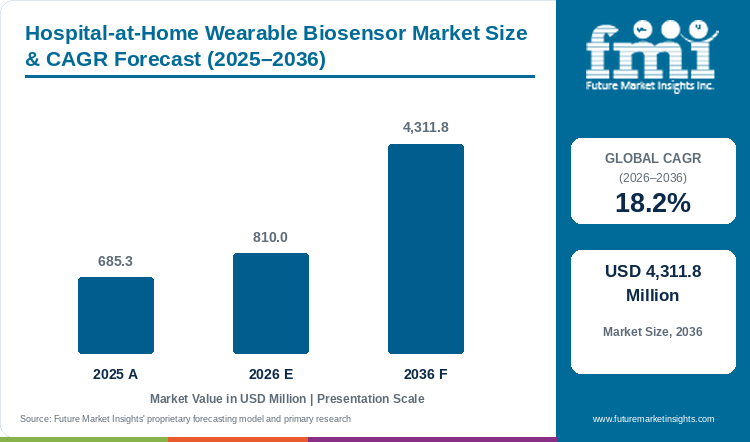
The hospital-at-home wearable biosensor market was valued at USD 685.3 million in 2025 and is estimated at USD 810.0 million in 2026 before reaching USD 4,311.8 million by 2036, at 18.2% CAGR from 2026 to 2036. Multi-parameter wearable patches accounted for 51.0% of product type revenue in 2026, owing to use of several observations through one patient-worn device. CMS released its second Acute Hospital Care at Home data in March 2026 covering April 2023 to September 2025, taking the available initiative record to nearly five years [1]. Longer program availability is supporting movement from small pilots towards regular hospital purchasing. Southern NSW committed USD 31.4 million for Hospital in the Home across four regions, with wearable devices monitoring four groups of vital signs in real time [3]. Apart from that, a South Eastern Sydney project is targeting Hospital in the Home utilization from 1.3% to 2% and remote patient monitoring and video use by 10% [4]. These developments are expected to improve repeat demand where hospitals can support review and escalation.
Key Market Trends & Insights
- By product type: Multi-parameter wearable patches accounted for 51.0% of product type revenue in 2026. The Southern NSW deployment monitors breathing rate, blood pressure, oxygen level and heart rate, supporting use of one device configuration across several observations [3].
- By parameter monitored: Cardiac and respiratory vitals represented 45.9% of parameter-monitored revenue in 2026. The FDA issued January 2025 draft recommendations for non-clinical and clinical testing, labeling and premarket submissions for medical pulse oximeters, making validated oxygenation performance an important selection requirement [19].
- By care pathway: Acute hospital-level care at home held 48.0% of care pathway demand in 2026. NSW Health requires district-wide access, a central clinical triage point, data reporting and after-hours support under its February 2025 Hospital in the Home policy [15].
- By end user: Hospitals and health systems generated 55.8% of end-user revenue in 2026. Participating CMS hospitals reports safety and quality information weekly or monthly, which keeps purchasing connected with clinical responsibility and continued monitoring [1].
Regional Highlights
- Fastest-growing profiled country: USA (17.5% CAGR, 2026 to 2036). The federal Acute Hospital Care at Home waiver is extended through September 30, 2030, providing a longer planning route for hospital-led monitoring programs [1].
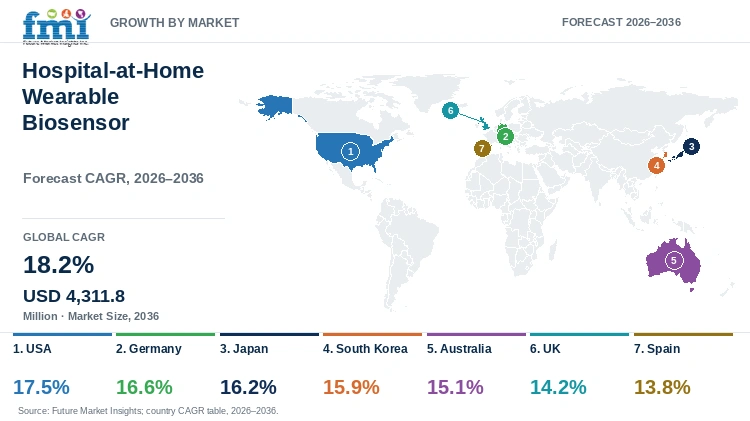
- By country: Germany (16.6%) and Japan (16.2%) follow, while Spain records the lowest profiled CAGR at 13.8%. Japan home-care research included 38 intervention patients and 36 controls, with 23 intervention patients using the wearable system, showing that growth will also depend on manageable clinical interpretation of alerts [13].
Market Size & Forecast
Table 1: Market Size and Forecast for the Hospital-at-Home Wearable Biosensor Market (USD million and CAGR), 2025 to 2036
| Metric | Value |
|---|---|
| 2025 Market Size | USD 685.3 million |
| Estimated Market Size in 2026 | USD 810.0 million |
| Projected Market Size by 2036 | USD 4,311.8 million |
| CAGR, 2026 to 2036 | 18.2% |
| Added Revenue, 2026 to 2036 | USD 3,501.8 million |
| Market Expansion Multiple | 5.32x |
According to FMI, availability of wearable medical devices alone cannot expand the market unless clinical teams are available for reviewing the received observations. NHS England recorded 12,554 virtual ward places and 9,737 occupied places in June 2025, equal to 77.6% occupancy [24]. This occupied capacity provides a measurable base for repeated readings, but product use will remain according to the commissioned pathway. South Korea expanded home medical care centers to 422 institutions across all 229 cities, counties and districts in February 2026 [17]. The nationwide integrated-care process also uses a 58-item assessment and monitors each support plan every three months [5]. A wider clinical network along with defined review process is likely to support use of wearable biosensors. Suppliers offering patient-worn capture, record connection, alert rules and device recovery through one monitored kit are expected to receive preference across acute care, discharge transition and chronic disease monitoring.
Care-Setting Readiness and Monitoring Demand
Hospital-at-home wearable demand depends on supervised home episodes and the staff available for reviewing received readings. The indicators below compares program scale, monitoring requirement and its meaning for wearable suppliers.
Table 2: Care-Setting Readiness and Monitoring Demand for the Hospital-at-Home Wearable Biosensor Market (programs, places, institutions, percentages, and monitoring intervals), mixed reporting years from 2025 to 2026
| Indicator | Data Point | Market Meaning | Source |
|---|---|---|---|
| CMS program continuity | Nearly five years of released data; waiver through September 30, 2030 | Supports longer device planning and repeat monitoring purchases | [1] |
| England virtual ward use | 12,554 places; 9,737 occupied; 77.6% occupancy in June 2025 | Shows a large supervised home-care base requiring repeated observations | [24] |
| South Korea home-care coverage | 422 institutions across 229 local areas in February 2026 | Creates national service availability for home observations | [17] |
| South Korea review process | 58-item assessment; monitoring every three months from March 2026 | Supports integration of wearable readings with defined care plans | [5] |
| Southern NSW deployment | USD 31.4 million expansion; four rollout regions; four vital-sign groups | Connects public program expansion with multi-parameter monitoring demand | [3] |
| SESLHD utilization target | HiTH utilization from 1.3% to 2%; RPM and video use up 10% | Shows additional demand where virtual monitoring becomes part of admission flow | [4] |
Basis: Market values and segment shares are report estimates. External indicators describe program scale, clinical coverage and monitoring readiness; they are not direct measurements of global market revenue.
Analyst Perspective
“Hospital-at-home programs will increase wearable demand where clinical teams can review readings without adding unmanageable alert workload. Suppliers combining reliable sensors with replacement supply and after-hours support will receive stronger adoption across hospital systems.”
- Anurag Sharma, Principal Consultant, Future Market Insights.
How is the hospital-at-home wearable biosensor market segmented?
Hospital-at-home wearable biosensor market is segmented on the basis of product type, parameter monitored, care pathway, end user and region. Multi-parameter wearable patches are projected to hold 51.0% share in 2026, while cardiac and respiratory vitals are expected to account for 45.9%. Acute hospital-level care at home and hospitals and health systems are anticipated to hold 48.0% and 55.8% share, respectively.
By product type: multi-parameter wearable patches, wrist-worn monitors, implantable and ingestible sensors, and ambient and bedside sensors.
By parameter monitored: cardiac and respiratory vitals, temperature and activity, blood pressure and hemodynamics, and metabolic parameters.
By care pathway: acute hospital-level care at home, post-discharge transitional care, chronic disease escalation prevention, and oncology at home.
By end user: hospitals and health systems, home health agencies, and payers and virtual care providers.
By region: North America, Latin America, Western Europe, Eastern Europe, East Asia, South Asia and Pacific, and Middle East and Africa.
Why do multi-parameter wearable patches lead product type purchasing?
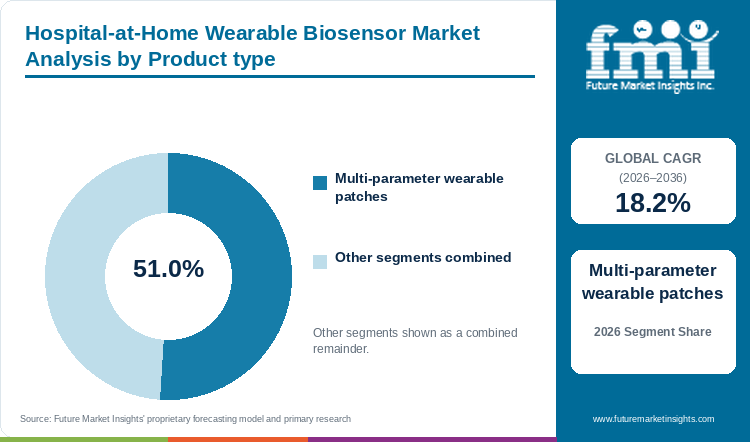
Multi-parameter wearable patches are projected to capture 51.0% of product type revenue in 2026, supported by multi-observation capture in a single configuration.
Table 3: Product Type Share for the Hospital-at-Home Wearable Biosensor Market (percentage share), 2026
| Product Type | Share (2026) |
|---|---|
| Multi-Parameter Wearable Patches | 51.0% |
| Other Segments Combined | 49.0%* |
| Total | 100.0% |
*Calculated as the balance remaining after deducting the leading segment's reported share from 100.0%.
Table 4: Product Type Leadership and Market Growth for the Hospital-at-Home Wearable Biosensor Market (segment and CAGR percentage), 2026 to 2036
| Metric | Value |
|---|---|
| Global CAGR (2026 to 2036) | 18.2% |
| Leading Segment | Multi-Parameter Wearable Patches |
Multi-parameter wearable patches combines cardiac rate, respiratory rate, temperature and other observations in one patient-worn device. These patches reduces the requirement for separate patient monitoring devices and allows the patient to move inside the home while readings are sent to the clinical team. Wear time, skin tolerance, battery life and connectivity affects how long the patch can be used during a hospital-at-home episode. In December 2025, Philips partnered with Southern NSW Local Health District for continuous cardio-respiratory monitoring in an Acute Care in the Home program [12]. Availability of several measurements from one wearable patch is increasing its use in supervised home treatment, which is expected to support the segment growth.
- Multi-parameter wearable patches are projected to hold 51.0% of product type revenue in 2026, owing to increasing use of several observations through one patient-worn patch.
- Longer wear time and use of several observations in one patch is expected to support repeat purchasing by hospitals.
How do cardiac and respiratory vitals guide parameter selection?
Cardiac and respiratory vitals are estimated to represent 45.9% of parameter monitored demand in 2026, reflecting continuous checks for early clinical deterioration.
Cardiac and respiratory vitals are among the primary observations used for checking a patient condition during hospital treatment at home. Heart rate, respiratory rate and oxygen saturation can show change between scheduled clinical visits, due to which these parameters are frequently included in wearable monitoring. In January 2025, the FDA proposed wider clinical performance testing of medical pulse oximeters across different skin pigmentation [19]. This recommendation is increasing requirement for tested oxygenation components and proper product labeling. Increasing use of cardiac and respiratory readings for deterioration checks is anticipated to drive the segment growth.
- Cardiac and respiratory vitals are estimated to hold 45.9% in 2026 because they support repeated checks between clinical contacts.
- Heart rate, respiratory rate and oxygen saturation are frequently selected because these readings can show patient deterioration between clinical contacts.
What supports acute hospital-level care at home within pathways?
In 2026, acute hospital-level care at home is anticipated to hold 48.0% of care pathway sales, driven by inpatient admission substitution and clinical escalation governance.
Acute hospital-level care at home provides hospital treatment to eligible patients inside their homes. Hospitals remains responsible for admission, medical review and movement of the patient back to hospital when required. Wearable biosensors are used in this pathway for providing repeated readings between home visits. The February 2025 NSW Hospital in the Home policy includes governance, triage, data reporting and after-hours support as important service requirements [15]. Presence of hospital responsibility and defined escalation is expected to increase use of wearable biosensors across home-based virtual care pathways. Owing to these factors, acute hospital-level care at home is projected to hold 48.0% share in 2026.
- Acute hospital-level care at home is projected to hold 48.0% of care pathway demand because hospitals retain episode responsibility.
- Defined hospital responsibility and after-hours escalation is expected to support use of wearables for higher-acuity patients at home.
Why do hospitals and health systems anchor end-user demand?
Hospitals and health systems are set to lead end user revenue with a 55.8% share in 2026, underpinned by institutional responsibility for home-care episodes.
Hospitals and health systems selects wearable biosensors according to patient eligibility, required measurements, connection with patient records and clinical escalation needs. Clinical teams decides the observation rules, whereas technical teams checks connectivity with digital health platforms, cleaning, data recovery and reuse of devices. In August 2025, a NSW project connected wider hospital care at home with remote monitoring and targeted an increase in utilization from 1.3% to 2% [4]. Expansion of hospital-led treatment at home is creating repeated requirement for wearable devices and replacement consumables. Due to this, hospitals and health systems are expected to hold 55.8% of end-user revenue in 2026.
- Hospitals and health systems are expected to command 55.8% of end-user revenue in 2026 because they control clinical governance.
- Hospitals are expected to lead purchasing as they control patient eligibility, clinical review, record connection and movement back to hospital.
What are the drivers, restraints, and opportunities in the hospital-at-home wearable biosensor market?
Increasing hospital treatment at home is the key driver for wearable biosensor demand. Performance variation and high alert volumes may restrict adoption, whereas use of the same monitored kit across acute, post-discharge and chronic care is creating growth opportunities.
- Driver: Movement of eligible hospital episodes into supervised homes is increasing demand for regular patient observations.
- Restraint: Variation in readings and repeated alerts can increase clinical workload and may limit use across wider patient groups.
- Opportunity: Wearable kits connected with one patient record can be used across acute, transitional and chronic-care applications.
Supervised Home Treatment Expands
Hospital treatment at home creates demand for regular measurements between clinical visits. Wearable biosensors records the patient observations while the patient remains inside the home and sends the readings to the responsible clinical team. In December 2025, Southern NSW started rollout across Bega Valley, Eurobodalla, Goulburn and Queanbeyan, with wearables monitoring breathing rate, blood pressure, oxygen level and heart rate in real time [3]. This allows clinical teams to identify change in patient condition while hospital treatment continues at home. Increasing numbers of supervised home healthcare episodes is expected to boost the utilization of wearable biosensors. However, availability of staff and after-hours response remains necessary for acting on the received alerts.
Signal Qualification Limits Adoption
Performance variation and high number of alerts can restrict adoption of wearable biosensors in hospital-at-home care. The FDA draft guidance issued in January 2025 recommends non-clinical and clinical testing, labeling and premarket information for medical pulse oximeters, including evaluation across skin pigmentation [19]. Manufacturers requires supporting evidence before oxygenation functions can be used for different patient groups. Apart from that, repeated alerts increases workload when thresholds are not matched with the local response team. An FMI analyst notes that high testing requirement and limited alert-review capacity may hamper the growth of hospital-at-home wearable biosensor market.
Coordinated Reuse Opens Opportunity
Wearable kits can be used across acute care, post-discharge and chronic disease monitoring when the readings enters the same patient record and response process. In March 2026, South Korea started nationwide integrated medical-nursing care at home using 58-item assessments and three-month monitoring of support plans [5]. The program provides scope for wearable observations where local care teams utilize telehealth infrastructure for reviewing patient condition. Use of the same devices across different home-care applications also requires cleaning, connectivity, replacement and device recovery. Expansion of coordinated home-care programs is expected to create new avenues for hospital-at-home wearable biosensor suppliers.
Which country CAGRs are profiled in the hospital-at-home wearable biosensor market?
Table 5: Country CAGR Comparison for the Hospital-at-Home Wearable Biosensor Market (CAGR percentage), 2026 to 2036
| Country | CAGR |
|---|---|
| USA | 17.5% |
| Germany | 16.6% |
| Japan | 16.2% |
| South Korea | 15.9% |
| Australia | 15.1% |
| UK | 14.2% |
| Spain | 13.8% |
How do country-level CAGRs compare in the hospital-at-home wearable biosensor market?
Adoption develops differently across countries because clinical authorization, reimbursement pathways, and outpatient continuation vary across healthcare systems. In the FMI report, the USA and Germany have more defined authorization or telemonitoring routes, whereas Japan and South Korea are expanding home medical care and coordinated patient monitoring.
- USA demand is supported by the extended federal Acute Hospital Care at Home waiver and continuing safety reporting.
- Germany demand is supported by a defined heart-failure telemonitoring route involving treating physicians and telemedical centers.
- Japan has home medical care evidence for wearable vital-sign monitoring, which is increasing attention towards early patient deterioration.
- South Korea is expanding home medical centers and integrated care, which creates wider requirement for supervised patient observations.
- Australia is using state Hospital in the Home policy with wearable-enabled regional programs.
- UK demand is supported by virtual ward capacity and increasing number of patients receiving supervised care at home.
- Spain is witnessing supervised early-transfer programs after complex hospital treatment, which creates requirement for monitoring between visits.
Full report country CAGRs cover: North America; Latin America; Western Europe; Eastern Europe; East Asia; South Asia and Pacific; Middle East and Africa.
Country-wise Analysis
- The USA hospital-at-home wearable biosensor market is projected to grow at 17.5% CAGR between 2026 and 2036. CMS released additional Acute Hospital Care at Home data in March 2026 covering April 2023 to September 2025, and the federal waiver is extended through September 30, 2030 [1]. The initiative allows approved hospitals to provide inpatient-level services in an eligible patient home. Participating hospitals reports safety and quality information according to their experience level. FMI research indicates that longer authorization periods are allowing hospitals to plan wearable monitors, replacement patches and clinical staffing for home treatment. Increasing number of approved hospital-at-home episodes is expected to drive wearable biosensor demand in the USA.
- Germany hospital-at-home wearable biosensor market is anticipated to expand at 16.6% CAGR over the assessment period. A June 2025 KVWL notice connects heart-failure telemonitoring with required professional qualification and equipment [14]. Treating physicians and telemedical centers uses the patient readings for continued monitoring and medical response. This defined route is supporting use of connected cardiac and physiological monitoring devices for eligible patients. However, products requires compatible data and clear division of work between the treating practice and telemedical center. Expansion of heart-failure telemonitoring is anticipated to support wearable biosensor demand in Germany.
- Wearable biosensor adoption in Japan is estimated to expand at 16.2% CAGR through 2036. A 2025 Japanese home medical care study enrolled 38 intervention patients and 36 controls, whereas 23 intervention patients used the wearable system [13]. The system recorded 68.2% sensitivity and 22.7% positive predictive value for acute illness events. These figures shows that wearables can support early warning but every alert cannot be treated as a confirmed illness. Hence, home-care providers requires systems that fits visiting-care routines and gives manageable alert volumes. Increasing use of wearable monitoring in home medical clinics is expected to support the Japan market growth.
- The South Korea market is projected to record 15.9% CAGR during the assessment period. In February 2026, the government expanded home medical care centers to all 229 cities, counties and districts through 422 medical institutions [17]. Teams of doctors, nurses and social workers visits eligible people and connects medical care with community services. This wider home-care network creates requirement for regular patient observations, especially where local plans includes continuous measurements. However, adoption depends on who receives and reviews the readings. Expansion of home medical centers is anticipated to support wearable biosensor demand in South Korea.
- Sales of wearable biosensors in Australia are forecast to expand at 15.1% CAGR through 2036. NSW Health began the Southern NSW rollout in December 2025 across Bega Valley, Eurobodalla, Goulburn and Queanbeyan [3]. Wearables monitors breathing rate, blood pressure, oxygen level and heart rate in real time for the clinical team. This gives hospital teams regular observations between home visits and can support earlier review of changes in patient condition. Regional connectivity, device recovery and after-hours response remains important for repeat use. Expansion of Hospital in the Home programs is expected to drive wearable biosensor demand in Australia.
- The UK hospital-at-home wearable biosensor market is anticipated to grow at 14.2% CAGR between 2026 and 2036. NHS England recorded 12,554 virtual ward places and 9,737 occupied places in June 2025, equal to 77.6% occupancy [24]. Virtual wards allows eligible patients to receive hospital-level care at home and can include wearable readings where local providers uses continuous monitoring. Higher occupied capacity increases the number of patients that may require repeated observations outside hospital wards. However, technology use differs according to the commissioned pathway and local service design. Increasing virtual ward activity is likely to support wearable biosensor adoption in the UK.
- The Spain market is expected to progress at 13.8% CAGR between 2026 and 2036. Hospital Clínic Barcelona reported in September 2026 on the first 100 kidney transplant patients using its home hospitalization model [6]. Conventional hospital stay reduced from 9 days to 5 days, while one-year graft survival remained 97% in both groups. Daily visits, laboratory testing, medicine monitoring and 24-hour availability continued under the pathway. Wearable observations can support patient checking between these clinical contacts but does not replace the care team. Expansion of supervised early-transfer programs is expected to create growth opportunities in Spain.
Who are the notable companies in the hospital-at-home wearable biosensor market?
Philips, Masimo, Biofourmis, Medtronic, VivaLNK, Current Health, VitalConnect, GE HealthCare, Dexcom, and Biobeat are notable companies profiled in this market.
In the FMI report, hospital-at-home wearable biosensor market is moderately fragmented with presence of enterprise monitoring companies, care platform providers and wearable biosensors sensing specialists. Philips, Masimo, Medtronic and GE HealthCare are offering hospital monitoring and connected device capabilities, whereas Biofourmis and Current Health are focusing on patient enrollment, monitoring and clinical response. VivaLNK, VitalConnect, Dexcom and Biobeat provides patch, continuous glucose monitoring and hemodynamic sensing products. Some of the key players are entering into partnerships, expanding product functions and increasing home-care deployments in order to cater the growing demand. Availability of different wearable and monitoring configurations is expected to increase competition during the forecast period.
- Enterprise monitoring and integration: Philips, Masimo, Medtronic, and GE HealthCare connect devices with hospital technology and clinical workflows.
- Hospital-at-home monitoring and clinical response: Biofourmis and Current Health organize enrollment, monitoring, and clinical response around connected devices.
- Wearable sensing specialists: VivaLNK, VitalConnect, Dexcom, and Biobeat provide distinct patch, metabolic, or hemodynamic configurations.
Competitive Benchmarking: Hospital-at-Home Wearable Biosensor Market
Table 6: Competitive Benchmarking for the Hospital-at-Home Wearable Biosensor Market (qualitative capability ratings), 2026
| Company | Measured parameter range | Workflow integration | Home-pathway evidence | Regional presence |
|---|---|---|---|---|
| Philips | High | High | Medium | High |
| Masimo | Medium | High | High | High |
| Biofourmis | Medium | High | High | Medium |
| Medtronic | High | Medium | Medium | High |
| VivaLNK | Medium | Medium | High | Medium |
| Current Health | High | High | High | Medium |
| VitalConnect | High | Medium | High | Medium |
| GE HealthCare | High | High | Low | High |
| Dexcom | Low | Medium | Medium | High |
| Biobeat | High | Medium | High | Medium |
Scoring basis: High indicates wider public evidence, Medium indicates limited evidence, and Low indicates less documented evidence for the stated capability. These ratings describes the available product and home-care information and does not represent product quality, company rank or market share.
Key Developments in the Hospital-at-Home Wearable Biosensor Market
- In September 2025, Masimo expanded its partnership with Philips for planned Radius PPG integration and next-generation wearable multiparameter monitoring [7]. This development is expected to widen availability of connected wearable measurements for hospital and home-care applications.
- In June 2025, Current Health announced its return to independent operation [9]. The company is continuing to provide connected monitoring and care-at-home services to hospitals.
- In February 2025, VitalConnect secured USD 100 million through equity and debt financing [10]. The company plans to use the financing for commercial expansion and product development.
- In January 2025, AdventHealth selected Biofourmis for an acute-care-at-home program beginning with AdventHealth Winter Park [8]. The program is increasing use of connected monitoring with hospital-level care provided inside the home.
- In April 2025, Dexcom received FDA clearance for the G7 15 Day adult glucose configuration [11]. Longer sensor wear is expected to support continued glucose observations across eligible home-monitoring applications.
- In 2026, CMS continued the Acute Hospital Care at Home initiative page for approved hospitals and public program data [18]. Availability of federal participation information is supporting continued planning of hospital-at-home programs.
Key Players in the Hospital-at-Home Wearable Biosensor Market
Enterprise monitoring and integration
- Philips
- Masimo
- Medtronic
- GE HealthCare
Care monitoring and clinical response platforms
- Biofourmis
- Current Health
Wearable sensing specialists
- VivaLNK
- VitalConnect
- Dexcom
- Biobeat
Hospital-at-Home Wearable Biosensor Market - Report Scope
Table 7: Report Scope for the Hospital-at-Home Wearable Biosensor Market (coverage fields and definitions), 2026 to 2036
| Coverage field | Report scope |
|---|---|
| Market breakdown | Product type, parameter monitored, care pathway, end user, and region. |
| Quantitative units | USD million. |
| Market definition | Revenue from wearable biosensor hardware and replacement consumables used in supervised home-care pathways. Clinical services and standalone software are excluded. |
| Regions covered | North America; Latin America; Western Europe; Eastern Europe; East Asia; South Asia and Pacific; Middle East and Africa. |
| Countries covered | USA; Germany; Japan; South Korea; Australia; UK; Spain. |
| Key companies profiled | Philips, Masimo, Biofourmis, Medtronic, VivaLNK, Current Health, VitalConnect, GE HealthCare, Dexcom, Biobeat. |
| Forecast period | 2026 to 2036. |
| Approach | The report covers wearable biosensor revenue, segment structure, company developments and country demand conditions within the defined market boundary. |
Hospital-at-Home Wearable Biosensor Market - Research Methodology
Table 8: Research Methodology for the Hospital-at-Home Wearable Biosensor Market (research methods and approach), 2026 edition
| Method | Approach |
|---|---|
| Primary Research | The research study includes primary interviews with manufacturers, technology developers, distributors, hospitals, home-care providers, procurement teams and industry experts. Interviews covers purchasing decision, product evaluation, pricing, adoption barriers, approval requirement and technical support. Respondents also explains the evidence required before a pilot or initial order develops into regular purchasing. |
| Desk Research | Desk research covers government statistics, regulatory publications, industry associations, technical literature, standards, product information and official company announcements. Sources are checked according to publication date, geography and direct relevance to hospital-at-home wearable biosensors. Product performance, approval, investment and company developments are included where public evidence is available. |
| Market Sizing and Forecasting | Market sizing combines the baseline value with historical performance, product segments, prices, adoption level, company participation and country demand. Forecasting considers regulatory developments, technology adoption, purchasing cycles, supply availability and factors that can restrict wider use. Segment and regional values are checked with the final market value. |
| Data Validation | Market estimates are checked with public data, company developments, industry activity and primary interview findings. Validation confirms whether the product, application and company revenue falls inside the stated market definition. Clinical services, standalone software, unsupported claims and overlapping revenue are excluded in order to reduce double counting. |
Hospital-at-Home Wearable Biosensor Market by Segments
Product type
- Multi-parameter wearable patches
- Wrist-worn monitors
- Implantable and ingestible sensors
- Ambient and bedside sensors
Parameter monitored
- Cardiac and respiratory vitals
- Temperature and activity
- Blood pressure and hemodynamics
- Metabolic parameters
Care pathway
- Acute hospital-level care at home
- Post-discharge transitional care
- Chronic disease escalation prevention
- Oncology at home
End user
- Hospitals and health systems
- Home health agencies
- Payers and virtual care providers
Hospital-at-Home Wearable Biosensor Market by Region
- North America
- United States
- Canada
- Latin America
- Brazil
- Mexico
- Argentina
- Chile
- Western Europe
- Germany
- France
- United Kingdom
- Italy
- Spain
- Benelux
- Nordics
- Eastern Europe
- Poland
- Czech Republic
- Romania
- Hungary
- East Asia
- China
- Japan
- South Korea
- South Asia and Pacific
- India
- ASEAN
- Australia and New Zealand
- Middle East and Africa
- GCC Countries
- South Africa
- Türkiye
- Israel
Research Sources and Bibliography
- [1] Centers for Medicare & Medicaid Services. (2026, March 17). Acute Hospital Care at Home Data Release Fact Sheet.
- [2] U.S. Food and Drug Administration. (2025, January 6). FDA Proposes Updated Recommendations to Help Improve Performance of Pulse Oximeters Across Skin Tones.
- [3] NSW Health. (2025, December 5). Hospital care at home: New technology to help reduce avoidable admissions across Southern NSW.
- [4] Agency for Clinical Innovation. (2025, August 22). PAVE the way: Providing more patients with at-home hospital care.
- [5] Korea.net. (2026, March 24). Integrated medical-nursing care at home to start from March 27.
- [6] Hospital Clínic Barcelona-IDIBAPS. (2026, September 7). The Clínic-IDIBAPS demonstrates that home hospitalization after a kidney transplant is safe, efficient and reduces healthcare costs.
- [7] Masimo Corporation. (2025, September 11). Masimo Announces Expansion of Strategic Partnership with Philips.
- [8] Biofourmis Inc.. (2025, January 6). Biofourmis Selected by AdventHealth to Support Whole-Person Care With New Acute Care-at-Home Program.
- [9] Current Health Ltd.. (2025, June 24). A personal message from Chris McGhee, CEO & Co-Founder of Current Health.
- [10] VitalConnect, Inc.. (2025, February 20). VitalConnect, Inc. Secures USD 100 Million in Financing.
- [11] Dexcom, Inc.. (2025, April 10). Dexcom G7 15 Day Receives FDA Clearance.
- [12] Philips Australia. (2025, December 3). Philips Australia partners with Southern NSW Local Health District to enable Acute Care in the Home.
- [13] Japanese Society of Internal Medicine. (2025, June 12). The Efficacy of a Wearable Device-based Vital Sign Monitoring System in a Japanese Home Medical Care Clinic.
- [14] Kassenärztliche Vereinigung Westfalen-Lippe. (2025, June 11). Telemonitoring bei Herzinsuffizienz.
- [15] NSW Health. (2025, February 18). Hospital in the Home Policy Directive PD2025_004.
- [16] Organización Nacional de Trasplantes. (2026). Balance de actividad 2025.
- [17] Ministry of Health and Welfare, Republic of Korea. (2026, February 13). Home medical care centers expanded nationwide.
- [18] Centers for Medicare & Medicaid Services. (2026). Acute Hospital Care at Home initiative approved hospitals and data release.
- [19] U.S. Food and Drug Administration. (2025, January). Pulse Oximeters for Medical Purposes: Non-Clinical and Clinical Performance Testing, Labeling, and Premarket Submission Recommendations.
- [20] VitalConnect, Inc.. (2026, August 10). iRhythm to Acquire VitalConnect, Expanding Its Cardiac Monitoring Platform Across Ambulatory, Inpatient and Hospital-to-Home Care.
- [21] Royal Philips. (2026, August 6). Philips expands open patient monitoring monitoring system to help health systems keep sight of patients beyond the bedside.
- [22] Masimo. (2026, June 22). Masimo Receives FDA 510(k) Clearance for AI-Enabled Opioid-Induced Respiratory Depression Detection on Radius VSM.
- [23] Current Health. (2026, March 31). Current Health taps Cardinal Health to scale Hospital at Home.
- [24] NHS England. (2025, July 10). Virtual Ward Capacity and Occupancy statistics in England: June 2025.
This bibliography is provided for reader reference. The full report contains the complete reference list and detailed citations.
This Report Answers
- What is the market worth during 2026 and by 2036?
- Which product type holds notable revenue share during 2026?
- Which parameter category holds notable market share during 2026?
- Which countries show notable expansion outlooks through the forecast period?
- Which companies are notable in hospital-at-home wearable biosensors today?
- What market boundary and methodology define the published estimates?
Frequently Asked Questions
How large is the Hospital-at-Home Wearable Biosensor Market expected to be in 2026?
Future Market Insights estimates that the hospital-at-home wearable biosensor market is valued at USD 810.0 million in 2026 and is projected to reach USD 4,311.8 million by 2036.
What CAGR is forecast for the Hospital-at-Home Wearable Biosensor Market through 2036?
As per FMI, the hospital-at-home wearable biosensor market is projected to grow at an 18.2% CAGR from 2026 to 2036. Growth is supported by the transition of acute care to home settings and expanding virtual ward programs.
Which product type holds a notable hospital-at-home wearable biosensor demand share in 2026?
Multi-parameter wearable patches are projected to hold 51.0% of product type revenue in 2026, owing to increasing use of several observations through one patient-worn patch.
Which monitored parameter category holds a notable share in 2026?
Cardiac and respiratory vitals are expected to account for 45.9% of parameter-monitored revenue in 2026, due to its use for repeated deterioration checks between clinical contacts.
Which country has a notable hospital-at-home wearable biosensor expansion outlook through 2036?
The USA market is anticipated to expand at a 17.5% CAGR from 2026 to 2036, supported by the federal acute-care-at-home pathway and extended waiver coverage.
Which companies are active in the Hospital-at-Home Wearable Biosensor Market during 2026?
Notable companies profiled in this market include Philips, Masimo, Biofourmis, Medtronic, VivaLNK, Current Health, VitalConnect, GE HealthCare, Dexcom, and Biobeat.
Preview the report firsthand - request a free sample
Get SampleGet the brochure for pricing and purchase details.
Get PDFTable of Content
- Key Takeaways
- Market Size and CAGR
- Top Growth Driver
- Fastest Growing Segment
- Leading Region
- Key Companies
- Emerging Opportunities
- Executive Summary
- Global Market Outlook
- Demand-side Trends
- Supply-side Trends
- Technology Roadmap Analysis
- Analysis and Recommendations
- Analyst Perspective (What is happening? Why now? What should investors know?)
- Key Questions Answered
- How large is the market?
- What is the CAGR?
- What are key trends?
- Which region dominates?
- Who are the leaders?
- Market Overview
- Market Coverage / Taxonomy
- Market Definition / Scope / Limitations
- Research Methodology
- Chapter Orientation
- Analytical Lens and Working Hypotheses
- Market Structure, Signals, and Trend Drivers
- Benchmarking and Cross-market Comparability
- Market Sizing, Forecasting, and Opportunity Mapping
- Research Design and Evidence Framework
- Desk Research Programme (Secondary Evidence)
- Expert Input and Fieldwork (Primary Evidence)
- Tooling, Models, and Reference Databases
- Data Engineering and Model Build
- Quality Assurance and Audit Trail
- Market Background
- Market Dynamics (Drivers, Restraints, Opportunity, Trends)
- Scenario Forecast (Optimistic, Likely, Conservative)
- Impact Analysis
- AI Impact
- Sustainability Impact
- Regulatory Impact
- Technology Impact
- Consumer / Buyer Analysis
- Purchase Drivers
- Adoption Barriers
- Buyer Journey
- Opportunity Map Analysis
- Product Life Cycle Analysis
- Supply Chain Analysis
- Investment Feasibility Matrix
- Value Chain Analysis
- PESTLE and Porter's Analysis
- Regulatory Landscape
- Regional Parent Market Outlook
- Production and Consumption Statistics
- Import and Export Statistics
- Global Market Analysis and Forecast, 2021 to 2036
- Historical Market Size Value (USD Million) Analysis, 2021 to 2025
- Current and Future Market Size Value (USD Million) Projections, 2026 to 2036
- Y-o-Y Growth Trend Analysis
- Absolute $ Opportunity Analysis
- Global Market Pricing Analysis, 2021 to 2036
- Global Market Analysis and Forecast, By Product type, 2021 to 2036
- Introduction / Key Findings
- Historical Market Size Value (USD Million) Analysis By Product type, 2021 to 2025
- Current and Future Market Size Value (USD Million) Analysis and Forecast By Product type, 2026 to 2036
- Multi-parameter wearable patches
- Wrist-worn monitors
- Implantable and ingestible sensors
- Ambient and bedside sensors
- Y-o-Y Growth Trend Analysis By Product type, 2021 to 2025
- Absolute $ Opportunity Analysis By Product type, 2026 to 2036
- Global Market Analysis and Forecast, By Parameter monitored, 2021 to 2036
- Introduction / Key Findings
- Historical Market Size Value (USD Million) Analysis By Parameter monitored, 2021 to 2025
- Current and Future Market Size Value (USD Million) Analysis and Forecast By Parameter monitored, 2026 to 2036
- Cardiac and respiratory vitals
- Temperature and activity
- Blood pressure and hemodynamics
- Metabolic parameters
- Y-o-Y Growth Trend Analysis By Parameter monitored, 2021 to 2025
- Absolute $ Opportunity Analysis By Parameter monitored, 2026 to 2036
- Global Market Analysis and Forecast, By Care pathway, 2021 to 2036
- Introduction / Key Findings
- Historical Market Size Value (USD Million) Analysis By Care pathway, 2021 to 2025
- Current and Future Market Size Value (USD Million) Analysis and Forecast By Care pathway, 2026 to 2036
- Acute hospital-level care at home
- Post-discharge transitional care
- Chronic disease escalation prevention
- Oncology at home
- Y-o-Y Growth Trend Analysis By Care pathway, 2021 to 2025
- Absolute $ Opportunity Analysis By Care pathway, 2026 to 2036
- Global Market Analysis and Forecast, By End user, 2021 to 2036
- Introduction / Key Findings
- Historical Market Size Value (USD Million) Analysis By End user, 2021 to 2025
- Current and Future Market Size Value (USD Million) Analysis and Forecast By End user, 2026 to 2036
- Hospitals and health systems
- Home health agencies
- Payers and virtual care providers
- Y-o-Y Growth Trend Analysis By End user, 2021 to 2025
- Absolute $ Opportunity Analysis By End user, 2026 to 2036
- Global Market Analysis and Forecast, By Region, 2021 to 2036
- Introduction
- Historical Market Size Value (USD Million) Analysis By Region, 2021 to 2025
- Current Market Size Value (USD Million) Analysis and Forecast By Region, 2026 to 2036
- North America
- Latin America
- Western Europe
- Eastern Europe
- East Asia
- South Asia and Pacific
- Middle East and Africa
- Market Attractiveness Analysis By Region
- North America Market Analysis and Forecast, By Country, 2021 to 2036
- Historical Market Size Value (USD Million) Trend Analysis By Market Taxonomy, 2021 to 2025
- Market Size Value (USD Million) Forecast By Market Taxonomy, 2026 to 2036
- By Country
- United States
- Canada
- By Product type
- By Parameter monitored
- By Care pathway
- By End user
- By Country
- Market Attractiveness Analysis
- By Country
- By Product type
- By Parameter monitored
- By Care pathway
- By End user
- Key Takeaways
- Latin America Market Analysis and Forecast, By Country
- Historical Market Size Value (USD Million) Trend Analysis By Market Taxonomy, 2021 to 2025
- Market Size Value (USD Million) Forecast By Market Taxonomy, 2026 to 2036
- By Country
- Brazil
- Mexico
- Argentina
- Chile
- By Product type
- By Parameter monitored
- By Care pathway
- By End user
- By Country
- Market Attractiveness Analysis
- By Country
- By Product type
- By Parameter monitored
- By Care pathway
- By End user
- Key Takeaways
- Western Europe Market Analysis and Forecast, By Country
- Historical Market Size Value (USD Million) Trend Analysis By Market Taxonomy, 2021 to 2025
- Market Size Value (USD Million) Forecast By Market Taxonomy, 2026 to 2036
- By Country
- Germany
- France
- United Kingdom
- Italy
- Spain
- Benelux
- Nordics
- By Product type
- By Parameter monitored
- By Care pathway
- By End user
- By Country
- Market Attractiveness Analysis
- By Country
- By Product type
- By Parameter monitored
- By Care pathway
- By End user
- Key Takeaways
- Eastern Europe Market Analysis and Forecast, By Country
- Historical Market Size Value (USD Million) Trend Analysis By Market Taxonomy, 2021 to 2025
- Market Size Value (USD Million) Forecast By Market Taxonomy, 2026 to 2036
- By Country
- Poland
- Czech Republic
- Romania
- Hungary
- By Product type
- By Parameter monitored
- By Care pathway
- By End user
- By Country
- Market Attractiveness Analysis
- By Country
- By Product type
- By Parameter monitored
- By Care pathway
- By End user
- Key Takeaways
- East Asia Market Analysis and Forecast, By Country
- Historical Market Size Value (USD Million) Trend Analysis By Market Taxonomy, 2021 to 2025
- Market Size Value (USD Million) Forecast By Market Taxonomy, 2026 to 2036
- By Country
- China
- Japan
- South Korea
- By Product type
- By Parameter monitored
- By Care pathway
- By End user
- By Country
- Market Attractiveness Analysis
- By Country
- By Product type
- By Parameter monitored
- By Care pathway
- By End user
- Key Takeaways
- South Asia and Pacific Market Analysis and Forecast, By Country
- Historical Market Size Value (USD Million) Trend Analysis By Market Taxonomy, 2021 to 2025
- Market Size Value (USD Million) Forecast By Market Taxonomy, 2026 to 2036
- By Country
- India
- ASEAN
- Australia and New Zealand
- By Product type
- By Parameter monitored
- By Care pathway
- By End user
- By Country
- Market Attractiveness Analysis
- By Country
- By Product type
- By Parameter monitored
- By Care pathway
- By End user
- Key Takeaways
- Middle East and Africa Market Analysis and Forecast, By Country
- Historical Market Size Value (USD Million) Trend Analysis By Market Taxonomy, 2021 to 2025
- Market Size Value (USD Million) Forecast By Market Taxonomy, 2026 to 2036
- By Country
- GCC Countries
- South Africa
- Türkiye
- Israel
- By Product type
- By Parameter monitored
- By Care pathway
- By End user
- By Country
- Market Attractiveness Analysis
- By Country
- By Product type
- By Parameter monitored
- By Care pathway
- By End user
- Key Takeaways
- Key Countries Market Analysis
- United States
- Pricing Analysis
- Market Share Analysis, 2025
- By Product type
- By Parameter monitored
- By Care pathway
- By End user
- Canada
- Pricing Analysis
- Market Share Analysis, 2025
- By Product type
- By Parameter monitored
- By Care pathway
- By End user
- Mexico
- Pricing Analysis
- Market Share Analysis, 2025
- By Product type
- By Parameter monitored
- By Care pathway
- By End user
- Brazil
- Pricing Analysis
- Market Share Analysis, 2025
- By Product type
- By Parameter monitored
- By Care pathway
- By End user
- Chile
- Pricing Analysis
- Market Share Analysis, 2025
- By Product type
- By Parameter monitored
- By Care pathway
- By End user
- Germany
- Pricing Analysis
- Market Share Analysis, 2025
- By Product type
- By Parameter monitored
- By Care pathway
- By End user
- United Kingdom
- Pricing Analysis
- Market Share Analysis, 2025
- By Product type
- By Parameter monitored
- By Care pathway
- By End user
- Italy
- Pricing Analysis
- Market Share Analysis, 2025
- By Product type
- By Parameter monitored
- By Care pathway
- By End user
- Spain
- Pricing Analysis
- Market Share Analysis, 2025
- By Product type
- By Parameter monitored
- By Care pathway
- By End user
- France
- Pricing Analysis
- Market Share Analysis, 2025
- By Product type
- By Parameter monitored
- By Care pathway
- By End user
- India
- Pricing Analysis
- Market Share Analysis, 2025
- By Product type
- By Parameter monitored
- By Care pathway
- By End user
- ASEAN
- Pricing Analysis
- Market Share Analysis, 2025
- By Product type
- By Parameter monitored
- By Care pathway
- By End user
- Australia and New Zealand
- Pricing Analysis
- Market Share Analysis, 2025
- By Product type
- By Parameter monitored
- By Care pathway
- By End user
- China
- Pricing Analysis
- Market Share Analysis, 2025
- By Product type
- By Parameter monitored
- By Care pathway
- By End user
- Japan
- Pricing Analysis
- Market Share Analysis, 2025
- By Product type
- By Parameter monitored
- By Care pathway
- By End user
- South Korea
- Pricing Analysis
- Market Share Analysis, 2025
- By Product type
- By Parameter monitored
- By Care pathway
- By End user
- Poland
- Pricing Analysis
- Market Share Analysis, 2025
- By Product type
- By Parameter monitored
- By Care pathway
- By End user
- Hungary
- Pricing Analysis
- Market Share Analysis, 2025
- By Product type
- By Parameter monitored
- By Care pathway
- By End user
- Türkiye
- Pricing Analysis
- Market Share Analysis, 2025
- By Product type
- By Parameter monitored
- By Care pathway
- By End user
- South Africa
- Pricing Analysis
- Market Share Analysis, 2025
- By Product type
- By Parameter monitored
- By Care pathway
- By End user
- Australia
- Pricing Analysis
- Market Share Analysis, 2025
- By Product type
- By Parameter monitored
- By Care pathway
- By End user
- United States
- Market Structure Analysis
- Competition Dashboard
- Competition Benchmarking
- Market Share Analysis of Top Players
- By Regional
- By Product type
- By Parameter monitored
- By Care pathway
- By End user
- Emerging Startups
- Innovation Benchmarking
- Competition Analysis
- Competition Deep Dive
- Philips
- Overview
- Product Portfolio
- Profitability by Market Segments
- Sales Footprint
- Strategy Overview
- Marketing Strategy
- Product Strategy
- Channel Strategy
- Masimo
- Biofourmis
- Medtronic
- VivaLNK
- Current Health
- VitalConnect
- GE HealthCare
- Dexcom
- Biobeat
- Philips
- Case Studies
- Success Stories
- Recent Developments
- Competition Deep Dive
- Assumptions & Acronyms Used


